About Damn Time
Pelosi’s Visit to Taiwan and Damn the Torpedoes!
Friends,
This weekend marks four years since Nancy Pelosi, as Speaker of the House, landed in Taipei to meet with Taiwanese President Tsai Ing-wen. I think it is fitting that the #1 song on the Billboard Hot 100 list as Pelosi’s plane taxied in front of the Taipei 101 Tower was Lizzo’s “About Damn Time.”

The tail of Speaker Pelosi’s plane at Taipei Songshan International Airport with the Taipei 101 tower in the background on August 2, 2022.
As she was flying into Taipei, Pelosi released an OpEd in the Washington Post explaining: “Why I’m leading a congressional delegation to Taiwan.” It is worthwhile reading that OpEd again today and I hope both Republicans and Democrats, MAGA and Democratic Socialists, take it to heart.
For decades, Chinese Communist Party leaders threatened the apocalypse if a visit like this took place… and for decades, American leaders cowered at these threats by their counterparts in Beijing. It is hard to imagine Clinton, Bush or Obama allowing a visit like this on their watch. It took someone like Nancy Pelosi, who spent her entire Congressional career standing up to the Chinese Communists, to finally break the spell.
Four years on and her visit did not result in the apocalypse. [Xi Jinping may still decide to attack and attempt to annex Taiwan, but the Pelosi visit in August 2022 won’t be the cause]
Four years later, the Taiwanese economy is outperforming its Communist neighbor. In 2025, the Taiwanese economy grew at a rate of 8.63%... more than double the “official” rate from the PRC, which as we all know is fiction anyway. This year, the Taiwanese GDP is set to reach 9.64% as the PRC economy continues to sputter.
The PRC is no longer Taiwan’s top trading partner, that position now belongs to the United States.
Taiwanese investment in the PRC has collapsed over the past 15 years. In 2010, more than 80% of Taiwan’s outbound investment went to the PRC, by 2025, it was down to less than 3%.
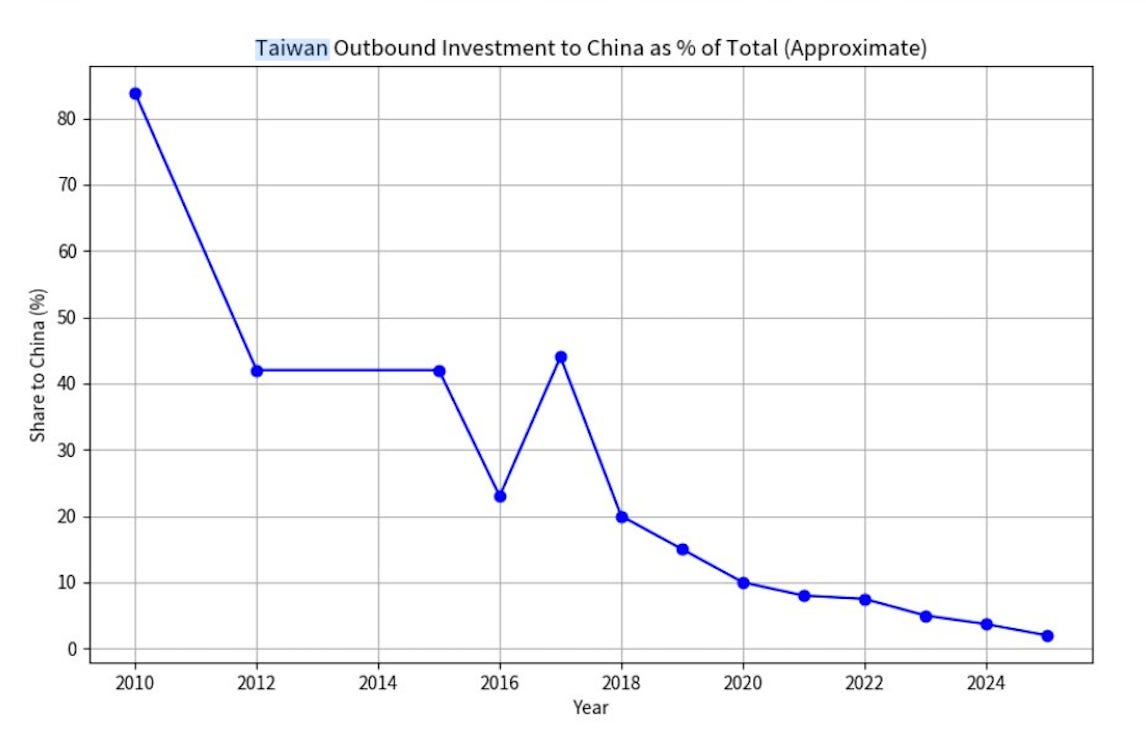
No one knows the PRC economy better than corporate leaders in Taiwan… if they have lost confidence in the PRC to this degree, others should be following their lead.
Oh wait, they have…
The Tiger is Back…
Between the 1960s and the 1990s, Taiwan grew into one of the four Asian Tigers (along with Hong Kong, Singapore, and South Korea). These economies implemented a series of domestic reforms, funded and supported largely by the United States, which resulted in spectacular growth and enormous benefits to their citizens (as an aside, this was America’s “Modernization Theory” in action, and it proved incredibly successful).
By the 1980s and 1990s, these four Asian Tigers, along with Japan, the United States and Europe, turned their attention to Asia’s laggard, the People’s Republic of China, and helped Deng Xiaoping pursue a similar path.
Taiwanese and Hong Kong business leaders poured massive investment into the PRC during this period, hoping to see their larger neighbor and cultural sibling, make similar economic and political reforms.
That all began to reverse starting 15 years ago as it became clear that the Chinese Communist Party would not follow through on the reform and opening that Deng had led the world to believe would happen. The chart above showing Taiwanese outbound investment to the PRC illustrates this shift.
While Hong Kong has succumbed to Communist domination through the National Security Law of 2020, Taiwan is an Asian Tiger again and it is using its wealth and influence to change the geopolitical dynamics just as it did in the 1980s and 1990s.
So, if Taiwanese investment isn’t going to the PRC, where is it going?
Taiwanese investment and more importantly, semiconductor manufacturing and microelectronics knowhow, is being spread to Japan, Europe, and the United States.
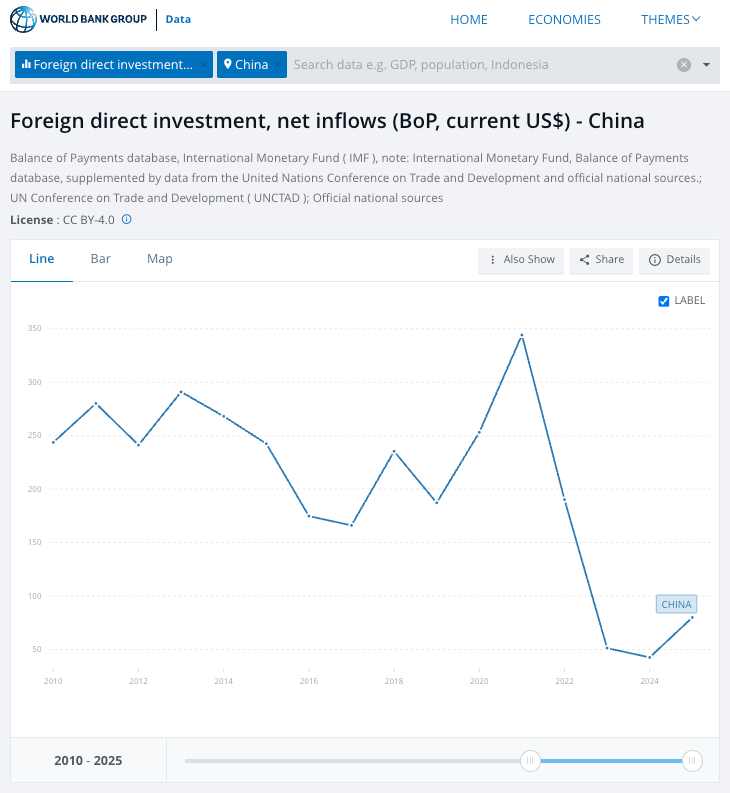
The single largest foreign direct investment in U.S. history was the TSMC investment of $265 billion to build advanced semiconductor manufacturing in Arizona. While this investment started during the first Trump Administration, it accelerated in the aftermath of Pelosi’s visit. If we were to place just that one $265 billion investment by TSMC on the chart above for “FDI, net inflows to China,” it would essentially equal the high-water mark of GLOBAL foreign direct investment into the PRC during the 2010s.
Has Xi’s coercion worked?
So, let’s think about Xi Jinping’s strategy to coerce Taiwan and force them to capitulate to their annexation by the Chinese Communist Party.
Starting in 2010 as the PRC began a series of aggressive campaigns against Japan over territory in the East China Sea and against the Philippines and Vietnam in the South China Sea, Taiwanese companies began reducing their exposure to the PRC economy from over 80% in 2010 to around 40% when Xi Jinping took power in early 2013.
That was an enormous shift that, frankly, the rest of the world missed.
As Xi took power, he initially treated Taiwan with kid gloves, hoping that the Taiwanese President, Ma Ying-jeou from the KMT, could push through a series of economic pacts between Taipei and Beijing that would essentially result in an economic union between the two countries (the Economic Cooperation Framework Agreement (ECFA), the Cross-Strait Trade in Services Agreement, and direct transportation links). When this collapsed under popular Taiwanese backlash in 2014 and the KMT lost to the DPP’s Tsai Ing-wen in January 2016, Xi decided to shift from carrots to sticks as he ramped up the pressure on Taiwan.
Xi adopted this policy of heavy-handed economic coercion and military threats based on one, critical assumption, that Taipei would bow to pressure because it had no economic alternatives to the PRC. CCP leaders believed that their rise to dominance was inevitable, that the West (aka the United States), after the Global Financial Crisis, was in permanent decline. Therefore, Beijing didn’t need to negotiate with Taipei, the CCP could dictate terms, and Taiwan would be forced to capitulate.
Xi and his cadres believed that their coercion would hobble the Tsai Administration, as Taiwanese business leaders and Taiwanese citizens demanded they bow to Beijing’s pressure. The CCP convinced themselves that they were the only economic game in town and that Taiwan would be forced to come crawling back, begging for a return to business as usual with the PRC.
The opposite happened.
As Xi hammered the PRC’s trade and investment ties with Taiwan, President Tsai adopted an economic diversification policy (“New Southbound Policy”) to further reduce Taiwan’s trade and investment dependence on the PRC and deepen ties with its neighbors in Southeast Asia, as well as other global powers, like Japan, the United States, Australia, and the European Union. While this economic diversification strategy (aka “decoupling”) was costly, Taiwanese business leaders made prudent, long-term decisions.
Rather than pressure Tsai to capitulate, the CCP’s economic coercion backfired by convincing Taiwanese business leaders that they had no alternative but to follow Tsai’s lead.
In 2026, Taiwan is much less vulnerable to PRC economic pressure and their ties to the rest of the world are much stronger, ensuring that any military action against Taiwan by the PRC would immediately involve the rest of the world.
Why did Xi misread the situation so badly?
I think there are a couple of explanations for why Xi Jinping misinterpreted the situation and pursued a self-defeating policy towards Taiwan.
First, the CCP fell prey to its own propaganda. Following the Global Financial Crisis, CCP leaders convinced themselves that the long dreamed for Marxist prediction that capitalism would collapse under its own weight had arrived. The slogan, “the East is rising and the West is declining” became a mantra early and that drove much of Xi’s thinking as he took the reins in early 2013. This confidence was evident during his first summit with President Obama at Sunnylands in August 2013 when Xi floated the concept of “New Type Great Power Relations” and it continued through the COVID pandemic and afterwards.
To now question this assumption and adjust the PRC’s strategy to account for its stagnation, is to question the entire program of Xi Jinping and Xi Jinping Thought. That is just something that intellectuals and Party members within the PRC cannot do given the rise of a personality cult around Xi Jinping. The Party is stuck operating under the assumption that the PRC will surpass the United States even as the hard evidence points in the opposite direction.
Second, the CCP is largely ignorant of dynamics within democracies and underestimates their resilience. The push to ensure that the PRC diplomats and foreign policy advisors are more “red” than “expert” has resulted in a distorted view of how the world outside the PRC operates. Xi Jinping and the rest of the Politburo Standing Committee have very little practical experience dealing with the outside world. These are deeply insulated Party men (they are all men), contacts with the outside world and experiences beyond the reach of the Party are viewed with deep suspicion and grounds for arrest, interrogation, and expulsion from the Party. Given their insulation from the outside world, exasperated by the COVID pandemic, CCP leaders have a tendency to listen to the people who tell them things they want to hear. This is where their reliance on the “Friends of China” becomes a liability.
These are not the kinds of men who possess the “strategic empathy” (a term popularized by H.R. McMaster, the former U.S. National Security Advisor) necessary for developing and executing a complex geopolitical strategy. They are prone to either mirror-imaging or acting on prejudiced ideas of how other types of regimes operate.
Third, by attempting to isolate Taiwan and not speak to Taiwanese leaders, the CCP assumed that they could force everyone else to isolate Taiwan’s leaders. This was a mistake. Two decades ago, Taiwanese leaders could hardly get a meeting with legislators or political leaders from other countries. But over the past five years there has been an enormous increase in visits by these leaders to Taiwan. While Speaker Pelosi visit is just the highest profile one, there have been countless others. For example, in the week I was visiting Taipei in the wake of the Pelosi visit, two U.S. State Governors were in Taipei to meet with Tsai Ing-wen as well. Multiple Japanese Prime Ministers have visited Taiwan just before their taking over the highest office in Tokyo. On a regular basis European, Canadian, and Australian legislators visit Taipei.
During this same time, the number of visits by legislators from these same countries to the PRC dropped off to a trickle. While folks point to the parade of leaders visiting Beijing over the past year, that masks the draught of visits in the preceding years and the absolute reduction of lower level visits.
Before Xi started his campaign to coerce and isolate Taiwan, Taiwanese leaders were largely isolated from the outside world. Over the past decade, Xi has made the CCP more isolated while encouraging the rest of the world to interact more with Taiwan and its leaders.
Lessons for Middle Powers…
Since early this year, there has been a lot of talk about how Middle Powers should navigate the rocks and shoals of geopolitics. Canada’s Mark Carney is perhaps the most famous for rising this with his speech at Davos, but this is the challenge facing other leaders like Germany’s Merz, Britain’s Burnham, and Australia’s Albanese.
Taiwan’s decade long decoupling from the PRC offers a roadmap for what other middle powers could do. If Britain, Germany, Canada or Australia could get even a sizeable fraction of Taiwan sized economic growth, their leaders would be heroes.
It is worth reading both Tom Shattuck’s analysis of the Pelosi visit, “Four Years Later: The Legacy of the Nancy Pelosi Visit on Taiwan’s Security” (Article #1 below), Chris Horton’s commentary on Taiwan’s shift away from the PRC, “Taiwan’s pivot away from China offers a lesson for democracies” (Article #2 below), and Peter Harrell’s excellent essay this week in Commonplace titled “The True Cost of Decoupling from China: Breaking with Beijing is more affordable than you think” (Article #8 below).
Unfortunately, it looks like Mark Carney is pursuing the opposite strategy of Tsai Ing-wen by embracing the PRC and making Canada’s future even more closely intertwined with the Chinese Communist Party. Perhaps this is due to the enormous leverage that the CCP wields over Carney’s Liberal Party, something his predecessor, Justin Trudeau enabled during his almost ten years in office.
In 2016, Tsai Ing-wen faced the question that Peter Harrell posed at the start of his essay and came to the same conclusion:
“Can the Western world afford to disentangle itself from China’s economy? A better question might be to ask whether it can afford not to.”
Taiwan’s position today and its economic performance suggests that decoupling from the PRC won’t result in an apocalypse, just as Pelosi’s visit four years ago didn’t cause one either.
Sure, it is a little scary to imagine decoupling from the PRC, but Taiwan did it over the past decade and they “might be better.” Let’s draw some inspiration from Lizzo: I got a feelin’ we’re gon’ be alright.
Oh, I’ve been so down and under pressure
I’m way too fine to be this stressed, yeah
Oh, I’m not the girl I was or used to be
Uh, bitch, I might be better
Turn up the music, turn down the lights
I got a feelin’ I’m gon’ be alright
Okay (okay), alright
It’s about damn time
***
Contingency
On different note, I just finished re-reading James McPherson’s excellent book, Battle Cry of Freedom: The Civil War Era.

Released in 1988 and the sixth volume of the “Oxford History of the United States” series, this book is the best single volume history of the American Civil War. In 1989, McPherson won the Pulitzer Prize for it. If you haven’t read it or if you haven’t read it in a while, I recommend picking it up and diving in. It is long, 904 pages, but the writing is clear and covers all aspects of that era, you will come away with a better understanding of that era, as well as an appreciation for contingency in history.
We live in a world that craves for theories to explain the present and predict the future. McPherson’s book helps you understand the role that contingency plays in understanding the past and present and in making the future.
I was inspired to re-read Battle Cry of Freedom after a visit to the Antietam National Battlefield last Sunday (it is why there wasn’t an edition last week). Walking the ground of the Cornfield, the Sunken Road, and Burnside Bridge reminded me of the sacrifices made that day which led directly to the Emancipation Proclamation and likely foreclosed the intervention of the UK and France on behalf of the Confederacy. The Civil War wasn’t won at Antietam, but the sacrifices there made the victory possible.
At Antietam on September 17, 1862, the United States suffered more casualties than any other day in American history. While the U.S. Army defeated Confederate troops under General Robert E. Lee and pushed them out of Maryland, Major General George B. McClellan failed to surround Lee’s Army of Northen Virginia and compel its surrender, extending the war for more than two years. By November Lincoln removed McClellan and committed the United States to a total war on the South.
This week marks the 162nd anniversary of the Battle of Mobile Bay, another example of contingency.
On August 5, 1864, Rear Admiral David Farragut led his fleet to attack the forts of Mobile Bay, Alabama, as well as the Confederate fleet led by Admiral Franklin Buchanan on his flagship, the ironclad CSS Tennessee. Buchanan was the senior most officer in the Confederate navy.
On the morning of battle, Farragut ordered his four ironclads, the USS Tecumseh, Manhattan, Winnebago, and Chickasaw into a column to drive into Mobile Bay, with a second column of wooden ships following. Simultaneously, U.S. Army troops under Major General Gordon Granger began their assault on the forts. Farragut had landed Granger’s troops, volunteers from 77th Illinois Infantry, the 34th Iowa Infantry, the 96th Ohio Infantry, and the 3rd Maryland Cavalry on August 3 about 15 miles away from the forts and they had march to within a half mile by the morning of the 5th.
As the USS Tecumseh started firing on the forts at the mouth of the bay and headed towards the CSS Tennessee, she was hit by a torpedo under her hull, filled with water and sank. The Tecumseh lost all but 21 of her crew including the captain.
The fleet hesitated as the newest Navy ironclad was destroyed and Farragut responded with his now famous order: “Damn the torpedoes, Full Speed Ahead!” All 14 Navy ships made it through the Confederate minefield and started sinking the Confederate fleet.
Buchanan ordered the CSS Tennessee to drive directly into Farragut’s fleet hoping to ram his enemy as he had done at Hampton Roads in 1862. The much nimbler U.S. Navy gunboats surrounded the Tennessee with the Chickasaw at her stern and the Manhattan pounding her at point blank range with her 15-inch guns. This pounding eventually shattered the Tennessee’s wooden backings behind the iron plates killing and wounding much of the crew, including badly wounding Admiral Buchanan. Eventually, the Tennessee surrendered and Buchanan was taken prisoner. Navy sailors would then repair the CSS Tennessee, rename her the USS Tennessee, and return her to action against the Confederate forts at Mobile.
While it would be another two plus weeks before all the Confederate forts would fall, the defeat of Buchanan’s fleet on August 5, sealed their fate.
This victory, along with the Fall of Atlanta to Major General William Tecumseh Sherman on September 2, 1864, gave a huge boost to Northern morale. This was critical time for the United States as Abraham Lincoln faced long odds in winning the presidential election on November 8, 1864. In the summer of 1864, Democrats had nominated General George McClellan, the same McClellan who Lincoln fired after Antietam, as their candidate. Democrats were running on a peace platform, with a strong dose of racism which accused Republicans of waging the war solely for the benefit of blacks.
In many ways, McClellan was a stalking horse for Clement Vallandigham, leader of the Copperhead faction of anti-war Democrats. Vallandigham had been a two-term congressman from Ohio and in 1863 he was convicted by an Army court martial for publicly expressing opposition against the war after he gave a speech in which his supporters burned the offices of a Republican-aligned newspaper. He was exiled to the Confederacy where he boarded a ship to Bermuda and another one on to Canada. Jeff Davis, the Confederate President, saw an great opportunity to use Vallandigham to further undermine the United States.
In Canada, Vallandigham ran for governor of Ohio while in exile. He ended up losing to a pro-Union Democrat. After the loss, Vallandigham stayed in Canada (under the noses of that government… thanks Canada) and organized the Order of the Sons of Liberty, serving as the group’s leader. The group colluded with the Confederacy and used funding from the Confederacy to wage an insurgency in the United States and interfere in the Presidential Election of 1864.
By borrowing McClellan’s reputation as a General who was fired by Lincoln and who had publicly denounced the Emancipation Proclamation, Democrats thought they could win in enough border states and northern urban centers to push the Republicans out and repeal the Emancipation Proclamation. This looked very likely before the victories at Mobile Bay and Atlanta. Northern voters could see no end to the carnage and loss. The Confederacy was on the ropes, but its leaders felt they had a chance to pull victory from the jaws of defeat if the South could just hold out long enough for the Democrats to defeat Lincoln in the election. This would bring Vallandigham and his supporters to power with a Democratic Party Administration. Some felt this Democratic Administration would negotiate a peace agreement recognizing the South’s independence.
However, faced with these victories at Mobile Bay and Atlanta, McClellan was forced to side with the pro-war factions of the Democrats, splitting the Party’s unity and undermining Confederate attempts to engineer the defeat of Lincoln at the ballot box. Plus U.S. agents uncovered the activities of Vallandigham and his Order of the Sons of Liberty and made it public.
In November, voters gave Lincoln 55% of the popular vote and he won re-election over McClellan by a wide margin in the electoral college, 212-21.
One can imagine an alternative history in which Farragut retreats after the sinking of the Tecumseh and Sherman fails to push aggressively enough to turn General John Bell Hood out of Atlanta. McClellan goes on to win in November as Northern voters are demoralized by continuous setbacks. When McClellan takes office in March 1865, Vallandigham joins his cabinet, McClellan removes Grant as Commanding General of the Army, negotiates an armistice with the Confederacy and withdraws Lincoln’s Emancipation Proclamation. The 13th Amendment is never passed, and the United States remains permanently divided.
But it didn’t go that way.
One last note about the scoundrel Clement Vallandigham.
After the war, Vallandigham returned to his native Ohio and attempted to run for the Senate and the House of Representatives, losing both times as a Democrat against reconstruction. He then changed his tactics in the spring of 1871 and adopted what was called the “New Departure” policy which sought to pretend that the Civil War never happened and that his party would now fully comply with the Constitution.
However, his political maneuvering came to an end in June 1871 when Vallandigham was 50.
As a lawyer, he was representing a client who was accused of murder in a barroom brawl north of Cincinnati. During the trial, Vallandigham was attempting to demonstrate that the victim had accidentally shot himself while drawing his own gun and that his client was innocent.
So Vallandigham stood in front of the jury, picked up a pistol off the table that he thought was unloaded, and put it in his pocket. Explaining to the jury that pistols can get caught on clothing and discharge, he pulled the pistol, it got stuck on his own clothing and he shot himself in the stomach.
A surgeon tried to remove the bullet, but couldn’t find it, and Vallandigham died the next day.
His demonstration was effective though; the jury acquitted his client and released him from custody.
Contingency can be bitch.
Thanks for reading!
Matt
Please consider supporting this newsletter by becoming a paid subscriber below.
MUST READ
Four Years Later: The Legacy of the Nancy Pelosi Visit on Taiwan’s Security
Thomas Shattuck, Global Taiwan Institute, July 30, 2026
…
Beijing wants to dictate the level and types of engagements and exchanges that foreign countries can have with Taiwan. And if they violate those terms, then Beijing will use that event as a pretext to escalate an already-planned course of action, such as increased coercive military pressure.
However, the United States and Taiwan’s allies and partners have for the most part rejected this modus vivendi. Foreign partners continue to visit Taiwan—even as Beijing continues to pressure them not to go, or sanction them for visiting, as was the case with New Zealand lawmakers in June 2026.
Despite the military imbalance between Taiwan and China, Beijing’s pressure campaign does not always result in total victory. Beijing used a variety of economic tools to coerce Lithuania after Taipei and Vilnius announced in 2021 that they would open unofficial representative offices in each other’s capitals. However, Lithuania did not back down—despite some teetering and doubts—and Beijing finally backed down in June 2026 with the establishment of diplomatic relations at the charges d’affaires level. Lithuania has made no apparent concessions related to Taiwan in response, though there is still time for Vilnius to appease Beijing. There is a clear lesson in this: standing up to Beijing can expose its weaknesses and defeat the narrative that it is all powerful.
Four years after Beijing used Pelosi’s visit as a pretext to escalate in the Taiwan Strait, countries have started to be more supportive of Taiwan, and to reject PRC narratives. There is still much progress to be made, but the Pelosi visit exposed the PRC’s machinations about Taiwan for the world to see.
The main point: The People’s Republic of China used the August 2022 visit to Taipei by then-US House Speaker as a pretext to escalate in the Taiwan Strait. As cross-Strait relations have continued to deteriorate since, Beijing’s actions have exposed a simple truth: it will use any excuse to increase its military coercion of Taiwan.
Taiwan’s pivot away from China offers a lesson for democracies
Chris Horton, Nikkei Asia, July 28, 2026
Tsai Ing-wen’s trade shift reduced Beijing’s leverage and made Taiwan indispensable to the US.
The democratic world is reawakening to an age-old truth that was forgotten during the salad days following the end of the Cold War: Trade and national security are inextricably linked.
In most democratic capitals today, the question of how to manage trade relations with China without giving Beijing too much leverage isn’t going away anytime soon. With China sitting at the center of global supply chains, and with dominance in critical goods such as rare earths, decoupling is not an option.
Taiwan had this conversation more than a decade ago, and now it is reaping the benefits of pivoting away from China. While its position in the global tech supply chain is unique, it still provides proof to other democracies that it is possible to reduce China exposure and thrive. By making itself more important to the U.S. than ever, Taiwan has staked its survival on a new transpacific relationship underpinned by a new tech cold war in which its role is irreplaceable.
Twelve years ago, Taiwanese students occupied parliament to stop a bill that would have effectively enabled China to buy its democratic neighbor, rather than invade. The Sunflower Movement, as it became known, served as a referendum of sorts on Taiwan’s business relationship with China. The majority of Taiwanese supported reducing their country’s economic exposure to the communist giant that seeks to subsume their hard-earned democracy.
That consensus among Taiwanese that China’s economic leverage over them was a national security issue was a major factor in the election of Tsai Ing-wen. As an opposition candidate, she had campaigned on a platform partially consisting of rebalancing Taiwan’s trade portfolio away from China and toward democratic partners.
When Tsai was sworn in as Taiwan’s president in May 2016, she inherited an economy that may have been the most reliant on China among major economies. China was Taiwan’s top trading partner, with total trade exceeding $119 billion, followed by ASEAN at $62 billion, and trade with the U.S. coming in at a modest $47.4 billion. Taiwan’s economy grew by 2% that year.
Ten years later, things have changed.
For the first time in 25 years, the U.S. is importing more from Taiwan than from China. Taiwan is now not just a factory for America, but also a major investor -- see TSMC’s planned $265 billion investment in its U.S. operations. The U.S. is also now the biggest destination for outbound Taiwanese investment. In the first quarter of this year, Taiwan’s economy grew by 14.6%.
Underscoring the benefits of the pivot, Taiwan’s economy is projected to grow this year more than twice as fast as China’s -- 10% vs 4.3%.
And yet Taiwan has not stopped doing business with China, which remains its second-largest trading partner. What it has done, crucially, is almost completely halt its investment in China. At its peak, in 2010, more than 83% of Taiwan’s total outbound investment went to China. As of the first five months of this year, that figure is now 0.9%.
The embrace between the U.S. and Taiwan has major ramifications for the emerging new world order.
Taiwan is perfectly placed to ride the global AI infrastructure investment boom, and part of its appeal for many countries is its role in an emerging “non-red” tech supply chain for democracies that do not trust China-made hardware. It is now tightly tethered to the U.S. economy and will be so as long as the Democratic Progressive Party (DPP) keeps winning elections. The opposition Kuomintang (KMT), should it ever reclaim the presidency, would be likely to pivot back to China, given how close it is with the Chinese Communist Party (CCP) now.
While some may argue that Taiwan traded one superpower for another, it is imperative to note that unlike China, the U.S. does not seek to annex Taiwan. And given that no other country comes close to supporting Taiwan as much as the U.S. does, despite its slow delivery of arms packages and glib comments by President Donald Trump about Taiwan being a “negotiating chip,” Taiwan has the unenviable choice of China or the U.S. That’s it.
It is likewise worth noting that while Taiwan needs the U.S., the U.S. also needs Taiwan. It relies on Taiwan both for cutting-edge technology that it cannot get from China, and benefits from its role in the First Island Chain, which also includes Japan and the Philippines. Were Taiwan to fall, China would instantly become a Pacific power, and the world would have to accommodate an ascendant Beijing, with Washington rendered a has-been power.
In October 2024, I had the opportunity to sit down with Tsai for her first post-presidential interview. She spoke in fond terms of her time in the 1990s as legal counsel for Taiwan’s negotiations to enter the World Trade Organization. For the young lawyer Tsai, who had studied at the London School of Economics and Cornell, it would be a crash course in politics -- the art of the possible. Taiwan entered the WTO in November 2001 -- a major victory for the diplomatically isolated island nation. The talks that led to that achievement had lasted longer than a decade.
“I experienced this process of making commitments that involve politics, that is, striking a balance between different interest groups, also the professional way to achieve that,” Tsai reminisced. “This was a very important education for a future president.”
That experience would prove invaluable to Tsai during her eight years as president. Not only did it help her pivot Taiwan’s economic focus away from China and toward the U.S., it informed her when managing the Democratic Progressive Party, which she kept disciplined and on-message during her two presidential terms.
We are now living in a world that Tsai built, with Taiwan providing the hardware that is driving the AI transformation of the world’s largest economy.
Despite his comments about Taiwan as a bargaining chip, even Trump knows that American power is now highly reliant on Taiwan’s continued sovereignty. It is imperative that he make clear to Beijing that an assault on Taiwan would be an unacceptable attack on the U.S. economy.
Beijing Is Celebrating a Race It Never Ran
Bobby Ghosh, Foreign Policy, July 23, 2026
A new Pew survey shows the world likes China more than the United States. Look closer, and the win belongs to nobody.
The Global Times could not help itself. Two days after the Pew Research Center published its annual audit of global opinion, the English-language megaphone of the Chinese Communist Party (CCP) ran an editorial with all the restraint of a victory parade. “When 27 of the 36 countries and regions surveyed ‘chose China,’” it announced, “it was not simply that China had ‘won.’”
Actually, the number is 25. The other two are countries where the gap is too small to mean anything. The editorial writer counted them anyway. But the rest of the Pew report is where the interesting material lives—and where the parade runs out of road.
There is no gainsaying the fact that the headline findings are startling. In 25 out of 36 countries, more people now view China more favorably than the United States. (In 22, more express more confidence in Xi Jinping than in Donald Trump.) The United States leads in six: India, Israel, Japan, the Philippines, Poland, and South Korea. Canadians and Mexicans, America’s closest neighbors, were not among them.
Pew has asked versions of this question since 2002 and never gotten results like these. The resulting coverage has been breathless and not just in the CCP’s own press. Bloomberg, among many others, described it as a soft-power win.
So, has China finally beaten the United States in the fight for global public opinion? Has the country that has spent two decades and untold billions of dollars trying to make the world love it succeeded at last?
The answer is no, and the survey itself says so, three chapters deep.
But before we get to that, it’s useful to revisit the definition of “soft power,” since everyone invoking the phrase this week seems to have skipped it. Political scientist Joseph Nye, who coined the term in this magazine 36 years ago, was pretty clear: Soft power, he said, is the ability to get the outcomes you want through attraction rather than coercion or payment. (Italics mine.)
Beijing’s cheerleaders keep letting that final clause drop because it inconveniences their narrative.
Consider where China’s numbers are strong. Per Pew’s breakdown, three-quarters or more respondents view China favorably in Indonesia, Kenya, Malaysia, Nigeria, Pakistan, and Sri Lanka. Seven in 10 or more view it unfavorably in Israel, Japan, South Korea, Sweden, and the United States. Plot favorability against per capita GDP, and the line slopes down. China does best where it lends, builds, and buys. Nye’s payment clause disqualifies that as soft power.
Now drill down into those numbers further. In only 11 of 37 countries (the 36 above plus the United States) do around half or more respondents say the Chinese government respects its people’s personal freedoms. Across North America, nearly all of Europe, Australia, Japan, and South Korea, roughly three-quarters or more say it does not. So people haven’t really changed their opinion of what China is.
Which brings me to the finding, buried in Pew’s Asia-Pacific chapter, that seems to have gone largely unnoticed.
Pew asked people, with no list in an open-ended question, to name the country that is the greatest threat to their own. Seventy-six percent of Filipinos picked China—as did 53 percent of Japanese and 52 percent of Australians. In South Korea, China placed second behind North Korea; in India, second behind Pakistan. Yet in Bangladesh, Indonesia, Pakistan, Sri Lanka, and Thailand, respondents ranked China as less of a threat than the United States.
Set the two groups side by side, and the pattern is unmissable: China is welcome wherever it arrives with money and feared wherever it arrives with power. Bridges, loans, and shipping containers buy affection; soldiers on borders and coast guard cutters in contested waters raise anxieties.
It’s easy for Kenyans and South Africans, at a safe remove, to think better of Beijing’s contribution to global peace. Among China’s neighbors, the numbers go the other way.
Pakistan is an interesting exception: It shares a border with China but rates it more warmly than any country Pew surveyed, at 90 percent favorable. Three-quarters of Pakistanis name China as their country’s top ally. But Pakistan is unusual among China’s neighbors in that the two have no border dispute. Pakistan’s quarrel is with India, and China is its hedge.
The numbers from Thailand, too, merit closer inspection. Overall, Thais name China a threat nearly as rarely as Pakistanis do—yet Thai concern about Chinese territorial conduct has climbed from 38 percent in 2024 to 52 percent this year, and Thailand is one of the very few countries where China’s favorability actually fell, by 11 points. Other polls have captured growing anxiety in Bangkok about Beijing’s ambitions in Southeast Asia.
Now to reckon with the American side of the report, where the collapse is close to total. In 2022, 83 percent of Canadians viewed the United States as a reliable partner; today, it is 35 percent. Ask Germans whether Washington considers the interests of countries like theirs, and 23 percent say yes, down from 60 percent three years ago—a more negative reading than during the Iraq War. Favorable views of the United States fell significantly in 15 of the 24 countries with year-on-year data. Confidence in Trump dropped in 16 of 24 and rose in none.
On the other hand, China’s median favorability across 37 countries is 51 percent against 39 unfavorable, which is nothing to sneeze at. In Italy, favorable views of China sit at 51 percent, up 20 points since 2022—this is the first time in nearly two decades of polling that half of Italians have looked kindly on China. Spain, at 54 percent, is net positive for the first time since 2011.
The U.S. standing has cratered before—in 2008, as George W. Bush limped out of office, and again in 2017, as Trump swaggered in. Neither time did China get past it: Jonathan Schulman, one of the Pew researchers, told the BBC that even at those low points, favorable views of China ran level with America’s or slightly behind. Which makes this year a genuine departure, and Beijing is entitled to say so.
What Beijing cannot claim is agency. Research suggests that expressions of pro-China sentiment often serve as a way for global audiences to register anger at the United States. Now, China has overtaken the United States not by dint of its own efforts but as a result of a U.S. collapse. (Pew was in the field from Feb. 8 to May 13, straddling the war with Iran, and its own regression analysis found opinion of the United States sinking week by week as the fieldwork rolled on.)
And collapses, even on this scale, can be reversed: German approval of the United States hit historic lows under Bush and then recovered almost overnight when Barack Obama took the oath. Hendrik Ohnesorge, whose study of the phenomenon I reviewed this year, calls it the “soft power pendulum.” It has swung with every U.S. election for three decades.
China needs a new growth model
Eswar Prasad, Financial Times, July 28, 2026
This matters for Beijing’s sake and for the rest of the world economy.
China’s economy is on the mend. And it is in serious trouble. Recent data supports both narratives, but the calm on the surface belies deep-rooted problems that are hurting not just China’s but the world’s growth prospects.
Perhaps there is reason for concern but not panic. The economy is supposedly chugging along, registering GDP growth of about 4.3 per cent on an annual basis. CPI inflation has turned positive and producer prices are also rising, after a long period of deflation. Industrial profits seem to be rebounding.
Even official statistics cannot hide the underlying fragilities, though. Feeble growth in household consumption means that domestic demand is not keeping pace with the goods churned out by China’s industrial machine, leaving exports to fill the gap. Private-sector investment is falling, suggesting a poor business environment and lack of confidence in the government. Inflation is being driven by the rise in energy prices rather than stronger demand.
For its own sake and that of the rest of the world, China needs a new growth model. This requires some key shifts. First, it needs to reduce reliance on public investment and exports to drive growth. Second, it must resolve an unravelling property sector and find substitutes to generate output and wealth. Third, China has to move away from low-wage, low-productivity manufacturing to higher-productivity industries and the services sector. Fourth, it should lessen the role of the state in the economy.
Such moves are essential to deal with a shrinking population, reduce wasteful investment and boost employment and household income growth. Each is challenging, but the government needs to take concrete action to fix both cyclical and structural problems.
The upcoming mid-year meeting of China’s Politburo, the country’s main decision-making body, thus takes on special significance. Either the government will decisively start tackling the economy’s weaknesses or, as has happened in the past, it will punt these problems into the future, heightening the dangers for China and the world. The deeper the imbalances get ingrained, the harder it becomes to pull the economy out.
The government has good raw material to work with. President Xi Jinping’s desire to promote a high-tech, high-value-added economy and put China in a dominant position in the race for AI supremacy is delivering results. China has achieved remarkable success in high-tech manufacturing. Cheap, high-quality products — from solar panels to electric vehicles — are a boon to consumers worldwide and are helping with the much-needed energy transition away from carbon. These shifts are not doing much for household income or employment growth, though, particularly since an unravelling property market has destroyed a great deal of household wealth.
To its credit, the government has not shied away from reform. The household registration system, hukou, has been revamped, giving migrants better access to public services and allowing freer mobility of labour across provinces. The central bank is modernising its monetary policy instruments. Such measures are welcome but fall short of what the moment calls for.
More open competition would help. While the private sector faces intense competition, partly on account of subsidised overcapacity, state enterprises remain protected in many industries. The private sector needs a more predictable regulatory environment rather than being subject to capricious crackdowns. Reform of the financial system is needed to ensure that more credit flows to small and medium-sized enterprises, especially in the services sector. Local governments, which carry enormous spending burdens, need more stable revenue sources.
Monetary and fiscal stimulus have a role to play but only in tandem with a broader reform plan. The quick and easy solution of making credit cheaper and more plentiful is unlikely to get traction at a time when households are loath to spend and businesses to invest. Budget deficits and public debt are worse than official figures indicate, so caution is warranted. But judicious stimulus will inevitably be needed to smooth the transition to a different growth model.
China’s vision of providing international leadership while defending globalisation and free trade rings hollow if it fails to tackle its homegrown problems, and continues to count on the rest of the world to keep its own economy afloat. China’s future and its international standing depend on its leaders acting decisively. And soon.
Britain promised to protect Hongkongers from China. Why does it now seem ready to sacrifice them?
Nathan Law, The Guardian, July 28, 2026
Activists under threat from Beijing are facing strange difficulties with UK immigration. Their safety must not be traded for warmer relations with China.
As authoritarian countries such as Russia, China and Iran are more active in engaging in long-arm strategies to silence their critics in the UK, transnational repression is garnering more attention. It is right that the Metropolitan police and other British law enforcement agencies have specific units and mechanisms to counter it. But it takes more than just confronting this long-distance repression to make political dissidents of these authoritarian countries feel safe in the UK, and the UK government is not living up to expectations.
The threat is real. Members of the Hongkonger community have received threats from the Chinese regime – some have had threatening letters, some people were deepfaked into sexual content, some even had families questioned and arrested back home. With the level of this targeting linked to the deterioration of Hong Kong politics, many have utilised the humanitarian pathway enabled by the previous government to relocate.
The British national (overseas) visa route, opened on 31 January 2021, allows Hongkongers to come and stay in the UK. It has already granted more than 230,000 visas. It’s seen as a success: as proof that the British government honours its commitment to those facing political pressure in Hong Kong. But now, with more high-profile critics of the Chinese regime facing obstacles in the UK’s immigration system, more doubt is being cast on whether the current government still takes the commitment seriously.
In May, Chloe Cheung, for whom the Hong Kong authority has issued an arrest warrant with a HK$1m (£100,000) bounty, applied for indefinite leave to remain but the approval was withheld (while her family’s applications were approved). The Home Office asked a victim of political persecution to explain her “criminality”, a term that echoes Beijing’s propensity to characterise political dissent as a crime. It has caused her an enormous amount of stress. Her leave to remain was granted after a public backlash and pressure from parliamentarians.
Finn Lau, who also has a bounty on his head, applied for citizenship in June 2025 and ticked every box. By March this year, the Home Office had spent more than eight months assessing his “good character”, despite a departmental target mandating a decision in 95% of applications within six months. The fear of his activism being counted against him loomed. He eventually had to make the incident public, and the Home Office finally approved his application after a series of public campaigns.
The latest case breaks my heart. Wu Chi-wai, 63, was chair of Hong Kong’s Democratic party and an elected legislator for eight years. He was jailed for more than five years because of his bravery in safeguarding Hong Kong’s freedom and democracy. After serving the jail time, he flew to the UK, where his family has settled. The British consulate in Hong Kong had told him he could apply for the BN(O) visa once he was inside the UK.
At Heathrow, he was refused entry. His passport was confiscated. He was told he would be removed to Hong Kong within seven days. He is in the country now, but only on temporary admission. The Home Office has called it an administrative issue with his paperwork, and has told the media of concerns that it was not a personal visit, but a bid to claim asylum. Only now, after his case became news here and abroad, has his length of stay been extended. He now has permission to remain in the UK with his family for six months.
Where is the humanity here? After years unable to hug his family or hold their hands, Wu’s reunion was halted almost before it began. What would he have done with his family in seven days, after so long a separation? Even asking this question feels cruel.
Most importantly, Wu had done nothing wrong. He did not enter the country illegally. He did not lie about his intentions. His history of facing political persecution should be seen as a crucial factor in why he decided to come to the UK to visit with his family, rather than seen as evidence that he may not comply with immigration requirements. He is entitled to apply for a BN(O) visa, or travel back to Hong Kong in a few months, depending on his circumstances. In a sensible world, there was no reasonable ground for authorities to reject Wu’s request – they should consider his circumstances and help.
Officials were right to think again, but they also need to reconsider their approach. A sense of security is not achieved only by countering transnational repression. It also comes from legitimately feeling that your host country is actively adopting measures that respect your choices and shield you from unjust political pressure. It is saddening that so many Hongkongers persecuted by the Chinese regime are facing hurdles and blockages from the UK government, exacerbating their already intense anxiety.
Britain made us a promise of humanitarian assistance. This promise should not be compromised because the current government seeks a warmer bilateral relationship with China. Removing all unjustifiable hurdles posed to persecuted Hongkongers is the first step to steer back to the UK’s promise. Britain must take it.
VIDEO – China and the Section 301 Investigations: The Legal, Economic, and Diplomatic Issues
Scott Kennedy, Wendy Cutler, Mary Lovely, Claire Reade, and Wei Liang, CSIS, July 13, 2026
The Trustee Chair in Chinese Business and Economics is delighted to invite you to attend this public, online roundtable discussion on China and the ongoing Section 301 investigations into how forced labor and overcapacity could be harming U.S. trade interests. The Office of the U.S. Trade Representative is currently carrying out two Section 301 investigations into the potential negative impact that forced labor and overcapacity elsewhere may be having on the U.S. economy. These investigations cover many countries, but China is a central target in both.
Moderated by Trustee Chair Scott Kennedy, this roundtable will analyze the investigation from the legal, economic, and diplomatic perspectives, featuring insights from Wendy Cutler (Asia Society Policy Institute), Mary Lovely (Peterson Institute for International Economics), Claire Reade (Arnold & Porter), and Wei Liang (Middlebury Institute of International Studies at Monterey). The discussion will compare the current case with the 2017-2018 Section 301 investigation into intellectual property rights (IPR) theft by China and consider potential alternative approaches to managing commercial relations with China.
This event is made possible by generous support to CSIS.
COMMENT – First it would be great if CSIS to actually reveal WHO provided the “generous support” that made the event possible. The “Chinese Business and Economics” organization at CSIS is incredibly friendly to business interests that want to see these tariffs removed, so it would be much better if CSIS were transparent about who is supporting them.
That being said, I think this “roundtable” with a number of former USTR officials is quite useful.
The fundamental question that the moderator and the panelists largely ignore is: does the U.S. have a legitimate case for imposing significant trade restrictions and tariffs on a country like the PRC? Or must the United States rely on Geneva and the WTO to resolve these issues?
I would have liked to see the panel address a longer historical period and place the actions by the Second Trump Administration in the context of 30+ years of WTO failure. The moderator starts from the position that tariffs are wrong and harmful, but provides no explanation of why the U.S. Government shouldn’t place duties on imports from other countries.
Just because a bunch of businesses spent decades lobbying to reduce tariffs so that they could move manufacturing jobs to other countries and then sell those goods back to the United States while retaining a higher share of the profits, doesn’t mean that tariffs are bad per se. Will these tariffs shift supply chains? Probably… but our multi-Administration policy of unilateral tariff disarmament also shifted supply chains and that shift was at the cost of U.S. manufacturing jobs and the destruction of communities across the country.
I will say the framing by Wei Liang, that this is all the fault of the 2018 “Trade War” by Trump and its continuation by Biden, is a poor way to think about this and unsurprisingly Wei Liang completely covers up any responsibility by Beijing.
Trump administration bans new Chinese humanoid robots, to protect US AI buildout
Alexandra Alper, Reuters, July 26, 2026
The Trump administration on Tuesday unveiled bans that target imports of new Chinese robots and power inverters, seeking to protect the U.S. AI buildout from national security threats and reshore key industries slated for explosive growth.
The Federal Communications Commission on Tuesday afternoon released the measures, which bar Chinese imports of new humanoid and quadruped robots, in addition to connected power inverters, which enable renewable energy sources and batteries to connect to grids and data center equipment.
The restrictions, as first reported by Reuters, show the Trump administration is aiming to safeguard the U.S. artificial intelligence supply chain from Chinese threats of disruption, data theft and cyberattacks, while also driving firms to shift manufacturing to the U.S.
“These devices could create supply chain vulnerabilities that could disrupt U.S. economic and national security and could create a cybersecurity risk that threatened American critical infrastructure,” the FCC said in a statement. “The FCC will continue to do our part to secure America’s critical supply chains,” FCC Chairman Brendan Carr added in the press release.
The Chinese embassy in Washington said Beijing “urges the United States to heed the objective and rational voices of the business communities in both countries” and “stop smearing Chinese companies and threatening them with sanctions.”
China’s government will “take all necessary measures in response to any action that causes material harm to its interests,” the embassy said.
Some analysts forecast broad adoption of humanoid robots, topped with AI-enabled “brains,” in consumer and industrial arenas, while explosive data-center construction in the U.S. will depend on reliable sources of inverters.
Treasury Secretary Scott Bessent has warned that Chinese AI firms could face U.S. sanctions for stealing U.S. intellectual property.
U.S. officials are also keen to avoid another scenario as happened with rare earth minerals — critical inputs for tech manufacturing so dominated by China that Beijing has been able to leverage access to them to secure big wins on the international stage.
FCC LIKELY TO EXEMPT NON-CHINESE SUPPLIERS
Following Tuesday’s actions, the FCC is expected to exempt many non-Chinese suppliers from the restrictions, as it has done with recent bans on foreign drones and routers, four additional sources said.
The measures, which went into effect upon publication, apply only to robot and inverter models that have not yet been released. However, the FCC has the authority to revoke authorizations for sales of models that have already been authorized for purchase in the United States.
President Donald Trump is credited with bringing international attention to the tech threat posed by China during his first term, giving voice to concerns about intellectual property theft by Chinese firms, and the threat of state-sponsored spying by Chinese telecom juggernauts like Huawei.
But he has so far taken a much more dovish approach during his second term, faced with Beijing’s aggressive use of export controls on rare earth minerals last year.
CHINESE ROBOT MAKER IN CROSSHAIRS
The robot ban is expected to hit Unitree, a world leader in humanoid robots with just under a fifth of global market share, according to Counterpoint Research.
The firm, which is one of three Chinese companies dominating the nascent but buzzy industry, was recently added to the Pentagon’s list of alleged Chinese military-backed companies, which can be a harbinger of tougher U.S. action.
Unitree recently formed a partnership with Nvidia to use the AI chip company’s cutting-edge Blackwell chip to power the brain of a Unitree robot. Nvidia has said data from the robots will remain in the U.S. and that Unitree’s biggest customers are U.S. academic and research institutions.
China hawks fear the robots could spy on key U.S. industries, extracting data and sending it to Beijing or disrupting critical functions.
Robots “collect data that could be leveraged by malign actors to surveil Americans, enhance the capabilities of foreign intelligence services, or to remotely commandeer the robots,” the FCC said on Tuesday.
U.S. Representative John Moolenaar, a Michigan Republican who chairs the House Select Committee on China and has proposed legislation targeting Chinese robots for national security reviews and potential bans, said the FCC move “protects our country and strengthens our nation’s robotics industry.”
China is the world’s largest maker of inverters, led by Sungrow Power Supply and Huawei, already heavily sanctioned by the U.S. Beijing has been expanding its share in the Western inverter market by driving down prices.
Reuters previously reported that the FCC was working on a Chinese inverter ban prompted by recent action by Europe and concerns around disruption and installation of malware.
Authorities want to avoid another Chinese government-linked hacking campaign like the one dubbed Volt Typhoon, revealed in 2023. By taking control of privately owned routers, the attackers sought to hide subsequent attacks on American critical infrastructure.
The U.S. Department of Defense is already barred from procuring solar photovoltaic cells, modules or inverters manufactured by a foreign entity of concern, which would include Chinese companies.
Unitree, Sungrow and Huawei did not immediately respond to requests for comment.
COMMENT - Great move! The FCC is a powerhouse of protecting national security.
I share my friend Divyansh Kaushik’s frustration…

The True Cost of Decoupling from China: Breaking with Beijing is more affordable than you think.
Peter E. Harrell, Commonplace, July 30, 2026
Can the Western world afford to disentangle itself from China’s economy? A better question might be to ask whether it can afford not to.
Focusing only on the first question makes the answer seem obvious. Earlier this month, consulting firm EY published a study arguing that the “cost of replicating China-linked supply chains” for the United States and Europe could reach nearly $24 trillion by 2050. The group’s press release reads, “even partial decoupling risks locking in structurally higher prices, leaving consumers and taxpayers to absorb the trade‑offs,” giving the distinct impression that such decoupling does not make financial sense.
But any serious discussion of the costs of decoupling should put those costs in perspective, compare them to the costs of staying put, and consider that decoupling over a quarter century would be substantially more cost-effective than a sudden collapse of economic ties if, for example, China invades Taiwan.
Decoupling from China will certainly have costs. Companies who purchase inputs heavily subsidized by the Chinese state will have to pay more for alternatives. The West will need to make strategic investments in technologies where China leads, such as robotics and electric vehicles, if it wants to compete in those industries.
The EY study tallies the costs of Western investment in manufacturing, infrastructure, and research and development at $23.6 trillion—a large headline number. But let’s add some context. Using simple assumptions of 2% U.S. GDP growth through 2050 and 1.5% GDP growth for Europe and the United Kingdom, total economic output from the West will reach more than $1.7 quadrillion in nominal dollars. In that case, $23.6 trillion turns out to be less than 1.5% of total GDP.
For further comparison, the U.S. will spend about 3% of its GDP on defense this year, while the European Union, where defense expenditures are rising, will spend more than 2%. If China remains America’s preeminent strategic competitor over the next several decades—a view that most U.S. foreign policy and elected officials share—spending about half of what we spend on defense in order to decouple from the Chinese Communist Party is not an unreasonable proposition.
Even that comparison is likely too generous. Most of what EY counts as the cost of decoupling is actually investment to produce goods needed to do so, such as mines, processing facilities, and electrical grid equipment. These investments would not only create resilience against China but would employ millions of our own people in construction and production.
Weighed against those potential costs, meanwhile, are the costs of not decoupling and instead maintaining today’s strategic dependencies.
The U.S. and Europe got a taste of that cost last year when, in response to President Trump’s April 2025 trade war, China began restricting a range of rare earth mineral exports to the U.S. and its allies. Within weeks, U.S. automakers and other industries were warning of potential plant slowdowns and closures, ramping up pressure on the Trump administration to cut a deal to reduce trade tensions.
This summer, the International Energy Agency published a study arguing that if China fully implemented its rare earth restrictions, the cost to the West would be $6.5 trillion per year “of downstream production outside China … across the automotive, high-tech, defence and energy sectors.” Unlike EY’s $24 trillion estimate of an aggregate decoupling cost through 2050, this estimate is of annual costs until alternative supplies are created. Thus, a single year of the disruption IEA describes would consume more than a quarter of the entire purported 25-year decoupling bill.
A separate estimate, from Bloomberg Economics, looked at the potential cost of dependency on Taiwan for semiconductors. The model estimated that if a war between China and Taiwan cut off global supplies of semiconductors from both countries, it could cost $10.6 trillion in economic damages in the first year alone.
China has repeatedly demonstrated its willingness to use this leverage to its advantage, and not only against the United States. Just last week, China cut off 14 European countries from obtaining access to a variety of Chinese inputs, including critical minerals, in response to Europe sanctioning 14 Chinese and Hong Kong firms over their support for Russia in its war against Ukraine.
The mere threat of cutting off supplies gives China substantial leverage at the bargaining table, potentially forcing the U.S., Europe, and other allies to make trade and national security concessions in order to avoid losing access to key inputs. It is hard to put a specific dollar figure on this loss of national autonomy, but the costs are nonetheless real and substantial.
COMMENT - Probably the most important essay on this topic in the last few years.
Authoritarianism
Inside the Chinese fraud rings stealing billions from banks and retailers
Gabrielle Fonrouge, et al., CNBC, July 17, 2026
China Wields Its Rare-Earths Leverage Over Europe with Export Controls
Keith Bradsher, New York Times, July 24, 2026
China Protests Trump’s Latest Tariffs
Micah McCartney, Newsweek, July 27, 2026China hits back at criticism over excess industrial capacity as more US tariffs loom
Chan Ho-him, Associated Press, July 28, 2026
China pushed back Tuesday against claims of overcapacity in the world’s second largest economy, ahead of the release of results of a U.S. probe on the matter that could result in new tariffs.
Massive capacity in a slew of Chinese industries, from automaking to solar panels, cement and steel manufacturing, among many others, has drawn increasing attention from Beijing’s trading partners in recent years. Although China’s own leaders have made rebalancing the economy a priority, slowing domestic demand has prompted companies to expand into markets overseas. Surging exports pushed China’s trade surplus to a record of nearly $1.2 trillion last year.
China has never sought a large trade surplus, the Ministry of Commerce said in a report titled “China’s Position on the So-called Excess Capacity Issue.” It took aim at recent talk of a “China shock 2.0” due to excess capacity.
Rags-to-riches Chinese fentanyl maker carries $5m bounty on his head
Nikkei Asia, July 24, 2026As China’s A.I. Gets Stronger, It Poses New Risks to Beijing
David Pierson and Berry Wang, New York Times, July 30, 2026
China has cast itself as a champion of low-cost, open-source artificial intelligence technology that it says should be made widely available to the world. It has accused the United States of “A.I. hegemonism” as the Trump administration has debated regulating Chinese open-source A.I. models.
Unlike closed systems such as ChatGPT and Claude, open models can be downloaded, modified and run by anyone, including with safeguards removed. The open approach, which is lower in cost, has won Chinese A.I. systems, made by companies like Alibaba and Moonshot, a start-up, millions of global converts, including Silicon Valley companies like Airbnb and DoorDash.
But the same openness that has helped Chinese models win influence abroad now raises concerns for Beijing, particularly about security and the potential threats the technology might pose to the Communist Party’s rule. In a speech earlier this month, China’s top leader, Xi Jinping, said that even as China supported openness in A.I., the government needed to “constantly refine measures to forestall loss of control.”
The party is concerned that the technology could be used by hackers, scammers, terrorists or other bad actors seeking to cause harm in China; that models could circumvent its tight censorship filters; and that the government could be blamed if Chinese systems spin out of control elsewhere.
Germany Maps China’s Weaknesses in Preparation for a Trade War
Kamil Kowalcze and Arne Delfs, Bloomberg, July 28, 2026
Scandal Exposes Limits of China’s Scientific Rise
James Palmer, Foreign Policy, July 28, 2026
50-year-old Greenfield Bookstore to close following arrests, national security raid
James Lee, Hong Kong Free Press, July 29, 2026Hong Kong’s Securitized Media Culture
Zack Chiang and David Bandurski, Lingua Sinica, July 28, 2026
A weekly TV series made by Hong Kong’s security bureau, recasting political prosecutions as morality tales, reveals a troubling convergence of media and political power in the city.
“I understand the things I did seriously harmed the country.” With these words last month, a contrite Leon Tong Ying Kit, the first person convicted under Hong Kong’s National Security Law in 2021, opened the debut episode of “NS Files: Decoded,” a televised series that reviews five separate cases that have been prosecuted as national security crimes. First airing on June 30 to mark the law’s sixth anniversary, the series has been pushed prominently and insistently through public advertising and on government service websites in the territory.
Episodes two and three touch on the publication and distribution of the allegedly seditious children’s book Sheep Village, and the prosecution of Hong Kong radio producer Tam Tak-Chi, arrested in 2020 for a public protest during which he shouted the slogan “Liberate Hong Kong! Revolution of our times,” which has been banned in the city. The same slogan is also at the core of Leon Tong’s case in episode one. On July 1, 2020, within hours of the national security law’s implementation, Tong rode a motorcycle through the city’s Wan Chai district flying a black flag bearing the slogan. He was arrested at the scene and charged with “incitement to secession” and “terrorist activities.” One year later, he was handed a nine-year prison sentence.
Prosecutions for such acts of protest have become a regular feature of political life in Hong Kong since 2020. “NS Files: Decoded”, a slick production cut with live footage of arrests and street violence and interviews with national security police, is a stark illustration of another growing trend over the past six years — the close coordination of national security police and local media outlets to dramatize such political prosecutions for viewing audiences.
Hosted by a seasoned media professional and a member of the national security establishment, “NS Files: Decoded” is a partnership that underscores the stark changes the national security push has brought for a media environment that once counted among Asia’s freest.
He Helped China Repress Uyghurs. He Says He’s a Victim, Too.
Li Yuan, New York Times, July 28, 2026
Australia is flying blind on Chinese drone data
Tilla Hoja, API Strategist, July 26, 2026
America Still Has the Upper Hand Over China
Ben A. Vagle and Stephen G. Brooks, Foreign Affairs, July 24, 2026
Iranian FM meets Wang, Lavrov at SCO amid divergences
China-Russia Report, July 28, 2026Stop Auditing China’s Support for Russia – Start Assessing It
Sari Arho Havren, Henry Jackson Society, July 24, 2026
In January this year, China’s Ambassador to the United Nations offered what he plainly considered a decisive rebuttal of Western criticism: had China really been helping Russia, he argued, Russia would already have won the war. A few months earlier, China’s top diplomat Wang Yi had told the EU’s High Representative something rather different – that China cannot afford to see Russia lose, because Washington would then turn its full strategic attention to China and the Indo-Pacific.
These statements cannot both be true. But both are revealing, and between the flat denial and the candid admission lies a problem in how the West has come to understand this relationship. For more than four years, we have treated China’s support for Russia as a customs problem. Each new disclosure- a spike in fibre-optic cable shipments, a surge in machine-tool exports, satellite imagery shared with Russian forces, and most recently the covert training of Russian servicemen at Chinese military facilities- arrives as a discrete story, generates a news cycle, and is filed away. We audit the variables one at a time. What we rarely do is assess what they add up to.
My report for the Henry Jackson Society, Calibrated Collusion – China, Russia and the War in Ukraine, argues that the sum is far greater than the parts. Taken individually, each stream of support can be minimised or explained away. Taken together, they describe a single, deliberate policy authorised at the highest levels of the Chinese Communist Party: China has become the indispensable enabler of Russia’s war effort, economically, technologically, and diplomatically, whilst calibrating every element of that support to remain below the threshold that would trigger the full weight of Western retaliation.
The evidence is not obscure. Over one-third of Russia’s entire oil export volume now flows to China, and some Western analysts estimate that Chinese energy purchases effectively bankroll up to sixty per cent of the Kremlin’s war budget. In addition, Beijing accounts for roughly three-quarters of Russia’s imports of high-priority battlefield goods. Nearly all bilateral trade is settled in yuan and roubles, increasingly through China’s own payment infrastructure. But no Chinese tank or missile has appeared on the Ukrainian battlefield, and that is precisely the point. Beijing supplies the engine and the fuel of Russia’s war machine whilst keeping its hands off the trigger. We keep searching for the smoking gun, and in doing so we miss that China is supplying everything one needs to manufacture it.
Calibrated Collusion – China, Russia and the War in Ukraine
Sari Arho Havrén, Henry Jackson Society, July 19, 2026
In late February 2022, just three weeks after Beijing and Moscow declared a bilateral partnership with “no limits” in scope, Russia launched its full-scale invasion of Ukraine. At first, China’s support for Russia’s war was measured and cautious: in the initial weeks, Beijing appeared to distance itself from the conflict, emphasising neutrality and calling for talks. Yet over time, China’s assistance became increasingly pivotal for the Kremlin, gradually expanding across economic, technological, diplomatic, and political domains.
British politicians, including senior government ministers and members of parliament, have raised persistent concerns about China’s support for Russia’s war in Ukraine. In October 2024, during a visit to Beijing, then Foreign Secretary David Lammy urged his Chinese counterpart to investigate and stop Chinese companies from supplying Russia’s military. He warned that such support risks damaging China’s relations with Europe while sustaining Russia’s war effort. Lammy has continued to raise these concerns in parliamentary statements and meetings.
Similar warnings have been voiced across the European continent. Ursula von der Leyen and Kaja Kallas have been among the most outspoken European Union leaders in criticising China’s support for Russia. In April 2026, Finnish Foreign Minister Elina Valtonen went so far as to declare that China’s close ties with Russia should be a “disqualifying factor” in Beijing’s bid to open free-trade negotiations with the European Union, a statement that illustrated both apprehension about the close Sino-Russian ties and the fragility of European unity: decisions would require the support of all twenty-seven member states. Valtonen was, in effect, announcing a veto connected to China’s support for Russia. Yet her intervention also highlighted how divided the bloc remains on China, given the depth of ties that countries such as Spain and Germany maintain with Beijing.
Overall, Beijing’s reluctance to condemn Russia’s invasion, and its refusal to respond positively to European requests that it restrain President Vladimir Putin, have further strained relations with Ukraine’s supporters and deepened political distrust.
John Dotson, Global Taiwan Institute, July 30, 2026
Girl’s undisclosed death in gene-editing trial raises red flags in booming Chinese industry
Simone McCarthy, CNN, July 31, 2026
Brendan Borrell, Science, July 23, 2026
Environmental Harms
China Refuses to Sign Agreement to Combat Illegal Fishing
ADF, July 28, 2026
China has refused to sign an agreement meant to improve efforts to combat illegal, unreported and unregulated (IUU) fishing. Beijing commands the world’s largest distant-water fishing fleet and is the world’s worst illegal fishing offender, according to the IUU Fishing Risk Index.
Seven African countries — Cameroon, the Gambia, Ghana, Guinea, Liberia, the Republic of the Congo and Somalia — signed the Mombasa Declaration during the 11th Our Ocean Conference in Kenya in June. Belgium, Chile, the Dominican Republic, France, Panama, Papua New Guinea, Peru and South Korea also signed.
The agreement supports the Global Charter for Fisheries Transparency, which aims to improve governance by modernizing digital vessel registries, publishing fishing licenses, authorizations, access agreements and quota allocations. It is also meant to ensure that all industrial fishing vessels have unique vessel identifiers and collect information on the beneficial owners of vessels and fishing companies to target and hold accountable illegal fishing violators.
COMMENT – We covered the 11th Our Ocean Conference a few weeks ago (see Article #34 in the July 12, 2026 issue titled “Born to be Alive”… I sure hope someone is looking into World Resources Institute (WRI) and their complicity in having Taiwan blocked in favor of the PRC which is the biggest offender when it comes to ecological damage to the world’s oceans).
Let’s consider what happened at that conference in Kenya. In the run-up to the conference, the CCP demanded that Taiwan be excluded from participating even though Taiwan has participated since the inaugural conference set up during the Obama Administration and has contributed millions to the causes and has signed out to other agreements.
The PRC showed up at this conference, which covers in part, massive illegal fishing and that damage that does to ocean ecology. The PRC is the biggest offender when it comes to illegal fishing and it refuses to sign an agreement meant to curb the worst behaviors of its fleet.
I wonder if WRI, who runs that conference on behalf of the U.S. and other stakeholders, made any mention of this failure by the PRC?
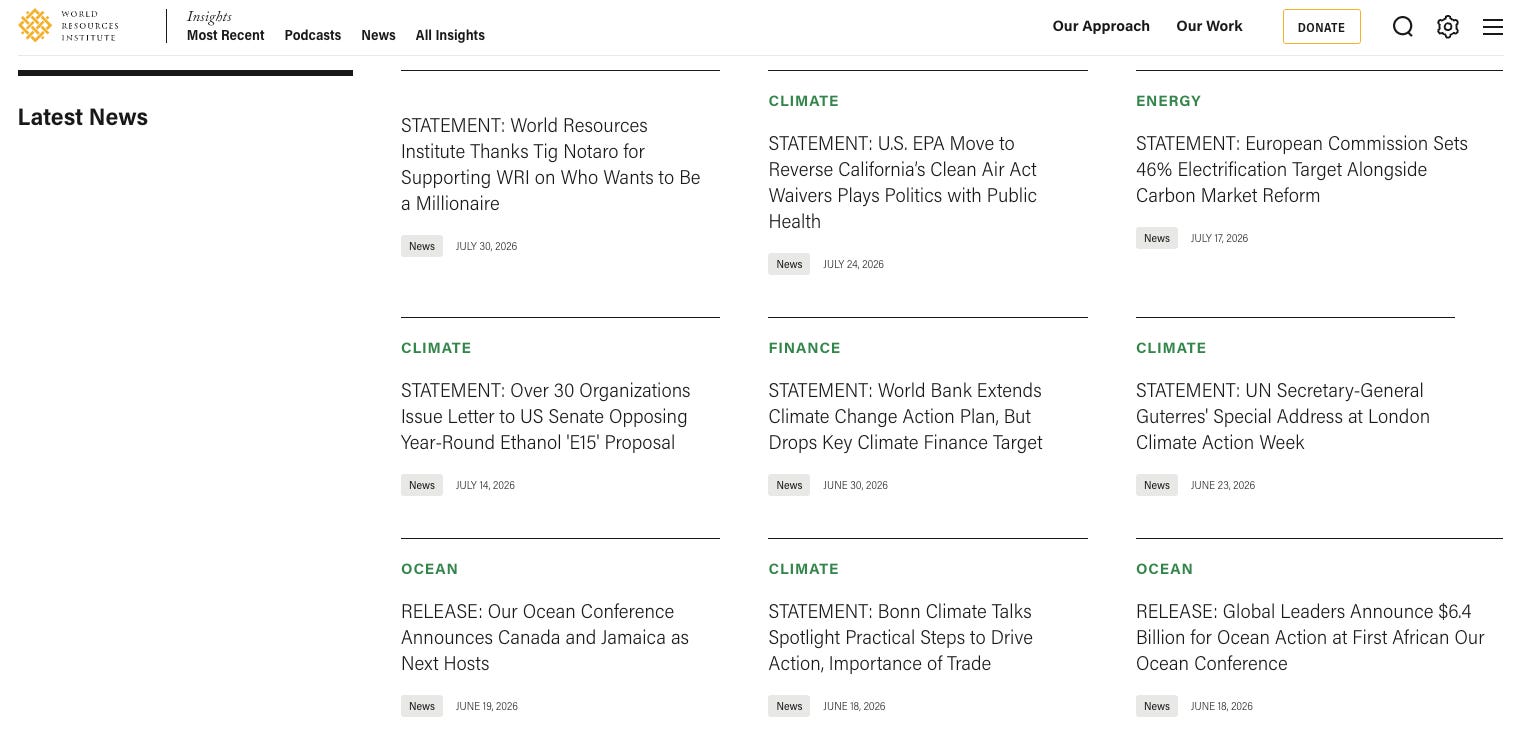
Nope… it’s just critical of the United States, not a single word of disappointment or rebuke of the People’s Republic of China for failing to sign an agreement on Illegal, Unreported, Unregulated (IUU) fishing… or any of the other horrendous environmental damages caused by the CCP.
Senators urge sanctions on China’s fishing support fleet
National Fisherman, July 29, 2026
A bipartisan group of U.S. senators is calling on the Treasury Department to expand sanctions targeting China’s distant-water fishing fleet by focusing on the vessels that keep it operating at sea, arguing the move could significantly disrupt illegal, unreported, and unregulated (IUU) fishing.
In a letter sent to Treasury Secretary Scott Bessent, Sen. Todd Young, R-Ind., and eight Senate colleagues urged the administration to sanction 29 Chinese support vessels, including refrigerated cargo ships, fuel tankers, and floating service bases, along with their owners. The lawmakers contend those vessels are the logistical backbone of China’s distant-water fleet, allowing fishing vessels to remain at sea for extended periods while avoiding ports where sanctions and enforcement actions are more effective.
“China’s distant water fishing fleet continues to disrupt global and regional fishing economies,” Young said in a statement. “Through overfishing and illegal incursions into foreign waters, China seeks to undermine the global fishing industry until there is nothing left. The United States must take steps to combat these activities and promote American fishing practices, which remain the gold standard for sustainable fishing.”
The letter was also signed by Sens. Ted Cruz, R-Texas; Dan Sullivan, R-Alaska; Andy Kim, D-N.J.; Tom Cotton, R-Ark.; Chris Coons, D-Del.; Roger Wicker, R-Miss.; Rick Scott, R-Fla.; and Marsha Blackburn, R-Tenn.
How China’s illegal fishing fleet evades justice
Washington Post, July 27, 2026
China’s illegal deep-sea fishing industry wrecks maritime ecosystems and keeps coerced labor trapped on the high seas. Sen. Ted Cruz (R-Texas) secured $170 million last year for tracking this shadow fleet to enable the U.S. government to impose sanctions on its support vessels. But the Department of Homeland Security, under ex-secretary Kristi L. Noem, spent the money on other priorities.
The Constitution gives Congress the power of the purse, and the maneuver shortchanged an important foreign policy goal. A bipartisan coalition wants the White House to make it right.
Almost all of the dollars intended for improving “maritime domain awareness” went instead to buying counter-drone technology for the World Cup and America250 events, according to Punchbowl News. Defending the country from attacks is the most fundamental responsibility of government, and Congress surely would have been willing to appropriate that special security funding if asked.
COMMENT – Let’s get this system set up for tracking the PRC’s shadow fleet… though I’m sure someone could do it for less than $170 million… perhaps that chunk of money should be spent on “doing something” about the ships, not just tracking them.
Emissions trading: China wants to give coal sector more leeway
Nico Beckert, Table, July 27, 2026
The People’s Republic wants to lower the threshold at which coal-fired power plants must buy carbon allowances far less than planned. This reduces the incentives to cut carbon emissions.
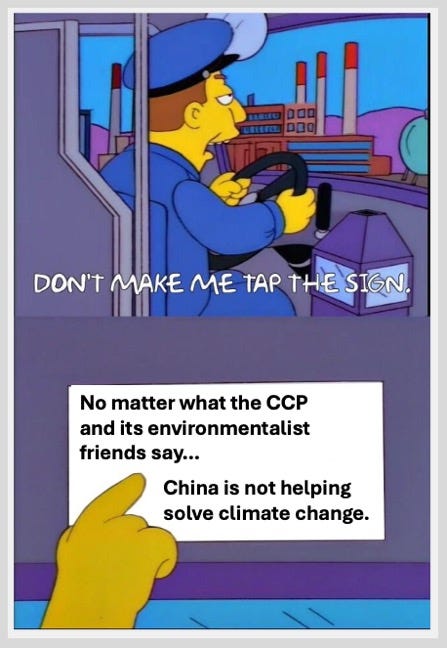
China Energy and Emissions Trends – May 2026 snapshot
Qi Qin, Centre for Research on Energy and Clean Air, June 18, 2026
Fossil power generation rebounded in May as exceptionally weak wind conditions limited clean power growth. Industrial activity remained subdued, while energy imports and refining weakened, and batteries and NEVs stayed strong.
Key findings
Fossil power generation rose 2% year-on-year in May, mainly because of exceptionally weak wind conditions. Wind speeds in March, April, and May were all lower than in any of the previous 10 years; without this drop, rising clean power supply would likely have reduced coal- and gas-fired generation. Curtailment may also have played a role, but weak wind was the key driver and is likely to reverse quickly.
Thermal power commissioning in the first four months surged by 116% year-on-year, reaching a record high. Solar power capacity additions fell by 52% year-on-year due to the high base in the same period last year, but remained above the level seen in the first four months of 2023. Wind power additions rose by 6.5%.
In May, shipping disruptions through the Strait of Hormuz continued to weigh heavily on China’s energy imports, with crude oil imports falling by 29% year-on-year. Coal imports also declined by 7.7%, mainly due to relatively high import prices. The pressure on energy supply also fed through to the refining sector: average daily throughput fell to its lowest level since 2023. Refiners are increasingly drawing on their own inventories to keep operations running.
Domestic natural gas output fell 2.2% year-on-year in May, marking its first monthly year-on-year decline since 2017, partly due to a high base in the same period last year and weaker seasonal demand. Cumulative output in the first five months still rose 1.7%. Gas imports stayed at the same level as the same period last year.
Industrial value-added growth rebounded modestly in May but remained weak, with steel and cement output continuing to fall year-on-year. Cement output remained at its lowest level for the same period since 2020, while chemical fibre output extended a decline that began in April, when output fell for the first time in 22 months. Non-ferrous metal output remained elevated, up 2.2%.
Solar cell production fell by 20.4% year-on-year, reflecting weaker domestic installations. The decline suggests that China’s solar manufacturing sector is adjusting after last year’s exceptionally rapid deployment boom. Battery output remained strong in May, rising 55.2% year-on-year, supported by energy storage demand and exports.
New energy vehicles (NEVs) continued to outperform the broader auto sector in May, with their share of total vehicle production rising to 57% and exports more than doubling to a record high for the month. Production of fuel-burning vehicles fell sharply, by 22%.
Coal power rose again as wind underperformed
Foreign Interference and Coercion
Sam Cooper, The Bureau, July 28, 2026
A Canadian woman linked to China stands today in a secret pre-trial court in Brussels, where a judge will weigh whether to keep her in custody on suspicion of spying inside the North Atlantic Treaty Organization’s (NATO) military command for a country prosecutors will not name, and of belonging to a criminal organization they will not describe.
Belgium’s Federal Prosecutor’s Office has said only that she is a Canadian national of Chinese origin, an intern at the Supreme Headquarters Allied Powers Europe in Mons, arrested Friday.
The Federal Prosecutor’s Office, responding to detailed questions from The Bureau, said the appearance comes five days after the arrest warrant was issued, and that the pre-trial chamber will decide whether her detention should be maintained.
What is not routine is how she reached a desk inside allied command.
By standard Canadian security procedures, she would have been vetted by the Canadian Security Intelligence Service (CSIS) before being hired at NATO. Asked by The Bureau how that screening is conducted, and whether the woman had previously held a Canadian government position or clearance, CSIS referred the questions to Public Safety Canada, which said it was not in a position to comment on specifics while the matter remains under investigation.
Sam Cooper, The Bureau, July 30, 2026
The Canadian woman of Chinese origin held in Belgium on suspicion of spying inside the North Atlantic Treaty Organization’s (NATO) military command for a third country, and of membership in a criminal organization, was vetted by CSIS and the RCMP and cleared for the posting — despite a finding by Canada’s public service watchdog that she committed fraud in a hiring competition run by the CBSA, CSIS’s sister agency inside the Public Safety Canada portfolio.
The Federal Court upheld that finding in a published judgment 11 months before she took up her post at allied command.
Whether the fraud finding ever surfaced in the screening, Ottawa will not say. As The Bureau reported Tuesday, CSIS referred questions about its vetting to Public Safety Canada, which declined to comment on specifics. Global Affairs Canada, which makes the final decision to grant, deny or revoke clearances for Canadians taking positions with international organizations including NATO, would not discuss the case.
She was arrested Friday, a day after searches of her home and her workplace at the Supreme Headquarters Allied Powers Europe in Mons, after her conduct was flagged by alliance security services.
On Tuesday a Belgian pre-trial judge refused her release and ordered her held for at least another month as the investigation continues. Thursday, the prosecutor confirmed the suspect has appealed that decision.
She has not been officially identified; Belgium’s Federal Prosecutor’s Office told The Bureau it never discloses the identities of suspects in ongoing investigations, and The Bureau is currently withholding her name for that reason.
CBC News identified her Wednesday through open-source techniques, Reuters reported her earlier as Claire Z., and the European outlet Follow the Money published similar material. The Bureau had independently assembled the same online resume profile this week and held it.
Her trajectory through the Canadian government’s national security and sensitive information and technology departments is on the public record.
She was a data scientist at the National Research Council for six months in 2017, an economist at Statistics Canada from April 2018 to October 2022, and a systems engineer at the Canadian Space Agency from May 2022.
She lists a policy analyst role at the European Space Agency, work in the economic research and statistics division of the World Trade Organization, and seats on mirror committees of the Standards Council of Canada.
She took a master’s degree at the University of Ottawa in 2022. In July 2025 she posted in a Mons housing group that she was arriving for a six-month internship at allied headquarters, CBC reported. A security source told Reuters she worked in its information technology department.
How China exploits EU divisions over trade
Joe Leahy, Peter Foster and Andy Bounds, Financial Times, July 26, 2026
Silicon Valley Splits Over Closing the Borders to Chinese A.I.
Mike Isaac, Kate Conger, Ana Swanson, and Meaghan Tobin, New York Times, July 26, 2026Zack Chiang, Lingua Sinica, July 31, 2026
A Chinese blockbuster dramatizing the 17th-century Qing conquest of Taiwan has been abruptly postponed. Why are China’s authorities so uneasy about a film that was meant to celebrate “unification”?
Scheduled for release over the past weekend, the Chinese action war film The Belief, a dramatic depiction of the 1683 Qing conquest of Taiwan, seemed on track to define a new and, for many, concerning genre — the “forced-unification blockbuster.” But the film, it appears, has run aground, its planned debut coming and going in silence.
Produced by a consortium of investors with a reported budget of 500 million yuan (about 70 million dollars), and backed by the state-owned Changchun Film Studio, The Belief centers on the 1683 naval battle at Penghu, an island 50 kilometers from the main island of present-day Taiwan, a country official policy in Beijing insists has been “an inalienable part of Chinese territory since ancient times.” The setting is the outset of the Qing dynasty (1644-1911), as Qing forces seek to defeat remnants of the Ming dynasty (1368-1644) holding out in Taiwan.
The allegorical connection to present-day tensions, which have resulted in persistent military exercises in the strait and containment of Taiwan internationally, is so plain it scarcely needs mentioning. The Chinese Communist Party (CCP) regards the island as unresolved business from a civil war fought in the 1940s with the Kuomintang, now one of several political parties in a democratic Taiwan.
The Belief has been heavily promoted by state media, including the CCP’s People’s Daily, since its first trailer dropped on October 25, 2025, the 80th anniversary of Taiwan’s “retrocession” from Japanese colonial rule at the end of World War II. An announcement on May 22 said it would be released on July 25. But the film, with its swashbuckling scenes of battles at sea, has so far not set sail — leading to speculation about what calculations China might be making.
And this is reportedly not the first delay the film has faced. According to BBC Chinese, it was already pulled from a planned Lunar New Year release back in February — prior to the May reschedule giving it the summer release date that passed on Saturday.
Media outside China have noted over the past week that the film’s official Weibo account has not been updated since June, and that the film remains unavailable on China’s domestic movie-ticketing website.
‘One Network, Two Systems’: The Research Security Risks of UK / China University Cyber Partnerships
Eugenio Benincasa, UK-China Transparency, July 29, 2026
UK‑China Transparency (UKCT) has released ‘One Network, Two Systems’, a landmark investigation revealing that the UK maintains more cyber‑related university partnerships with China’s defence‑linked institutions than any country in Europe, including extensive collaborations with universities authorised to conduct classified weapons research.
Considering the growing record of Chinese state cyber hostility against the UK, this is a remarkable finding. British organisations spend billions of pounds countering this phenomenon.
The report identifies 34 UK/China partnerships in cybersecurity, computer science, and telecommunications, nearly matching the total across all 27 EU member states. Thirteen of these involve Chinese universities embedded in China’s defence research system, including four institutions holding Top Secret military research clearance.
“Some of these partnerships involve Chinese institutions deeply embedded in China’s defence research system, creating structural risks that the UK’s current research security framework is not designed to address.” (Report)
Key Findings
1. UK universities are exceptionally structurally exposed to China’s defence research ecosystem. The report documents that the UK has more Chinese government-registered partnerships with China’s highest‑risk defence universities than any other country – the “Seven Sons of National Defence” plus Beijing University of Posts and Telecommunications (BUPT), all of which are authorised to conduct classified weapons R&D – than any other country globally (including Russia).
2. There is deep operational integration between Chinese partner universities and the PLA. Case studies of BUPT and Beihang University reveal direct collaboration with the People’s Liberation Army, defence‑industrial conglomerates, and intelligence‑linked entities. Faculty profiles show recurring patterns of classified funding, redacted project titles, and research applied to PLA cyber, aerospace, and electronic‑warfare scenarios. “Analysis of over 100 BUPT and nearly 80 Beihang faculty profiles reveals recurring patterns: explicit military or defence‑aligned funding… and connections to intelligence agencies including the Ministry of State Security.” Moreover, during the period of research of UKCT’s paper, information relating to defence work was removed from some faculty staff profiles, raising questions about deceptive behaviour and the limits of open-source due diligence.
3. UK partnerships are deeply institutionalised, and are expanding. The most extensive collaboration, the BUPT/Queen Mary University of London Joint Education Institution, has produced more than 9600 dual‑degree graduates and generated 465 co‑authored computer‑science publications. Many BUPT faculty involved in this collaboration simultaneously conduct defence‑designated research. Nearly half of all UK cyber partnerships with China were established since 2020, indicating rapid expansion despite rising security concerns.
4. UK research security mechanisms appear insufficient. The report finds that the UK’s current framework (including Trusted Research, RCAT, and ATAS) remains advisory, fragmented, and focused on individuals rather than institutions, leaving major structural risks unaddressed. The paper also includes evidence of defence work and affiliations removed from academic profiles in China, attesting to the limits of due diligence based on open sources and trusted inquiry, and some efforts to conceal military connections.
5. Other countries have already acted. The USA, Canada, Taiwan, the EU, and several European universities independently have imposed categorical restrictions on partnerships with China’s defence‑linked universities. The UK has not.
Policy Recommendations
UKCT has not historically proposed policy recommendations, its usual practice being to set out the evidence and to allow policy makers to draw their own conclusions. However, on this occasion we have allowed the report’s author, Eugenio Benincasa, to propose five targeted reforms himself:
Establish a UK Named Research Organisation List modelled on Canada’s approach to identify high-risk institutions and guide restrictions on grants and institutional partnerships, including joint programmes and co-supervised doctorates.
Mandate research security officers at universities engaged in high-risk partnerships to oversee such partnerships, supported through access to government threat briefings and specialised training.
Address financial dependency through relief funding to enable institutions to terminate or restructure high-risk partnerships and to prevent viable research projects from being blocked due to concerns about high-risk partners or funders.
Encourage pre-travel security briefings and post-travel reporting for staff engaged in China-related teaching, supervision, and partnership management.
Maintain balanced and consistent messaging, clearly communicating that research security is about targeted risk management, not blanket restrictions on collaboration with China.
Author’s Comment
Benincasa said “the UK’s research security architecture has not kept pace with the scale and structure of university partnerships with China. This report shows that the risks are systemic, not incidental, and that other countries have already moved to address them. The UK appears to need a coherent, institution‑level response.”
COMMENT – Why is Britain so blind to these kinds of vulnerabilities?
University working with MoD has links to Chinese military
Richard Holmes, The Telegraph, July 30, 2026
Queen Mary is partnered with Beijing institution developing secret underwater capabilities for China.
A British university selected for a government defence partnership also works with a Chinese institution developing underwater military projects, The Telegraph can disclose.
Queen Mary University of London, a founding member of the Government’s Defence University Alliance (DUA), is partnered with a university in Beijing that develops top-secret underwater capabilities for the People’s Liberation Army.
The DUA aims to strengthen domestic research and help graduates land British defence jobs in cyber, robotics and AI. A £182m investment supports the scheme, which involves 35 founding universities from across the country.
An investigation reveals that Queen Mary is one of several founding members of the DUA to hold research partnerships with Chinese institutions linked directly to Beijing’s military in fields related to cybersecurity, computer science and telecommunications.
Seven of the selected institutions also have partnerships with Chinese universities. Four of these Chinese universities maintain direct links with Beijing’s military apparatus.
The partnerships follow warnings from spy chiefs that China could have access to British intelligence and challenge British interests.
Anne Keast-Butler, the GCHQ director, warned in May that China was a “tech superpower with sophisticated cyber, intelligence and military capabilities”.
Universities in the UK defence scheme have been found to share students, information and faculty with Chinese institutions which are linked to military projects and provide recruitment channels into state-backed firms accused of human rights abuses.
One of the oldest and most extensive collaborations is between Queen Mary and the Beijing University of Posts and Telecommunications (BUPT).
The partnership has produced more than 9,600 dual-degree graduates despite BUPT’s direct involvement in the development of top-secret underwater military for China’s People’s Liberation Army and its strategic role in the country’s cybersecurity ambitions.
It comes after explicit warnings from British intelligence chiefs about the increased cyber risk stemming from Beijing.
In 2024, Ken McCallum, the director-general of MI5, briefed vice-chancellors that hostile states were targeting sensitive British research to boost their militaries and undermine British national security.
Despite the warnings, UK universities have continued to enter partnerships with Chinese entities at an increasing rate. A new report from the charity UK-China Transparency (UKCT) has found that the UK has more partnerships with Chinese entities authorised to conduct classified weapons research for Beijing than any other country.
While allies have imposed sanctions and restrictions on collaborations with China’s defence-linked universities, the UK has seen a continued expansion of these partnerships.
Brazil turns to China trade deal after Trump’s tariffs, as years of resistance end
Igor Patrick, South China Morning Post, July 28, 2026
Nvidia Staff Detained by Taiwan in China Chip Smuggling Case
Mackenzie Hawkins, Bloomberg, July 28, 2026American Sovereignty or Chinese Capital? There is only one choice
Vermilion China, July 29, 2026
BLUF: A Shanghai fund with Chinese military-civil fusion ties sits on the cap table of a US next-generation battery materials company that received over $100 million in federal grants and is backed by major defense investors such as In-Q-Tel and 8VC. That fund facilitated US-to-PRC technology transfer in the past. Nobody in Washington noticed.
Australian Labor Party rejects China demand to expel Taiwan officials from conference
Keoni Everington, Taiwan News, July 24, 2026
Beijing-backed Taiwan unification film shelved before release
Anne Chan, Nikkei Asia, July 27, 2026
Nvidia Staff Detained by Taiwan in China Chip Smuggling Case
Mackenzie Hawkins, Bloomberg, July 28, 2026Beyond False Comparisons: Why Taiwan and the Malvinas Are Not the Same
Jessica Shiao, Global Taiwan Institute, July 30, 2026
In April 2024, Minister of Foreign Affairs of the People’s Republic of China (PRC) Wang Yi held a public meeting with his Argentine counterpart, Diana Mondino, in response to months of speculation that Argentina and Taiwan might conduct a rapprochement. Prior to the meeting, reports had suggested that representatives from Taiwan were seeking to facilitate improved relations between Taipei and Buenos Aires. The Wang-Mondino meeting, held in Beijing, concluded with both governments reaffirming their mutual diplomatic positions: the PRC reiterated its support for Argentina’s claim over the Malvinas (Falkland) Islands, while Argentina reaffirmed its support for its One China policy and its recognition of “Taiwan as part of China.”
This diplomatic exchange reflected a broader tendency in Argentine political and academic discourse to draw parallels between the Malvinas dispute—involving Argentina and the United Kingdom—and the question of Taiwan’s sovereignty. However, such comparisons often oversimplify the fundamentally different historical, legal, and geopolitical foundations of the two cases. Whereas the Malvinas dispute is framed by Argentina within the context of decolonization, the Taiwan issue emerges from competing claims of political legitimacy and contemporary great power rivalry in the Indo-Pacific. Despite these distinctions, support for one position is frequently portrayed by the PRC as necessarily requiring support for the other.
In this context, Beijing has been able to strategically leverage Argentina’s adherence to the One China principle in ways that reinforce its own diplomatic objectives. By framing support for Argentina’s Malvinas claim as part of a broader solidarity among Global South nations, the PRC has strengthened a narrative in which Argentina’s position on Taiwan becomes explicitly tied to continued Chinese political backing.
This article argues that the analogy between Taiwan and Malvinas is analytically flawed and diplomatically counterproductive. The comparison obscures the distinct nature of both disputes and limits Argentina’s ability to pursue pragmatic engagement with Taiwan in areas such as technology, trade, education, and human capital development. Strengthening unofficial ties with Taiwan would not require Argentina to abandon its Malvinas claim. Rather, greater engagement with Taiwan could provide economic and technological opportunities consistent with President Javier Milei’s emphasis on innovation, human capital formation; and could foster closer alignment with the United States and other like-minded partners.
COMMENT – If you support decolonialization then you should support Taiwan’s self-determination, as opposed to falling back under Chinese imperialism, as has happened to Tibet, Inner Mongolia, and Xinjiang.
A SenseTime Team Is Buying America’s Frontier Tech: US regulators are asleep at the wheel
Vermilion China, July 31, 2026
The people who raised the money for a three-times blacklisted Chinese AI company are now investors in American frontier technology companies.
3C AGI Partners (”3C”) is a Hong Kong fund that buys into the most sensitive hardware companies in the United States: wafer-scale AI chips, optical interconnect, brain-computer interfaces, orbital data centers, and fusion. What it does not advertise is that its investment team was assembled, in large part, out of SenseTime, a company the United States placed on the Commerce Entity List in 2019, on Treasury’s investment blacklist in 2021, and on the Pentagon’s 1260H list in 2025. In addition, the fund’s backer is a family office affiliated with that same blacklisted company’s effort to build AI data centers in Hong Kong.
That team has taken positions in at least eight American frontier-technology companies, several of them funded by DARPA, In-Q-Tel, the Department of Energy, and Lockheed Martin. And across three years of doing it, the fund has drawn no public scrutiny. In Chinese-language media it is celebrated as the Chinese fund that broke into American AI.
Thanks for reading! Subscribe for free to receive new posts and support my work.
US policy has spent years building walls to stop American capital and technology from flowing to Chinese AI and chip firms. Why are these people still allowed to invest in US advanced technology companies?
Human Rights and Religious Persecution
Wang Huning Tours Tibet to Enforce the New Ethnic Unity Law
Lopsang Gurung, Bitter Winter, July 27, 2026
Ethnic Unity Law: Veteran Wuhan Dissident Arrested in Lhasa
Lopsang Gurung, Bitter Winter, July 23, 2026
Mentally impaired waiter jailed for 2 years and 4 months for inciting subversion by promoting pro-Taiwan party
Hong Kong Free Press, July 21, 2026UN Body Finds China’s Detention of Programmer “Arbitrary”
Chinese Human Rights Defenders, July 30, 2026
CHRD welcomes the adoption of an opinion by the United Nations Working Group on Arbitrary Detention (WGAD) that found the Chinese government’s imprisonment of computer programmer Niu Tengyu to be arbitrary, in violation of his rights to liberty, a fair trial, and freedom of expression.
In its May 2026 assessment, the WGAD called for Niu’s immediate release, and for the Chinese government to provide him an enforceable right to compensation and other reparations, highlighting Chinese government violations of the Universal Declaration of Human Rights and other international law.
“Niu Tengyu designed websites, while Beijing designed elaborate means to torture him,” said Shane Yi, researcher at CHRD. “This UN opinion shows which one of them is breaking the law.”
Sinicization of Religion Reaches Macau
Yoyo Ng, Bitter Winter, July 30, 2026
The first Macau Summit on the Sinicization of Religion opened on July 20 at the Fisherman’s Wharf Convention Center. It was presented as an international event on Buddhism and religious dialogue, yet the structure of the gathering reveals its political purpose. Senior representatives of the Chinese People’s Political Consultative Conference attended, together with officials from the Central Government Liaison Office and the United Front, and leaders of the government-controlled Chinese Buddhist Association. Their presence confirms that the summit is part of a national strategy aimed at aligning religious life with the authorities’ priorities.
Chinese Buddhism is quintessentially Chinese, and its “Sinicization” does not mean making it more Chinese, but more aligned with the Chinese Communist Party’s control.
The theme chosen for the summit, described as “local wisdom resonating with the world,” was used to promote the idea that religious traditions should adapt themselves to the cultural and social framework defined by the state. The president of the Chinese Buddhist Association, Venerable Yanjue, delivered a keynote speech insisting on the need for religious teachings to merge with history, social conditions, and Socialist values. This language mirrors the formula used in Mainland documents on Sinicization, where doctrinal reinterpretation, patriotic education, and political reliability are central requirements.
COMMENT – More on making religion and spirituality serve the interests of the Chinese Communist Party, not the individual believers.
China: New Detention in Lhasa, Ongoing Cases Show Persistent Repression
Chinese Human Rights Defenders, July 23, 2026
Former Hong Kong opposition leader Wu granted stay in Britain, lawyer says
Reuters, July 28, 2026
The East Turkestan Flag at the World Cup
Abdulrehim Gheni Uyghur, Bitter Winter, July 24, 2026
Industrial Policies and Economic Espionage
The Chinese economic experiment that failed
The Economist, July 23, 2026
Taiwan Says It Worked with US to Bust High-End Chip Smuggling
Yian Lee, Bloomberg, July 28, 2026
China’s XPeng Charts Course from EVs to Robots
Jiahui Huang, Wall Street Journal, July 23, 2026
World’s biggest EV battery maker pivots to AI, grids and ships
Edward White and Kana Inagaki, Financial Times, July 29, 2026
CATL, BYD battle for supremacy in Middle East energy-storage market
Themis Qi, South China Morning Post, July 28, 2026
Investment with Chinese characteristics: how Beijing’s money is reshaping tech ventures
Wency Chen, South China Morning Post, July 25, 2026
China’s tech sector thrives on state-backed investment, reshaping funding dynamics and sparking a debate about balancing risk and innovation.
On the surface, China’s cutting-edge tech sector – from the algorithmic breakthroughs of DeepSeek and Zhipu AI to the hardware of Unitree Robotics and ChangXin Memory Technologies (CXMT) – mirrors Silicon Valley’s venture capital-backed ecosystem.
But a closer look at their financing histories reveals a common investor: the Chinese state.
Beijing’s strong presence underscores a more profound structural shift in how China’s frontier technology is being funded. As Western venture capital and domestic private wealth retreat, the government has been steadily expanding its role in the market, constructing a state-capitalist apparatus which blurs the line between public policy and private equity.
Rather than operating via a single entity, this public capital flows through a layered matrix of national funds, local investment vehicles, state-owned enterprises (SOEs) and privately managed funds. It is a system that converts top-down policy priorities into private-market bets, with an alternative perspective on what can be considered a return on investment.
Last year, state-affiliated investors supplied more than 90 per cent of the committed capital tracked in China’s private-equity market, a surge from just under 79 per cent in 2021, according to domestic data provider Zerone.
This mandate comes directly from the top. At a high-level national science and technology gathering in Beijing on July 8, President Xi Jinping urged financial capital firms to “invest early, invest small, invest for the long term and invest in hard technology”.
How this capital is deployed could determine whether China will succeed in its ambitions to become a self-reliant tech superpower – or suffocate its economy under the weight of state-engineered overcapacity.
How the money moves
“2018 was roughly the turning point for us,” said Shen Qinhua, founding partner of Puhua Capital, a Hangzhou-based investment firm with about 40 billion yuan (US$5.91 billion) under management. Puhua aimed to raise between 7 billion and 8 billion yuan in 2026, with state-affiliated investors expected to account for about 90 per cent of the total, he said.
According to Shen, it was around eight years ago that traditional private-business owners in eastern Zhejiang province started to pull back their investments in Puhua, as they realised that venture funds’ long holding periods had failed to match their liquidity expectations.
China’s enormous industrial advantage has not yet translated into a profit advantage
– Zhou Kaibing, Hangzhou Venture Capital Association
Around the same time, dollar funds began retreating amid escalating US-China tensions. More recently, restrictions on investment in sensitive technologies from both sides have deepened the financial divide, while Beijing’s aggressive push into strategic technologies has drawn a diverse array of state investors.
This state support arrives in vastly different forms and at distinct stages of a company’s life cycle.
For CXMT, which is headed for a blockbuster public market debut in Shanghai next week, a combination of national, provincial and municipal investors supplied the massive capital, credit support and project construction resources required to build a capital-intensive memory chipmaker from scratch. Industrial and private investors came later.
It is one of the clearest examples of the “Hefei model”, under which the provincial capital of central China’s Anhui uses state investment vehicles to back strategic industries, absorb early risk and anchor companies locally before bringing in market capital.
By contrast, state funds entered Unitree Robotics much later in the game. That financing came after the robot maker had already proven its technological and commercial viability, timing that aligned with Beijing’s elevation of robotics to a strategic priority.
Unicorn artificial intelligence firm DeepSeek, initially funded entirely by private wealth, only recently drew backing from the national AI fund after emerging as a powerful symbol of China’s challenge to US tech supremacy.
Hong Kong-listed Zhipu, whose market cap at the market close on Friday was HK$585.95 billion (US$74.72 billion), attracted a cluster of local government funds when it neared its initial public offering in January, as cities vied for a stake to secure a share in the booming AI sector – or remain economically relevant.
One main delivery mechanism for state capital is the fund-of-funds model.
Puhua Capital, for instance, has twice been selected to manage sub-funds backed by the National SME Development Fund, which is financed by central and local fiscal capital alongside smaller state and institutional investors.
In this set-up, the national fund typically provides a 30 per cent anchor commitment. Puhua would raise another 30 per cent to 40 per cent from provincial, municipal or district-level state vehicles, before securing the remaining balance and deciding where to base the fund.
Puhua would retain its day-to-day investment autonomy, but operate under strict oversight. An appointed observer, separate from the investment committee, could join deal discussions from an early stage and veto proposed investments.
Furthermore, at least 70 per cent of the capital must be deployed into “522” companies – businesses with no more than 200 million yuan in annual sales, 200 million yuan in assets and 500 employees. Performance metrics and related-party transactions would be regularly audited.
“The requirements are higher,” Shen said, “but so is the support for policy direction and industrial coordination.”
In this way, a fund-of-funds brings in broader outside capital while steering it to policy priorities. Meanwhile, the National Venture Capital Guidance Fund, launched late last year, operates further upstream, channelling central fiscal money through regional funds into hundreds of professionally managed sub-funds focused strictly on early-stage technologies.
Some point towards specific industries. For example, the “Big Fund” – China’s flagship semiconductor investor – concentrates capital into this fiercely competitive arena, taking equity stakes directly and backing specialist funds across the chip supply chain.
Others can be deployed through local platforms that take stakes or finance construction, as in Hefei, as well as via investments and acquisitions by state-owned companies.
Who bears the risk?
Capital is pouring into strategic industries through funds with longer lifespans as exit routes expand. Platforms like Shanghai’s Nasdaq-like Star Market and the Hong Kong stock exchange now allow these companies to go public sooner, enabling broader retail investors to share in the potential gains.
“A loop is gradually taking shape, directing more capital towards hard tech companies,” said Mi Lei, founder of CAS Star, a venture-capital firm spun out of an institute under the state-run Chinese Academy of Sciences. The firm’s early bets on China’s photonics sector have begun to see tangible returns amid the AI boom.
However, state investors and private funds do not always share the same scorecard. While a market fund is judged mostly on financial returns, local governments must also account for the number of factories built, jobs created and taxes generated – competing goals that can weaken financial discipline and fuel intercity rivalries.
This local tournament has made China’s industrial policy unusually entrepreneurial – and competitive. Beijing signals the strategic direction, while cities fiercely contest fund structures, industrial estates, credit support and real-world applications.
In the nascent stages of an industry, this rivalry can foster healthy development, or what Shen described as “a hundred flowers blooming”. But it can also lead to severe overcrowding, driven by local governments’ fear of missing out on the next big macroeconomic wave.
The solar panel and electric vehicle (EV) sectors offer stark cautionary tales for today’s policy darlings, such as AI, semiconductors and embodied intelligence.
Expanding production capacity can benefit a single city seeking to boost its local economy, but when dozens of cities replicate the strategy simultaneously, the result is crippling overcapacity and collapsing profit margins on a nationwide basis.
China’s XPeng Charts Course from EVs to Robots
Jiahui Huang, Wall Street Journal, July 26, 2026
China adds 14 EU entities to export control list
Trivium China, July 27, 2026China’s Path to Chip Independence: When Will the Middle Kingdom Make Enough of Its Own Compute?
Ryan Fedasiuk, Choosing Victory, July 30, 2026
World Bank moves to phase out China loans by 2031
Iori Kawate, Nikkei Asia, July 24, 2026
First US LNG Shipment to China in a Year to Be Re-Exported
Stephen Stapczynski and Sing Yee Ong, Bloomberg, July 27, 2026
Volkswagen’s CARIZON and Horizon Robotics deepen self-driving partnership in China
Rachel More, Reuters, July 22, 2026
Cyber and Information Technology
Inside the White House debate over what to do about Chinese AI
Sophia Cai, Politico, July 26, 2026
US moves to ban ‘Made in China’ humanoid robots from military use
Jijo Malayil, Interesting Engineering, July 26, 2026
The Robots Cometh
Charlie Campbell, Time, July 23, 2026
When China Gets Its Own Mythos
Michael Sulmeyer, Foreign Affairs, July 22, 2026
Robot blowback in Korea and China growth slows
Jim Anderton, Design World Online, July 27, 2026
Inside China’s All-Out Push to Catch Up with American AI Chips
Josh Chin and Raffaele Huang, Wall Street Journal, July 23, 2026
Chinese AI models will slash adoption costs, says Singapore’s GIC
Owen Walker and George Hammond, Financial Times, July 24, 2026
Military and Security Threats
China is gaining troubling military know-how from Russia
The Economist, July 23, 2026PLA building more Taiwan mock-ups
Chen Yu-fu and William Hetherington, Taipei Times, July 28, 2026
The Ministry of National Defense yesterday said it is monitoring the construction of full-scale replicas of military and government sites in Taiwan by the Chinese People’s Liberation Army’s (PLA).
The comments from ministry spokesman Major General Sun Li-fang come after a report by the Telegraph on satellite imagery showing replicas of Taiwan’s Presidential Office Building, Suao Naval Base and other sites.
Citing satellite imagery and defense analysts, the report, published on Sunday, said that the PLA had built life-size replicas of key government facilities to rehearse military operations under realistic conditions.
Nvidia’s China Partners and the PLA
Noah Berman, The Wire China, July 26, 2026
Taiwan Tests How It Would Resist a Chinese Siege at Sea
Chris Buckley and Amy Chang Chien, New York Times, July 25, 2026
China holds air, navy patrol in South China Sea
Reuters, July 26, 2026
Technological Progress in ‘Time War’ With the West
Ryan Wu, Jamestown Foundation, July 24, 2026Blurred Orbits: Inside China’s Commercial Space Expansion
Kari A. Bingen, Aidan Powers-Riggs, and Chantal Li, CSIS, July 29, 2026
Coverage of China’s space ambitions has largely focused on its military and human spaceflight developments, but far less attention has been given to its commercial space sector and the industrial base supporting it, which are growing at stunning pace on an unprecedented scale. Chinese launch startups, satellite internet companies, and remote sensing firms are building reusable rockets and mega-constellations, while satellite gigafactories, aerospace cities, technology hubs, and new launch sites are appearing across the country.
This report offers a comprehensive assessment of China’s commercial space developments, capturing the policies, companies, investments, and manufacturing trends shaping its commercial space activities and their strategic implications for U.S. economic and national security interests.
The Gulf’s China Problem
Mohammed Alsudairi, Andrea Ghiselli, and Aaron Glasserman, Foreign Affairs, July 21, 2026
US posts photo of coastguard working with Taiwan after Beijing starts patrols
Lawrence Chung, South China Morning Post, July 29, 2026
Beijing’s Next Play for the South China Sea
Lynn Kuok, Foreign Affairs, July 29, 2026
Japanese Military Officer Indicted Over Armed Break-In at Chinese Embassy
Luo Zilin, Caixin Global, July 28, 2026China cracks down on sales of decommissioned military equipment ‘to protect PLA’s image’
Alcott Wei, South China Morning Post, July 28, 2026
Government notice covering everything from uniform to equipment bans sales and promotions without official authorization.
Beijing has tightened its rules on the sale of military equipment to ban its sale through unauthorised channels.
“In recent years, some business operators have openly sold, online and offline, goods … such as decommissioned and scrapped military equipment, causing an adverse impact and creating security risks,” an administrative notice issued by multiple state bodies said.
The notice – made public on Tuesday and published internally last week – covers everything from uniforms to machinery, components and ammunition that have been formally withdrawn from service and designated for disposal.
There are already laws concerning the sale or transfer of equipment and weapons, with offenders facing up to 10 years in prison, but these are vaguely worded.
The new notice sets out specific examples of what is prohibited, citing concerns about security, military secrecy and the image of the People’s Liberation Army.
“Any form of commercial promotion for decommissioned equipment and imitations that could be mistaken by the public for military equipment is prohibited,” it said.
“Any organisation or individual is prohibited from producing, modifying or assembling equipment using dismantled parts from decommissioned or scrapped equipment, or selling imitations that could be mistaken by the public for military equipment.”
The notice said individuals and organisations needed official approval to sell surplus military kit and instructed the authorities to conduct routine inspections of related sales and marketing activities.
The notice was issued by the State Administration for Market Regulation on Tuesday, with co-signatories including the Central Military Commission’s general logistics and equipment development departments and the Ministry of Public Security.
It is not known what triggered the latest ban. On Monday, Beijing Ronghe Law Firm, which provides military-related services, published an analysis of three cases that could be covered under the notice.
They involved service personnel accused of stealing military uniforms to be sold online, which the firm said “created a risk of crimes involving people impersonating military personnel”.
One Belt, One Road Strategy
As the World Courts Beijing, Namibia Shows How Africa Can Sharpen Its China Strategy
Huiyi Chen and Ovigwe Eguegu, The Diplomat, July 26, 2026
Zijin-Controlled Manono Project Launches Congo’s First Lithium Exports
Lu Yutong, Caixin Global, July 29, 2026
Opinion
Amid Trump’s unpredictability, a region rises to face China
Craig Singleton, Washington Post, July 27, 2026
Governments across the region are assuming more responsibility for their countries’ security.
For decades, stability in the Indo-Pacific rested on a simple assumption: If the regional balance came under serious strain, the United States would lead the response. Choices in Beijing and Washington are now testing that premise, prompting governments across Asia to assume more responsibility for their countries’ security before Chinese pressure forces their hand.
The evidence is increasingly difficult to miss. Japan has launched its largest postwar defense buildup, finalizing military-access agreements with Australia and the Philippines. India, traditionally reluctant to align with any great power, is expanding military exercises and arms exports to regional partners. Taiwan has committed billions to harden its military, civil defense and critical infrastructure against Chinese blockade or invasion. Even Southeast Asian governments with differing views of Beijing are expanding joint maritime patrols to counter incursions and defend their sovereignty.
No single development is transformative on its own, nor do these arrangements amount to a NATO-style mutual-defense pact. Instead, governments are building a flexible web of overlapping partnerships, logistics planning and intelligence sharing. The result is a more connected, resilient region, better able to respond in a conflict.
This restructuring reflects two converging judgments. The first is that Chinese bullying is no longer episodic. Under leader Xi Jinping, Beijing has combined military pressure on Taiwan, maritime coercion against Japan and the Philippines, and economic retaliation against other neighbors. Isolated disputes increasingly look like a broader campaign to bend the region to China’s will.
The second judgment concerns American predictability. President Donald Trump’s transactional approach to alliances and preference for personal diplomacy with Xi have raised doubts about Washington. The U.S. remains Asia’s indispensable military power. Yet allies are increasingly unwilling to rely on American guarantees alone. Instead, they are investing more heavily in one another and assuming greater responsibility for their own security.
Together, these twin disruptions are changing the logic of deterrence. Beijing often pressures its neighbors bilaterally, exploiting the imbalances in each relationship. Trump likewise favors bilateral bargains, pressing allies separately on trade and defense spending. Asian governments are drawing the same lesson from both: Isolation is vulnerability. Their answer is to meet bilateral pressure with multilateral cooperation, building resilience against Beijing while showing Washington they can shoulder more of the burden.
History helps explain why: When revisionist powers challenge an existing order and the role of a distant power becomes uncertain, exposed states rarely wait. They begin preparing. They cannot replace that outside power, but they can deny an aggressor a quick victory, buy time for intervention and strengthen any eventual response.
Europe followed this pattern before World War II. As Germany overturned the continent’s balance of power and the U.S. remained on the sidelines, European governments drew closer in order to resist German expansion. Those efforts failed to prevent war. They nonetheless forged relationships that strengthened the Allied response after Washington entered the conflict.
Ukraine offers a similar lesson. Years of military reform, Western training and intelligence cooperation before Russia’s invasion helped Kyiv survive the opening assault. Asian governments confronting China’s bid to reshape the Indo-Pacific are acting on the same insight: The relationships that matter most in a crisis are built before it begins.
That history sharpens a modern irony. China’s coercion is creating exactly what Beijing has long sought to prevent: neighbors pooling their military, economic and diplomatic power. Acting together, Asia’s middle powers can absorb pressure that might overwhelm any of them individually. In doing so, they can deny China the easy concessions on which coercion depends.
Trump’s approach may reduce free riding. But repeatedly casting doubt on American commitments, including by leaving a major arms package for Taiwan unresolved, could push allies toward outright hedging. Governments that question whether the U.S. would come to their aid may accommodate Beijing, cut separate deals or avoid risks Washington would prefer them to take. Their calculation is simple: China will remain their neighbor long after the Trump administration leaves office.
The paradox is that a more capable region may ultimately become safer even as the transition grows more dangerous. These partnerships raise the costs of coercion but remain uneven and untested. Beijing will almost certainly probe them before they mature, and governments may overestimate the support they would receive from Washington or one another. If the U.S. responds to greater allied capacity by reassuring less, it will deepen the very doubts driving Asia’s reorganization.
A more autonomous Asia should fit an “America First” agenda. Regional governments could assume greater responsibility for their security while the United States preserves the influence needed to shape outcomes. But, to be successful, that bargain depends on predictable American commitments and clear crisis planning.
The lasting shift, though, belongs to Asia. Its governments are no longer bystanders in a great-power contest. They are becoming strategic actors in their own right. China may have accelerated the shift; Asia’s governments want to determine where it leads.
The US may find it hard to shrug off Moonshot’s AI shockwaves
Richard Waters, Financial Times, July 24, 2026
How to stop China from leapfrogging the U.S. in biotech
Washington Post, July 17, 2026
What is the risk of using Chinese open AI models like Kimi K3?
Samm Sacks, Financial Times, July 26, 2026
The Hidden Cost of China’s Free A.I.
Tal Feldman, New York Times, July 29, 2026