Addicted to Partisanship
We like to think that we’re immune to the stuff
Friends,
In case you missed it, on Friday the Commerce Department imposed an “emergency” export control directive on Anthropic’s latest models (Fable 5 and Mythos 5). The Government suspended all access to these models for any foreign national whether inside or outside the United States (including Anthropic’s own employees).
The directive was imposed on Anthropic at 5:21pm on Friday and apparently the government did it with less than four hours’ notice to Anthropic.
That evening Anthropic suspended all access to their newest models everywhere.
It remains to be seen whether this was the right call, perhaps it was. Clearly the models are powerful and the government found an exploit that could be used to conduct cyber-attacks. I’m prepared to believe that the Government was acting with prudence.
But…
Interpreting this action has become a bit of a Rorschach test.
The timing and the circumstances of the suspension don’t inspire confidence, especially after the dispute between Anthropic and the Pentagon earlier this year and the way in which the courts rejected Secretary Hegseth’s designation of the company as a “supply chain risk.”
I’d like to make three points about what are truly unique actions that seem to be taking place on a weekly basis:
I get the impression that the dispute between Anthropic and the Trump Administration has moved away from the realm of good faith disagreements between a company and the government and into a partisan battle. It looks like this has become yet another battlefield for imposing partisan political costs on one’s domestic opponents. This is really bad for a technology sector that is so critical to the country. This is especially true since there are enormous costs that Beijing is imposing on U.S. companies that the Administration is being a bit quiet about and should be directing its energies against (see articles #1, #2, #3, #4, #5, and #6)
The Commerce Department demonstrated on Friday that it could move incredibly fast in closing a vulnerability that was open to a hostile foreign rival. This raises serious questions of why the Commerce Department has failed to demonstrate even a modicum of this level of urgency in preventing the PRC from gaining access to advanced AI chips so that Chinese AI companies can’t build these kinds of models. Obviously, Commerce would have no authority to issue this kind of suspension on a PRC AI company once they have the hardware to build and run these models. Certain semiconductor companies (I won’t name names) have shown that they are far more willing to turn a blind eye to the smuggling of their chips and outright sales to “foreign nations of concern,” yet Commerce appears completely unwilling to use the powers they have used against Anthropic.
It seems quite obvious that the PRC will exploit these divisions for their own benefit, whether that is pulling more Chinese employees away from U.S. AI companies or exploiting the obvious partisan gaps in the enforcement of U.S. controls and restrictions.
We need to confront how partisanship has infected our national security decision-making process. While this applies to both sides of the aisle, the responsibility today falls on the individuals in the executive branch to act in ways that don’t appear blatantly self-serving, even if they believe that the “other side does it too.”
In that spirit, this week’s song is Robert Palmer’s “Addicted to Love.”
Whoa, you like to think that you’re immune to the stuff
Oh, yeah
It’s closer to the truth to say you can’t get enough
You know you’re gonna have to face it
You’re addicted to love
Plenty of folks think they are immune to the addiction of partisanship (I’m no exception), but we need to face the fact that it is overwhelming our decision-making processes and imposing huge biases on our judgement.
It might feel good to “beat” your domestic political opponents, but it is a sugar rush, and it results in ever escalating cycle that only undermines the country as a whole. Scoring partisan points isn’t the same as “winning.”
Fixing this requires self-discipline to avoid jumping to conclusions, a willingness to admit that you “take sides,” and a willingness to be critical of your own side.
Enough on that…
The song was released 41 years ago, and the music video is iconic with Palmer in a tie singing in front of identically dressed women in heavy make-up. It was a style of video he repeated with “Simply Irresistible” and “I Didn’t Mean to Turn You On.” It is hard to get more 1980s than a Robert Palmer music video.

Unfortunately, Palmer died of a massive heart attack at the age of 54 in September 2003. He was in a Paris hotel room on a break between gigs.
Thanks for reading!
Matt
MUST READ
China’s hunt for US tungsten escalates global critical minerals race
Martha Muir and Camilla Hodgson, Financial Times, June 2, 2026
Chinese buyers have been quietly stockpiling tungsten from scrap yards across the US, driving up prices of a crucial defence industry metal amid an escalating global race for critical minerals, US sellers told the FT.
Since early 2025, Chinese scrap traders have been seeking tungsten throughout the US, prompted by a shortage outside China caused by declining supply and intense demand from the aerospace, weapons and tools industries. The effort has set off a bidding war with American buyers and calls to ban sales of a critical national security resource to overseas buyers.
“We’ve got to stop the export back to China,” said Ryan McAdams, chief executive of Texas-based tungsten recycler and refiner Amermin. “This is a secret war that nobody’s talking about.”
There are no US prohibitions on sales of tungsten to buyers who plan to export it. A White House official said Donald Trump’s administration is committed to rebuilding the US domestic minerals industry and ensuring American supply chain security.
John Moolenaar, a Republican congressman from Michigan and chair of the House select committee on China, told the FT: “It is no surprise China is trying to dominate the market” for tungsten. “We must do more to make sure we have a reliable supply.”
Sellers said they were fielding calls from Chinese buyers looking for the material, while American buyers said they were being outbid by Chinese rivals willing to pay as much as five times the usual price.
“When I’m going into scrap yards or my suppliers that I’ve dealt with for years, they’re telling me the Chinese are coming in,” said Kent Vandiver, who owns a metal recycling company in Dallas, North Carolina.
During a visit to a Texas supplier, Vandiver said he was told Chinese buyers had been there “20 mins ago” offering “quite a bit more”. An Oklahoma supplier gave a similar account, saying they had promised: “Whatever price you get, we’ll pay more.”
Tungsten scrap commonly comes from worn-out industrial tools such as drill bits and mining equipment. It can be crushed and chemically processed back into tungsten powder or carbide for use in new machinery and tools.
The shortage has been triggered by Beijing imposing export restrictions on it and an array of other critical minerals in early 2025 and the country cutting mining quotas. China accounts for more than half of global mined and refined tungsten supply and about half of demand.
The Fight to Break China’s Rare-Earth Dominance Moves to a New Front in Brazil
Samantha Pearson, Wall Street Journal, June 8, 2026
Brazil holds the world’s second-largest reserves and wants to become a processor of critical minerals, but it refuses to choose sides between Washington and Beijing.
Western companies are pouring money into Brazil’s rare-earth industry, hoping the South American nation can help loosen China’s grip on the minerals used in electric vehicles, wind turbines and advanced weapons.
Miners are racing to develop deposits across Brazil, which holds the world’s second-largest rare-earth reserves after China. But their ambitions extend beyond digging up ore. Companies and government officials say they want to build processing plants that can separate rare earths, produce metals and eventually manufacture magnets.
The realization of that ambition would represent a much bigger challenge to China. While Beijing holds roughly half of global rare-earth reserves, it controls more than 90% of processing and magnet production, giving it a dominating influence over global supply chains.
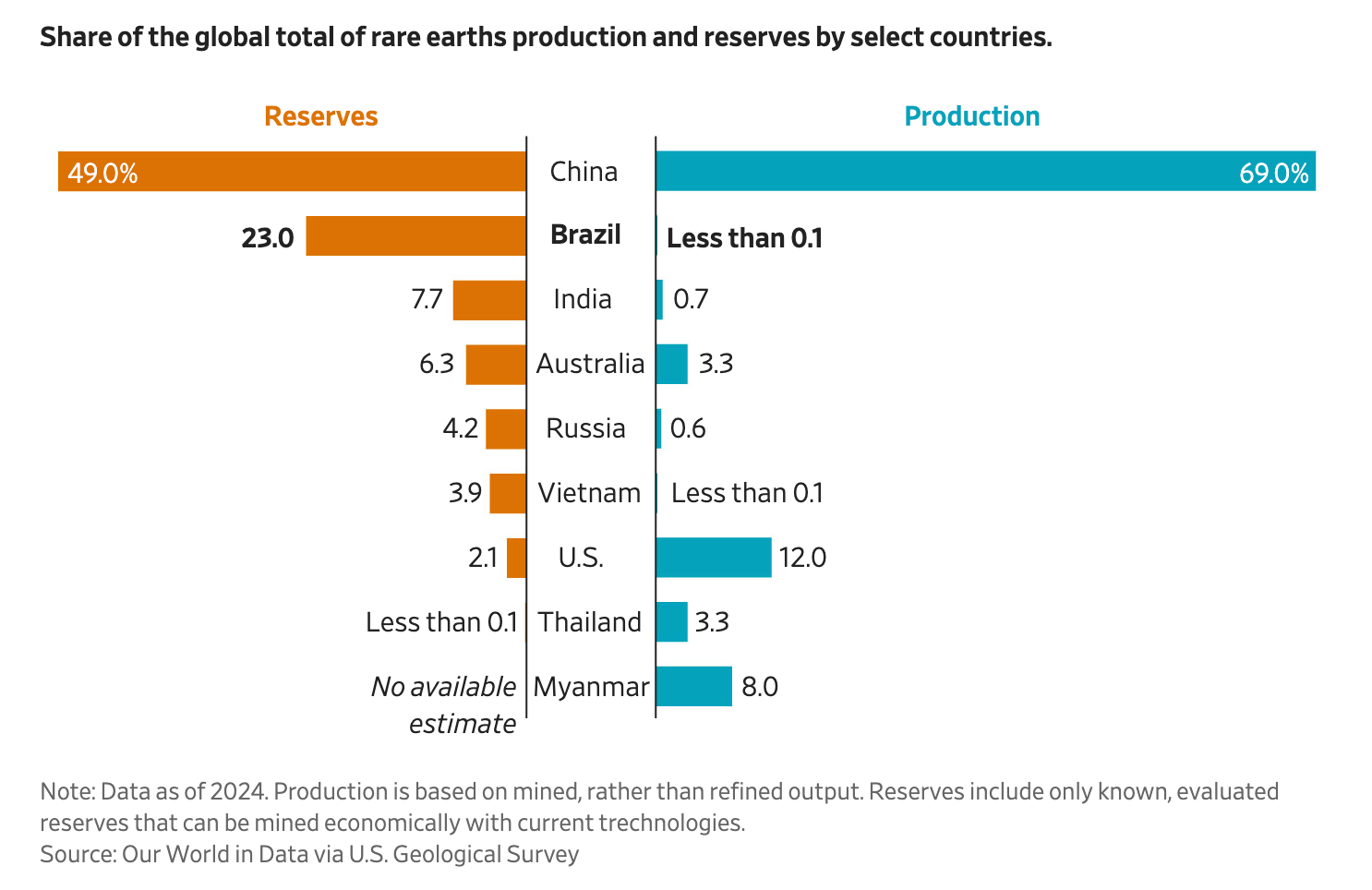
“This is world-class geology,” said Rafael Moreno, chief executive of Australian-listed miner Viridis, one of several companies developing projects in southeastern Brazil. “Brazil is now positioned to play an increasingly strategic part in supplying critical raw minerals to Western economies.”
The push has turned Brazil into a focal point in the struggle between Washington and Beijing over critical minerals. The U.S. has been scouring the globe for rare earths, backing projects from Africa to Australia in an effort to loosen Beijing’s grip on the industry.
Yet Brazil has resisted pressure to join a U.S.-led minerals bloc, insisting it will accept investment from any country willing to help develop the industry.
“Brazil is open to investments from whichever country respects our sovereignty,” Mines and Energy Minister Alexandre Silveira said in an interview. “We’ve been in talks with various foreign players including the U.S., the European Union, China and others.”
Poços de Caldas, a city built in the caldera of an extinct volcano, has become one of the centers of the rush. A towering Christ the Redeemer statue overlooks a landscape rich in the clay deposits that miners think could help reshape global supply chains.
After opening a pilot plant in the city last month, Viridis plans to begin production in 2028, including scarcer heavy rare earths that help magnets retain their strength at high temperatures—crucial for everything from electric vehicles to jet fighters.
Like many of Brazil’s rare-earth deposits, Viridis’s reserves are found in clay, which executives say is cheaper and easier to process than the hard-rock deposits common in Australia and elsewhere. Cheap hydropower, relatively low labor costs and proximity to U.S. markets have further deepened investor interest.
For years, rare earths attracted little attention outside mining circles. That changed in 2025, when China imposed export controls on several rare-earth elements and magnets in response to trade tensions with Washington, exposing the extent of Western dependence on Chinese supply chains.
Western governments and manufacturers have rushed to develop alternatives.
COMMENT - Simply developing an alternative rare earth processing capability is “siding” with the United States and the rest of the world being coerced by Beijing. The CCP doesn’t want anyone else to eat into their market dominance because it is a weapon to use for geopolitical advantage and only works in the PRC holds it alone.
US business group says some critical minerals are ‘nearly unobtainable’ from China
Michael Martina, Reuters, June 10, 2026
U.S. access to critical minerals from China remains difficult due to export controls and licensing delays, a U.S. business lobby said on Wednesday, with Beijing’s restrictions driving three-quarters of impacted companies to search for new supplies.
Introduced in April 2025 in retaliation for U.S. President Donald Trump’s tariffs, Beijing’s controls tightly restrict exports of certain rare earths crucial for advanced manufacturing.
That’s despite Trump’s deal with China’s Xi Jinping in October in which the White House said China committed to “effectively eliminate” all current and proposed critical mineral export controls.
The U.S.-China Business Council said in a report that some rare earth elements remain “nearly unobtainable.”
“Despite some progress, confidence in longer term access remains low,” USCBC said based on results of its annual member survey conducted in February and March.
According to its survey, of 38 impacted companies, 29% said they were actively shifting to non-Chinese suppliers of critical minerals while 47% said they were searching for but had not yet found viable alternatives to China.
“China is forcing this diversification away from China and creating a strong interest on the part of the corporate sector to find alternatives,” USCBC President Sean Stein told Reuters.
China’s dominance over critical minerals has brought the rival countries to at least a temporary trade war truce, but the Trump administration has made a concerted push to revive mineral supply chains from the U.S. and partner countries.
Stein said it would be difficult for the U.S., despite those efforts, to eliminate supply issues over the next three years.
Samarium cobalt magnets, important for high-temperature aerospace and defense applications, and yttrium and cadmium were among minerals that were still very difficult for U.S. companies to access, Stein said.
Kyle Sullivan, USCBC vice president, said securing finished rare earth magnets - not just the minerals themselves - was a challenge due to China’s hold over both mining and processing.
“That’s the perfect case for congressional involvement, because it can’t be solved by the Trump administration alone,” Stein said.
Uncertainty in U.S.-China relations is suppressing companies’ investments in China, Stein added, with the report noting that “just half” (49%) of 134 companies plan to invest in China this year.
“China’s business environment for foreign companies is not improving. The country’s support for domestic companies, including through industrial policy and preferential treatment in government procurement, is eroding the gains from formal market access openings,” the USCBC report said.
COMMENT - So years of lobbying on behalf of the CCP hasn’t helped the companies at the US-China Business Council escape this punishment… perhaps these companies, and this lobbying group, should reconsider their approach to the PRC.
China’s control over indium phosphide exports threatens AI data centre rollout
Laurie Chen and Liam Mo, Reuters, June 10, 2026
Barely a week after Nvidia-backed chipmaker Coherent warned of a shortage of indium phosphide in an earnings call in early May, its CEO Jim Anderson was on a plane with a U.S. business delegation accompanying President Donald Trump on his trip to China.
Anderson’s visit was partly to raise the issue of delays in China’s export licenses involving the highly strategic material, essential in manufacturing high-speed optical chips for AI data centres, said three sources familiar with the matter.
The issue was also discussed during talks in Seoul between top trade negotiators of the two countries ahead of Trump’s May 14-15 summit with China’s President Xi Jinping, according to two U.S. government officials and a person briefed on the talks.
The U.S. urgency to resolve China’s export controls on the compound highlights how indium phosphide (InP) has emerged as a powerful trade weapon for Beijing that experts and executives say could disrupt the global rollout of AI data centres.
“InP is one of several supply chain bottlenecks collectively gating AI data centre buildouts,” said Konrad Wang, a research analyst at SemiAnalysis.
With AI workloads growing exponentially, InP is in high demand as it is a core material with no substitute in the new technology that data centre developers are turning to - using light through optical fibres, or photonics, instead of electrical signals through copper wire.
Nvidia announced $2 billion investments each into U.S. photonic product makers Coherent and Lumentum in March, while custom-chip maker Marvell Technology announced the acquisition of semiconductor startup Celestial AI last year to tap into its work on photonics.
China’s export restrictions on InP that began in February 2025, however, have become a major hurdle in their race to design the fastest, most energy-efficient components for AI data centres.
China’s commerce ministry did not respond to a faxed request for comment.
Its control over InP highlights Beijing is prepared to expand on its well-proven export curbs on rare earths, which have disrupted global automotive, semiconductor and aviation supply chains since last year amid its tariff disputes with Washington.
“Beijing is developing a more granular ‘materials chokepoint’ toolkit,” said Paul Triolo, a partner at consulting firm Albright Stonebridge Group.
Thomas Bollyky, Rush Doshi, Prashant Yadav, and Olivia Kosloff, Council on Foreign Relations, June 2026
U.S. dependence on China for essential medicines is structural—deeper, broader, and more consequential than conventional market analyses suggest. That dependence began with generic medicines and their ingredients but is now growing in biologics manufacturing, first-in-human trials, and synthetic DNA. That dependence is not simply the result of market conditions but rather decades of Chinese state investment.
The United States (and just about every other nation) faces a growing risk that China will deliberately withhold essential pharmaceutical inputs as a tool of economic or political coercion outside of a military conflict, public health emergency, or natural disaster, as China has done with rare-earth critical minerals. Those risks are greatest for the subset of essential medicines and inputs that China exports directly, which include medications to prevent organ transplant rejections, broad-spectrum hospital antibiotics, and a powerful blood thinner. China also dominates upstream inputs for many other critical medicines, such as the antibiotic amoxicillin and the circulatory stimulant norepinephrine, but those inputs are not exported directly to the United States. China would need to restrict supplies or their use in a third country—typically India—to prevent those inputs from being made into active pharmaceutical ingredients (APIs, the chemical compounds in a drug responsible for its effect) or finished dosage forms (FDFs, the final, consumer-ready version of the drug) and exported to the United States. But it has the means, clandestinely if desired, to do so. And if Chinese authorities choose to act, the adverse consequences of cutting off the supply of key starting materials (KSMs), the building blocks that typically feed multiple API and FDF manufacturers, would reverberate throughout multiple pharmaceutical supply chains.
How the PLA Has Tried to Get Around Chip Export Controls
Savannah Billman, The Wire China, June 4, 2026
Procurement tenders shows how military agencies attempted to purchase Nvidia hardware through a network of commercial partners.
For years, the United States has tried to stop China from getting its most advanced chips out of concern the technology could bolster the People’s Liberation Army’s capabilities. But the web of export controls it has imposed has not stopped the Chinese military from trying to get Nvidia’s products.
Between 2019 and 2025, the PLA sought advanced AI chips and computing equipment through a network of institutions and commercial firms, according to a recent WireScreen report that analyzed over 3,800 military procurement tenders.
PLA units and military academies sought out specific models 540 times over the six-year timeframe, with nearly half of the requests for Nvidia’s export-controlled A100 and A800 AI chips.
After the implementation of U.S. export controls, the PLA broadened its sourcing network and sought new avenues for obtaining advanced hardware. A wide variety of companies identified by WireScreen have bid to supply both controlled and non-controlled items, ranging from traditional defense industry suppliers to single-employee firms.
COMMENT - I’m pretty sure I remember a prominent semiconductor CEO claiming that the PLA would never want these chips because they were too afraid of having them cut off.
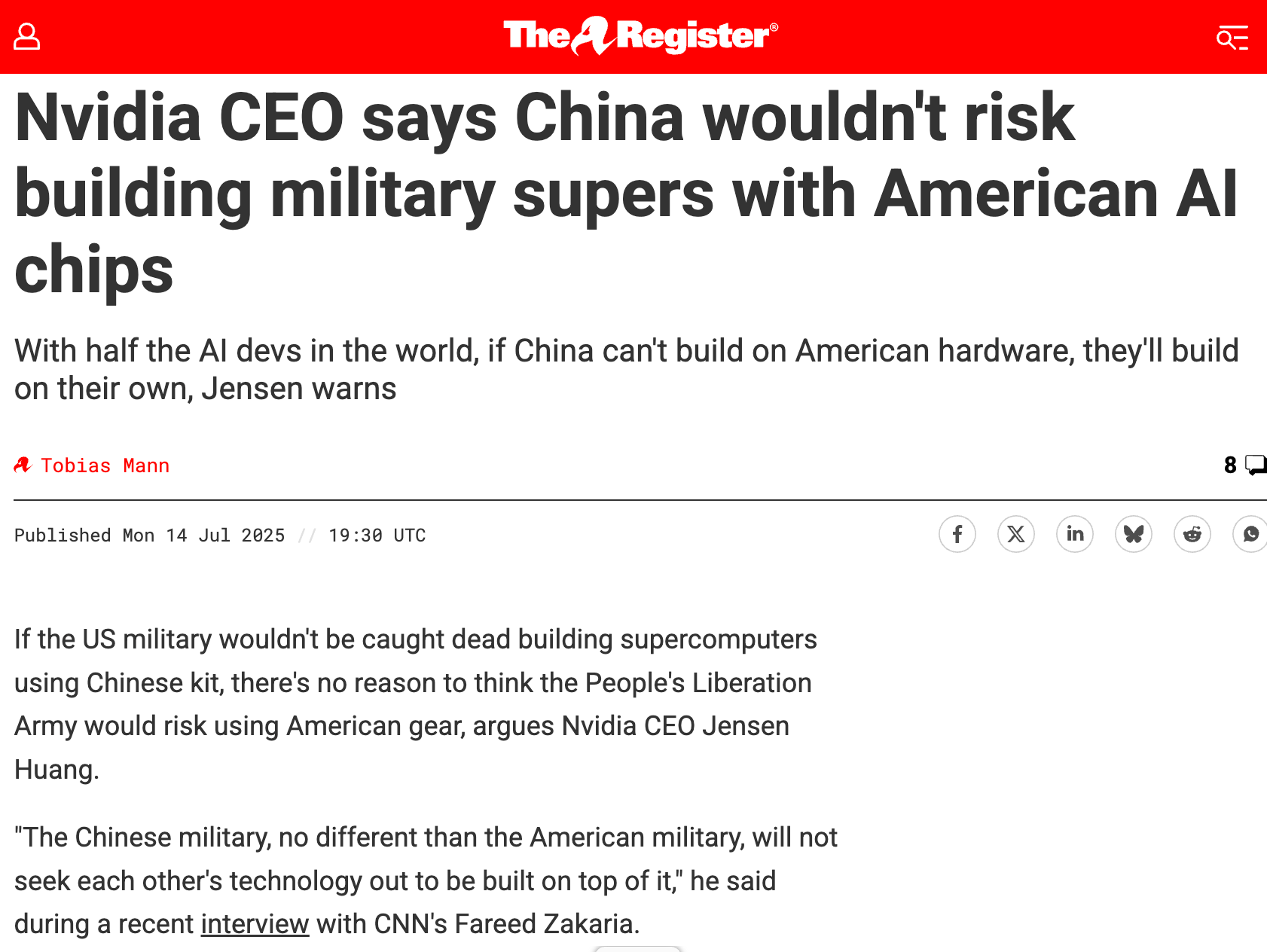
Seems like the Chinese military is different from the American military as it looks willing to build its technology on top of U.S. chips.
What Are Chinese AI Companies Saying About the Impacts of Export Controls?
Konstantin F. Pilz, June 7, 2026
Export controls are supposed to limit compute in China and thus slow down China’s AI development and deployment. Do they work? One type of evidence is what Chinese AI companies directly say about compute. I’ve compiled several dozen relevant quotes below.
Almost all companies acknowledge compute is scarce in China. Some voice optimism about domestic alternatives for inference but are doubtful Chinese companies will be able to compete at the frontier.
COMMENT – This is a fascinating post.
How China Misperceives Itself: Beijing’s Blind Spots Hinder Real Reform
Francesca Ghiretti, Foreign Affairs, June 5, 2026
Great powers rarely fail because they are unaware of their problems. More often, they fall apart because they misidentify or only partially identify the root of those problems. The ability to accurately diagnose weaknesses, to distinguish between temporary constraints and structural limits, and to generate the political will to fix deep-seated problems separates states that adapt and thrive from those that stagnate or crumble.
China today faces an imposing list of challenges that it needs to assess and address. Economic growth is slowing, the population is aging, the financial system is under stress, and other countries have been tightening trade controls and scaling up their own industrial policies to compete. For many years, China’s economic expansion could mask the country’s underlying vulnerabilities. That era is now over. And in party documents and major speeches alike, leaders in Beijing admit these pressures and acknowledge the country’s weaknesses.
But recognition is not diagnosis, nor does it automatically translate into meaningful action. Beijing describes China’s challenges as technical, developmental, or externally imposed rather than products of systemic problems. This distinction is strategic. It downplays political and institutional vulnerabilities that are causing the issues or making them worse, including the concentration of authority in the hands of Chinese leader Xi Jinping, tensions between central directives and local implementation, misaligned incentives between leaders and rank-and-file cadres, and a demand for ideological rigidity that leaves limited room for feedback or policy correction.
How China views its own weaknesses is as consequential as the weaknesses themselves. When Beijing casts structural problems as technical hurdles or pressures from abroad, it limits the reforms it is willing to pursue while offloading responsibility by blaming factors outside the Chinese political-economic system itself. For policymakers in the United States and Europe, understanding how China interprets its own problems is essential to managing long-term competition, calibrating deterrence, and identifying areas, however few, where real engagement remains possible.
COMMENT - I think it is nearly impossible for the Chinese Communist Party, under the conditions that Xi has imposed for the last 13 years, to objectively evaluate its own policies and judge whether it is achieving its own stated objectives.
Now there will be plenty of folks claiming that the same problem afflicts the United States and I don’t think that is true. There is no restriction whatsoever on openly criticizing U.S. policies, decision-making, or whether any Administration is achieving its stated objectives or not. There is plenty of constructive (and un-constructive) criticism within the United States and from every corner of the globe. Political leaders in the US hear it all the time… they may not like it, but they are confronted with it.
That is simply not the case for the CCP’s senior leadership.
The Real Problem with Global Trade: How China’s Currency Manipulation Is Warping the World Economy
Brad Setser and Shahin Vallée, Foreign Affairs, June 11, 2026
As the Group of Seven meets in Évian, France, beginning June 15, French President Emmanuel Macron has pushed to bring about a broad recognition that rising trade imbalances are a global economic problem. But G-7 leaders will nevertheless likely ignore one of the most important sources of those imbalances: the undervaluation of the currencies of Asia’s large economies, especially China’s.
This is unfortunate. There is a growing consensus that Asia’s trade surplus has grown too big. But without discussion of currency undervaluation, there is little chance that the G-7 can mount a meaningful effort to change the policies that have given rise to these imbalances. In 2021, when China’s property bubble collapsed, it weakened the renminbi, which helped Beijing’s pivot to export-led growth. The currency’s reduced value made Chinese goods cheaper for foreign buyers, and foreign goods more expensive in China. Weak growth in demand, a falling currency and widespread industrial subsidies have led China’s overall trade surplus to triple since 2018. Moreover, Chinese state banks and other state institutions are now giving China’s exporters an artificial edge in foreign markets by holding China’s currency down.
U.S. President Donald Trump’s tariffs were meant to slow China’s export juggernaut. But it has not worked out that way. Rather than assembling its own parts for shipment direct to the United States, China now ships intermediate goods—often high-tech components—to neighboring countries for final assembly, thus sidestepping tariffs. To keep their own exports competitive and workers in their manufacturing sectors employed, many of China’s neighbors have felt compelled to keep their own currencies weak. Indeed, several other Asian currencies are at historic lows against the dollar.
These rising imbalances in global trade are as much a problem for Europe as for the United States. Europe’s automotive, chemical, steel, and machine-tool industries are on the frontline of this so-called second China shock. This is why Macron has made global trade imbalances a major theme of this year’s G-7. But in Europe, as in the United States, there is still a reluctance to make currency diplomacy integral to the broader trade discussion. This is an intellectual and policy blind spot that risks a failure of economic policy coordination. As long as it persists, trade imbalances will only grow. This situation is unsustainable. The G-7 must present Beijing with a choice: it must allow its currency to appreciate, or it must face new trade restrictions.
TRADING TROUBLES
Large surpluses and large deficits create financial risks as well as trade tensions. To address these problems, G-7 finance ministers have agreed to a minimal communiqué that does little more than highlight the “common interest” that surplus and deficit economies share in bringing down persistent trade imbalances. But they did not press for a change of China’s exchange rate policy. Moreover, the G-7’s call for yet another IMF report on the underlying drivers of imbalances are unlikely to persuade Beijing to move away from its current reliance on exports to achieve growth targets that it cannot meet from domestic demand. Chinese think tanks, state media, and officials still attribute its rising surplus to its comparative advantage in new industrial sectors.
The United States, meanwhile, appears to have lost interest in an agenda that would try to facilitate a simultaneous reduction in trade surpluses and deficits. U.S. Treasury Secretary Scott Bessent’s early talk of a grand global economic reordering has disappeared into a world of communiqués that promise “constructive strategic stability.” Beijing likely understands this to mean that Washington will not demand major changes to its current set of economic policies. Bessent’s initial ambition to bring the fiscal deficit, which is once again trending back above six percent of GDP, down toward three percent seems to have vanished. The administration is instead celebrating a surge in AI-related capital goods imports that is likely to push the U.S trade deficit even higher.
Against this backdrop, a strange disconnect has emerged, as the recognition of a growing problem has not translated into support for the most obvious solution. Economists across the ideological spectrum recognize that China’s scale, its technological sophistication, and the yawning gap between its rapidly growing exports and its stalled imports have created a profound challenge to the world’s other manufacturing powers. Similarly, few would challenge the proposition that reliance on China for critical inputs creates an important strategic and economic vulnerability. Indeed, there is even a grudging acknowledgment in Washington—though less so from the IMF—that Beijing’s mix of central government support and subsidies from competing local governments has been effective in mastering and scaling the production of cutting-edge technologies.
And yet the consensus does not extend to recognizing the need to end deep currency undervaluations—notwithstanding the fact that ending them is the one policy change that would directly bring balance to global trade. International economic policy decision-makers seem to be studiously avoiding any commitment to macroeconomic coordination or talk of exchange rate policy, and instead maintain that cooperation should be limited to each country making its best individual efforts to pursue appropriate monetary and fiscal policies.
SOMETHING IS MISSING
Over the last five years, governments and international financial institutions have adopted the view that the currency policies of the world’s largest economies do not have any real or persistent effect. As the IMF’s recent paper on imbalances argues, moves in the exchange rate will be offset by changes in the level of domestic prices. But the empirical evidence to the contrary is overwhelming: domestic prices are rigid and only move slowly.
This neglect of currency issues was evident at the latest G-7 Finance Ministers’ meeting in May. Attendees did not even acknowledge that a growing undervaluation of the renminbi played a meaningful role in China’s recent export outperformance. Similarly, there is a lack of appreciation—including at the IMF—of how China’s capital controls make the exchange rate an independent policy tool under Beijing’s direct control. For example, the IMF’s most recent assessment of China’s economy did not mention, let alone analyze, the role of the state banks in maintaining the tight trading band around the renminbi that effectively lets China’s central bank control the movement in the currency. Only a few specialists—and actual currency traders—understand the tools that Beijing, and some other Asian capitals, use to maintain deeply undervalued currencies.
The current neglect of currency issues is a break from the past. Economists in the aftermath of World War II understood the connection between currencies and the balance of trade. The Bretton Woods system of fixed but adjustable exchange rates was built around this principle. And recognition that currency moves were central to external adjustment persisted for decades. As the U.S. trade deficit ballooned, in 1985, representatives of France, Japan, the United Kingdom, the United States, and West Germany met at the Plaza Hotel in New York to solve the problem. They agreed to coordinated intervention in the foreign exchange market, and they adopted economic policies to weaken the dollar. Doing so successfully brought down the U.S. trade deficit. Although this is sometimes attributed to the concurrent tightening of U.S. fiscal policy, in reality, dollar adjustment and fiscal adjustment were mutually reinforcing.
Currency moves were also central to the development of the trade imbalances that preceded the 2008 global financial crisis. From 2002 to 2005, for instance, the renminbi was tightly linked to a depreciating dollar even as Beijing’s entry to the World Trade Organization turbocharged Chinese exports. The resulting depreciation is a key reason why China’s surplus reached ten percent or so of its GDP—the first China shock. Conversely, the 40 percent real appreciation in the renminbi from 2005 to 2014 was a big reason why China’s surplus fell back to under two percent of its GDP. Exchange rates still matter, and they have a meaningful impact on the balance of trade.
FIDDLING THE FIGURES
Since the COVID-19 pandemic, China has seen steady technological advances and rising productivity in a number of industrial sectors. These are developments that should normally cause the renminbi to appreciate. Yet it has depreciated by roughly 15 percent in real terms. The IMF suggests that a 15 percent depreciation should increase China’s net exports by between two and 2.5 percentage points of China’s massive GDP—not far from the three percentage points of GDP rise observed in the last two years.
China is not the only Asian country with an undervalued currency. Compared with the dollar and the euro, the Korean won is as weak as it was during the global financial crisis of 2008. This is despite the fact that Seoul has experienced record trade surpluses. Taiwan’s massive export of chips and rising trade surplus in the last few quarters has also coincided with a five percent depreciation of the already weak Taiwan dollar. The Japanese yen, when adjusted for inflation, is as low as it was in the early 1970s. This broad Asian currency weakness is a key reason why the world’s trade surplus is so concentrated in East Asia. At $1.5 trillion, Asia’s trade surplus is far larger as a share of world GDP than at any point since 1945. It is also the only large surplus in the global economy. These Asian undervaluations are not accidental. China has a long history of using its central bank to intervene in the foreign exchange market and to manage capital flows so that its currency does not appreciate. In 2025, China resumed foreign currency purchases that keep the renminbi’s value artificially low. Meanwhile, Taiwan has successfully found ways to get its dollar to depreciate, even as rising demand for chips has driven a massive increase in its trade surplus.
In March, the IMF proposed a timid policy package to reduce global imbalances. It shied away from calling for the appreciation of Asian countries’ currencies. The G-7 also seems poised to avoid any commitments of its own, let alone make any direct call on China or Asia to lead a broad revaluation. By taking this approach, the G-7 has neither made any real space for economic policy coordination nor laid the groundwork for creating pressure for action by the broader G-20. In some respects, this is understandable. The G-7’s approach is politically expedient, as it allows the group to steer clear of discussing how exchange rate coordination fits within the European policy architecture and avoids discussion of the global consequences of Washington’s runaway fiscal policy amid a domestic investment boom. But the time for such evasions has passed. The G-7 and its partners should offer China a clear choice. Beijing can elect to face coordinated tariffs against its exports, or it can allow a coordinated appreciation in its currency—to the benefit of all.
COMMENT - A really important article.
AUTHORITARIANISM
The Economic Downturn and China’s Silent Press
Tian Jian, Lingua Sinica, June 11, 2026
As China’s economy sputters, journalists are falling silent — not for lack of facts but because the space for telling these stories continues to narrow, undermining public understanding.
In recent years, China’s economic environment has continued to weaken, with real estate risks coming to a head after more than four years of market decline, mounting pressure on local government finances as land-sale revenues dry up, and widespread business closures and job losses — with AI-driven displacement adding fresh strain to an already weakened labor market. For many residents, these have become part of daily life. Yet in sharp contrast to these lived realities, news coverage of the economic downturn has been steadily contracting in the public sphere, and the full picture of the situation has grown increasingly difficult to present.
In 2025, as restrictions on public expression tightened and controls expanded, economic conditions deteriorated further. The Central Propaganda Department and the Cyberspace Administration of China moved to further limit how news media, privately operated “self-media” accounts on social media platforms like WeChat, and individual internet users could describe the country’s economic troubles. Platform operators, news organizations, and journalists have had to be increasingly cautious in handling economic topics deemed negative — including real estate issues, business conditions, and unemployment.
Because of safety concerns and the professional risks of speaking openly about censorship in China, the journalists interviewed by Tian Jian — Li Xi, Liu Yang, and Hu Yue — as well as the self-media practitioners identified here as S and K, are referred to in this article by pseudonyms, upon request and at the discretion of Tian Jian’s editors.
Li Xi, a financial journalist at a Beijing media outlet, told Tian Jian that beginning in the first half of last year, his publication introduced new rules governing coverage of “negative” economic conditions. These included a long list of topics — the property market slump, the collapse of local government revenues from land sales, declining household incomes, existential challenges facing businesses, corporate layoffs and unemployment, and the banning of coal-burning for rural household heating. All of these were marked as demanding “caution.” “Our editors have repeatedly told us to be careful with our pitches,” Li said, “and instead to ‘sing the praises of a bright future,’ and not spread bad news.”
“Writing about which stocks are underwater, about rising social security contributions, about farmers not being allowed to burn coal for heat — none of that is acceptable,” Li added.
Stories on these topics, said Li Xi, have gradually come to be classified as “high-risk story pitches.” Even when they are not explicitly prohibited, they tend to be rejected at the pitch stage, and rarely do they ever find their way into real editorial discussions. “At our meetings, we don’t even bring up these kinds of negative pitches anymore,” he said.
In many rural areas, the impact of the economic downturn has been compounded by other restrictive policy measures that can be keenly felt. In parts of rural Hebei, for example, local residents have told reporters that environmental policies such as the “clean heating” push have required households to stop burning coal for heat. The mandated switch to natural gas or electricity has come just as heating costs have risen significantly. Some families have struggled as a result to stay warm through the winter. They have reduced their gas use, and in some cases simply endured the cold.
Those interviewed for this article said that the coal-burning practices on which they had long depended were abruptly halted, and this change came with limited subsidies. Costs have been an added strain on rural incomes.
Such issues are not reported in China’s state-controlled media, and related discussion can happen only privately among villagers, or in a scattered fashion on social media platforms.
On January 9 this year, the Chinese agricultural and food media outlet Foodthink published a commentary on its WeChat public account about the hardships caused by the coal burning bans. But the post was quickly deleted.
Liu Yang, a veteran economic reporter who has worked at several metropolitan newspapers, told Tian Jian that much economic journalism in China is still weighed against political standards — assessing whether it serves political imperatives. And constraints have tightened notably of late, he said.
“In the past, newsrooms would still cover stalled construction projects, reporting from the ground on deteriorating business conditions and homeowners asserting their rights,” Liu told Tian Jian. “But over the past two years, and especially in the past year, that kind of pitch has dropped off sharply. Both editors and reporters are restraining themselves.”
COMMENT – So much for all that Chinamaxxing.
China Inc deploys ‘quiet’ layoffs as Beijing promotes AI adoption
Laurie Chen, Reuters, June 9, 2026
Liu, a Hangzhou-based contractor at a large Chinese internet firm, says her employer began quietly firing contractors in March after it ordered staff to use AI tools including AI agent OpenClaw, which saw lightning-fast adoption in China this year.
While she does not know the full scope of the layoffs, her employer has also started reducing graduate hiring as Chinese companies race to implement AI systems.
“The tasks most people do can be completely replaced by OpenClaw. After a person writes all their workflows (into OpenClaw)... they can basically be fired,” said the 26-year-old, who asked not to use her full name or her company due to the sensitivity of the subject.
While companies around the world are grappling with AI adoption, Chinese firms face a unique challenge: Beijing wants companies to adopt AI fast enough to transform productivity, but not so fast or visibly that workers are pushed out in numbers that threaten social stability.
Liu’s company is among a number of Chinese enterprises quietly implementing small-scale layoffs as they seek AI-linked productivity gains without attracting government scrutiny, nine workers from industries spanning tech, entertainment and advertising told Reuters.
Rachel Cheung, The Wire China, June 7, 2026
Rapid adoption of artificial intelligence could deal another blow to China’s weak jobs market. The Chinese Communist Party is determined to lessen the impact, but at what cost to its larger ambitions to lead the AI revolution?
Financial Times, June 9, 2026
China Expands Outbound Investment Rules to Cover Individuals
Bloomberg, June 3, 2026
How China’s Wealthy Sidestep Strict Rules to Get Money Out of the Country
Lulu Yilun Chen, Bloomberg, June 2, 2026
China’s capital controls remain among the world’s strictest. Individuals are generally limited to transferring $50,000 overseas each year, while emigrants are given a one-time opportunity to move their assets abroad.
Concerns about China’s economic outlook and a drive by President Xi Jinping to reduce inequality have prompted many wealthy families to seek a financial foothold overseas. Households, institutions and companies moved a record $807 billion, roughly, out of the country last year, according to estimates from the Institute of International Finance.
But demand for overseas assets — as well as the rapid accumulation of private wealth — has fueled a vast underground industry dedicated to circumventing capital controls. While the true scale of illicit capital flight is impossible to quantify, court records, regulatory disclosures and interviews with industry participants point to sprawling networks that move billions of dollars offshore each year.
This has drawn increasing scrutiny from authorities. China’s latest crackdown on overseas brokers accused of helping mainland clients trade offshore is the latest sign that regulators are intensifying efforts to monitor cross-border capital and ensure tax compliance on such money flows.
Trump’s Sharp Turn on China: Embracing It as a Peer Power
Edward Wong, New York Times, June 9, 2026
…
Some American officials and analysts argue that the United States is not backing away from Asia. U.S. Indo-Pacific Command is creating a new logistics and refueling hub on the Pacific island of Palau. Training exercises across the region led by the United States have been growing.
Exercise Balikatan, the annual joint military drills between the Philippines and the United States, brought together 17,000 troops from seven countries in April and May. During the exercise, Japanese combat troops were active in the Philippines for the first time since World War II, and the United States tested the Typhon missile system, widely seen as a deterrent against Chinese forces.
“This was being done as a clear show of force, a demonstration that the United States and its allies could defend against a P.L.A. amphibious assault,” Matt Turpin, a White House national security official in the first Trump administration, wrote afterward, referring to the People’s Liberation Army of the People’s Republic of China. “I feel confident that the Trump administration is taking the military threat from the P.R.C. seriously.”
COMMENT – The New York Times put my comments at the end… I got to give the last word, but I guess I hold the minority opinion of the folks Edward Wong spoke to.
Xi and Kim express hopes for greater ties between China and North Korea
Korea Herald, June 8, 2026
China and Russia are competing for influence over North Korea
The Economist, June 7, 2026
China Reasserts Itself, to Contain North Korea’s Tilt Toward Russia
David Pierson and Choe Sang-Hun, New York Times, June 8, 2026
Behind the Pageantry in Pyongyang with Xi and Kim
Pablo Robles, Agnes Chang and Choe Sang-Hun, New York Times, June 9, 2026
Videos Show Chinese Businesses Hawking North Korean Labor
Jiawei Wang and Choe Sang-Hun, New York Times, June 8, 2026
Quick deliveries of large orders for stuffed toys, fake eyelashes and crocheted bags that are made with cheap labor, including some workers who are on the job for 16 hours straight.
This is the pitch some Chinese businesses are making on social media to potential customers. But the products they are selling are made in North Korea, like in this video of a wig factory.
In the posts, which have proliferated in recent years, some Chinese entrepreneurs say that they own factories in North Korea and openly share contact information, splashing their account handles on videos of their products — in a clear violation of sweeping U.N. Security Council sanctions that bar nations from running “joint ventures or cooperative entities” in North Korea.
The videos have been viewed tens of thousands of times and offer a rare glimpse into factory life in North Korea. They are also a sign of the renewed ties between the neighbors — official trade between the countries has jumped recently and the Chinese leader Xi Jinping arrived in Pyongyang on Monday for a summit with his North Korean counterpart, Kim Jong-un.
The New York Times reviewed 34 social media accounts and over 400 posts that promoted goods made in North Korean factories on Douyin, China’s version of TikTok, and Xiaohongshu, which is also known as Red Note. The Times used satellite imagery and other online footage to verify where the videos in this article were recorded. People behind two of the accounts that posted the videos declined to comment and the others did not respond.
COMMENT – So the Kim Jong Un is fine with turning his own citizens into slave labor for Chinese business leaders so they can make greater profits. At some level, that must really hurt Korean pride.
Why China’s defense minister skipped the Shangri-La Dialogue
Katsuji Nakazawa, Nikkei Asia, June 4, 2026
US asks China to resume rare-earth exports to Japan
Takeshi Kawanami, Nikkei Asia, June 9, 2026
Left With Few Choices, EU Braces for a Trade Fight with China
Richard Bravo, Daniel Basteiro, and Jenny Leonard, Bloomberg, June 3, 2026
The European Union is gearing up to warn its citizens and companies about a potential trade war with China as the bloc starts weighing new restrictive measures against Beijing aimed at resetting an imbalanced economic relationship.
The European Commission, which handles trade matters for the EU, held a closed meeting last week with its top officials to discuss next steps. Publicly, the commission said the bloc’s relationship with China was no longer sustainable and promised a “more robust and coherent response.” Privately, the officials accepted that China would likely retaliate, according people familiar with the talks.
During the gathering, which included commissioners in charge of all the EU’s policy briefs, the officials agreed that the European public needed to be made aware of the likelihood of increased trade frictions with China, said the people, who spoke on the condition of anonymity.
China’s Xi Projects Strength. His Constant Purges Reveal Insecurity.
Lingling Wei, Wall Street Journal, June 9, 2026
Philippines takes diplomatic action against China over floating structure in South China Sea
Reuters, June 9, 2026
China Central Bank-Linked Official Placed Under Investigation
Wang Juanjuan and Zhang Yuzhe, Caixin Global, June 10, 2026
China’s Techno-Industrial Strategy in the Xi Era: Producing Under Pressure
Gerard DiPippo, Jonathon Sine, Benjamin Lenain, RAND, June 11, 2026
ENVIRONMENTAL HARMS
China’s new carbon metric leaves Germany-sized gap in its emissions
Lauri Myllyvirta, Carbon Brief, May 28, 2026
A major change in the way that China measures its core climate goal has effectively halved the growth in the country’s carbon dioxide (CO2) emissions over the past five years.
China’s emission numbers aren’t clean
Washington Post, June 10, 2026
China’s carbon emissions rise again as more clean power is wasted
Matteo Civillini, Climate Home News, June 4, 2026
FOREIGN INTERFERENCE AND COERCION
A Mayor, Her Boyfriend and China’s Mysterious Propaganda Machine
Amy Qin, New York Times, June 9, 2026
France Identifies Network of Fake News Sites Managed by Chinese State Media
Stella Robertson, Domino Theory, June 8, 2026
China-linked operatives used ChatGPT to influence data centers debate: OpenAI
Sam Sabin, Axios, June 10, 2026
OpenAI has banned China-linked accounts that used ChatGPT to draft social media influence campaigns targeting U.S. debates over tariffs and AI data centers, the company said Wednesday.
Why it matters: The campaigns don’t appear to have been effective, but they show how pro-China actors are testing AI tools to amplify existing political and economic divisions in the U.S.
PRC-linked influence operations are targeting AI debates in the US
OpenAi Threat Report, June 2026
Report on the PRC’s Transnational Repression and Malign Influence in 2025
Congressional-Executive Commission on China, June 4, 2026
Key Findings
The PRC’s transnational repression and malign influence operations pose significant threats to human rights and sovereignty, intimidating and censoring legal residents on U.S. soil and others around the world.
The PRC targets Hong Kongers, Uyghurs, Tibetans, former Chinese government officials, and others through a global coercive toolkit that includes physical attacks, AI-enabled sexual harassment, threats to family members in China, pressure to return to China, censorship, and lawfare.
PRC transnational repression aims to silence criticism, isolate victims, shape public narratives, and/or deter others from challenging the CCP’s authority, even outside of China.
PRC malign influence operations use covert and coercive tactics to skew public debate, and influence decision-making in the U.S. and allied democracies, undermining democratic governance, institutional integrity, and effective U.S. responses to autocratic interference.
The PRC’s malign influence and transnational repression operations violate rights protected by the International Covenant on Civil and Political Rights and the Universal Declaration on Human Rights, and may contribute to violations by other governments when those governments assist, enable, tolerate, or fail to prevent PRC-linked coercion within their territory or return victims to places where they face a credible risk of persecution or abuse.
China Uses LinkedIn to Lure Spy Recruits in West, U.S. and Allies Warn
Brian Spegele, Wall Street Journal, June 4, 2026
Tim Law, LinkedIn, June 7, 2026
In 2020, I was asked to brief British Embassy Beijing staff, British and Chinese, on the risks associated with the export of technology with potential military end use from the UK to China.
During my address, which was held inside the embassy and streamed on Microsoft Teams to many others dialling in across the UK’s China network, I mentioned the events at Tiananmen Square that took place 37 years ago last night.
Immediately, the Teams link was cut, sending a poignant, and chilling, message to those present.
Last night, hashtag#UKCT (UK-China Transparency), the charity that I help direct, remembered those events in a safer environment, helped by the reflections of Howard Zhang, who was there, and the wise words of Tom Tugendhat.
Let us never forget such acts of barbarity.
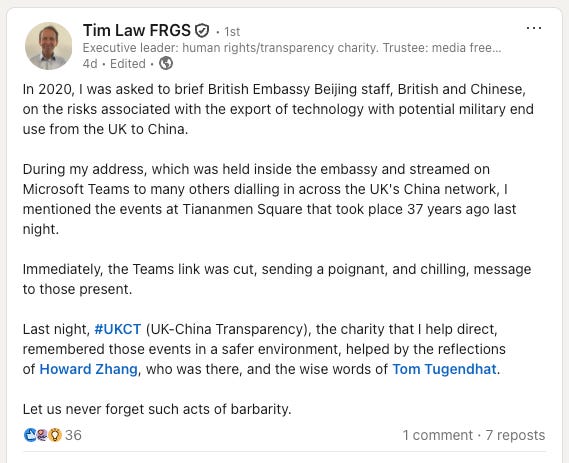
COMMENT – Let’s hope the UK has fixed this problem.
UK spying fears after secret camera found in Whitehall ceiling panel
Caroline Wheeler, The Paper, June 8, 2026
Security officials discovered the hidden device in a sensitive UK Government building.
A secret camera has been discovered in a sensitive Whitehall building, sparking fears of espionage, The i Paper has learned.
Security officials working at Marsham Street in Victoria, central London – a vast suite of offices that houses the Home Office and the Department for Housing, Communities and Local Government (MHCLG) – found a hidden camera in a ceiling panel, ministers have been informed.
The discovery sparked alarm because officials in the building had been involved in the controversial planning application for China’s proposed new mega-embassy in London.
Author of Home Office report on China reveals attempts to compromise him
Daniel Boffey, The Guardian, June 7, 2026
Dr David Wilson says former British police officer approached him as part of efforts to influence his work
The author of a Home Office-sponsored report on the Chinese state and organised crime in the UK was the target of failed honey traps and a suspected attempt to compromise him by a former British police officer, it is claimed.
Dr David Wilson, whose groundbreaking analysis was declassified in February, has told of multiple attempts to influence him or discredit his work as he sought to examine the policing challenges posed by the Chinese Communist party (CCP) and criminal gangs.
Among the apparent attempts to interfere with Wilson’s findings – based on interviews with officials from 14 law enforcement agencies in the UK – was an approach to him by a former British police officer who had been a Chinese citizen before being naturalised in the UK, he said.
China put secret tracking device on the PM’s car four years ago
Sam Merriman, Daily Mail, June 9, 2026
India’s Tata taps Chery for premium EV push, leveraging Chinese tech
Aditi Shah, Reuters, June 2, 2026
From protest to silence: China’s long game in Zambia
Shannon Van Sant, The Strategist, June 12, 2026
Zambia’s abrupt decision to postpone RightsCon, an annual summit on human rights in the digital age, shocked organisers and those who planned to attend. The summit’s organiser, New York-based advocacy group Access Now, says the Chinese government pressured Zambian officials, objecting to the inclusion of Taiwanese participants and demanding censorship of some topics planned for discussion.
Access Now cancelled the summit rather than complying. China had provided a US$30 million (A$43 million) grant supporting the expansion of the Mulungushi International Conference Centre, where RightsCon was scheduled to take place, helping to build the hall it later forced empty. Zambia has become a case study for how economic investment from China can progress to suppression of dissent, silencing a population that once protested in the streets against such influence. Public opinion in Zambia also has global import for international security. Zambia sits on the central African copperbelt, one of the world’s richest sources of copper and cobalt – minerals now central to power grids, data centres and defence. Democracies which continue to support free speech, from the United States to its allies in Europe and Asia, including Australia, should not view this as a distant African problem.
U.S. Department of Justice, June 10, 2026
FBI disables 13 Chinese suspected spying websites targeting US officials
Mark Magnier, South China Morning Post, June 11, 2026
PRC Cognitive Warfare & the Pacific Islands
Cliff Bean and Renee Will, Cognitive Warfare by China, May 21, 2026
Taiwan hits back at Beijing’s ‘cognitive warfare’ after coastguard patrols
Lawrence Chung, South China Morning Post, June 8, 2026
2 Chinese nationals sentenced to prison for filming Busan naval base
Yonhap News Agency, June 10, 2026
Australian think tank says China blocking Taiwan security cooperation abroad
Lai Jyun-tang, Taiwan News, June 5, 2026
China to the Philippines: don’t let ‘a few clowns’ sabotage ties with ‘political theatrics’
Orange Wang, South China Morning Post, June 3, 2026
China hits Philippine defense chief with entry ban over South China Sea remarks
Associated Press, June 11, 2026
With Stephen Curry Deal, Li-Ning of China Shoots for Global Sneaker Spotlight
Jonathan Wolfe, New York Times, June 2, 2026
China’s rare-earth exports to Japan drop 80%, sending companies scrambling
Nikkei Asia, June 8, 2026
HUMAN RIGHTS AND RELIGIOUS PERSECUTION
Tiananmen Mothers Robbed Even of Their Grief
Hu Zimo, Bitter Winter, June 10, 2026
Buddhist Monk Detained After Marking the Tiananmen Anniversary
Wang Yichi, Bitter Winter, June 8, 2026
Dutch Parliament Hits Beijing Where It Hurts
Abdurehim Gheni Uyghur, Bitter Winter, June 9, 2026
Sick and Pensionless: The Long Punishment of a Xinjiang Falun Gong Professor
Yang Feng, Bitter Winter, June 5, 2026
The Long Reach of Beijing Now Extends Across the Democratic World
Massimo Introvigne, Bitter Winter, June 12, 2026
INDUSTRIAL POLICIES AND ECONOMIC ESPIONAGE
Beijing escalating AI espionage to catch up with the U.S. on tech, cybersecurity firm says
Evelyn Cheng, CNBC, June 10, 2026
Chinese hackers pose biggest espionage threat to tech firms, CrowdStrike says
A.J. Vicens, Reuters, June 9, 2026
China is innovative. Its economy is a mess. Which will win out?
The Economist, June 8, 2026
Chinese investors turn to digital bets for exposure to US tech IPOs
Sun Yu and Cheng Leng, Financial Times, June 9, 2026
China is killing Europe’s chemicals industry. Brussels wants to intervene.
Carlo Martuscelli, Politico, June 7, 2026
China’s Unitree Will Dominate Global Robotics
Reyk Knuhtsen, Niko Ciminelli, and Jacob Rintamaki, SemiAnalysis, June 8, 2026
Why the West Keeps Losing Critical Mineral Assets to China
Gracelin Baskaran, CSIS, June 2, 2026
China Auto Sales Stayed Weak in May
Jiahui Huang, Wall Street Journal, June 8, 2026
Chinese entrepreneur’s e-truck startup Windrose faces unpaid wage claims
Pak Yiu, Nikkei Asia, June 9, 2026
China’s solar panel giants bleed red ink on oversupply, price war
Tamaki Fukui, Nikkei Asia, June 9, 2026
CYBER AND INFORMATION TECHNOLOGY
China Preps $295 Billion Plan to Fund Nationwide AI Buildout
Bloomberg, June 9, 2026
World’s first wind-powered underwater datacentre starts operating in China
Amy Hawkins, The Guardian, June 9, 2026
China’s Strength in Semiconductors, Rare Earths Drives Export Surge
Jonathan Cheng, Wall Street Journal, June 9, 2026
China begins large-scale delivery of gallium chips for space-ground 6G network
Zhang Tong, South China Morning Post, June 8, 2026
MILITARY AND SECURITY THREATS
China adds warheads as nuclear powers ‘walk away’ from disarmament: SIPRI
Seong Hyeon Choi, South China Morning Post, 8 Jun 2026
Swedish think-tank says Beijing now has 620 nuclear warheads and may be increasing deployment as New Start’s expiry ends arms control era.
China expanded its nuclear warhead stockpile over the past year and might have increased the number deployed with operational forces, a Swedish think tank report said, warning that major powers were “walking away” from disarmament commitments.
Increasing focus on nuclear weapons amid heightened escalation risks—new SIPRI Yearbook out now
SIPRI, June 8, 2026
SIPRI estimates that China now has around 620 nuclear warheads. China is expanding its nuclear arsenal faster than any other country and showcased several new nuclear systems during its 2025 military parade. By January 2026, China had loaded hundreds of missiles into three large missile silo fields in the north of the country, while working to complete 30 silos in three mountainous areas in the east.
Depending on how it decides to structure its forces, China could potentially have at least as many ICBMs as either Russia or the USA by the turn of the decade. Yet even if China surpasses 1000 warheads by 2030, that will still amount to only about one quarter of each of the current Russian and US nuclear stockpiles.
Chinese Grid Operators Maintain Offensive Cyber Programs
T.A. Talbert, Jamestown Foundation, June 12, 2026
Executive Summary:
State Grid Corporation of China (SGCC) and China Southern Power Grid (CSG) have established standing cyber teams that they describe as “red and blue team special forces.” They are part of an ecosystem in the People’s Republic of China (PRC) that sets Chinese national cybersecurity standards, runs their own grid attack simulation facilities, and publishes research on tool development to attack the industrial control systems that run Western power grids.
Simulated attacks used for internal cybersecurity development have included testing against Western systems, the results of which could be used to support PRC state-backed attacks.
The PRC’s doctrine of military–civil fusion and requirements around cyber vulnerability reporting ensures that the Ministry of State Security, Ministry of Industry and Information Technology, and other government organs have access to these vulnerabilities.
Japanese and South Korean navies hold first joint drills in nine years
Jesse Johnson, Japan Times, June 8, 2026
Japan’s new defense document to name China the biggest concern
Ryota Ogata, Nikkei Asia, June 10, 2026
Taiwan simulates destroying an invading Chinese force in coastal drill
Angie Teo and David Lague, Reuters, June 9, 2026
The Shangri-La Dialogue at 23: China’s Loss, Allies’ Gain
Benjamin Ho, RSIS, June 2, 2026
U.S. Expands List of Chinese Tech Companies It Says Assist Beijing’s Military
Heather Somerville, Wall Street Journal, June 9, 2026
Getting Strict on Chinese Military Companies
Savannah Billman, The Wire China, June 10, 2026
The Department of Defense has made some surprising new inclusions on its latest list of companies that support China’s armed forces.
Chinese military hovered as global executives flocked to Taiwan tech show
Ben Blanchard, Max A. Cherney and Wen-Yee Lee, Reuters, June 7, 2026
As AI heavyweights including Nvidia, Intel and SK Group last week championed Taiwan’s significance as a crucial hub for the global supply chain, a hostile exchange with China was brewing at sea.
On the final day of the high-profile Computex conference in Taipei on Friday, Taiwan’s coast guard faced off against Chinese counterparts in the contested South China Sea.
“Peace in the Taiwan Strait is vital to the stability of the global economy, and the lifeline of the technology industry,” Taiwan’s coast guard broadcast in a warning to a Chinese vessel near the Taiwan-controlled Pratas Islands.
Taiwan is home to TSMC, the world’s largest contract chipmaker and supplier to Nvidia and Apple, and Foxconn, Nvidia’s largest server maker, along with dozens more companies working across the AI hardware stack.
China views the democratically governed island as its territory, and Beijing has stepped up military pressure to assert its sovereignty claims in recent years, particularly over the past month.
During the June 2-5 Computex event, Taiwan’s defence ministry reported 79 Chinese warplanes operating near the island, a stark reminder about the risk to the global AI supply chain should Beijing ever make good on threats to take Taiwan by force.
On Wednesday, China’s military held another “joint combat readiness patrol” around Taiwan.
China’s defence ministry did not respond to a request for comment about its activities last week.
Billions of dollars are being invested in Taiwan to produce the hardware needed to power the AI revolution, but there is a potential sting in the tail, said David Feith, senior fellow at U.S. think tank the Hudson Institute and a former U.S. Deputy Assistant Secretary of State.
“There’s an enormous security threat, and it emanates from Beijing,” he told Reuters on Saturday at a forum in Taipei held by DEST, Taiwan’s National Science and Technology Council-backed think tank.
“I do think that markets globally and governments, I fear, are underestimating the risk of a crisis.”
Dasl Yoon and Austin Ramzy, Wall Street Journal, June 8, 2026
ONE BELT, ONE ROAD STRATEGY
US-China Rivalry Is Laid Bare by a Contract to Deepen an Argentine River
Jonathan Gilbert, Bloomberg, June 7, 2026
A government tender in Argentina underscored tensions between Washington and Beijing in Latin America as President Javier Milei’s administration awarded a 25-year contract to upgrade a key trade artery to a venture with a history of ties to China.
Milei officials announced late Thursday that Jan de Nul NV, a Belgian dredger, won the bidding to expand and maintain the shipping lane of the Parana River. Deepening the crucial export-import route for the Southern Cone region, which runs from the estuary at Buenos Aires inland to the world’s biggest crop-loading hub in Rosario and beyond, will require some $10 billion.
To the losing bidder, DEME Group NV — another Belgian dredger, favored by an array of US interests — the problem is that Jan de Nul’s partner for the job is Servimagnus SA, a local company that’s worked for years with China’s state-run CCCC Shanghai Dredging Co.
OPINION PIECES
After the Invasion: China Considers the Problem of Ruling Taiwan
Jude Blanchette and Richard McGregor, War on the Rocks, June 5, 2026
Hong Kong’s Private Wealth Bankers Should Be Anxious
Shuli Ren, Bloomberg, June 7, 2026
Shortly after Hong Kong narrowly overtook Switzerland as the world’s largest offshore wealth management hub, the sustainability of this business is already being called into question.
The seismic event is China’s recent crackdown on cross-border stock trading. Steep penalties aside, Beijing has asked three online brokers, the biggest of which is based in Hong Kong, to liquidate all existing accounts held by mainland Chinese within two years. In a concurrent move, the city’s securities watchdog put out a statement warning against poor due diligence with client onboarding and demanding close monitoring of dormant accounts.
For now, Beijing’s ire is aimed at the three retail-facing online securities firms, Futu Holdings Ltd., Up Fintech Holding Ltd.’s Tiger Brokers and Longbridge Securities Ltd. But the bigger question is whether Hong Kong’s prized private banking business will be affected, too. The move is widely interpreted as China tightening controls on capital flight from the mainland, fearing that unchecked outflows would weaken the yuan and destabilize its financial system.
Some institutions are already treading with caution. The Shanghai branch of Hong Kong-based Bank of East Asia Ltd. has suspended offshore account openings for its high-net-worth clients, reported the South China Morning Post. UBS Group AG has postponed a midyear wealth outlook event in China, while HSBC Holdings Plc is discouraging non-essential mainland travel for Hong Kong-based private bankers.
Managing money for affluent individuals is highly lucrative. At HSBC, this business can notch up a 35% return on equity, well above the company average of 17%, according to Goldman Sachs Group Inc.’s estimates. Last year, Hong Kong’s cross-border wealth rose 10.7% to $2.9 trillion, with mainland flows representing 59% of assets under management, per the Boston Consulting Group Inc.
Seth G. Jones, Wall Street Journal, June 8, 2026
In Selling Arms, China Is Still No Superpower
Juliana Liu, Bloomberg, June 8, 2026
Two military conflicts less than a year apart have renewed attention on China’s prospects as an arms exporter. But even with a compelling commercial pitch built on advanced technology, low prices and no questions asked, the country will struggle to find a mainstream market beyond a highly concentrated group of existing clients.
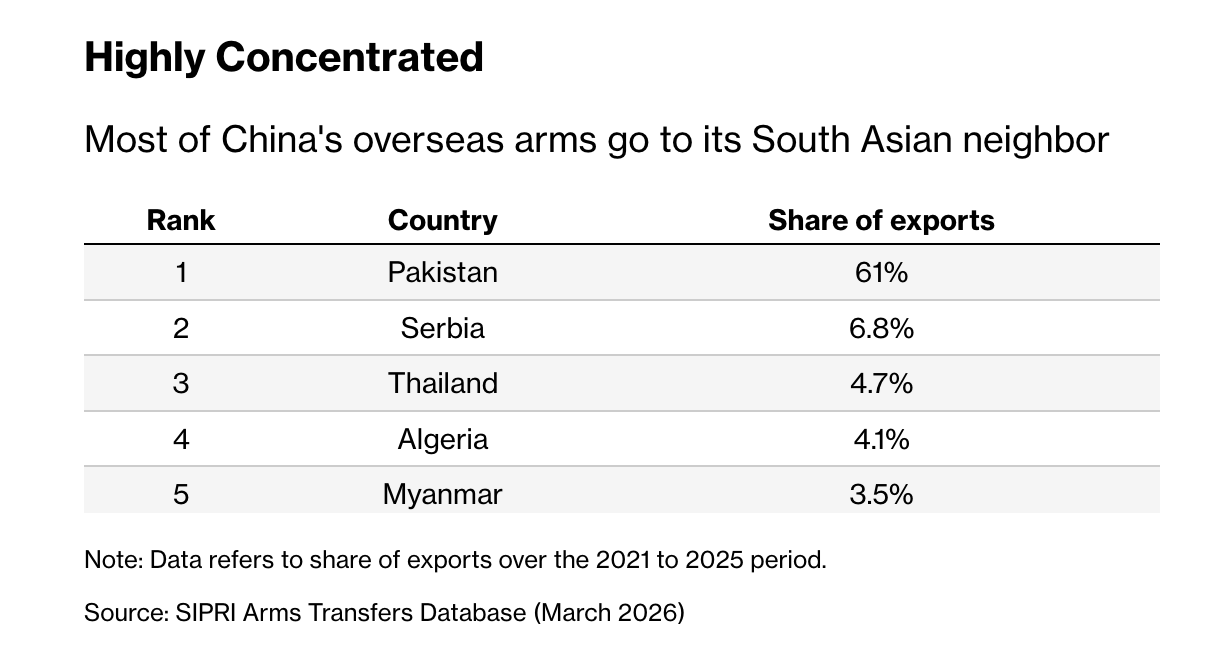
COMMENT - Surprising not to see Cambodia or Laos in the top five.