Better Off Alone?
Examining America's Dilemma
Friends,
For anyone who spent time living in Europe in the late 1990s or early 2000s, Alice Deejay’s Eurotrance hit, “Better off Alone,” will bring back some distinct memories, at least it does for me.
I lived in Germany just after Eurotrance emerged as a genre, which merged techno from Detroit (yes, really) with EBM (Electronic body music) from Frankfurt, to create a sound associated with Western European dance clubs. The Dutch group tapped into this with their 1998 song.

This was the time when you would still pay for Red Bulls and Vodka with Deutsche Marks, your cloths would stink of cigarette smoke, and your ears would ring for much of the next day from music played at what was, frankly, an unsafe level.
When I hear that song, I’m transported back to those heady, pre-9/11 days of the U.S. Army in Europe. We still had Bundeswehr partnerships units (before they were all deactivated), we would do six-month deployments to Kosovo (how quaint that six months felt like a long time back then), and the clubs all had that same 140 beats per minute throbbing that you could feel from the street outside. The one thing I don’t miss is the cigarette smoke… thank goodness the Europeans outlawed that.
The song’s theme is simple enough, a woman who clearly feels abandoned by her boyfriend asks rhetorically whether he thinks he will be “better off alone.”
When I heard the song recently it got me thinking of a similar vibe from the transatlantic strategic community as folks ask whether the Trump Administration really thinks that it will be “better off alone.”
The overwhelming sentiment is that it will turn out for America, much as it does for the boyfriend in the music video: dead and covered in sand on a dune in the middle of an unforgiving desert.

America buried under the sands of the Middle East?
There is a thesis among foreign policy and national security experts in Washington (and across the transatlantic community) that the United States cannot achieve its objectives or be a world power without the consent and support of its Western European and Canadian allies. This thesis rests on the assertion that America’s most important advantage is its alliances because when Washington acts in concert with those allies, its power is multiplied and it gains legitimacy.
Conversely, when Washington acts alone, its power on the world stage evaporates and it fails to achieve its objectives.
Iraq is the most obvious example of this when the Bush Administration ignored Paris, Berlin, and Ottawa’s objections.
Under this framework, military power and economic influence pale in importance to the alliance relationships and the legitimacy it confers.
The accepted wisdom is that the United States is better off getting the consent of its allies (in particular its Western European and Canadian allies) before undertaking a major foreign policy or national security initiative.
I think President Trump and many in his administration question this bedrock idea of post-WWII U.S. foreign and security policy. It is also clear that the Trump Administration isn’t the first U.S. Administration to be frustrated by this received wisdom.
So, is the United States better off alone?
I understand that the question itself will be treated, in some quarters, as heresy and that for those folks the answer is obviously a negative. I also understand that in other quarters, some folks will be refreshed by the question, as they have concluded for themselves that the answer is an affirmative.
So, knowing that folks will have strong opinions one way or the other, I think it is worth examining the underlying assertions and assumptions of this thesis because it serves as the foundation of so much of our foreign and national security policy. In doing so we may either reinforce this commonly held thesis, we might reject the thesis, or we might make some adjustments and some caveats to the thesis. So, in the spirit of Thomas Kuhn (author of The Structure of Scientific Revolutions) let’s examine the paradigm many of us have grown up to accept as axiomatic and try to understand what is changing.
To start, a country certainly does benefit if other countries agree with and support its initiatives on the world stage. But it is rarely that straightforward because that support depends on how those countries perceive the costs.
It is relatively easy to get support for maintaining the status quo. Most of America’s allies look to the United States to maintain stability and uphold the existing international order. They see it as Washington’s job to underwrite the system that they depend on.
One example of this line of thinking came through clearly in remarks given by the Singaporean Foreign Minister, Dr. Vivian Balakrishnan during an interview with Reuters this week:
The US is now a revisionist power. For 80 years, the US was the underwriter for a system of globalisation based on UN Charter principles, multilateralism, territorial integrity, sovereign equality. It actually heralded an unprecedented and unique period of global prosperity and peace. Of course there were exceptions. And of course, the Cold War was still in effect for at least half of the last 80 years. But generally, for those of us who were non-communists, who ran open economies, who provided first world infrastructure, together with a hardworking disciplined people, we had unprecedented opportunities.
The story of Singapore, with a per capita GDP of 500 US dollars in 1965. Now, [it is] somewhere between 80,000 to 90,000 US dollars. It would not have happened if it had not been for this unprecedented period, basically Pax Americana and then turbocharged by the reform and opening of China for decades. It has been unprecedented. It has been great for many of us. In fact, I will say, for all of us, if you look back 80 years.
But now, whether you like it or not, objectively, this period has ended. There is no point trying to assign blame or pejorative adjectives. That is not helpful. Basically, the underwriter of this world order has now become a revisionist power, and some people would even say a disruptor. But the larger point is that the erosion of norms, processes, and institutions that underpinned a remarkable period of peace and prosperity; that foundation has gone. What you are seeing now, whether you watch the war in Ukraine, in the Middle East or elsewhere, including in Asia, to me these are symptoms of the underlying tectonic rupture.
What Singapore wants is for the system not to change… it wants the United States to continue to underwrite the system that has made Singapore prosperous.
The same can be said for many of America’s other allies.
They want the United States to continue to underwrite the system that has made them prosperous. If the United States comes to them with a proposal to make significant changes to that system, even if those changes are a response to the actions of other revisionist powers, they will resist and push back. That had been my experience in negotiations with European and Canadian counterparts over our approaches to the PRC.
The way those other powers see it is that the United States receives their support only if the United States maintains the system they are comfortable with.
This predisposition for the status quo is completely understandable. Humans have a “status quo bias” based on loss aversion, regret avoidance, and the cognitive effort to evaluate new arrangements. Humans have a “default bias” in which they prefer the arrangements they are in, rather than evaluate changes that appear risky. Humans also tend to postpone difficult decisions, hoping problems will resolve themselves. If someone is satisfied with the status quo, i.e. a beneficiary of Pax Americana, they want stability. If they see that the stability is eroding, they will blame the folks who are responsible for underwriting the status quo, not the folks who are undermining it.
If the United States is rallying countries to maintain the status quo, it is relatively easy to persuade prosperous countries to consent (even if they provide very little actual support to achieve it).
However, if the United States is trying to change the status quo, it is difficult to get consent and support.
One example is the years Washington spent trying to persuade Berlin to reduce its energy dependence on Moscow. Multiple Administrations tried to get German leaders to change course and when they would employ sanctions or other actions, Berlin would howl that the United States wasn’t being a good ally. Looking back, it is clear that the European security situation would have been much better had German leaders consented to what Washington wanted.
While persuading others to do something that they don’t want to think about is difficult, the other problem is whether their support actually helps. Can those partners provide the material support, beyond rhetoric and diplomatic backing, to achieve an objective?
In decades past, some of these partners actively maintained the system themselves, but since the end of the First Cold War and the emergence of the so-called “unipolar moment,” these partners have largely dismantled their own capabilities and look to Washington (and its taxpayers) to underwrite the system entirely.
I’m sure there are folks working in No10 or in Whitehall who are a bit peeved the United States didn’t coordinate its strikes on Iran with London… but as we saw last week in the recounting of the decades-long suicide of the Royal Navy, why would Washington coordinate with a nation that has nothing to contribute? It would be another thing entirely if the Royal Navy had 250 commissioned warships, instead of just six operational ones.
If the UK had that sort of power, the United States would feel obliged to consult with No10, provide the Prime Minister with an opportunity to make decisions on the plan, and perhaps even veto it. Washington would be forced to make concessions in order to secure the hard power capabilities that would increase the likelihood of success of a combined operation. But since the UK has unilaterally disarmed itself, it has largely made itself irrelevant to these debates.
What if the status quo is no longer tenable?
If U.S. allies can only be persuaded to support initiatives that maintain the status quo and the status quo is longer tenable, then should the United States act alone?
This is the fundamental dilemma we should be wrestling with.
I think the Singaporean Foreign Minister is right, “whether you like it or not, objectively, this period has ended,” but I think he is still stuck wishing for that period to return so that Singapore doesn’t have to make some difficult decisions about how it positions itself in this new era.
We have entered a Second Cold War which is characterized by multiple hot conflicts and the weaponization of interdependence. Just like the First Cold War, the existence of nuclear weapons will incentivize the great powers to avoid direct military conflict with each other and it will push their rivalry into proxy wars and competition in other domains. The conflicts in Europe, in the Persian Gulf, the actions in Venezuela, the breakdown of a global trading system, these are all symptoms of this new cold war.
Eventually, there will be a new status quo with new arrangements for who is responsible for maintaining that status quo, but in the meantime, the changes will carry considerable costs.
***
What Changes Should the U.S. Make to its Cross-Strait Policies
In the spirit of questioning long-standing policies as the status quo changes, I recommend reading the “Cross-Strait Crossroads” project that is in the Must Read section. It is a collection of papers that came out of a series of workshops organized by the Brookings Institution and RAND over the past six months. The workshops explored how U.S. policy towards the PRC and Taiwan might shift given the changing geopolitical circumstances. I authored one of the papers, “The case for greater clarity and less ambiguity in the Taiwan Strait.”
The title gives away my position.
The argument that I make is that deterring a PRC attack on Taiwan is a vital national interest for the United States and the likelihood that the Chinese Communist Party will try to use force to annex Taiwan is rising. Given those circumstances, Washington should make it clear to Beijing that the United States will intervene militarily, if the PRC attacks Taiwan. While being ambiguous about U.S. intentions may have encouraged both sides to negotiate in the past, creating space for Beijing and Taipei to resolve their differences, the conditions facing all parties are very different today and that requires a policy change by the United States. Ambiguity by the United States helps Beijing isolate Taiwan. Unsurprisingly, ambiguity creates uncertainty and that uncertainty may encourage Beijing to pursue a military option when it feels it cannot achieve its desired objective through negotiation.
A shift to strategic clarity should not simply be rhetorical. By providing strategic clarity, the United States should conduct combined military planning with Taiwan and Japan, as well as any other allies that want to deter a PRC attack on the island nation or any of the PRC neighbors. Those partners should conduct rehearsals and exercises together, make changes to force posture, and develop concepts that prevents Beijing from isolating Taipei.
The Chinese Communist Party (and its friends) will howl that this policy change is warmongering. These are the accusations that Beijing leveled at Japanese Prime Minister Takaichi when she observed that a PRC attack on Taiwan would threaten Japanese security and prompt a response by Tokyo. But we need to separate Beijing’s rhetoric (which seeks to deter third countries from providing this kind of support to Taiwan) from what actually makes conflict more or less likely.
If Beijing believes that Taiwan is isolated and won’t receive military support, the PRC is far more likely to use force to “solve” its Taiwan problem.
If Beijing believes that it faces a group of countries that would fight to prevent the PRC from achieving its military objectives (making a military campaign far more costly), the PRC is more likely to pursue other methods to achieve their ends.
Shifting to strategic clarity doesn’t solve every problem, it just helps deter the worst-case scenario.
***
If you find this newsletter helpful, then please consider becoming a paid subscriber, just click the button below.
Thanks for reading!
Matt
MUST READ
Leaders of AI Firm Bought by Meta Are Restricted from Leaving China
Peter Landers, Wall Street Journal, March 25, 2026
Beijing weighs penalties for key figures at Manus, a Singapore startup with Chinese origins.
China has told two co-founders of artificial-intelligence startup Manus not to leave the country while authorities review the company’s $2.5 billion sale to Meta Platforms, people familiar with the matter said.
Earlier this month, Manus’s Xiao Hong and Ji Yichao were called in for a meeting with officials from the National Development and Reform Commission in Beijing to discuss the acquisition, the people said. Officials later told the two Singapore-based executives not to leave China until receiving further instructions because the review is ongoing, the people said, describing the message as guidance rather than a formal exit ban.
Manus develops an AI agent that can carry out sophisticated tasks such as writing in-depth research reports and preparing presentation slides. Early versions of Manus were created by engineers at Beijing Butterfly Effect Technology, which Xiao founded in 2022, and many of the company’s top people including Xiao are Chinese citizens.
Subsequently, a Singapore-based entity, also called Butterfly Effect, took over operation of the AI agent product in markets outside China. Last year, Manus relocated most of its China-based employees to Singapore.
The series of events that culminated in a U.S. company’s purchase of China-originated technology has angered Beijing regulators. They are concerned Manus’s moves would encourage other Chinese companies to follow suit and move out of China without Beijing’s vetting.
Chinese regulators are considering potential penalties against Beijing Butterfly Effect Technology and key Manus executives, the people familiar with the matter said. Since January, Beijing has been reviewing the deal, saying that cross-border acquisitions and the export of technology must comply with the law.
COMMENT – This will have a profound effect across the PRC tech ecosystem. Every founder has to ask themselves: if I build something in China, can I ever really be certain that the CCP won’t step in and take it away?
Audit slams California school officials’ ties to Chinese boarding school
Nicole Einbinder, Politico, March 23, 2026
The Val Verde school district issued diplomas to students at the Pegasus boarding school in China.
California education officials have released an audit into a local school district and its ties to a private boarding school in China, finding “sufficient evidence” of “fraud, misappropriation of funds, or other illegal fiscal practices.”
Riverside County Superintendent of Schools Edwin Gomez said the 1,000-plus-page report “identified serious concerns that merit further review by the appropriate authorities” and that the district attorney, among other authorities, had been notified.
The audit, spurred by a June 2021 investigation by Business Insider, looked at the relationship between the Val Verde Unified School District and Pegasus California School, more than 6,000 miles away in Qingdao, China, and the involvement of former government officials.
Pegasus was seen as a way for Chinese students to access California’s public education system; the report noted that it guaranteed students acceptance to a top-100 American university or their money back.
Val Verde adopted Pegasus as a “sister school” in 2016 and formally approved a pilot program a year later in which the district issued diplomas to Pegasus graduates. Pegasus was also added to the district’s list of schools on its website.
The audit found that Val Verde improperly issued those diplomas and concluded there was no evidence that Pegasus students had satisfied course requirements and proficiency standards.
Val Verde teachers were encouraged to teach at the Chinese school, living in furnished apartments with benefits and the promise they could return to their U.S. jobs, the report said. It also cited evidence of Val Verde teachers’ salaries being “improperly increased upon their return from the unpaid leaves of absence.”
Auditors also focused attention on former education officials who established the district’s relationship with Pegasus and promoted it with leading California universities. They included Tom Torlakson, who at the time was the state superintendent of public instruction; David Long, the former California secretary of education and a former Riverside County superintendent of schools, who was also a paid consultant to Val Verde; and Michael McCormick, Val Verde’s then-superintendent.
The auditors said they requested interviews with the trio, who they said either failed to respond or were unavailable.
COMMENT – I suspect similar corruption has been rampant across higher education in the United States as well.
Time for the IMF to Stop Blaming the Victim
Brad W. Setser, Council on Foreign Relations, March 23, 2026
The IMF standard analysis of imbalances puts too much blame on Europe and way too little on China.
The IMF’s standard analysis of global imbalances puts equal emphasis on the United States (too little saving), Europe (too little investment), and East Asia (too much saving).
That analysis is now dated.
East Asia’s surplus (correctly measured) has soared—and while it will dip with the new oil shock, that dip will be temporary if the oil shock isn’t sustained.
Europe’s surplus (correctly measured) has almost disappeared, even before the oil shock.
Europe may well need reforms to reduce internal barriers to commerce and increase investment, but the China shock (together with the Russian energy shock) has already wiped out the underlying goods surplus (setting aside US firms avoiding US corporate income tax through their Irish operations).
The IMF’s overly balanced analysis ignores an uncomfortable fact that is clear in the numbers: China’s recent export success has come at Europe’s expense.
China’s Trade Dominance and the Role of Industrial Policies
François de Soyres, Ece Fisgin, Mike Liu, and Eva Van Leemput, Federal Reserve, March 23, 2026
China’s trade surplus surged to a record $1.2 trillion in 2025, exceeding 6% of its GDP, marking a new milestone in its integration into, and dominance of, the global trading system. This development has attracted heightened attention from policymakers and analysts, not only because of the sheer size of the surplus, but also because of growing concerns about the distribution of global manufacturing, the persistence of global external imbalances, and the role of industrial policy interventions in shaping trade outcomes.
This note contributes to that discussion in two important ways. First, we document how China achieved this unprecedented trade surplus by establishing three salient aspects of China’s trade dominance: the breadth of its export expansion across sectors, the corresponding loss of export market share by advanced economies, and the limited growth of China’s imports outside of commodities. Second, we examine the relationship between China’s industrial policies and sectoral trade outcomes, highlighting systematic links between policy interventions, export growth, and trade balance dynamics. Taken together, the evidence suggests that industrial policy is a contributing factor to China’s trade surplus and should be considered alongside more traditional macroeconomic drivers.
Three aspects of China’s trade dominance
A defining feature of China’s recent trade performance is the broad-based nature of its export expansion. As shown in the left panel of Figure 1, China has gained global export market share in nearly all manufacturing sectors over the past decade. These gains span low-value-added consumer goods, such as apparel and textiles, as well as advanced products including automobiles. The expansion in advanced sectors is consistent with broader evidence of rising research and development intensity and innovation capacity in China, as documented in Ates and Jeon (2025). Therefore, contrary to the common view that China would move up the value chain as it gradually exhausted its pool of low-cost labor, it has expanded into higher-value sectors without ceding market share in lower-value industries.
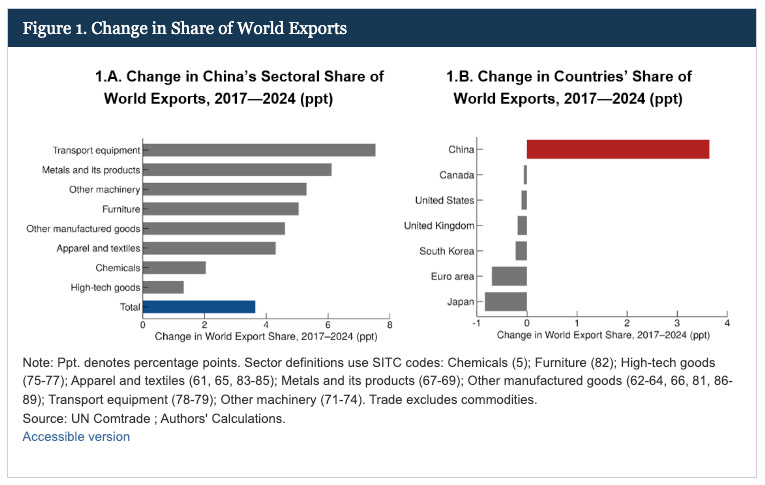
This pattern has important implications for China’s trading partners, which leads us to the second aspect. As China’s export share has increased, exporters in advanced economies have experienced widespread losses in global market share. The right panel of Figure 1 illustrates changes in export shares for selected advanced economies alongside China. Losses are evident across most sectors and are particularly pronounced in economies with strong manufacturing bases, such as Japan and euro area members. Within the euro area, Germany is especially affected due of its exposure to sectors where China’s export growth has been strongest. These shifts underscore how China’s rise is reshaping the global manufacturing landscape and altering industrial competitiveness and trade dynamics across advanced economies.
A third aspect of China’s trade dominance is the asymmetry between exports and imports. As seen in the left panel of Figure 2, exports have expanded rapidly whereas import growth has lagged. The middle panel shows that imports have become even more concentrated in commodities and commodity-intensive inputs, now accounting for 44 percent of all Chinese imports. As shown in the right panel of Figure 2, this shift has supported economic activity in several commodity-exporting economies. In contrast, imports of manufactured goods from advanced economies have grown much more slowly, and exports to China as a share of gross domestic product have declined for many advanced economies. This divergence points to a change in the geography of China’s growth spillovers, away from manufacturing exporters and toward commodity producers. This divergence has contributed directly to the rise in China’s trade surplus and to a growing imbalance between global demand for Chinese goods and Chinese demand for foreign production.
Taken together, these three features, broad-based export gains, declining market shares for advanced economies, and limited import growth, define the current phase of China’s trade dominance—one that is fueling concerns over global imbalances.
Industrial policy and sectoral trade outcomes
A central question in current policy debates is whether China’s trade surplus reflects only macroeconomic fundamentals or also the effect of industrial policies and other non-market interventions. Standard analyses of external balances typically focus on factors such as saving-investment dynamics, productivity, currency valuation, and demographics, mostly abstracting from industrial policies. Recent work has begun to examine this link more explicitly, including Cesa-Bianchi et al. (2026) and Setser and Tordoir (2025).
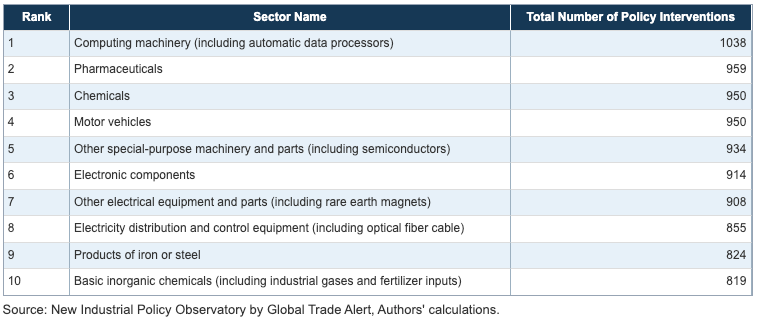
To examine the role of China’s industrial policies in shaping its trade outcomes, we use data from the New Industrial Policy Observatory (NIPO) database, part of Global Trade Alert (Evenett et al., 2024), which tracks trade-related policy interventions across countries and sectors. We construct a measure of industrial policy intensity by counting the number of interventions affecting each sector in China between 2017 and 2024, capturing relative differences in policy activity. A drawback of this measure is that it assigns equal weight to each policy intervention and does not account for differences in their magnitude. That said, we believe that the NIPO data offer two important advantages. First, it captures a broad range of industrial policy measures. As Table A.1 in the appendix shows, these policies span import restrictions and subsidies to credit policies and local procurement requirements. This breadth is particularly important in the case of China, where authorities rely on multiple policy levers to support targeted industries (DiPippo et al. 2022). Second, the NIPO data capture interventions that are difficult to quantify in monetary terms, including policies such as implicit loan guarantees and local labor requirements, which play an important role in China’s industrial strategy. Taken together, these features make the NIPO data well suited to capturing the diverse set of industrial policy instruments employed by Chinese authorities.
Table 1 shows the sectors with the highest concentration of interventions. These include computing machinery, electronic components, motor vehicles, and pharmaceuticals, which were explicitly targeted under the Made in China 2025 initiative, as they are deemed central to strategic competition and industrial upgrading. Given this alignment, we believe the NIPO measure captures meaningful variation that corresponds closely to the actual priorities of China’s industrial policy.
Table 1: Sectoral exposure to Industrial Policies in China, 2017-2024
COMMENT – This is exactly what the reports from the U.S. and EU Chambers of Commerce predicted would happen back in 2017 when the implications of “Made in China 2025” were first observed.
Laid Off in Midlife, China’s Reform Generation Braces for Downward Mobility
New York Times, March 21, 2026
The future once seemed boundless for those who grew up during China’s reform era. Now in middle age, they are pinned between economic stagnation and institutional age discrimination.
Harry Guo built a life that defined success in China. Born in 1971, he came of age in the 1990s, when China deepened its economic reforms. He taught himself computing and found his way into jobs in multinational firms and then Chinese internet giants. By his mid-40s, he was comfortably middle class. He and his wife paid off two mortgages early and sent their daughter to high school and college in Canada.
Then Mr. Guo was laid off. Now 55, he has not had a job in more than two years. It’s not for lack of trying. The supermarket near his Beijing apartment won’t hire cashiers over 50. The warehouse where he inquired about work turned him away. An acquaintance who runs a small business told him, with some embarrassment, that his age made him unemployable.
For decades, people like Mr. Guo — I call them the reform generation — felt they had struck a straightforward bargain with the system: Work hard, don’t criticize the government, and life will steadily improve.
During the boom years, when China’s economy was growing in double digits, career opportunities were abundant as Chinese and multinational companies competed for talent. A job hop could mean a 30 percent raise. They were the first in their families to go to college, own apartments and rise through corporate ranks. They sent their children to tutors and schools abroad.
The Chinese dream, much like the American one, was the expectation that those who worked hard could have a better life than their parents’ and that their children’s would be better than their own.
Now that dream is unraveling. There is little room for upward mobility and a strong downward pull. The housing market has contracted sharply. Private investment has slowed. Multinational companies shuttered or scaled back their operations. Layoffs have spread through technology, media, education and property-related industries since the pandemic, even though China’s official urban unemployment rate has hovered around 5 percent for years.
Across China’s cities, midcareer professionals who rode the reform-era boom are discovering that the labor market has little use for them. They are too old for an economy that prizes youth, too expensive for firms under pressure and too financially committed — mortgages, tuition, aging parents — to stop working.
Mr. Guo invoked a popular social media meme: “At 40 you’re dead professionally. You’re simply waiting to be buried.” At 55, he feels he has already been interred.
When Mr. Guo lost his job in October 2023, he registered his unemployment status with an official administrative office in his neighborhood and was added to a WeChat group labeled “40/50,” a bureaucratic designation for unemployed women over 40 and men over 50. In his residential compound of roughly 1,000 households, the group has grown from four members to 86 in just over a year.
Age discrimination is so normalized that it has its own name: the Curse of 35, a widely held belief that white-collar workers become liabilities rather than assets once they cross that age threshold. Although Chinese law contains general prohibitions against employment discrimination, it does not clearly define or strongly enforce protections against age bias. A recent WeChat post from a recruitment company in Chongqing was typical: a customer service role capped at 30, a bank call center at 35, a semiconductor plant at 30, a warehouse sorting job at 45.
Chinese tech firms skew notably young. According to 2021 data from the job platform Maimai, the average employee age at ByteDance, the parent company of TikTok, was 27; at Alibaba and Huawei it was 31. In large U.S. tech firms, the average employee age, according to one analysis, is 37.
For many, however, the indignity of ageism is only part of the problem. What is more disorienting is that the ladder of mobility they climbed has been pulled from under their feet.
One man, who asked to be identified only by his last name, Ma, spent more than two decades as a reporter and editor at a state broadcast station. He had moved to Shanghai from Inner Mongolia in 2003, part of a wave of provincial talent drawn to opportunities in bigger cities. During their peak earning years, he and his wife, who still works there, brought home roughly $70,000 a year combined. They had two daughters, bought cars and traded up to a bigger apartment.
Then, around 2018, advertising revenue began to dry up. Mr. Ma’s work increased even as pay declined. In 2022, he was diagnosed with a blood disorder requiring a bone-marrow transplant and time off. He returned to work early, against his doctor’s advice, because he had heard that the broadcaster was restructuring and he feared losing his job.
He lost it anyway. On Dec. 31, 2024, he recorded his final broadcast. He now receives about $280 a month in unemployment benefits. He buys discounted vegetables and meat. He has applied for audio editing and journalism roles. No one has called back. He is 47.
“The moment you’re past a certain age, you become invisible,” he said. “It doesn’t matter what you’ve done or what you know.”
When I asked him about his future, he said he’d rather not think about it.
In a second-tier city in northern China, a 39-year-old network infrastructure salesman had a career that followed the same arc. He asked to be identified only by his nickname, Benchi, which is the Chinese name for Mercedes. He left his village for college, joined a major internet company, got married and bought an apartment in 2019, when real estate prices were at their peak.
Benchi was laid off in 2023. After an eight-month search, he found a position paying roughly half his previous salary.
The apartment he purchased has lost at least a quarter of its value and is difficult to sell. His wife, a full-time homemaker, wants to have a second child. He doesn’t see how they can afford another child, and thinks they should cut back on expenses, even cancel their daughter’s dance class.
“I used to think next year will be better,” Benchi said. “Now I think about how to make sure what I have doesn’t collapse.”
Harry Guo has made peace with his situation. “This has nothing to do with me,” he said. “It’s like the Cultural Revolution or the ’90s mass layoff of the state-owned enterprises. It’s a historical cycle. It just happens to be our turn.”
He now believes in making the greatest effort while preparing for the worst. “When the Titanic is sinking,” he said, “all you can do is try to go down with some dignity.”
COMMENT – Sure some may accept their fates and try to show some dignity as the Titanic sinks, but plenty of Chinese citizens won’t accept it and they will blame their leaders for their dashed expectations… that is a big problem for the Chinese Communist Party.
How China Forgot Karl Marx: The Chinese Economy Runs on Labor Exploitation
Yasheng Huang, Foreign Affairs, March 23, 2026
In the early 1980s, rural Chinese workers saw their incomes surge amid the country’s economic liberalization. It was the beginning of one of the most remarkable feats in history as hundreds of millions of Chinese citizens rose out of poverty. But while many watched in awe, one high-ranking official in the Chinese Communist Party was worried by what he saw happening.
Deng Liqun (no relation to Deng Xiaoping, China’s leader at the time, who had initiated the economic reforms) noticed that many rural businesses had started to hire a large number of workers. Deng, citing Das Kapital by Karl Marx, began to sound the alarm about the greedy capitalists extracting surpluses from the Chinese proletariat. To him, large private businesses were inherently exploitative.
Deng’s warnings were ignored, but they turned out to be prescient: China’s workforce was about to get squeezed. According to official Chinese statistics, in the real economy—that is, agriculture, industry, and utilities—the share of labor compensation relative to the value of all economic inputs, such as raw materials, production components, and capital, fell from 21 percent in 1987 to 15 percent in 2023, the last year for which data are available. (The share of wages for service jobs, including in real estate, finance, and the government sector, is roughly on par with what it was in the 1980s.) In other words, the relative position of Chinese factory and farm workers today is worse than it was before China joined the World Trade Organization in 2001.
To be sure, this is about relative distribution of income, not about absolute income changes for the Chinese workforce. Incomes and living standards have risen dramatically since the 1980s, and the country achieved an impressive record of poverty reduction, all of which should be recognized and applauded. But the fact remains that Chinese workers have lagged far behind the owners of capital and the government when it comes to income gains. It may not be the abject labor extraction envisioned by Deng, but it is labor extraction nonetheless.
COMMENT – The Chinese Communist Party is the exploitive bourgeoisie that Marx warned about in the 19th Century. It will try to portray itself as the champions of the proletariat, but the more that senior party leadership is hereditary and is exercised through the wealth of party members, the more that Chinese citizens will be sympathetic to a new revolution, particularly as the economy slows down and the benefits of technological innovation accrue to the wealthy and the powerful.
Cross-Strait crossroads: Pathways for America’s Taiwan policy
Ryan Hass, Jude Blanchette, Kharis Templeman, Jennifer Kavanagh, Bonnie Glaser, David Sacks, Matt Turpin, Brookings Institution, March 20, 2026
For three-quarters of a century, Washington, Taipei, and Beijing have shown that adaptive statecraft can prevent crises from becoming conflicts. As the security environment in the Taiwan Strait grows increasingly contested, the Center for Asia Policy Studies at the Brookings Institution and RAND’s China Research Center organized a series of workshops with leading experts to consider a range of future U.S. policy approaches toward Taiwan.
These workshops produced policy briefs that explored U.S. priorities regarding Taiwan, options for limiting U.S. commitments while expanding Taiwan’s self-defense capabilities, options for calibrating diplomacy to stabilize cross-Strait dynamics, the merits and risks of a more active denial strategy, and the feasibility and consequences of a policy shift toward strategic clarity. While these policy briefs represent differing perspectives and policy options, they clearly illustrate where the expert community agrees and disagrees and where further examination is needed.
COMMENT – For the last several months, I participated in a series of workshops organized by the Brookings Institution and RAND to examine potential shifts in U.S. policy towards the PRC and Taiwan. I wrote one of the papers that the workshop produced, “The case for greater clarity and less ambiguity in the Taiwan Strait,” but I encourage you to read all the submissions.
On March 23, the authors of four of the papers, including myself, participated in a panel discussion and the video is here:
VIDEO – Cross-strait crossroads: Pathways for America’s Taiwan policy
Brookings Institution, March 23, 2026
As the security environment in the Taiwan Strait grows increasingly contested, policymakers face mounting questions about whether U.S. policy toward Taiwan and cross-strait relations remains fit for purpose. To examine this question, the Brookings Institution and RAND’s China Research Center co-hosted workshops with leading experts to consider a range of future policy pathways. Through a series of workshops and policy briefs, experts explored: U.S. priorities on Taiwan; options for limiting U.S. commitments while expanding Taiwan’s self-defense capabilities; options for calibrating diplomacy to stabilize cross-strait dynamics; the merits and risks of a more active denial strategy; and the feasibility and consequences of a policy shift toward strategic clarity.
On March 23, the Center for Asia Policy Studies at the Brookings Institution and RAND’s China Research Center will co-host a fireside conversation with a panel of experts encompassing four of the five paper authors for the launch of this new series, Cross-strait crossroads: Pathways for America’s Taiwan policy. They will discuss various policy pathways presented in the papers and the varied perspectives on U.S. Taiwan policy. Panelists will examine how these options could shape U.S. deterrence posture, Taiwan’s political environment, Beijing’s strategic calculus, and the broader Indo-Pacific security landscape.
Authoritarianism
Mass Ban of Feminist Accounts on Eve of March 8 International Women’s Day
China Digital Times, March 11, 2026
In what is becoming an annual event, a spate of bans on the eve of March 8 International Women’s Day has struck numerous WeChat public accounts focused on feminism, women’s rights, LGBTQ+ rights, combatting human trafficking, and promoting mental health, a sign of the continuing stigmatization and silencing of debate about these issues. Many bloggers and commentators have criticized the bans, which formed a glaring contrast to official- and state-media coverage of March 8 International Women’s Day, whose theme this year is “Rights. Justice. Action. For ALL Women and Girls.”
Some noted that amid the Cyberspace Administration of China’s (CAC) ongoing campaign to “clean up” content purportedly “promoting extreme feminism and inciting gender antagonism,” the red lines seem to be shifting, with even the most cautious and moderate voices now in the firing line.
CDT editors have also archived a farewell letter from Ai Daxun, discussing the closure of her WeChat account and thanking her readers for their support. Ai mentions that she is likely the most moderate of the social-affairs commentators many readers follow, and that despite her best efforts, even she was unable to avoid the red lines of censorship.
Hong Kong introduces new requirement for national security suspects to hand over passwords
Hans Tse, Hong Kong Free Press, March 23, 2026
Under the new rules, police can require people under national security investigation to provide passwords or help decrypt their electronic devices.
The government on Monday gazetted amendments to the “implementation rules” of the Beijing-imposed national security law, introducing the password requirement alongside granting several new powers to authorities. Officials are set to brief lawmakers on the amendment on Tuesday.
Under the new rules, police can require people under national security investigation to provide passwords or help decrypt their electronic devices. Failure to do so can be punished by up to one year behind bars and a HK$100,000 fine.
Providing a false or misleading statement can be punished by up to three years’ imprisonment and a fine of HK$500,000.
Police can also compel anyone believed to know of the password or the decryption method of a device under investigation to disclose such information. Similarly, those who own, possess, control, or have authorised access to a device, as well as current or former users, can be subject to such an order.
U.S. Consulate General Hong Kong, March 26, 2026
On March 23, 2026, the Hong Kong government changed the implementing rules relating to the National Security Law. It is now a criminal offense to refuse to give the Hong Kong police the passwords or decryption assistance to access all personal electronic devices including cellphones and laptops. This legal change applies to everyone, including U.S. citizens, in Hong Kong, arriving or just transiting Hong Kong International Airport. In addition, the Hong Kong government also has more authority to take and keep any personal devices, as evidence, that they claim are linked to national security offenses.
China Summons US Envoy to HK Over Alert on Security Law Changes
Pearl Liu, Bloomberg, March 29, 2026
Beijing summoned the US’s top envoy to Hong Kong after the consulate posted an alert about new rules giving authorities power to demand passwords for smartphones or other devices in national security investigations.
China’s foreign ministry office in Hong Kong said Commissioner Cui Jianchun met with US Consul General Julie Eadeh on Friday, and urged the US to immediately cease all interference in Hong Kong and Beijing’s internal affairs.
The meeting followed a March 26 security alert from the US consulate general warning that it is now a criminal offense for anyone, including US citizens, to refuse to provide police with passwords or decryption access for personal electronic devices.
COMMENT – Apparently officials in Hong Kong (and their masters in Beijing) did not like the fact that the United States warned its citizens about this action.
As if you needed another reason, you should not be visiting or doing business in Hong Kong.
SEC urged to restrict Chinese companies’ access to US capital markets
Lauren Fedor, Demetri Sevastopulo and Stefania Palma, Financial Times, March 19, 2026
China cracks down on fuel and fertiliser exports
Edward White, A. Anantha Lakshmi and Nic Fildes, Financial Times, March 19, 2026
Beijing is trying to preserve its own stockpiles by limiting sales.
China is throttling exports of jet fuel, diesel and fertilisers, adding to fears in some of Asia’s biggest resource, manufacturing and agricultural nations that supplies could run short because of the war in the Middle East.
The National Development and Reform Commission, China’s top economic planner, has in recent days told fertiliser exporters to halt overseas shipments of some product lines, according to industry insiders, diplomats and analysts.
This follows NDRC’s instructions earlier this month to large state-backed oil refiners to stop overseas shipments of jet fuel, diesel and kerosene.
China is the world’s second-largest exporter of fertiliser, after Russia, and the sixth-largest exporter of jet fuel, according to International Trade Centre data. It is trying to preserve energy and food reserves and protect the domestic market, analysts say.
There has been no official announcement from Beijing of export controls on the products it sells to countries such as Australia, Vietnam and India.
One employee at a fertiliser producer in northern China’s Shandong province, who asked not to be named, confirmed their company had been told to stop exports to India but said some shipments to south-east Asia were still permitted. Analysts briefed on the industry and diplomats also confirmed the extension of export controls.
COMMENT – Expect to see these critical exports used as coercive weapons to extract concessions from Beijing’s trading partners. Beijing will claim that the shortages are caused by the United States and that will ring true for many countries.
President Trump really should have thought through the second and third order effects of his decision.
China builds new economic empire in occupied Ukraine — NV analysis
Financial Times, March 18, 2026
China Isn’t Rushing Taiwan—It’s Squeezing It Slowly
Lingling Wei, Wall Street Journal, March 24, 2026
COMMENT – I’m a big fan of Lingling Wei’s reporting, but on this particular story I think she’s off. Certainly, Beijing is squeezing Taiwan and trying to harm its economy and make it more isolated, but judging from the track record of the last 15 years, whatever Beijing has been doing has resulted in the opposite.
The Taiwanese economy is performing extremely well (better than the PRC economy), the country maintains a budget surplus (something Beijing hasn’t done in who knows how long), its largest trading partner is no longer the PRC, it is the United States, and the PRC economy is dependent on the chips Taiwan produces for its most valuable consumer electronics exports.
On the isolation side, more European, Japanese, and American political leaders have visited Taiwan since the pandemic the pandemic than visited the PRC. It may not be at the head of state level, but subnational level leaders, ministers, and legislators make constant visits to the island nation.
Beijing’s coercion and attempts to isolate Taiwan are largely backfiring.
China’s leaders hunt for strategic gains from US quagmire in Iran
Joe Leahy, Edward White, Leo Lewis and Daniel Tudor, Financial Times, March 23, 2026
COMMENT – I think it is a little early to call it a quagmire… if the U.S. is still involved in open combat as long as the Russians have been fighting in Ukraine (or even just a quarter as long), then I think the label can be applied. Until we get to that point, let’s not make unsubstantiated conclusions about what “strategic gains” the CCP can seize.
China’s Aging Population and the Implications for China’s Security
Jennifer Bouey, Michael S. Pollard, Agnes Xiangzhen Wang, Rakesh Pandey, Rand, March 12, 2026
How China Is Quietly Helping an Isolated Iran Survive
Austin Ramzy and Rory Jones, Wall Street Journal, March 18, 2026
China Voted Against the World on Fentanyl. Days Later, It Announced a Perfunctory Crackdown.
Sam Cooper, The Bureau, March 19, 2026
Xi Jinping’s Morality Crackdown Has a New Victim: The Global Wine Trade
Jon Emont, Wall Street Journal, March 23, 2026
Ming Yang: Labour government blocks Chinese wind factory plans for Scottish Highlands over security fears
David Bol, The Scotsman, March 25, 2026
The Labour government has blocked a controversial Chinese windfarm factory earmarked for the Highlands that would have created hundreds of jobs and handed the Scottish economy a £1.5bn boost, The Scotsman understands.
Ming Yang hoped to build the facility at Ardersier Port and would have been a huge vote of confidence to the offshore wind supply chain, particularly over manufacturing.
The company has confirmed to The Scotsman it is “disappointed” by the UK government decision to block its plans.
But it is understood that the UK government has remained unconvinced over national security concerns by allowing Chinese firms into Britain’s renewables supply chain.
The UK government has today backed factory plans being brought forward by Danish manufacturer, Vestas, which it claims will deliver 500 jobs in Scotland.
UK Energy Secretary Ed Miliband said the Vestas plans was proof of “boosting growth as part of our drive to give the UK energy security”.
The Scottish government has worked for years to lobby Ming Yang to invest in Scotland through ministerial meetings, including by First Minister John Swinney and Deputy First Minister Kate Forbes, and also through its overseas investment arm, Scottish Development International. SNP ministers had called for a decision to be made to hand the industry more certainty over investment decisions.
COMMENT – The perils of subnational engagement by the PRC. When countries let their subnational governments pursue “economic development” with the PRC, they are invariably put into this position. It would be far better to impose blanket bans on these kinds of investments, so that national governments don’t have to come in at the last hour to rain on everyone’s parade.
Russian Oil Shipment Puts Focus on Kremlin Spy Outpost in Cuba
Michael Crowley, New York Times, March 24, 2026
Moscow may be challenging President Trump’s effort to choke Cuba’s economy. China also has suspected listening posts on the island.
A Russian oil tanker possibly bound for Cuba is highlighting a key U.S. security concern: the communist island’s ties to foreign adversaries who use Cuba to spy on the United States.
In an executive order in January, President Trump declared a national emergency and listed several reasons he was acting to choke off Cuba’s oil imports. Near the top was his complaint that the country “blatantly” allows Russia and China to “base sophisticated military and intelligence capabilities” there that threaten U.S. national security.
Specifically, the order noted, Cuba “hosts Russia’s largest overseas signals intelligence facility, which tries to steal sensitive national security information of the United States.”
That is a reference to a Russian facility near Havana, established during the Cold War, that surveilled the United States for decades until it closed almost 25 years ago at a relatively warm moment in U.S.-Russian relations. But as tensions between Washington and Moscow froze over again, in 2014 Russia reopened the site, known as Lourdes.
Former U.S. officials and experts say the base, which bristles with antennas and other eavesdropping equipment, is less sophisticated than China’s installations in Cuba. But it still puts Russian ears roughly 200 miles from the coast of Florida, which is home to several key U.S. military facilities, including Central Command, which oversees the Middle East; the satellite launchpads of Cape Canaveral; and Mr. Trump’s Mar-a-Lago club and residence at Palm Beach.
“What an unbelievably rich location,” said Glenn S. Gerstell, a former general counsel for the U.S. National Security Agency. “Who would think that sitting in Cuba you might learn about what we’re doing in the Middle East?”
COMMENT – Three of America’s Combatant Commands are headquartered in Florida.
As Carney Travels the Globe for New Alliances, He Looks Away on Human Rights
Ian Austen, New York Times, March 17, 2026
Senior Chinese financial regulator and ex-graft fighter Zhou Liang under corruption probe
Xinlu Liang, South China Morning Post, March 24, 2026
G7 leaders seek summits with Takaichi as they try to balance China, US ties
Ryuto Imao, Nikkei Asia, March 24, 2026
Environmental Harms
The rare earths race risks environmental disaster
Patrick Schröder, Chatham House, March 3, 2026
How China Silences Environmental Reporters Beyond Its Borders
Katie Surma, Inside Climate News, November 23, 2025
Foreign Interference and Coercion
Police Investigates the Aggressors of Amsterdam’s Lonely Uyghur
Abdurehim Gheni, Bitter Winter, March 19, 2026
What happened in February in The Hague is evidence of China’s transnational repression and should not be condoned.
On February 14, 2026, I was brutally assaulted in The Hague, a city that symbolizes global peace and democracy. Inside the City Hall, during a Chinese New Year event, my peaceful protest was met with sudden and violent aggression. A group of Chinese individuals twisted my arms and neck, pinned me to the floor, slammed my head against the ground, and whispered death threats into my ear: “You belong in a concentration camp! You deserve to die! I am going to kill you!” This was a blatant act of transnational repression.
On March 11, 2026, the Dutch National Police officially accepted my criminal complaint and issued a signed report. This means that the crimes committed by these Chinese actors will no longer remain hidden; the Dutch judicial system has now opened a formal investigation.
March 11, 2026, is a historic day for me and for the entire Uyghur diaspora. The Dutch National Police formally registered my case (Aangifte) concerning the violence I endured. In the official document I signed and received, the actions of the Chinese perpetrators were classified under Article 300 of the Dutch Penal Code, covering assault, physical injury, and threats. This confirms that the violence carried out in the heart of The Hague is no longer regarded as a mere “confrontation,” but is being investigated as a criminal act.
On the same day, the police accepted my complaint, the City Executive of The Hague responded to questions from City Council members, stating that the “violent behavior of the Chinese party during the event is absolutely unacceptable.” That same day, one of the Netherlands’ largest newspapers, “Algemeen Dagblad (AD),” published a report titled: “Violence against Uyghur demonstrator is unacceptable; Chinese security guards have no right to act this way.” The article also exposed the deception of the Chinese organizers, who had falsely listed the City of The Hague as a “supporter” on their website to spread propaganda. The city clarified that it had provided no financial support for the event. This revelation is an international embarrassment and a significant blow to the credibility of the Chinese Embassy. The incident was also discussed in another AD article and one published by Dagblad070.
The event itself was organized by the Ministry of Culture and Tourism of the People’s Republic of China and the Embassy of the PRC in the Kingdom of the Netherlands. Although the organizers claimed support from the City of The Hague and various Chinese associations, the city has now publicly distanced itself. The Zhejiang Wu Opera Research Center carried out the performance. The names of the organizers appear on the poster reproduced here. The poster indicated: the Ministry of Culture and Tourism of the People’s Republic of China, the Embassy of the People’s Republic of China in the Kingdom of the Netherlands, De gemeente Den Haag, Vereniging van Wenzhou Chinezen in Nederland, Stichting Landelijke Federatie van Chinese Organisaties in Nederland, Vereniging Nederland China, CCEN Stichting Chinese Culturele Evenementen Nederland, Zhe Jiang Wu Opera Research Center (ZheJiang Wu Opera Troupe, Wu Opera Aat Heritage Center Of Jindong District, Jinhua City, Lanxi Li Yu Drama Research Institute).
This event was directly supervised by the Chinese Embassy and organized through its proxy organizations. The individuals who choked me, slammed my head to the ground, and threatened my life were not random bystanders but leaders of the very organizations supporting the event. The organization Anti-CCP, founded by Jiang Peikun, has exposed their identities on its website.
One of them is Qing Xudong, Honorary Chairman of the Dutch Chinese Business Federation, identified as the man who choked me. Qian Xudong, originally from Wenzhou, China, immigrated to the Netherlands in 1989 and rose from a grassroots entrepreneur in the culinary and textile sectors to a high-level strategic liaison for Chinese interests in Europe. Beyond his commercial success in catering and trade, he is regarded as a key operative in United Front–style community affairs.
In 2018, he was appointed President of the 5th Board of the Netherlands-China Chamber of Commerce (NCCC), a position he has used to systematically advance trade and strategic cooperation between the Communist Party of China (CPC) and the Netherlands. As a dedicated member of the CPC, his role extends into the diplomatic sphere. On September 17, 2019, he presided over the grand celebration of the 70th Anniversary of the People’s Republic of China in the Netherlands. He serves as a primary point of contact for visiting Chinese government delegations, facilitating high-level official missions and ensuring that overseas Chinese business activities remain aligned with the Party’s economic and political objectives.
Another individual involved in the assault is Zhang Aimin, Chairwoman of the Dutch Chinese Cultural and Sports Exchange Association, identified as the woman who forcibly seized my banner. A Wenzhou native who immigrated to the Netherlands in the 1980s, she is a prominent figure in the Dutch-Chinese community and the daughter of a Chinese military officer. Although she presents herself as a community activist frequently featured in the press, her long career has involved managing and operating multiple organizations that serve the interests of the Communist Party of China. A long-time operative in the administrative work of the diaspora, she was an early participant in the General Association of Chinese Professionals in the Netherlands. Her influence has grown through several key appointments: in 2018, she served as Executive President and Secretary-General of the Singapore-Malaysia-Chinese Association in the Netherlands; in 2023, she became President of the Board of the Chinese Cultural and Sports Exchange Association in the Netherlands, a position she still holds in 2026. She also serves as a Senior Advisor to the European Dutch Overseas Chinese Women’s Union. In the context of international political analysis, she is identified as a key manager of organizations linked to Beijing’s United Front strategy. By directing these various cultural, athletic, and women’s associations, she plays a central role in maintaining the CCP’s influence over the overseas diaspora, ensuring that community activities and organizational narratives remain aligned with the political objectives of the Chinese state.
These individuals acted as proxies for a state organ to suppress political expression. In addition, a man wearing an orange “Security” vest who physically restrained me and caused psychological terror remains unidentified pending the police investigation.
COMMENT – Why did it take a month for the Dutch National Police to officially accept this man’s criminal complaint?
Hong Kong government employee denies ordering surveillance of UK dissidents
Daniel Sandford, BBC, March 23, 2026
US Worried by Rise in ‘Foreigner Butchering’ Scams from China
Rosalind Mathieson, Bloomberg, March 25, 2026
Congressional Probe Alleges Beijing Weaponizing the United Nations Through Corruption, Espionage, and Influence Operations
The Bureau, March 25, 2026
US lawmakers ask whether Nvidia CEO’s smuggling remarks misled regulators
Stephen Nellis, Reuters, March 24, 2026
Spylandia: How a Stretch of Florida Real Estate Has Become a Covert Corridor for Chinese and Russian Spies
Adam Ciralsky, Vanity Fair, March 19, 2026
The Campus Front for Xi’s World Vision
Lingua Sinica, March 20, 2026
A USCET Working Group Report — America’s China Talent Challenge: Investing in Deeper American Understanding of China
USCET, March 23, 2026
China Likely Launched Large-Scale Cognitive Warfare Campaign Over Takaichi’s Taiwan Remark
The Japan News, March 23, 2026
Japan to drop ‘most important’ tag for China ties
Tamiyuki Kihara, Japan Times, March 24, 2026
China makes energy security ‘reunification’ offer to Taiwan amid Iran war
Nikkei Asia, March 18, 2026
US mission to UN backs Taiwan’s participation
Lee I-chia, Taipei Times, March 22, 2026
Human Rights and Religious Persecution
China’s New “Illegal Activity”: Providing Legal Defense to Christians
Qi Junzao, Bitter Winter, March 24, 2026
Lawyers for Zion Church face suspensions, threats, and pressure to renounce both their cases and their faith.
The campaign by Chinese authorities against independent Christianity has reached a new level. The state now targets not just pastors and congregations but also those who defend them. Lawyers representing persecuted Christians, especially those linked to Beijing’s Zion Church, are facing the same intimidation, surveillance, and coercion their clients have long endured. In cases involving religion, even defending the law is seen as a subversive act.
Zion Church, one of the most influential unregistered Protestant communities in Beijing, has faced pressure for years. Its founder, Pastor Ezra Jin, stood out in the house church movement by refusing to submit to the state-run Three Self Patriotic Movement. His sermons gained wide online circulation, earning him admiration from believers and hostility from authorities. Last year, dozens of church members were arrested in what many observers called one of the most significant crackdowns on Christians in recent years. Pastor Jin was among those detained.
Since then, the authorities have shifted their focus to the lawyers who have defended these detainees. Several attorneys have been called in repeatedly for “a tea” or “talks,” which is a euphemism for off-the-record interrogations where threats occur without documentation. Some twenty of them have suffered consequences for their defense of Christians.
One prominent lawyer, Zhang Kai, has already had his license revoked. Six have faced suspension for months, conveniently preventing them from representing their clients during critical phases of the legal process. Some have received warnings that continuing to work on the Zion Church case will have “serious consequences,” a phrase that in China could mean anything from losing their profession to facing criminal charges.
The pressure extends beyond administrative actions. Lawyers report being followed, questioned, and threatened. Some have been explicitly told to withdraw from cases or risk ending their careers. In some cases, the intimidation has affected their families. Officials have visited lawyers’ homes to scare their spouses and children. Others have traveled to lawyers’ hometowns to pressure elderly parents or siblings, using family ties to force compliance. These tactics are familiar to anyone who has observed the repression of human rights lawyers in China, but they are increasingly being applied to attorneys defending Christians.
Independent book shop staff arrested over ‘seditious’ publications, Jimmy Lai title among books seized – reports
Hong Kong Free Press, March 24, 2026
The gate at Book Punch in Sham Shui Po was closed when HKFP arrived at around 5pm, with a Chinese-language notice taped onto it reading: “Closed for one day due to an unexpected incident. Apologies for the inconvenience.”
Hong Kong independent bookseller Pong Yat-ming and three of his staff have reportedly been arrested on suspicion of selling seditious titles, including a biography of jailed media tycoon Jimmy Lai.
Local media reported on Tuesday evening that national security police arrested one man and three women for allegedly “knowingly selling a publication that has a seditious intention,” an offence under Hong Kong’s homegrown security law, the Safeguarding National Security Ordinance, known locally as Article 23.
Citing anonymous sources, the reports said police also raided Pong’s Sham Shui Po bookstore, Book Punch, and seized allegedly seditious publications, including Lai’s 2024 biography, The Troublemaker: How Jimmy Lai Became a Billionaire, Hong Kong’s Greatest Dissident, and China’s Most Feared Critic, written by Mark Clifford, a former director of Lai’s Next Digital media conglomerate.
The offence carries a maximum penalty of seven years behind bars – 10 years if the offender is found to have colluded with an external force.
In an emailed reply to HKFP’s enquiry on Tuesday, a police spokesperson said the force “will take actions according to actual circumstances and in accordance with the law.”
CFHK President Mark Clifford Slams Hong Kong Arrests Linked to His Jimmy Lai Biography
CHFK, March 24, 2026
Prominent Rights Lawyer Sentenced to 5 Years
Human Rights Watch, March 23, 2026
Industrial Policies and Economic Espionage
Super Micro shares tank 33% after employees charged with smuggling Nvidia chips to China
Jordan Novet, CNBC, March 19, 2026
The U.S. Attorney’s Office for the Southern District of New York has charged associates of an unidentified U.S. server maker with illegally diverting billions of dollars in Nvidia-powered servers to China.
The U.S. government has been trying to figure out how high-powered chips have reached China without authorization, as American artificial intelligence companies such as Anthropic and OpenAI face challenges from DeepSeek and other Chinese rivals.
In an indictment unsealed Thursday, the U.S. government alleged that Yih-Shyan “Wally” Liaw, Ruei-Tsan “Steven” Chang and Ting-Wei “Willy” Sun worked together to violate the Export Control Reform Act.
The server company’s products containing Nvidia chips “are subject to strict U.S. export controls barring their sale to China without a license,” the plaintiff said in the indictment. “Those controls are in place to protect U.S. national security and foreign policy interests, among other things.”
Liaw is a co-founder of server maker Super Micro Computer
and a member of its board of directors. He controls $464 million worth of Super Micro shares, according to FactSet. He did not respond to a request for comment.
Shares of Super Micro fell 33% on Friday after a federal court released the indictment.
Super Micro said that while the company isn’t named as a defendant, Liaw works as senior vice president of business development, Chang is a sales manager in Taiwan, and Sun is a contractor. The company has placed the employees on leave and ended its relationship with the contractor.
Liaw and Sun were both arrested Thursday, while Chang is a fugitive, the attorney’s office said.
“The conduct by these individuals alleged in the indictment is a contravention of the Company’s policies and compliance controls, including efforts to circumvent applicable export control laws and regulations,” according to a statement. “Supermicro maintains a robust compliance program and is committed to full adherence to all applicable U.S. export and re-export control laws and regulations.”
Xiaomi Quarterly Profit Falls Amid Rising Memory Costs
Jiahui Huang, Wall Street Journal, March 24, 2026
China’s $1.6 Trillion Fund Rekindles Ties with US Money Managers
Sridhar Natarajan and Preeti Singh, Bloomberg, March 24, 2026
China taps rocket, satellite startups to catch up to SpaceX
Nikkei Asia, March 24, 2026
The New Weapons of Global Power Are Oil, Rare Earths and Microchips
Georgi Kantchev, Wall Street Journal, March 22, 2026
Sinopec Says Has Enough Oil Inventory to Ensure Stable Production for Now
Fabiana Negrin Ochoa, Wall Street Journal, March 23, 2026
Chinese IPOs in US falter amid scrutiny of manipulation schemes
Financial Times, March 21, 2026
Minerals, Metals, and Megawatts: How China’s Power Generation Drives Its Industrial Metals Ecosystem
Rogan Quinn, Rhodium Group, March 24, 2026
India’s trade deficit with China set to cross $100bn for first time
Kiran Sharla, Nikkei Asia, March 25, 2026
COMMENT – How screwed up is this… Delhi has let itself get into a situation where it maintains persistent and growing trade deficits with the PRC, even though it is a developing country.
Cyber and Information Technology
Three Charged with Conspiring to Unlawfully Divert Cutting Edge U.S. Artificial Intelligence Technology to China
Office of Public Affairs, U.S. Department of Justice, March 19, 2026
Super Micro’s Fate Lies in Nvidia’s Hands
Dan Gallagher, Wall Street Journal, March 24, 2026
Super Micro Computer Issues Statement on Action by U.S. Attorney’s Office
PR Newswire, March 19, 2026
Is cheap energy the key to China gaining AI supremacy?
The Economist, March 18, 2026
US must suspend Nvidia AI chip exports to China, senators say
Demetri Sevastopulo, Financial Times, March 23, 2026
The EU Trips Itself Up in the AI Race
Andy Puzder and Jacob Helberg, Wall Street Journal, March 23, 2026
ByteDance is swallowing the internet—in China and beyond
The Economist, March 23, 2026
Is Your Wi-Fi Router Safe from the FCC Ban? Nearly Every Major Brand Is Impacted
Joe Supan, CNET, March 23, 2026
Xi Renews Push to Develop New High-Tech City Outside Beijing
Foster Wong and Josh Xiao, Bloomberg, March 24, 2026
China AI labs face growing open-source dilemma
Robyn Mak, Reuters, March 25, 2026
AI Poisoning
China Media Project, March 24, 2026
Military and Security Threats
China is mapping the ocean floor as it prepares for submarine warfare with the U.S.
Pete McKenzie, Reuters, March 24, 2026
China’s growing influence in the Pacific is 5,000 meters deep
Kara Fox, CNN, March 24, 2026
China’s deep-sea mining fleet may also track US submarines
Andy Lehren, Mongabay, March 19, 2026
Taiwan concerned by depletion of US missile stocks during Iran war
Kathrin Hille, Financial Times, March 20, 2026
Marcos Says War May Spur Energy Talks with China in Disputed Sea
Cliff Harvey Venzon, Bloomberg, March 24, 2026
As China Encroaches, Even New Zealand Is Getting Serious About Its Military
Mike Cherney, Wall Street Journal, March 24, 2026
One Belt, One Road Strategy
Protracted War in the Middle East: Strategic Opportunity for China
Jacob Mardell, Sinification, March 19, 2026
China’s Expanding Interests in Latin America: Development, Leverage, Coercion, and Crime
Henry Ziemer, CSIS, March 23, 2026
Battery Metal Curbs Sting Chinese Miners Who Spent Big in Africa
Annie Lee and William Clowes, Bloomberg, March 24, 2026
Opinion
U.S. Leaders Need to See What’s Happening in China
Jing Qian and Neil Thomas, New York Times, March 22, 2026
Implementing the Biden Administration’s China Strategy
Christopher S. Chivvis and Senkai Hsia, Carnegie Endowment, March 24, 2026
Trump, Xi, and the Case for Strategic Calm
Ryan Hass, Foreign Affairs, March 20, 2026
What the Donroe Doctrine Could Mean for China’s Economic Statecraft
Audrye Wong and Derek Scissors, War on the Rocks, March 20, 2026
China Is Squeezing Southeast Asia
Jessica C. Liao and Zenel Garcia, Foreign Affairs, March 24, 2026
China is not going to bail Trump out
Edward Luce, Financial Times, March 17, 2026
The U.S. Ammo Shortage Is Worse Than You Think
Seth G. Jones, Wall Street Journal, March 20, 2026
Britain must be more vigilant to the risk of sabotage by hostile states
Camilla Cavendish, Financial Times, March 20, 2026