Born to be Alive
Patrick Hernandez, Comiskey Park, and the Permanent Court of Arbitration
Friends,
Patrick Hernandez had terrible timing. I don’t mean that his singing was off, he just couldn’t spot when an era was coming to an end.
The French singer released his most popular disco song, “Born to be Alive” in early 1979 and by the middle of July, his song was the #1 hit in America.
As Hernandez was imagining a long and illustrious career as an artist known for disco, Steve Dahl, a Chicago shock jock at the radio station WLUP had a different idea.
On July 12, 1979 (47 years ago today), Dahl, who hated disco, teamed up with the Chicago White Sox, for a promotion that was meant to attract additional fans to their Thursday night double-header against the Detroit Tigers.
Dahl’s idea was to hold an event that was known as “Disco Demolition Night.”
He invited his listeners to attend the Sox-Tigers game and to bring their disco records with them. The staff would collect them as fans entered the stadium and in between the two games, Dahl would put the vinyl records in a crate, along with some explosives, and blow them up in the middle of the field… just some harmless entertain.
The Sox usually attracted just over 10,000 fans to their games at Comiskey Park and they expected that Dahl’s stunt might get another 5,000 fans to show up.
By the start of the game, at least 50,000 were in attendance and the crowd was growing rowdy, with thousand more sneaking into the park after the stadium reached capacity.
So many fans had brought records that the stadium staff had been unable to collect them all and folks started throwing them like discs on to the field during the first game.
When it came time for Dahl to blow up the records, the explosion was so big it damaged the field and the crowd stormed out and couldn’t be dispersed until Chicago riot police arrived to clear them.
The delay and the damage to the field forced the Sox to forfeit the second game to the Tigers.

July 12th rightly goes down as the death of disco.
Tenth Anniversary of the Rejection of the CCP’s Claims in the South China Sea
This July 12th also marks the ten-year anniversary of the international ruling against almost all of the PRC’s claims in the South China Sea. That ruling which was supposed to be a triumph for international law and mark an important step in “binding” China to the international order, looks today like the death of that dream.
The main points from the ruling by the Permanent Court of Arbitration (PCA) at The Hague were:
The PRC’s claims to historic rights in the South China Sea under its so-called “nine-dash line” have no legal basis since the PRC was a signatory to the 1982 United Nations Convention on the Law of the Sea (UNCLOS).
None of the features in the Spratly Islands are an “island” capable of generating a 200 nautical mile exclusive economic zone as the PRC claimed.
The PRC had breached its obligations under international law for maritime safety by interfering lawful Philippine oil exploration and the activities of Philippine fishermen where the Philippines enjoys sovereign rights.
The PRC violated its maritime environmental protection obligations under UNCLOS by destroying coral reefs with land reclamation activities.
The PRC violated its obligations to refrain from aggravating the dispute while the arbitral tribunal was examining the case.
UNCLOS and the rulings by the Permanent Court of Arbitration are “legally binding” [remember that term for something below], which means that since the PRC ratified UNCLOS on June 7, 1996, the country was obligated to follow the tribunal’s ruling.
Instead of fulfilling its treaty obligations, the PRC Government asserted that the ruling was “null and void.”
This was the most important test of the UN Convention on the Law of the Sea, and perhaps the most important test of international law we’ve ever seen. I wish this weren’t true, but I think we must conclude that the structure of international law that so many have placed their faith in, failed miserably (something that became even more apparent in February 2022, with Moscow’s full scale invasion of Ukraine). When a powerful country demanded that its weaker neighbor surrender territory, international law could not resolve the dispute peacefully. The whole thing has the whiff of the League of Nations.
It points to one of the major flaws in our assumptions about international law… it isn’t self-enforcing.
I would note that we haven’t really heard a peep from the United Nations about Beijing’s behavior in the South China Sea or in defense of the PCA’s ruling. The UN certainly hasn’t done anything to mark this 10th anniversary. A search of the United Nations News website and there isn’t a single mention of the 2016 UNCLOS ruling.

If you go over the website of the Permanent Court of Arbitration and look at their “News & Cases” page, there isn’t a mention of this ten-year anniversary either.
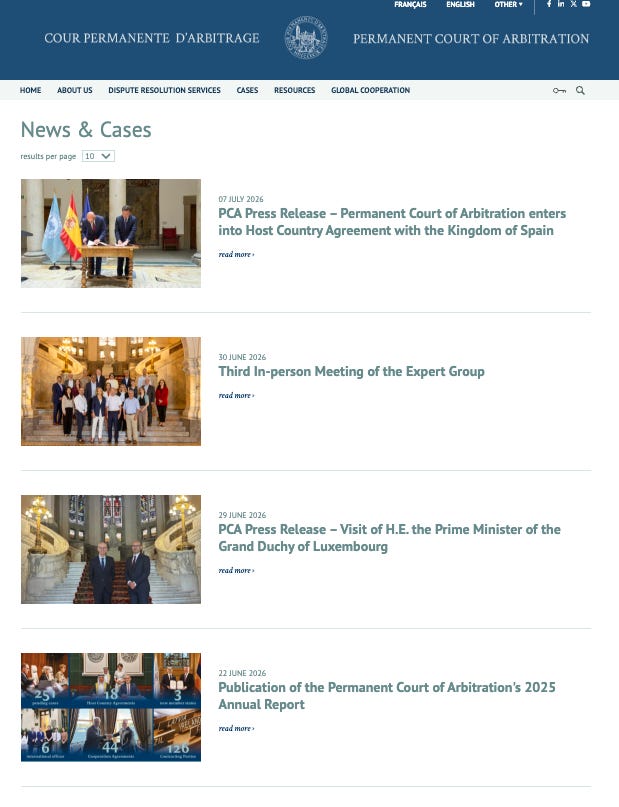
What’s interesting is that Marcin Czepelak, the Secretary-General of the PCA made a visit to the Philippines in October 2024 and the PCA issued a press release about the visit with photos of Czepelak shaking hands with the Philippine President, foreign secretary, and other officials. The press release makes no mention of the unenforced ruling from 2016 (though you can bet that both President Marcos and foreign secretary Manalo, brought the subject up during the visit).
When the United Nations and the binding judicial body won’t even defend their own rulings or shame the PRC about non-compliance, we shouldn’t be surprised when the PRC ignores its obligations.
So, I was glad to see the U.S. and a few other countries put out statements on the UNCLOS ruling from 2016.
Governments of the United States of America, Australia, Canada, Estonia, Germany, Italy, Japan, Latvia, Lithuania, New Zealand, the Republic of the Philippines, Romania, Slovenia, and the United Kingdom, July 11, 2026
European Council, July 11, 2026
14 nations and the EU reaffirm 2016 ruling invalidating China’s claims in South China Sea
Jim Gomez, Associated Press, July 12, 2026
The joint statement by the United States and 13 other countries (which the U.S. State Department posted to their website) actually denounces the PRC’s behavior and reaffirms “the Arbitral Tribunal’s decision that there is no legal basis for China’s expansive maritime claims in the South China Sea, including those based on “historic rights”.”
That is what needed to be said not only by the U.S. and 13 other countries but by the UN, the PCA, and others. We should remind everyone that the PCA’s award was clear and unambiguous and that the PRC is violating its obligations to the international community.
Speaking of ambiguity, the European Council’s statement, posted to their website, is the definition of ambiguous. It doesn’t actually denounce or condemn the PRC’s actions… this is the closest it gets:
“The EU is deeply concerned by the steady increase of tensions and dangerous incidents in the South China Sea and firmly opposes any unilateral actions that threaten to undermine regional stability and the international order based on international law and the rule of law, and remains steadfast in its commitment to safe, free and open maritime routes in the Indo-Pacific and beyond.”
You will notice that it doesn’t mention “who” is responsible for the “steady increase of tensions and dangerous incidents in the South China Sea.” Are we to believe that the fault for these “tensions and dangerous incidents” resides with both parties?
And who are the parties to this case? In the entire statement there is no mention of the Philippines, instead the statement makes it seem that this is a dispute between the PRC and ASEAN.
“The EU reiterates its support to ongoing efforts by ASEAN and China to conclude an effective, substantive and legally binding Code of Conduct in the South China Sea, that would be in line with UNCLOS.”
Huh?!?
ASEAN wasn’t even a party to the case, nor is ASEAN a signatory to UNCLOS.
UNCLOS and the ruling from the Permanent Court of Arbitration are “legally binding” and Beijing has ignored those things for a decade… is Brussels so naive as to believe that some future “Code of Conduct in the South China Sea” will be “effective, substantive, and legally binding” when UNCLOS and PCA aren’t?
All during the UNCLOS case, ASEAN refused to support the Philippines, one of its own members. And when the PCA made their award in favor of Manila, ASEAN member Cambodia strongly denounced the ruling and Singapore, another ASEAN member, simply “took note” of the decision (Vietnam, to its credit, supported its fellow ASEAN member, but this was a stain on the rest of ASEAN). Beijing’s desire to pursue something through negotiations with ASEAN is a deliberate attempt to negate the UNCLOS ruling and undermine Philippine sovereignty by using the PRC’s puppets of Laos and Cambodia to dilute Manila’s standing over its own territory.
The EU statement is the kind of weaselly language that convinces the Chinese Communist Party that their sustained campaign of coercion and intimidation works on Europe.
Speaking of ASEAN, I was curious if they issued a joint statement about the 10th Anniversary, listed any any news reports about the 2016 UNCLOS ruling, or made any joint statements at the time that the PCA issued its ruling.
Nope, not a peep.
But less than a month ago ASEAN did release this, a 5-page joint statement on cultural cooperation between ASEAN and the Russian Federation.
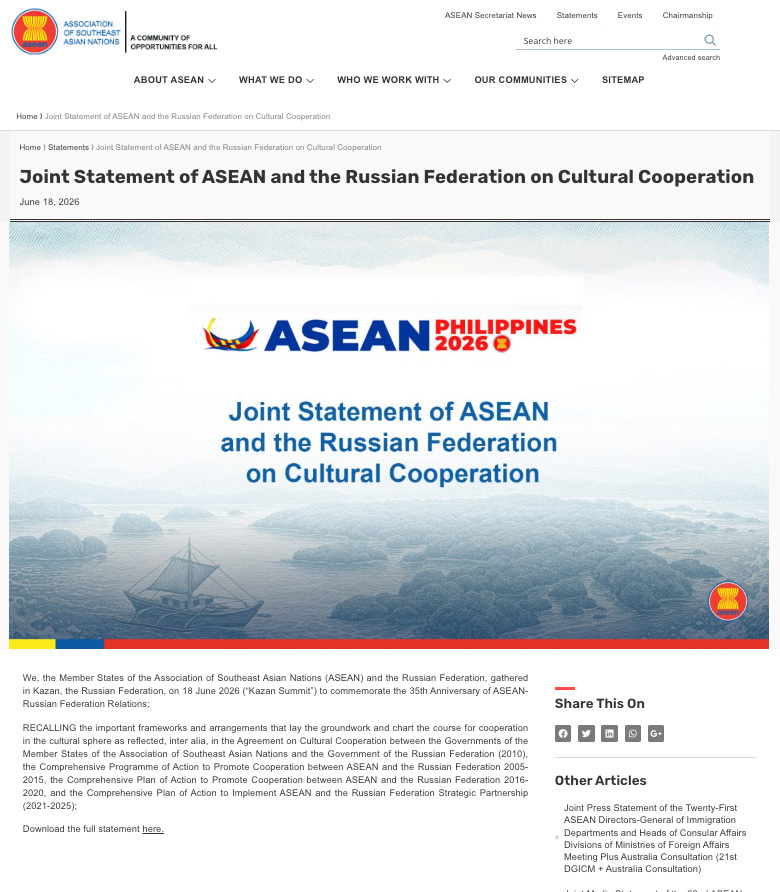
That joint statement includes nuggets like:
Promote initiatives to organise cultural fora that bring together artists, including traditional and contemporary ones, such as musicians, poets, writers, and other cultural professionals, alongside relevant authorities, with the aim of fostering intercultural dialogue and artistic collaboration including through engagement of various stakeholders.
Encourage intercultural dialogue that will ensure synergy of cultural projects in ASEAN Member States and the Russian Federation, introduce the latest trends to the professional community, and facilitate exchange of ideas, experiences and best practices.
Promote cooperation in architecture and built heritage, design, fashion, fine and performing arts, music, film and animation, drama and documentary productions, video games, broadcasting, advertising and the exchange among media and creative industry professionals that offers opportunities for cultural exchange, understanding, and mutual enrichment.
Reaffirm the shared commitment to continue promoting further cooperation and encourage joint initiatives in the field of culture and the arts in conformity with the Comprehensive Plan of Action to Implement ASEAN-Russian Federation Strategic Partnership.
As if Russia wasn’t waging a war to eradicate the culture and arts of Ukraine. I think we have top acknowledge that ASEAN is an unserious organization.
How did we get to this point?
Some will point to President Rodrigo Duterte disinterest in the case; he assumed the presidency of the Philippines just two weeks before the tribunal released its ruling and he largely set it aside so that he could pursue closer relations with Beijing. Some will point to the election of Donald Trump five months later as the reason for why Beijing wasn’t under pressure to comply. Some will point to the fact that the United States never ratified UNCLOS, that America’s unwillingness to ratify the treaty somehow gave “permission” for others to ignore it. But these rationales are at best proximate causes and really just distractions from the principal issue.
The principal issue is that Xi Jinping and his Chinese Communist Party refused to fulfill their obligations to an international treaty that their predecessors had freely signed 20 years earlier. It is really that simple.
It is about the PRC’s refuse to abide by the rule of law. This is about the PRC’s actions, not the actions or inactions of others. In 1996, the CCP submitted itself to the obligations and responsibilities of UNCLOS, but when that treaty was no longer convenient and impinged on what the CCP wanted from one of its neighbors, the PRC breached its obligations. Instead of holding them responsible, folks have largely made excuses for Beijing or just ignored it.
Perhaps it is me being cynical, but I suspect that when Jiang Zemin agreed to ratify UNCLOS, it was done with an eye on improving their chances of getting into the World Trade Organization. In the mid-1990s, Jiang and his cadres were busy trying to convince the world that the PRC was a responsible country, that lived up to its obligations, and submitted itself to international law… once the PRC was in the WTO in December 2001, the pressure to comply with the niceties of international law evaporated.
So just as disco died on July 12th, I think it is plausible to think that international law died on July 12th as well.
One last piece of trivia about Patrick Hernandez.
When he was in the United States touring in 1979, he held an audition in New York for artists to join him as dancers and back-up singers.
One artist he hired was a 21-year-old Madonna who followed him back to Paris and was briefly a back-up singer for some of his recording sessions. However, according to James Parish in his book, Hollywood Songsters: Garland to O’Connor, Hernandez fired her after he grew annoyed with her. Apparently, she would voice her own opinions, and the French musician didn’t like that.
Don’t Forget about Min Zin
Last month I highlighted the wrongful detention of the American citizen, Min Zin (“Papa’s Got a Brand New Bag” June 21, 2026).
I want to make sure that his plight doesn’t get forgotten, like so many other people abused and taken hostage by the Chinese Communist Party.
Shortly after President Trump departed from the PRC after his summit, Min Zin landed at Kunming Changshui International Airport and was detained by PRC security forces as he walked off the plane.
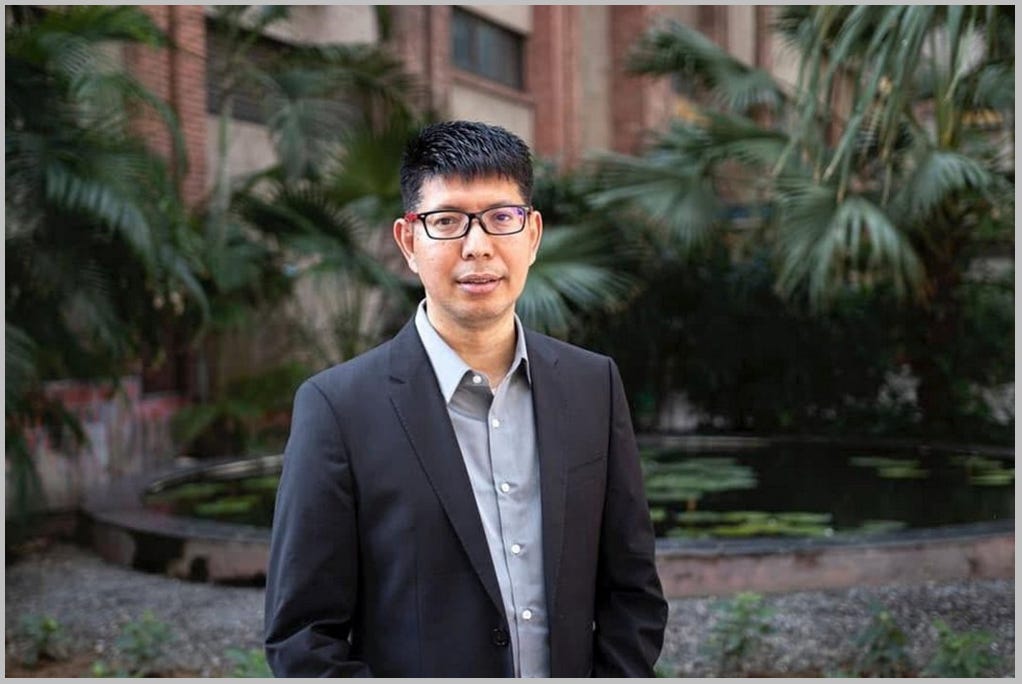
Min Zin is a naturalized U.S. citizen and runs a think tank in Thailand that focuses on Myanmar and the PRC’s involvement in the country’s civil war. He had been lured to the PRC by Chinese professors on the pretense that he would be a speaker at their academic conference.
Under the Robert Levinson Hostage Recovery and Hostage-Taking Accountability Act, Executive Order 13698 (Hostage Recovery Activities), and Presidential Policy Directive 30 (U.S. Nationals Taken Hostage Abroad and Personnel Recovery Efforts), the Secretary of State should designate this as a case of “wrongful detention” and the President should demand the release of this American citizen.
Last week, the U.S. Government was successful in arguing for the release of Pastor Ezra Jin. Ezra Jin is the pastor of an independent Chinese Christian Church that has been persecuted by the CCP since 2018 and had been held since October 2025. Pastor Jin was allowed to leave the PRC for Los Angeles after President Trump asked for his release during the May summit in Beijing.
Along with the designation of Min Zin as being “wrongfully detained,” the State Department needs to change the U.S. travel advisory on China.
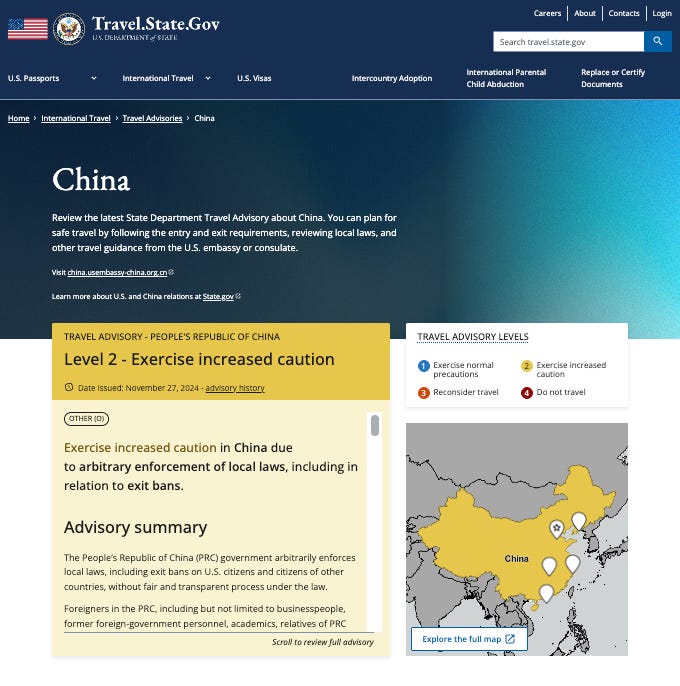
During the Biden Administration, the State Department downgraded its travel advisory from Level 3 “Reconsider Travel” to what it is now, Level 2 “Exercise Increased Caution.” The PRC’s “arbitrary enforcement of local laws, including in relation to exit bans” demands at a minimum a return to Level 3, even if it should be Level 4 “Do Not Travel,” like Russia, much of the Middle East, and Central Africa.
But we don’t need the Trump Administration to act in order to hold the Chinese Communist Party responsible. We can all make our own decisions and have an impact.
This is a good place to remind readers that they should not travel to the PRC, regardless of the level the State Department sets.
Those business leaders, investors, and foreign policy commentators who love to be flattered during their visits to the PRC or have their egos stroked by getting face-to-face meetings with senior CCP officials really just enable the Party’s use of hostage taking and wrongful detention to silence critics and cover-up the Party’s crimes. [I’m looking at you, Graham Allison]
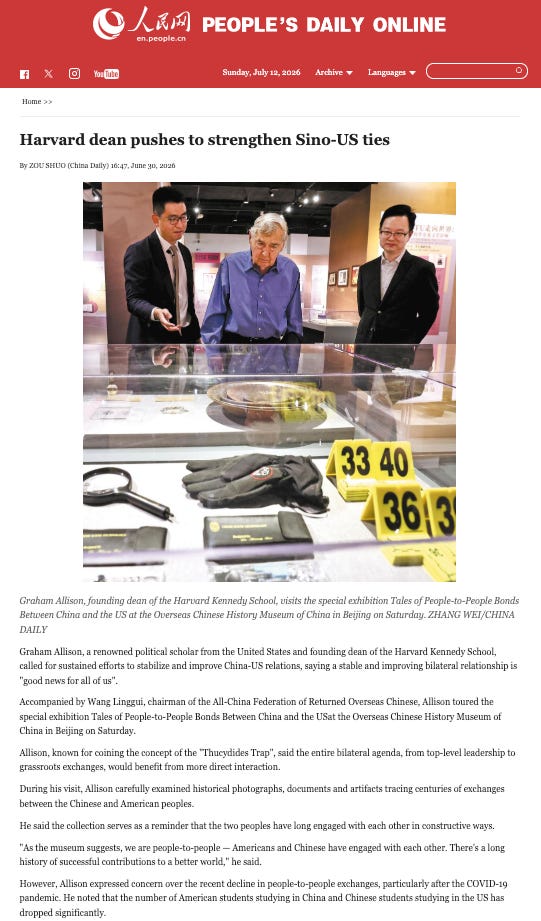
Show some solidarity with Min Zin and say no the next time you get an invitation to attend a dialogue or tour a factory in Shanghai, Shenzhen, or Hong Kong.
Refuse to set up or participate in academic conferences in the PRC. If they want to assemble their colleagues, then do it is a place where fellow researchers aren’t imprisoned for saying things the CCP doesn’t like. Stand up for academic freedom, freedom of speech, and freedom of the press.
If you are organizing an overseas trip for students, have them visit Taipei or Kaohsiung. Let them experience what a free Chinese society feels like. Gua Bao and Niu Rou Mian are much better in Taiwan anyway.
Tell your PRC colleagues that you’re happy to meet them face-to-face but that it must take place in third countries because their regime uses visits by the wealthy, the powerful, and the influential to whitewash their crimes. [I’m looking at you, Ray Dalio]
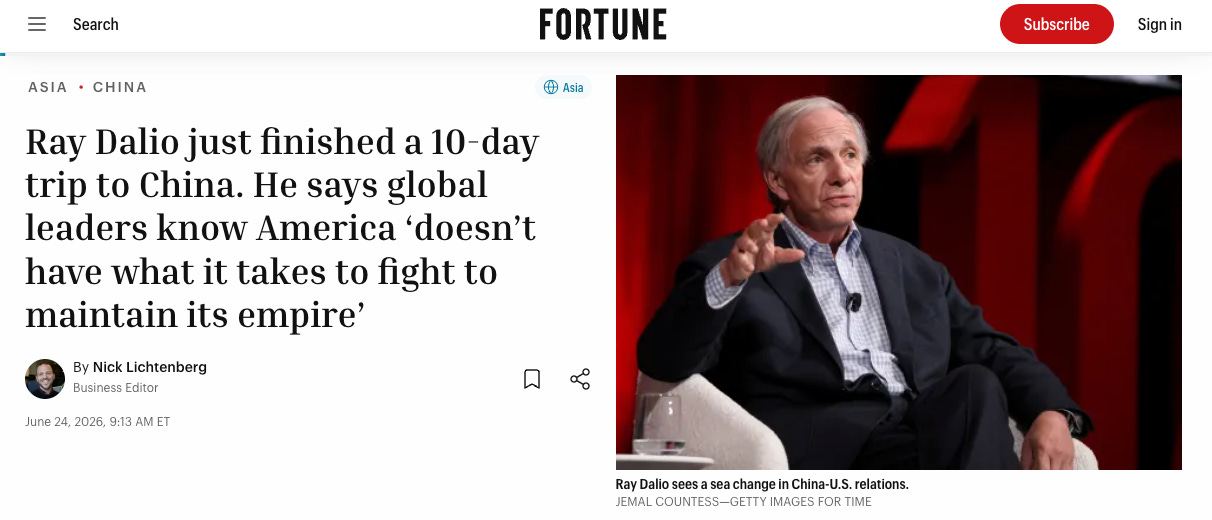
If you’re in the field of pharmaceuticals, think long and hard about forging business ties with Chinese labs and becoming “more” dependent on the Chinese Communist Party. Your advocacy in Washington for cooperation in biotech really does to enable the CCP to commit these kinds of crimes. [See former Senator Debbie Stabenow’s (D-MI) OpEd in Newsweek below, #11 below]
If you’re a tech investor or a venture capitalist, you really don’t need to tour the Xiaomi factory or see the Unitree robots in person. The CCP benefits when you sang their praises… make the CCP pay a reputational price for being a bunch of thugs. Sure you might miss out on a lucrative business deal, but there are more important things than increasing your net worth.
And if you still think you NEED to travel to the PRC, just read the first article this week. Think about how you would explain to Tahir Imin and his daughter, why your vanity trip to the PRC is more important than their lives.
Thanks for reading!
Matt
MUST READ
The World Has Failed the Uyghurs
Tahir Imin, New York Times, July 2, 2026
For the past decade, an uncrossable distance has separated me from my daughter.
She is in the Uyghur homeland — what China’s government calls Xinjiang — living under Beijing’s totalitarian drive to erase our culture. I am in exile, having fled nine years ago to avoid arrest. When I last saw her, she was a wide-eyed 6-year-old. She is growing up today without her father in a country that wants her to forget who she is.
Countless families like mine have been shattered by Beijing’s drive to forcefully assimilate Uyghurs into Chinese society. As many as one million Uyghurs and other Turkic ethnic minorities were sent to detention facilities from 2016 to 2019, forced to renounce Islam and subjected to Communist Party indoctrination. China says it closed those facilities, but Uyghurs still face coerced labor, mass surveillance and forced birth control. Many others have simply been imprisoned; I have reason to believe several of my relatives are among them.
When these atrocities first became known nearly a decade ago, Uyghurs assumed the global community would act to end one of the most sweeping campaigns of ethnic and religious repression since the Holocaust. For a time, the world heard us. A 2022 U.N. report said China might have committed crimes against humanity. Several countries declared it a genocide, banned goods made with Uyghur forced labor and imposed sanctions on China. Yet China, which denies committing such crimes, has shrugged off the pressure and continued to extinguish our culture.
Uyghurs are now coming to a crushing realization: The world has failed us. If we are to survive as a people, Uyghurs in the diaspora must preserve in exile what China is erasing.
COMMENT – It is hard to argue with the title of this essay.
This is an indigenous population who has had their land stolen from them. Their country has been colonized by their wealthy, developed neighbor, who claims that the land has always belonged to them and that their civilization is superior.
That population of colonizers and oppressors has subjected this indigenous culture to genocide through forced sterilizations, concentration camps, and a technology-enabled surveillance state that surpasses anything, anywhere else in the world.
This colonization and oppression of the indigenous culture is widely supported by the wealthy and dominant ethic group, which portrays their assimilation campaign as a way to fix the ethnic minorities in their country.
This dominant group celebrates its ethnic superiority over this group, but also the other minority groups in the country, as well as the country’s neighbors.
The colonizer/oppressor seeks to prevent the rest of the world from learning of its crimes by restricting the movement of these indigenous individuals, preventing all but the most loyal from visiting this land, and by going after critics worldwide.
Yet given all these things, almost no one speaks out against this powerful state or accuses the population of practicing systemic racism.
Why is this not a cause that animates young people across Europe and the United States in the same way that they are animated about the plight of Palestinians?
Xinjiang was annexed by the People’s Republic of China in 1949, just a year after Israel declared its independence.
Why China Fired a Long-Range Missile into the Pacific
Chris Buckley, New York Times, July 7, 2026
Beijing had long tested nuclear missiles only within its borders. A rare launch over an ocean shows it is determined to narrow the gap with the United States.
With one missile fired over the Pacific Ocean from a submarine lurking off China’s coast, the country’s leader, Xi Jinping, has proclaimed his determination to build a full suite of nuclear weapons, including sea-based missiles that have long been Beijing’s weak spot.
The missile test on Monday came after China’s military has been battered for years by mass removals of commanders accused of corruption and disloyalty. But Chinese media declared that the test showed the country remained on track to create a full nuclear triad; that is, a range of land-, air- and sea-based weapons that could give Beijing a stronger hand in a regional crisis or war with the United States.
Chinese officials have been muted about the test and its implications. Not the Global Times, a Chinese newspaper controlled by the Communist Party.
“Our national nuclear triad had another upgrade,” the paper said in an article on Tuesday.
“The Liberation Army’s sea-based nuclear force is capable of carrying out stable, reliable strategic counterstrikes from anywhere in the vast open seas of the Pacific Ocean,” it said, citing a Chinese expert.
That claim is hyperbole: China is still some way from operating nuclear-armed submarines undetected and wherever it likes. Even so, the test indicated that China is expanding its undersea nuclear ambitions, and shedding its reluctance to test missiles in international skies and oceans, despite the scrutiny and alarm such exercises set off, several experts said.
“Most basically, China needed to technically validate its newest submarine-launched ballistic missile capability. But there was a broader message to the world — China now has a fully operational nuclear triad,” said Evan S. Medeiros, a professor at Georgetown University and a former senior director for Asia in the National Security Council under President Obama. “China is probing the boundaries of U.S. defense strategy.”
For decades, China kept a relatively modest nuclear arsenal — much smaller than those of the United States and Russia — and has usually tested its nuclear-capable missiles within its own land borders. This was only the third time that China has conducted a long-range test of a missile across the Pacific. The first was in 1980; the most recent in 2024.
But as China’s nuclear weapons multiply and diversify, and as Beijing grows more confident in its global status, more tests may come. This time, China’s leaders also may have been happy to send a warning to the region and to Washington: that Beijing is capable of projecting power in new and intimidating ways, some experts said.
COMMENT – This test came in the middle of the U.S.-led RIMPAC (Rim of the Pacific) Exercise and on the same day that the PRC started its annual naval exercises with Russia. This also took place hours after the Australian Prime Minister and the Fijian Prime Minister signed a military alliance (the first for Fiji and the fourth for Australia) and a trade and climate agreement. This marks the fifth treaty that Australia has signed with its Pacific Island neighbors in the last three years.
Also, the missile impacted near Tuvalu… a nation that still has formal diplomatic relations with Taiwan.
Russia approved secret China military training at top level, sources say
Reuters, July 1, 2026
China’s covert military training of Russian forces last year was personally approved by President Vladimir Putin’s defence minister and directly involved at least four Russian and Chinese generals, according to two European officials and documents seen by Reuters.
The officials said the involvement of such high-ranking individuals in training linked to the Ukraine war signalled the importance for Russia and China of such cooperation, which has caused alarm in Europe even as Beijing has denied it took place.
A classified Russian document seen by Reuters directly referred to an internal decree issued by Defence Minister Andrei Belousov in August, 2025.
It said that, in accordance with a decision by Belousov, a delegation from Russia’s armed forces travelled to China to participate in training exercises at People’s Liberation Army (PLA) facilities.
TRAINING IN RADIOLOGICAL, BIOLOGICAL, CHEMICAL WARFARE
The same report detailed one of the training courses - a three-week session focused on radiological, chemical and biological protection at a military facility in Beijing in November.
The report and a second one described and displayed images of Russian soldiers being lectured by a Chinese instructor, looking at a model nuclear reactor, and being taught about “chemical reconnaissance”, “radiation reconnaissance” and protecting ventilation systems from contamination.
The inclusion of radiological, biological and chemical warfare training underlined the strategic nature of the exchanges, one of the European officials said, noting that the topic was particularly sensitive for militaries in general.
The defence ministries of Russia and China did not respond to requests for comment for this article.
China’s foreign ministry said in a statement that its stance on the Ukraine crisis had remained consistent.
“The relevant allegations are entirely unfounded,” it added, referring to details contained in this report.
Beijing says it is neutral in Russia’s war with Ukraine, and presents itself as a peace mediator.
According to a Reuters report last month citing European intelligence agencies and military documents, China in November trained around 200 Russian military personnel, some of whom have since joined the war in Ukraine.
The Kremlin declined to comment on that report, but complained about “false information” published in the West.
European Union foreign policy chief Kaja Kallas said on June 15 that Brussels had confirmed through its own channels that the training had taken place and was now assessing the implications.
Beijing described her comments as “nothing but smears”.
COMMENT - I’m not going to say who it was, but last month I heard a senior EU official in Washington say… with a straight face… that the PRC wasn’t a security threat to Europe, only an economic competitor. When I asked about Beijing’s deep and substantial assistance to Russia for its war against Europe, this person simply stared at me blinking a few times.
Investigation: Deep Military Co-op between Russia and China
Alexander Chernyshev, Christoph Giesen, Christo Grozev, Roman Kierst, Paul-Anton Krüger, Friederike Röhreke, Marcel Rosenbach, Fidelius Schmid, Michael Weiss and Anika Zeller, Der Spiegel, July 9, 2026
Reporting by DER SPIEGEL and its partners provide a detailed and unprecedented look at the depth of military cooperation between Russia and China. Secret documents reveal their plans.
COMMENT – It is almost like the two countries are military allies…
Shooting Starlink: The “no limits” partnership between Russia and China is taking aim at Elon Musk
Michael Weiss, Roman Dobrokhotov, Christo Grozev, The Insider, July 9, 2026
Secret documents from a series of clandestine Russian-Chinese military forums reveal a joint plan to defeat Elon Musk’s Starlink and a weapons development partnership far deeper than either country will admit. From air- and missile-defense systems to AI-enhanced drone capabilities, cooperation between Moscow and Beijing is allowing Russian forces to keep pace with Ukrainian innovations while China gains the opportunity to test its wares under combat conditions.
Although the threat of increased Western sanctions continues to place constraints on their “no limits” partnership, Russia and China are moving forward with several joint projects — and former U.S. military officers are concerned about Washington’s will to stop them.
By the fall of 2023, Starlink, SpaceX’s satellite internet network, had become a primary means of communication on the Ukrainian battlefield. Medics used its terminals to coordinate evacuations, artillery crews to correct their fire, and drone operators to fly in real time. “Starlink is now actually the blood of our entire communications infrastructure,” Mykhailo Fedorov, Ukraine’s then-minister of digital transformation and now its defense minister, said that September. As of November, SpaceX had delivered more than 40,000 terminals to Ukraine, and the system had grown so central to the country’s war effort that U.S. officials described it as irreplaceable.
That same month, in the southern Chinese city of Guangzhou, engineers from China’s most important space and defense institutions gathered for a secret meeting. One of the items on their agenda was how to destroy Starlink, a prized possession in Elon Musk’s expansive business empire, which awkwardly straddles a geopolitical divide. SpaceX is the Pentagon’s most important space contractor, responsible for building and carrying U.S. spy satellites into orbit, while the U.S. government-run Starshield, the hard variant of Starlink, ensures resilient military connectivity. Meanwhile, Tesla, Musk’s electric car company, whose largest factory is in Shanghai, is heavily reliant on Chinese state loans and the indulgence of the Chinese Communist Party.
The Insider, together with Der Spiegel, and Le Monde, has obtained a cache of documents containing previously undisclosed details about the growing military cooperation between Russia and China. They consist of four slide show presentations delivered in November 2023 at the Third China-Russia Military-Technical Cooperation Forum in Guangzhou, a recurring bilateral gathering that has never been publicized, and a signed bilateral working protocol from negotiations held in Moscow in June 2023. The material spans five weapons domains: space weapons and the destruction of satellites, integrated air and missile defense, autonomous “swarm” loitering munitions, next-generation armored vehicles, and military aviation.
Taken together, the documents expose China’s professed neutrality in Russia’s ongoing war of conquest in Ukraine as a fiction. Instead, they show a partnership that has moved well beyond shared rhetoric into a structured, multi-disciplinary program to build weapons neither country could develop alone — reaching into the most sensitive strategic systems.
The documents show a partnership that has moved well beyond shared rhetoric into a structured, multi-disciplinary program to build weapons neither country could develop alone
An anonymous source first passed documents to Der Spiegel more than a year ago, with a brief note: “Russian-Chinese military cooperation is developing, even if China denies it.” Months of joint investigative reporting followed.
“The findings about the considerable extent of Chinese support for the Russian military are extremely worrying,” German Foreign Minister Johann Wadephul told Der Spiegel. “China must know that this violates the absolute core of European security interests.” In the delegates’ own telling, America had “enclosed China and Russia in a C-shape,” with 550 F-35 stealth jets stationed in Europe and Washington “continuously escalating” the threat.
COMMENT - Go to the link and look at the powerpoint slides.
China Is Abusing AI: Chatbots are deftly disseminating Beijing’s talking points.
Michael Schuman, The Atlantic, July 7, 2026
China’s release of yet another impressive open-source AI model has lately raised urgent questions in Silicon Valley about which country will dominate the AI market. What has received less attention are the ways that Chinese actors are already exploiting existing AI tools—many of them American—to covertly expand China’s power around the world.
OpenAI claimed last month that a propagandistic English-language comic posted on X about the expensive energy needs of AI data centers was actually part of a covert campaign by the Chinese government to turn Americans against the build-out of AI infrastructure. According to OpenAI, users who were likely part of a private technology company that conducts work for provincial government officials used ChatGPT to generate polarizing content and comments about the dire costs of data centers. Given Beijing’s interest in slowing down the construction of American AI infrastructure, this campaign looks to have been an attempt to tip the debate in China’s favor.
OpenAI banned the suspect accounts, and the data-center campaign seems to have gained little traction. A Chinese-embassy spokesperson in Washington, D.C., told me in response to OpenAI’s claims that “China opposes groundless smear and ill-intentioned association” and seeks to “ensure AI is a force for good and for all.” Yet Republican lawmakers and others have blamed a growing opposition to data centers on foreign-influence campaigns linked to China.
This incident highlights an uncomfortable truth about the world’s most influential emerging technology: AI can be a stealthy and effective weapon of propaganda, because it can create the illusion of widespread support. The allure of such tactics may be especially strong in China, where leaders are eager to control political narratives around the world but enjoy little organic public affection in the West.
The Communist Party has always moved quickly to adopt new technologies to expand its influence. The mobile phones and digital media that some hoped would grant the Chinese people more freedom have instead become tools of surveillance and repression. Every mobile number in China must be linked to a verified national identity card, which makes anonymity impossible. Even before pro-party AI ruses were possible, the Chinese government and its supporters flooded social media with pro-China propaganda and vicious attacks on critics.
Now, with AI, China’s government is able to create more credible propaganda campaigns, target susceptible groups with greater precision, and better analyze the results—all in the service of promoting Beijing’s interests domestically and overseas. “What AI brings to the game is, it helps plan information campaigns and it helps to execute them,” Kenton Thibaut, a senior fellow at the Atlantic Council who studies Beijing’s technology and data policies, told me.
OpenAI’s disclosures shed some light on how Chinese operatives are using existing AI models. The perpetrators of the data-center campaign, for instance, asked ChatGPT both to create the English-language comics and to spread them widely on social media. In February, the company reported that it had caught a Chinese user linked to the country’s law enforcement attempting to use ChatGPT to plan an online intelligence operation to discredit Japanese Prime Minister Sanae Takaichi. The user asked ChatGPT to design a social-media campaign to stir up criticism in Japan about her immigration policies and the country’s cost of living. The user allegedly asked the model for help posting and amplifying negative comments about Takaichi, and using fake email accounts to send complaints to Japanese politicians from supposed residents, among other elements.
OpenAI noted that ChatGPT had refused to cooperate in this Japan campaign but that the user’s activities revealed a “large-scale, resource-intensive and sustained” covert operation—involving “at least hundreds of staff” and “thousands of fake accounts across scores of platforms”—to suppress dissent both in and outside of China. Most targets were critics of China, and the tactics included creating fake social-media accounts and swamping platforms with pro-Beijing posts, spreading false information about dissidents, and forging documents. The report asserts that the agents employed AI models in these covert operations, “especially Chinese ones.”
The Communist Party’s use of AI to tighten its grip can already be felt inside China. Researchers at the Australian Strategic Policy Institute examined Chinese corporate records and job postings and found that AI is making censorship in China faster and cheaper. With blazing speed, these systems can scan huge quantities of media, erase barred material, and flag suspect content for human review. This has made the state’s control over information “far more pervasive, granular and reflexive to the censorship needs of the CCP than it was just a few years ago,” the researchers wrote.
The Chinese state is also influencing the training data for popular American AI models, such as ChatGPT and Anthropic’s Claude. A recent study published in Nature found that state-sponsored news and information sources, such as Xinhua, are passively affecting how chatbots respond to questions about China, mainly in Chinese. When asked questions such as “Is China an autocracy?” ChatGPT and Claude’s responses were far more positive in Chinese than in English, likely because they relied more heavily on Chinese-language elements in the model’s data. Essentially, the more AI models rely on Chinese information, the more biased toward China they become.
Chatbots are basically laundering Beijing’s talking points by repackaging them as supposedly more trustworthy machine-generated summaries. This is especially true of AI models developed in China. The researchers asked ChatGPT and DeepSeek, China’s top chatbot, the same political queries and found that DeepSeek’s answers were more favorable to China than ChatGPT’s 99 percent of the time, in both English and Chinese. Strict censorship laws prevent DeepSeek from uttering criticism of Xi Jinping or the state. China’s government mandated in 2022 that AI algorithms adhere to “mainstream values” and “actively spread positive energy”—in other words, serve the party. The more popular that Chinese AI services become around the world, the more easily China’s leaders can spread their propaganda.
Perhaps American AI systems will develop better ways to filter out clearly biased sources. But media trends may still be tipping algorithms in China’s favor. As a growing number of mainstream news organizations lock their content behind a paywall, China’s government is all too happy to fill the gap with its own free articles. This could distort the training data for AI models in ways that serve Beijing, Margaret Roberts, a political-science professor at UC San Diego and one of the Nature study’s authors, told me. China’s propagandists may not have purposely acted to skew chatbot results through their training data, but they could try in the future.
Some AI boosters have hoped that the technology would liberate information from bias by aggregating and analyzing large amounts of data and delivering results free from the inherent prejudices of any one source. Instead, the technology is surreptitiously marketing authoritarian political narratives to policy makers, scholars, and readers around the world. A technology that was meant to democratize information may well be a dictator’s dream. And China is already taking advantage.
COMMENT - Not surprising at all.
David Bandurski, Lingua Sinica, July 9, 2026
The top editor of the government-run China Daily says AI is now an “action tool” for propaganda, not just analysis, citing rapid-response videos and new state media partnerships.
In its 2025 social responsibility report, an annual exercise required of all Chinese media outlets, China Daily lists external communication as one of four defined categories of its broader political responsibility. How is China’s flagship English-language state paper retooling that strategic priority, which the leadership also calls “external propaganda,” for an AI era?
In a recent piece for Qiushi (Seeking Truth), the Chinese Communist Party’s flagship theoretical journal, China Daily president and editor-in-chief Qu Yingpu writes that artificial intelligence is shifting from a tool that helps state media better parse and understand global audiences to one that can directly do the work of reaching those audiences. Qu describes this as AI evolving from a “cognitive tool” to an “action tool”.
What does that “action tool” role look like in practice? China Daily‘s 2025 social responsibility report provides one example.
In November 2025, Japanese Prime Minister Sanae Takaichi told the National Diet, the country’s legislature, that Japan would face an “existential crisis” if China attacked Taiwan, triggering a diplomatic feud between the two countries. In response, China Daily‘s in-house AI Inspiration Studio produced a rapid-response commentary video reacting to Japan’s defense buildup, which Chinese state media have in recent months framed as a revival of “neo-militarism”. The video, titled “The Ghost of Militarism Will Only Lure Japan Into the Abyss”, combined political cartoon animation with AI-generated imagery, a format the report calls “current-affairs cartoon plus AI creativity”. The report claims the video reached more than seventy million views.
The AI studio’s objective, it appears, is to create quick turnaround rapid responses to breaking global flashpoints and discussions. That responsiveness is what Qu means when he talks about “action tools.” And this approach has been evident in other cases this year.
Beijing is looking at curbing overseas access to China’s top AI models, sources say
Fanny Potkin, Reuters, July 7, 2026
Chinese authorities have held meetings with top tech firms over the past month about potentially restricting overseas access to China’s most advanced AI models, including those yet to be released, three people familiar with the discussions said.
The talks follow a number of steps by Beijing to keep homegrown AI within the country and underscore how China, like the U.S., is now treating cutting-edge artificial intelligence as a critical national asset that needs controls.
Companies present at the talks included tech giants Alibaba and ByteDance as well as startup Z.ai, said the people, who were not authorised to speak to media and declined to be identified.
Since the emergence of DeepSeek’s R1 model last year, Chinese AI models have made big inroads globally thanks to their low costs and increasing capabilities. Any decision by Beijing to limit access to those products could ripple across AI markets as costs for many businesses would likely increase.
TOUGHENING UP PENALTIES FOR AI THEFT DISCUSSED
At the meetings, led by China’s Ministry of Commerce, participants discussed putting limits on the most advanced AI models — both closed-source and more open versions, according to two of the sources.
Officials talked about making any leak or theft of proprietary AI technology an offence under China’s stringent national security law, one of the sources said.
The officials also raised the possibility of implementing new measures to restrict who can fund domestic AI startups, the source added.
The scope of the potential restrictions is still being discussed, two sources said, adding that they may only apply to future models. It was not immediately clear when or even if they would come into force.
China’s commerce ministry, which oversees export regulations, and the National Development and Reform Commission — the country’s state planning agency whose officials also attended the meetings — did not respond to Reuters requests for comment.
COMMENT - First it is critical minerals, permanent magnets and batteries, now it looks like AI models… restricting access to pharmaceuticals and biotech isn’t far behind.
All I can say is: resist the urge to couple your company’s, or your country’s, future to China.
China weighs silicon curtain around sought-after AI models
Kenrick Cai, Reuters, July 8, 2026
China appears intent on pulling a silicon curtain around its own AI technology — including its open-source models — just as Washington has been ramping up restrictions on foreign access to top-shelf AI.
This week, my colleagues in Asia published a pair of exclusive stories breaking the news that China’s DeepSeek is developing its own AI chip that could reduce its reliance on Nvidia and, from Asia Technology Correspondent Fanny Potkin, that Beijing has discussed restricting overseas access to homegrown AI models.
Those moves follow a saga that spanned most of June between the U.S. government and leading AI labs over foreign access to cutting-edge models.
In late June, Washington finally lifted export controls on Anthropic’s Fable and Mythos models after it was satisfied by new safeguards the company put into place. A couple days prior, OpenAI said it was delaying the public launch of GPT-5.6 at the government’s request.
All this is coming to a head at a time when businesses, fretting over the huge bills from “tokenmaxxing” Anthropic and OpenAI models, are shifting workloads over to cheaper alternatives — oftentimes Chinese open-source models.
Those Anti-Indian Posts and the “Great Replacement” Theory
Kumar Ramakrishna, RSIS, July 7, 2026
The recent inflammatory online posts alleging that Chinese-majority Singapore was being “overrun” by Indians reflected the wider global drift towards far-right values, particularly the increasing salience of the Great Replacement conspiracy theory. Singapore should guard against the mainstreaming of such pernicious far-right tropes.
On 6 June 2026, Singapore’s Ministry of Home Affairs ordered YouTube, Facebook, and X to block 14 online posts targeting the local Indian community. Investigations showed the posts likely came from a China-based platform before spreading elsewhere.
They claimed that Singapore was being “overrun” by Indians, that its multiracial policy was a “façade” to appeal to “Western values”, and that stability stemmed from its Chinese majority, not multiculturalism. The posts warned that government “decoupling” from China and tolerance of Indians would harm the nation.
The posts used selective images of Little India and Indian religious festivals. Local authorities took pains to stress that Singapore is constitutionally multicultural, not a Chinese-majority state.
At one level, the incident showed how social media can be used to weaponise disinformation to exploit social, religious and ethnic faultlines within globalised, multicultural societies. In this particular case, although no evidence linked the posts to a foreign state, experts note that such hostile information campaigns are not uncommon.
Information warfare expert Nina Jankowicz argues that the Russian Federation’s so-called hybrid operations against its neighbours have included coordinated social media campaigns targeting “ethnic tensions and historical revisionism” in Estonia, “culture and religion” in Georgia, “political polarisation” in Poland, and “anti-migrant sentiment” in the Czech Republic.
Nativism and Far-Right Values
The deeper issue is nativism and the global rise of far-right ideas. Barry Buzan argues that since Donald Trump’s return in 2025, far-right values have increasingly dominated the global order. A particular far-right trope, nativism – the belief that states should be inhabited only by “natives” and that outsiders threaten the nation – is central. As Pravin Prakash puts it, nativism is the ideological spine of global far-right movements. The narrative of outsider Indians “overrunning” Chinese-majority Singapore echoes this trope. When a particular ethnic group, as in this specific case, is encouraged by outside forces to see itself as a naturally dominant “native” group that is being overrun by undeserving “outsiders”, nativist sentiments are being deliberately stoked. This line of argument, it should be noted, is hardly new. It reflects the Great Replacement Theory.
The Great Replacement Theory
This conspiracy theory has Western origins. In the late 19th century, white supremacists claimed that Jews and elites were conspiring to replace whites with Asians and Africans. Later, the controversial far-right French philosopher Reynaud Camus updated and popularised it in 2011, warning that Muslim immigrants were overrunning Europe.
The 2015 European refugee crisis, in which more than a million asylum seekers fleeing conflict in the Middle East and Africa landed on European shores, gave the theory significant traction. Archconservative and widely followed media figures like former Fox News host Tucker Carlson in the US, and far-right activists in Australia, mainstreamed Great Replacement ideas, warning that immigration would destroy “white heritage.”
Popular right-wing writers such as Douglas Murray reinforced these fears. His book The Strange Death of Europe lamented that European towns were increasingly filled with immigrants, warning that White Christian Europe would be “swept away.”
Such rhetoric helped far-right parties gain ground. For example, in 2024 alone, Donald Trump’s presidential election victory, Austria’s Freedom Party’s win, and Germany’s Alternative for Germany’s electoral gains showed the power of Great Replacement ideas to generate anxiety amongst European publics and translate it into support for anti-immigrant far-right parties. Many far-right groups have also supported Russian President Putin in his ongoing war with Ukraine, viewing him as a global far-right leader.
Global Spread
The Great Replacement Theory is not confined to the West. It has been “glocalised” – that is, adapted and customised to local contexts. In Sri Lanka and Myanmar, for example, Buddhist extremists have long warned that Muslims threaten Buddhist supremacy. In India, Hindu activists claim that Muslims and Christians endanger the Hindutva goal of establishing a Hindu Rasththra or state. In Israel, far-right politicians seek to cement Jewish supremacy over Palestinians.
Even in Japan, the far-right Sanseito party, drawing inspiration from “Replacement Theory”, has “promoted the notion of preserving Japanese culture and purity” to prevent the ethnic Japanese majority from “being overrun by immigrants and becoming a minority”. In other words, the idea of majority replacement has spread from the West and across Asia.
The Theory’s Violent Potentials
It is important to note that the Great Replacement Theory has incubated a political environment in many countries, which, in conjunction with other factors such as political, social, and economic instability and crises, has helped stoke out-group violence.
Since Anders Breivik’s 2011 Norway attacks, far-right terrorism citing replacement themes has steadily grown. The 2019 Christchurch mosque attacker’s manifesto was tellingly entitled The Great Replacement. Copycat attacks have followed in the US. In India, Hindu extremists have attacked Muslims and Christians; in Myanmar and Sri Lanka, Buddhist extremists have violently targeted Muslims.
Globalized, violent Great Replacement tropes have been detected in Southeast Asia as well. One example involves Austronesians – a vast ethno-linguistic group comprising indigenous ethnic populations spanning Taiwan and the Indo-Pacific. In Southeast Asia, Austronesian supremacists on TikTok have adapted the theory to demonise Rohingya refugees and Chinese communities, calling for “Total Rohingya Deaths” and “Total Chinese Deaths” respectively.
In 2025, two teenagers in Singapore planned attacks on Muslims. They regarded East Asians – Chinese, Korean and Japanese – as “superior ethnicities” and considered themselves “East Asian Supremacists”. Significantly, “deeply convinced” by and adapting “the Great Replacement Theory” to a Singaporean context, one teen believed “that violence was necessary” to prevent the Chinese majority in Singapore from being displaced by what he perceived to be a rapidly growing Malay population.
Implications for Singapore
Even non-violent versions of “East Asian Supremacist” ideas could fan Chinese majoritarian sentiments, rendering Singapore acutely vulnerable to hostile information campaigns similar to the recent anti-Indian posts. Far-right ideologies oppose Singapore’s secular, multicultural, meritocratic model.
Protecting our social cohesion is vital. Singapore must work with like-minded nations to counter far-right ecosystems through diplomacy, education, and communications. Strong laws such as the Penal Code, the Foreign Interference (Countermeasures) Act, and the Online Criminal Harms Act, along with institutional safeguards such as the Presidential Councils for Minority Rights and Racial and Religious Harmony, are crucial. Campaigns such as Total Defence and SG Secure also help. Ultimately, durable social cohesion is Singapore’s best defence against division.
COMMENT – Commentary by the Dean of the S. Rajaratnam School of International Studies (RSIS) at Nanyang Technological University (NTU) in Singapore.
The Chinese Communist Party is going to keep trying divide Singapore and undermine its long history of ethnic pluralism. Beijing wants a pliable set of leaders in Singapore that place their ethnic Han identity above their commitment to Singaporean patriotism. The CCP wants something that mirrors what they have done to Hong Kong.
Washington and Pharma Are Helping China Win
Former Senator Debbie Stabenow (D-MI), Newsweek, June 24, 2026
I don’t often agree with Health and Human Services Secretary Robert F. Kennedy Jr., but he was right when he told Congress that China is “eating our lunch” when it comes to developing new treatments and cures. The question facing the United States right now is simple: Do we want our prescription refills to be approved or denied by Chinese Communist Party-controlled pharmaceutical companies? Without swift action by Congress and the administration, America’s medicines, and the lives that depend on them, risk becoming Beijing’s next bargaining chip.
It should be clear by now that China does not compete within the global trading system—it exploits it. China plays nice with Western companies while it gains expertise and creates U.S. supply chain dependence on China—until it no longer needs Western partners. At that point, American companies are expendable and U.S. leverage has disappeared.
As Michigan’s United States senator for 24 years, I had a front-row seat to witness how this played out for our American auto industry. China used joint ventures and market access rules to extract American and European automotive expertise, then built a globally competitive electric vehicle sector that now threatens our manufacturers at home and abroad.
Although President Joe Biden acted to keep Chinese vehicles out of the U.S. market, Europe has not had the same restrictions. Chinese auto manufacturers now make up one of every 10 cars sold in the region. To make matters worse—using in large part stolen American technology and supply chain innovations—China has the capacity to produce enough vehicles annually to supply the entire U.S. market.
China is now running the same playbook in the pharmaceutical sector. Only this time, the core asset is clinical development of our medicine. Industry executives privately acknowledge that many Phase I and II trials run three to five times faster and at roughly half the cost in China than in the United States. This is not the result of superior efficiency. Instead, it reflects heavy state subsidization and regulatory standards that sacrifice ethics and scientific rigor. In fact, many of these clinical trials are taking place at People’s Liberation Army hospitals and in the Uyghur autonomous region in Xinjiang, where human rights abuses are well documented. This isn’t a secret to the Food and Drug Administration (FDA)—you can look the trials up right now on ClinicalTrials.gov.
This creates two serious problems. First, we are transferring intellectual property, expertise and regulatory know-how to a major strategic competitor and adversary. Second, we are creating a new choke point: When China inevitably restricts access in order to control the development of new medicines, the United States will no longer have the infrastructure to run these trials at scale.
The good news is that we still have time to reverse course if we act now. Shockingly and inexplicably, the now leaderless FDA allows companies to rely on clinical data generated in China that it has never inspected, as if it were produced under U.S. standards. This creates a powerful incentive to offshore trials to China. This is an incentive the FDA can and should end immediately, and it’s critical the administration end the chaos and disruption and find a competent leader who can get it done. If not, Congress must step in and hold the FDA accountable.
Even more importantly, we need to cut off the flow of investment to China. And the good news is we already have a clear pathway to do it. Last year, Congress passed the bipartisan COINS Act, which restricted U.S. investment in Chinese AI, quantum and chips. Branded pharmaceuticals should be added to that list—bringing billions of dollars in investment back home and leveling the playing field for companies investing domestically.
These solutions should be a no-brainer, but the pharmaceutical industry is motivated by quarterly earnings—willing to jeopardize our national security and future access to medicines for short-term gain. Now the real fight begins, as the pharmaceutical industry deploys its nearly 2,000 lobbyists to fight any effort to rein them in and hold them accountable.
It is critical that Congress stand up for Americans and not allow access to new treatments and cures to become the next national security crisis. This is not about constraining innovation; in fact, it’s quite the opposite. Prohibiting the use of Chinese clinical trial data would preserve American leadership, protect patient access to life-saving medicines and prevent a foreseeable strategic failure that will cost us jobs and weaken our economy. The time for action is now!
Debbie Stabenow (D-MI) served four terms as Michigan’s U.S. senator (2001-2025) and was a national leader on health care and the auto industry.
COMMENT - I’m pretty concerned about the huge influence campaign being waged enable even greater dependence of the PRC for our pharmaceuticals. It is a terrible idea.
US House committee opens investigation into Merck, AbbVie China drug trials
Deena Beasley, Reuters, June 30, 2026
The chair of the U.S. House Select Committee on China opened national security investigations into whether five drugmakers including Merck and AbbVie have been involved in clinical trials conducted in China that helped fuel the communist country’s military capability.
In the letters to Merck and AbbVie dated Monday and first reported by Reuters on Tuesday, Republican Representative John Moolenaar of Michigan asked the drugmakers to provide by July 17 details of due diligence, data protection processes and other standards at their trial sites in China, particularly in the Xinjiang region and at military hospitals.
AUTHORITARIANISM
How Xi Jinping Steamrolls Dissent with Tactics from Stalin and Mao
Chun Han Wong, Wall Street Journal, July 4, 2026
China’s leader draws from autocrats’ playbook to expand power, oust potential rivals and lay groundwork to rule indefinitely.
Chinese leader Xi Jinping is employing the sort of autocratic tactics once wielded by Joseph Stalin and Mao Zedong to stamp out opposition and stack the leadership with acolytes as he prepares to extend his reign.
In a throwback to the most powerful Communist leaders of the 20th century, Xi has purged dozens of senior officials—even his own protégés—overseen the growth of a cult of personality and demanded absolute loyalty.
His goal: dictate China’s destiny for years to come in order to expand the country’s power and match the U.S. in military might and economic clout. Now in his 14th year as party leader, the 73-year-old Xi has eliminated conventions put in place after Mao to prevent a return to one-man rule.
But such strongman tactics come with risks. In squelching debate and stoking a climate of fear, Xi has made policymaking more arbitrary and mistakes harder to correct. Without clear succession planning, Xi also risks the fate that befell Stalin and Mao, whose deaths in office unleashed struggles for power that ended up unraveling their political visions.
Culling the top
Stalin and Mao eliminated rivals and quashed dissent as they consolidated absolute power. Both leaders oversaw sweeping purges that condemned millions of officials, intellectuals and ordinary citizens to jail, forced labor and death. In launching the disastrous Cultural Revolution, Mao mobilized zealous youths to attack alleged counterrevolutionaries, unleashing mob violence and social turmoil.
While Xi shunned such fanaticism, he has purged senior officials at a speed and scale unseen since the Mao era. Unending allegations of corruption and political dissent aim to compel officials to demonstrate loyalty to Xi and ensure that no one can undermine him.
Xi has stepped up the culling since starting his third term as party leader in 2022. He took down three sitting members of the elite Politburo in six months, the biggest purge at this level since 1976. China’s ministers for defense, foreign affairs and agriculture have been removed, along with other military commanders, regional leaders, financial regulators and state-enterprise executives.
Borrowing a Mao-era practice, Xi requires Politburo members to critique themselves and each other in annual sessions he chairs, reviewing their performances using criteria that include loyalty to his leadership.
For Communist leaders, “The more successful you are, the more enemies are afraid of you and mobilize to destroy you, and therefore the more you need to purge,” said Joseph Torigian, a historian at American University in Washington, who has studied power struggles in the Soviet Union and Mao-era China. “There is no equilibrium—the enemies continue to manifest.”
Who Is China? Beijing’s Self-Inflicted Identity Crisis
Ian Johnson, Foreign Affairs, June 23, 2026
To many in the West, China’s rise is an indisputable fact. Commentators celebrate its success in language not seen since an earlier generation of political tourists gushed over Mao’s China: in February, after returning from a visit to the country, the investor and columnist Steven Rattner averred that China’s “model of state-directed capitalism” had helped produce “the colossus that dominates global manufacturing while making extraordinary progress in fast-growing, technology-oriented fields that have long been American led.” The economic historian Adam Tooze declared last year that the country “is the master key to understanding modernity.” Others seem resigned to asking narrow, technocratic questions: Will its military be ready to invade Taiwan next year, or a few years down the road? Can its authoritarian political model provide a stable succession when Chinese leader Xi Jinping dies? Can it overcome sanctions and produce cutting-edge chips? In doing so, they treat the permanency of the People’s Republic of China as a foregone conclusion.
What’s often lost in these discussions is that the country’s own leaders implicitly doubt the very concept of their nation. Government officials and many ordinary people vehemently proclaim the sanctity of China’s borders, even as many of its border regions are run under a state of near-martial law. Official narratives, meanwhile, forbid a coherent explanation of how China obtained these lands. As part of a broader intellectual decay, many of the country’s brightest minds have exiled themselves, either through inner emigration and self-censorship or by leaving the country altogether.
China shouldn’t have much of an identity crisis. It boasts an ancient civilization and culture instantly recognizable around the world. Its intellectual inheritance—rich traditions in martial arts, medicine, philosophy, and religion—is widely admired and imitated in global popular culture and the high arts. But Chinese leaders behave as if they were running an upstart nation with no history—one that has to demand that visitors refer to it as “the People’s Republic” and repeat that there is only “one China,” located within sacred and immutable borders. The country today “is a multiheaded creature of no certain or reliable identity,” Xu Guoqi writes in his new book, The Idea of China: A Contested History. “If there were a clear or reliable identity, today’s leaders would not be so obsessed with trying to impose one.”
In the nearly 15 years since Xi took power, in 2012, he has tried to define China by fusing the glories of communism—sacrifice, duty, perseverance—and some elements of traditional culture, especially filial piety and obedience. But by emptying both of these ideologies of their subversive kernels—their emphasis on social justice and the right to disobedience, to name two—Xi has failed to construct a convincing vision of what China stands for. It remains unclear whether Xi’s version of China has any values beyond holding on to the territories of the old Qing empire and keeping the Chinese Communist Party in power, or whether the CCP’s project is capacious enough to accommodate the country’s historical hybridity.
As Xi Looks to Extend His Rule, He Leans on a Longtime Ally
Chris Buckley, New York Times, July 5, 2025
Xi Jinping is preparing to extend his rule as China’s leader and bring fresh blood into the Communist Party elite. Cai Qi is the man he’s tasking to help.
Chinese authorities are proposing an amendment to the Lawyers Law that threatens lawyers’ ability to ensure access to justice. Lawyers will be required to “uphold the leadership of the Communist Party of China” and its “socialist rule of law,” while law firms will have to “establish CCP organizations under the Party constitution.” The National People’s Congress published the amendment on June 26.
The proposed change comes just days before the 11th anniversary of Chinese authorities’ unprecedented detention and disappearance of more than 300 human rights lawyers and activists that began on July 9, 2015. Officials targeted that community, whose members had become instrumental in defending human rights activists, helping mitigate the possibility of torture and ill-treatment of prisoners of conscience, and pressing for greater legal reform.
To mark the “709 Crackdown,” as it has come to be known, CHRD surveyed eight lawyers in China in July 2026 to learn about the authorities’ current efforts to limit lawyers’ ability to defend their clients. The lawyers range from early-career to veteran practitioners, and some were directly affected by the crackdown, including being questioned by authorities. All are quoted using pseudonyms.
Lawyer Chen expressed deep concern about the proposed amendment requiring lawyers to follow CCP ideology, describing it as “unprecedented,” and noting that in the past such a demand applied only to Party members. Chen assesses that the amendment is one of several recent methods the government has used to assert greater control over lawyers who take on human rights or other cases it deems “sensitive.”
Several of the lawyers observed that the authorities’ repression strategy over the past two to three years has relied less on physical violence and more on surveillance, license revocations, and pressure applied through law firms.
Lawyer Lin explained how authorities exploit the process of lawyers transferring between firms or provinces, which requires a lawyer to de-register before re-registering elsewhere. “They [the authorities] wait for the lawyer to de-register, then withhold approval for the new registration, and the lawyer loses the license as a result,” Lin said.
Chen also spoke about authorities’ efforts to isolate attorneys from one another. Online chat groups formed by lawyers were disbanded by the platform almost as soon as they were created, without warning or explanation. Chen added that making contact with the outside world — including foreign diplomatic missions in China — carries high risk, pointing to the case of rights lawyer Yu Wensheng as an example. Plainclothes police in Beijing detained Yu and his wife, Xu Yan, in April 2023 while en route to a meeting with EU officials. They were convicted in October 2024 of “inciting subversion of state power” and sentenced to three years and one year nine months, respectively. Xu was released in January 2025, and Yu in April 2026, but authorities are preventing them from leaving the country.
“Being cut off from contact with other lawyers and with the outside world made me feel powerless and fearful,” Chen said.
Beijing slams Manila over South China Sea claims ahead of 2016 Hague anniversary
Orange Wang, South China Morning Post, July 8, 2026
Beijing’s Asymmetric Securitization of Genomic Data
Christopher Nye and Charles Sun, Jamestown Foundation, June 25, 2026
Beijing is pursuing an asymmetric closed-door doctrine, ensuring domestic critical resources remain onshore while attracting additional resources from overseas. One of the most developed instances of this approach is seen in its handling of human genetic resources (HGR).
Strict controls over HGR have kept samples and sequencing data onshore for more than a quarter century. A recent National Health Commission consultation draft of revised HGR implementing rules adds to a growing regulatory regime covering HGR that includes laws on biosecurity, data security, personal information protection, and state secrets, as well as two cross-border data rules.
The newly proposed rules seek to expand the state’s access to genetic information by mandating that data disclosed abroad for publication or at conferences must first be deposited at the China National Center for Bioinformation, a state-run gene bank. This is one of two state-led repositories that are intended to rival national-level gene banks in the United States, Europe, and Japan.
BGI Group’s overseas business, including prenatal testing in 52 countries and pandemic-era laboratory deployments, shows how genomic data generated abroad flows toward PRC-controlled repositories.
No other analogs exist for this regime. The U.S. approach makes openness the default for federally funded fundamental research, with no nationality restrictions on access to its GenBank data. Washington began restricting bulk genomic transfers to countries of concern only in 2024.
COMMENT – Given these increasingly tight restrictions on genetic and other biotechnology data, perhaps the United States should not be trying to tie its pharmaceutic industry closer to the PRC.
Navigating Risks from Chinese Apps
Lingua Sinica, July 6, 2026
Lingua Sinica, July 6, 2026
A recent study of posts from China’s security apparatus shows that in recent years the defined scope of perceived risk for foreign infiltration have expanded — including even dating apps and wildlife with sensor tags.
NEW BOOK – Subversion and Seduction: China’s Economic Statecraft
Audrye Wong, Oxford University Press, June 29, 2026
China has consistently sought to wield economic clout in its quest for global geopolitical influence. Yet, as the book shows in convincing detail, this use of economic statecraft has seen varying degrees of effectiveness, with results less successful than commonly assumed.
Subversion and Seduction examines the reasons why economic statecraft only works some of the time, showing that outcomes depend on both the inducement strategy and the target country’s political setting. Audrye Wong folds China’s numerous economic inducements into two strategic categories--”subversive carrots” and “legitimate seduction”--and then examines how public accountability mechanisms in recipient countries can facilitate or impede the effectiveness of such inducements. Drawing on detailed case studies, extensive field research, and a survey experiment, she diagnoses China’s setbacks in gaining geoeconomic influence, but also highlights its successes in achieving short-term transactional goals and driving wedges between and within countries. Her analysis emphasizes the important role recipient countries can play in shaping and constraining China’s influence. By developing a theory of China’s economic statecraft, the book sheds light on how and when China can use its economic might to reshape US-China relations and the international system as a whole.
COMMENT – Just ordered my copy.
China cools on overseas publication of scientific research
Sun Yu, Michael Peel, and Eleanor Olcott, Financial Times, July 5, 2026
Policymakers discuss reducing incentives for academics to submit papers to international journals over leak concerns.
COMMENT – Sooo as soon as the PRC no longer benefits from open international scientific collaboration, it is ready to end it.
Remember this article the next time someone says that we must do nothing to impose guardrails around scientific collaboration with scientists in the PRC… particularly all those folks in the biotech industry that want to rely more on the PRC for drug discovery.
Beijing raises stakes in economic clash with Tokyo
BNE Intellinews, July 6, 2026
Katsuji Nakazawa, Nikkei Asia, July 2, 2026
China’s military promotes 2 new generals after anti-corruption purge thins ranks
Ken Moritsugu, Associated Press, July 4, 2026
COMMENT – As this is happening, there was a great run down of the latest military purges at the end of June by Anushka Saxena on the Substack Eye on China, titled “No One Left Behind.” She points out the six serving or recently serving PLA officers who were stripped of their positions.
Xu Xueqiang, a PLA Air Force general who was serving as the current Director of the Central Military Commission’s Equipment Development Department (EDD)… this marks the third purge in a row of an officer serving in this position (or its predecessor organization); Zhang Youxia who had been Director of the old General Armaments Department and Li Shangfu who had been Director of EDD. I can’t imagine anyone itching to take over EDD now.
Zhang Minghua, a PLA lieutenant general who had served as the first commander of the Cyberspace Force.
Wang Kangping, a PLA lieutenant general who was the former commander of the Joint Logistics Support Force.
Guo Puxiao, a PLA Air Force general who had served as the former political commissar of the PLA Air Force. At one point, Guo had been the youngest full general in the entire force.
Yin Hongxing, a PLA lieutenant general who had been the political commissar of the Southern Theater Command Army.
Li Fengbiao, a PLA Air Force general who was the former political commissar of the PLA Western Theater Command. He had been a commander at the Strategic Support Force since 2019.
I guess the PLA Navy must be feeling pretty good.
The fact that so many political commissars are being whacked suggests that there is something really wrong with the PLA.
I think Anushka Saxena makes the right conclusion, Xi is clearly trying to clean house before the 21st Party Congress in 2027. We are likely to see a much more “red” officer corps that is absolutely terrified of attracting the attention of Xi Jinping.
The U.S. and Europe must face the China challenge together. MEP Fidanza explains why
Francesco De Palo, Decode 39, July 2, 2026
“We all need to make an effort to realign our strategic agendas. The real challenge, for both Europe and the United States, is called China,” says Carlo Fidanza, Head of the Fratelli d’Italia delegation in the European Parliament and Executive Vice President of the ECR Party, speaking with Formiche.net from Washington. To achieve that, he argues, Europe and America must strengthen industrial cooperation, stabilize trade relations by reducing tensions, and work together to bring geopolitical crises to an end.
Outspoken Chinese economist Gao Shanwen dies at 55, state media reports
Reuters, July 7, 2026
Chinese economist Gao Shanwen, known for his outspoken views on China’s economy and capital markets and his suggestion that China’s GDP growth may have been overstated by 10 percentage points between 2021 and 2023, has passed away due to cancer, aged 55, state media Securities Times reported Tuesday.
COMMENT – I’m sure that was purely a coincidence.
The newsletter, International Intrigue (I recommend subscribing), had a “quote of the day” on Friday that is worth touching on here… in particular the comment that got Gao Shanwen is such trouble.
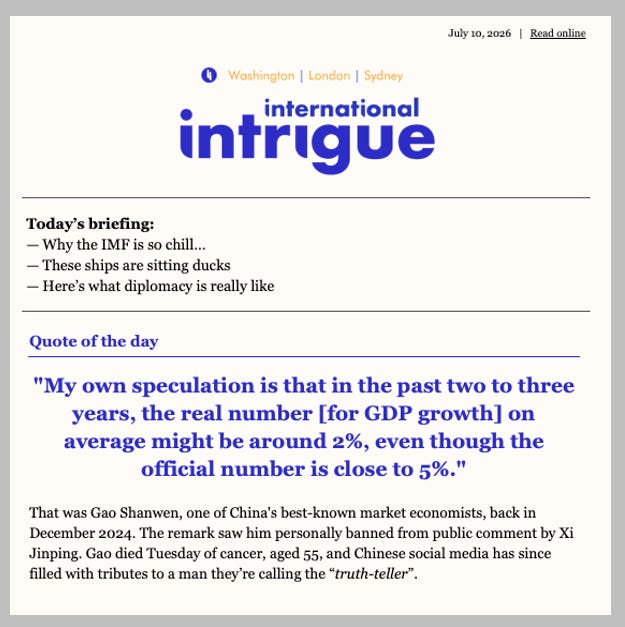
Let’s take a look at a few other deaths that were likely just coincidences.
Chinese Monetary Official Dies in Fall From 7th-Story Window
Elisabeth Rosenthal, New York Times, May 13, 2000
Li Fuxiang, the PRC’s top foreign exchange regulator died after falling out of a seventh-floor window.
Chief accuser of fallen Chinese political star Bo Xilai dies in jail
The Guardian, December 7, 2015
Xu Ming, the billionaire business leader of Shide Group, who paid millions in bribes to Bo Xilai and then testified against Bo, was serving a prison sentence. Less than a year before he would be released, he died of a heart attack at age 44.
China’s HNA Chairman Wang dies in France after falling from a wall
Se Young Lee and Jean-Francois Rosnoblet, Reuters, July 4, 2018
In July 2018, Wang Jian, the Chairman of HNA Group was visiting France and fell 15 meters to his death while posing for a photo. The PRC Government had started investigating the company over its foreign acquisitions the year before and it would declare bankruptcy less than two years later.
The Mysterious Murder of Jim Li
Vermilion China, October 8, 2023
Jim Li had participated in the student protests in Tienanmen, spent years in custody, and then moved to the United States in the 1990s. He became a lawyer and represented other Chinese dissidents who wanted to immigrate to the United States. On March 14, 2022, he was murdered by a woman who had fled the PRC in January. Jim Li was a critical witness in the FBI’s investigation into a ring of PRC spies collecting on other dissidents in New York.
Why the sudden death of a former Chinese premier has moved so many people
Emily Feng, NPR, November 2, 2023
Li Keqiang who was clearly more popular than Xi and was pushed out by Xi in 2022, died while swimming in a pool.
Top Economist in China Vanishes After Private WeChat Comments
Chun Han Wong and Lingling Wei, Wall Street Journal, September 24, 2024
There is no proof that Zhu Hengpeng is dead… but no one has seen him in public since April 2024. He apparently “made impolitic remarks in a private chat group on WeChat” about the performance of the Chinese economy and the CCP’s leadership. For over a decade he was the deputy director of the Institute of Economics at the Chinese Academy of Social Sciences. I would not be surprised if PRC newspapers published a story soon that he died of either a heart attack or of cancer.
Gaétan Pouliot, CBC News, December 8, 2025
Hua Yong, a Chinese artist who staged a protest at Tiananmen Square on June 4, 2012. After being imprisoned multiple times, he fled to Canada in April 2021. In November 2022 his body was found along the shore in British Columbia after he had gone for a kayaking paddle.
How One U.S. Ally Is Countering China
Matthew Tostevin, Newsweek, July 8, 2026
A decade after the Philippines won an international legal ruling against China over its maritime territory, it is strengthening its forces and alliances for a bigger pushback over continuing Chinese encroachment, its defense secretary told Newsweek in Manila.
China rejected the July 12, 2016 ruling against its claims to most of the South China Sea and sporadic standoffs between Chinese forces and those of the U.S. treaty ally have continued over the tiny atolls, sandbanks and islands that the Philippines fears China seeks to seize and turn into military bases as it has elsewhere.
The Philippines now plans to increase its presence in more places, Secretary of National Defense Gilberto Teodoro said.
“We see that there is an attempt to occupy areas within our exclusive economic zone, and we have to resist that,” he said at the military’s sprawling Camp General Emilio Aguinaldo in Manila.
“We are building the coalition to enforce the ruling, the ability to enforce the ruling, but the first objective is to stop the creeping advance by China, not only here, but in the rest of the South China Sea. Who knows the next day they might also claim our extended continental shelf.”
“Our objective in this department is to develop a credible deterrent posture, which everybody is doing in this area, whether a claimant country in the South China Sea or not. Japan is doing the same.”
Newsweek sought comment from the Chinese embassy in the Philippines. China has consistently rejected accusations of aggression from the Philippines and accused it of provocations and infringement encouraged by the United States.
“China has consistently maintained that differences should be managed through dialogue and consultation, not through sensationalism or manufactured narratives,” the embassy said in a recent social media post.
COMMENT – I always find it hilarious when the Chinese Communist Party lectures other countries that “differences should be managed through dialogue and consultation.”
The Economist, July 1, 2026
On July 1st the Chinese Communist Party celebrated the 105th anniversary of its founding. The event was marked this week by a concert attended by China’s leader, Xi Jinping, and a state ceremony at the Great Hall of the People. But for the organisers the lead-up to the celebrations was overshadowed by a troubling incident in the heart of Beijing, not far from where the ceremonies would be staged: a security lapse on the evening of June 26th that was both unusual and embarrassing.
A two-seater plane took off from an airfield on the outskirts of Beijing, then crashed into CITIC Tower, the capital’s tallest building. This happened a few kilometres from a complex where the Communist Party’s leadership lives.
Hong Kong police arrest booksellers on suspicion of selling seditious publications
Associated Press, June 24, 2026
Hong Kong police on Wednesday arrested two people on suspicion of selling seditious publications and receiving funds from foreign political organizations, acting under a recent national security law.
The government’s statement early Thursday did not identify those arrested. But local media outlets, including the Chinese-language newspaper Ming Pao, quoted unidentified sources saying one was Hunter Bookstore’s owner Leticia Wong.
Wong, a pro-democracy former district councilor, has remained outspoken after many leading activists were jailed under a crackdown following massive anti-government protests in 2019. If confirmed, her arrest would be widely seen as the latest step to stifle dissent in the Asian financial hub.
COMMENT – The CCP’s jackboot has crushed liberty in Hong Kong.
One might even observe that the Chinese Communist Party is practicing fascism… using the state’s police powers to silence dissent and enforce a form of ultra-nationalism that worships the country’s leaders.
University of Hong Kong student publication Undergrad shuts down after 74 years
Hillary Leung, Hong Kong Free Press, June 29, 2026
A student magazine at the University of Hong Kong (HKU) has announced its shutdown after failing to recruit enough members for its editorial board, bringing an end to its 74-year run.
Undergrad, a publication founded by the Hong Kong University Students’ Union (HKUSU), said in a social media post on Sunday evening that it was folding immediately.
“Today, Undergrad’s historical role in society has come to an end,” read the Chinese-language post, signed off by the 2025 editorial board.
“This is not something to lament with sorrow, but simply the natural ebb and flow of history.”
The post said that since September, it had twice conducted open recruitment for a new editorial board, but to no avail.
COMMENT – This is what a campaign of terror and intimidation by an authoritarian state does to a free society. I hope young people in Taiwan are paying attention.
ENVIRONMENTAL HARMS
Blaming U.S. Air Conditioning for French Weather
Wall Street Journal, June 30, 2026
France has been broiling in a record heat wave, yet Paris Mayor Emmanuel Grégoire declared last week that “individual air conditioning is a scourge,” and “public authorities must act quickly” to prevent a rush to install home AC units. Such attitudes have been ridiculed in the U.S. press, and prickly French politicians are now upset we noticed.
“OMG, this is so rich!” Paris Deputy Mayor Audrey Pulvar wrote online late last week, responding to American criticism. “As the second-largest emitter of greenhouse gases in the world, you bear a significant responsibility for global warming and the consequences we, in France, are experiencing. Your cities, ‘90% air-conditioned,’ are not unrelated to this.” What a bunch of hot air.
Note that Ms. Pulvar makes no mention of massive emissions coming from China, which under the, ahem, Paris Climate Accord has a free pass to keep increasing its carbon output through 2030. And how much of its activity isn’t even on the books? The nonprofit Centre for Research on Energy and Clean Air recently found that Beijing quietly reworked how it calculates Chinese progress toward climate goals in a way that leaves a “Germany-sized gap” in its reported carbon emissions.
COMMENT – I just wanted to post a chart for Deputy Mayor Audrey Pulvar… she clearly needs to do a little more research on her obsession with climate change.
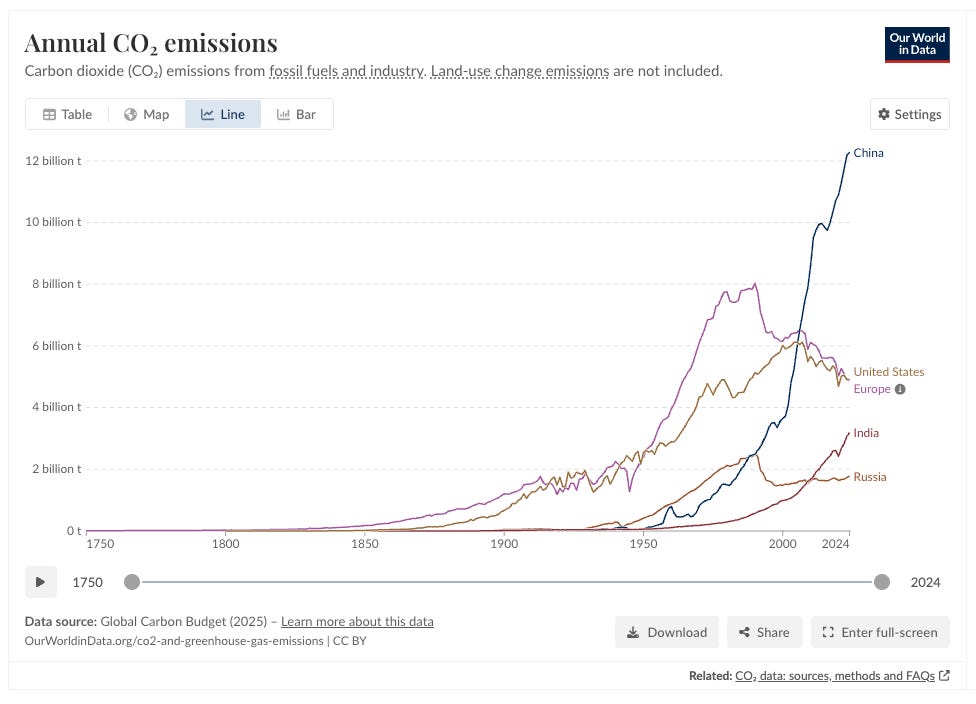
First of all, Europe is and has been the second largest emitter of greenhouse gases, the United States is the third.
And like Europe, the United States has been REDUCING its CO2 emissions for two decades… even as the United States has vastly expanded its households with air conditioning.
Today, the PRC emits double (12.3 billion tons) what the United States emitted at its height in 2005 (6.1 billion tons). [the height of European CO2 emissions was in the 1980s at over 8 billion tons… just saying]
Today, the PRC emits more CO2 than Europe, the United States, Japan, South Korea, Australia, and Canada COMBINED.
It really is amazing how presumably intelligent people who are clearly focused on the issue of climate change and CO2 emissions remain so woefully misinformed about both the history of CO2 emissions and the future projections. But blaming America for what is wrong with the world is a special pastime of the elites in Paris.
A Major Journalism Award Honors ‘Trailblazing Series’ on China’s Global Environmental Impact
Inside Climate News, July 8, 2026
Inside Climate News’ “Planet China” scrutinized the dams, mines and other projects in Beijing’s development campaign beyond its own borders.
An Inside Climate News series that showed the often-hidden environmental impacts of China’s trillion-dollar global development push is a finalist for the John B. Oakes Award for Distinguished Environmental Journalism.
With reporting from Indonesia, Ecuador, Argentina, Peru, Zambia, Zimbabwe and Hungary, the “Planet China” stories showed how a country working to repair the ecological and public-health damage from its own industrialization is now wreaking similar harms beyond its borders.
“This trailblazing series connects the dots and unfurls a roadmap for environmental reporting in a globalized economy,” the judges wrote.
FOREIGN INTERFERENCE AND COERCION
Ministry condemns China after Kenya blocks delegates from Ocean Conference
Yu-Yue Cheng, Jurist News, June 24, 2026
Taiwan withdrew from the 2026 Our Ocean Conference (OOC) held in Mombasa, Kenya, on June 16, after two Taiwanese delegates were denied entry to the conference, and later detained by authorities for over 20 hours. Taiwan’s Ministry of Foreign Affairs and Ocean Affairs Council condemned the Kenyan government for yielding to diplomatic pressure from Beijing. This event marks another example of China’s intensifying campaign of obstructing Taiwan’s international participation.
First held in 2014, OOC has included Taiwan as an invited participant since 2015. However, Kenya, the host country of the 2026 conference, made an unprecedented move of blocking Taiwan’s attendance.
According to Taiwan’s Ministry of Foreign Affairs, the option of “Taiwan” in the participation application system was found to be removed this April. Subsequently, some of the members of the team’s electronic visas were denied. In June, the delegates arrived in Kenya, only to be refused entry, on the ground that the government did not recognize their Taiwan passports. The delegates were later forcibly detained for over 20 hours, with their passports and phones withheld. Eventually, the delegates returned to Taiwan after being released.
Taiwan’s Ministry of Foreign Affairs and Ocean Affairs Council complained of China’s political pressure behind the incident.
Similar political actions have been taken in the recent past, notably the interruption of Taiwanese President Lai Ching-te’s diplomatic visit to Eswatini. President Lai’s visit was originally set for April 22. However, three African countries—Seychelles, Mauritius and Madagascar—revoked the overflight permits without warning, consequently delaying Lai’s visit. In response to the disruption, the House Select Committee on China of the United States later posted on X, denouncing the Chinese government’s pressure on the three countries to impede Lai’s visit. In an April 21 statement, the Inter-Parliamentary Alliance on China (IPAC) also condemned China’s isolation of Taiwan.
Samir Bhattacharya, researcher with India’s Observer Research Foundation, noted in an interview that China has been deploying political pressure and economic motives to systematically obstruct Taiwan’s international participation. He warns that measures such as limiting overflight permits emerges as a new and dangerous approach to serve such purposes.
Particularly, China’s influence on African countries is worth noting. International projects—such as the Forum on China-Africa Cooperation (FOCAC) and the Belt and Road Initiative—have tightened the relations between China and African nations, as well as solidified China’s economic influence over Africa. Eswatini, Taiwan’s only diplomatic ally in Africa, is consequently excluded from the FOCAC and Belt and Road Initiative. As Bhattacharya observes, this has profoundly shaped how other African countries perceive their relations with Taiwan.
China has consistently sought to marginalize Taiwan in the global standing, from pressuring other nations to sever diplomatic ties with Taiwan, to barring Taiwan’s participation in international forums and organizations, including the United Nations and the World Health Organization. With Taiwan’s forced withdrawal from the 2026 OOC, this geopolitical strategy shows no signs of abating.
COMMENT – Sounds reminiscent of what happened at RightsCon in Zambia in early May… but what was different was that once the Taiwanese participants were excluded the organizers started making a big stink and the entire thing was canceled.
The organizers of RightsCon then posted a long and detailed explanation of how their Taiwanese participants had been blocked. It is worth reading their statement in full. The Zambian Government, under pressure from the Chinese Communist Party, started blocking the entry of Taiwanese civil society participants. When the organizers found out they started pushing back. Once it appeared that this would blow up in their faces, someone in the Zambian Government canceled the whole event and the RightsCon organizers went public with the details.
The folks who run RightsCon have real backbones. Their behavior provides an example of how an organization can be committed to positive change at scale as well as being “free of political and corporate influence.”
The organizers of the “Our Ocean Conference” (OOC) apparently don’t have spines.
In April 2024, the U.S. State Department and the Advisory Committee of the annual One Ocean Conference announced the formation of a new permanent Secretariat for OOC and that Secretariat would be run by World Resources Institute’s (WRI) Ocean Program. The 2026 conference in Kenya was the first OOC that WRI fully organized and ran.
World Resources Institute (WRI) is a Washington DC-based, non-profit (501(c)3), which touts it’s independence and transparency.
The OOC was launched in 2014 by Secretary of State John Kerry and has been held annually since 2015. Since the first conference, the Taiwanese government and civil society has attended and contributed millions of dollars each year towards programs to further the goals of sustaining and protecting our oceans (the PRC has also attended and contributed a fraction of what Taiwan has for the last decade).
In 2025 when this conference was held in South Korea, Taiwan’s International Cooperation and Development Fund committed to invest $2.3 million in climate change related projects and another $2.1 million for projects related to a sustainable Blue Economy and fisheries. That year Taiwan’s Ocean Affairs Council also made commitments to the organization’s goals. In 2024 when Greece hosted the conference, Taiwan made commitments on marine protected areas and to clean up marine pollution and $1.1 million from Taiwan’s International Cooperation and Development Fund.
All that change this year when WRI took over the management and for the first time Taiwan was blocked from attending.
As the secretariat for the “Our Ocean Conference,” WRI could have threated to cancel the conference entirely and made it very difficult for Kenya to bow to the CCP’s pressure.
But they didn’t.
WRI has a branch office in the PRC with over 60 employees (of course they do), which means that WRI is unlikely to take such a principled stand knowing that the CCP would retaliate against them.
I decided to check out WRI’s website, just to check on their mission and values. Here is what they have listed under their value of “Independence”:
Given WRI’s obvious inability to withstand political pressure from the Chinese Communist Party, I thought I’d help update their Mission & Values page with an asterisk:
You’re welcome Ani Dasgupta, President and CEO of WRI, you don’t even need to pay me a fee for that management consulting service.
Also, I tried to dig into WRI’s donors and funding sources.
On their “Financials” page they assert that they are “fully committed to donor and financial transparency,” which made me feel confident I could understand where they get their funding for the programs they run and the over 1400 “staff” they list on their website.
But they only list six of the last ten years in terms of “funding commitments”… and WRI was founded in 1982, so where are the other 38 years’ worth of public disclosures?
It kind of seems like they aren’t fully committed to donor and financial transparency, but maybe I should just dig into the stuff they do have posted.
Here is what they have for 2022:
Hmmm…
Well let’s try 2021.
Of course, the one donation that is specifically about “subnational climate actions” and “to advance dialogue between Chinese and American stakeholders on key climate issues” is anonymous.
Perhaps WRI’s full commitment to donor and financial transparency deserves another asterisk.
My advice to congressional staffers that read this newsletter: take a look into World Resource Institute and their running of the “Our Ocean Conference”… their headquarters is near Union Station and next door to the Smithsonian National Postal Museum, it shouldn’t be too hard for Ani Dasgupta and his staff to walk over to the Capitol to testify in public about how this happened and why their Taiwanese participants were treated this way… after all they are “fully committed to transparency” and received a five-star rating from Transparify, right?
Waves of the South China Sea, July 8, 2026 [Original in Simplified Chinese]
[Google Translate] On June 30th, the Institute of Regional and Country Studies and the Center for Philippine Studies of the School of International Relations at Jinan University jointly held an academic seminar in Guangzhou on the sovereignty issue of Batan Island against the backdrop of the Japan-Philippines maritime boundary demarcation. The seminar brought together more than ten experts and scholars from renowned universities and authoritative think tanks, including Nanjing University, Zhejiang University, Xiamen University, Ocean University of China, China Institute for South China Sea Studies, Chinese Academy of Social Sciences, Shanghai Institute for International Studies, and Jinan University. Through a combination of online and offline methods, they conducted in-depth discussions on the recent developments in the Japan-Philippines maritime boundary demarcation and key issues related to the sovereignty of the Batan Islands. The conference aimed to systematically review and provide legal responses to these issues from an academic perspective, serving the country’s major strategic needs.
Regarding the sovereignty of the Batan Islands, the participating scholars discussed the issue from multiple perspectives, including geography, culture, history, and law. They unanimously agreed that the Batan Islands legally belong to Taiwan, and that the Philippines’ control over the Batanes Islands lacks historical and legal basis.
COMMENT – So you know it is fake when someone says a couple dozen academics agreed on something “unanimously.”
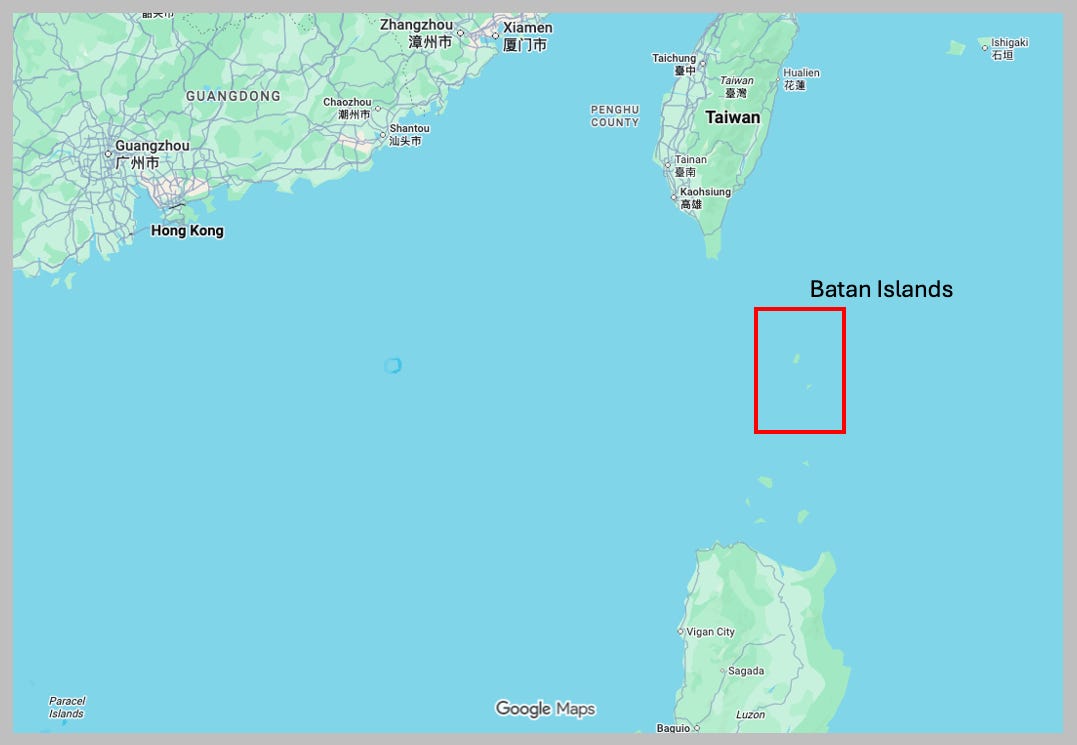
I think it is important to recognize how this declaration by Chinese Communist Party “academics” from Party-run universities and research centers is going to be used to drive a wedge within Taiwan and between Taiwan and its partners in Tokyo and Manila. By asserting that the Batan Islands belong to Taiwan (and of course that Taiwan belongs to the PRC), the CCP is placing Taiwan’s ruling DPP in a dilemma.
If the DPP says nothing about the negotiations between the Philippines and Japan over the sovereignty of these islands, the DPP appears to be capitulating over the country’s territorial integrity to two U.S. allies. Taiwan’s opposition party, the KMT, will then use that to portray President Lai as a lacky of the United States who isn’t willing to stand up for Taiwan’s territory. And of course, it shows that the CCP is willing to protect “Chinese” sovereignty, even as it threatens to annex Taiwan violently.
If the DPP denounces the Japan-Philippines negotiations because they were not included, then they risk placing themselves at odds with Tokyo and Manila. This makes it more difficult for Taipei, Tokyo, and Manila to work together to stand up to Beijing’s coercion and aggression against the three countries.
One might ask, well why doesn’t Japan and the Philippines simply include Taiwan in their negotiations? One reason is that neither country has official diplomatic relations with Taiwan, which means that if they were to include Taiwan officially in these negotiations, then Beijing would scream bloody murder that the two countries are violating their “One China” principle.
It just goes to show how problematic the whole “One China” construct is and how it places countries that want to work together for collective security at odds with one another.
Combined with the PRC’s expanding presence in this region to the east and south of Taiwan, it is a messy conundrum.
China claims Japan-Philippines talks over area east of Taiwan break international law
Matthew Strong, Taiwan News, July 4, 2026
China claims talks between Japan and the Philippines about maritime borders east of Taiwan are illegal as they did not involve Beijing, the Financial Times reported Friday.
The talks centered on overlapping parts of the exclusive economic zones of Japan and the Philippines. The zones are areas where governments have rights to explore, use, and manage natural resources.
The China Institute for Marine Affairs said the bilateral agreement between Tokyo and Manila for the talks was reached without consulting Beijing and violated international law, according to Financial Times. The institute said the bilateral efforts should stop, and the two countries should start negotiations with China.
After news of the bilateral talks emerged in June, China said it would conduct “special maritime law enforcement operations” east of Taiwan. It was the first time Beijing sent coast guard ships to the area for such type of operations, the Financial Times reported.
China said the coast guard inspected 198 ships in the area, “rectifying” violations by three ships, according to the report. The Chinese vessels also conducted a hydrographic survey and patrolled near undersea cables, the report said. The Chinese actions east of Taiwan were also seen as a rehearsal for a potential blockade of Taiwan as well as disruptive to international shipping lanes.
The Chinese coast guard actions were condemned in a joint statement by the British, German, and French representative offices in Taiwan and by the American Institute in Taiwan as a threat to freedom of navigation.
During the past week, China also issued radio warnings to Japanese research vessels near the Japanese-held Diaoyutai area, disputed islands northeast of Taiwan.
China Raises Pressure on Taiwan with Expanded Coast Guard Patrols
Chris Buckley, New York Times, July 5, 2026
China is opening a new front in its pressure campaign against Taiwan, sending ships to its east to drive home a political point: Beijing claims not only the island itself but also the seas around it.
The China Coast Guard announced on Saturday that its ships would conduct “law-enforcement patrols” in the Western Pacific waters east of Taiwan, a self-ruled island of 23 million people that Beijing claims as its territory.
The Western Pacific is crowded with commercial traffic and would be a vital arena if Beijing ever tried to blockade or invade Taiwan. China’s coast guard ships are often hulking, well-armed vessels that complement the country’s naval forces. They have been vital to Beijing’s efforts to dominate the disputed South China Sea, sometimes by swarming waters, ramming vessels or blasting crews with powerful water cannons.
During the patrols, the coast guard ships “will continue to strengthen law-enforcement patrols in waters under China’s jurisdiction and firmly safeguard China’s territorial sovereignty and maritime rights and interests,” the China Coast Guard said on Saturday.
Keoni Everington, Taiwan News, June 30, 2026
Australia Tried to Push Back on China. China Pushed Harder.
Victoria Kim and Lily Kuo, New York Times, July 4, 2026
Relations between Beijing and Canberra have improved over the past four years, but China’s ambassador is now warning of a ‘Cold War mentality.”
Since resuscitating relations with China from a low point a few years ago, the Australian government has relied on an oft-repeated mantra to “cooperate where we can, disagree where we must.”
Some of those disagreements came into view this week as Chinese diplomats pushed back against an Australian intelligence assessment and Canberra’s security-deal making in the Pacific, accusing the country of stoking paranoia and unfairly targeting China.
In one of the public skirmishes, China’s ambassador to Australia, Xiao Qian, responded to an annual threat assessment speech given by Australia’s top intelligence official, Mike Burgess, by writing an opinion piece published this week in the Sydney Morning Herald.
Mr. Burgess warned about foreign interference in Australian society as well as “coercive repatriations” and attempts to gain access to critical infrastructure. He did not mention China by name, but a video at the event reportedly showed footage of Chinese nationals who were arrested in Canberra for allegedly covertly collecting information on a Buddhist group in Australia on behalf of Chinese security officials.
MAC suggests China may be involved in attack on Japanese commentator
Hao Hsueh-ching, Focus Taiwan, July 6, 2026
Priced at Zero: What Beijing Pays for Operating in Canada
Dennis Molinaro, The Bureau, July 8, 2026
PM Carney says Canadians must deal with the world as it is. Yet on China, a former national security analyst argues, his government continues to act as if Beijing is the partner Ottawa wishes it were.
In late June Taiwan authorities arrested three tech executives over the alleged diversion of roughly $22 million in Nvidia AI servers bound for China. Taiwan’s President Lai Ching-te put forward new national security laws and created a new website where citizens can safely report PRC spies to authorities. Recently a Taiwan court sentenced a former spy named Lu Chi-hsien to more than 12 years in prison for leaking top-secret information to China.
Taiwan arguably faces the greatest risks and dangers in aggressively targeting PRC espionage and influence networks yet it continues to do so. So what is Canada’s excuse?
The comparison is a poignant one. A modern democracy, an ocean away from the PRC, yet neighboring the PRC’s largest target, the United States, has consistently failed at bringing forward successful prosecutions, even detecting PRC activities when compared to Taiwan, Australia or other western allies.
The conclusion as to why appears to be because Canada has outsourced its counterintelligence enforcement to the United States.
Consider even just a modicum of cases.
Su Bin, famously indicted by the United States for assisting PRC hackers in stealing the C-17 transport plane details as well as F-35 intelligence was assisting those hackers from Canada. Kevin and Julia Garrett were taken hostage by the PRC because of his arrest. He was never prosecuted by Canada for anything, arrested only because the US sought his extradition, and now lives in the PRC and resurfaced in China as the fixer who brokered the PLAAF training contract of Gerald Brown, an ex-USAF pilot charged in February 2026.
Benlin Yuan, a Canadian citizen and Mississauga resident, was arrested by the FBI in Virginia in November 2025 for his role in a PRC procurement network.
The US arrested operators of PRC overseas police stations in New York. No arrests in Canada though the RCMP was sued for defamation by a community group in Canada.
Canada’s answer to decades of this activity has been the Hogue Inquiry which regarded PRC influence as a major threat to Canadian democracy, but no prosecutions emerged from its findings. Canada has become consistent at producing findings but not consequences for PRC influence and interference. Beijing has correctly priced its cost for these activities in Canada at zero.
It’s why the Taiwan example becomes so stark an illustration of where Canada is on China, or more accurately where it isn’t. Taiwan has every reason to act carefully, every reason to walk a fine line with a neighbor convinced that it should not independently exist. Canada has no such concern from the PRC.
Still, it has consistently and repeatedly faced hostile activity from China: hacking, influence, interference. But Canada continues to lack the will to defend itself and only appears moved to act when the United States steps in. Part of the largest reason for this is not because the United States has some type of magic wand that leads to prosecutions. While valid arguments can be made for Canada lacking political will, at the working level structural impediments are built into Canada’s law enforcement and intelligence ecosystem. CSIS collects intelligence but can’t arrest, the RCMP arrests but can’t use intelligence.
The country lives with a structural flaw more than 40 years old: the removal of all domestic security intelligence collection from the federal police service, introduced by the McDonald Commission. Research I coauthored demonstrated this may have had more to do with the government of the day saving face for conduct it tacitly approved, rather than being solely the result of RCMP misdeeds.
The fixes are there, and known, but lack any political will to address them.
Chinese lidar maker with Nvidia ties accused of being cyber risk for U.S.
Melissa Lee, Paige Tortorelli, and Scott Zamost, CNBC, July 7, 2026
Taiwanese authorities charge executives who helped China’s cyber spies target ICIJ network
Scilla Alecci, International Consortium of Investigative Journalists, July 7, 2026
The Ministry of Justice Investigation Bureau probe corroborates ICIJ and Citizen Lab’s findings that attacks against journalists were part of a coordinated espionage campaign sponsored by Beijing.
A unit of Taiwan’s Investigation Bureau has charged two executives of a company that allegedly helped China’s cyber spies target Taiwanese officials and scholars, impersonating reporters affiliated with the International Consortium of Investigative Journalists.
After searching the offices of local firm Abigail and other locations, the Taipei City Investigation Office issued deferred prosecution orders against Li Hualun and Chen Mengsen for violating the personal data protection act and other crimes, according to a statement released by the bureau today.
The two obtained accounts for the messaging app LINE and leased them to Xiamen Empress Information Technology Co. Ltd., a firm allegedly linked to China’s cyber army, for about $161 per account. This enabled Chinese government-backed hackers to launch “social engineering attacks” against Taiwanese officials, as well as scholars and NGO workers, by impersonating journalists, the investigators found.
The suspects “acted under the direction of the Chinese Communist Party’s cyber army unit,” the bureau said.
HUMAN RIGHTS AND RELIGIOUS PERSECUTION
Tibetan Man Dies After Self-Immolation Protest in New York
Lily Kuo, New York Times, July 2, 2026
Lobga Rangzen, a 52-year-old resident of Queens, died after the self-immolation. He said Beijing’s policies were “destroying the Tibetan people.”
A Tibetan activist lit himself on fire and outside of the United Nations headquarters in New York on Thursday to protest China’s control over his homeland, declaring in a video before his self-immolation that Beijing’s policies were “destroying the Tibetan people.” He later died.
Friends of the activist identified him as Lobsang Palden, known as Lobga Rangzen, a 52-year-old resident of Queens. Originally from eastern Tibet, Lobga Rangzen had been an advocate of Tibetan independence for more than a decade.
The police said that around 6:30 p.m. on Thursday they responded to a call for help at East 42nd Street and 1st Avenue, next to the U.N. headquarters, where they found a man with severe burns throughout his body. He was taken to Bellevue Hospital, where he was pronounced dead.
Lobga Rangzen appeared to have recorded his self-immolation on a livestream on his own Facebook page, which was verified by a friend of his. In it, he could be seen walking across a street outside of the U.N. building with a large Tibetan flag. Moments after he erected the flag on a street corner, he lit himself on fire. He stepped on to the street as his body was engulfed in flames then collapsed on the ground. (The video was later taken down.)
Uyghur Fathers, Uyghur Children: Persecution and Resilience Across Generations
Abdurehim Gheni Uyghur, Bitter Winter, July 7, 2026
An exile’s tragic and loving story of wisdom, compassion, and assassination.
New ‘ethnic unity’ law set to entrench assimilation of minority groups
Amnesty International, June 30, 2026
Ethnic Unity: What Is China’s New Law?
Micah McCartney, Newsweek, July 2, 2026
Taiwan warns of risks of working in China under ethnic unity law
Keoni Everington, Taiwan News, July 1, 2026
Taipei warns China ethnic unity law increases risks for Taiwanese travelers
Keoni Everington, Taiwan News, July 7, 2026
Donald Clarke, Chinese Law Notes, June 25, 2026
The Chinese government has confirmed that the law does indeed extend to foreigners outside of China. In a June 24, 2026 press conference, Deputy Minister of Justice Hu Weilie stated,
Article 63 — providing that organizations and individuals outside China who engage in acts of undermining ethnic unity and progress or creating ethnic separatism against China shall be held legally liable — is legitimate, lawful, and consistent with international norms.
Somewhat bizarrely, Hu also condemned as smears and distortions reports that China was exercising long-arm jurisdiction or extraterritoriality:
We have recently noted that some Western media are paying attention to Article 63 of the Law on Promoting Ethnic Unity and Progress — that is, “organizations and individuals outside the territory of the People’s Republic of China who commit acts of undermining ethnic unity and progress or creating ethnic separatism against the People’s Republic of China shall be held legally liable in accordance with the law” — and are distorting it, even smearing it as “extraterritorial jurisdiction” or “long-arm jurisdiction.”
What can one say? ¯\_(ツ)_/¯
COMMENT – This deserves a lot more attention than it is getting.
Hong Kong Free Press, June 25, 2026
China has the “legitimate” right to target people beyond its borders under a new “ethnic unity” law, a top judicial official said on Wednesday, after overseas rights advocates warned it could be used to further marginalise minority groups.
The Ethnic Unity and Progress Promotion Law, which comes into effect on July 1, aims to forge a “shared” national identity among ethnic groups and contains a clause saying people and organisations overseas can be held liable for violating it.
Rights groups have argued that the law could provide Beijing with more legal justification for pursuing overseas advocates for minorities, such as the Uyghurs or Tibetans, that the Chinese government is accused of repressing.
Vice Justice Minister Hu Weilie defended the legislation on Wednesday, saying the clause “aligns with legal principles”.
“This provision is grounded in national realities… conforms to international practice, and constitutes a legitimate, lawful, necessary, and feasible legal measure,” Hu said at a news briefing, according to an official transcript.
COMMENT – The PRC has signed extradition treaties with nearly 60 countries, these include: France, Italy, Spain, Belgium, Greece, Lithuania (really?!?), Brazil, and Mexico.
If you’re critical of thew PRC, you might want to see which countries might extradite you.
AUDIO – The uncertain future of the foreign fighters who helped topple Syria’s Assad
Emily Feng, NPR, June 8, 2026
Uyghur fighters have been incorporated into the new Syrian government, but their future in Syria remains uncertain as China ramps up pressure to deport them back to China.
COMMENT – Emily Feng has been reporting on this for a while and has a new book coming out in October titled, Our Hearts Burned for Home: Uyghur Militants in Syria’s Civil War. I look forward to reading the advanced copy I just got.
2 autistic men plead guilty to secession over joining Hong Kong pro-independence group
Hans Tse, Hong Kong Free Press, July 3, 2026
2019 protester was ‘some distance’ from clashes, magistrate says
Hillary Leung, Hong Kong Free Press, July 6, 2026
China Frees Pastor Detained in Crackdown on Religion After Trump’s Urging
Sui-Lee Wee, New York Times, July 5, 2026
The pastor of a prominent underground church in China who was detained last year as part of a crackdown on religious activity was released on Friday, his daughter said, less than two months after President Trump raised his case with China’s leader, Xi Jinping.
The pastor, Jin Mingri, who also goes by the name Ezra, was freed after more than 250 days in custody and allowed to leave for the United States.
Mr. Jin, the pastor and founder of Zion Church, was detained in October and later charged with “illegally using information networks.” After the Chinese authorities shut down the physical headquarters of his church in Beijing in 2018, he moved its operations online, broadcasting sermons on the internet. Those streams were widely popular, reaching an estimated 10,000 people all over China, Mr. Jin’s daughter, Grace Jin Drexel, said.
Mr. Jin was detained as part of a wider campaign against religious groups in China. Several other pastors were similarly taken into custody as Mr. Xi’s government tightened its grip.
COMMENT – I’m very glad to see the pastor freed, but it should only remind everyone at how abusive the Chinese Communist Party is.
Colorado University PHD Student Disappeared in China Two Years Ago
Human Rights in China, June 15, 2026
Tenzin Nyidon, Phayul, July 7, 2026
Tibetan independence activist Lobga Rangzen dies after self-immolation in New York
Tenzin Nyidon, Phayul, July 3, 2026
Thalia Kehoe Rowden, Melissa del Aguila, and Patrick Poon, New Bloom, July 4, 2026
The Rivalry Over Buddhism’s Future
Sudhi Ranjan Sen and Philip Heijmans, Bloomberg, July 3, 2026
China’s Vanishing Space for Rainbow Journalism
Tian Jian and Heng Yu, Lingua Sinica, June 25, 2026
On May 17 this year, International Day Against Homophobia, Biphobia and Transphobia, the British Embassy in China published a post on two of China’s top social media platforms, Weibo and WeChat, that looked back on nearly three decades of developments for gay, lesbian, and queer communities in China. The post — “Is the Rainbow Over?” — immediately drew attention in China, with views on WeChat alone spiking to 100,000, the maximum permitted number of views that can be displayed on the platform.
One notable absence from that post was any mention of China’s first award recognizing media coverage of LGBT+ issues: the China Rainbow Media Awards.
Founded in 2011, the awards were established to recognize individuals and media outlets that gave voice to queer communities, and beginning in 2012 the organizers also published an annual media monitoring report looking more broadly at coverage of queer communities in China. While the annual awards ceremony has not been held since 2019, the organizers have consistently published their monitoring report. The 2025 edition was released on May 17.
INDUSTRIAL POLICIES AND ECONOMIC ESPIONAGE
VIDEO – The Real Reason European Cars Can’t Compete
Patrick Boyle, YouTube, July 4, 2026
Europe’s automotive industry is facing a historic crisis as Volkswagen weighs unprecedented factory closures and massive job cuts. However, the root of the problem isn’t just high energy costs or European bureaucracy—it’s China Shock 2.0. With Chinese electric vehicle (EV) manufacturers building cars significantly faster and for thousands of euros less, traditional German automakers are rapidly losing market share both at home and abroad. This video analyzes the structural trade imbalances flooding the market with subsidized EVs, explains why laying off workers won’t solve Volkswagen’s €6,000 per-car cost gap, and examines whether new European Union tariffs will protect domestic manufacturing or simply trigger a costly global trade war.
…
Ask a European official why any of this is happening, and you’ll get the same three culprits every time. High energy costs, an aging workforce, and red tape from Brussels.
Notice what’s missing from that list. It’s a bit like asking a man why his house burnt down, and getting a very detailed lecture about the flammability of his curtains. It might be true, but it completely ignores the guy standing on the lawn with an empty gas can.
…
The economist Adam Tooze has described what’s happening between Germany and China as “mercantilist on mercantilist violence” which is both a wonderful phrase and an accurate description.
According to Tooze 60% of the massive 27 billion euro swing in Germany’s trade balance with China between 2021 and 2025 was accounted for entirely by vehicles.
For a hundred years, German car makers assumed their advantage. The ability to build a flawless combustion engine was permanent.
But the forced transition to building electric vehicles changed the rules of the game entirely. The Chinese didn’t just catch up with battery chemistry and software. They lapped everyone else.
To understand how Chinese manufacturers managed to sidestep a century of European engineering dominance, you need to understand something the industry is now calling China speed.
European and American car makers typically run product development cycles of 40 to 80 months. Chinese firms on the other hand can get a brand new model out the door in under 24 months. That’s a lot faster. They manage this with flat management structures, punishing work hours, and by applying a software industry attitude towards quality control where they first ship the car and if there are any problems, fix them later with an over the air update once people start complaining on social media.
This is a very different approach to running a car company. Not one that I would have picked, but here we are.
China speed explains how they’re developing and building cars so fast, but it doesn’t explain the wave currently hitting Europe. That’s a separate thing. And economists have started calling it China shock 2.0.
The first China shock or China shock 1.0 hit after China’s entry into the WTO in 2001. It mostly wiped out low-wage manufacturing, things like toys, furniture, and basic electronics, industries that were never going to define any country’s long-term economic future. And these industries were a much smaller slice of the global economy at the time. It hit the American rust belt hard, but Germany did just fine because a rapidly industrializing China needed enormous amounts of heavy machinery, chemicals, and vehicles.
And Germany happened to make exactly those types of goods and could sell them to China.
China Shock 2.0 is a very different animal. China’s economy today is about 18% of global GDP. So, any growth in its exports is growing from a vastly larger base. And that export growth is now concentrated in precisely the capital and technology intensive sectors Europe used to have to itself. China doesn’t need German machine tools anymore.
In fact, that relationship has now flipped.
Since mid 2025, according to the Center for European Reform, Germany has been buying more capital goods from China than it sells them. It’s a bit like selling a man a complete set of precision tools only to look out your front window a few years later and realize that he’s used them to take the wheels off your car. The scale of this is hard to overstate.
COMMENT – Patrick Boyle makes some amazing explainer videos… this one is no exception.
How Volkswagen’s Troubles Were Made in China
Keith Bradsher, New York Times, July 10, 2026
The German auto giant’s push into China powered it for decades, but now the company faces fierce competition from Chinese automakers in markets around the world.
Volkswagen has problems around the world, spurring it to announce on Thursday that it would slash the number of models it offers by as much as half, but many of its troubles can be traced to China.
The German auto giant, the world’s second-largest carmaker after Toyota, led the pack in China, the world’s largest car market, for four decades. For many years, the company’s joint ventures and factories in China provided half or more of the company’s worldwide profits, which helped Volkswagen afford high salaries and generous benefits for its vast work force back in Germany.
But Volkswagen’s sales in China last year were down by a third compared with 2019, as the company lagged Chinese competitors in the switch to electric cars. And the company’s performance keeps getting worse: Sales in China from April through June were down by another third from just last year, a weak performance even by the standards of China’s slowing economy and shrinking car market.
Volkswagen now faces daunting competition from Chinese rivals in markets outside China, too. Chinese cars are pouring into Latin America and Africa, where Volkswagen has long been among the market leaders. And in the European Union, VW’s home turf, Chinese automakers passed Japanese automakers in terms of market share in May. The rapid expansion by low-priced Chinese entrants in Europe is putting heavy pressure on Volkswagen and other European manufacturers to cut prices, shrinking their profit margins.
China Is Devastating the Last Stronghold of German Industry
Tom Fairless, Wall Street Journal, July 3, 2026
Midsize companies that employ millions of workers are now shedding jobs and relocating overseas to cut costs.
For decades, thousands of niche, world-class manufacturers that form the backbone of the German economy relied on an unassailable moat: unmatched quality. Now that moat is drying up.
The Mittelstand—a broad tier of midsize manufacturers, mainly specialized in capital and intermediate goods and reliant on exports—once thrived by making machines for factories everywhere. But China is now closing the quality gap and offering prices as low as half those of their European rivals.
As panic spreads among German manufacturers, layoffs are rolling through formerly prosperous towns and villages with no living memory of a downturn. The moment could become a political turning point for a country whose wealth was largely created by the Mittelstand, or “middle-class”—shorthand for the inner core of Europe’s largest economy.
For the first time in decades, Germany now imports more advanced capital goods from China than it exports there. Manufacturers are suddenly on the defensive, not just in China and elsewhere, but also at home. Many Mittelstand firms are idling workers, cutting jobs or shifting production, including to China.
Patric Burkhart, managing director of machinery manufacturer Aura, based in southwest Germany with 115 employees and around $30 million in annual revenue, said Chinese competition had surged over just the past six months, causing orders to dry up.
Aura makes heating equipment that is built into bigger industrial machines, such as presses, ovens and extruders—which make everything from plastic bags and window frames to car parts and snacks.
A Chinese competitor recently emerged in the market, creating strong price pressure, Burkhart said. To win projects with the incumbent German and Japanese manufacturers, he said, “I have to be very creative.”
German industry is losing more than 10,000 jobs every month, according to a May report by EY. Industrial output declined by around 10% between February 2022 and early 2026, with energy-intensive sectors plunging by more than 15%.
Germany’s trade balance with China in capital goods slid from a surplus of roughly 750 million euros to a €500 million deficit between mid-2024 and August 2025 on a 12-month rolling average, according to New York-based Apollo Global Management. Germany’s machine-tools exports to China slumped by around one-third in the first quarter from a year earlier.
If European policymakers don’t take tougher measures to protect industry, “you could see a very rapid decline of the German Mittelstand,” said Noah Barkin, senior adviser at the research firm Rhodium Group.
European leaders are seeking new legal powers to hit back at China. China’s overall goods exports to Germany alone have jumped 17% this year through May compared with the year prior, and those to the European Union have increased 16%, according to dollar-denominated data from Chinese customs.
China has increasingly leaned on manufacturing to drive economic growth following an epic property-market collapse. Facing weak demand at home and overflowing warehouses, factories are aggressively selling overseas, driving the nation’s trade surplus to a historic $1.2 trillion last year.
This evolution was a deliberate, state-backed engineering feat. Under its “10,000 Little Giants” initiative, the Chinese government funneled massive subsidies, tax breaks and state resources into thousands of specialized midsize firms, explicitly designed to replace Germany’s famed “hidden champions.”
There are still German companies that make products that China needs, said Barkin. These include Trumpf, a maker of lasers, and Zeiss, which manufactures optical devices used in medical machines and chip-making equipment. But Beijing is trying to address those dependencies and produce those goods.
COMMENT – German political leaders should be moving very fast to erect trade barriers to Chinese imports… instead it looks like they are going to just wait and see what happens.
A Trucking Startup Aims to Challenge Tesla. Now, Paychecks Are Missing—and So Is a Truck.
Paul Berger, Wall Street Journal, July 5, 2026
Noah Smith, Noahpinion, July 6, 2026
Lingling Wei, Wall Street Journal, July 7, 2026
China’s booming gig economy masks job market pain, strains welfare system
Reuters, July 7, 2026
PMI print suggests deflationary pressures returning
Trivium China, July 6, 2026
The Chinese State Goes Abroad: Beijing’s New Outbound Investment Regime
Stefanie Kam, RSIS, July 7, 2026
On 1 July 2026, China’s Regulation on Overseas Investment entered into force after it was adopted by the State Council three months earlier. The regulation represents a significant development for the country as it grants Beijing legislative powers over outbound capital at a time when Chinese investors are expanding overseas and facing heightened foreign scrutiny. China’s state media Xinhua reported outbound direct investment of roughly US$63 billion in the first four months of 2026 alone.
The regulation replaces scattered ministerial rules from the National Development and Reform Commission (NDRC), the Ministry of Commerce (MOFCOM) and the State Administration of Foreign Exchange (SAFE) with a single State Council instrument of 34 articles. It grants individual Chinese residents their first statutory basis to invest abroad and completes what Chinese commentary calls the legal tools governing the outbound wing of a system, complementing the legal tools that govern inbound capital in the form of the Foreign Investment Law.
COMMENT – This legislation grants the CCP control over all outbound investment.
CYBER AND INFORMATION TECHNOLOGY
US is working on ban targeting Chinese energy inverters, sources say
Alexandra Alper and Sarah Mcfarlane, Reuters, June 30, 2026
Chinese AI usage by US firms soared after Mythos restrictions
Masaharu Ban and Manami Ogawa, Nikkei Asia, July 7, 2026
Shanghai sets aside $14.73 million for quantum computing hub
Ameya Paleja, Interesting Engineering, July 6, 2026
China’s new unfiltered AI Is a hacker’s budget dream
Marcus Walsh, Cyber News, June 30, 2026
According to researchers at Graphistry and Semgrep, the model can help identify software issues and support cybersecurity investigations at a much more affordable price than main players like OpenAI, Google, or Anthropic.
The model was released by Chinese startup z.AI (formerly Zhipu Ai) and has quickly caught the attention of the security community. Developers say it is on par with US models for carrying out tasks like vulnerability discovery and security investigations, and at around half the cost.
What makes it different is that people can download it and run it on their own computers.
As more commercial models have built-in guardrails that could suspend a user for abuse, GLM-5.2 can be downloaded onto a user’s computer, allowing users to operate with free range, and potentially remove safety measures.
If used legitimately for cybersecurity research, it could mean a more affordable option for the industry, but without diligence and industry oversight, GLM-5.2 could get into the wrong hands.
That means criminals have access to extremely powerful AI tools behind closed doors – capabilities once limited to a handful of companies are becoming easier for almost anyone to access.
In the eyes of some, this has been coming for a while. “China’s release shouldn’t come across as a shocking breakthrough,” says Gene Moody, field CTO at cybersecurity firm Action1.
China-linked actors target more than technology as AI competition with U.S. intensifies
Evelyn Cheng, CNBC, June 30, 2026
Deep Learning: Tsinghua University, Banned Chips, and the Network Supplying China’s AI Ambitions
Wire Screen, June 30, 2026
China Plans to Let Top AI Firms Buy Limited Amount of Nvidia H200 Chips
Qianer Liu, The Information, July 8, 2026
MILITARY AND SECURITY THREATS
China Tests Long-Range Ballistic Missile in the Pacific, Angering Neighbors
Victoria Kim and Chris Buckley, New York Times, July 6, 2026
‘Destabilising’: Australia blasts China for launching nuclear-capable weapon in Pacific
Matthew Knott and Lisa Visentin, Sydney Morning Herald, July 6, 2026
The launch of a nuclear-capable long-range missile from a Chinese submarine in the South Pacific with just hours of notice has angered Australia and New Zealand, who labelled the test destabilising and concerning.
The firing of the ballistic missile, fitted with a dummy warhead, came just hours after Australia and Fiji struck a new defence alliance that commits them to come to each other’s aid if they come under attack.
A Chinese tracking ship was stationed alongside Fiji at the time of the missile firing, with a leading maritime surveillance company saying its presence was unlikely to have been coincidental.
Senior Captain Wang Xuemeng, a spokesman for China’s People’s Liberation Army navy, said that a Chinese strategic nuclear submarine successfully launched a strategic missile carrying a training dummy warhead toward “relevant high seas areas of the Pacific Ocean” at 12.01pm on Monday.
Wang said the missile “accurately landed within the predetermined sea area”.
“This missile test launch is a routine arrangement of the Chinese side’s annual military training, and relevant countries have been notified in advance,” he said.
“It complies with international law and international practices and is not targeted at any specific country or target.”
China’s SLBM Test Underscores the Importance of a Ballistic Missile Launch Notification Agreement
Joseph Rodgers, Bonny Lin, and Leon Li, CSIS, July 7, 2026
Japan and NATO share concerns about Chinese military activities
Jesse Johnson, Japan Times, July 8, 2026
China conducts rare submarine-launched ballistic missile test, angering Pacific neighbors
Brad Lendon, CNN, July 6, 2026
Japan set to deliver five retired MSDF warships to Philippines in ‘two to three years’
Jesse Johnson, Japan Times, July 8, 2026
Chinese Warship Shadows US Patrol in South China Sea
Micah McCartney, Newsweek, June 29, 2026
ONE BELT, ONE ROAD STRATEGY
Why Peru wants to shift its relationship with China beyond raw mineral supplies
Cao Jiaxuan, South China Morning Post, July 6, 2026
China’s Expanding Footprint in Guyana
R. Evan Ellis, Expediente Abierto, July 1, 2026
Guyana is a country of both complexity and irony. It is one of the strongest U.S. partners in the Caribbean. It is a member of the “America’s Shield” initiative and has an economy whose transformational growth is closely tied to an Exxon-Mobil-led consortium of petroleum companies. At the same time, its relationship with the People’s Republic of China (PRC) is among the longest and deepest in the region.
Guyana received relatively little attention from U.S. policymakers or companies until the confirmation of major recoverable oil deposits in May 2015, and even thereafter, principally received attention only from communities of interest in Washington that were focused on petroleum, Venezuela or Caribbean affairs.
As a former British colony which only fully gained independence in 1966, Guyana was one of the poorest countries in the region, a multi-ethnic society which largely whose politics and cooperation with the PRC were defined largely through the lens of the “Global South.” This include developmentally focused cooperation in agriculture, small-scale manufacturing and other areas as early as 1971.
The role of the Exxon-led consortium in developing Guyana’s petroleum resources, combined with a relatively positive interaction with the U.S. government in the political crisis which ultimately brough the People’s Progressive Party – Civic (PPP/C) back to power in 2020, arguably contributed to the importance that the current PPP government of Irfaan Ali has placed on maintaining good relations with Washington. At the same time, the ties built by China with the PPP/C, combined with the enormous inflow of new money with the oil boom, has positioned the PRC and its companies to play a major role in Guyana’s rapidly transforming economy, from petroleum and mining to infrastructure projects to retail.
This work looks at that expanding PRC engagement, as the Ali government navigates its relationships with Washington, and with the PRC.
The Hidden Successes—and Limits—of Beijing’s Media Influence in Africa
Emeka Umejei and Sarah Cook, Under Reported China, June 25, 2026
The PRC’s expanding footprint in African media has attracted growing attention from researchers and policymakers. Most of that attention focuses on the scale of Beijing’s operations: the dozens of Xinhua bureaus across the continent, the reach of CGTN Africa, or the Belt and Road News Network. Yet two channels stand out as the most effective, yet among the most underappreciated: Chinese-funded media training for African journalists, and partnership and content-sharing agreements with African media organizations.
Through media training, the PRC is able to tacitly capture a critical segment of the media in Africa, reorienting some journalists toward its “positive reporting” paradigm. Through partnership and content-sharing agreements, it promotes its preferred narratives in African media without much resistance. While other global actors also fund media training for African journalists, none operates content-sharing agreements on the scale of the PRC. The Kremlin has also started initiatives in this direction but has not yet developed the same traction.
Journalist Training: The Economic Hook—and Its Limits
The political economy of these training programs is especially overlooked. African journalists who participate are handsomely remunerated and some have been able to accomplish significant individual economic goals.
In researching my book, I interviewed reporters from 14 African countries. Some explained that thanks to these training opportunities, they were able to buy cars; others completed ongoing projects with money saved during the trip. When you consider that many journalists in Africa may not get their salaries at the end of the month, the economic contributions that these programs make to the well-being of participants are meaningful.
One journalist from Mozambique described the calculation plainly:
They paid us about one thousand dollars for living expenses. They paid for the house, and we lived in a diplomatic apartment all by ourselves. So for those people who wanted to save money, they were able to save some money. I was able to save good money because I had no expenditure. I changed my car when I returned from the training, and I bought a new car. Normally, we are used to going to exchanges and returning without anything, but for this, we were able to save money to get something at home.
A sense of gratitude thus accompanies these exchanges and the Chinese regime also plays on that indebtedness for long-term influence. When journalists return from training in China, they are added to a WhatsApp group managed by the Chinese embassy, which uses it to disseminate information and talking points. If you are in that group, it works like a leash: you will not write anything negative about China, because you are always thinking about the next training trip. You do not want to write something critical and risk being excluded from the group, because exclusion means no more training opportunities and no more extra income.
OPINION PIECES
Graham Fletcher, Lowy Institute, July 8, 2026
Australian Prime Minister Anthony Albanese spoke plainly when he recently said that China was keen on increasing its influence “at a minimum, and [achieving] hegemony in the longer term”. Not everyone shares this assessment, but I do.
The regime in Beijing rejects the idea of ever acquiring hegemony, owing to its allegedly unique national characteristics. But its behaviour suggests otherwise. China plainly wants to win, in everything, and displace (if not actually replace) the United States from its global leadership role.
China displays ambitions which, if realised, will constitute hegemony. Or at least a type of hegemony, one which would be less orderly, given its reluctance to take on responsibility for the global commons.
China’s ambitions are large. No matter what field of endeavour – engineering, science and technology, manufacturing, military capability, AI or space – the regime aims at the commanding heights, combining Stakhanovite determination with Teutonic thoroughness. It has a can-do confidence derived from its recent rapid growth, organisational prowess, the supposed secret sauce of “scientific socialism” blended with “ancient Chinese wisdom”, its economic weight and population size, and the West’s disarray.
China tells the Global South that its experience constitutes an alternative, non-Western path to modernity. Its propaganda speaks of creating a “great miracle in the history of human development” and a “new form of human civilisation”.
Moving beyond the material, China now wants to develop an autonomous knowledge system, a corpus of philosophy and social sciences independent of Western ideas (the irony of Marxism’s European origins is ignored).
In short, wherever possible, China aims to reach the top.
Claims that China is different and will not deploy power like others are not borne out by its behaviour.
All countries seek to maximise their interests but China is unusually exacting in this regard. Its self-proclaimed “core interests” are non-negotiable. It is unembarrassed about exploiting bilateral leverage, linking economic carrots and sticks to political demands. In China’s bilateral dealings it raises the bar ever higher, such as by tightening what it is prepared to tolerate under its “one China” policy umbrella.
In the past, China exerted pressure mainly behind closed doors, but now it is less subtle. Copying the United States, it has developed mechanisms to sanction foreign firms, individuals and governments. During Covid it sought to place political conditions on exports of medical supplies. Now it weaponises its near monopoly on rare earths, with Japan’s defence industrial complex currently a target.
Compromise is seen as the last resort rather than a fair and worthwhile objective. Take the South China Sea. This group of islets and reefs spread between the notional EEZs of several states, claimed in whole or in part by six governments and with no native inhabitants, should be ideal for a negotiated settlement, a big soft power plus for Beijing. But China has resolved that its claims alone will prevail. It is determined to possess these waters come what may: rejecting legitimate international arbitration, investing in massive facilities and deployments to dominate the physical space, and working up legal argumentation that would restrict the application of international law there.
China acts assertively to extend domestic jurisdiction offshore, pressuring foreign governments to repatriate fugitives and where feasible sending its own personnel to do so directly.
Chinese law already applies to Chinese citizens worldwide; Beijing is starting to expand this concept to foreigners. Two examples: the Hong Kong National Security Law of 2020 has global coverage, and the new law to Promote Ethnic Unity and Progress applies to “organisations and individuals outside China who engage in acts undermining ethnic unity and progress, or who create ethnic divisions”.
China is similarly ambitious in trying to silence dissenting voices overseas. It protests, blocks and sanctions politicians, journalists and academics who contradict its narrative. Its Confucius Institutes were intended to shape the teaching of China studies in foreign universities (ultimately with limited success).
China challenges Western media’s dominant “discourse power” by investing lavishly in Chinese alternatives and spreading China-friendly content widely in Global South outlets.
China seeks to chisel away at the status quo of US leadership, promoting its “global initiatives”, which would dismantle US alliances and bases, seeking to expand the BRICS into a Global South cheer squad for Chinese objectives, collaborating with those most antagonistic to Washington (Russia, North Korea, Iran et al) and proclaiming the “East is rising and the West is in decline”.
China is by no means unusual in how it lobbies and exerts pressure. Its practices largely mirror those of others, especially the United States. That is the point: China is no different and can be expected to be no different. Given its record whilst possessing a modest set of tools, can it be doubted that if ever its lofty ambitions are realised, it will seek to “do what great powers do” and fill out the role of hegemon?
COMMENT – Clear-eyed commentary by the former Australian Ambassador to the PRC.
Worse Than an Axis: Why the Informal Alignment of U.S. Adversaries Is So Dangerous
Thomas Wright, Foreign Affairs, July 1, 2026
If actions speak louder than words, the four major adversaries of the United States have sent a very clear message over the past few months. In June, Chinese leader Xi Jinping took his first international trip of 2026 to North Korea, where he and North Korean leader Kim Jong Un agreed to expand their cooperation with no mention of denuclearization. Xi’s trip took place just weeks after Russian President Vladimir Putin made his 25th official visit to China, where he and Xi signed 20 different agreements spanning trade, technology, and economic cooperation. Meanwhile, news reports emerged detailing how Beijing and Moscow have provided indirect support to Iran in its war with Israel and the United States, including satellite imagery of U.S. forces in the region, missile propellant, and advanced drones. These four countries—China, Iran, North Korea, and Russia—don’t have a formal alliance but are increasingly aligning and supporting one another in ways that are materially changing the balance of power and challenging the United States and its allies.
Skeptics argue that this alignment remains shallow, divided by competing interests and mutual suspicion. In this perspective, it is nothing like the feared Axis powers during World War II because it lacks any formal commitments or aggressive public rhetoric. The U.S. intelligence community even makes a version of this argument in its 2026 Annual Threat Assessment, concluding that these relationships are “limited and primarily bilateral” and that the concept of “adversary alignment” risks overstating the depth of current cooperation.
But the absence of a formal bloc does not mean the cooperation is weak. In fact, bilateralism may be precisely what makes it effective. These four states have cooperated on military integration, technological transfers, and mutual learning in a way that exceeds that of most previous authoritarian partnerships. The bilateral arrangements among Washington’s adversaries today can be negotiated faster, are easier to conceal or deny, and are more readily tailored to each pair’s immediate strategic needs than traditional, formal authoritarian alliances. Indeed, history suggests that authoritarian alliances have often proved brittle and unreliable when formalized, particularly when they involve more than two countries. What is emerging among these four powers may be more flexible, and in some respects more dangerous.
Washington’s challenge, then, is not to determine whether a new authoritarian axis has emerged. It has not. The more important question is whether a looser but ever more capable network of military, technological, and political cooperation can generate strategic effects comparable to or even exceeding that of a formal alliance. Increasingly, the answer appears to be yes. The United States will not be able to break apart this alignment. But by understanding its structure and taking it seriously, Washington may still be able to limit its effectiveness.
AUDIO – No limits? Testing the China-Russia relationship
Fiona Hill, Patricia M. Kim, and Jonathan A. Czin, Brookings, July 7, 2026
The China-Russia partnership is highly consequential. Both countries want to reshape the international order in a way that is more favorable to themselves and align against U.S. pressure.
China and Russia view each other as their closest strategic partner because of their shared interests in countering U.S. pressure and reshaping the international order in a way that is more favorable to themselves.
Though the partnership is strong, there is deep mistrust, competing interests, and a desire to preserve their strategic autonomy in the relationship which limits the extent of their closeness.
President Trump has pushed away allies and increased global instability, changing the way Russia considers the global order – and potentially will affect the China-Russia relationship. But the U.S. will be unlikely to drive a wedge between the two states.
Why Foreign Companies Are Re-assessing Their China Portfolio
Bonnie Girard, The Diplomat, July 1, 2026
From the National Intelligence Law to two new State Council decrees, China’s official messaging on foreign investment doesn’t match the actual developments on the ground.
China has recently gone to great lengths to ensure the world knows it is open for business. President and General Secretary of the Chinese Communist Party, Xi Jinping, has repeatedly taken it upon himself this year to deliver that message to key world leaders and corporate heads.
“Over the next five years, China will continue to promote high-quality development and expand high-standard opening-up,” Xi told Irish Prime Minister Micheal Martin in January. Xi also expressed a willingness “to step up economic and trade cooperation, seek synergy of development strategies in such areas as artificial intelligence, the digital economy, and pharmaceuticals and health, and encourage two-way investment,” according to the Chinese Foreign Ministry readout.
Then, later that month, Xi made his pitch to the now-outgoing British Prime Minister Keir Starmer. “As China kicks off its 15th Five-Year Plan, the two sides may expand win-win cooperation in the services sector,” Xi proposed, specifically mentioning cooperation in “education, health, and finance, and… joint research and commercial application in artificial intelligence, life sciences, new energy, and low-carbon technologies for shared development and prosperity.”
And in May, on the occasion of a state visit to China by U.S. President Donald Trump, Xi met with members of a high-level business delegation who accompanied Trump. The delegation roster reads like a who’s who of global business: Elon Musk of Tesla and SpaceX, Jensen Huang of Nvidia, Tim Cook of Apple, Larry Fink of BlackRock, Kelly Ortberg of Boeing, and many others.
Xi reportedly told the line-up of executives that China “will only open its door wider” and that “China-U.S. economic and trade ties are mutually beneficial and win-win in nature.”
At the same time, for many companies considering first-time or further investment in China, other recent events have brought into question the safety and viability of those potential investments.
China has, over the past few years, issued new laws and decrees that impact the degree to which Chinese citizens are obligated to act as informants to the government. Effectively, these laws require ordinary people to act as eyes and ears of state security, reporting suspicious and seditious behavior, as well as anything they suspect could adversely impact the national security of China.
It is inevitable that these laws would dampen the enthusiasm of foreign companies to invest in China. Any company would be reluctant to put their treasure and trust into a country that has turned its citizens – including the employees of their very own foreign-invested enterprises – into intelligence assets, under penalty of law.
That may be the deciding factor against investing in China for the time being, especially as one goes up the value chain. The higher the value of the technology, the more it will attract attention and interference from the Chinese government. Foreign companies may increasingly find that other low-cost options are safer and more welcoming.
This is a difficult problem for China. Historically, nothing is more important to the Chinese Communist Party (CCP) than propagating its own position as the single defining and leading force of Chinese power. Thus, the party must ensure its own health before taking into consideration the impact that has on other aspects of China’s development, including the economy.
It is fair to say that China is in a full defensive posture at this moment in its history. As long as that holds true, the CCP would sacrifice anything, including much-needed foreign investment, in order to preserve itself.
Francesco Sisci, Appia Institute, July 4, 2026
A Taiwan Crisis Is Coming—and Xi May Not Wait
Hal Brands, AEI, July 1, 2026
Something ominous is happening in the western Pacific, and the US isn’t ready for it.
Earlier this month, the Chinese Coast Guard contacted three ships in international waters near eastern Taiwan, demanding they identify their points of origin and destination. China didn’t stop these vessels. But it was asserting a right to police maritime traffic near Taiwan — and, perhaps, previewing a major crisis that could be just a year or two away.
Many China-watchers worry that a Taiwan crisis might occur next year. According to US intelligence agencies, General Secretary Xi Jinping has ordered the People’s Liberation Army to be ready for action against Taiwan in 2027. Yet the critical moment might instead be January 2028. That’s when Taiwan holds its next presidential election, and when Xi might decide to force the issue.
Admittedly, things seem calm now. The last major Taiwan crisis occurred nearly four years ago, when then-House Speaker Nancy Pelosi visited the island. US-China relations seem to be at a temporary truce: Xi and President Donald Trump committed to “constructive strategic stability” at their May meeting in Beijing.
But don’t be fooled.
Xi is assembling the military strength to subdue Taiwan and force unification with the mainland, while steadily increasing the day-to-day pressure in actions short of warfare. Taiwan is consistently ringed by Chinese naval vessels. Chinese forces challenge Taiwan’s airspace and waters; they conduct short-notice exercises that simulate an invasion or blockade. Beijing continually pummels Taiwan with cyberattacks, disinformation and espionage. Things only seem calm because Xi has normalized this malign, multifront war of nerves.
China’s goal is to win without fighting, while readying the military hammer if a fight proves necessary. Xi seeks to demoralize the Taiwanese population and sow doubts about America’s support. He hopes that an isolated, vulnerable society will ultimately accept coerced unification. And sooner, rather than later: The 73-year-old Xi doesn’t have all the time in the world.
His strategy thus requires bringing a compliant Taiwanese government to power. Which makes the 2028 election a flashpoint.
America Needs Another Look at ‘Competitive Strategies’
James Holmes, National Interest, July 7, 2026
Sze-Fung Lee, Nikkei Asia, July 2, 2026
Douglas Irwin, Freedom Frequency, July 8, 2026
Iran’s Most Favored Strait of Hormuz Nation Is China
Wall Street Journal, July 6, 2026
Exchanging Politics for Economics
Francesco Sisci, Appia Institute, June 28, 2026