Friends,
It has been a quarter century since the terrorist attacks of 9/11.
Like many of a certain age, I remember where I was when it happened.
It was early Monday afternoon and I was in my office at Conn Barracks in Schweinfurt, Germany. One of my lieutenants came in to tell me to come watch the News. At the time, I was commanding a cavalry troop in the 1st Infantry Division, and my unit was between field exercises. For my 130 troopers, one day we were living in the Post Cold War Era, getting ready for peacekeeping in the Balkans, and the next we were in the Global War on Terrorism, uncertain of what the future would bring.
When I think back to late summer 2001 in Germany, one song comes to mind: the Swedish band Alcazar’s “Crying at the Discoteque.”
First released in Sweden in the spring of 2000, it didn’t make it to the rest of Europe until July 2001. The song was the band’s first international hit, making it in the Top 10 in the summer and fall of 2001 across Europe. It samples heavily from the 1979 hit “Spacer” by the French singer Shelia and the disco group she fronted for, Black Devotion.
The song includes a tangential connection to the PRC. The chorus refers to the Hollywood star who received a lifetime ban from entering the PRC in 1993 when he spoke at the Oscars in support of human rights in Tibet. The rest of the industry would sideline him for fear that their movies would be blocked from entering China.
The golden years
The silver tears
You wore a tie like Richard Gere
While Alcazar’s version is solid, personally I like Sophie Ellis-Bextor’s 2020 cover of “Crying at the Discoteque”. In the video, she performs in empty music venues… very on point for pandemic ravaged 2020.
***
Julian Gewirtz had a great Twitter/X post last week about how PRC Leader Jiang Zemin responded when he learned of the attacks on New York and Washington.
2001 had been a roller coaster year for U.S.-PRC relations. Even though Governor George W. Bush supported the PRC’s entry into the WTO during the Presidential campaign of 2000 (the PRC would formally join the WTO in December 2001, a 11 months after he became President), many in the Republican Party had been concerned about the military threats posed by the PRC. The National Defense Authorization Act of 2000 (which passed in October 1999) included a number of provisions which showed the growing national security tensions between the two countries, including restrictions on Military-to-Military contacts, the requirement for an annual “China Military Power Report” from the Secretary of Defense, and restrictions on “Chinese Military Companies.” It was just six years since the PRC seized Mischief Reef from the Philippines and just five years since the Third Taiwan Strait Crisis when the PRC launched a missile barrage in response to Taiwan’s first democratic elections. It was also just two years since the diplomatic fall-out from the U.S. bombing of the Chinese Embassy in Belgrade.
Then on April 1, 2001, a Chinese fighter jet collided with an American surveillance plane, a four-propeller engine U.S. Navy EP-3, conducting a routine patrol in the South China Sea in international airspace. The Chinese pilot died in the accident and the damaged U.S. Navy aircraft with a crew of 24 had to make an emergency landing on the Chinese island of Hainan.
The crew was taken off the aircraft at gun point and subjected to days of non-stop interrogation, as the PRC government refused to respond to repeated calls from Washington for details of what happened to the 24 Americans or whether they would be released. Ten days later, the crew was released and President Bush would send a personal letter of condolence to the widow of the Chinese pilot.
The Bush Administration had been in office about 70 days, and this event was the Administration’s first foreign policy crisis and would remain the most serious until that September.
Jiang Zemin’s decision to immediately call George W. Bush, along with offering condolences and support, changed the entire trajectory of U.S.-PRC relations for then next decade. The attacks of 9/11 also reoriented America’s intelligence and national security agencies away from what appeared to be the country’s most serious national security and foreign policy challenge in early 2001: the People’s Republic of China.
Jiang Zemin’s decision to support the U.S. response to Islamic terrorism also kicked off another set of contingencies that continues to reverberate to this day. As the United States sought to find the perpetrators of 9/11 and identify the global movement that sustained them, the Chinese Communist Party decided to portray Uyghur Muslims who resented the PRC’s annexation and colonization of their land, as related terrorists.
For a short period during the Bush Administration, Washington and Beijing portrayed themselves in common cause against a broad Islamist coalition. While public opinion in the United States and across the Middle East would turn on the United States, the PRC used the situation to start a campaign against their own Uyghur minority, which has yet to result in significant reputational costs for the PRC.
When protests broke out in Urumqi, Xinjiang in 2009, which escalated into ethnic clashes between Uyghurs and Han Chinese, the Chinese Communist Party sought to paint Uyghurs as terrorists. Chinese leader Hu Jintao sought President Obama’s support and received only mild push back from Washington.
Less than a decade later, Xi Jinping would start an ethnic cleansing campaign against Uyghur Muslims which included mass incarceration, torture, forced sterilizations, the destruction of mosques, and the setting up of Han Chinese settlements across Xinjiang.
All this makes the new book by Emily Feng so powerful, Our Hearts Burned for Home: Uyghur Militants in Syria’s Civil War (2026).
Emily spent her career as a journalist covering China and Taiwan, but in December 2024 she was covering the overthrow of the Assad regime in Syria. There she found a portion of the Uyghur diaspora, a group that has been largely forgotten by a world that is more afraid of angering the PRC than standing up for human rights and national self-determination.

Cover of Emily Feng’s new book, Our Hearts Burned for Home: Uyghur Militants in Syria’s Civil War (2026).
In this short book, Emily Feng chronicles the interviews she did with a community of Uyghurs who had found a home in war-torn Syria, a location where they could live their lives in ways that were safer than what they could in their homeland under the boot of the Chinese Communist Party.
The book will be out in October, and I’ve gotten a chance to read it early. I’ll provide a review next week along with a review of the new book by Steve Tsang and Olivia Cheung, China’s Global Strategy under Xi Jinping… SPOILER ALERT: both books are excellent.
Thanks for reading!
Matt
MUST READ
China-Based Artificial Intelligence Companies Conducting Industrial-Scale Distillation Campaigns Against U.S. AI Companies
Cybersecurity and Infrastructure Security Agency, September 8, 2026
Executive summary
China-based artificial intelligence (AI) companies are conducting systematic extraction of proprietary functionalities and capabilities of U.S. AI companies’ models through industrial-scale knowledge distillation campaigns that form the core—not merely a supplement—of their AI development strategy. While “distillation” is recognized as a legitimate and useful technique in AI research, China-based AI companies are engaging in aggressive, malicious, and targeted distillation activities at an industrial scale that extract restricted proprietary functionalities and capabilities of U.S. frontier AI models. The National Security Agency (NSA), Cybersecurity and Infrastructure Security Agency (CISA), and Federal Bureau of Investigation (FBI) (hereafter referred to as the authoring agencies) are releasing this joint Cybersecurity Advisory to alert organizations about these malicious activities and techniques and recommend mitigations to reduce their potential impact.
Likely with Chinese government awareness, DeepSeek, Moonshot AI, Alibaba, MiniMax, StepFun, and Z.AI extracted billions of tokens across millions of exchanges/requests from U.S. frontier AI models, including variants of Claude, GPT, Gemini, and Grok, since at least late 2024. DeepSeek has conducted organized campaigns since at least 2024 targeting reasoning capabilities, specialized optimizations, and domain-specific functions to train its R1 and V3 models. Alibaba leveraged industrial-scale distillation to improve the company’s Qwen family of AI models. Moonshot AI, MiniMax, Stepfun, and Z.AI also engaged in malicious knowledge distillation of U.S. AI companies’ models.
China-based AI companies route distillation requests through multiple pathways to gain unauthorized access, consequently violating U.S. AI companies’ terms of use. These pathways include native application programming interfaces (APIs), remote cloud providers, and third-party aggregators that automatically obfuscate user metadata to avoid detection. Further, China-based AI companies use a gray market of proxies known as “transfer stations” to bypass U.S. AI companies’ geographic restrictions, breach terms of use, evade safeguards, and undermine traceability. China-based AI companies achieve cost savings for their industrial-scale distillation campaigns through bulk procurement of the U.S. AI companies’ premium subscriptions shared across teams of developers. Advanced industrial-scale distillation tactics include chain-of-thought (CoT) reasoning extraction, automated failover between pathways during blocking attempts, and sophisticated quality evaluation frameworks to detect defensive countermeasures. China-based AI companies that conduct industrial-scale distillation against U.S. AI models see significantly shorter AI development timelines and reduced financial expenditures in training a frontier model.
China-based AI companies deliberately distribute operations across multiple providers, platforms, and pathways to avoid single-point detection. They also attempt to distill the best capabilities and proprietary features of each U.S. frontier model to train their China-based AI models. This represents systematic extraction of proprietary functionalities and capabilities threatening U.S. technological leadership. Addressing industrial-scale distillation merits a coordinated response across the AI ecosystem, including effective information-sharing, spanning the U.S. Government, private industry, and allied nations.
The authoring agencies recommend U.S. AI companies take three immediate actions:
Implement comprehensive detection and mitigation: Detect anomalous and malicious prompts, accounts, networks, and behaviors. Additionally, monitor subscription-to-usage ratios, immediate maximum usage from new accounts, and enterprise-scale throughput patterns.
Deploy targeted response changes: Subtly alter responses for suspected malicious distillation attempts to attenuate the payoffs to companies conducting industrial-scale distillation campaigns.
Establish cross-organization intelligence sharing: Correlate activity across model providers, cloud platforms, and API aggregators to reveal distributed campaigns.
COMMENT – Beijing isn’t pleased that the U.S. Government issued this publicly.
A U.S. Scholar Was Invited to China. Then He Vanished.
Robbie Gramer and Yoko Kubota, Wall Street Journal, September 12, 2026
Min Zin stepped off his China Eastern Airlines flight on the afternoon of June 3 and sent his family a text: “Just landed in Kunming.” The U.S. citizen and Myanmar scholar was on a three-day trip in western China to take part in a workshop on economic cooperation, according to a family spokeswoman.
His family hasn’t heard from him since.
When Min Zin landed, he was swiftly detained at the airport. The Chinese government says he engaged in espionage, allegations that both his family and U.S. government deny.
In the months since, the University of California, Berkeley, graduate has been cloistered in a small, windowless room estimated to be only 16 paces long with lights that never turn off and two guards who keep constant watch over him, the spokeswoman said. The Trump administration declared him wrongfully detained and has called on Beijing to release him. Min Zin has yet to be formally arrested or charged.
Now, Min Zin and other detainees in China are expected to be on the shortlist of issues President Trump will raise with Chinese leader Xi Jinping this month when the two meet for a summit in Washington, officials said.
His case highlights how China’s all-powerful state security system enforces opaque laws in unpredictable ways that raise risks for U.S. passport holders, all while Beijing works to court foreign investors, academics and tourists.
It also underscores how U.S. ties with China are fraying over detentions, trade clashes and geopolitical tensions even as Trump works to curry favor with Xi as a fellow superpower leader.
“Min Zin was lured to China by official government organizations and entrapped by Chinese security services. The accusations against him are completely unfounded,” a State Department spokesperson said.
Liu Chang, a spokesman at the Chinese Embassy in the U.S., said that Min Zin has been subject to “criminal coercive measures,” which means he is under investigation. Min Zin’s “legitimate rights have been fully guaranteed,” he said.
COMMENT – His “legitimate rights have been fully guaranteed” my ass.
I guess what this really means is that the Chinese Communist Party doesn’t believe that Min Zin has ANY legitimate rights.
I’ve written this on multiple occasions but feel compelled to repeat myself: No one should be traveling to the PRC, the U.S. State Department should formally advise U.S. citizens not to travel there, and investors and business leaders should stop providing the Party with what it wants most (international legitimacy) while it wrongfully detains American citizens it wants to silence and intimidate.
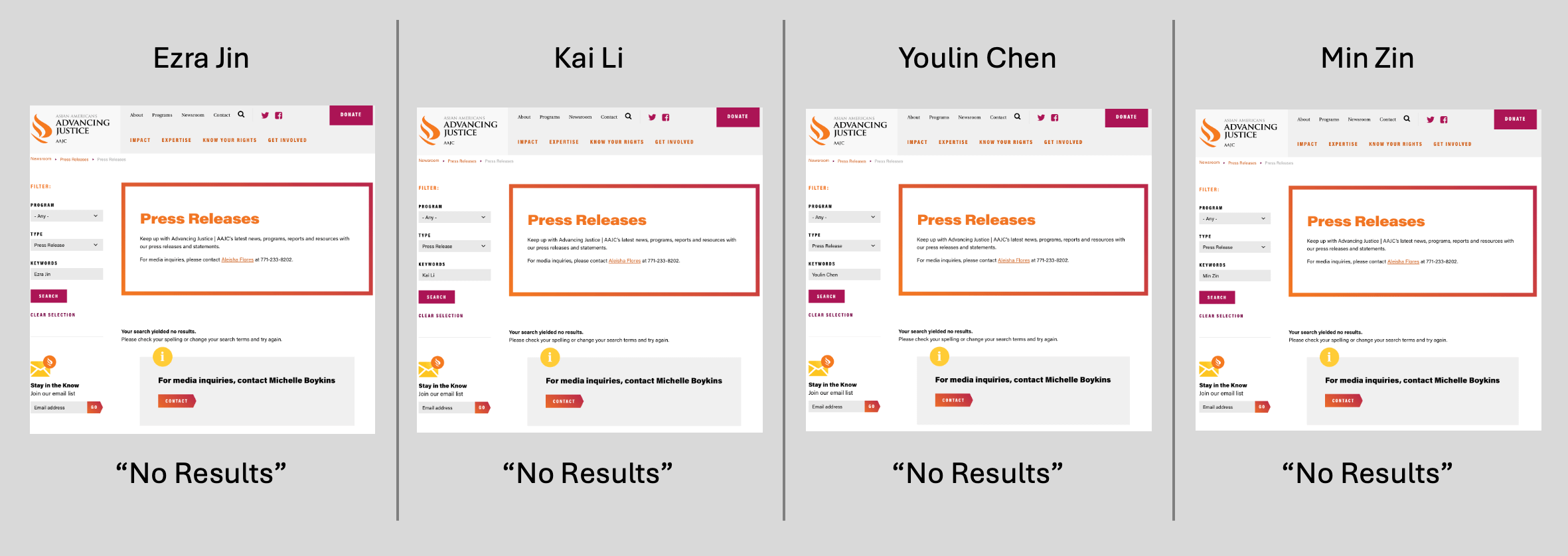
I had hoped that an organization like Asian Americans Advancing Justice (AAJC) would at least acknowledge how Asian Americans like Min Zin and Youlin Chen are being held without charge by the PRC… perhaps they might even go so far as to criticize the PRC Government for abusing Asian-Americans.
But I can’t find a single mention on their website or in the history of their press releases where they have even acknowledged the horrendous abuses the CCP commits against Chinese-Americans or Asian-Americans writ large.
Here are just four of the most recent, high profile Asian-Americans held by the Chinese Communists.
Since there are Tibetan-Americans and Uyghur-Americans, and they face some really horrendous abuse by the Chinese Communist Party, certainly a group like AAJC has said *something* about them since the founding of the organization in 1991.
Nope.
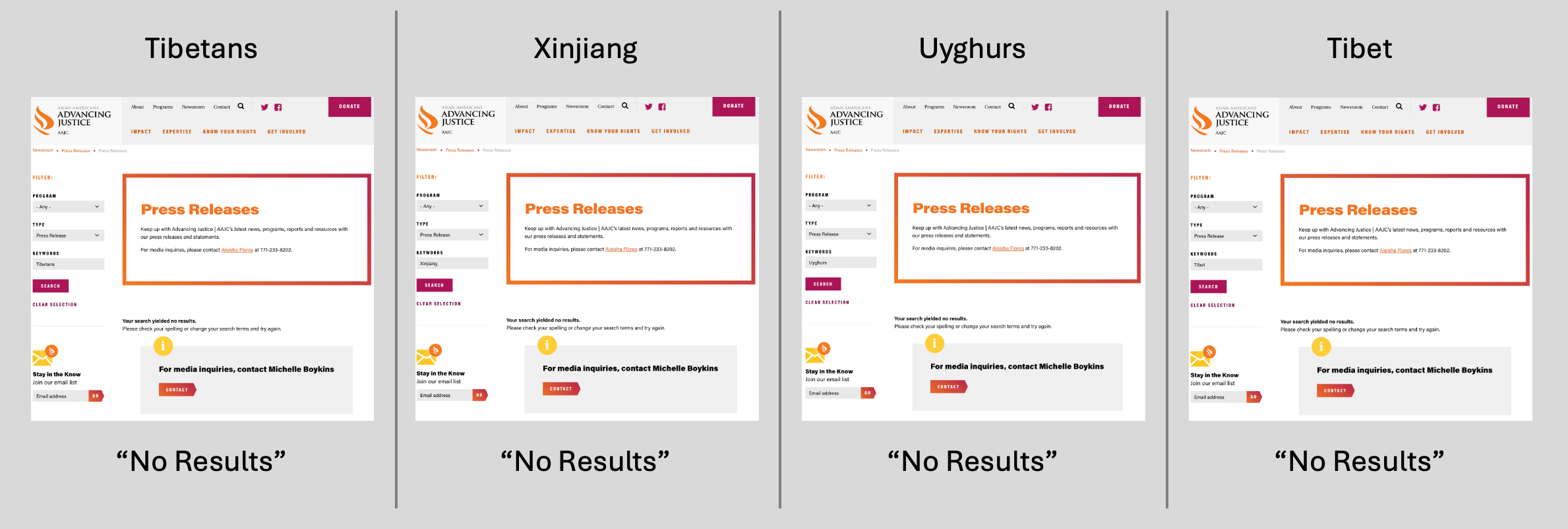
Apparently, Americans of Tibetan or Uyghur heritage don’t qualify as “Asian-Americans” or deserve “justice” despite the fact that they are the world’s most persecuted ethnic groups, facing the erasure of their culture through genocide.
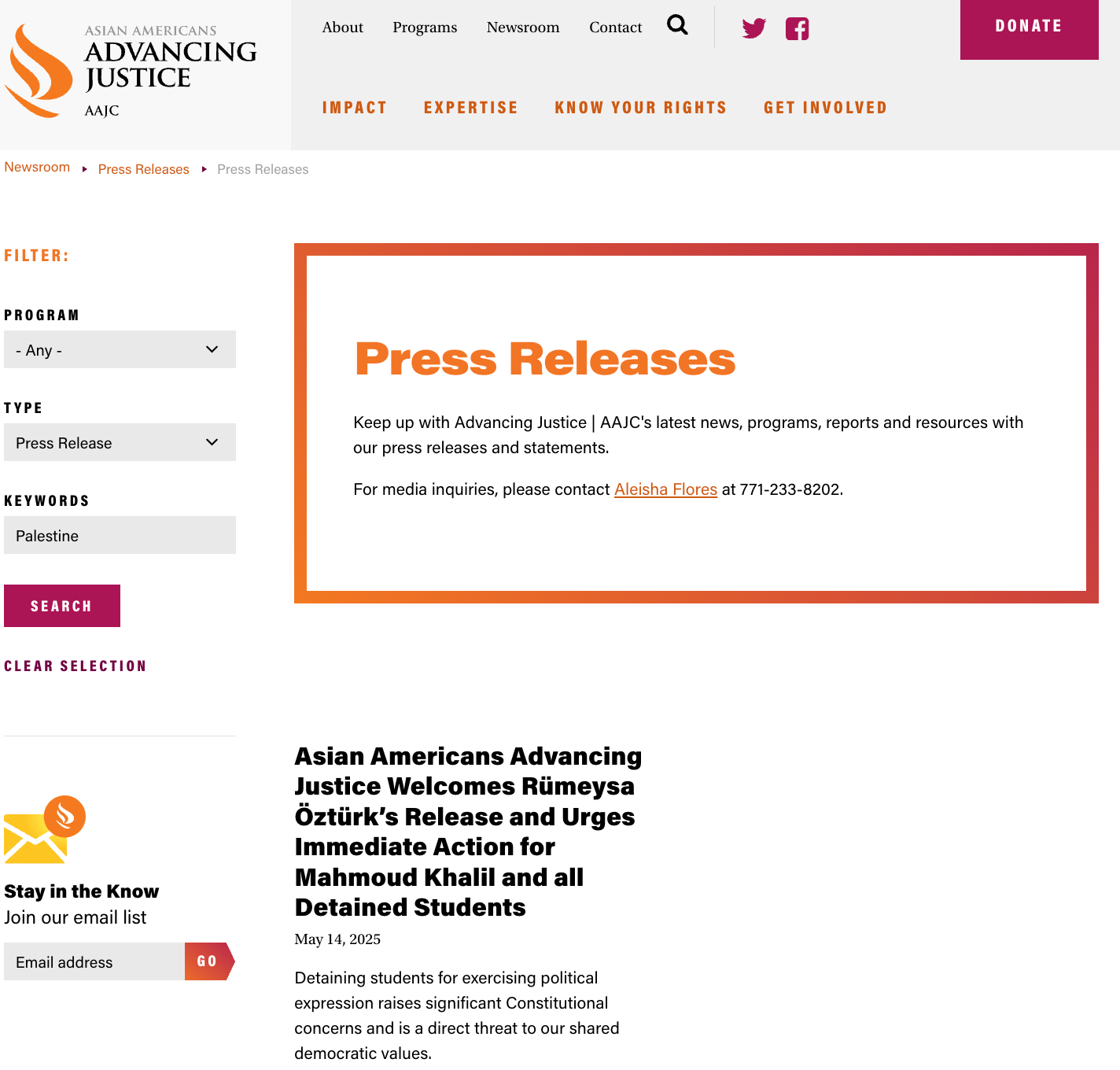
But apparently individuals from Palestine deserve “justice” from AAJC even if few would consider them to be Asian-Americans…
AAJC could have issued a press release “welcoming the release” of Pastor Ezra Jin or of Li Kai and urge the immediate release of other Asian-Americans held by the PRC… but they never have.
U.S., China Arm for Space Warfare: Hunter Satellites and Orbital Weapons
Cassell Bryan-Low, Joey Roulette and Eduardo Baptista, U.S. News & World Report, September 2, 2026
In June, a secretive unmanned Chinese spaceplane closely monitored by U.S. military analysts released a small satellite hundreds of miles above Earth in an orbital region crowded with commercial and military satellites. The object then looped around another Chinese satellite before returning towards the spaceplane, according to U.S. space-tracking firm LeoLabs.
Little is known about the satellite or the mission. But the U.S. military operates a similarly secretive spaceplane resembling a small shuttle, also with no crew. Both programs reflect the rapidly evolving field of military space operations as Beijing and Washington prepare for the possibility of conflict extending into space, according to a Reuters review of documents, space-tracking data and interviews with current and former military officials.
Chinese researchers linked to the military are developing technologies ranging from satellites designed to pursue and even capture other spacecraft to systems that could extend fuel supplies while doing so, according to a Reuters review of patent-related documents, procurement notices and academic papers. And the United States and Britain conducted their first joint military operation in space in the path of a suspected Chinese spy satellite, according to commercial space-tracking data.
“The Chinese are rapidly developing capabilities,” including ground- and space-based weapons designed to interfere with or destroy targets, U.S. Space Force’s Chief of Space Operations General Chance Saltzman said in July. The threat from China is “substantial,” added Saltzman, who is retiring.
Satellites have become indispensable to modern warfare, as conflicts in Ukraine and the Middle East have demonstrated. For decades they have provided communications, navigation and intelligence services to armed forces on Earth, and once placed in orbit typically remained on fixed paths. Increasingly, however, militaries view them as active weapons platforms capable of launching attacks by disrupting a satellite’s operations through jamming or laser dazzling, or even capturing enemy spacecraft.
Disruption of U.S. space capabilities would “cripple our massive military in the terrestrial sphere,” affecting everything from surveillance to missile defense, said Everett Dolman, a former professor at the U.S. Air Force’s Air War College. Spaceplanes, because they are agile and capable of deploying satellites or carrying cargo, could appear to opponents as potential “space fighters,” he said.
COMMENT – Just as the atmosphere became a domain of conflict in the 20th Century, outer space is now a domain of conflict in the 21st Century.
Iran’s Covert Weapons Supply Chain Runs Through Canada and China — Fueled by Trade-Based Money Laundering
Sam Cooper, The Bureau, September 3, 2026
An Iranian immigrant living in Vancouver spent more than five years buying American missile-testing equipment and drone cameras for Iran’s Department of Defense, routing the goods and the payments through front companies in China. A Seattle court sentenced him to 42 months in prison in 2018. He was arrested not by Canadian police but by an American agent, at the border crossing in Blaine, Washington.
The case is a public record illuminating the Iranian-Chinese procurement system that now sits at the center of Washington’s financial war against Iran, and that Canada has never confronted. Iranian government buyers stand at one end of it, Chinese operators and their front companies at the other end, and hundreds, if not thousands of Canadian residents from Iran serve as its trusted Western face, operating from major Canadian cities, wired into Canadian banks, trade and technology and real estate companies, and Canada’s political system.
The scheme moves sensitive American technology to Tehran through fake import and export firms and transshipment points, and it settles the bills in oil and Chinese currency, often laundering euros and US currency through currency exchange hubs in the Middle East, Canada or Hong Kong.
According to one of The Bureau’s sources, the file also explains the unexamined machinery behind an explosive story by the Canadian national security reporter Stewart Bell.
Bell revealed that the son of a former Iranian vice-president, described by Canadian Security Intelligence Service as a participant in a covert weapons procurement structure for the Islamic Revolutionary Guard Corps, spent a quiet decade in Edmonton winning some $2 million in contracts from the Royal Canadian Mounted Police and the Department of National Defence.
CSIS warnings went nowhere inside Justin Trudeau’s government, and Ottawa’s single attempt to remove him apparently collapsed on a notorious structural error in Canadian law: intelligence gathered by the spy service often cannot be used in court by the border enforcement agency that needs it.
The covert Iranian financing machinery involved is the target of the newest phase of Washington’s war, which Treasury Secretary Scott Bessent calls an economic D-Day.
American military officials say Iran’s ability to close the Strait of Hormuz is degrading, and the pressure has moved to the Revolutionary Guard’s money — the channels that fund its war machine and run the country’s economy. They are the same channels running through the Canadian cases examined here, including Bell’s, which has produced Conservative calls for an inquiry into Canada’s security failures.
Speaking at the Group of 20 finance meeting in Asheville, North Carolina, this week, Bessent described the system. “The Chinese pay the Iranians (for oil) in RMB,” he said. “The RMB comes back to the Gulf Region, and whether it is through neighbors shipping that supplies over, or whether it is through banks — such as the one we put out of business in Dubai on Friday — or whether it is the cash houses, those are being closed down. When that money cannot be converted to dollars, then the regime will starve.”
Fourteen years earlier, a Vancouver man had written the same system down in an email to his partners in China.
COMMENT – It would be great if the Canadian Government took seriously the deaths of several hundred thousand Americans rather than dragging their feet for fear of angering the Chinese Communist Party.
Taiwan’s Six-Year Hunt for China’s Undercover Chip Labs
Kinling Lo, Rest of World, September 2, 2026
Previously unpublished government data reveals the scale of Taiwan’s crackdown on Chinese companies accused of hiding their ties while recruiting chip talent and pursuing sensitive technology.
In the spring of 2020, a Taiwanese engineer felt “extremely lucky” to be offered a job as a chip designer at Blue Ocean Smart System, an American company based in his hometown Hsinchu, the heart of Taiwan’s semiconductor industry. He said the role gave him a chance to work on an ambitious AI-chip design project and a $120,000 salary, doubling the industry average, which would help pay off his two children’s private elementary education.
But several months into his new role, the engineer, who was 32 at the time, noticed something strange: He was never in touch with any American coworkers, and there was no information about the U.S. office. Instead, he told Rest of World, he spent most of his time working with team members based in Nanjing, China. That’s who he spoke with in weekly online meetings, and with whom he shared his engineering code and chip designs.
What followed confirmed the engineer’s suspicion: In August 2021, Taiwanese authorities raided Blue Ocean Smart System, alleging that the company illegally operated in Taiwan by disguising its Chinese ownership behind a locally registered company.
The Taiwan-registered company shared the exact same English name as Nanjing-based Blue Ocean Smart System, while its Chinese name differed by just one character. The Taiwan operation was later forced to shut down. Blue Ocean Smart System in Nanjing did not respond to Rest of World’s requests for comment.
“I was explicitly told that the company was backed by American investment,” the engineer told Rest of World, recalling the inconsistencies he picked up during his time there. “But I kept going because I was happy at my job.”
Blue Ocean Smart System is one of the 166 cases investigated by Taiwanese authorities over the past six years for allegedly concealing ties to China, according to exclusive data provided to Rest of World by Taiwan’s Ministry of Justice Investigation Bureau, or MJIB. Another 67 China-related trade-secret probes in the technology sector were completed in the same period, according to MJIB figures that have not previously been made public.
The crackdown remains active. As recently as August 5, the MJIB announced it had raided another 18 technology companies, following operations carried out just days earlier between July 13 and August 4.
Taiwan is a global powerhouse in chip manufacturing. Thanks to companies like Taiwan Semiconductor Manufacturing Company — known as TSMC — Mediatek, and United Microelectronics Corporation, the island nation produces over 60% of the world’s semiconductors and 90% of the world’s most advanced chips. But the strength and vibrancy of the industry has also attracted unwanted interference, with Chinese competitors accused of illegal investments and talent poaching. Taiwan’s crackdown reflects a broader trend to limit China’s access to critical technology across the world, and in the U.S.
COMMENT – The Chinese Communist Party has weaponized commerce and business in ways that will require the rest of us to take far more action in understanding who is in our supply chains and who we collaborate with on science and innovation.
Why Seeing China as a Normal Rising Power Misses the Point
Lingling Wei, Wall Street Journal, September 8, 2026
When Xi Jinping sat across from President Trump in Beijing in May, he reached for a borrowed phrase. Could the two nations, he asked, avoid the “Thucydides Trap”—the ancient pattern, described by the Harvard political scientist Graham Allison, in which a rising power and a ruling one stumble into war?
It sounded statesmanlike, almost conciliatory. Later this month Xi arrives in Washington for a return visit, and he may reach for the phrase again.
Beijing keeps using it because it works. To understand why, I called Chenggang Xu. A scholar who lived in the Chinese system himself, Xu is the author of “Institutional Genes,” a 2025 book that traces how China fused Soviet communism with its own imperial bureaucracy into a totalitarian system built to resist reform.
Xu’s answer starts with the theory itself. The “Thucydides Trap” is seductive, he said, because it empties the contest of everything that matters. “This is a story borrowed from ancient Greece. In that story there are no different systems—only two powers, a rising one and an old one. The Chinese Communists love it, because they don’t want people to know that they are different.”
Different how? Xu’s life’s work rests on a distinction many in Washington and elsewhere have waved away: China isn’t authoritarian but totalitarian. In an ordinary authoritarian state, however brutal, some independent institutions survive—be they a church, a temple, a nongovernmental organization—so long as they stay out of politics. A totalitarian party allows none of it. Every organization must be controlled by the party.
That distinction matters because it shapes policy. Put something in the wrong category, Xu said, and “you apply a whole set of policy tools in the wrong way.” Call Beijing a normal rising power, and you treat its outward expansion as ordinary great-power rivalry—a competition to be managed, balanced, and split into spheres.
Accepting the framing, Xu said to me, “comes at a tremendous cost” to the West: it lets an outward-pushing party-state pass as an ordinary competitor.
Xu knows this not only as a scholar, now at Stanford University after years in Hong Kong and London, but from experience. He was a teenage “revolutionary rebel” when the Cultural Revolution erupted in the 1960s. By 19, he had been branded the head of a “counterrevolutionary clique.” The charge, he said, was fabricated: He was a student trading ideas with others in different schools and places, accused of leading a network across nine provinces.
His real offense, he came to believe, was the one thing a totalitarian party can’t allow: organized reading and exchanging ideas outside it. He suffered years of hard labor in the Great Northern Wilderness.
Xu argued that today’s China, which he describes as a “totalitarian system with Chinese characteristics,” is a continuation of the Cultural Revolution. In his view, that upheaval was the clearest expression of the party’s founding logic: Mao’s doctrine of permanent revolution, in which the state must keep manufacturing enemies and crushing any organization it doesn’t control. That logic, Xu said, was never repudiated, only suspended during the reform years. Under Xi it has returned. The system that branded him at 19 is, in his telling, the same one governing China today.
Beijing has never allowed a full public reckoning with that era, and under Xi daily life has grown more surveilled and tightly policed—even as the country pours resources into artificial intelligence and the tools of a high-tech state. The instruments are new. The instinct, Xu argued, is old.
How a Blacklisted Chinese Tech Giant Kept Buying America’s Best A.I. Chips
Ana Swanson, Paul Mozur, Tripp Mickle and Keith Bradsher, New York Times, September 6, 2026
Washington imposed sanctions on Inspur because of its work with the Chinese military. But the company’s subsidiary kept shipping Nvidia’s best chips to feed China’s leading A.I. firms.
For years, a sign outside one of Silicon Valley’s many nondescript offices said Inspur, the name of one of China’s most important technology companies.
But in March 2023, the United States added Inspur Group to the so-called entity list, a blacklist with more than 3,000 companies that have been restricted from doing business with the United States because they are considered a security risk.
Not long after, the Inspur sign was changed to Aivres, the name of Inspur’s new U.S. subsidiary. The subsidiary continued with its Chinese parent company’s work, helping it build a thriving global network to provide the computing power that supplies China’s growing artificial intelligence industry.
The Silicon Valley subsidiary, which appears to be taking advantage of several loopholes in U.S. export law, has played a key role in Inspur’s sidestepping of American restrictions. Federal officials have begun looking into the subsidiary’s business, but it is not clear where that inquiry stands, said four officials who spoke on the condition of anonymity because they were not allowed to discuss it.
The New York Times examined thousands of shipment records, corporate documents and supply contracts to piece together how Inspur’s network works. Reporters also visited sites in China, Southeast Asia and California, and spoke with more than a dozen current and former officials, tech executives and industry analysts.
The U.S. government prohibits the most advanced chips, like the Blackwell chip from the Silicon Valley giant Nvidia, from being sent to any company in China. And U.S. law bars any company anywhere in the world from buying restricted products made with American technology on behalf of a blacklisted company. But there are few restrictions on companies in China that bar them from remotely gaining access to A.I. data centers in Southeast Asia.
Whether Chinese firms are getting access to cutting-edge technology, particularly high-end computer chips made by Nvidia, has become a hot question in Silicon Valley and Washington, where executives and officials worry that China could use A.I. for hacking, surveillance and military operations.
Chinese A.I. companies are also closing the performance gap on systems made by their American competitors, raising concerns that the Chinese companies are using American technology.

COMMENT – The Commerce Department’s Bureau of Industry and Security (BIS) is either willfully turning a blind-eye to these activities, or it is grossly incompetent. If reporters at the New York Times can uncover this, why can’t BIS?
Authoritarianism
China buys 1 million tons of US soybeans ahead of Xi visit, sources say
Ella Cao and Naveen Thukral, Reuters, September 10, 2026
China has bought around 1 million metric tons of U.S. soybeans this week, four traders told Reuters, as the world’s top oilseed buyer steps up purchases ahead of Chinese President Xi Jinping’s visit to Washington later this month.
The purchases take China’s total U.S. soybean buying to nearly half of the 25 million tons the White House said Beijing had committed to annually through 2028.
While China’s purchases of U.S. soybeans could help bolster trade and diplomatic ties with Washington, the buying also coincides with tightening global oilseed supplies amid dwindling inventories in top exporter Brazil.
“There have been more purchases made by Sinograin in the past few days,” said one Asia-based trader. “They have been buying before Xi’s visit to U.S.”
State buyers Sinograin and COFCO did not immediately respond to Reuters requests for comment.
The U.S. Department of Agriculture on Wednesday reported 340,000 tons of U.S. soybean sales to China and another 100,000 tons to unknown destinations.
China still has a 10% additional tariff on all U.S. goods, including agricultural products after a tit-for-tat tariff war last year. A cut to the tariff on soybeans could draw private Chinese crushers back to U.S. supplies after tariffs largely shut them out of the market.
COMMENT – Usually I take exception when news outlets say something like “China has bought…” because of course China is not a monolith. But in the case of buying soybeans from the United States, China is monolithic.
Sinograin (China Grain Reserves Group) and COFCO (China National Cereals, Oils and Foodstuffs Corporation) are two Chinese State-owned Enterprises, and they handle all (or nearly all) purchases of soybeans from the United States. The PRC’s private domestic companies that buy soybeans have been forbidden from buying from the United States and essentially make all their purchases from Brazil. This arrangement lets the Chinese Communist Party maximize its political control over trade with the United States while Chinese companies gain greater inroads into Brazil and build-out infrastructure in South America to make the PRC less dependent on the United States.
This is a deliberate strategy of decoupling in which the PRC only buys American soybeans if it can extract concessions from the United States Government while it simultaneously builds a mercantilist relationship with Brazil and other parts of South America. For more see #87 below, “Capricorn Bi-Oceanic Corridor Could Expand China’s Strategic Reach in South America.”
China’s Unity Through Erasure Should Worry Central Asia
Tilla Hoja, The Diplomat, September 8, 2026Katsuji Nakazawa, Nikkei Asia, September 10, 2026
A new political wind is blowing in China.
A cohort of politicians born in the 1970s is rising rapidly amid supreme leader Xi Jinping’s extended rule and could sideline the generation born in the 1960s.
Zhu Zhongming, 54, is currently the most promising of these relatively young politicians. On Sept. 4, he became acting mayor of Shanghai, one of China’s four directly administered municipalities, along with Beijing, Tianjin and Chongqing.
Xi, 73, was born in 1953. The president and Communist Party general secretary thus belongs to the wulinghou generation.
Zhu, who has now been thrust into the political spotlight, is expected to become Shanghai mayor, replacing Gong Zheng, who resigned on Sept. 4. Zhu is 12 years younger than Gong.
Born in 1972, Zhu belongs to the qilinghou, or 1970s, generation. The previous generation is known as the liulinghou.
The generational shift in Shanghai marks a significant change in Chinese politics, as Shanghai’s mayor is the No. 2 post in the financial and commercial hub after the city’s party secretary.
The selection of Xi’s eventual successor has been a topic of conversation for the past decade. Conventional wisdom has it that someone born in the 1960s should step into Xi’s shoes.
But Xi is poised to seek a fourth five-year term as party chief at the Communist Party’s 21st national congress in the autumn of 2027, and no potential successor has yet emerged.
If Xi stays in power at least until 2032, politicians born in the 1960s, even those seen as potential next-generation leaders, will have no real chance to shine.
COMMENT – Worth watching Zhu and other members of the qilinghou generation.
Will Xi finally let someone become his heir apparent? Probably not until the late 2030s when these guys (Xi will only look for men) are in their 60s and finally get a chance.
Not having a clear concept of succession is destabilizing. Xi could drop dead of a stroke or heart attack, he could fall down a set of stairs or be assassinated. This would plunge a nuclear superpower and the world’s second largest economy into crisis as Xi has spent the last dozen years dismantling the apolitical bureaucratic functions of the Chinese state with shadowy Party apparatus that controls the entire society.
If you are a senior PLA officer, would you let another Xi-like civilian gain control or would you intervene to ensure that the PLA is protected from future purges like the ones that Xi has carried out?
If you are a regional Party leader, would you let a rival from another region take power knowing that individual will likely carry on the kind of rectification campaign that Xi has waged against his rivals?
If you are a Party official who has carried out Xi’s rectification campaign, would you let someone who was a target of those campaigns take power, or would you act preemptively to ensure that your faction takes over?
Too many people pretend as if the PRC is a well-functioning state with a stable political system… it is not. One should examine the other periods of political transition in the PRC to see that this veneer of stability will crumble when the strongman departs the scene. It will be a free for all as Chinese elites rush to take over, not just for their own lust for power, but for the logical rationale that they must protect themselves, their families, and their followers from the kind of retribution that their rivals would wage if they were to win the prize of Xi-like power.
By dismantling the somewhat normal functioning that took place in the transitions between Jiang Zemin-Hu Jintao and Hu Jintao-Xi Jinping, as well as crushing the apolitical bureaucratic functions of the Chinese state, Xi has created a far more dangerous situation for the Chinese people AND the businesses and supply chains that depend on the PRC.
If one wants a degree of stability, transitions of power should be routine, and the process should be known to all in advance. That was the wisdom of what Deng Xiaoping created in the 1990s and Xi destroyed that system.
One proxy for the destruction of transparency and predictability is the rise and collapse of Chinese economic disclosures over the past four decades. Deng Xiaoping, Jiang Zemin, and Hu Jintao each led their system to provide the outside world with insight into how the Chinese economy was operating. Xi Jinping completely reversed those policies and has imposed a degree of opacity the country hasn’t seen since the 1980s.
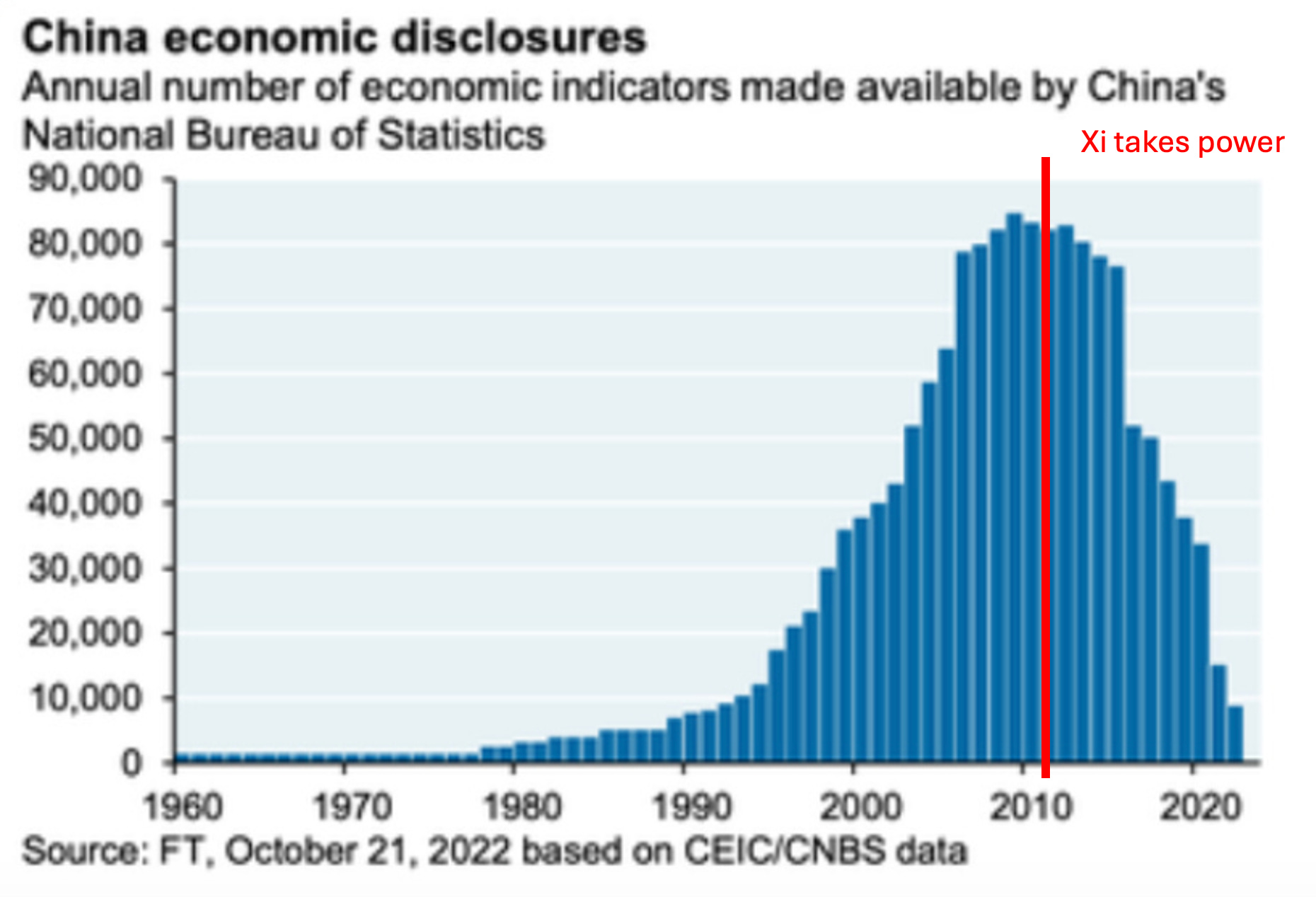
In response to this lack of transparency, as well as the perception that Xi’s PRC is hostile to foreigners, there has been a corresponding hit to foreign investment in the PRC.
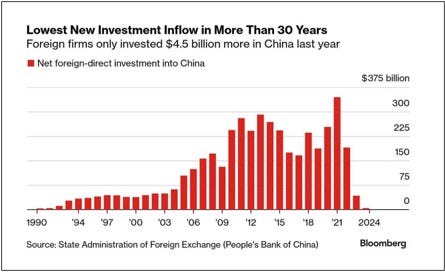
Chinamaxxing by paid social media influencers or more propaganda from the CCP’s mouthpieces about the wisdom of Xi Jinping isn’t going to reverse the loss of confidence in China’s stability. The best thing Xi could do for his country, and its future, would be to guide his government back to the kind of routine and transparent operations that his predecessors encouraged. The most important part of that is to plan for a leadership succession.
At Taiwan’s Temples, a Glimpse of What China Could Have Been
Lingling Wei, Wall Street Journal, September 6, 2026
Former China Securities Regulator Sentenced to Life for $14 Million Graft
Wang Juanjuan, Caixin Global, September 8, 2026
‘Mama, I Miss You’: Relatives Go Online to Grieve Tibet’s Flood Victims
Lily Kuo and Pei-Lin Wu, New York Times, September 8, 2026Taming News of a Border Tragedy
Lingua Sinica, September 8, 2026
The catastrophe that struck the China-Nepal border last month is a case study in information control — and the clearest sign yet that Xi Jinping has rewritten the script for domestic media.
The devastating floods that struck Nepal and Tibet last month after a glacial collapse in the Himalayan border region have to date resulted in at least 1,300 dead, with many more still missing. Through the final week of August, the tragedy dominated headlines around the world. In China, where the border checkpoint of Gyirong port was struck by a destructive wall of water coursing down from the mountains, there was equally intense interest in the story. But that demand was fed through a tightly centralized news system in which the Chinese Communist Party (CCP) held the facts close — and kept the focus on the official response over human reactions.
It is true that China quickly dispatched reporters to the scene. It is also true that limited information about the disaster circulated widely across online media, news apps and social media channels. However, it is crucial to recognize how the centralized containment of reporting and release of information about this tragedy fits within the broader historical development of information controls in the country. Drawing on the news and social media monitoring platform Wisers as well as searches of archived Chinese-language newspapers and online coverage, the China Media Project explored a single critical question: Who produced the core information that circulated inside China, including through millions of social media accounts and thousands of posts on platforms like WeChat and RedNote.
Our findings show that Chinese authorities were essentially effective in ensuring that the source of information on the breaking story was contained to a small number of central-level Party-state media, including the government-run Xinhua News Agency and the various outlets — such as China Central Television (CCTV) and China Radio International (CRI) — under the powerful China Media Group (CMG), the conglomerate directly under the Central Propaganda Department.
Despite Foreign Ministry Spokesman Guo Jiakun’s insistence on August 31 that “China has been open, transparent and timely in information release,” this story should be read as yet another unmistakable sign that Xi Jinping has completely rewritten the script for China’s domestic media.
Information Controls Follow Catastrophic Flooding in Gyirong on the China-Nepal Border
China Digital Times, September 2, 2026
On the morning of August 26, a glacial collapse caused catastrophic flooding and mudslides on the China-Nepal border, destroying a port and border crossing in Gyirong County in Shigatse, Tibet, and inundating communities on both sides of the border. Nepalese authorities have confirmed 1,050 deaths, with nearly 4,000 people still missing. Chinese state media reported as of September 2 that 16 people were killed in Tibet, with over 546 still missing, approximately half of them foreign nationals. Search and rescue efforts are ongoing.
In addition to highlighting the increasing risks of climate change to Himalayan communities, the collapse and flooding have also drawn attention to Chinese authorities’ unrelenting efforts to clamp down on and control the tone of information in the wake of natural disasters. Chinese and overseas netizens alike have noted the stark asymmetry between the regular updates and open information sharing from Nepalese authorities, and the tight press controls, limited information sharing, and lack of first-person survivor accounts on the Chinese side. Recent reports that ten people in Tibet have been punished for “spreading rumors” online about the flooding only serve to reinforce these observations.
China restrict Tibetan volunteers, relief efforts in flood-hit Kyirong
Phayul, September 4, 2026
Chinese authorities have imposed stringent restrictions on movement into flood-hit Kyirong region in occupied Tibet, preventing Tibetans from other parts of the region from travelling to the disaster zone to provide relief and express solidarity with affected communities, according to an exile-based source who spoke to Phayul on condition of anonymity for safety reasons.
The source said the Chinese government has adopted an unusually restrictive approach to relief efforts in Kyirong, where severe flooding has affected areas along the Tibet-Nepal border. “Many Tibetans want to travel to Kyirong to help the affected people, but they are not being allowed to enter the area,” the source told Phayul, adding that the restrictions appear particularly stringent given the region’s proximity to Nepal.
According to a government notice issued following the floods, entry into the affected border area is restricted to officially designated relief personnel. Civilians and personal vehicles are prohibited from entering the disaster zone, while travel from Saga, Tingri and Nyalam Counties into Kyirong has been explicitly barred for civilians. Authorities have warned that those who violate the restrictions could face severe legal consequences.
The source contrasted the restrictions with the response to the devastating January 2025 Dingri earthquake, during which some Tibetan-led relief and assistance efforts were reportedly permitted. “This time, the restrictions are much stricter. During the 2025 Dingri earthquake, some Tibetans were able to provide assistance, but in Kyirong they are not allowing such efforts at all,” the source said. The source stated that the heightened controls may be linked to Kyirong’s strategic location on the Nepal border, where authorities are particularly sensitive to the movement of people and information.
Meanwhile, Chinese state controlled propaganda mouthpiece have released carefully curated photographs and videos showing government-led rescue and relief operations in the affected areas. The imagery focuses on state-organised emergency responses and relief personnel, while independent access to the disaster zone remains heavily restricted.
Speech in China Is in the Deep Freeze
The Economist, September 7, 2026
Social Media in China Is Getting Really Dark
Yuan Li, New York Times, September 7, 2026China artists quit S. Korea art show after organisers let ‘Taiwan’ be used in name of exhibition
Hong Kong Free Press, September 5, 2026
Chinese artists withdrew from a major South Korean art show after organisers allowed “Taiwan” to be used in the name of an exhibition, officials said Thursday, as China issued a rebuke.
The Gwangju Biennale, one of Asia’s largest contemporary art events, is due to open Saturday, with its Pavilion Project bringing together artists from around the world at venues across the southwestern city.
The dispute began after Taiwanese artists said organisers had initially agreed to call their exhibition the “Taiwan Pavilion”, but changed the name in June to “NTMoFA”, the acronym for Taiwan’s National Taiwan Museum of Fine Arts.
The change was made “without the consent of the participating team, and brutally erased Taiwan from the poster,” the artists said in a joint statement last month, accusing organisers of “political censorship”.
China insists Taiwan is part of its territory and has threatened to use force to annex the self-ruled island of more than 23 million people.
Last week, the Gwangju Biennale foundation reversed course and agreed to restore the name “Taiwan Pavilion”.
Hong Kong’s Cardinal Zen Loses Appeal Over Protest Fund
Kenji Kawase, Nikkei Asia, September 3, 2026
China Hits Japan with Anti-Dumping Measures on Chip Chemical
Nectar Gan, Yoshiaki Nohara and James Mayger, Bloomberg, September 8, 2026
China Tells Steel Mills to Hold Off on Buying Rio Tinto’s Ore
Alfred Cang and Katharine Gemmell, Bloomberg, September 8, 2026Ruth Wang, Chinese lawyer for underground church, flees to Taiwan – rights group
Hong Kong Free Press, September 5, 2026
The Decline of China and Taiwan CODELs
Isabella McCallum and Ryan Featherston, Center for Strategic and International Studies, September 4, 2026Federal Trial Against Huawei Begins After 8 Years
Santul Nerkar, New York Times, September 9, 2026
The Chinese telecommunications giant has been accused of stealing intellectual property from six companies, including Motorola Solutions and T-Mobile.
The 2018 arrest in Canada of a senior executive at Huawei, the Chinese telecommunications giant, inflamed already strained relations between Beijing and Washington.
After three years of detention in her luxurious Vancouver homes, the executive, Meng Wanzhou, reached a deal with federal prosecutors and flew back to China. But the agreement did not end the U.S. government’s efforts to prosecute Huawei, which officials say has long defied U.S. law by stealing from American companies and evading sanctions against Iran.
Now, after eight years, the case against the company is being heard in a federal courtroom in Brooklyn.
Opening statements began on Wednesday, and the trial could last four months.
“The entire business operated through a pattern of theft, lies and cover-ups,” Taylor Stout, a federal prosecutor in the Justice Department, told jurors.
The witnesses who are expected to testify include former Huawei employees, experts on telecommunications technology and a banker who Ms. Meng admitted misleading about the company’s dealings in Iran.
Ms. Meng, who is Huawei’s chief financial officer and whose father founded the company, struck the deal with prosecutors in 2021 to avoid jail time. Since 2019, Huawei has been effectively banned from selling its products in the United States; U.S. officials have feared that they could pose a national security threat.
Want to stay updated on what’s happening in China? Sign up for Your Places: Global Update, and we’ll send our latest coverage to your inbox.
Huawei has continued to sell smartphones and equipment that support telephone and internet networks worldwide. It is also an important part of the Chinese government’s efforts to develop artificial intelligence chips, despite Washington’s efforts to slow China’s progress. A guilty verdict for Huawei may not significantly affect the company’s fortunes.
But federal prosecutors are moving ahead with their case against the technology giant, which U.S. officials have viewed with suspicion for decades. The United States has long accused the Chinese government of sponsoring efforts to steal trade secrets, ranging from sophisticated defense technology to corn seeds in Iowa.
Defenders of Huawei have argued that the case has been fueled by retaliation against China’s efforts to build 5G networks around the world, using Huawei’s technology. Huawei has denied any wrongdoing, saying it operates independently from the Chinese government. It attributes its growth not to stealing trade secrets, but rather to strong investment in research and development.
In a pair of statements, Huawei said the “U.S. government’s overarching narrative is demonstrably false” and that it had “the utmost respect for intellectual property.”
Huawei was founded in the 1980s by Ms. Meng’s father, Ren Zhengfei. Its rise mirrored that of China, which was undergoing a momentous transition toward becoming a capitalist economy.
Brian Heberlig, a lawyer representing Huawei, said Mr. Ren built Huawei through hard work and that he “hired people with the same work ethic.”
As Huawei ascended, U.S. officials worried that the company’s technology could be used to spy on Americans, that Huawei was ripping off American competitors and that it was doing business with Iran, in defiance of U.S. law.
A new indictment filed against Ms. Meng and Huawei in 2020 echoed some of those concerns. Huawei and its affiliates, prosecutors said, used “a pattern of racketeering activity” to steal trade secrets from American companies. Huawei, prosecutors said, stole intellectual property from six companies — identified by The New York Times as Cisco Systems, Motorola Solutions, Fujitsu, Quintel Technology, T-Mobile and CNEX Labs.
The stolen information included source code and operating system manuals, according to an indictment. The company even launched a bonus program for employees who stole information from competitors, according to the indictment.
In one particularly brazen example of theft from 2004, prosecutors said, a Huawei employee was caught trying to steal from a competitor at a Chicago trade show. The employee, prosecutors said, was discovered late at night trying to photograph the inside of a networking device.
And through working in Iran with a subsidiary known as Skycom, prosecutors say, Huawei gave Iranian intelligence services the means to spy on its own citizens. Huawei hid the fact it was doing business in the country, said Mr. Stout, the federal prosecutor, including by removing Huawei’s logo off packaging shipped to Iran.
Huawei’s lawyers have argued that the charges are part of a misguided effort by the Justice Department to target Chinese people and businesses. Competition over 5G and the U.S.-China trade war “made Huawei a prime target for the Justice Department and other federal agencies,” lawyers for Huawei wrote in a filing last year.
On Wednesday, Mr. Heberlig said that prosecutors had provided a “distorted picture” of Huawei, arguing that they had described ordinary business as crime and unfairly focused on a few instances of trade theft among a company with hundreds of thousands of workers.
“Huawei’s success did not come from theft, racketeering or fraud,” Mr. Heberlig said in court.
The case burst into the open with the arrest of Ms. Meng by Canadian police in December 2018, which came at the request of the U.S. government. In retaliation, the Chinese government detained two Canadians, charging them with espionage.
The standoff further calcified relations between the United States and China, which were locked in a trade war initiated by President Trump. He at one point suggested that Ms. Meng could be a bargaining chip in a potential trade deal with China.
Yet Ms. Meng remained detained under an $8 million bail in Vancouver until September 2021, when she reached the deal with the Justice Department, then under President Biden, for her to return to China, where she received a hero’s welcome.
Under a deferred prosecution agreement, Ms. Meng admitted that Huawei had misled a bank about its dealings with Iran, which dodged U.S. sanctions. Her admission will be key evidence during Huawei’s trial, after a federal judge ruled in June that it was admissible.
Within hours of Ms. Meng’s departure in 2021, China released the two Canadians from detention, though U.S. officials said their release was not part of the deal reached with Ms. Meng.
COMMENT – What took so long to bring this case to court?
My impression is that Attorney General Garland completely ignored this case after he essentially cut a sweetheart deal to let Ms. Meng go and get the two Canadian hostages released. Now its eight years after the indictments and the Justice Department has a tough job ahead.
Environmental Harms
China’s Expansion in Squid Fishery Poses New Maritime Security Challenges
Juan Delgado, Dialogo Americas, August 28, 2026
The expansion of China’s fishing fleet in South American waters is no longer limited to the large concentrations of vessels operating on the high seas along the edge of the region’s exclusive economic zones (EEZs). Chinese companies have also expanded their presence within national fishing fleets through acquisitions, local subsidiaries, and the reflagging of vessels, allowing them to operate both inside and outside national waters.
Squid is at the center of that pressure. China’s distant-water fishing fleet, widely regarded as the world’s leading source of illegal, unreported, and unregulated (IUU) fishing, has deployed a harvesting capacity in the Southwest Atlantic unmatched by any coastal nation. Its presence — both on the high seas and within national fishing industries — creates new challenges for catch traceability, corporate oversight, and the sovereign management of marine resources.
Korea unveils tougher measures to curb illegal Chinese fishing near NLL
Yonhap, August 27, 2026
Foreign Interference and Coercion
Australia’s Scrapping of University Deals with China Prompts Security Debate
Jonathan Pearlman, The Straits Times, September 5, 2026
Australian Academics Partnered with Chinese Military Tech and Russian Toxin Research Experts
Natasha Bita, The Australian, September 8, 2026
An Australian rocket scientist collaborated with Chinese students recruited to work in China’s military research institutions, while a top professor helped a Russian scientist trying to create drugs from spider venom, in new revelations of risky research at Australian universities.
University of Sydney professor Matthew Cleary – who is director of the Australian Rocket Systems Training Network – insisted on Tuesday that his Chinese collaborations did not involve any rocket science.
Scientific journals published on the university website show Professor Cleary co-authored a paper on soot particles last year with engineers from China’s Institute for Aero Engine at Tsinghua University – which helps develop China’s missile technology and nuclear weapons.
He has also collaborated with three scientists from the Research Institute of Aero-Engine at Beihang University in Beijing, which is a “Seven Sons of National Defence’’ institution in China.
Their research on atomisation and combustion of liquid fuel spray, published last December, disclosed funding from the Australian Research Council as well as Chinese science bodies.
Real Madrid deletes Nepal-Tibet flood post after Chinese backlash
Phayul, September 3, 2026
Spanish football powerhouse Real Madrid has deleted a social media post referring to victims of the devastating Tibet-Nepal floods, days after the club came under intense criticism from Chinese state media and online users for using the word “Tibet” rather than Beijing’s sinicised term “Xizang.”
The post, which had appeared on Real Madrid’s official social media platforms on August 30, featured a photograph of players observing a minute’s silence at the Santiago Bernabéu for victims of the catastrophic floods and landslides that struck communities on both sides of the Tibet-Nepal border on August 26. The accompanying message referred to those affected in “Nepal and Tibet.”
The post was removed on September 3, following mounting criticism in China. Although Real Madrid has not publicly stated that the deletion was made in response to Chinese pressure, its removal came after Chinese state-affiliated media and online users repeatedly demanded that the club retract or amend the wording.
The Global Times, a Chinese Communist Party mouthpiece, urged Real Madrid to replace “Tibet” with “China’s Xizang”, arguing that the club’s humanitarian gesture had been overshadowed by what it described as politically inaccurate wording. The newspaper stressed that “Xizang is an inalienable part of China” and said placing it alongside the sovereign nation of Nepal ran counter to the one-China principle. Chinese social media users also piled pressure on the club, calling for the post to be deleted and for Real Madrid to issue an apology.
The criticism was accompanied by a pointed reminder of the club’s commercial stakes in the Chinese market. The Global Times noted that Real Madrid commands a sizeable following in China and has cultivated long-term commercial interests across Asia, warning that the club’s public communications are therefore expected to meet a higher threshold of sensitivity when addressing territorial issues.
The deletion marks a striking turn in a controversy that began with what was ostensibly a humanitarian gesture. A football club’s expression of solidarity with victims of a natural disaster has instead become entangled in one of China’s most sensitive political fault lines: the terminology used to describe Tibet.
COMMENT – Real Madrid’s only real mistake was not calling it “PRC-occupied Tibet.”
Belgium’s Arrest of Chinese Alleged Chip-Tech Thief Fuels European Fear of Beijing
Kim Mackrael, Wall Street Journal, September 8, 2026A US journalist sentenced to 2 years in federal prison for acting as an illegal agent for China
Fu Ting, Associated Press, September 3, 2026
An American journalist has been sentenced to two years in federal prison for acting as an agent of a foreign government within the United States, the U.S. Justice Department said.
Thomas Weir Pauken II, 51, pleaded guilty earlier this year and is not planning to appeal, according to his defense lawyer, Charles Burnham. Pauken also was sentenced to 36 months of supervised release with no overseas travel, the department said in a news release on Tuesday. He was arrested in February.
The case is the latest in a series of federal prosecutions involving people accused of working for the Chinese government without proper disclosure, as tensions between Washington and Beijing remain high.
“Pauken betrayed his country for money” for supporting “Chinese Ministry of State Security (MSS) operations, recruiting, and gathering of sensitive information from potential assets,” said Assistant Attorney General for National Security John A. Eisenberg in the news release.
COMMENT - Thomas Pauken II is also the son of a Republican Party grandee who was the Chairman of the Texas Republican Party and for a short time ran for Governor of Texas in 2014.
These are the individuals that the Chinese Communist Party targets.
Report Raises Concerns Over CCP-Linked Exchange Programs in U.S. Schools
Maria Shagina, Idaho News, August 21, 2026
UNC Ends Study-Abroad at Chinese University Added to Feds’ Threat List
Jane Winik Sartwell, The News & Observer, August 28, 2026
Ohio State to Pay Feds $2.1M Over Researchers’ China Ties
Kathryn Palmer, Inside Higher Ed, September 2, 2026
Number of Taiwanese Missing in China Is Rising
Keoni Everington, Taiwan News, September 4, 2026
Taiwan Foreign Minister Decries Chinese ‘Bullying’ at Pacific Forum
Sophie Mak, Nikkei Asia, September 1, 2026
Xi Tells U.K.’s Burnham They Have More Common Interests Than Differences
Nikkei Asia, September 8, 2026
China Arrests 52 Singaporeans for Alleged Pyramid Scheme Activities
Nikkei Asia, September 4, 2026
China Boycotts a Top Art Festival Over Taiwan Exhibition
Jin Yu Young and Murphy Zhao, New York Times, September 3, 2026
China Lashes Back at U.S. Over G20 Row Ahead of Xi-Trump Summit
Financial Times, September 4, 2026
China State Media Revives ‘Manufactured’ Batanes Claim
The Philippine Star, September 7, 2026
President Ruto Orders Immediate Shutdown of Chinese Shops in Kenya
Morgan Wanyonyi, The Kenya Times, September 2, 2026
Auto Industry: Workbench or Out — Chinese Supplier Threatens Employees
Martin Benninghoff, Handelsblatt, September 2, 2026
Human Rights and Religious Persecution
China: ‘If You Defend House Churches, We Will Shut Down Your Law Firm’
Hu Zimo, Bitter Winter, September 7, 2026Hong Kong Free Press, September 7, 2026
Fujian Villagers Halt Attempted Demolition of Guanyin Statue
Zeng Liqin, Bitter Winter, September 8, 2026
China: Repression Deepens as Abuses Go Unaddressed at U.N.
Chinese Human Rights Defenders, August 31, 2026
The United Nations and member states can reverse deepening Chinese government impunity for human rights violations by addressing allegations of crimes against humanity targeting Uyghurs, CHRD said today. August 31 marks the fourth anniversary of a landmark UN report on those and other abuses, yet Chinese officials have faced no serious scrutiny at the UN. The next UN Human Rights Council session begins September 7, 2026.
“The Chinese government’s record of human rights violations gets longer each year, partly because it pays no real price for abuses,” said Sophie Richardson, Co-Executive Director at CHRD. “The High Commissioner, the Human Rights Council, and member states can change that by demanding answers from Beijing and mapping out investigative strategies.”
On August 31, 2022–the last day of former High Commissioner for Human Rights Michelle Bachelet’s term–the Office of the High Commissioner for Human Rights (OHCHR) released its long-delayed analysis, “OHCHR Assessment of human rights concerns in the Xinjiang Uyghur Autonomous Region, People’s Republic of China.” That report concluded that patterns of arbitrary and discriminatory detention “may constitute international crimes, in particular crimes against humanity.” It remains the most authoritative UN documentation of these abuses, supplemented by reporting from other UN human rights experts, working groups, and treaty bodies.
Chinese authorities continue to commit widespread abuses across the Uyghur region. CHRD’s research, covering cases from 2019 to 2024, finds that prisoners of conscience from minoritized communities remain disproportionately represented among those wrongfully detained; the average prison sentence for Uyghurs and Kazakhs in the region is 15 years, more than double the national average. The Uyghur Transitional Justice Database counts over 12,600 cases classified as “missing,” and Xinjiang Victims Database documents more than 100,000 cases overall. A May 2026 Financial Times investigation, based on analysis of satellite imagery, government documents, local media, and eyewitness accounts, found that the region’s detention facilities can hold approximately 627,000 people, “making it the world’s largest detention system relative to population.”
In 2025, a Chinese Foreign Ministry spokesperson maintained that Xinjiang “enjoys social stability, economic growth and ethnic solidarity, and the local people now live a better life”—yet heavily restricts access to the region for independent human rights investigations.
Chinese authorities also continue to silence criticism outside the country. On August 24, 2026, the Chinese embassy in Buenos Aires, Argentina pressured the city legislature into canceling an event featuring Uyghur speakers, forcing organizers to relocate on short notice. Citizen Lab, a research group based at the University of Toronto, has tracked a Chinese government-linked phishing and impersonation campaign since April 2025 targeting Uyghur, Tibetan, Taiwanese, and Hong Kong diaspora activists and journalists.
In the four years since the assessment’s release, the Chinese government has thwarted various UN attempts to scrutinize its human rights record. It dismissed the OHCHR report as “completely illegal and void,” fails to submit credible reports on key human rights issues including torture, commits reprisals against human rights defenders who seek to engage UN human rights bodies, and inflicts collective punishment on defenders’ family members.
In that same period, the Human Rights Council has not acted on repeated calls — from UN Special Procedures experts, treaty bodies, and civil society — to have a dedicated discussion about or establish a monitoring mechanism on the Chinese government’s human rights record and non-compliance with UN human rights mechanisms. The High Commissioner for Human Rights has yet to update the Council on what progress his office has made with the Chinese government through a dialogue to discuss the report’s recommendations.
COMMENT – This reminds me of the cartoon that made the rounds shortly after Hamas massacred over 1200 in Israel and kidnapped more than 250, including women, children and the elderly, on October 7, 2023.
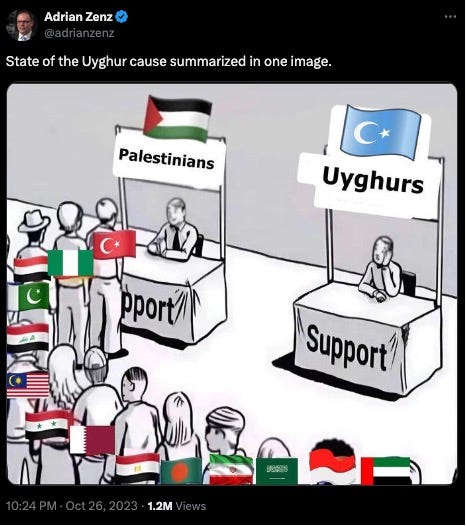
I mean I get it; there are about 7 million Jewish Israelis and nearly 6 million Muslim Palestinians and they are fighting over who can control the same land, which totals about 8,000 square miles, equivalent in size to the state of New Jersey or the country of Slovenia.
Just this week, Britain, France, and Canada announced an import ban on all goods from Israeli settlements in the West Bank, along with other sanctions against Israel. These governments are outraged that a country has seized land militarily and is implementing a policy of ethnic/religious cleansing by allowing its own citizens to use violence to set up “settlements” on the land that belongs to another ethnic/religious group.

Map from the International Crisis Group along with their report on Israel’s “annexation” of the West Bank.
Gee… I wonder where else this kind of “settler colonialism” is taking place in the world today?
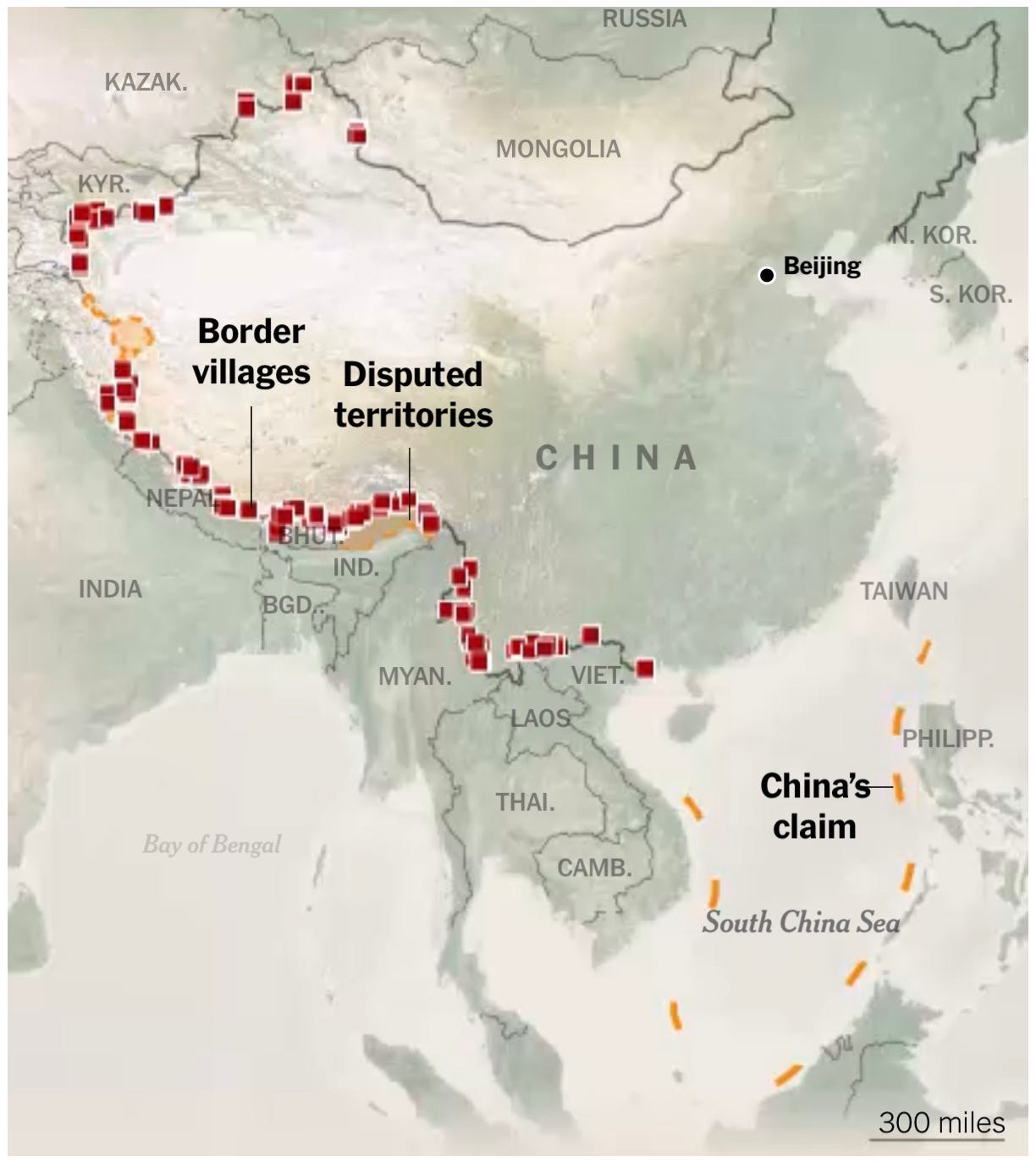
Image from the New York Times article, “China’s Great Wall of Villages,” April 10, 2024.
Of course, what the Times leaves out of their article is that all the Chinese settlements in Tibet and Xinjiang are on the annexed land of Tibetans and Uyghurs that the PRC seized militarily and have been waging a multi-decade campaign of cultural genocide to “Sinicize”.
There are about 1.3 billion Han Chinese and they are taking the land of about 3.6 million Tibetans and 12 million Uyghurs. Without Tibet and Xinjiang, the Han Chinese control over 2.5 million square miles of territory, which would make it the sixth largest country in the world… but by annexing Tibet and Xinjiang and bringing it under the ethnic domination of Han Chinese, the PRC is the third largest country behind Russia and Canada.
Hong Kong court upholds convictions of Cardinal Joseph Zen and others over protester relief fund
Kanis Leung, Associated Press, September 3, 2026
A Hong Kong court on Thursday dismissed appeals brought by a 94-year-old Roman Catholic cardinal and four others over their convictions for failing to register a now-defunct fund that aimed to help people arrested during anti-government protests.
Cardinal Joseph Zen, a retired bishop and vocal advocate for democracy in the city, was a trustee of the 612 Humanitarian Relief Fund, which helped pay medical and legal fees for arrested protesters until it ceased operations in October 2021. The other defendants — singer Denise Ho, scholar Hui Po Keung, and former pro-democracy lawmakers Margaret Ng and Cyd Ho — also served as trustees.
The five were found guilty and fined 4,000 Hong Kong dollars ($512) each in 2022 for breaching the Societies Ordinance, which requires local organizations to register or apply for an exemption within a month of their establishment. Their convictions were the first of their kind.
COMMENT – The Vatican still hasn’t weighed in on this and has largely abandoned one of its own Cardinals.
WAY BACK MACHINE – The Pope Abandons Cardinal Zen: As Hong Kong puts the bishop on trial, Francis still offers no support.
William McGurn, Wall Street Journal, September 19, 2022
Industrial Policies and Economic Espionage
US-China borrowing costs diverge to widest level ever
William Sandlund, Financial Times, September 10, 2026
Rising Treasury yields threaten to accelerate shift in capital flows between world’s two largest economies.
The gap between benchmark borrowing costs in the US and China has reached its widest level ever, threatening to accelerate a shift in capital flows between the world’s two biggest economies.
The spread between 10-year bond yields in the US and China rose to a record 3.17 percentage points on Thursday as their economies faced divergent inflation outlooks.
The 10-year Chinese government bond yield stood at 1.68 per cent, while the equivalent US Treasury yield reached 4.85 per cent, its highest level since 2023.
Higher Treasury yields, which translate to lower bond prices, are likely to stoke capital outflows that Beijing is rushing to contain.
“The risk is that if interest rate differentials become wider and wider then that will draw capital away from China,” said Mansoor Mohi-uddin, chief economist at Bank of Singapore.
Chinese bond yields have been grinding lower as the country grapples with a chronic lack of credit demand and deflationary pressures from slowing economic growth.
“You can call China the most profitable and successful bond market in the world among major benchmarks, possibly for the wrong reasons,” said John Woods, chief investment officer for Asia at Lombard Odier. “Prices are rallying hard largely because of underlying disinflation and economic conditions.”
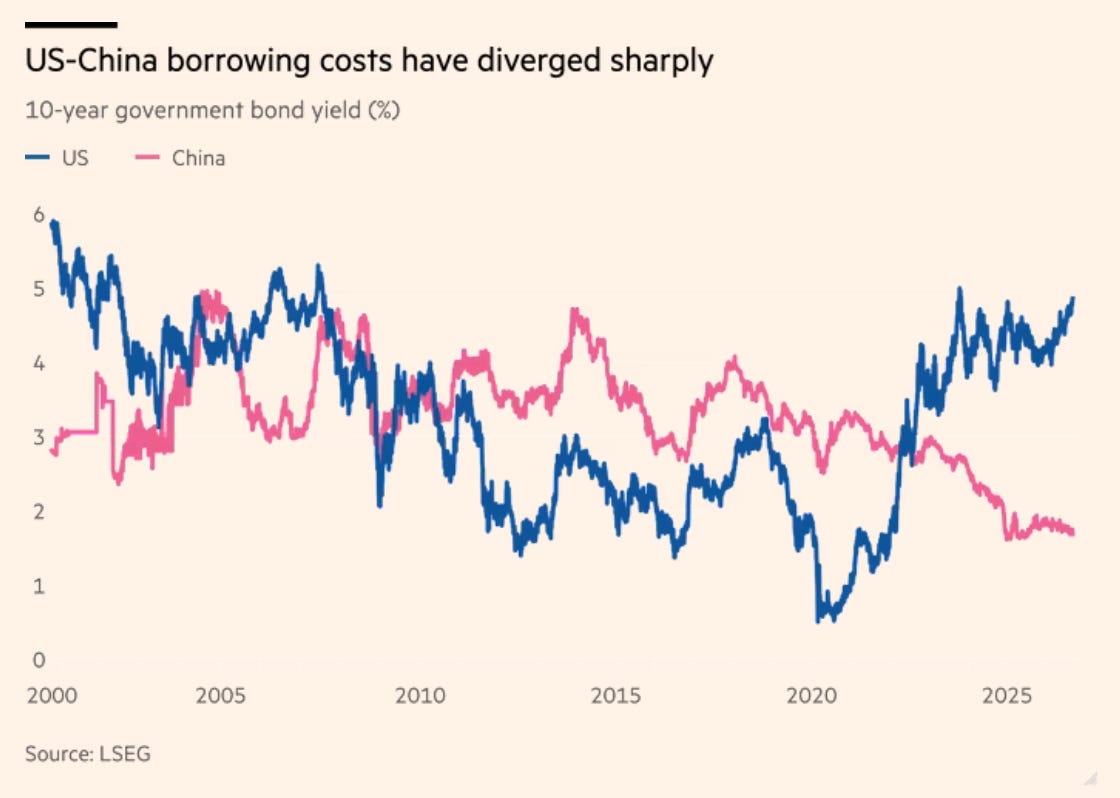
COMMENT – Back in 2015, the PRC imposed draconian capital controls to keep money from fleeing from China and that was under favorable borrowing costs compared to the U.S. Now that has reversed, which means it is even tougher for the PRC to keep the money of its citizens caged in the PRC.
Think Your EV Holds Its Value? China Has Some Bad News for You
Indranil Ghosh and Itika Sharma Punit, Rest of World, September 8, 2026
Southeast Asia Emerges as Crucial Driver of China’s Clean-Tech Exports
Gavin Maguire, Reuters, September 7, 2026
BYD Targets 2 Million Overseas Sales in 2026 After Strong Run in Brazil, Europe
Glorial Li, Nikkei Asia, September 7, 2026
China’s Car Exports Roar in August While Domestic Sales Extend Declines
Reuters, September 8, 2026
China Oil Demand Revival Spurs Price Spikes from Congo to Brazil
Bloomberg, September 7, 2026
Ahead of Xi’s U.S. Visit, China’s Soybean Crushers Face High Costs, Weak Margins
Ella Cao, Naveen Thukral and Roberto Samora, Reuters, September 7, 2026
China’s Huawei Heads to Trial in U.S. Over Sanctions and Trade Secrets
Pak Yiu, Nikkei Asia, September 9, 2026
Huawei Drives China’s Push to Make Advanced Chips
Eleanor Olcott and Zijing Wu, Financial Times, September 8, 2026
China’s Surging Exports Loom Over Trump’s Talks with Xi
Alexandra Stevenson, New York Times, September 8, 2026
China’s 25% Export Surge Sets Stage for Record Annual Trade Surplus
Joe Leahy and Haohsiang Ko, Financial Times, September 8, 2026
China Pumps $54 Billion Into Banks and Insurers
Joe Leahy, Financial Times, September 7, 2026
Chinese Company Draws Fire for Laying Off 100 Grads a Month After Hiring Them
Katrina Northrop, Wall Street Journal, September 8, 2026
Patients Are Flying to China for the Latest Cancer Treatment
Jonathan Cheng, Wall Street Journal, September 7, 2026
The Trillion-Dollar Bright Spot in China’s Economy: Tourism
Hannah Miao, Wall Street Journal, September 8, 2026
Three Numbers That Show Just How Big China’s Export Boom Is
Grace Zhu, Wall Street Journal, September 8, 2026
China’s Foreign Exchange Reserves Continue to Climb
Wall Street Journal, September 7, 2026
Trade: U.S. Wants to Decouple from China — and Hits German Companies
Dana Heide and Kathrin Witsch, Handelsblatt, August 27, 2026
Critical Minerals Replace Oil as Top Geopolitical Battleground
Benzinga, September 6, 2026
China Rare Earth Firms Halt Some U.S. Shipments Over Geopolitical Worries
Laurie Chen, Solomon Cefai, Trevor Hunnicutt and Lewis Jackson, Reuters, September 4, 2026
U.S. Grab of Venezuela Denies China Oil, Billions in Debt Payments
Bloomberg, September 4, 2026
Volkswagen Plans to Cut 50,000 Jobs Amid Dire Need to Reduce Costs
James Paton, New York Times, September 3, 2026
Japan Protests as China Slaps New Measures Against Its Exports of a Key Chipmaking Material
Chan Ho-him and Mari Yamaguchi, Associated Press, September 8, 2026
U.S. Says It’s Fed Up with China’s Overcapacity — and More Countries Agree
Jon Emont, Wall Street Journal, September 2, 2026
Tesla-Challenging EV Truck Startup Windrose Loses Most of Chinese Staff
Paul Berger and Yijing Shen, Wall Street Journal, September 4, 2026
Cyber and Information Technology
U.S. and China Eye Trump-Xi Talks on AI Guardrails Despite Tech Rift
Stella Yifan Xie, Nikkei Asia, September 7, 2026
China Targets Fourfold Boost in AI Computing Capacity by 2030
Howard Liu, South China Morning Post, September 8, 2026
Saudi AI Firm Humain Unveils Model Based on China’s MiniMax
Luz Ding and Zheping Huang, Bloomberg, September 3, 2026
Superpowers and AGI
Jacob Stokes, Center for a New American Security, August 27, 2026
Military and Security Threats
From Dance Floor to War: China Readies Humanoid Robots for Combat
Eduardo Baptista, Reuters, September 7, 2026
VIDEO – Australians Funding Hostile Military-Linked Research with Taxpayer Money
The Australian, September 8, 2026
Canada Has Reopened Military Channel to Beijing After Eight Years, China’s Defense Ministry Announces
Sam Cooper, The Bureau, September 7, 2026
Taiwan Aerospace Contractor Zeroes in on Countermeasures to China’s Drones
Thompson Chau, Nikkei Asia, September 8, 2026
Pacific Islands Leaders Express Concern Over China’s Missile Launch
Sophie Mak, Nikkei Asia, September 4, 2026
U.K. Urged to Overhaul Military Procurement to Remove China-Made Parts
Kris Cheng, Nikkei Asia, September 4, 2026
Chinese Warships Are Cruising Too Close for Comfort Off Japan’s Shores
Jason Douglas and Junko Fukutome, Wall Street Journal, September 2, 2026
One Belt, One Road Strategy
China’s Exit from Utility Sales Hints at Declining Interest in Pakistan
Adnan Aamir, Nikkei Asia, September 9, 2026Capricorn Bi-Oceanic Corridor Could Expand China’s Strategic Reach in South America
Julieta Pelcastre, Dialogo Americas, September 4, 2026
The completion of a key section of the Capricorn Bio-Oceanic Corridor marks a new phase in South America’s logistical integration. As the route brings the continent’s interior closer to Pacific ports and Asian markets, analysts warn that it could also strengthen the trade, logistics, and infrastructure network underpinning China’s growing strategic influence in Latin America.
The corridor brings together Argentina, Brazil, Chile, and Paraguay in a regional integration initiative that will connect the Atlantic and Pacific oceans through highways, bridges, border crossings, logistics centers, and port infrastructure. Its action plan defines the project as a mechanism to strengthen connectivity, facilitate trade, and promote development across the territories it traverses.
The Regional Master Plan for Integration and Development, supported by the Inter-American Development Bank, also prioritizes the coordination of investments, cross-border procedures, regulatory harmonization, and physical and digital infrastructure. These systems will be essential to the corridor’s operation and will help determine which companies and technologies gain access to its logistics networks and commercial data.
Once fully operational, the corridor will create a more direct land connection between productive regions in South America’s interior and ports in northern Chile, facilitating access to Asia-Pacific markets. Chile’s official action plan estimates that the route could reduce transportation times between inland Brazil and Paraguay and Asian markets by as much as 10 days.
In July 2026, construction crews completed the physical connection between the Paraguayan and Brazilian sections of the Bioceanic Bridge, linking Carmelo Peralta, Paraguay, with Porto Murtinho, Brazil. The bridge represents one of the corridor’s most visible milestones, although access roads, border facilities, customs systems, and other supporting infrastructure must still be completed before the route becomes fully operational.
How China’s Green Tech Is Undercutting U.S. Energy Strategy in Africa
Dulue Mbachu, South China Morning Post, September 7, 2026
China Marks Major Tunnel Milestone for Central Asia Railway Bypassing Russia
Carol Yang, South China Morning Post, September 7, 2026
The Limits of America’s Anti-China Campaign Come into View in Peru
Genevieve Glatsky, New York Times, September 7, 2026China Consolidates Its Position in Peru’s Critical Minerals Sector
Julieta Pelcastre, Dialogo Americas, September 8, 2026
Indonesia to Take Control of China-Funded Whoosh Rail Operator
Nikkei Asia, September 8, 2026
China Consolidates Its Position in Peru’s Critical Minerals Sector
Laura Solano, Diálogo Américas, September 8, 2026
Qatar’s PM Vows to Prioritise China’s Energy Supply Amid Middle East Tensions
Shi Jiangtao, South China Morning Post, September 8, 2026
Himalayan Disaster Tests China’s Clout as Regional Leader
Austin Ramzy, Wall Street Journal, September 2, 2026
Opinion
The Emerging U.S.-China Détente
Da Wei, Foreign Affairs, September 7, 2026Why Beijing isn’t taking the bait with Trump
Ryan Hass, Brookings, September 9, 2026
Key Points:
During his second term, President Trump has made notable conciliatory gestures toward Xi Jinping and China, even as his administration has advanced a range of competitive actions.
Beijing has not let its guard down. China remains focused on strengthening its long-term position for competing with the United States, not on securing breakthroughs with Trump.
Chinese leaders continue to treat strategic competition as an enduring and undiminished attribute of the relationship.
Beijing is working to buy time to build greater capacity to withstand the pressure it expects to face from the United States and others as China accrues more power and influence on the world stage.
China’s Xi Sends a Strong Message Before His U.S. Visit
South China Morning Post, September 8, 2026
Zombie Automakers Are Fueling China’s Export Chaos
Zhai Shaohui, Caixin Global, September 7, 2026
‘Chimerica’ Is Now a Chimera — and Global Stability Is the Victim
Adam Tooze, Financial Times, September 7, 2026Alice Liu, The Monitor, September 8, 2026
Alice Liu: Dr. Huang, you published a new edition of Statism with Chinese Characteristics earlier this year. What’s the book about?
Yasheng Huang: The book is a substantially revised and expanded version of my book published in 2008. One objective of the book is to update the Chinese economy today. The book is, at its most basic, a narrative and an interpretive history of Chinese reforms. I say it’s both a narrative—documenting what has happened—and an interpretation of these historical policy developments, reforms, and resulting economic performance. So that’s the idea of the book. The other purpose, and I’ve said this many times in my book, is to get the details right.
So, my reading of a lot of the Chinese economic books, by the way, in both English and Chinese, is that they are at a very high level. A lot of the details are missing, especially about the earlier period. And missing those details, in fact, has consequences for how we interpret Chinese economic performance and Chinese policy development. So what I aim to do is to provide those details.
AL: One of the book’s central arguments is that, in scholarly discussions of China’s economic takeoff, the era of the 1980s deserves far more analytical attention than it has received. Why is the decade often overlooked, and what significance does it hold?
YH: I think it’s overlooked for a number of reasons. One is that American academics only began to pay attention to China in the 1990s. Even Chinese scholars didn’t pay as much attention to China in the 1980s as they did to the later period. I was just a student in the 1980s, and I have to admit that I myself didn’t really know what was going on. Only by writing my 2008 book did I begin to have a considerably new perspective on the decade. And the other reason is that the Chinese statistics from the 1980s are very fragmented and incomplete. The Chinese Statistical Yearbooks didn’t have many data series at a level that is important for doing in-depth research. Academics, at least Western academics, really didn’t undertake complicated income surveys. One happened in 1988, and that was already toward the end of the 1980s. So that’s the lack of materials and data.
And then, crucially, there was a powerful idea that emerged in the study of the Chinese economy: gradualism. The person who was most instrumental for that literature is Professor Barry Naughton, who is a professor at UCSD. In 1996, he published the book Growing Out of Plan. As the title suggests, his view is that China can grow out of the central planning rather than having to reform central planning directly to grow. The implication is that China began to take small-step reforms at the beginning and then generate growth and then China gradually built on these steps and began to undertake bigger and more radical reforms. Naughton’s perspective was tremendously influential in that it set a tone for how the rest of the academic community viewed China. They drew the conclusion that reforms in the 1980s were gradualist, small steps, and they only grew radical after the eighties. A lot of these pronouncements about the 1980s are based on this framework, rather than based on actual observations of that era. As such our views of the 1980s are really inferences rather than direct observations.
AL: What else is mistaken about Chinese reform history? What would you find problematic about orthodox explanations of China’s economic miracle? You called the whole China model “ahistorical” and “getting cause and effects backward,” and I’m especially interested in hearing more about that.
YH: Well, I think these two critiques of mine, ahistorical and getting the cause and effect backward, are interconnected. It’s ahistorical in the sense that people essentially view the 1980s from their perspective on the 1990s, and by the way, this is one reason why so many people have a very high opinion of Zhu Rongji, who passed away recently. Globalization, state-owned enterprise (SOE) privatization, these are well-known events that people talk about, and they are meaningful reforms, but they all happened in the 1990s or early 2000s. And then the view is that China did none of that in the 1980s. Well, it’s ahistorical, because China implemented a lot of incredibly meaningful reforms in the 1980s. In fact, on some dimensions, the reforms in the 1980s were far more radical and fundamental than the reforms in the 1990s. But more importantly, and what is completely missing in the standard account of the Chinese economy is that in the 1990s, the policy makers reversed many of those reforms of the eighties.
Going back to your first question of why academics don’t know much about the 1980s, it is in part because a lot of these reforms in the 1980s happened in the countryside. In the 1980s, the Chinese countryside was massive. Remember, in the 1980s, the countryside was 80% of the population. And so substantial reforms took place in a part of the economy that has 80% of the population.
Another thing about the 1980s is that it was a decade in which meaningful political reforms took place. That has been largely overlooked; those political reforms have inextricable links to the nature and the type of the growth in the 1980s—more equitable and beneficial type of growth to the average Chinese. The other portion of your question was about reversing the cause and effect. The narrative that emerged in the 1990s is that the Chinese economy succeeded because of industrial policy, massive infrastructure building, and state-coordinated programs. And that became the dominant narrative of why the Chinese economy succeeded. It’s a cause-and-effect view: building roads leads to economic growth. Well, it turns out that China, in the 1980s, had terrible roads and had very little really respectable infrastructure.
As you may know, a lot of people believe that China succeeded due to superior infrastructure, whereas India did not. But in effect, in the 1980s, by one measure that mattered at the time—railway, India had better infrastructure than China. In terms of this cause and effect, well—this cause was practically non-existent in the 1980s. And I would argue that causal direction is exactly the opposite. The reforms in the 1980s, plus the momentum built in the Chinese countryside, created economic growth and resources, which in turn led to infrastructure-building. Infrastructure is a result of, rather than the primary cause of, China’s growth.
How Does the World Really View China?
Adam Y. Liu, Foreign Affairs, September 2, 2026The Case for Letting China In: American Businesses Need More Foreign Capital and Know-How
Brian Deese, Foreign Affairs, September 10, 2026
Industrial policy is back in fashion in the United States. As fragile global supply chains and a weakened industrial base present growing economic and national security risks, policymakers in both parties have embraced energetic efforts to rebuild the country’s industrial capacity. With interventions such as the 2022 CHIPS and Science Act, Washington has made historic commitments to strengthening the United States’ technology and manufacturing base, which is becoming increasingly important to the country’s economic success and ability to defend itself. As director of U.S. President Joe Biden’s National Economic Council, I helped to design and drive this shift.
Initiatives to revive domestic capacity are a necessary response to real dangers. But more and more, American leaders are seeking to support industry at home in ways that are counterproductive. In particular, they are growing hostile to foreign investment.
Many policymakers fear that foreign investors could steal sensitive data or gain dangerous leverage over U.S. companies or critical infrastructure. Their aversion is most pronounced with respect to China but has been trained on allies and partners as well. It applies not only to cases of foreign ownership of U.S. companies but also to joint ventures, the licensing of foreign intellectual property, and other arrangements in which a foreign company shares its knowledge or resources. Stephen Miran, the chair of the president’s Council of Economic Advisers, has suggested imposing fees on foreign holdings of U.S. assets, including those owned by allies. Senators Tammy Baldwin and Josh Hawley have introduced bipartisan legislation in the U.S. Congress that would tax foreign capital inflows outright.
At the federal, state, and local level, those in power are taking steps to shut global capital out of the United States and prevent American enterprises from harnessing the latest advances in data storage, critical mineral processing, and chip-making. This is a troubling and ultimately self-defeating strategy. Of course, the U.S. government should mitigate the risks of foreign investment. But today, its screening regime is overzealous. The United States is undermining its own industrial policy by denying itself the tools to become competitive globally in crucial sectors.
COMMENT – Hmmm… rather than cut another Faustian Bargain with the Chinese Communist Party (remember the CCP maintains draconian capital controls, so the ONLY investments flowing out of the PRC are ones approved by the CCP), perhaps the United States could make it more attractive for the citizens and businesses of the world’s wealthiest country to invest in themselves?
Imagine if a company like Apple invested just a fraction of what it has poured into the PRC over the past two decades?
Now this would mean actual regulatory reform and a serious effort to counter NIMBY-ism… it might also require both political parties to NOT demonize their own companies and investors.
If the United States wants the capital and know-how to expand its industrial base, it should first look in the mirror.
This Obscure Airport Tells You a Lot About China
Tom Tugendhat, Washington Post, September 4, 2026
Luckin Coffee Killed Our Lunch Spot. Here’s What That Says About Geopolitics
George Steer, Financial Times, September 4, 2026
Why India Baffles China
The Economist, September 6, 2026