Dancing in the Moonlight
The Artemis program should make us optimistic
Friends,
The lion’s share of my commentary for this week can be found beneath the first article with my response to Greg Ip’s OpEd in the Wall Street Journal today. I’ve got a lot of respect for Greg Ip (and Eddie Fishman) but I think they are misinterpreting the dynamic between Washington and Beijing.
***
For this week’s musical selection and title, of course it has to do with the moon.
In 1969, Sherman Kelly wrote the song, “Dancing in the Moonlight” while he was recovering from a brutal beating by a gang on the Caribbean island of St. Croix that attacked him with baseball bats and raped his girlfriend. The song was an attempt to imagine a positive, alternative reality that celebrated life in the aftermath of something horrible.
While Sherman performed the song with his band, Boffalongo, in 1970, his brother Wells Kelly would introduce the song to his band, King Harvest which had formed in Ithaca, New York as a group of French and American students studying at Cornell University together.
In 1972, King Harvest released the song as a single which became their one and only hit. Here is a video of their performance of “Dancing in the Moonlight” in June 1973.
The English band, Toploader, would cover the song in 2000 and made it a world-wide hit again.

King Harvest lead singer and bassist, David “Doc” Robinson (right) and drummer Steve Cutler (left).
I think it is fitting to use this song as we celebrate the safe return of the American-Canadian Artemis II mission this week.
Much of the reporting on the Artemis overlooks just how international this program is.
The Artemis Accords were launched in 2020 by the Trump Administration as an international program “united for peaceful exploration of deep space.” In January 2026, Oman became the 61st country to join.
Aside from Jeremy Hansen, the Royal Canadian Air Force colonel, who became the first non-American to travel beyond low-earth orbit this week, Canada has been instrumental in building the robotics for the program and will continue to have astronauts involved. Japan is building the new lunar rover that will be a part of future missions along with Japanese astronauts. The European Space Agency (ESA) is building the habitation modules, and we should expect to see Europeans on future missions as well. There are countless engineers and scientists involved in this program from everywhere on earth.
Signed during the pandemic, the Artemis Accords and its program for crewed space exploration, continued during the Biden Administration. While President Biden was in office, an additional 43 countries joined.
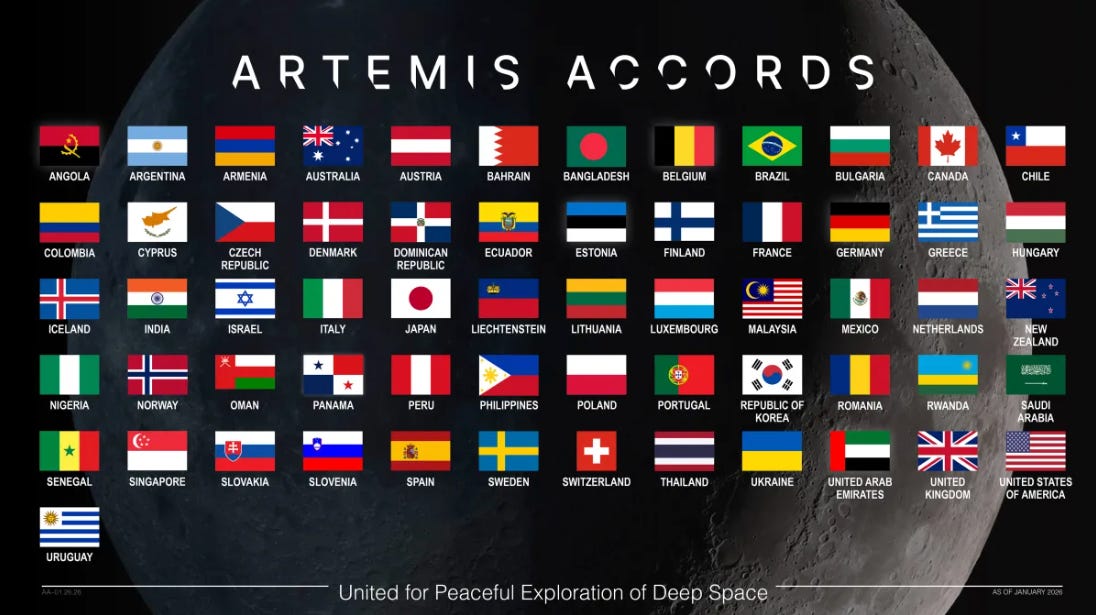
Seeing us restart the human exploration of our solar system after a 50-year hiatus is exciting.
Over the past week I’ve seen many complaints that we shouldn’t be doing this while there are still problems here on earth. The naysayers criticize the expense, think we will ruin the rest of the solar system, and advocate that we keep our dreams constrained. These folks view the future as dystopian and have little faith in what we can achieve as a species.
A version of this pessimism was on display in the school scene of the 2014 movie Interstellar.
Just as Matthew McConaughey’s character Cooper did in the film, I reject that line of thinking.
We need to explore, find new worlds, and strive for more. That is what makes life worthwhile and meaningful.
This affirmative vision is captured clearly in Erik Wernquist’s short film from 2015, Wanderers, which includes a voice over by Carl Sagan that was drawn from the reading of his 1994 book, Pale Blue Dot: A Vision of the Human Future in Space, which came out shortly before his death from cancer in 1996.

If you haven’t seen this short film, watch it now, Carl Sagan’s voice, the art of his language, and the composition by Erik Wernquist is inspiring.
For all its material advantages, the sedentary lift has left us edgy, unfulfilled.
Even after 400 generations in villages and cities, we haven’t forgotten.
The open road still softly calls, like a nearly forgotten song of childhood.
We invest far-off places with a certain romance.
The appeal, I suspect, has been meticulously crafted by natural selection as an essential element in our survival.
Long summers, mild winters, rich harvests, plentiful game – none of them lasts forever.
Your own life, or your band’s, or even your species’
might be owed to a restless few – drawn, by a craving they can hardly articulate or understand, to undiscovered lands and new worlds.
Herman Melville, in Moby Dick, spoke for wanderers in all epochs and meridians.
He said: “I am tormented with an everlasting itch for things remote.
I love to sail forbidden seas…”
Maybe it’s a little early. Maybe the time is not quite yet.
But those other worlds – promising untold opportunities – beckon.
Silently, they orbit the Sun, waiting.
We are a species of explorers, pioneers, and adventurers… astronauts are the best of us.
If you come away from Wanderers with anything but optimism, then perhaps you need to see a mental health professional.
That feeling of optimism hit me when I saw this video, captured by someone on their smartphone out the window of an American Airlines passenger jet of the Artemis II launch from Cape Canaveral.
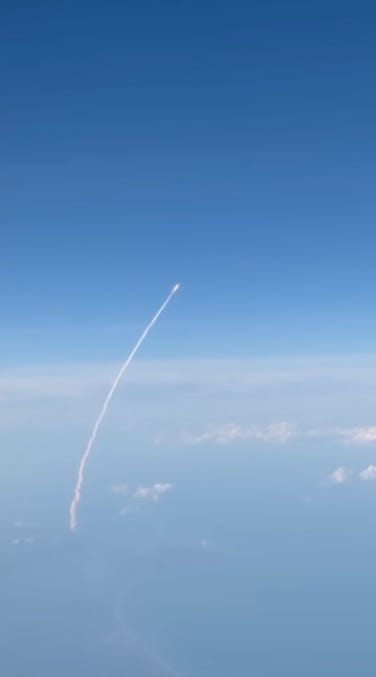
There are a lot of things to be pessimistic about in the world today, but this isn’t one of them.
For those who are looking for a positive example of international cooperation, American leadership, and human ingenuity, just look up (or out your window).
Thanks for reading!
Matt
MUST READ
Kryptonite to America’s Economic Super Powers: Chokepoints
Greg Ip, Wall Street Journal, April 12, 2026
The U.S. brings superior size to economic warfare, but China and Iran have fought back through control of critical economic assets.
Few presidents have waged economic war as aggressively as Donald Trump. Yet twice now, other countries have effectively waged economic war against him.
A year ago, Trump imposed steep tariffs on China, which then retaliated by restricting exports of rare-earths products that are essential in industries ranging from electric vehicles to aerospace. Trump soon sought a trade war truce.
Six weeks ago, the U.S. and Israel attacked Iran, which then closed the Strait of Hormuz and sent the price of oil, jet fuel, fertilizer and other commodities skyrocketing. This week, the U.S. and Iran reached a cease-fire.
Neither Iran nor even China possess anything like the economic sway the U.S. does. What they do control are “chokepoints”—China produces 94% of rare earth magnets, and 20% of the world’s oil passes through the Strait of Hormuz.
Chokepoints work fundamentally differently from tariffs, and that distinction exposes the flaws in Trump’s entire approach to economic warfare.
This is what I learned from Edward Fishman, who worked on sanctions policy in the Obama administration and literally wrote the book on this subject: “Chokepoints: American Power in the Age of Economic Warfare.”
Fishman says a chokepoint has three attributes. First, a country or coalition must have a dominant enough market position to swing the supply or price of a commodity or service. Second, substitutes for that commodity or service must be hard to find in the short run (in the long run, everything has a substitute). Third, closing that chokepoint must have asymmetric effects, i.e., hurt your adversary more than it hurts you.
Chokepoints can be physical or economic. Physical chokepoints include waterways such as the Strait of Hormuz or the Bosporus and Dardanelles, which connect the Mediterranean to the Black Sea, and thus Russian and Ukrainian grain exports. Control of that waterway figured prominently in the Peloponnesian War between Sparta and Athens, World War I and Russia’s current war against Ukraine.
Fishman says the bar is high for exploiting a physical chokepoint since that usually requires the use or threat of military force. With economic chokepoints, the bar is much lower. As finance and supply chains have globalized, potential economic chokepoints have multiplied, as have efforts to weaponize them.
Because the dollar accounts for 88% of world currency transactions, 55% of international bank claims and 50% of international payments, U.S. control over the dollar-based banking system constitutes a formidable chokepoint. Washington has used it with growing frequency to sanction terrorists, drug dealers, North Korea, and of course, Iran. With the Netherlands and Japan, U.S. control of the technology for producing advanced semiconductor chips has become a chokepoint to slow China’s progress. Russia tried to intimidate Ukraine and then Western Europe by restricting supplies of natural gas.
Trump is more committed to economic warfare than his predecessors, but by different means. Sanctions, he believes, are too blunt and overused. Tariffs are quicker, more flexible, and have domestic benefits such as protecting manufacturing and raising revenue.
Yet tariffs don’t meet Fishman’s chokepoint criteria. Trump assumes other countries will do almost anything to avoid losing access to the enormous American market. But Fishman says the U.S. share of world imports, at 13%, is too small to sway other countries’ behavior. With a few exceptions, most can find substitute markets. China’s exports to the U.S. fell last year because of tariffs, but exports to the rest of the world more than made up the difference.
This is why cultivating allies is critical to chokepoints: they can turn a moderate economic edge into a dominant one. Ben Vagle and Stephen Brooks illustrate this in their book “Command of Commerce: America’s Enduring Economic Power Advantage Over China.” They calculate that in 2022, U.S. firms generated 38% of world profits, and its allies another 35%, i.e., 73% in total. China’s generated just 16%. In high tech, the U.S. and its allies generated 84% of world profits, China just 6%.
They conclude that the U.S., with its allies, could inflict far more pain on China, by withholding critical technology or market access, than China could inflict on the U.S.
And yet Trump has pursued exactly the opposite strategy by ignoring and undermining allies, such as by threatening Europe with tariffs to seize Greenland and temporarily lifting some sanctions on Russian oil. Except for Israel, he didn’t consult them before attacking Iran, and they refused to join the war.
Just as Trump overestimates the efficacy of his own way of economic war, he underestimates the potency of others’. The Pentagon has known for decades Iran might close the Strait of Hormuz, yet seemed unprepared when it did.
Even so, Iran’s ability to extract a cease-fire by closing the strait is surprising. Trump himself noted the U.S. gets almost no oil from the Persian Gulf, and as a net exporter of oil and gas, stood to gain from a prolonged period of higher prices and restricted supplies.
Perhaps Trump believes the U.S. can still come out ahead by sharing in Iran’s oil or the tolls Iran says it has imposed on ships that transit the strait. Or perhaps Trump just wants lower gasoline prices. “The Achilles’ heel of the U.S. in economic warfare is our low tolerance for economic pain,” said Fishman.
That said, the story isn’t over. Iran may yet overplay its hand. Its military, nuclear ambitions, economy and leadership are all in ruins. Fishman notes that once a chokepoint has been weaponized, vulnerable nations will go to great lengths to neutralize it. Western Europe has found substitutes for Russian gas; Russia, China and Iran found substitutes for the dollar-based payments system; and China is developing substitutes for Western semiconductor technology.
If Iran seeks to keep control of the strait, the Gulf economies will build alternative routes to export their oil and gas while consuming nations will find alternative suppliers or diversify into other energy. And if the U.S. and its allies conclude that Iranian control is intolerable, there is always military force.
COMMENT – I usually find Greg Ip’s OpEds persuasive… this one, not so much.
Obviously, access to the U.S. consumer market is a chokepoint by the definition Eddie Fishman uses in his own book (which is on the shelf behind me). I’m disappointed that Greg did not press Eddie on this.
As Greg points out, economic statecraft (I prefer the term “economic statecraft” over “economic warfare” because it better describes what has been happening and how we use these tools) is determined by chokepoints and America’s economic sway is due to a number of chokepoints it controls. Some of these are physical (side-eye at the Panama Canal) and some are structural like the dominance of the U.S. dollar as a global reserve currency. But being the largest and wealthiest consumer market is also a chokepoint, particularly for the world’s largest manufacturer of consumer goods who has purposefully designed their economy to produce more than it can consume in an effort to build dependencies that it can use as its own chokepoints.
Let’s remember that Beijing employed its rare earth/permanent magnet chokepoint as a retaliation to the Trump Administration choking off Chinese market access to the world’s largest and wealthiest consumer market by raising the costs of imported goods from the PRC, making them less competitive to alternatives. And by applying tariffs globally, the Administration sought to prevent “transshipment” of Chinese goods through third markets.
Choking access to the U.S. consumer market with tariffs doesn’t work in every situation (the U.S. has had a trade embargo on Iran for fifty years, so there is no trade between the U.S. and Iran to tariff), but it does work with regard to the PRC. One only needs to observe that for years Beijing has been trying to mitigate this chokepoint by diversifying its export markets with the Belt and Road Initiative.
Unfortunately for Beijing this is extremely difficult to do (far more difficult than building processing facilities for rare earths and permanent magnets) because no other market can absorb the goods the U.S. turns away at the prices that they can fetch in the United States. Plus, the strategy of dumping overcapacity on to third markets creates a dilemma for Beijing… in order for those third markets to purchase the goods Beijing wants to sell them, the consumers in those markets need the jobs that are being wiped out by Chinese dumping of finished goods.
The only real alternative that the PRC has is Europe (a large and wealthy consumer market), which was already saturated by Chinese exports before the start of 2025 (remember all the concern Brussels voiced about overcapacity and here).
Now the PRC is dumping even more on Europe, which is undermining European firms in their home markets and leading to its own “China Shock.” That will have political and policy ramifications, just as it did in the United States, and will eventually convince European politicians to abandon their orthodox commitment to free trade… or it will lead to a political rupture that creates the same effect.
Chinese Communist leaders will also “try” to boost domestic consumer spending to mitigate the effects of this chokepoint but that will be even more difficult than convincing third countries to accept Chinese dumping. The Party has shown that it does NOT want to actually empower Chinese citizens with serious economic power because that would come at the expense of the Party’s power over the Chinese economy. It would lead to the fracturing of the Party domestically by empowering constituencies within the PRC to pull the Party apart. This is Xi Jinping’s ultimate red-line as he knows that the Party cannot survive in power if it surrenders the economic high ground to competing constituencies pursuing their own self interests.
Beijing has designed its economy to be vulnerable to this chokepoint… Chinese leaders believed that American commitment to “free trade” was absolute and therefore they could pursue a strategy of making the United States dependent on the PRC. They likely believed that America would try to maintain the Post-Cold War international order at all costs and therefore Beijing’s parasitic approach would eventually work as the United States was hollowed out.
The thing they did not expect is that Washington would so rapidly jettison its religious commitment to “free trade” and the maintenance of the liberal, rules-based international order. Chinese leaders probably made this mistake because they only listened to American business leaders, Wall Street investors, and Davos-man (side-eye at Ray Dalio, Henry Kissinger, and Robert Zeollick) who were the most committed to this orthodoxy. Chinese Communist leaders fell into the trap of mirror-imaging… believing that the American elites that they knew would remain in power and would exercise the kind of control over the United States that Chinese leaders exercised over the PRC. Chinese leaders likely imagined that these elites would never permit someone like Donald Trump to employ this chokepoint against them because it would destroy the liberal, rules-based international order.
This chokepoint has placed Beijing on the “horns of a dilemma.” The best thing for Washington to do is to keep the structural chokepoint in place and continue to ratchet it down as Beijing squirms.
It is fashionable in Washington and New York (as well as San Francisco, Los Angeles, London, Paris, Brussels, and Berlin) to assert that everything that Donald Trump does is stupid and counterproductive and that our adversaries are outsmarting us (this conclusion is much more about partisanship, than an objective analysis of what Washington should do in its situation). However, using access to the U.S. consumer market as a chokepoint against the PRC isn’t one of those stupid and counterproductive moves. It is a costly move for the United States, no doubt (let me be very clear: there are NO low-cost solutions to the challenge we face from the PRC, we won’t simply negotiate our way out of this), but employing economic statecraft to create a chokepoint against the PRC for access to the U.S. market is MUCH more costly for the PRC because Beijing’s potential responses only undermine their position more.
America’s AI Build-Out Hinges on Chinese Electrical Parts
Emily Forgash and Akshat Rathi, Bloomberg, April 1, 2026
The struggle to manufacture transformers, switchgear and batteries domestically has forced the US to rely on imports, delaying data center construction.
In the red dirt of Abilene, Texas, more than 6,000 workers travel around on electric buggies, spending day and night constructing a massive data center that will feed the world’s growing artificial intelligence needs. When completed this year, the eight sprawling buildings — which OpenAI will use — will consume 1.2 gigawatts of power, or enough electricity for nearly 1 million American households.
As the global AI race heats up, there is a huge rush to build data centers fast. There’s no lack of money chasing these projects, with tech giants Alphabet Inc., Amazon.com, Meta Platforms Inc. and Microsoft Corp. committed to spending more than $650 billion this year alone. Yet neither ambition nor capital is enough to materialize all the necessary components for these power-hungry computers.
Almost half of the US data centers planned for this year are expected to be delayed or canceled. One big reason is the shortage of electrical equipment, such as transformers, switchgear and batteries. They are needed not just for powering AI, but also for building out the grid that is seeing increased consumption from electric cars and heat pumps. US manufacturing capacity for these devices cannot keep up with demand, and the scarcity has caused data center builders to rely on imports.
Electrification is a key solution to both tackling climate change and powering AI ambitions. But America’s AI prowess on computer chips and cutting-edge software is being hamstrung by the country’s inability to manufacture the electrical parts. “There’s not enough domestic capacity to go around, so people are pretty much forced to go to the export market,” says Benjamin Boucher, senior analyst with Wood Mackenzie.
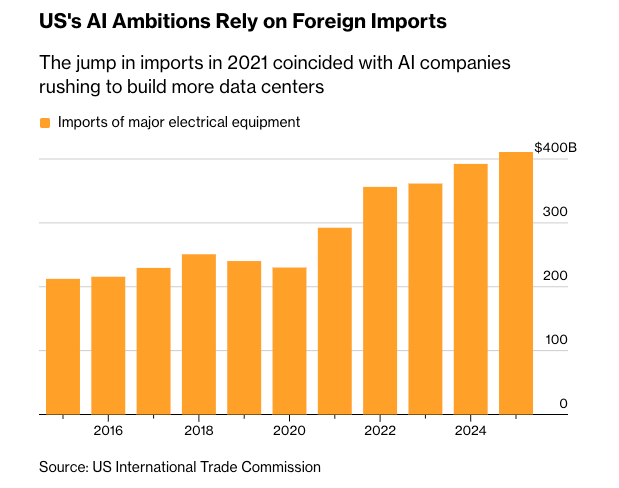
The import dependence is putting data center companies in a bind. “There’s only going to be one winner,” President Donald Trump said in December, “and that’s probably going to be the US or China.” While he wants the US to win, his America First doctrine calls for installing trade barriers to cut imports.
Data centers consuming as much as 12 gigawatts of power are supposed to come online in 2026 in the US, according to analysts at market intelligence firm Sightline Climate, who will be releasing a new report in the coming weeks. However, only a third of that is currently under construction, Sightline estimates.
Crusoe won the contract to build the Texas data center campus because of its promise of speed. Cully Cavness, Crusoe’s chief strategy officer and co-founder, says the company pledged to get a portion of the data center powered up in less than a year after starting construction. The secret to achieving that was buying enough of the right electrical equipment through early orders, securing some supplies before export barriers were erected.
Electrical infrastructure adds up to less than 10% of the total cost of the data center, but it’s impossible to build the operation without it. “If one piece of your supply chain is delayed, then your whole project can’t deliver,” says Andrew Likens, Crusoe’s energy and infrastructure lead. “It is a pretty wild puzzle at the moment.”
Most companies contacted by Bloomberg News declined to comment on the problems they are facing or where they source their equipment from. The few that responded highlighted the solutions they have enacted. Spokespeople for Amazon and Microsoft said they plan electrical equipment procurement ahead of time when building their data centers, and a spokesperson for Equinix Inc. pointed to a recent investment in a manufacturing facility that makes switchgear. Google, Oracle, Nebius Group NV, and Coreweave Inc. declined requests to comment.
Though few companies are eager to talk about it, the US has been outsourcing its manufacturing to other countries, primarily China, for decades. That has contributed to a significant shortage of electrical components in the US, says WoodMac’s Boucher.
In January, a group of US utility executives visited a transformer factory in China as part of a tour of Chinese electricity and technology plants and noticed that around half the transformers slated for delivery sported the US flag. Some were specifically going to data center companies, according to one person on the trip who requested anonymity to share commercially sensitive information.
Over the past 10 years, the US government has tried a series of policies to reshore manufacturing, but they haven’t yet yielded a significant boost to domestic capacity, forcing businesses to look to China regardless of the tariffs or the alleged national security risk. That means the US needs crucial parts from China to dominate it in the AI race, while China needs advanced chips from American companies to stay in the race.
In March, Trump issued a new framework to speed up permitting of new power plants for data centers. Without addressing electrical equipment shortages, many are worried that the trillions of dollars of spending aimed at data centers won’t yield the decisive steps the US must take to win the AI race. “We’ve seen firsthand the value it can create if you are not hamstrung by electrical infrastructure lead times,” says Crusoe’s Likens. “They can make or break a project.”
Data centers have rapidly grown in size and now consume more electricity than their predecessors a decade ago. That demands bigger transformers, which safely pull electricity from the high-voltage grid to feed to tiny computer chips. Without the right transformers, there’s no way to make the data center work.
Before 2020, these high-power transformers typically arrived 24 to 30 months after an order was placed. Those timelines were “totally manageable in the old world” when data centers didn’t need such large transformers or at such short timelines, says Philippe Piron, chief executive officer of GE Vernova’s electrification division. But AI companies “want something typically in less than 18 months.”
The spike in demand from data centers and grid expansion have pushed up prices and extended delivery times to as much as five years. That is why some, like Crusoe, have even resorted to refurbishing old transformers from shuttered power plants as a stopgap measure.
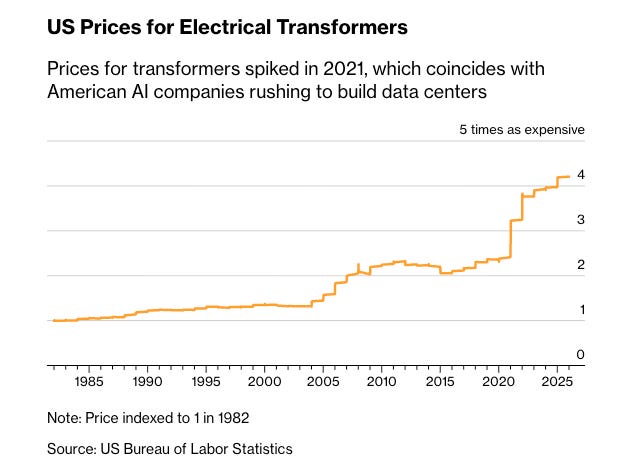
In October, GE Vernova spent $5.3 billion to buy the remaining stake in Prolec, a transformer company, to fully acquire it. In February, Siemens Energy announced an investment of $1 billion to expand its US manufacturing capacity of transformers and gas turbines over the next two years.
Neither immediately relieves demand, which forces data center developers to look abroad. While most of the US’s transformers come from Canada, Mexico and South Korea, US utilities imported more than 8,000 high-power transformers in 2025 through October from China, up from fewer than 1,500 imported in all of 2022, estimates WoodMac’s Boucher. This build-out “is going to be highly dependent on the import market,” he says.
Once transformers lower the voltage of electricity so it can be used in data centers, it then needs to be distributed across the data center safely. That’s done through switchgear, which includes circuit breakers and fuses. There too, data center developers are seeing delivery delays – though not as extreme as the timelines for transformers.
Equinix Inc.’s solution is to commit at least $350 million to support Hanley Energy’s new manufacturing facility in Ireland, which will make switchgear and other data center components. Equinix expects to achieve 10% to 15% faster lead times as a result.
Crusoe’s answer to that shortfall has been to pre-order lots of the equipment. That means spending many millions of dollars on supplies before the company even knows it has an order to fill, but it’s proved a winning strategy. Recently, Crusoe also began manufacturing their own switchgear.
To speed deployment, Crusoe started packaging the switchgear in what the company calls power distribution centers. The PDCs look like a shipping container that someone could live in – they have a sloped roof, gutters and a door, although no windows.
Crusoe manufactures all parts of the building from the raw materials it buys, including the roof trusses, foundation and walls. Inside the PDCs are refrigerator-sized circuit breakers, like a much larger version of the breaker panels on the outside of houses.
It now sells its PDC equipment to other data center companies. “We felt like that was a risk in the marketplace and wanted to kind of secure our own destiny,” says Likens.
With transformers and switchgear secured, the data center can open for business. But without additional equipment, the racks full of expensive computer chips could degrade quickly, and that’s where lithium-ion batteries come in.
The moment an office worker uploads a huge dataset and asks AI to analyze, it can cause a spike in electricity demand at a data center. That spike can cause the flow of electricity to change very quickly, which reduces the lifetime of the equipment.
Lithium-ion batteries smooth out the sudden spikes in power consumption. They store extra electricity when there’s too much and release it when there isn’t enough, helping keep power steady and manage how servers use it.
The share of US imports of transformers and switchgear from China has declined steadily in recent years – although for specific types of equipment that share is still hovering around 30%. The Chinese share of battery import volumes remains stubbornly above 40%.
COMMENT – It seems to me that this will likely result in the recreation of a U.S. industry to produce electrical transformers and the components needed for this stuff.
Had Jack Welch not destroyed General Electric by turning it into a financial services company, GE would have been well-positioned to take advantage of this situation. But with GE a shadow of its industrial lineage, the field is open for a new group of American entrepreneurs and engineers to step into the void.
As that happens, the new domestic industry will then lobby for trade barriers to block Chinese components, and any future Administration and Congress will be deeply sympathetic to imposing those trade barriers to protect a nascent industry from Beijing’s predations and preventing the PRC from recreating a chokepoint.
The same thing will likely happen with rare earth processing, the manufacture of permanent magnets, and batteries, but the manufacture of electrical transformers will be a higher margin business and so something that investors will likely gravitate to.
This is NOT financial advice, but it would seem to me that the companies that start making electrical transformers and the components for this infrastructure will do very well as our demand for energy increases and we abandon the belief that we can rely on foreign suppliers for these components.
Jack Welch was a true disaster for America, but we will learn from his blunders and recover from the era of “shareholder value” as the only measure of a company.
Isaac Yee, CNN, April 8, 2026
A hacker has allegedly stolen a massive trove of sensitive data – including highly classified defense documents and missile schematics – from a state-run Chinese supercomputer in what could potentially constitute the largest known heist of data from China.
The dataset, which allegedly contains more than 10 petabytes of sensitive information, is believed by experts to have been obtained from the National Supercomputing Center (NSCC) in Tianjin – a centralized hub that provides infrastructure services for more than 6,000 clients across China, including advanced science and defense agencies.
Cyber experts who have spoken to the alleged hacker and reviewed samples of the stolen data they posted online say they appeared to gain entry to the massive computer with comparative ease and were able to siphon out huge amounts of data over the course of multiple months without being detected.
An account calling itself FlamingChina posted a sample of the alleged dataset on an anonymous Telegram channel on February 6, claiming it contained “research across various fields including aerospace engineering, military research, bioinformatics, fusion simulation and more.”
COMMENT – Oh that is a shame…
Over 60 Tibetan activists call on China to stop force assimilation in Tibet
Yangchen Dolma, The Tibet Post, April 1, 2026
The Tibetan Youth Congress (TYC) organised the peace march to raise global awareness on Tibet and to oppose the ongoing genocide in Tibet. The march began on March 31, 2026, at Lhagyal Ri in Dharamsala, to commemorate the day when His Holiness the Dalai Lama, accompanied by the Tibetan Cabinet and nearly 80,000 Tibetans, stepped onto Indian soil in exile in 1959; it will conclude in New Delhi on April 25, 2026, to mark the birthday of Tibet’s “Stolen Child,” the 11th Panchen Lama, who was abducted at the age of just six and whose whereabouts remain unknown to this day.
The Black Hats March puts forward three demands: “Cease forced assimilation, repeal the ‘Ethnic Unity Law’ and break the silence; release the Panchen Lama as well as all Tibetan political prisoners; and—Tibet is not a resource colony—put an end to ecocide in Tibet.”
The TYC organised an event to launch the “Black Hat March” on March 31, 2026, at Lhagyal Ri in Dharamsala. The guest of honor was Gari Dolma, Kalon (Minister) of the Department of Security of the Central Tibetan Administration; special guests included Shri Ajit Nehria, President of the Indo-Tibetan Friendship Association; Shashwat Kapoor, State General Secretary for the Bharatiya Janata Party (BJP); as well as Tenzin Jigme and Lhagyari Namgyal Dolkar, members of the Tibetan Parliament-in-Exile.
Tenzin Lobsang, General Secretary of TYC read out the Black Hat March statement, he read,”The Black Hat March is a protest against the unlawful and forced military annexation of Tibet, beginning with China’s illegal invasion in 1949, the forcible imposition of the so-called “Seventeen Point Agreement” under military intimidation in 1951, and the complete occupation of Tibet by 1959 From that time onwards, the Chinese Communist government has systematically eradicated Tibet’s language, script, religion, culture and natural environment, all of which stand as living testimonials of Tibet’s independence and sovereignty. Over one million Tibetans have been arbitrarily arrested, imprisoned and massacred under politically fabricated charges, while forced assimilation has been aggressively pursued through China’s relentless sinicisation policy. The recent passing of the so-called “Law on Promoting Ethnic Unity and Progress” represents yet another calculated attempt to accelerate the sinicisation and eradication of Tibetan identity. The Black Hat March from Dharamshala to United Nation office, Delhi stands as a powerful act of resistance against these grave injustices inflicted upon the Tibetan people.”
“Historically, Tibet was a powerful empire and a deeply religious nation that wielded vast influence across Asia during its imperial dynasties. With over a several thousand years of history, Tibet possesses its own distinct language, script, religion, culture and traditional way of life, and is endowed with abundant natural resources including gold, silver, copper, iron, dense forests and rich water sources. The Tibetan people, descended from the six original ancestral clans, are a distinct race from the Chinese,” the statement explained.
It added by saying, “However, since China’s forced and illegal occupation of Tibet in 1959, over one million Tibetans have been massacred and countless others subjected to relentless persecution. Under successive Communist dictators, through ideologies such as the “Three Represents” and Xi Jinping’s “New Era of Han-centric Nation Building,” Tibet’s natural environment has been destroyed, while Tibetans are denied even the most basic freedom to live, subjected to boundless suffering, torture and exploitation.”
COMMENT – The Chinese Communist Party is the most egregious practitioner of “settler colonialism” in the 21st Century.
Panama asks China for respect after ship detentions tied to ports ruling
Daniela Desantis and Brendan O’Boyle, Reuters, April 8, 2026
Panama’s top diplomat on Wednesday said a rise in inspections and detentions of Panama-flagged vessels in China stemmed from a Panama court ruling against Hong Kong-based CK Hutchison and asked China to respect its sovereign affairs.
Panama’s Supreme Court in January invalidated the legal framework supporting conglomerate CK Hutchison’s right to operate via its Panama unit two key terminals near the Panama Canal, which led the Panama government to cancel the cancel the concessions.
Speaking at a conference in Paraguay’s capital Asuncion, Panamanian Foreign Minister Javier Martinez-Acha said he hoped the uptick in ship detentions in March would fall back to normal levels.
“As a result of the ruling, our commercial shipping fleet - the most important in the world - has seen an increase in inspections and detentions of vessels flying our flag in ports of the People’s Republic of China,” he said.
“Panama ... respects the legal sovereignty of all countries, and we simply ask for the same treatment for ourselves.”
China’s embassy in Panama did not immediately respond to a request for comment.
‘Walking on eggshells’: How Trump is managing his delicate China truce
Diana Nerozzi and Megan Messerly, Politico, April 5, 2026
What President Donald Trump wants most out of his next visit to China isn’t a fight.
The Trump administration is filled with China hawks who have spent the first 15 months in office pushing for a harder break with Beijing. But what President Donald Trump wants from his trip to China next month isn’t a confrontation — it’s a win.
It’s a goal so important to the president that administration officials are under orders not to rock the boat with China, especially ahead of the trip. Two officials are enforcing that edict: Treasury Secretary Scott Bessent, according to a former Trump official and another person familiar with the dynamic, and White House deputy chief of staff Stephen Miller, according to a China analyst and a person close to the White House, all granted anonymity to discuss the matter candidly.
The idea is to give Bessent and U.S. Trade Representative Jamieson Greer, who have led talks with China, maximum room to build on the existing peace between the two countries.
“The U.S. bureaucracy is very much under orders from the president not to disrupt this truce that they’re in” since Trump met with Chinese leader Xi Jinping in South Korea in late October, the former Trump official said. “They’re all walking on eggshells. Bessent is effectively the one who has to enforce the truce.”
Bessent has focused on notching economic wins, including offering Beijing a path to a “big deal” if it agreed to rebalance its economy — in contrast to top officials like White House trade adviser Peter Navarro and Undersecretary of Defense Elbridge Colby, who have historically pushed for a more aggressive and urgent posture toward China.
Bessent’s allies frame the Treasury secretary as a committed hawk, but one who believes impatience is its own kind of strategic failure. Untangling decades of economic dependence, they say, requires patience, not speed.
“We don’t unwind a generation of outsourcing and product dependency quickly. I mean, you just can’t without such massive disruptions that it’s really not worth it. You’re killing the patient you’re trying to save — the American worker,” said a second person close to Bessent and the White House, granted anonymity to share candid views.
White House aides say each part of the administration is self-enforcing on China policy in order to “maintain consistency and discipline.” They also frame Bessent as one among many top figures, including Greer, with a key role on China policy.
“Every administration official plays from one playbook, President Trump’s playbook, to carefully play their specific role in the implementation of the President’s agenda,” White House spokesman Kush Desai said. “President Trump has consistently called to put Americans and America First, and the administration has never wavered from this commitment in our dealings with any country, including China.”
The president’s mid-May trip to China, which was delayed roughly five weeks because of the Iran war, comes at a precarious moment.
The United States attacked Iran and captured the leader of Venezuela — both countries with close ties to Beijing. The so-called Donroe Doctrine, Trump’s updated version of the Monroe Doctrine aimed at reasserting American dominance in the Western Hemisphere, is as much about countering Chinese influence in the region as projecting American strength.
“There is clearly a policy of tough negotiation — maybe even aggressive negotiation — but avoid confrontation,” one of the people familiar said. “It’s essential at a time when the economy has other stressors.”’
“We’re still engaging China, not letting them continue their imperialist goals around Asia, but we’re doing it in a prudent and thoughtful way, and it’s all part of this cautious detente,” the person added. “The president is the architect. Bessent is the builder of that detente — which is essential to both countries right now.”
Bessent’s leading role points to the president’s desire to have a “financial chess match with Beijing,” said a third person close to the White House, granted anonymity to discuss administration dynamics. “You’ve got to solve the dollars-and-cents problem first, so you send your dollars-and-cents guy.”
The China portfolio being handled by the Treasury secretary and not a national security head “tells you something about how the president sees the relationship. Primarily about trade,” a fourth person close to the White House said.
Bessent’s leading role on China is key to Trump’s longer-term vision, allies say — one that favors coming to a deal with Beijing now as the U.S. improves its global position, while the U.S. strengthens its military and industrial base for a longer-term fight. That approach, they argue, buys time without ceding ground.
“The president has a very clear vision that China is a long-term threat, but in the short term, we have to find a way to reach some sort of trade equilibrium with them that protects our interests and also gives us time to harden ourselves and to become more resilient so we can resist their economic coercion, and, frankly, also time to get our military and industrial base house in order,” said Alexander Gray, Trump’s former National Security Council chief of staff.
Greer, a trade lawyer by training, has provided an intellectual roadmap by which to counter China economically in the long term, a policy known as managed trade. The idea is to strategically wean the U.S. from depending on China for resources critical to national security.
Another Fish Story From the WTO
Ambassador Jamieson Greer, Wall Street Journal, April 7, 2026
The organization has failed, and the U.S. will chart its own course on trade policy.
The World Trade Organization isn’t a serious forum. That’s what I was thinking as I sat through the triumphant finale of the four-hour opening session of the 14th Ministerial Conference in Yaoundé, Cameroon, on March 26. The WTO’s leadership was playing a self-congratulatory song about progress on an incomplete agreement on fisheries subsidies. I tried in vain to gauge the reactions of other trade ministers, but comparatively few had even bothered to make the trip. The U.S. government assessed that only a couple dozen cabinet-level trade ministers attended, with the majority of attendees represented by vice ministers or lower-ranked delegates. As WTO staff bopped to the beat, I grew concerned about how productive the next three days would be.
I arrived a skeptic of the WTO and left even more so. The organization was established in 1995 with the aspiration to create certainty for trade based on common market-based rules. It has been on a path to irrelevance for some time and has even undermined U.S. interests. The WTO system helped create a world in which China dominates global manufacturing and our trading partners maintain high trade barriers with impunity. Because of their self-declared status as “developing” economies, about three-fourths of members aren’t obligated to follow some of the agreed-on trade rules, and they constantly seek carve-outs from new ones. Multilateral negotiations have been lackluster for years. The WTO dispute-settlement system devolved into a forum for endless litigation, which prevented countries from combating unfair trade practices, rarely led to compliance, and served as a disincentive to settle disagreements.
The WTO is ineffective and dysfunctional. Take one example: WTO members since 1998 have refrained from imposing tariffs on electronic products—like software and music—that can be transmitted digitally. Even though this approach has become the default practice globally, the WTO still goes through a performative renewal of this “e-commerce moratorium” on digital tariffs every two years. Doing so consumes enormous time and energy, and many members hold the renewal hostage to trade away for unrelated objectives.
The U.S. and 24 co-sponsoring countries this year proposed a common-sense reform: Instead of settling for another two-year renewal, members should agree to a permanent e-commerce moratorium. That would prevent future ministerial conferences from wasting time on a nonissue while demonstrating that the WTO could have a role in future trade negotiations. But even this proposal—the lowest-hanging fruit—wasn’t picked up.
Despite broad support, the need for consensus among all WTO member countries prevented passage. Some insisted on a time-limited extension, and some tried to tie their support to the creation of a multimillion-dollar WTO slush fund for “development.” The U.S. and other e-commerce moratorium supporters showed significant flexibility, and 164 members agreed to a compromise—extending the moratorium for about four years rather than permanently. But even this modest outcome wasn’t to be, as delegations from Brazil and Turkey insisted on maintaining the two-year renewal cycle. These members’ intransigence halted attempts at much-needed reform. These matters have been referred for further discussion at the WTO’s headquarters in Geneva in a last-ditch effort to find consensus. Unless members pull a rabbit out of a hat, the outcome from Yaoundé is less certainty on e-commerce and worse prospects for a broader reform agenda.
Why is the WTO like this? Because all 166 members must agree to adopt new rules, and members hold divergent views on a range of issues, down to the purpose of the organization. Under these conditions, consensus is nearly impossible.
It wasn’t always this way. The WTO’s predecessor organization, the General Agreement on Tariffs and Trade, originated in 1947 as a group of 23 countries. Its focus on market-based trade meant that it largely excluded communist states. Regardless of whether one agrees with the outcomes of various negotiating rounds, it’s clear that the leaner GATT system functioned reasonably well.
The U.S. isn’t going to spend 30 years waiting for the WTO to respond to the needs of American workers and businesses. The WTO was of no use during the first “China shock,” which crushed American manufacturing, and it’s no help amid today’s huge trade imbalances.
So the U.S. is charting its own course on trade policy—working regionally, bilaterally and, where necessary, unilaterally. The Trump administration’s recent wave of reciprocal trade agreements has been the most successful effort in years to open foreign markets while protecting domestic production and disciplining out-of-control imports. The U.S. is driving reform on trade globally, tackling tariffs and nontariff barriers, addressing structural imbalances in trade, and diversifying and securing supply chains. The WTO is nowhere to be seen on these issues. Instead, it’s spending time on silly fish songs.
COMMENT – The WTO is well and truly dead.
I wish Jamieson had been more explicit about the role that Beijing has played in destroying this institution, as the so-called leader of “developing economies.”
Authoritarianism
FBI declares suspected Chinese hack of US surveillance system a ‘major cyber incident’
John Sakellariadis, Politico, April 1, 2026
The designation suggests the hackers successfully compromised swathes of sensitive data stored directly on FBI systems.
The FBI last week deemed a recent China-linked cyber intrusion into a sensitive agency surveillance system a “major incident,” meaning it poses significant risks to U.S. national security, according to one congressional aide and two U.S. officials with knowledge of the matter.
The bureau first told Congress on March 4 that it was investigating suspicious activity on an internal agency system that contained “law enforcement sensitive information.” The FBI did not publicly identify who was behind the activity at the time, but POLITICO previously reported that China is suspected.
The FBI determined the intrusion meets the definition of a major incident under a federal data security statute known as FISMA, said the three people. Congress was informed of the decision earlier this week, according to the aide. This person, like others in this report, was granted anonymity because they were not authorized to speak publicly on the investigation.
The determination suggests the hackers successfully compromised swathes of sensitive data stored directly on FBI systems, likely marking a major counterintelligence coup for China. FISMA requires agencies to tell lawmakers within seven days about any digital intrusion it has determined is “likely to result in demonstrable harm” to U.S. national security.
Cynthia Kaiser, the former deputy assistant director of the FBI’s cyber division, said she is not aware of the FBI making any such determination on a hack affecting its own systems since at least 2020.
“Thresholds under FISMA are quite high, and only a few agencies declare a major cyber incident every year,” Kaiser said.
An FBI spokesperson declined to comment on the declaration, instead referring POLITICO to a prior comment it made on the incident in early March: “FBI identified and addressed suspicious activities on FBI networks, and we have leveraged all technical capabilities to respond.”
Under guidelines set by FISMA, an intrusion can meet the major incident threshold if it involves the exfiltration or compromise of personally identifiable data, or presents acute risks to the national security, foreign relations, public confidence or civil liberties of Americans.
It is not clear what finding triggered the FBI determination.
In the March notice to Congress viewed by POLITICO, the FBI told lawmakers that unspecified hackers appeared to break into an agency system by “leveraging a commercial Internet Service Provider’s vendor infrastructure,” which it described as a reflection of the group’s “sophisticated tactics.”
The notice also said the “affected” system contained “returns from legal process, such as pen register and trap and trace surveillance returns, and personally identifiable information pertaining to subjects of FBI investigations.”
COMMENT – The FBI Director is not doing a good job. Now that the AG is out, maybe its time for him to leave as well.
Hong Kong independent media outlet says reporters ‘harassed’ and ‘stalked’
Hong Kong Free Press, April 8, 2026
FBI urges users not to download Chinese mobile apps over privacy risks
Sead Fadilpašić, Tech Radar, April 3, 2026
China Mourned an Education Influencer. The Grief Was a Quiet Revolt.
Li Yuan, New York Times, April 6, 2026
China slams former US envoy’s ‘nefarious’ claims about Beijing’s position on Iran, Venezuela
Saadet Gokce, AA, April 7, 2026Security Concerns Spur India to Bar Chinese Cameras on Tollways
Bloomberg, April 8, 2026
How China’s tax crackdown on undeclared overseas income is targeting retail investors
Xinyi Wu, South China Morning Post, April 8, 2026
Iran eyes ‘true friend’ China as security guarantor. Chinese analysts are not so sure
Josephine Ma and Wendy Wu, South China Morning Post, April 8, 2026
Environmental Harms
China’s coal-based urea insulates its farmers from global fertiliser turmoil
Ella Cao, Reuters, April 7, 2026The Myth of the PRC’s Overseas Energy Vulnerability
Daniel Fu, Jamestown Foundation, March 31, 2026
How China Built Its Vast Natural Gas Stockpile
Keith Bradsher, New York Times, April 8, 2026
Foreign Interference and Coercion
Rubio accuses China of ‘bullying’ for holding up Panama-flagged ships after canal clash
Associated Press, April 3, 2026
U.S. Secretary of State Marco Rubio on Thursday accused China of “bullying” by detaining or holding up dozens of Panama-flagged ships — though for a short period of time — after the Central American country seized control of two critical ports on the Panama Canal earlier this year from a subsidiary of a Hong Kong-based company.
China denies the allegations. Panama has been caught in a broader rivalry between the United States and China after U.S. President Donald Trump accused Beijing last year of running the Panama Canal. The Trump administration sees the critical maritime trade route as strategically important, both commercially and militarily, and Trump has talked about retaking the Panama Canal since his campaign.
“China’s decision to detain or otherwise impede Panama-flagged vessels engaged in lawful trade destabilizes supply chains, raises costs, and erodes confidence in the global trading system,” Rubio said on social media. “The United States stands with Panama against any retaliatory actions against its sovereignty and will always support our partners in the face of bullying.”
Of the 124 ships detained in Chinese ports for inspection in March, 92 — or nearly 75% — were Panama-flagged, according to public data from Tokyo MOU, a regional port state control organization comprising 22 member authorities in the Asia-Pacific region. The Panama-flagged ships were typically detained for a few days — as short as one day or as long as 10 days — before being released.
That is up drastically from the previous two months, when 19 out of 45 ships — or more than 40% — held in February were Panama-flagged, and 23 out of 71 — or over 30% — in January hung the Panama flag.
America’s “repeated wrongful allegations only reveal its attempt to take control of the canal,” said Liu Pengyu, spokesperson for the Chinese embassy in Washington. In a statement, he did not address the uptick in the number of Panama-flagged ships held up in Chinese ports.
It comes amid the backdrop of Panama’s supreme court ruling in January that the concession held by a subsidiary of Hong Kong’s CK Hutchison Holdings over the Balboa and Cristóbal terminals was unconstitutional.
The U.S. has pressured Panama and other Latin American countries to curb China’s sway in the Western Hemisphere, where Trump has said he would increasingly focus. The Trump administration has gotten involved in Latin American affairs more aggressively than the U.S. government has in decades, most dramatically by capturing Venezuela’s leader Nicolás Maduro in a military raid in January.
The Federal Maritime Commission in Washington has been tracking Panama-flagged vessels that are being detained or held up in Chinese ports.
“Secretary Rubio’s statement highlights the disruptive effects of the government of China’s actions against Panama-flagged vessels,” said Laura DiBella, chair of the commission. She said the commission “is not aware of any other country in recent history conducting vessel safety inspections and detentions in a punitive manner.”
COMMENT – More hostage diplomacy by Beijing.
CK Hutchison takes Maersk to arbitration over Panama port
Arjun Neil Alim, Financial Times, April 8, 2026
Hong Kong conglomerate escalates legal campaign over its ejection from canal terminals.
CK Hutchison has taken Maersk to arbitration after Panama forced the Hong Kong conglomerate out of two canal ports and handed over operations of one of them to the Danish shipping group.
The proceedings will take place in London and are separate from a $2bn damages claim that CK has filed against Panamanian authorities, the company said on Tuesday.
Authorities stripped CK’s subsidiary of its concession to run two ports on the Panama Canal in January after the country’s top court ruled it unconstitutional.
A unit of Maersk took over operations of the Balboa port on the Pacific side of the canal, while the port wing of MSC is running the Cristóbal port on the Atlantic side.
The action against Maersk is an escalation of CK’s legal campaign over its ejection from trading posts seen as a potential global chokepoint. Beijing had warned that Panama would pay a “heavy price both politically and economically” after the supreme court ruling.
“Maersk undermined the contract and aligned with the Republic of Panama in connection with its state campaign against PPC and scheme to replace it through a takeover that installed new port operators,” said the Panama Ports Company, the CK subsidiary that operated the terminals, on Tuesday.
“PPC will vigorously pursue its claims in the Maersk arbitration and its claims against Panama, as well as other rights and remedies,” it added.
Maersk said it did not “believe it is liable for the claims and will address them in the appropriate forum”.
The conglomerate run by Hong Kong’s richest man Li Ka-shing had negotiated a $23bn deal with a BlackRock-led consortium in March last year to sell its non-Chinese port subsidiaries, which operate in strategic locations such as Rotterdam and the UK’s Felixstowe.
The initial deal terms would have given BlackRock a controlling stake in the Panama Ports Company, while Aponte family-controlled MSC would become the majority owner of CK’s 41 other non-Chinese ports, including in south-east Asia, Europe and the Middle East.
But the proposal alarmed Beijing, where officials have worked to reshape the deal, including demanding it undergo China’s merger review process even though no mainland assets are involved.
The FT reported in March that BlackRock, MSC and CK were working to close the sale without the two ports in Panama.
FBI labels suspected China hack of law enforcement data ‘a major cyber incident’
Dan De Luce, Michael Kosnar and Kevin Collier, NBC News, April 2, 2026
Taiwan Pivots to Coal Power as War Disrupts Global LNG Market
Sing Yee Ong, Bloomberg, April 7, 2026
Taiwan opposition leader arrives in China on what she calls a ‘journey to peace’
E. Eduardo Castillo and Simina MIstreanu, Associated Press, April 6, 2026
China targets Taiwan’s chip prowess to evade global ‘containment’, Taipei government says
Reuters, April 6, 2026
Human Rights and Religious Persecution
‘Escalating threats:’ Toronto’s Four Seasons Centre cancels 5 remaining Shen Yun performances
Joanna Lavoie, CTV News, April 2, 2026
Shen Yun’s run in downtown Toronto has come to an abrupt end after the venue pulled five remaining performances amid report of threats.
Last Sunday, the classical Chinese dance and music show’s 2 p.m. performance at the Four Seasons Centre for the Performing Arts, near Queen Street West and University Avenue, was cancelled following a reported bomb threat.
CFU Honors the Legacy of Those Who Stood Against Tyranny 36 Years on From the Barin Massacre
Campaign for Uyghurs, April 4, 2026
Industrial Policies and Economic Espionage
Super Micro Co-Founder Pleads Not Guilty in China Smuggling Case
Bob Van Voris, Bloomberg, April 1, 2026Hedge Funds Bet on Won, Yuan Via Options After Ceasefire News
David Finnerty, Bloomberg, April 9, 2026
China’s Aiming for the Moon, and NASA Is Looking Over Its Shoulder
New York Times, April 2, 2026
ASML shares fall after proposed U.S. export curbs target an already fragile China market
Arjun Kharpal, CNBC, April 7, 2026
Chinese pigs fed new menu as Beijing weans farmers off US soy
Daphne Zhang, Reuters, April 7, 2026
China and Europe launch rare joint space mission
Clive Cookson and Ian Bott, Financial Times, April 5, 2026
This Is Not China’s War, but Beijing Started Preparing for It Years Ago
Alexandra Stevenson and Murphy Zhao, New York Times, April 6, 2026
Stricter Chinese scrutiny of offshore vehicles a blow for tech and biotech IPO candidates
Julie Zhang, South China Morning Post, April 7, 2026
BYD added to Brazil’s labor ‘dirty list’ after construction site scandal
Nikkei Asia, April 6, 2026
Uyghur Refugee’s Testimony Challenges Canada’s China Policy
Turkistan Press, April 6, 2026
Cyber and Information Technology
Chinese chip firms hit record high revenue driven by the AI boom and U.S. curbs
Arjun Kharpal, CNBC, April 3, 2026
OpenAI, Anthropic, Google Unite to Combat Model Copying in China
Shirin Ghaffary and Maggie Eastland, Bloomberg, April 6, 2026
Bill to ban sale of key AI chipmaking equipment to China introduced in House
Jared Perlo, NCBC News, April 2, 2026
China Built the World’s Drone Industry. Now It’s Locking Down the Skies.
Joy Dong, New York Times, April 6, 2026
Military and Security Threats
Chinese firms market Iran war intelligence ‘exposing’ U.S. forces
Cate Cadell and Lyric Li, Washington Post, April 4, 2026
The private companies — some with ties to the military — are marketing detailed intelligence on movements of U.S. forces, even as Beijing seeks to keep its distance.
As the war in Iran erupted five weeks ago, social media sleuths across Western and Chinese platforms flagged a wave of viral posts detailing equipment at U.S. bases, the movements of American carrier groups and granular breakdowns of how military aircraft were assembling for strikes on Tehran.
The intelligence came from a fast growing new market: Chinese firms — some with links to the People’s Liberation Army — marrying artificial intelligence with open-source data to market information they claim can “expose” the movements of U.S. forces.
Beijing has sought to distance itself from any direct involvement in the Iran war, but the firms — many of which have emerged in the past five years as part of the government’s push to harness private AI for military use — are capitalizing on the conflict.
U.S. officials and intelligence experts are divided over whether Chinese firms’ publicly marketed tools pose a genuine threat or are being credibly used by U.S. adversaries, but say the surge in private-sector offerings points to a growing security risk and reflects Beijing’s intent to project the strength of its intelligence capabilities.
Beijing has poured hundreds of millions of dollars into supporting private firms developing AI with practical defense applications under its civil-military integration strategy, and last month announced plans to supercharge those efforts as part of a broader five-year national strategy.
Trump threatens 50 percent tariffs on Iran arms supplies. His legal path is murky.
Megan Messerly, Politico, April 8, 2026
While the president has often wielded tariffs to pressure other countries, the Supreme Court this spring took away his main legal tool.
President Donald Trump on Wednesday threatened 50 percent tariffs on any country that supplies military weapons to Iran, though it’s not clear he has the legal authority to do so.
“A Country supplying Military Weapons to Iran will be immediately tariffed, on any and all goods sold to the United States of America, 50%, effective immediately. There will be no exclusions or exemptions!” Trump wrote in a post on Truth Social.
While the president previously wielded tariffs to pressure other countries to bend to his will, the Supreme Court in February took away the main legal justification — a 1977 emergency law — he had used to slap those levies on countries at will.
The tariff tools he has left at his disposal are more limited and cumbersome, requiring more specific justifications and more thorough investigations before tariffs can be imposed.
The White House did not immediately respond to a request for comment about what legal authority the president plans to use to enforce his threat.
Trump could, for instance, try to use Section 338 of the Tariff Act of 1930, which allows the president to impose tariffs of up to 50 percent. However, that statue is supposed to be used to combat foreign discriminatory trade practices or restrictions against U.S. goods — a legal stretch in the case of weapons sales.
His most legally durable tariff option, based on investigations into dozens of countries’ unfair trade practices, is still in the works. But he could use a previous investigation into China’s trade practices conducted in his first term to potentially justify tariffs on Beijing, specifically.
Beijing supplies Tehran with dual-use items including drones and spare parts that the Iranian regime weaponizes for its military forces. Iran was close to sealing a deal to buy Chinese-produced ship-killer cruise missiles, Reuters reported last month.
COMMENT – I think Politico is misreading the Supreme Court’s ruling on IEEPA. The court ruled against the use of IEEPA for the global reciprocal tariffs… using the authority to deter the transfer of arms to a country the United States is in open conflict with seems like a clearer use of emergency authority.
But even without IEEPA, there is an existing Section 301 case against the PRC which grants the President all the authority he needs to impose higher tariffs on the PRC.
Though I really do wish the President would bother looking in his toolbox of authorities to analyze using something other than tariffs.
China Is Building Another Massive Base in the South China Sea
Mike Cherney, Wall Street Journal, April 1, 2026Indonesian fisherman nets surprise catch – a Chinese underwater drone
Meredith Chen, South China Morning Post, April 8, 2026
Iran using covert network to rebuild drone army
Tom Cotterill, Telegraph, April 1, 2026PLA troops facing Taiwan Strait and Japan simulate response to nuclear attack
Liu Zhen, South China Morning Post, April 8, 2026
Chinese firms market Iran war intelligence ‘exposing’ U.S. forces
Lyric Li, Washington Post, April 4, 2026
China Creates New Aviation Mystery With Offshore Warning Zones
Joyu Wang, Wall Street Journal, April 5, 2026
How China Helped Iran Cushion the Blow of Sanctions and Fund Its War Machine
Rory Jones, Brian Spegele and Austin Ramzy, Wall Street Journal, April 6, 2026
China offers diplomatic immunity in bid to host oceans treaty
Kenza Bryan, Financial Times, April 6, 2026
One Belt, One Road Strategy
Between Cooperation and Control: China’s Expanding Role in Central America
The Diplomat, April 1, 2026
Opinion
The Iran War’s Real Lessons for China: U.S. Tactical Successes Should Give Beijing Pause
Carter Malkasian, Foreign Affairs, April 10, 2026
In nearly six weeks of war with Iran, the United States’ and Israel’s military performance has been unexpectedly effective. Between the start of the war on February 28 and the start of this week’s cease-fire, U.S. and Israeli airstrikes destroyed thousands of targets in Iran. Although Iranian retaliatory strikes caused damage, American and Israeli air defenses worked well. Complete details about the targets the U.S. and Israeli militaries hit, the Iranian drones and missiles they intercepted, and the units they deployed are not yet public. But judging by the available information, it is likely that the two militaries’ methods and technology attained new levels of tactical effectiveness.
The performance should give pause to U.S. adversaries that have been watching the war in Iran unfold. Massive volleys of long-range drones and ballistic missiles are a preferred offensive tool of China, North Korea, and Russia, used to pound military bases and headquarters, sink fleets, and level civilian infrastructure. If a U.S. adversary were to undertake a war of aggression in Asia or Europe, its plan would be to launch strikes to try to neutralize U.S. and allied military forces, likely inflicting high civilian losses in the process, and then use that cover to carry out its war objectives. The success of high-end Western missile defenses against Iranian strikes calls such a plan into question. Ballistic missiles and drones may not be the decisive offensive weapons that many countries thought them to be. They could still be effective in a campaign of attrition and coercion—but this would be a slow process, not a path to quick victory.
The implications are most consequential for a potential war with China. Until now, U.S. defense analysts expected that China could use long-range strikes to severely impair American air and naval operations in a conflict over Taiwan. The way the war in the Middle East has progressed suggests that this basic assumption must be reassessed. The United States may be able to carry out far more effective operations against China than analysts once thought—and this potential could give China good reason to refrain from military aggression for some time.
COMMENT – A solid essay by Carter.
America and China Can Make AI Safer
Christina Knight and Scott Singer, Foreign Affairs, April 7, 2026
Cooperation Is Necessary—and Possible.
As artificial intelligence increasingly defines economic and strategic competition between the United States and China, the technology also creates extreme risks that transcend national borders. An individual could potentially use an AI model or a combination of models to engineer a dangerous pathogen, launch autonomous cyberattacks on power grids or hospital networks, or create and disseminate realistic deepfakes that erode public trust—regardless of whether that individual lives in Dalian, Dallas, or Delhi. Neither the United States nor China benefits from an AI race in which a model from either country could cause catastrophic harm anywhere.
Chinese models present particularly acute vulnerabilities. DeepSeek’s open-source large language model, R1-0528, for example, lacks many of the safeguards that are built into U.S. systems. It accepts malicious instructions 12 times more often than leading U.S. models do, according to U.S. government research. Its models are also significantly more vulnerable to attackers: standard jailbreaking methods—techniques to bypass a model’s built-in safety controls—elicit harmful responses 94 percent of the time versus just eight percent of the time for comparable American systems. This risk increases when a Chinese model powers many autonomous agents, such as the now viral OpenClaw, which can browse the web and access databases at scale without human oversight.
As the two dominant powers in transformative AI, Washington and Beijing will determine whether it creates widely shared benefits or generates dangerous new risks. When great powers develop high-risk technologies, open communication channels are essential to prevent misunderstandings that could lead to disaster. During the height of the Cold War, for example, U.S. scientists shared information with the Soviet Union about technologies to prevent unauthorized nuclear use. Deciding when to share information related to critical technologies requires careful discretion about what to disclose and what to withhold. But even the most intense rivals can find ways to effectively cooperate.
The United States and China must collaborate to manage the growing risks of AI while they compete for technological supremacy. A prudent U.S. risk mitigation strategy does not mean slowing down innovation. Instead, it means working with Beijing to come to an understanding of safety research priorities, to coordinate testing for vulnerabilities and implementing safeguards, and to jointly establish best practices to contain truly global risks. China, meanwhile, needs to invest in the technical capacity that makes engagement on AI safety worthwhile. Working together is necessary, and with the right approach, it is feasible. By focusing on how to look for risks rather than the specifics of what they find, Washington and Beijing can compete fiercely on AI while still mitigating the most extreme dangers it presents to the world.
CHALLENGE ACCEPTED
Making AI safer requires a clear understanding of both the risks that the technology creates and the tools available to minimize them. Systematic assessments of frontier AI developments serve the same function as clinical trials do for new drugs and crash tests do for automobiles. They identify dangers before and during deployment to ensure that technological innovation does not cause preventable harm.
But AI systems differ from drugs and cars. They are general-purpose technologies that evolve continuously after deployment, can be repurposed by users in ways that developers never anticipated, and spread globally at unprecedented speed. Testing new systems before they are released is not enough to account for the unexpected ways in which AI capabilities can develop. This unpredictability is why it is urgent to continuously and rigorously screen for new risks and intervene in real time.
Both the United States and China have started to recognize the need for stronger safety practices across the AI supply chain. In the United States, a layered system is taking shape. It starts with leading AI companies, which have vast technical resources to assess the potential for extreme contingencies and to adjust their models accordingly. Third-party evaluators with independent credibility and expertise can test these models. Safety also extends to other applications that use AI. An array of independent organizations are building tools that can be tailored to intercept harmful content in specific AI-powered applications, such as coding assistants or tutoring bots. The government can also contribute to these efforts. U.S. government bodies, such as the Department of Commerce’s Center for AI Standards and Innovation and its partner AI Safety Institutes, can leverage findings and technical tools from both developers and independent safety organizations to craft more informed policies and standards and fix vulnerabilities before models are publicly released.
China lacks the same technical infrastructure to measure and minimize catastrophic risks. Beijing has historically prioritized what it calls content security, or ensuring that AI systems do not generate politically sensitive or ideologically undesirable content. As a result, both regulators and companies in China have focused on ensuring that models align with Chinese Communist Party priorities. But this narrow focus on social and political control is widening. China’s leaders are now paying attention to the broader risks posed by AI. In February, for example, China’s cyberspace agency proposed a policy to regulate interactions with humanlike AI, which reflects concerns about the human harms of addiction and dependence.
…
What is needed now is a narrow, stable conversation on global AI risks divorced from the ups and downs of the broader U.S.-Chinese bilateral relationship. Such a discussion is in the selfish interests of both countries. But getting the best people in the room to have this discussion requires creativity. One promising approach is to involve experts connected to but situated outside government, such as individuals from the China AI Safety and Development Association, a domestic network of institutions that includes Tsinghua University, the hub of China’s AI safety research, and Shanghai AI Lab. Bringing together researchers with both deep technical understanding and proximity to government power would anchor the dialogue in a shared vocabulary and focus official government discussions.
Other countries with technical know-how and good diplomatic relations with both the United States and China can help sustain these conversations. The United Kingdom, for instance, can leverage the unique technical expertise in its AI Security Institute to discuss AI risk management with each of the superpowers. Such efforts can bridge U.S.-Chinese divides when bilateral tensions rise.
A successful dialogue will help policymakers gain insight into dangerous activity without stifling innovation. Ultimately, investing in cooperation will help both countries detect risks from new models, improve AI safeguards, and promote transparency among companies, governments, and international users on what they know—and even more important, on what they don’t know—about emerging AI capabilities. Only by working together can the United States and China understand and mitigate the global AI risks that threaten them both. Prudent conversations now could prevent catastrophic harm later.
COMMENT – Ah yes, that dream of policy wonks, the “successful dialogue” in which experts from both sides can be sequestered from politics to “solve” thorny problems.
Hope springs eternal.
Europe Is Done with Appeasing Trump
Serge Schmemann, New York Times, April 9, 2026
“When we’re serious, we don’t every day say the opposite of what we said the day before,” President Emmanuel Macron of France said last week, adding, cuttingly: “And, maybe, one shouldn’t speak every day.”
It sounded like a grown-up speaking down to an obstreperous child, and that was probably what the French president intended. The target of his admonition was, of course, Donald Trump. Mr. Macron was speaking shortly after the American president had issued another boorish rant that included rude comments about the French president and his wife.
Mr. Macron is one of the few European leaders who have dealt with Mr. Trump almost from the first day of his first term. His transition from initial deference and feigned friendship to very public rebuke reflects the degree to which respect for the American president has fallen among European leaders and their publics. Mr. Trump’s war on Iran, about which NATO allies were not consulted and in which they subsequently declined to participate, has made clear that Europeans no longer defer to Mr. Trump as the de facto “leader of the free world.”
Mr. Trump’s comments about Mr. Macron and his wife were made at an Easter lunch with Christian leaders and close allies. They were not intended for public consumption, but they somehow made it onto YouTube long enough to be downloaded and widely shared. Typical of Trump tirades, they are richly laced with grievance, malice and crudeness: In addition to mocking the Macrons, he bashes NATO and the Supreme Court. The video is especially discomfiting when Mr. Trump’s spiritual adviser Paula White compares the president to Jesus Christ. (“You were betrayed and arrested. And falsely accused,” she said.)
COMMENT – I suspect there will be more appeasing.
Editorial Board, Wall Street Journal, April 10, 2026
Take a break from trying to figure out what’s happening in Iran, because America’s interests elsewhere aren’t on pause. It has been an important week in the Taiwan Strait, and Americans should understand the Chinese Communist Party’s divide and conquer strategy for the island of 23 million free people.
Taiwan’s opposition party leader Cheng Li-wun is on a rare trip to China, and she met Xi Jinping on Friday. The Chinese Communist Party refuses to deal directly with Taiwan’s duly elected government—President Lai Ching-te of the Democratic Progressive Party (DPP). Ms. Cheng of the Kuomintang (KMT) described her mission as a “historic journey for peace,” according to the press.
Mr. Xi will doubtless exploit her voyage to press President Trump that Taiwan is a Chinese family matter—and that many on the island want the joys of Communism. Let’s hope Mr. Trump doesn’t fall for it. The real story is about Taiwan’s young democracy—first direct presidential election held 30 years ago this year—weathering partisan politics and wondering whether the U.S. will be a reliable friend when the chips are down.
Mr. Lai has proposed to rev Taiwan’s defense spending to about 3.3% of the economy, with a nearly $40 billion infusion. The package includes missiles, drones and expanding domestic production, which suggests Taiwan is learning from the war in Ukraine. The measure is broadly popular, but Mr. Lai’s party doesn’t control parliament and the KMT counter proposal is only about $11 billion for defense.
The KMT hasn’t won a national election since 2012, and one political liability is the party’s credulity about the threat from Beijing, even as Mr. Xi steps up his aggression. The charitable interpretation of Ms. Cheng’s visit is that her party thinks Taiwan’s best bet is to soothe Mr. Xi and push off a crisis. Nice kitty.
The most potent argument for that conciliation is doubt that Taiwan can count on American support in a crisis. Taiwan’s public is watching Mr. Trump’s coming meeting with Mr. Xi and wondering if he’ll trade away arms support for Taipei as part of some grand bargain.
Mr. Xi also wants Washington to outright “oppose” Taiwanese independence, versus the current U.S. policy of “not supporting.” The distinction may sound semantic, but the change would be a success for Beijing that frames Taiwan as the rogue and legitimizes Mr. Xi’s predations on an island that the Chinese Communists have never ruled.
U.S. Senators visiting Taiwan recently underscored the urgency of the island’s special defense budget, which is crucial for deterrence and also showing Americans that Taipei is serious about survival. But Americans shouldn’t delude themselves that Taiwan is a mere dot on the map and a charity case.
Taiwan checks about every box on any list of U.S. national interests. Mr. Xi’s control of Taiwan would allow his military to be a Pacific power and snap in half the American defense perimeter from Japan to the Philippines. The economic stakes are enormous given Taiwan is the center of the world’s advanced semiconductor production.
If Mr. Trump wants to be a Pacific peacemaker, his best openings aren’t in Beijing but across the Strait. Taiwan’s President Lai talks of “peace through strength.” The U.S. interest is in backing up that urgency with faster arms sales, weapons co-production, and a clear statement that Taiwan isn’t on the menu at next month’s Xi summit.
Peggy Noonan, wall Street Journal, April 9, 2026
Cease-fires give hope even if temporary, tenuous and fragile. But does anyone imagine negotiations with Iran in the next two weeks will bear real fruit, resolve central questions? If they don’t, what then?
We’re in a fluid, dangerous story that isn’t going away any time soon. But I want to speak of something that made it worse, those social-media posts in the middle of the night.
The first story here is the U.S. joining the war, the second is the ultimate outcome, but third in importance is those posts, because they seemed so desperate, so cruel, and so Suez-like in their historical size and import.
You know them well. On Tuesday, Donald Trump on Truth Social: “A whole civilization will die tonight, never to be brought back again. I don’t want that to happen but it probably will.” On Good Friday, “Our Military, the greatest and most powerful (by far!) in the World, hasn’t even started destroying what’s left in Iran. Bridges next, then Electric Power Plants!” On Easter Sunday, “Open the f— Strait, you crazy bastards, or you’ll be living in Hell—JUST WATCH.” He ended that post “Praise be to Allah.”
The posts left his friends and foes slackjawed. I want to talk about why they were so horrifying.
They constituted hitting a new bottom, a new and infernal, face-lit-by-flames bottom, in world communications. The posts weren’t showbiz, they were sinister. You destabilize the world when, as the American president, you say such things. You make all the babies in this delicately poised, always knock-down-able world less safe. You rob your own nation of a claim to moral seriousness in the military action in which it’s engaged: You are saying we’re not trying to protect life but plan to attack, and in the attacking kill noncombatants who are members of the targeted civilization. The moral high ground is relinquished. You lower the bar for all potential response. You encourage violent action by trumpeting your readiness for it.
It bolsters the position of your enemies—their animus is justified, their commitment deepened. It allows them to pretend they’re fighting for the continuation of their people and not only the continuation of their regime.
It’s even ineffective as a threat. The reason the “madman theory” worked for Richard Nixon, if it did, was that world leaders knew he wasn’t crazy but might be tripped into extreme behavior by an adversary’s intransigence. Donald Trump plays the part of the madman every day. His head fake would be sanity. If his advisers thought this was a good negotiating tactic—“Give ’em a little madman theory, Mr. President”—they really are hicks.
Previous presidents haven’t always been lit by inner dignity, but all at least attempted to fake it in public, as a bow to the people and their presumably moral ways. They didn’t feel free to get revved up in the middle of the night and take their rage out for a walk to relieve itself on the sidewalk.
Here I ask you to google “U.S. presidents at war, how they spoke and wrote.” Lincoln and FDR of course, but also Eisenhower and Korea, Reagan in the Cold War, both Bushes in their wars. This isn’t an exercise in nostalgia. If we don’t actively remember and summon past standards, we have no chance of getting them back, because we’ll have forgotten what they were, and the current fecal matter will be all we know and can continue.
You unconsciously stand up straight in a cathedral. The art, the sweep, the ceilings are so high that you aspire even in your posture. You crouch down low to enter a darkened shack. The sound of our leadership now makes us all crouch too low.
Why do we recoil when a leader is vulgar and violent in his language and thinking? Coarse language obviously implies coarse thinking, and no one wants that in a leader entrusted to bring peace and prosperity. Beyond that, throughout history political authority has come wrapped in a certain formality and ceremony. Dignity enhanced power. A British king even 500 years ago didn’t think himself free to speak in public like a fishmonger or a street whore. He had to present himself at a certain height so people would look up to him.
As for threats, when you resort to them, you’re revealing you are uncertain of the sufficiency of your power. Real menace shuts its mouth. Napoleon acted as if a threat was information given to the enemy. He didn’t want to signal intent or commit to an action, he wanted the foe wondering what he’d do next.
In the past, Trump supporters often received criticism of his language as if it were criticism of them. That didn’t happen this time. They know he was doing something they themselves wouldn’t do and don’t want. Tucker Carlson caught this when he challenged Mr. Trump the day after Easter: “Who do you think you are?”
I think Mr. Trump shocked his followers. What he used this week was not the diction of the common man but the language of sociopathy. That isn’t how his supporters want the world to see him. It’s not what they want him to be.
Beyond that, we haven’t learned much new about Mr. Trump during his Iran endeavor, it’s more a matter of “more so.”
He has enormous personal tolerance for dramatic, high-stakes situations in which outcomes are unknown and won’t immediately be known. The waiting doesn’t wear him down.
He operates as if he honestly believes we don’t need allies, as if the concept is antique. He’s threatening again to leave the North Atlantic Treaty Organization. But having and holding allies is simple prudence. They steady your position in moments of danger—they help you make the case, and share the intelligence burden—and broaden your influence in peace. More than that, allies add legitimacy and moral authority. You’re acting with others, not only for yourself, and you’re going forward with shared values that imply historical meaning, which has its own force. Having allies means that when something bad happens you don’t stand alone.
It is not sentimental to care about this, it is babyish to think it means nothing.
Mr. Trump’s trust in his gut seems to have grown overwhelming—not in his reasoning power, not his analysis of intelligence data, but gut. George W. Bush was famously a gut player too, and having a good gut, a good brain and good judgment are a great boost in life and leadership. But it can’t be all gut. A lot of gut instinct is pattern recognition—I’ve lived long, experienced much, and know how this movie ends. But that means gut is weighted toward past experience. It can have limited utility in wholly new territory. Sometimes gut is mere emotion dressed up as instinct. Sometimes it’s wishful thinking that feels like conviction. Sometimes it conveniently pre-empts hard reasoning. You can trust your gut straight into catastrophe.
Also gut never does a full audit—you need your brain for that, for reflection and self-examination on how or where you went wrong, to help you next time.
And gut doesn’t necessarily travel. A good gut in one domain can be a bad one in another. You can confuse domains.
COMMENT – Worth considering Peggy’s commentary.