Friends,
If you haven’t seen the videos from CCTV cameras at the PRC’s Gyirong border crossing site in the Himalayas, it is terrifying. I recommend against showing these videos to children.
It was mid-morning on a Wednesday, the weather was clear, and the border crossing site was packed with people, trucks, and buses trying to cross into Nepal. Outside the immigration and customs building there are more than a dozen buses, likely filled with people in the parking area, and along the road we see a string of cars and trucks stretching back in the distance. What we don’t see in the video is how many people, trucks, and buses were waiting on the Nepali side, but it is likely safe to assume that the number was similar.
Gyirong Port is (or more precisely *was*) the busiest crossing site between the PRC and Nepal for both tourists and commerce. This was also the busiest time of year, given that heavy snow and extreme weather prevents passage through this pass during much of the year.
A decade ago, the PRC built dozens of buildings for the hundreds of officials and visitors that would have been there on a week-day morning. Those waiting in trucks and buses or working in the building had just seconds to respond as they could hear the roaring rapidly grow louder. Millions of tons of water and rock, with the consistency of wet cement, fell on them and scoured the valley clean to the bedrock.
There just wasn’t enough time to escape.
Initially, some reported that the disaster was caused by a PRC State-owned Enterprise that was building a hydro-electric plant in the area, but as more evidence has come out and satellite photos reveal, it seems pretty certain that it started when a portion of a rock beneath a glacier high on a mountain in Nepal’s Langtang National Park broke off and tumbled into a small tributary.
Langtang National Park borders the two countries and the particular mountain, where this face of rock broke off, sits just above the tributary that forms the valley that divides Tibet and Nepal.
Seismic readings from around the world initially recorded this as a 4.5 earthquake, but additional investigation showed it to be millions of tons of rock, which transformed into a slurry, falling thousands of feet into a valley. Apparently, earthquakes and rockfalls give off distinctively different signal patterns and these patterns were recorded independently at multiple locations around the world.
That rock fall, which also brought down the glacier on top of it, set off a chain reaction as it liquified to create a debris flow that briefly crossed into PRC-occupied Tibet, wiping out the border crossing site at Gyirong Port, and then flowed back into Nepal spreading south into the central part of the country north of Kathmandu.
Beyond the PRC Government facilities at Gyirong, it doesn’t appear that the debris flow did further damage in PRC-occupied Tibet (at least the PRC Government has not released much information). The Sino-Nepali border runs along the south side of the Himalaya range that divides the two and the peak where this slab of mountain broke off was on the south side of that range. A few years before a landslide on the north face of this mountain buried a Tibetan village, killing nearly all of its residents.
For centuries, the crossing site at Gyirong has been the gateway between Southern Tibet and Nepal. In 2017, the PRC opened a massive border control checkpoint with a number of multi-story buildings, housing units, and dozens of other buildings to support the inspection of vehicles and people moving between the two countries. It also appears that the PRC housed the government officials who worked at this site, along with their families, at Gyirong. All of whom were likely doing their jobs and living their lives that fateful Wednesday morning.
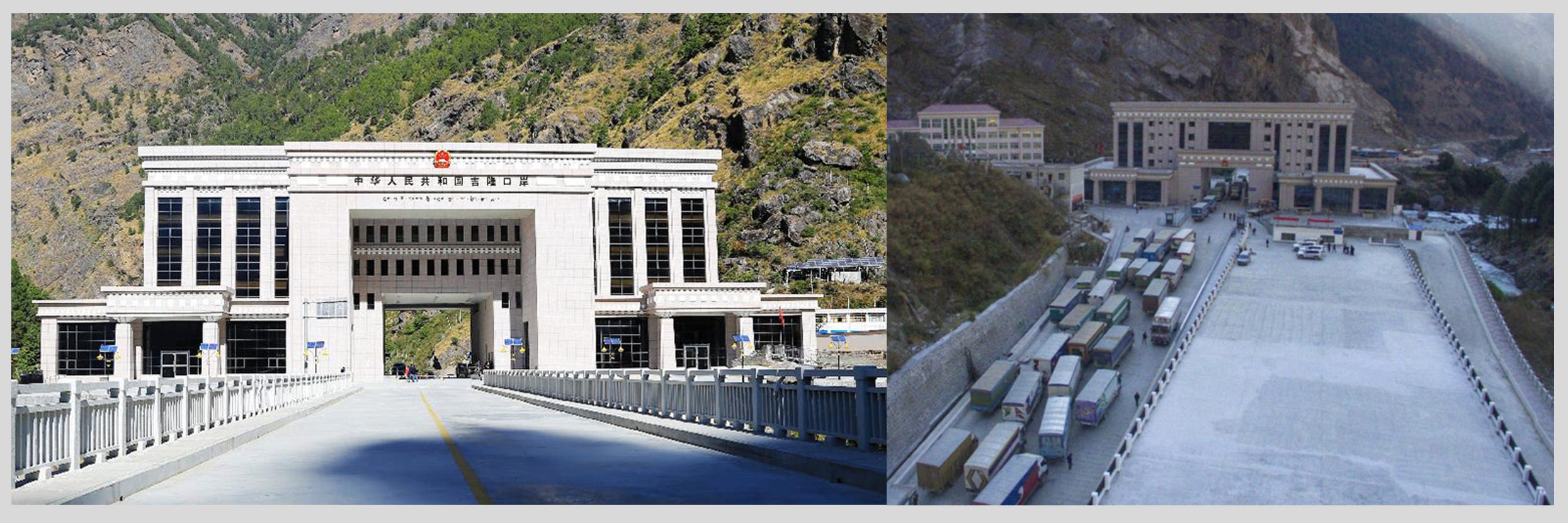
Photos of the PRC immigration and customs building at Gyirong Port. The photo on the left was taken from the Nepali side towards the PRC side on the Nepali-China Friendship Bridge (the permanent bridge in this photo was washed away by floods in July 2025 and replaced with a temporary Bailey bridge photographed below). The photo on the right was taken from the PRC side towards the Nepali side and shows the holding area for trucks and buses that was pictured clearly in the videos from the security cameras at the time of the disaster.
Countless visitors have photographed themselves standing in front of the PRC immigration and customs building at Gyirong Port, particularly in July and August. It made for impressive social media posts as visitors flock to this part of the Himalayas so close to Everest when the weather allows them to explore the mountains. This is also the busiest time for commerce to cross the border as the weather gets far too extreme as fall and winter set in.
The facility was the terminus of China National Highway 216, a nearly 60-mile road through the mountains to the north of Gyirong that connects to the rest of Tibet’s highway system.
At Gyirong, Highway 216 connects with the Nepali highway system over the Nepal-China Friendship Bridge which was finished in 2019 (pictured above left).
Last year, the permanent bridge was washed away during monsoon floods and was replaced with a temporary Bailey bridge.
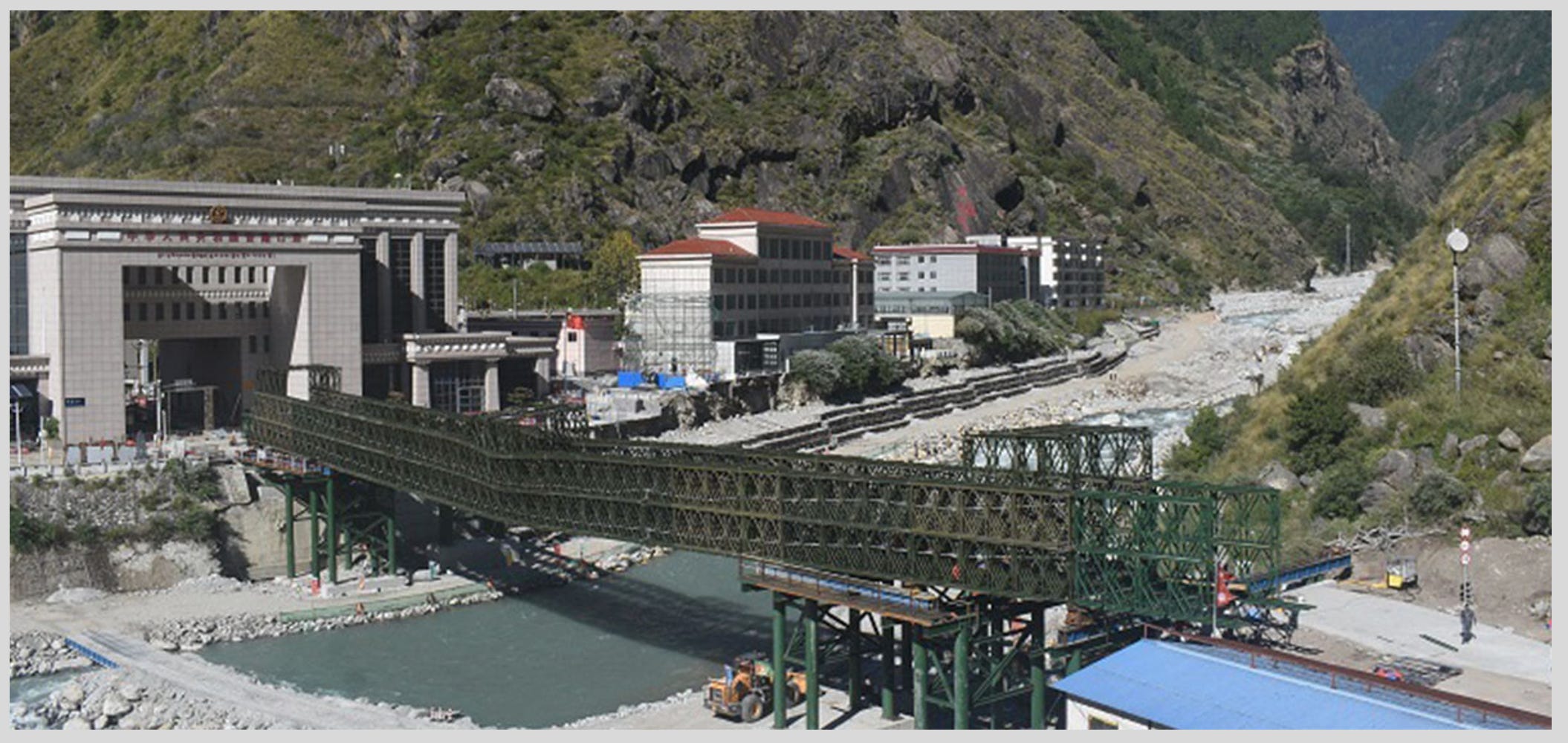
The temporary Bailey bridge constructed in the last few months to replace the permanent bridge that was destroyed by floods in July 2025. This photo is taken from the Nepali side towards the PRC side (the far side of the bridge). Behind the bridge on the Chinese side is the large immigration and customs building in the photos above and to the right are buildings that housed the PRC government officials and their families that worked at Gyirong. The debris flow originated up the tributary valley in the upper right and continued south into Nepal over the blue roofed building in the lower right.

A family of American tourists crossing the Bailey bridge at Gyirong on August 7, 2026. The photograph is taken from the PRC side pointed toward the Nepali side.
On the Nepali side, the bridge connects to Nepal Highway 42. South of Gyirong along Highway 42 is the turn-off for the Everest Base Camp, meaning that for anyone who has attempted a summit, they are familiar with this area. The debris flow that destroyed Gyirong Port moved south into Nepal along the Highway 42 corridor. One interesting statistic is that along a 13-mile stretch of this corridor the elevation drops 10,000 feet… nothing could stand in the way of millions of tons of rock and water moving at nearly 100 miles an hour over that steep of an elevation drop.
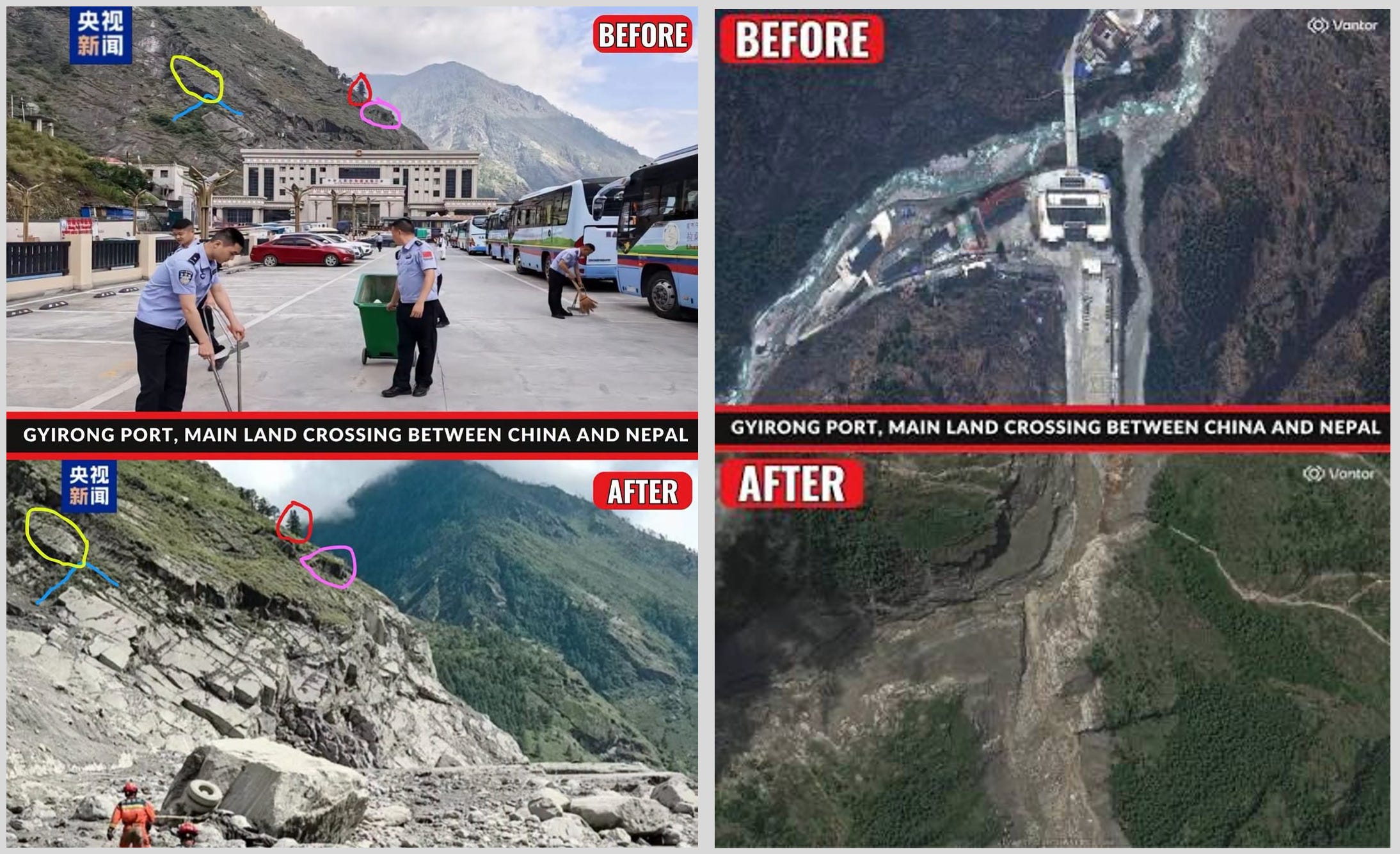
Before and after at Gyirong Port. The bedrock was wiped clean.
It appears that the PRC did not provide early warning to Nepal before the debris flow continued downslope into more densely populated areas of Nepal.
But based on the dozens, if not hundreds, of individuals fleeing in those videos of Gyirong Port, it seems unlikely that the PRC Government would have had time to do so. The PRC officials who would have done the actual alert to their counterparts in Nepal, probably worked in the buildings that were hit at precisely 10:59:54 on August 26th… just seven minutes after the side of the mountain gave way.
In the months prior, the PRC and Nepal had coordinated on an alert system, but it appears they designed it to detect floods caused by monsoon rains, the likes of which destroyed the Nepal-China Friendship Bridge in July 2025.
The two countries placed sensors along river valleys that would send out automated signals once raising waters were detected. This raising water would then set off alarms in Nepal and give citizens time to move to higher ground. They did not build an alert system to account for millions of tons of rock scouring the valleys clean of sensors.
However, the CCP’s playbook in disasters like this, particularly in sensitive places like occupied Tibet, is to withhold information and try to paint the Party’s conduct in a positive light. That is bound to lead to speculation that the PRC was culpable in some way or that it failed to protect the most vulnerable in cities downstream in Nepal. We should expect to see recriminations as the full scope of this disaster sinks in.
I’m not going to recommend a song this week, a moment of silence is appropriate for the thousands who lost their lives in the Himalayas.
Thanks for reading!
Matt
MUST READ
The SCO’s Diminishing Usefulness for India
C. Raja Mohan, Foreign Policy, August 28, 2026
Indian Prime Minister Narendra Modi’s three-way handshake with Chinese President Xi Jinping and Russian President Vladimir Putin at last year’s Shanghai Cooperation Organisation (SCO) summit in Tianjin, China, went viral across the global media. The optics were especially powerful because they came amid the Trump administration’s relentless pressure on India over trade and its purchases of Russian oil. President Donald Trump soon declared that the United States appeared to have “lost” India and Russia to China. The images intensified an argument in Washington over who lost India and reinforced the case for political reengagement with the Modi government, slowly but steadily stabilizing the relationship.
As it celebrates its 25th jubilee at a summit in Kyrgyzstan next week, the SCO will focus on regional stability, economic integration, transport connectivity, and digitalization. Measured against the Trump administration’s chaos and political disarray of the West, the China-led SCO will look more productive and purposeful. India, though, might not be too comfortable with the growing dominance of China over the forum, but it would want to make the best of the bilateral diplomatic opportunities presented by the summit, attended by a large section of leaders from inner Asia.
COMMENT - Delhi has some tough choices to make.
Chinese Shipper COSCO Collects Intel for Beijing with Concealed Equipment, U.S. Officials Say
Michael Martina, Reuters, September 1, 2026
China’s state-owned shipping giant COSCO uses concealed equipment on board its ships to spy on military communications near the coastlines of target nations including the U.S., two senior Trump administration officials said.
The officials, who spoke on condition of anonymity to discuss the U.S. assessment of the Chinese program, said COSCO has a decades-long intelligence-collection partnership with Beijing. The arrangement allows China to collect communication signals from vessels and aircraft operating across Europe, North America and Asia, they said.
The advanced equipment aboard the ships is intended to enable China to gather information about “military communications technologies and encryption developments,” one of the officials said.
The effort also allows Beijing to monitor key shipping lanes and maritime routes crucial for trade and military navigation, the official added.
COSCO did not respond to a request for comment, while China’s embassy in Washington rejected the U.S. claims.
U.S. President Donald Trump and Chinese leader Xi Jinping plan to meet in Washington for a summit later this month, when they are expected to discuss a range of sensitive security and trade issues.
The officials did not detail the type of equipment COSCO ships were allegedly using, but said they were “sophisticated signals intelligence collection” platforms, not routine communications hardware.
They said Beijing uses the information gleaned to bolster its position in territorial disputes and provide maritime reconnaissance and early-warning indications of foreign military targets.
China’s embassy in Washington said the Chinese government would never ask any company or individual to “collect or provide data, information or intelligence located abroad against local laws.”
“We oppose vilifying China by peddling the so-called ‘intelligence collection’ narrative, which is totally baseless,” embassy spokesperson Liu Chang told Reuters.
ALLEGED TIES BETWEEN CHINESE GOVERNMENT AND SHIPPERS
A report published by the U.S. Naval War College in April 2025 said it was likely that China’s People’s Liberation Army (PLA) was harnessing the country’s fishing and commercial shipping fleets for intelligence and surveillance gathering.
The Pentagon put COSCO on its list of companies linked to China’s military in January 2025, a designation that carries serious reputational costs for companies as well as U.S. government procurement bans, but does not entail formal sanctions.
Chinese law requires the country’s firms to support government intelligence work.
Nonetheless, COSCO remains one of the top global shipping companies calling at U.S. ports and has several terminal service joint ventures for container ships at U.S. ports.
The Trump administration last year planned to implement billions of dollars in port fees on Chinese shipping companies, including COSCO, in an effort to revitalize the atrophied U.S. shipbuilding and maritime industries.
The plan was paused, however, after Trump reached an agreement last October with Xi for a year-long trade war détente. The agreement expires in November, and a possible extension is expected to feature in the September talks between the leaders.
Isaac Kardon, an expert in Chinese maritime strategy at Johns Hopkins School of Advanced International Studies, said the U.S. government would likely have difficulty decisively addressing the security concerns given the degree to which COSCO is interwoven into U.S. trade.
“Taking COSCO out of our supply chains and transport networks could be life-threatening surgery to U.S. trade networks,” Kardon said.
COMMENT - We should prohibit COSCO from operating in the United States or its territorial waters.
Friends and activists rally behind Hong Kong protest leader Joshua Wong
Shweta Sharma, The Independent, August 31, 2026
Activists, friends and former Hong Kong democracy campaigners have rallied behind Joshua Wong with messages of solidarity after the prominent pro-democracy leader pleaded guilty to a national security charge that could carry a life sentence.
Wong, 29, went from being the teenage face of Hong Kong’s democracy movement to one of its most prominent imprisoned activists, having spent nearly six years behind bars as Beijing’s national security crackdown dismantled the city’s pro-democracy movement.
On Wednesday, Wong appeared in Hong Kong High Court and answered “guilty” to the charge of conspiracy to collude with foreign forces, which was read in full after the court recognised a high level of public interest in the case.
He was accused of conspiring with other pro democracy campaigners to lobby lawmakers, specifically the US politicians Nancy Pelosi and Marco Rubio, to impose sanctions on Hong Kong and China for muzzling democratic rights in the semi-autonomous territory.
The court heard that Wong and Nathan Law had participated in “international lobbying on numerous occasions”, including via visits to the US, Germany and Italy.
However, the guilty plea has sparked outrage among the supporters of Wong who believe that the government is determined to keep the pro-democracy icon behind bars, producing a chilling effect on remaining civic space.
Critics have argued that Wong is being prosecuted retroactively for alleged offences committed before the national security law came into force.
Andrew Duncan, who knew Wong while making the award-winning 2017 Netflix documentary Joshua: Teenager vs. Superpower, said he is a proxy for the millions of people who went to the streets during the 2019 protests.
COMMENT - What has happened to Joshua Wong is absolutely terrible. He is a political prisoner being punished for activities that were legal in Hong Kong when he did them.
The Chinese Communist Party is terrified of young people like Joshua Wong because they understand that folks like him are able to win over Chinese citizens and undermine the Party’s legitimacy.
China’s Policy Toward Japan Remains Unchanged, CCP Official Says
Yukio Tajima, Nikkei Asia, August 31, 2026
Lu Kang tells Japanese delegation Takaichi’s position on Taiwan must be revised.
COMMENT – Much as the CCP did to Australia, the PRC will coerce and try to undermine the Japanese economy in an effort to drive Takaichi from power by eroding her domestic political support. This is what the CCP did to the Australian Liberal Party after Prime Minister Scott Morrison asked for an independent investigation into the origins of COVID in April 2020. The PRC officially enacted its first round of trade restrictions on Australia in mid-May 2020, then continued to ramp the coercion up until after Morrison was forced out.
The Party believes it succeeded with Australia by getting an Australian Labour victory in May 2022 and the fact that Anthony Albanese dropped the call for that independent investigation.
Ironically, the Albanese Government claims that it forced the Chinese to back down without ever acknowledging that the Albanese Government has never called for an independent COVID investigation which is what caused Beijing to impose the economic punishment. Beijing knows they won that round and it is why they are so confident that their tactics will work again on Tokyo.
This same dynamic is playing out with Lithuania. In 2021, Lithuania allowed for a “Taiwanese Representative Office”, as opposed to a “Taipei Representative Office”, to open in Vilnius. Beijing immediately retaliated with economic sanctions and trade restrictions designed to undermine the Lithuanian economy and force other Europeans to pressure Vilnius to reverse course. When the new Prime Minister entered office in July 2026, he signaled that his predecessor’s decision to allow a de facto Taiwanese embassy was a mistake and now Vilnius wants to repair relations with Beijing.
Beijing is increasingly confident that its coercion works because political opposition parties are willing to cave to CCP coercion in order to get relief from Chinese coercion.
Successful coercion begets more coercion.
China Is Flatlining
Michael Schuman, The Atlantic, August 31, 2026
Compared with Donald Trump’s chaotic, divided, and violent America, China is a bastion of steady progress and serene order. This, at least, is the story that Beijing’s propagandists have been eager to spread. The Global Times, a Communist Party–run news outlet, proclaimed earlier this year that “the world’s peace and development increasingly rely on China’s stability.” The state news agency Xinhua chimed in that “in today’s uncertain world, China’s stability and predictability provide a rare and valuable anchor, which is set to benefit other countries.”
This message appears to be resonating around the world. A Pew Research Center survey of three dozen countries recently found that China is now seen more positively than the United States. Respondents expressed more confidence in Chinese President Xi Jinping to “do the right thing” in world affairs than Trump.
China’s stability may appear desirable to a world in turmoil. But inside China, this “stability” looks a lot like policy paralysis, economic stagnation, and intensified political repression. What all the hand-wringing over China’s growing influence and surging exports fails to recognize is that the country is flatlining politically and economically. The evidence is in plain sight.
Policy makers around the world are understandably fixating on China’s abundant and cheap electric cars and competitive AI models, which present a serious threat to national industries. But these advances are one small part of a broader economy with pernicious and deep-rooted problems. The country’s property-market downturn, triggered by the 2021 meltdown of the real-estate developer Evergrande, has not hit bottom. Home prices continue to fall, eating away at the wealth of many middle-class households.
COMMENT – I’ve been reading some economic analysis pieces from firms that analyze the Chinese economy, most of which aren’t public. It appears clear from their estimates that the Chinese economy is in recession and that it will not grow this year (nor did it grow appreciably since the end of the pandemic). You won’t see this widely reported because the PRC Government lies in its official statistics and institutions like the IMF cover for the CCP by giving their fictional official numbers legitimacy.
Chinese economists know what’s happening, but they are terrified to speak the truth given that challenging the Party’s official numbers (that the PRC economy is growing between 4-5%) will result in being detained, striped of one’s positions, and potentially killed. This is what happened to Gao Shanwen near the end of 2024 after he spoke at an event at the Peterson Institute for International Economics (PIIE) in Washington and said that the Chinese economy may have only grown at 2% between 2021 and 2024.
Beijing is putting a huge effort into intimidating its own economists to stick to the Party line and then portray anyone outside of the PRC who doubts the numbers as being “anti-China.”
Authoritarianism
Gen Z ‘Chinamaxxers’ fantasise about life in China. This journalist and this artist can never go back there
Kat Wong, The Guardian, September 1, 2026
Translation: ‘You Can’t Address Sexual Assault at Banquets Without Addressing the Nature of Power’
China Digital Times, September 1, 2026
China’s Information Control Could Hamper Flood Rescue Efforts in Tibet
Lily Kuo, New York Times, August 27, 2026
China censors Kyirong flood footage, grossly under-reports death toll
Tenzin Nyidon, Phayul, September 1, 2026The Nepal-Tibet Catastrophe: What Is China Hiding?
Lopsang Gurung, Bitter Winter, September 3, 2026
Nepal counted its dead and opened its data; Tibet’s losses vanished behind China’s digital erasure.
Natural disasters often reveal more than landscapes’ fragility. They expose the political systems that decide which tragedies are acknowledged, minimized, or erased. The recent floods along the Nepal–Tibet frontier—particularly in Rasuwagadhi and the surrounding border settlements—have become a stark illustration of how environmental catastrophe can be transformed into a contest of narratives.
In late August, torrential rains triggered landslides and sudden flooding across the high Himalayan corridor linking Nepal and the Tibetan Autonomous Region. Roads collapsed, bridges were swept away, and entire clusters of homes vanished under mud and water. Nepal’s Home Ministry later reported at least 903 confirmed deaths and over 4,200 people missing, a figure that continues to evolve as rescue teams reach previously inaccessible areas.
Yet the disaster did not unfold solely in Nepal. The same surge of water also struck Tibetan villagers living near the border. According to one Tibetan resident who managed to speak with relatives across the frontier, three Tibetans died in the initial wave, and dozens more were displaced. But these numbers remain uncertain—not because the situation is unclear, but because authorities are actively suppressing information.
Within hours of the flooding, videos filmed by residents of the border town on the Tibetan side began circulating on Chinese social media platforms. They showed submerged homes, collapsed infrastructure, and frantic attempts to rescue trapped villagers. The footage was widely shared on WeChat and other networks—until it abruptly disappeared.
Multiple Tibetan users reported that their posts were deleted, their accounts temporarily restricted, and they received warnings that sharing “unverified disaster information” violated platform regulations. Some were told that posting images of damage or casualties constituted “spreading rumors” and could lead to legal consequences.
When disasters occur in politically sensitive regions, the Chinese state often prioritizes narrative control over transparency. In this case, the censorship served two purposes: preventing public scrutiny of the scale of destruction inside Tibet and avoiding any implication that infrastructure failures or upstream water management contributed to the severity of the flooding downstream in Nepal.
COMMENT – This is what happens in Communist occupied Tibet.
Punishment and Silence: China Pulls Out the Disaster Playbook in Tibet
Alexandra Stevenson, New York Times, September 1, 2026
China Offers Condolences to Nepal While Emphasizing Disaster Began There
Lily Kuo, New York Times, August 28, 2026
Tibetan researchers, activists demand transparency from China over Kyirong flash floods - Phayul
Tenzin Nyidon, Phayul, September 1, 2026
Why the Floods Took a Well-Prepared China by Surprise
Lily Kuo and Pei-Lin Wu, New York Times, August 31, 2026
In HK, mourning a dog killed in mainland China means walking a fine line
Hong Kong Free Press, August 24, 2026
The Four Seasons of Xi’s Foreign Policy
Jonathan Czin, China Leadership Monitor, September 1, 2026
China’s Emerging Grand Strategy: Timeline, Intellectual Origins, and Contours
Minxin Pei, China Leadership Monitor, September 1, 2026
The Long Arm of the Chinese State
The Economist, August 27, 2026
China Pushes Back After Trump Tightens the Screws on Iran
Alexandra Stevenson, Aaron Krolik and Keith Bradsher, New York Times, August 25, 2026
Lawmakers Press Treasury to Target Chinese Banks Over Iran
Phelim Kine, Politico, August 26, 2026
Environmental Harms
China says solar power capacity surpasses coal for first time
Hong Kong Free Press, September 1, 2026
COMMENT - While “solar power capacity” may have surpassed coal, that is only because the PRC is adding so much power capacity, in all categories… it is still emitting more CO2 than North America, Japan, Australia, and Europe combined.
There are no plans to actually shutdown coal fired power plants.
Nepal-Tibet Floods Expose Dangers of China’s Himalayan Gamble
Brahma Chellaney, Nikkei Asia, August 31, 2026
Environmental Risks of China’s Yarlung Tsangpo Mega-Dam
Khedroob Thondup, Tibet Express, September 1, 2026
Foreign Interference and Coercion
China accused as Pacific nations block statement condemning missile test
Stephen Dziedzic and Lice Movono, Australian Broadcasting Channel, August 31, 2026
China Voices Angst Over Taiwan as Pacific Island Leaders Meet
James Mayger, Bloomberg, September 1, 2026
Pacific leader’s shock departure from PIF meeting
Stephen Dziedzic and Chrisnrita Aumanu-Leong, Australian Broadcasting Channel, August 31, 2026
China ‘likely’ ran targeted campaign to align Pacific with its latest five-year plan
Eugene Whong, Radio Free Asia, August 20, 2026
The Pacific Is the Front Line of U.S.-China Competition
Charles Edel and Kathryn Paik, Foreign Policy, August 28, 2026David Bandurski, Lingua Sinica, September 3, 2026
As a leaders summit in the Kyrgyz capital of Bishkek brought together heads of state from across Eurasia, the Middle East and South Asia on Monday morning, China’s official People’s Daily newspaper dedicated the top spot on the front page to a self-congratulatory report on the cross-regional success of a television program about the pithy, homespun talk of Chinese leader Xi Jinping.
The multi-lingual production, the report said, had aired through Kyrgyzstan’s national broadcaster on Sunday, the day of the Chinese leader’s arrival. It had showcased to millions of viewers “the outstanding political wisdom of President Xi.”
At first glance, this front-page story looks like more of the same from the flagship paper of the Chinese Communist Party (CCP) — straight up propaganda promoting the global charisma of the man at the top of the political pack. In fact, this example is something more. It is meta-propaganda, and it points to the broader global infrastructure China builds and leverages, day in and day out, to promote its political system and interests abroad.
In this case, as is often true when it comes to parsing official CCP discourse, “reading” between the lines is about grappling with the structures beyond the text — and taking them seriously.
The Xi broadcast that aired Sunday on Kyrgyzstan’s National Television and Radio Broadcasting Company (NTRK), a network that reaches close to 40 percent of the country’s population, ran on at least nine other outlets in Eurasia, South Asia and the Middle East, all corresponding with the Bishkek summit of the Shanghai Cooperation Organization (SCO), the Eurasian regional political and economic organization. Broadcast partners included Kazakhstan’s national television network, the Belarussian outlet Belteleradio, Kazakhstan’s state-run Khabar Agency as well as its presidential broadcast service, Russian state television and the Russian government outlet Rossiyskaya Gazeta, the Russian-led regional news organization MTPK, Iran’s Islamic Republic News Agency (IRNA), and Pakistan’s state-run PTV.
According to Chinese state media reports, the same broadcast of “Classics Quoted by Xi Jinping”, an hour of saccharine propaganda about the wisdom and learning of the man said to have inspired China’s success and its benefits for the world, also aired on outlets in India. It was additionally broadcast through China’s state-run broadcast channels overseas, including CGTN America, which claims to reach 30 million households in the US, and China Central Television’s feed at the United Nations.
COMMENT – I wonder what it is like to have a narcissistic political leader that tries to make everything about them and their great accomplishments…
American Citizen who Worked as an Agent for the PRC Sentenced to Two Years in Prison
U.S. Department of Justice, September 1, 2026
Canada ends ‘lifeboat’ immigration scheme for Hongkongers
Hillary Leung, Hong Kong Free Press, August 31, 2026
ASPI Executive Director Justin Bassi, a Government Critic, to Leave the Think Tank
Finn McHugh, Politico, September 1, 2026
Gwangju Biennale Controversy Reflects Chinese Pressure on Taiwan in the Art World
Brian Hioe, New Bloom Magazine, August 20, 2026
Human rights and diaspora groups urge UK Prime Minister to act on reported use of prohibited weapons at Chinese Embassy in London
Frances Bell, Hong Kong Watch, August 21, 2026
Denmark Arrests 13 Chinese Nationals in $15 Million Money-Laundering Probe
Yue Yue, Caixin Global, August 28, 2026
Chinese Court Freezes Dutch Chipmaker Nexperia’s Stakes in Four China Units
Eduardo Baptista, Reuters, August 31, 2026
China Is Secretly Fueling America’s Data Center Rage
Josephine Walker, Axios, August 28, 2026
How Beijing Turns Human Relationships into Instruments of Power
Asiye Uyghur, Bitter Winter, August 27, 2026
Human Rights and Religious Persecution
Artist known for sculptures of Mao Zedong jailed for slandering ‘heroes and martyrs’
Yu-chen Li, The Guardian, September 1, 2026
What to know about the Tiananmen vigil organizers convicted of inciting subversion in Hong Kong
Kanis Leung, Associated Press, September 1, 2026
Tiananmen vigil trio: Gov’t praises guilty verdict as rights groups aghast
Hong Kong Free Press, August 22, 2026
Hong Kong court verdict aims to erase Tiananmen memory, 1989 student protester says
Meng Ou, Radio Free Asia, August 25, 2026
Danish artist writes to HK court demanding return of Tiananmen statue
Hong Kong Free Press, September 1, 2026
China tightens restrictions on online advocacy, prison visits for imprisoned Tibetan businessman
Tenzin Nyidon, Phayul, September 1, 2026
China Expands Religious Scrutiny into Chengdu Schools, Hospitals
Tenzin Chokyi, Tibet Express, September 1, 2026
Tibetan representation shrinking under centralized Beijing rule: Report
Tenzin Nyidon, Phayul, September 1, 2026
Beijing resumes demolition of major Tibetan Buddhist academy, satellite imagery shows
Noh Jung Min and Dickey Kundol, Radio Free Asia, August 19, 2026
China Deploys Troops and Tightens Controls at Larung Gar as Demolitions Continue
Palden, Tibet Times, August 18, 2026
China denies US citizen held since June is wrongfully detained
Hong Kong Free Press, August 21, 2026
Australian Senator urges targeted sanctions on Chinese leaders enforcing transnational Ethnic Unity Law
Tibetan Review, September 1, 2026
China: Decade of Impunity for Crimes Against Uyghurs
Human Rights Watch, August 27, 2026
Hunan: Leaders of Yueyang Panshi Bible Church Remain in Custody
Lei Yingtai, Bitter Winter, August 27, 2026
Industrial Policies and Economic Espionage
US, China debate ‘nonsensitive’ tariff cuts ahead of Trump-Xi summit
Stella Yifan Xie, Nikkei Asia, September 2, 2026
China Makes Cars So Quickly That Regulators Are Getting Worried
Annie Lee and Chunying Zhang, Bloomberg, September 1, 2026
Shein’s Shares Fall in Long-Awaited Hong Kong Debut
Stu Woo, Wall Street Journal, September 1, 2026
China’s Economic Grand Strategy: Mission-Driven Finance and Tech Self-Reliance
Zongyuan Zoe Liu, China Leadership Monitor, September 1, 2026
China’s Three Biggest Airlines Post Heavy First-Half Losses as Fuel Shock Bites
Julie Zhu and Sophie Yu, Reuters, August 31, 2026
G20 Countries Should Consider More Trade Barriers with China to Cut Imbalances
David Lawder, Reuters, August 30, 2026
U.S. Treasury Secretary Scott Bessent said on Sunday he will encourage G20 members to re-examine terms of trade with China to shrink global imbalances and press Beijing to rebalance its economy away from exports and toward domestic consumption.
Bessent said in an interview ahead of a G20 finance leaders meeting that the current flood of exports from China was unsustainable, even though the U.S. direct trade position with China was “rapidly improving.”
“The world cannot have a China with a $1.2 trillion trade surplus,” Bessent said. “In China, the economy is quite weak, and they are trying to export their way out of it, and they need to rebalance their economy.”
Bessent’s push to mobilize a coordinated trade response to China comes as legal setbacks force the U.S. to rebuild its tariff policy, which had sharply reduced imports from China but led to an influx of Chinese imports elsewhere, especially to Europe and Latin America.
The U.S. has walled off its economy from many Chinese goods with high tariffs and outright bans on some products including autos. Bessent said he told other industrial economies last year they would face pressures from the China import surge and that “now they are confronted with some very stark choices.”
Brazil Rare-Earth Mine Shows Hurdles of Breaking Free from China
Mie Dahl, Bloomberg, August 31, 2026
China’s Official Gauges Point to Continued Contraction in Economic Activity
Junko Fukutome and Jason Douglas, Wall Street Journal, August 31, 2026
Huawei Profit Slumps by a Third on R&D Expenses, Raw-Material Costs
Jiahui Huang, Wall Street Journal, August 31, 2026
Some Chinese Workers See an Ally in Brussels as EU Trade Tensions Mount
Claire Fu, Reuters, August 26, 2026
Xi’s Unprecedented Tax Clawback Hammers Chinese Listed Companies
Bloomberg, August 31, 2026
U.S. Probes Singapore Firm Over Alleged Nvidia Chip Smuggling
Kari Lindberg and Mackenzie Hawkins, Quartz, August 27, 2026
German Industry Presses Merz for Tougher China Policy
Maria Martinez and Rachel More, Reuters, August 28, 2026
Von der Leyen turns up pressure on China over trade deficit
Peggy Corlin, Euronews, August 27, 2026
US supplies most of the world’s plasma. No country depends on it more than China
CNN, August 23, 2026
Cyber and Information Technology
The next target in China’s secret war against US data centers
John Feng, Newsweek, September 2, 2026
Security researchers find surveillance implants in Chinese-made routers sold worldwide — three different backdoor-like implants hidden in firmware
Zak Killian, Tom’s Hardware, August 31, 2026
China Rebukes Anthropic, Sets Terms for Key U.S.-China AI Dialogue
Bloomberg, August 31, 2026
China Sees Opportunity in America’s Recent A.I. Security Scares
Steve Lohr and Meaghan Tobin, New York Times, August 28, 2026
China’s Actors Written Out of Dramas as AI Doubles Ready to Take Their Roles
Joe Leahy and Isaac Castella-McDonald, Financial Times, August 28, 2026
Nvidia Wants to Run the World’s Robots. China Is an Eager Customer.
Raffaele Huang, Wall Street Journal, August 31, 2026
U.S. Robot Curbs Lay Bare Industry’s Dependence on Chinese Parts
Stella Yifan Xie, Nikkei Asia, August 31, 2026
Nvidia Steps Back into China Market with First H200 Chip Sales
Maggie Eastland, Bloomberg, August 31, 2026
Bill Gates, alarmed by AI, Has Policy Ideas He Wants to Discuss with China’s Xi
Jeffrey Dastin, Reuters, August 26, 2026
Bill Gates is looking to meet with Chinese President Xi Jinping later this year, eager to propose global efforts to mitigate the growing risks posed by artificial intelligence.
The Microsoft co-founder and billionaire philanthropist told Reuters in an interview that he believes China might agree to restricting potentially dangerous AI model releases if the U.S. took initiative on that first.
“The whole world would go along with that,” said Gates, who met with Xi three years ago, when he was the first foreign entrepreneur to be hosted by the Chinese president post-pandemic.
Gates also said he’d like to propose that countries monitor AI’s ability to create molecules and carry out biological attacks — something that would not get in the way of any tech industry’s development.
Gates’ staff are working to finalize a meeting with Xi for his next China trip, his spokesperson said, scheduled tentatively for November.
President Xi “might be surprised by how vehement I am,” Gates said. He said China is protecting children from AI companion addiction, but he believes few leaders globally are rising to the occasion to get ahead of a litany of potential harms from AI.
“Yes, in the past, technology never did this. This time is different. This is like an evolutionary milestone that needs incredible policy management by society as a whole.”
COMMENT – I think the whole Gates Manifesto on AI should be viewed as a public relations ploy to get folks to forget about his long and very problematic relationship with Jeffrey Epstein. Bill Gates is sleezy sociopath, and he should just slip into obscurity, enjoy his billions, and stop trying to resurrect his reputation.
My 2 cents.
FBI Shuts Down Sprawling China-Linked Hacking Network
Robert McMillan, Wall Street Journal, August 26, 2026
Tencent Touts New AI Model It Claims Outperforms Z.ai and Moonshot
Bloomberg, August 31, 2026
Researchers Discover Additional Backdoors in Chinese-Made Zbtlink Routers
A.J. Vicens, Reuters, August 27, 2026
Huawei AI Data Center Bid in Egypt Spurs U.S. to Mull Counter
Mackenzie Hawkins, Bloomberg, August 26, 2026
Military and Security Threats
Vietnam Demands ‘Immediate Cessation’ to Construction Activities in Paracel Islands
Sebastian Strangio, The Diplomat, September 2, 2026
Why Intelligence Officials Are Wary of Cars Made in China
Der Spiegel, September 1, 2026
The Lengthening Reach of China’s Armed Forces
The Economist, September 1, 2026
Taiwan Says Unpredictable China Strengthens Air and Sea Control Nearby
Ben Blanchard, Reuters, August 31, 2026
AUDIO – The Factors That Matter: A Formula for Understanding China’s Use of Force Calculus Over Taiwan
Lyle Morris, Asia Society Policy Institute, August 31, 2026
How the Iranian Shahed Drone Transformed War—With China’s Help
Austin Ramzy, Wall Street Journal, August 27, 2026
One Belt, One Road Strategy
China’s Xi gets his moment at meeting of anti-US bloc
John Feng, Newsweek, September 2, 2026
In Film and in Life, China Pursues ‘Dragon Restaurant Diplomacy’
The Economist, August 31, 2026
China’s Xi pitches AI hub as SCO casts itself as pillar of stability
Ck Tan and Yevgeniya Mikhailidi, Nikkei Asia, September 1, 2026
Russia and China’s Grand Strategy
Elizabeth Wishnick, China Leadership Monitor, September 1, 2026
What’s Behind China’s Problematic Advance in Uruguay?
Evan Ellis, Center for Strategic and International Studies, August 27, 2026
Opinion
Higher Education’s Secret Foreign Funding
Craig Singleton, Wall Street Journal, August 31, 2026
China’s Great Power Vision Comes into Focus
Ryan Hass, China Leadership Monitor, September 1, 2026
Where is the CCP Vulnerable? Look at Chinese Cognitive Warfare Attacks on Palau to Find Out
Cleo Paskal, September 2, 2026
Chinese proxies at Solomon Star hit Palau with another false story. Does it give clues on how to strike back at the CCP?
Tibet Flood Victims Have a Right to be Heard
Maya Wang, Human Rights Watch, August 31, 2026
Why the CCP’s Ethnic Cleansing in Tibet Will Fail
Khedroob Thondup, Tibet Express, September 1, 2026
China Muddies the Flood Waters in Nepal
Matthew Hennessey, Wall Street Journal, August 31, 2026
Hubei issues a challenge to Xi Jinping’s economic policies
Katsuji Nakazawa, Nikkei Asia, August 31, 2026