Don't Stop Believin'
Prime Minister Takaichi, and her party, win a landslide victory
Friends,
When I think of songs about having a dream and making it happen, I think of Journey’s 1981 hit, “Don’t Stop Believin’.”
I can just imagine this song is playing on a loop inside the campaign headquarters of the Japanese LDP today.
The link above is to the live version of the song performed during Journey’s first leg of the 1981 Escape Tour. The tour started in Osaka with six shows in Japan before performing another 83 shows across North America over the rest of 1981.

DVD cover of the Journey: Live in Japan 81 (Escape Tour 1981)
I have no proof of this, but perhaps a 20-year-old Sanae Takaichi attended the very first show of the Escape Tour on July 27, 1981 at Osaka’s Festival Hall and was in the audience of this video.

The old and new Festival Hall in Osaka, the building on the left is where Journey performed their first show of the Escape Tour on July 27, 1981.
On the other hand, Journey probably wasn’t heavy metal enough for the young Takaichi, who played drums for a metal band in college and has said that Deep Purple’s “Burn” and Iron Maiden’s “Run to the Hills” are her favorite songs.

Cover of Iran Maiden’s single, “Run to the Hills,” from the album The Number of the Beast released in 1982.
On Sunday, Takaichi won a supermajority in the lower house of the Japanese Diet. Not all the results are in, but it looks like her party, the LDP, will capture nearly 300 of the 465 seats in the House of Representatives, up from the 198 seats they had going into the snap election.
Young voters appear to have shown up for Takaichi in force, and it appears from polling that Japanese voters are confident in the tough stand she has made against Beijing’s coercion of Japan. While Xi and his cadres likely thought they were weakening her with their coercion, that looks as if it has backfired, making Takaichi much more powerful and able to push through her agenda.
The LDP will still need a coalition because they still lack a majority in the upper house, but real power resides in the lower house, so the lack of a majority in the House of Councilors is unlikely to derail Takaichi’s plans.
Prime Minister Takaichi deserves all the credit for this victory. She has been grinding away at Japanese domestic politics for decades and clearly saw an opening a few weeks ago for a bold political move that most of her colleagues and commentators missed (including myself, who thought calling a snap election was crazy).
Just a small town girl
Livin’ in a lonely world
She took the midnight train going anywhere
Sanae Takaichi is that small town girl who had a dream and made it happen.
Born in Yamatokoriyama, town of 40,000 in 1961 and a distant suburb of Osaka, she did well enough in school to be accepted to the best universities in Tokyo. But her parents, who both worked middle income jobs, wanted her to pursue a two-year degree and stay close to home. So she took some part-time jobs and attended Kobe University outside of Osaka, which required nearly a six-hour commute.
In the late 1980s she moved to the United States and worked as a congressional aide to Democratic congresswoman Pat Schroeder who spent nearly a quarter century representing Colorado’s 1st district. Interesting fact, during Pat Schroeder’s first term in office just before Nixon resigned over Watergate, she and her staff were under FBI surveillance with agents going so far as to pay a man to break into her home and steal documents showing that she was a member of the League of Women Voters (as revealed by a FOIA request which released her FBI file years later).
When Takaichi returned from Washington, she did a short stint as a TV anchor before entering politics in 1992 with a run for a seat in the upper house of the Diet, which she lost. A year later, she won a seat in the lower house as an independent.
While she is certainly a conservative Japanese politician, Takaichi is also undoubtably the product of an edgy post-WWII Western culture that spanned Asia, North America, and Europe in the 1980s. She wasn’t the child of a political dynasty; she spent her 20s in Japan of the 1980s and started working her way up Japanese politics in the 1990s. She had benefited from Japan’s success in the 1960s, 1970s, and 1980s, and was likely frustrated by the closed system of Japanese politics as the country stagnated in the 1990s and 2000s.
She was an outsider with little in common with her fellow LDP colleagues like Shinzo Abe, Shigeru Ishiba, Fumio Kishida, Kono Taro, or Shinjiro Koizumi who all came from political dynasties or had fathers that were senior government officials. In this way, she is a bit more like Barak Obama. They both were born in 1961, five months apart, to families unconnected to politics and government. Though I doubt Obama was much of a “Trooper” in his 20s, he was more likely a Journey fan… or perhaps Joe Jackson’s 1982 hit “Steppin’ Out” was more his style… not that there’s anything wrong with that, it is a great song.
This victory by the LDP will likely have far reaching impacts… even if it is little noticed within the Euro-centric media echo chambers we are used to today.
The narrative that we usually hear is that centrist parties are failing, that Washington is turning its back on its traditional allies, that Beijing is making appeals to those allies, and that those traditional allies of the United States are pivoting towards Beijing.
When viewed from the perspective of Ottawa, London, Paris, Brussels, and Berlin, this narrative looks obviously true… which is why we see a torrent of articles, Op-eds, and essays reaffirming this “truth.”
Here are just a few examples:
The Carney Doctrine – New York Times, January 22, 2026
China Isn’t Winning. America Is Just Losing – Modern Diplomacy, January 28, 2026
Pushed by Trump, US allies are resetting relations with China – Associated Press, January 30, 2026
U.S. Allies Are Drawing Closer to China, but on Beijing’s Terms – New York Times, January 31, 2026
Trump Is Making The ‘Pivot to China’ Trade Great Again – Forbes, January 31, 2026
As a parade of US allies rattled by Trump visit China, Beijing claims a win for its new world order – CNN, February 2, 2026
Why America’s Allies Are Quietly Turning to China – China Focus, February 5, 2026
The Globalization of Canadian Rage – New York Times, February 6, 2026
They Used to Rule the West. Now They’re Dying. – New York Times, February 7, 2026
But it all looks pretty different from Tokyo.
Here a conservative leader has re-invigorated her center-right party and led them to a landslide victory that folks like Emmanuel Macron, Friedrich Metz, Mark Carney, and Keir Starmer could only dream of.
Think back 18 months ago when French President Macron called a snap election which ended in a disaster for him and his government. Or German Chancellor Metz’s unimpressive election win in February 2025 and his near failure to be chosen Chancellor by his own coalition in May 2025.
Starmer won a landslide in July 2024, but his government is tottering today with Reform surging in the polls… the controversy surrounding his pick of Lord Mandelson, good buddy of Jeffrey Epstein who it looks like he shared sensitive government secrets with, to be UK Ambassador to the United States, is dragging him down even more.
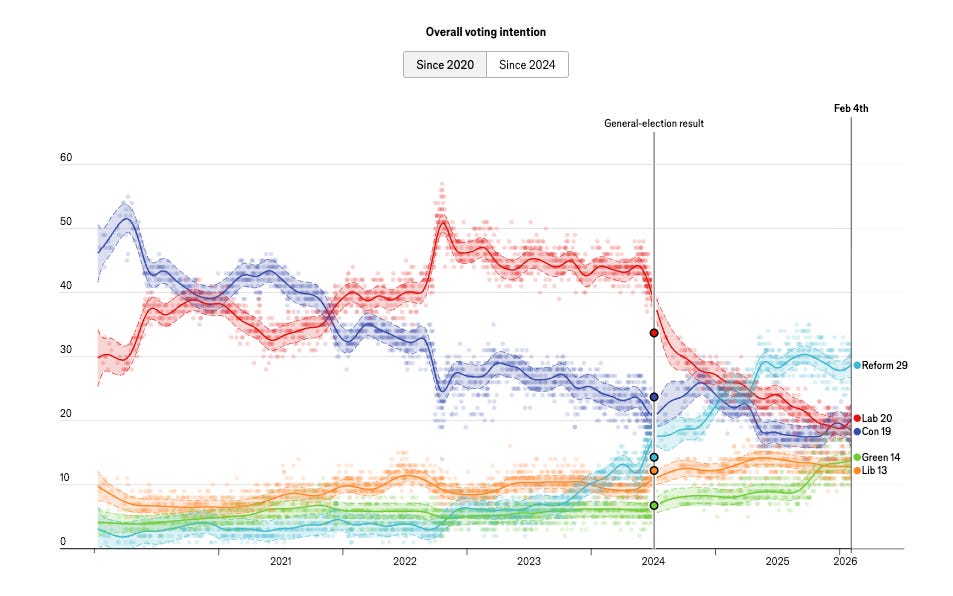
From the Economist, “How unpopular is Britain’s Labour government?,” February 6, 2026.
As for Carney, his popularity seems buoyed by his standing up to Trump, but the fundamentals that made the Canadian Liberal Party so unpopular in late 2024, and so unsuccessful at boasting Canadian prosperity, have not gone away.
This is what makes Sanae Takaichi unique as a leader of a G7 country.
She openly, and loudly, acknowledges that Beijing poses a huge threat to her country and global peace.
She openly recognizes that Beijing AND Moscow are working together to harm Japanese interests and undermine the international order that have served Japanese interests so well.
She is willing to set aside free trade orthodoxy and WTO rules to further the interests of Japan and other democracies.
She doesn’t interpret Trump’s tariffs as a “declaration of war” and she doesn’t grandstand at Davos.
She has advocated for increased Japanese defense spending well before Washington put pressure on its allies to do more to defend themselves.
She is working hard to formulate policies that would tie Japan and the United States closer together through concepts around economic security and alliance management.
She is proactively trying to build the next international order that favors democracies rather than waxing nostalgically about multilateralism and jetting off to Beijing to supplicate herself to Emperor Xi.
Last week, when it appeared clear that her snap election gamble would pay off, President Trump endorsed Takaichi and invited her to visit the White House in March. This is significant because a March visit would mean that the President and the Prime Minister, and their staffs, would meet BEFORE Trump conducts his trip to Beijing.
My impression is that Prime Minister Takaichi is a leader with a vision and drives her government with a sense of mission to craft a world that protects Japanese interests and provides for long-term Japanese prosperity in a world that is changing.
If you meet with her staff or just officials from the various Japanese ministries, you get the impression of folks who are in a hurry to build a new international order. I contrast those interactions with the ones I have with my European and Canadian colleagues which largely consists of hand-wringing, a sizeable helping of pessimism, and a plan that consists of solely of hedging between Beijing and Washington… to put it less charitably, I get the impression that the Europeans and Canadians really just want to triangulate against the United States and do whatever they can to see Washington fail.
I mentioned this point last week, but I find it quite striking how Canadian and European leaders show absolutely no solidarity with Japan as they undergo enormous coercion from Beijing. If these leaders were serious about the values and norms that they want America to protect then they would be teaming up with Takaichi, not pretending she doesn’t exist.
I’m sure the CCP was overjoyed when Takaichi announced her snap elections. They increased their coercion in the hopes that it would result in an overwhelming defeat for her. Instead, Beijing’s coercion likely solidified her victory.
One wonders why Canadian and European leaders don’t draw lessons from this.
European and Canadian leaders are terrified of Chinese coercion and economic punishment. Because of that they downplay the threat posed by the PRC, take actions to mollify Beijing, and travel to Beijing with business delegations to be seen by their constituents as engaging with the PRC.
Quote from Keir Starmer’s personal Substack explaining why he went to China two weeks ago:
In recent years we’ve seen just how directly global events land in our daily lives – often right onto the kitchen table. Higher food prices. Rocketing energy bills. That lingering sense that too much is out of our control. In today’s world, there’s no guarantee that what happens abroad will stay there.
That’s exactly why the way Britain engages with the world really matters. And it’s why this visit to China matters.
If we are serious about easing the cost of living and a building a stronger, more secure economy, we can’t afford to just look inward. We have to engage abroad – establishing pragmatic, consistent relationships that further British interests while standing firm in our values.
Because there’s no getting around it, China is one of the world’s biggest economic powers. What happens there affects what happens here – in our supermarkets, our high streets and our household bills.
And with that, comes huge opportunity.
Done right, a renewed relationship with China offers British businesses new markets & investment, British workers better jobs & higher wages, and British families lower prices & greater choice. Refusing to engage might feel like the easy option. It might even make for some nice headlines. But it would be a staggering dereliction of duty at a time when the cost of living is being felt so heavily.
One can legitimately ask: does “engaging” with China really do anything to help British families? Or is “engaging” just the “easy option” because that is what his European and Canadian counterparts are doing.
I can almost hear the questions: But Matt, Donald Trump is going to Beijing in April and Takaichi met with Xi in November in South Korea? What makes their visits “OK,” while its “bad” for Starmer, Macron, Carney, and Merz to do the same thing.
Well, it isn’t the same thing.
Both Takaichi and Trump have built and are continuing to build significant leverage against Beijing… Carney, Starmer, Macron, (and to a lesser degree Merz, so far) appear to be allergic to building leverage against Beijing.
They have made it clear to the Chinese Communist Party (and the rest of the world) that their pursuit of greater “engagement” with Beijing is meant to gain leverage against the United States. This is why the CCP doesn’t take them seriously. This makes them supplicants when their planes land at PEK (Beijing Capital International Airport).
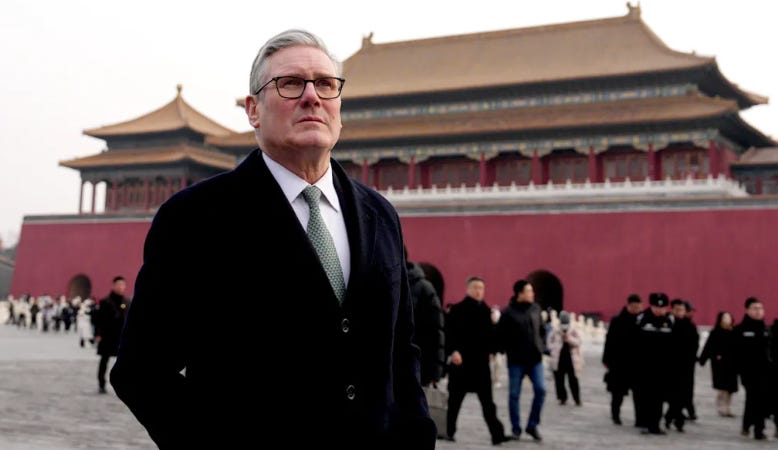
Starmer on a self-guided tour of Tiananmen last month, his Chinese hosts didn’t even bother clearing the square (Getty Images).
I have no doubt that Takaichi will go to the 2026 APEC summit when the PRC hosts it in Shenzhen, but she will attend from a position of geopolitical strength. While she will likely still be in the CCP’s doghouse with People’s Daily vilifying her, Xi and his cadres will have to deal with her carefully and seriously. Takaichi has demonstrated that Tokyo will not bow to a Sino-centric Asia and that Tokyo is capable of creating its own alternative regional order to challenge Beijing.
On the other hand, Europeans and Canadians remain willfully ignorant of the CCP’s intentions. Canadian and European leaders demonstrate with their words and deeds that they couldn’t care less what Beijing does in its own sphere of influence (or in Europe’s sphere of influence… side-eye at Beijing’s “no limits friendship” with Moscow). Canadian and European leaders are quick to equate Washington and Beijing as equally at fault for stabilizing the world. This false comparison predates Donald Trump, as the French Indo-Pacific Strategy of the mid-2010s showed, Paris didn’t view the United States as an ally in the region, but as destabilizing force on par with Beijing. From the point of view of Paris, France would team up with other middle powers to pursue its own “third-way” against both the PRC and the United States… it is why Macron strongly opposed opening a NATO office in Tokyo during the Biden Administration.
Sure, they all say they will bring up human rights with the Chinese behind closed doors and stress to their Chinese counterparts how important values are, but the folks flying with these leaders to the PRC are business leaders, not human rights advocates. The folks shaping what the Europeans and Canadians do with the PRC are folks like Lord Peter Mandelson and John McCallum.
So that’s why I think the Japanese election is so important, it points towards the future we should expect to see, even as the European and Canadian leaders triangulate against the United States and hope for a return to the 1990s.
The next international order that serves the interests of democracies will be forged in Tokyo and Washington and recognize that the locus of power has shifted from Europe to Asia.
***
As for the Super Bowl this evening, I’m rooting for the NFC Champion Seahawks because, years ago, I developed a loathing for the Patriots… mostly just a loathing of Robert Kraft and Bill Belichick, both of whom got snubbed by the Football Hall of Fame this year, and who apparently don’t like one another.
The Kraft-Belichick feud seems to be escalating rather quickly. Last night at the Duke-UNC basketball game, Belichick’s girlfriend wore an “Orchids of Asia Day Spa” t-shirt… if you know, you know.
I have to say, that is kind of a sick burn.
Thanks for reading!
Matt
P.S. If you’d like to support this newsletter, please consider becoming a paid subscriber.
MUST READ
‘I’m Free’: A Muslim Official Who Lost Faith in China Gains a Voice
Li Yuan, New York Times, February 1, 2026
Ma Ruilin worked as a Communist Party cadre helping fellow Muslims navigate their country as religious minorities, until the official hostility became too great to bear.
In the final years of his career as a Chinese Communist Party official, Ma Ruilin lived two lives.
During the day, he carried out policies that were used to control Muslims. In the evening, he visited a mosque to pray. To hide his identity from surveillance cameras, he wore a motorcycle helmet when he entered.
Mr. Ma knew exactly how China’s surveillance systems worked — he helped design them.
“By day, my face looked exactly like one of my colleagues,” he said. “At night, I knelt on the prayer mat and became a different human being.”
For two decades, Mr. Ma was a midlevel party cadre in China’s religious affairs bureaucracy. A technocrat, he managed policies for Muslim communities and led hajj delegations to Mecca.
About 10 years ago, when the party intensified a crackdown on Islam, Mr. Ma, a member of China’s Hui Muslim minority, found it increasingly difficult to reconcile his conflicting identities.
Now 50 and living in New York, Mr. Ma is determined to tell his life’s story despite the risks to himself and his family.
Sitting in the Midtown Manhattan halal restaurant where he now works as a manager, he was at ease with his new life.
“I’m free,” he said. “Finally I’m at peace with myself.”
It is highly unusual for a Chinese party official — a member of the country’s ruling class — to emigrate to the United States. It is rarer still for someone like Mr. Ma to speak out against the system he served. His journey from cadre to critic, which he shared in a series of interviews with me, opens a window to the inner workings of how China controls religion.
More Than a Number: The Gravity of China’s Growth Target
Lingling Wei, Wall Street Journal, February 3, 2026
A prominent Chinese economist once told a Washington forum that China’s official growth rate “will always be around 5%,” regardless of how grim the reality looked on the ground. Gao Shanwen was effectively muzzled for that bit of candor, but his logic has aged uncomfortably well.
For three years running, Beijing has defied the laws of economic gravity, reporting growth that has unfailingly hovered around 5%. It’s a statistical miracle performed against a backdrop of a shattered property market, a stubborn deflationary spiral, and a West striving to uncouple from Chinese factories. Now, as local governments begin sketching out targets for 2026, the signal is clear: the era of the 5% range is being willed into existence for another year.
In fact, as a senior Chinese policy adviser explained to me recently, that 5%-or-so figure has become a political straitjacket. For every major economic meeting over the past few years, the adviser said, the “specter of 2035” has loomed over Beijing. That’s the year when Xi Jinping said in 2020 that China would double the size of its economy and per-capita income.
It’s for the simple reason that the date determines exactly how much money the Chinese leader is willing to burn to keep the economy from sliding.
To reach the finish line, China must maintain an average annual growth rate of roughly 4.7% to 5%--a narrow margin for error. For Xi, the economic adviser told me, maintaining that speed of growth is no longer just an economic goal but a metric of the Communist Party’s legitimacy.
We saw the stakes peak in late 2024. For months, the data from the provinces had been bleak. Consumption was flat, and the reverse wealth effect of crashing home prices had turned middle-class families into defensive savers. By September of that year, it became clear that China was on track to miss its 5% target--a failure that would be viewed as in direct conflict with the 2035 vision.
When the raw data reached the Zhongnanhai leadership compound, sources told me, Xi was furious. The result was the “September Surprise”: a sudden wave of stimulus, rate cuts, and stock market life-support.
It signaled that while Beijing talks about the need for “high-quality growth” over raw speed, it remains terrified of a headline miss. The directive to the bureaucracy was clear: hit the number, whatever the cost.
COMMENT - I’m hearing that the Party might be revising the target down to 4.5%.
What Xi’s Military Purge Means for Taiwan
John Garnaut, New York Times, February 3, 2026
President Xi Jinping’s long-running battle to bring China’s military under his absolute personal control has reached a tipping point.
On Jan. 24, China’s Ministry of National Defense confirmed that the nation’s highest-ranking general, Zhang Youxia, had been placed under investigation, accused of a litany of political misdeeds. It was Mr. Xi’s boldest move yet in his purge of the military, the most sweeping in Chinese Communist Party history.
The opacity of China’s political system has fueled speculation about factional warfare and reports that General Zhang is accused of receiving bribes for ministerial promotions and leaking nuclear secrets to the United States.
The real drivers are probably less sensational than that — and potentially more consequential for peace and stability in Asia.
The yearslong shake-up may suggest that the People’s Liberation Army is in turmoil, setting back Mr. Xi’s goal of reunifying Taiwan with mainland China.
But it is part of a long-term plan by the Chinese leader to make room for a new generation of more disciplined generals capable of mastering advanced technologies such as artificial intelligence and drones, as well as space, undersea and cyberwarfare. The ultimate aim is to create a military force capable of conquering Taiwan and prevailing in a potential confrontation with the United States.
There is no evidence that purged commanders directly challenged these ambitions. But it has become increasingly apparent that Mr. Xi believes he needs to build a foundation of absolute ideological unity and personal loyalty for future battles, and he is drawing on the Maoist and Stalinist playbooks he absorbed in his youth.
The party has framed General Zhang’s removal as part of a mission to remove rot and regenerate flesh and to achieve the renewal and rebirth of the People’s Army. This is coded language of great significance in the Chinese Communist Party, referring to the pivotal period when Mao Zedong’s battered Communist forces regrouped at Yan’an in north-central China in the late 1930s after a series of setbacks.
For Mr. Xi and his fellow party princelings — the children of revolutionaries — Yan’an is hallowed ground, where Mao rallied the Red Army and turned it into the disciplined fighting force that went on to defeat the Nationalist government of China and seize control of the country. It was also where Mao unleashed a campaign of political terror to eliminate rivals or those he considered ideologically unreliable for the challenges ahead.
Move Fast, but Obey the Rules: China’s Vision for Dominating A.I.
Meaghan Tobin and Xinyun Wu, New York Times, February 2, 2026
Beijing wants to lead the world in developing cutting-edge artificial intelligence, but it also wants companies to adhere to an increasingly complex set of rules.
In late January, China’s leader, Xi Jinping, told a gathering of officials from across the country that China was on the cusp of an “epoch-making major technological revolution.”
Artificial intelligence, he said, is as transformative as the steam engine, electricity and the internet. But for all of its promise, China must not let the new technology “spiral out of control,” Mr. Xi warned during a study session for leaders of the Chinese Communist Party, according to state media. China must act early and decisively, anticipating and preventing problems with prudence and caution, he said.
Mr. Xi’s remarks highlight a tension shaping China’s tech industry. China’s leadership has decided that A.I. will drive the country’s economic growth in the next decade. At the same time, it cannot allow the new technology to disrupt the stability of Chinese society and the Communist Party’s hold over it.
The result is that the government is pushing Chinese A.I. companies to do two things at once: move fast so China can outpace international rivals and be at the forefront of the technological shift, while complying with an increasingly complex set of rules.
COMMENT - To what degree will the CCP’s desire to control the outputs of AI undermine Xi’s dream of technological dominance?
China has been kicked out of most of Horizon Europe
Goda Naujokaitytė, Science Business, January 27, 2026
Starting this year, Chinese organisations will no longer be allowed to take part in most projects funded by Horizon Europe, as the EU moves to tighten restrictions on who can take part in its research programme.
In 2023, the EU put a blanket ban on Chinese organisations taking part in Horizon Europe innovation projects, which produce results close to market readiness. This year, it is also banning most participation in research projects for developing new knowledge and exploring the feasibility of new technologies.
As a result, starting in 2026,, research actions on topics such as health, digital and civil security are fully closed to Chinese entities, in addition to selected sensitive topics in culture, climate and bioeconomy research.
The European Commission’s reasoning for the ban is simple: it wants to protect European intellectual property from “undesired” transfers, which Chinese state policy actively supports.
COMMENT - I think this is a smart move by folks in Brussels.
Trump Unveils $12 Billion Critical Minerals Stockpile
Alan Rappeport and Tony Romm, New York Times, February 2, 2026
The “Project Vault” initiative is intended to reduce U.S. reliance on China for key technology components.
President Trump on Monday rolled out a $12 billion initiative aimed a bolstering domestic stockpiles of strategic critical minerals, as the United States looks to reduce its reliance on China for key components of technology that powers cars, computers and phones.
Known as “Project Vault,” the effort will entail procuring and storing minerals for American manufacturers. In remarks at the White House on Monday, Mr. Trump likened the endeavor to the government’s oil reserves and other emergency caches. The reserve will be financed by $1.67 billion in private funds and a $10 billion loan from the U.S. Export-Import Bank.
The bank’s board of directors approved the loan on Monday.
Speaking in the Oval Office, Mr. Trump framed the announcement as the latest move by the United States to develop its own supply chain for critical minerals, after China curbed exports of its magnets last year, creating shortages for cars, robots, semiconductors, drones and other products.
Authoritarianism
Trump, Xi discuss Taiwan and soybeans in call aimed at easing China, US relations
Trevor Hunnicutt and Xiuhao Chen, Reuters, February 4, 2026
China’s Xi Presses Trump on Taiwan in Phone Call
Erica L. Green, New York Times, February 4, 2026
Both leaders gave versions of what they discussed, but the Chinese president’s take made clear the issue of the island was front and center.
President Trump and President Xi Jinping of China had a lengthy phone call on Wednesday during which, Mr. Trump said, the two leaders discussed a wide range of issues — including Iran, the war in Ukraine and soybeans — ahead of Mr. Trump’s visit to China this spring.
But the call, which Mr. Trump enthusiastically described as “excellent” and “long and thorough,” included a warning from Mr. Xi about an issue that Mr. Trump has tiptoed around: the future of Taiwan.
In Mr. Trump’s description of the call, posted to his Truth Social account, he listed the issue of Taiwan among more than a half-dozen topics — “all very positive” — that the two had discussed. The call lasted almost two hours, according to people familiar with it. Mr. Trump said they discussed his trip to China for a high-stakes summit in April, as the two leaders have sought to ease tensions in recent months after engaging in an aggressive trade war shortly after Mr. Trump took office. The two last met in October in South Korea, where they agreed to a yearlong trade truce. The two did not discuss Taiwan during that meeting.
“The relationship with China, and my personal relationship with President Xi, is an extremely good one, and we both realize how important it is to keep it that way,” Mr. Trump wrote in the social media post. “I believe that there will be many positive results achieved over the next three years of my Presidency having to do with President Xi, and the People’s Republic of China!”
But a description of the call from Chinese state media was much more forceful, and suggested that the issue of Taiwan was front and center.
Mr. Xi told Mr. Trump that the American position on Taiwan was “the most important issue in China-U.S. relations,” it said, and asserted that China “will never allow Taiwan to be separated from China.”
“The U.S. must handle arms sales to Taiwan with extreme caution,” Mr. Xi told Mr. Trump, according to the description in Chinese state media.
It is not unusual for China to include the issue of Taiwan among its priorities in diplomatic talks with the United States, but the warning comes just months after the U.S. in December approved an arms package for Taiwan valued at more than $11 billion.
COMMENT – I’m certain Taiwan was Xi’s top issue… it just goes to show how obsessed he is with annexing the island democracy.
US must be prudent when supplying arms to Taiwan, Xi tells Trump
Kelly Ng and Tessa Wong, BBC, February 5, 2026
China bankrolling Putin’s war to gain advantage over West, MPs told
Tom Cotterill, The Telegraph, February 3, 2026Dissident Who Daringly Documented Uyghurs’ Repression Wins Asylum
Amy Qin, New York Times, January 28, 2026
A federal immigration judge on Wednesday granted asylum to a Chinese dissident who had taken great risks to secretly record his country’s mass detention and surveillance of Uyghurs.
Heng Guan, 38, was detained last August in upstate New York, and supporters feared that he would be sent back to China, where human rights activists said he would almost certainly face persecution.
After an outcry from human rights advocates, Democrats and The Wall Street Journal editorial page, the Trump administration sought to deport him instead to Uganda.
Then in late December, the administration dropped that request, but Mr. Guan has remained in immigration detention.
Chinese man who filmed Uyghur internment camps to be released from ICE detention center in Batavia
Celia Clarke, WSKG, February 3, 2026
An asylum seeker who was held in the Broome County jail for almost five months is scheduled to be released from federal custody Tuesday.
Guan Heng waited over four years to have his asylum application heard in a United States immigration court. He fled China in 2021 after filming Uyghur detention centers in the far western region of Xiajiang. Uyghurs are a Muslim minority who live in a far western region of China.
China’s Disappearing Generals
Amy Chang Chien, Agnes Chang and Chris Buckley, New York Times, February 3, 2026
China’s efforts to boost the birth rate have failed. Is coercion next?
Simon Elegant, Washington Post, January 31, 2026
Xi the Destroyer
Jonathan A. Czin and John Culver, Foreign Affairs, February 2, 2026
China: independent journalists Liu Hu and Wu Yingjiao arrested for reporting on corruption
RSF, February 3, 2026
Top consulting firms test boundaries with China workarounds
Reuters, February 3, 2026
U.S. Allies Are Drawing Closer to China, but on Beijing’s Terms
David Pierson and Berry Wang, New York Times, January 31, 2026Jan Svec, Modern China, January 21, 2026
This article explores China’s responses to the international pressure regarding the mass detention of Uyghurs in re-education detention camps in Xinjiang. To understand the evolution of China’s responses to the mounting international pressure, the article employs a process-tracing method based on a qualitative analysis of Chinese official documents, reports, leaked files, and media articles. China’s official narrative is also traced through a content analysis of articles from Chinese official media. The article argues that the shifts in narratives, and even in policies, were shaped not solely by domestic considerations but also by international pressure.
In response to growing international pressure, the authorities moved through several stages: initially showing lax control over the narrative, then concealing the camps’ existence, subsequently acknowledging and justifying them, followed by downsizing and reframing the policy, and eventually partially abandoning the practice. The article contributes to the underresearched area of authoritarian regimes’ responses to international pressure regarding their domestic political repression.
Beijing’s backtrack on Xinjiang detention camps spurred by ICIJ investigation, research finds
Fergus Shiel, ICIJ, February 4, 2026
Academic research shows that investigative reporting, NGO advocacy, and scholarly scrutiny pushed Chinese authorities from denial to dismantling parts of their mass detention system for Uyghurs.
Reporting by the International Consortium of Investigative Journalists helped force a shift in Beijing’s public stance on Xinjiang, according to new academic research — from denying the existence of a vast detention camp system to justifying it and, eventually, to partially dismantling it.
In an article published in Modern China, a peer-reviewed academic journal dedicated to China studies, political scientist Jan Švec traces how China responded to growing global scrutiny of its “re-education” campaign in Xinjiang between 2014 and 2022. Švec, who’s based at the Institute of International Relations in Prague, used official Chinese documents, state media analysis, leaked files, and international reporting to argue that international exposure played a decisive role in forcing Beijing to adjust both its narrative and its policies.
Following ethnic rioting, and a series of deadly terror attacks within and outside Xinjiang which Beijing blamed on Uyghurs, President Xi Jinping launched a “Strike Hard Campaign against Violent Extremism” in 2014 that framed Uyghur identity as a security threat. Local authorities experimented with so-called “de-extremization” centers, openly praising them in regional media. At this stage, there was little international awareness — and little effort to conceal what was happening.
That changed dramatically in 2017, when mass detentions expanded across the region. As arrests surged, Beijing imposed a strict information blackout. References to the camps disappeared from national media, and Xinjiang coverage was softened to emphasize development and stability. But outside China, journalists, researchers and Uyghur exile groups began piecing together evidence of mass incarceration.
Environmental Harms
Why China is building so many coal plants despite its solar and wind boom
Ken Moritsugu, Associated Press, February 3, 2026
Even as China’s expansion of solar and wind power raced ahead in 2025, the Asian giant opened many more coal power plants than it had in recent years — raising concern about whether the world’s largest emitter will reduce carbon emissions enough to limit climate change.
More than 50 large coal units — individual boiler and turbine sets with generating capacity of 1 gigawatt or more — were commissioned in 2025, up from fewer than 20 a year over the previous decade, a research report released Tuesday said. Depending on energy use, 1 gigawatt can power from several hundred thousand to more than 2 million homes.
Overall, China brought 78 gigawatts of new coal power capacity online, a sharp uptick from previous years, according to the joint report by the Centre for Research on Energy and Clean Air, which studies air pollution and its impacts, and Global Energy Monitor, which develops databases tracking energy trends.
China wields fishing force as geopolitical weapon, report finds
Indo-Pacific Defense, February 2, 2026
Foreign Interference and Coercion
China hacked Downing Street phones for years
Gordon Rayner, The Telegraph, January 26, 2026
Chinese phishers impersonate U.S. policy briefings
Sam Sabin, Axios, February 3, 2026
Popular open-source coding application targeted in Chinese-linked supply-chain attack
A.J. Vicens, Reuters, February 2, 2026
Britain and China hail reset in ties as Starmer seeks ‘sophisticated’ relationship
Andrew Macaskill, Reuters, January 29, 2026
China warns Australia against taking back control of key port in Darwin
John Power, Al Jazeera, January 29, 2026
UK’s Starmer faces backlash over China trip amid claims he was ‘tricked’
South China Morning Post, February 3, 2026
As diplomatic row drags on, how is Japan coping with a fall in Chinese tourists?
Ralph Jennings, South China Morning Post, February 2, 2026
Las Vegas bio lab raid possibly tied to California case, federal Chinese investigation
David Charns, 8News Now, February 1, 2026
Illegal Biolabs in Vegas and California Linked to Chinese National with Alleged Military-Civil Fusion Ties, $330M Canadian Fraud Judgment
Sam Cooper, The Bureau, February 3, 2026
Pathogens labeled ‘HIV’ and ‘Ebola’ found inside secret, illegal Chinese-owned biolab in California
Victor Nava, New York Post, November 16, 2025
Nuclear weapon storage banned at Chagos base
Genevieve Holl-Allen, The Telegraph, January 27, 2026
Human Rights and Religious Persecution
Fujian: Police Mobilized to Demolish Village‑Funded Temple, Several Injured
Zeng Liqin, Bitter Winter, February 2, 2026China out to eradicate Tibetan civilization, UN rights expert warns
Tibetan Review, February 5, 2026
China criticizes decision to award a Grammy to the Dalai Lama
AP News, February 2, 2026
China: Repression Deepens, Extends Abroad
Human Rights Watch, February 4, 2026
The Silenced Profession
China Media Project, February 3, 2026
Prominent Chinese Journalist Liu Hu Detained by Police in Chengdu
Zhang Yichuan and Xiao Hui, Caixin Global, February 3, 2026The Disappearance of a Tibetan Lama and China’s Expanding Religious Crackdown
Ashu Mann, Eurasia Review, February 2, 2026
The reported detention and disappearance of a Tibetan Buddhist lama, Lobsang Lungrik, has sparked alarm among Tibetan rights advocates. He was a senior religious official in China’s Qinghai province.
It sheds light on Beijing’s expanding crackdown on Tibetan religious leaders. It goes on to reveal how the Chinese Communist Party (CCP) uses state power to erode Tibet’s cultural and spiritual foundations.
Lobsang Lungrik, 51, is the head lama of Ba Gön Monastery in Chumarleb County, Yushu Tibetan Autonomous Prefecture–a region that forms part of traditional Kham in eastern Tibet. He was reportedly detained by Chinese authorities in December 2024. His whereabouts have been unknown since then.
The Tibetan Centre for Human Rights and Democracy (TCHRD) has said that he was detained after being accused of sheltering a senior monk, a Geshe, who had returned from India and who later died of natural causes while staying at Ba Gön Monastery.
Before his disappearance, Lobsang Lungrik had a respected career in both monastic and government institutions. Born in 1975 in Chumarleb, he was recognised as the 11th incarnation of Bartri Gyuchen at the age of seven. He studied for more than 21 years at Sera Monastery in Lhasa and later earned a master’s degree from Qinghai Normal University. Over the years, he rose to several prominent positions, including Vice President of the Buddhist Association of Qinghai, Executive Vice President of the Yushu Buddhist Association and Vice Chairman of the Yushu Prefectural Chinese People’s Political Consultative Conference (CPPCC).
Despite such state-approved credentials, his official status offered no protection against political persecution. On 26 December 2024, Qinghai Daily reported the removal of “Luosong Longri” (his Chinese name) from all political appointments. While two other officials named in the same notice were accused of “disciplinary violations,” no charges were publicly filed against Lungrik, suggesting that his purge was politically motivated.
Analysts argue that this disappearance fits a deeper pattern in Beijing’s policy toward Tibetan religious leaders. The CCP systematically targets influential monks with ties to India or to the Dalai Lama, labelling them as “foreign-influenced” or “separatist.” In Lungrik’s case, the accusation of “sending money abroad” mirrors other prosecutions used to criminalize connections with the Tibetan diaspora. As TCHRD notes, such charges enable the government to ban traditional exchanges of learning and religious support across the Himalayas.
China’s government defends its policies as necessary for national security and social stability, but evidence shows the real motive is control and assimilation. Since President Xi Jinping introduced the campaign for the “Sinicization of Religion,” Tibetan Buddhism has faced increasing ideological intrusion. Monks must attend political training sessions, portraits of CCP leaders are displayed in monasteries and loyalty to the Party is treated as a test of faith. Lamas who resist or maintain religious independence risk arrest or disappearance.
Industrial Policies and Economic Espionage
China Factory Activity Slips Back into Contraction
Fan Qianchan, Caixin Global, February 3, 2026
China Manufacturing Gauge Shows Pickup in Activity
Wall Street Journal, February 1, 2026
However, business confidence slipped to a nine-month low amid concerns around costs.
A private gauge of China’s manufacturing sector showed Chinese factories continued to expand activity in January, with production growing at a faster pace amid more new orders.
The RatingDog China general manufacturing purchasing managers index, compiled by S&P Global, edged up to 50.3 last month from 50.1 in December, according to a statement released Monday. The 50 threshold separates expansion in activity from contraction.
Improving employment, mainly due to growth in orders, was the main driver of last month’s activity expansion, according to RatingDog.
“Notably, new export orders returned to expansion territory after a contraction in December, primarily buoyed by increased demand from Southeast Asia and other overseas markets,” said Yao Yu, founder at RatingDog.
Still, business confidence slipped to a nine-month low amid concerns around costs, indicating weak growth momentum, according to the survey.
The reading pointed to a different direction compared with an official survey released Saturday, which showed factory activity unexpectedly contracted last month. The official manufacturing PMI fell to 49.3 for January, compared with 50.1 in the prior month.
Luxury Brands Need a Comeback in China. They Shouldn’t Count on It.
Carol Ryan, Wall Street Journal, February 1, 2026
Former Google engineer found guilty of espionage and theft of AI tech
Jennifer Elias, CNBC, January 30, 2026
Ex-Google Engineer Convicted of Stealing A.I. Secrets for Start-Up in China
Tripp Mickle, New York Times, January 29, 2026
Chinese EVs’ Slow Charge Toward America
Noah Berman, The Wire China, February 1, 2026
Ford held talks with China’s Xiaomi over EV partnership
Financial Times, February 2, 2026
Metals Traders Lose at Least $144 Million as ‘Hat’ Flees China
Alfred Cang and Julian Luk, Bloomberg, February 1, 2026
China has launched a huge free-trade experiment
The Economist, February 1, 2026
China Economy’s Weak Start Bolsters Case for Early Easing
Bloomberg, February 1, 2026
BYD Vehicle Sales Slump 30% in January as China Demand Cools
Bloomberg, February 1, 2026
EU companies adopt BYD, Yutong buses despite China security fears
Jens Kastner, Nikkei Asia, February 2, 2026
Xi Jinping calls for China’s renminbi to attain global reserve currency status
Financial Times, February 2, 2026
China’s Tech Regulation Paradox Amid Great Power Competition
Xing Jiaying, The Diplomat, January 26, 2026
Even as China deepened its review into Meta’s acquisition of Manus, another long-running technology standoff was brought to a close. After six years of sustained political and regulatory pressure, ByteDance finalized a deal over TikTok to establish a majority American-owned joint venture designed to secure U.S. data and avert a U.S. ban on the platform.
Taken together, these two high-profile episodes signal a shrinking strategic space for Chinese technology companies pursuing global expansion and expose a growing paradox at the core of Beijing’s technology regulation.
How China’s tightening regulatory framework is reshaping its technology firms’ global expansion – and what this policy shift implies for its technological trajectory and competition with the U.S. – has become an increasingly urgent question for policymakers in Beijing. Chinese technology companies’ outward expansion is no longer driven purely by market logic but is increasingly shaped by geopolitical risk management. Meanwhile, Beijing’s technology regulation faces a growing paradox: efforts to tighten control over technology outflows are increasingly in tension with the need to sustain domestic innovation and global competitiveness.
At World’s Busiest Port, China’s Unbalanced Economy Comes into View
Keith Bradsher, New York Times, January 29, 2026
Cyber and Information Technology
Nvidia helped DeepSeek hone AI models later used by China’s military, lawmaker says
Stephen Nellis, Reuters, January 28, 2026
A Slow but Steady Acceleration
Rachel Cheung, The Wire China, February 1, 2026
After years of planning and investment, robotaxis are finally hitting the road in China. Accidents and the impact of self-driving vehicles on employment remain concerns, but the government remains committed to developing the industry into a global leader.
‘Optimus chain’: Chinese suppliers form the backbone of Tesla’s humanoid robot initiative
Wency Chen, South China Morning Post, February 1, 2026
The New AI Chip Export Policy to China: Strategically Incoherent and Unenforceable
Chris McGuire, Council on Foreign Relations, January 14, 2026
China’s CXMT and YMTC to massively expand memory output amid global crunch
Cheng Ting-Fang and Lauly Li, Nikkei Asia, February 3, 2026
Military and Security Threats
China’s ambassador warns Albanese reclaiming Port of Darwin will force Beijing to intervene
Tom McIlroy, The Guardian, January 28, 2026
China’s Xi, Now Alone atop His Military, Is the Sole Voice in Tackling Taiwan
Lingling Wei, Wall Street Journal, January 31, 2026
Taiwan Doubles Down on U.S. Partnership, even as America’s Alliances Fray
Joyu Wang, Wall Street Journal, February 3, 2026
China counting how many missiles it needs to win a Taiwan war
Gabriel Honrada, Asia Times, January 31, 2026
US senate advances pro-Taiwan bills
Jules Quartly, Taiwan News, January 31, 2026
One Belt, One Road Strategy
Serbians pushed out as China takes over a mining empire
Matteo Trevisan, Politico, February 1, 2026
China’s plan to internationalise yuan quietly takes a step forward as Zambia gets on board
Jevans Nyabiage, South China Morning Post, February 1, 2026
China Belt and Road Initiative (BRI) Investment Report 2025
Christoph Nedopil Wang, Green Finance and Development Center, January 18, 2026
Venezuela and Iran Unrest: Implications for China’s Oil Import Economics
Fabio Ashtar Telarico, Geopolitical Monitor, February 4, 2026
New Gas Deposit Discovered in Contested South China Sea
Micah McCartney, Newsweek, January 22, 2026
China’s Shenghe feuds with Australian rare-earth partner in Greenland
Kenji Kawase, Nikkei Asia, February 3, 2026
Opinion
China Loses a Foothold in Panama
Mary Anastasia O’Grady, Wall Street Journal, February 1, 2026
Panama’s Supreme Court of Justice declared late Thursday that two government contracts to operate ports at the mouths of the Panama Canal—Balboa on the Pacific and Cristóbal on the Atlantic—are unconstitutional.
Panama Ports Co., owned by Hong-Kong-based conglomerate CK Hutchison Holdings Ltd., holds those concessions. Hutchinson agreed to sell most of Panama Ports and some 43 other ports around the world to the U.S. company BlackRock in March 2025. But Beijing reportedly held the deal up, demanding the Chinese state-owned shipping company Cosco retain a majority stake.
The high court’s decision means Panama Ports is no longer authorized to operate in Panama. It’s a win for the Trump administration, which has been complaining for more than a year about the Chinese presence in the country.
Panamanian President José Raúl Mulino, a U.S. ally, has already withdrawn Panama from China’s Belt and Road initiative. Now the two port concessions will need to be auctioned off. It remains to be seen how Panama will ensure that China is blocked from the bidding, but it almost surely will be.
The ruling is also a win for Panamanians. A lack of confidence in their politicians has long fueled speculation around Panama City that something fishy has gone down more than once between the Hong Kong company and Panamanian governments since 1997, when the concessions were first awarded.
Those rumors are unsubstantiated and the government extended the concessions, beginning in 2023, for another 25 years. But an April 2025 audit report by Panama’s comptroller found irregularities—including alleged nonpayment of fees—that might have cost Panama hundreds of millions of dollars. Panama Ports rejected the auditor’s findings. But if the high court’s recent ruling forces greater transparency in government deal-making, it’s good news for the nation.
China’s Crying Horse Doll Shows a Generation Is Losing Faith
Karishma Vaswani, Bloomberg, February 1, 2026
The Case for Policy Transformation to Avoid Losing the Techno-Economic-Trade War with China
Robert D. Atkinson, ITIF, February 2, 2026
China’s opacity brings Pekingology back into vogue
The Economist, February 2, 2026
China’s Economic Statecraft Is Working
Audrye Wong, Foreign Affairs, January 28, 2026
The New Bipolar World of AI
Tom Tugendhat and Christopher Ahlberg, Wall Street Journal, January 29, 2026
Resilience, cooperation, self-reliance: what US strategies mean for Indo-Pacific
Jihoon Yu, ASPI Strategist, February 2, 2026
The Great Chinese Vibe Shift
Helen Gao, Foreign Policy, January 23, 2026
A country once obsessed with success is taking things slower.
The zeitgeist shift that first began about a decade ago in China now feels complete. Isolated grumblings from students and tech workers about impossible workloads have evolved into a widespread belief that in today’s China, hard work no longer pays off. A 2023 survey conducted by two American scholars of China, Scott Rozelle and Martin K. Whyte, found that for the first time since the survey started in 2004, respondents said that having connections and growing up in a rich family mattered more than personal ability when it came to getting wealthy in China.
It is hard to overstate the significance of this shift. Meritocracy was virtually a national religion during the decades of economic reform. The assumption that hard work paid just rewards was so intrinsic to the national psyche, so hammered in by parental instruction and patriotic fable, that it was rarely analyzed. Only as times began to change did the Chinese term for meritocracy, youji zhuyi, begin to circulate as people grappled with the loss of a condition that they had so long taken for granted.
The transparency imperative: Defending Philippine democracy vs foreign interference
Ray Powell, James Carouso, Philstar, January 31, 2026