Get Your Sunscreen Ready
Days Away from Beidaihe and the CCP is Feeling Confident
Friends,
Senior Chinese Communist Party officials are getting a bit itchy to leave town.
It is about that time of year to decamp from Beijing and the Party’s leadership compound in Zhongnanhai to head to the coastal resort of Beidaihe for the annual retreat. By Friday, Beijing will be sweltering in the mid-90s with over 90% humidity… essentially what it is like in DC and Manhattan… I bet plenty of Party members are looking forward to those ocean breezes.
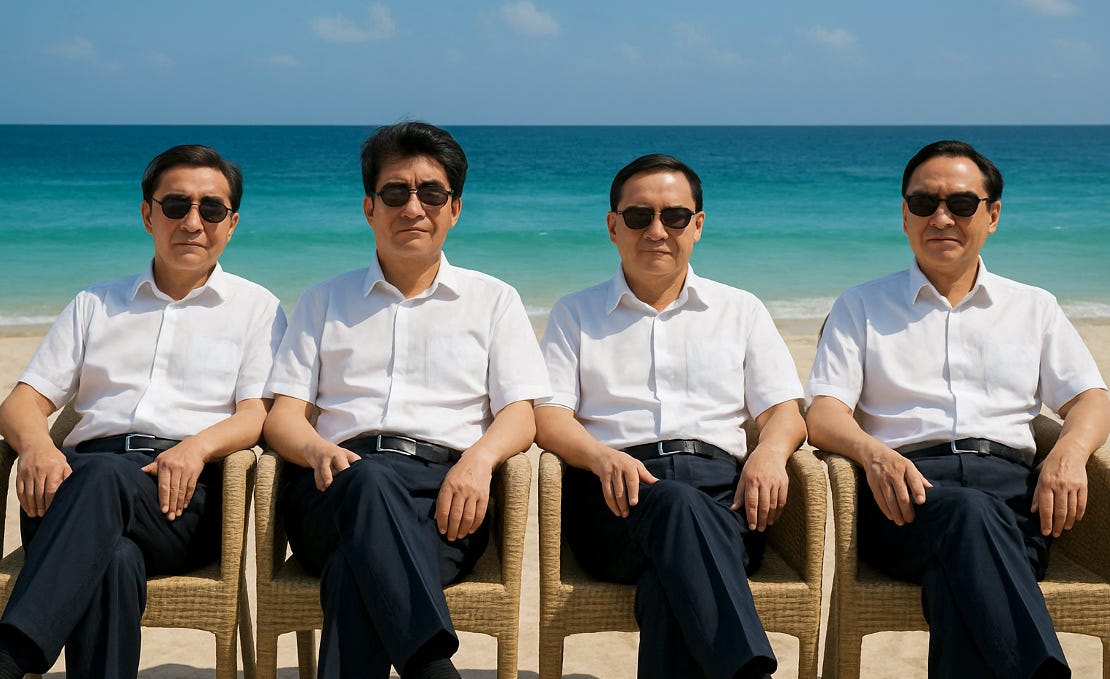
Almost exactly a year ago, I wrote a piece on how the Chinese Communist Party puts a lot of weight on political strength and unity when judging the relative balance of power between itself and its rivals (“What’s the vibe going into Beidaihe?” July 28, 2024).
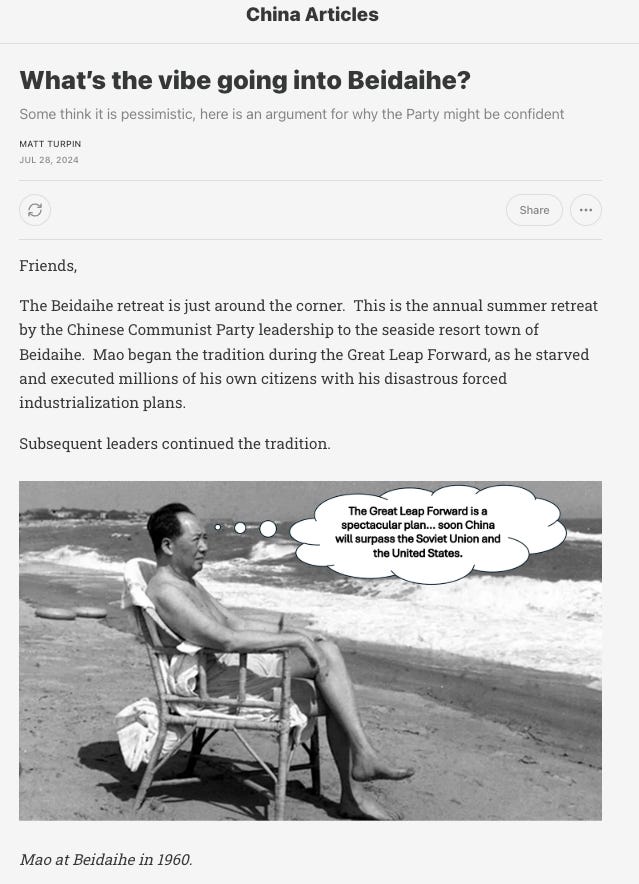
If the Party views itself as fractured and lacking the backing of the Chinese people, while its foreign rivals are united and possess strong support from their populations, the CCP will be more cautious and focus on resolving its internal divisions (a rebuild your strength and bid your time approach).
If the Party judges the opposite conditions are true, then the Party likely judges that there are opportunities to act more boldly on the international stage.
My top line assessment last year was: “While the Chinese economy certainly faces serious headwinds, Beijing’s rivals are divided, politically weak (or weakened), and overwhelmed. From Beijing’s perspective, their hierarchy of rivals are not strong, and their coalition is brittle.”
A year later and I think my analysis holds up pretty well.
I want to spend some time this week doing a refresh on how the Party sees its immediate neighbors.
[NOTE - I’ll save the analysis of Europe, India, and the United States for next week… but Spoiler Alert… the Party still sees those rivals as weak and divided]
Japan’s Upper House Election
Japan’s political stability has not improved over the past year and in many ways it is worse with Prime Minister Ishiba’s government teetering on the edge of collapse.
Last weekend, Japanese voters went to the polls and delivered Prime Minister Shigeru Ishiba, and his minority ruling Liberal Democratic Party (LDP), yet another setback. 124 out of the 248 seats in Japan’s upper chamber (the House of Councillors) was up for election on July 20. Ishiba and the LDP went into the election with 119 seats (six seats short of a majority, which is 125) which forced them into a coalition with Komeito, a party with 27 seats. Going into the election the LDP-Komeito coalition had a comfortable 146 seats.
The LDP and Komeito did not have a great day.
The LDP lost 18 seats, and its coalition partner lost 6, giving them a combined total of 122, three short of a majority.
The upper house is less powerful than the lower chamber, the House of Representatives which selects the Prime Minister, develops budgets and legislation, and forms the Cabinet. But the LDP-Komeito coalition is in a minority in the lower chamber as well with just 220 out of 465 seats.
The question on everyone’s mind is: how long will Prime Minister Ishiba hold on? It is looking likely that he won’t make the one-year mark (October 1) and the LDP will be plunged into yet another time-consuming leadership contest among its warring factions with months lost forming a new government with an even weaker political mandate.
Two parties did relatively well with one making most of the headlines. Starting with the one that didn’t get as much coverage, the DPP or the DPFP (Democratic Party for the People) picked up 12 seats, more than doubling its 10 seats from before the election. The DPFP is a center-right, conservative party that formed in 2018, then a portion merged with the Constitutional Democratic Party (the main center-left opposition party) with the remainder taking over the DPFP brand and adopting more conservative positions. In the lower house, DPFP has a respectable 28 seats, making it the fourth largest party in the House of Representatives.
The other winner in last Sunday’s election was Sanseitō, known in English as the “Party of Do It Yourself.” Sanseitō went from 1 seat on the House of Councillors to 15 seats (it only has 3 seats in the lower chamber, making it the smallest, and holds only a tiny fraction of seats at the Prefectural and Municipal levels across Japan… 156 seats out of a total of nearly 32,000 seats).
Commentators consider the party to be ultra-conservative and populist, seeking to tie Sanseitō success with other right-wing populists around the world, drawing equivalence with Donald Trump.
It strikes me that the success of Sanseitō and DPFP signals strong dissatisfaction with the current LDP leadership team, rather than some fundamental shift in Japanese politics. But that dissatisfaction means that it will be very difficult for Japan to make good on its defense spending increases (mostly because Japanese voters object to the tax increases necessary to fund it) and that Japan will find it difficult to lead others in the region towards a geopolitical vision that is an alternative to what Beijing offers.
Taiwan’s Recall Election
In January 2024, President Lai Ching-te and his Democratic Progressive Party (DPP) won the presidency of Taiwan, but failed to win a majority in the country’s parliament (the Legislative Yuan). Its rival party, the KMT, gained parliamentary control and used its legislative position to block President Lai’s initiatives, including a threat to cut Taiwan’s defense budget.
To get around this obstacle, the DPP organized the largest recall election in Taiwan’s history this weekend, challenging 25 KMT held seats or about a fifth of the parliament. The plan was to push out a portion of the legislators blocking the DPP’s efforts and replace them with the DPP’s own.
The results are in and the DPP gamble failed miserably with all 25 holding on to their seats.
This weakens President Lai significantly and will likely result in an emboldened KMT which focuses its efforts at further derailing Lai’s priorities.
The next major election for Taiwan will happen in late 2026 and is known as the “nine-in-one” election of local leaders held every four years in November. Historically, the KMT has done better than its DPP opponents in these local elections and if the pattern holds, the KMT will build even more momentum going into the next Presidential and Legislative Yuan election which will be held about 14 months later in January 2028.
Beijing is likely quite pleased by the outcome of the recall election and feels optimistic that Lai and the DPP will be defeated in two and a half years. The CCP also likely feels confident that Lai’s efforts to revitalize Taiwan’s defense capabilities will be hamstrung by an uncooperative legislature that has no interest in giving Lai and the DPP a political victory. Expect to see KMT legislators focus on accusations of DPP corruption and dissatisfaction with the Taiwanese economy.
The CCP’s preferred approach towards Taiwan has been political warfare with the goal of discrediting Taiwanese political leaders who favor independence. The outcome in Taiwan over the weekend likely makes the CCP more optimistic about the long-term success of its own strategy.
Two Months After the South Korean Presidential Election
Had you been watching South Korean politics for a while and then taken a break for eight months, you would have been surprised to learn that the political landscape changed quite a bit since last November (though if you had considered the history of South Korean politics, perhaps you would not be surprised).
Late last year, Yoon Suk Yeol was about half-way through his five-year term as President. Before becoming the candidate for the conservative People Power Party (PPP) in June 2021, Yoon had been the prosecutor general for his predecessor, President Moon Jae-in, the leader of the PPP’s rival, the left-wing Democratic Party of Korea (DPK). President Moon nominated Yoon for the top prosecutor job to go after government corruption (Moon saw Yoon as a neutral bureaucrat with little political skill), but when he began investigations into Moon’s cabinet, the rest of the DPK tired to oust him and Yoon grew in popularity within the PPP.
Needless to say, domestic politics in South Korea is contentious.
When Moon finished his five year term, the PPP put Yoon forward as their candidate and he won in 2022.
From the very beginning of his Presidency, Yoon was at loggerheads with his domestic opponents, made a number of rookie political mistakes, and his public approval rating was terribly low. But since South Korean presidents can’t run for re-election, there was no reason to think he wouldn’t stay in place until May 2027.
All of that changed on the night of December 3, 2024, when President Yoon abruptly declared martial law and tried to send the Army into the National Assembly to seize lawmakers from the DPK and other left-wing parties he accused of aiding North Korea. The National Assembly met and nullified his martial law declaration a few hours later and within two weeks, Yoon was impeached.
[NOTE - I’ve heard rumors that President Yoon had been drinking heavily that night and ordered martial law while under the influence… driving drunk is a bad idea, governing drunk is also a bad idea.]
In early April, Korea’s Constitutional Court upheld the impeachment which triggered a new election which was held on June 3. With the decision by the court, Yoon faces a lengthy prison sentence and potentially the death penalty.
Yoon’s party was never able to put forward a strong candidate and the DKP’s candidate, Lee Jae Myung, won the election for President.
Under Yoon, South Korea had forged closer ties with Japan, took a strong stand against Russia’s invasion of Ukraine, and began taking actions to distance Seoul from its ties with Beijing. From an alliance perspective, the Biden Administration had a great partner in President Yoon.
Much of that alliance building now stands to be overturned by President Lee and there is likely little the Trump Administration can do to prevent it.
President Lee criticized President Yoon for antagonizing the PRC and while Lee and his DKP advocate for strong U.S.-Korea relations, Lee pushes back on attempts to isolate Beijing, saying that China is also Korea’s “strategic partner.” While the Korean President rhetorically welcomes strong economic relations with Japan, he stands against Japan-Korea military cooperation (except in cases when the US demands cooperation). The DKP largely views Japan as Korea’s natural enemy and sees the PRC as a partner to offset Japan.
What had been a promising trilateral relationship between President Yoon in Seoul and Prime Minister Kishida (Ishiba’s predecessor) in Tokyo, along with Washington, has now been turned upside down, with Korea reverting back to the policies of the Moon Administration with its old anti-Japan proclivities and a tendency to lean towards the PRC. The success of Sanseitō will only exasperate the tensions with Tokyo as the DKP hypes the potential for an aggressive, nationalistic Japan.
Main Take-away
So, what’s the main take-away from these developments in Tokyo, Taipei, and Seoul?
In all three countries, the political parties that are most inclined to challenge the CCP have been either further weakened or replaced. With the defeat of the Korean PPP and the return to power of the DKP, we will likely see an erosion of Korea-Japan relations as the DKP abandons Yoon’s efforts to partner with Japan to offset PRC power in the region.
Historically, the DKP demonizes Japan to stoke popular Korean support while the DKP seeks to strengthen economic relations with the PRC, as a way to maintain support from the Korean business community. Beijing will be very pleased by this.
In Taipei, the CCP likely believes that its strategy to isolate the DPP is working and that President Lai will be further neutralized over the next 2.5 years, paving the way for a KMT victory in January 2028.
A decade ago, Japan under Prime Minister Shinzo Abe made a persuasive case for a region organized around the concept of a “Free and Open Indo-Pacific.” This FOIP challenged Beijing’s hierarchical concept of an Asia organized around, and dependent on, the Middle Kingdom. Today, Japan lacks the leadership to make that persuasive argument and they have largely ceded the narrative field to Beijing. This allows the CCP to paint their concept as an “Asia for Asians” and the United States as an outside power trying to maintain its hegemony. Without Tokyo to offer an alternative narrative, Beijing is likely to get greater purchase for its vision.
As Chinese leaders look out on Northeast Asia from their resort on the Bohai Sea, I suspect they will feel confident that their neighbors are divided among themselves, as well as fractured domestically.
On that happy note… try to enjoy your week.
Thanks for reading!
Matt
MUST READ
Marcel Oppliger, Commonwealth Magazine, July 18, 2025
Taiwan’s recurring air‑raid drills—sirens wailing, families ducking into shelters—are rehearsals forced on a peaceful democracy by a neighbor that calls conquest “reunification.” In this op-ed, the author writes in anger at this grim routine, noting that Taiwan practices only defense while Beijing frames potential bloodshed as familial love. If protecting one’s children from missiles is now branded provocation, what does that say about the world’s tolerance for coercion disguised as kinship?
Today I am breaking two self-imposed rules as a writer.
The first is to never write in the heat of the moment about a subject that’s dear to me -in this case Taiwan-, to make sure the writing comes from level-headed reasoning and not from the gut.
The second rule is more recent. As a current resident in Taiwan, I’ve decided not to write about China and cross-Strait relations, there’s enough of that already. I would much rather write about the many things this amazing country has earned a right to boast about (yes, I said country, so sue me).
But today I’m angry, so rules be damned. Because we’ve just had a series of nationwide defense drills, for the second time in the year I’ve been here, and that irks me in ways that impel me to write about it.
Why should the citizens of a democratic and peaceful country, that poses no threat to any of its neighbors, live under the fear that a cascade of missiles can start raining on their heads any day, destroying their homes and killing untold numbers? Why should they drill how to prepare to face bombers and tanks, and hide in air raid shelters to escape death? Why should they have to explain to their children that sirens are blaring because peace is a luxury that they can only enjoy for as long as a foreign leader across the Strait doesn’t decide to let loose the dogs of war?
Whatever your political preferences are, the undeniable truth is that Taiwan is no warmonger. If anything, it is an agent of stability and promoter of prosperity in the region, and the world at large. Yet it finds itself forced to prepare for war because it faces the constant menace of a powerful neighbor bent on annexing this island and imposing its system of government on 23 million people that (mostly) would like nothing better than to go on with their lives and decide their future for themselves.
Ukrainians know the feeling. Moscow justified its war of aggression on the blatant lie that, by leaning towards the European Union, Ukraine presented a mortal danger to the very survival of Russia. In a similarly twisted fashion, Beijing argues that the goal of “reuniting the Chinese family” -in itself a doubtful concept- may well justify killing hundreds of thousands, perhaps millions, of their “relatives”.
Really? What kind of family is that which can only be saved by murdering each other? What kind of familial love can survive the mass killing of your supposed kin? Keeping your relatives in constant fear for their lives is no way to show love for the “family”. Everybody knows that. I’m sure the Chinese people, with their long tradition of filial piety and ancestor reverence, know it too.
A war of aggression -and that’s what any invasion of Taiwan would be- is always a deliberate act, a conscious decision, not a historical inevitability dictated by geopolitical forces or kinship obligations. The only reason the Taiwanese people prepare for war is the fear that war will be unleashed upon them, not any desire to be the aggressors themselves.
COMMENT – Indeed, “why should the citizens of a democratic and peaceful country, that poses no threat to any of its neighbors, live under the fear that a cascade of missiles can start raining on their heads any day, destroying their homes and killing untold numbers?”
The Chinese Communist Party exhibits the attributes of an abusive spouse… the Party threatens to kill the object of its obsession AND it threatens violence on any outsider who gets involved in preventing this domestic abuse.
Forget TACO. Trump Is Winning His Trade War.
Greg Ip, Wall Street Journal, July 15, 2025
The president wants tariffs, the higher the better. Whether that is achieved unilaterally or via deals is secondary.
President Trump has announced that tariffs will rise sharply on key trading partners on Aug. 1, absent new deals.
Markets and foreign negotiators have responded with a shrug. After all, Trump paused the bulk of his tariffs in early April, and his team promised as many as 90 deals in 90 days.
The 90-day mark came and went a week ago, and there has been just one deal, with Britain, and concepts of deals, with Vietnam and Indonesia.
The dearth of deals to date has fed the narrative that “Trump Always Chickens Out,” the so-called TACO trade, that he overplays his hand, and that his trade war is going badly.
This narrative misconstrues Trump’s goals, overstates the importance of deals and breeds complacency about his willingness to raise tariffs.
Going into his second term, many of Trump’s own advisers liked to portray tariffs as a negotiating chip to get other countries to lower their own trade barriers and buy more American stuff.
Trump himself never subscribed to this. He has been clear and single-minded about his goal: He wants tariffs, the higher the better. Whether that is achieved unilaterally or via deals is secondary.
Trump advisers argue that only tariffs can effectively address trade deficits, which, they say, reflect a plethora of nontariff barriers such as regulations and taxes that suppress consumption and imports. Yet since the 1980s, Trump has advanced a simpler rationale: Others should pay for access to the U.S. market or the protection of the U.S. military.
And, despite the absence of deals, he has succeeded. In June alone, Treasury collected $27 billion in customs revenue, up $20 billion from a year earlier, a pace that would imply $240 billion more a year. That isn’t enough to eliminate most families’ income tax as Trump once promised, but it can still pay for plenty of other priorities.
The idea that Trump backs down dates to April, when he announced steep “reciprocal” tariffs on almost everyone, and 145% on China. Markets cratered, and he walked the tariffs back.
But he never relinquished his 10% “baseline” tariff on almost all imports. When he first floated such a tariff on the campaign trail, it seemed like a worst-case scenario. Today, many trading partners now see that as a best-case scenario.
Including his tariffs on steel, aluminum and autos, the average effective tariff on all U.S. imports as of July 2 was 13.4%, according to JPMorgan Chase. That’s below the April 9 peak, but well above the 2.3% last year, and the highest since the 1940s, before the U.S. and its allies set up the mechanisms to bring down world trade barriers.
So even without deals, Trump has, by his own definition of success, already won his trade war.
Trump’s ambivalence regarding trade deals seems out of character for someone who prides himself on the art of the deal. Yet as a private developer, Trump understood that deals generally required everyone to give something up. Trump couldn’t dictate terms to bankers or investors when he needed them more than they needed him.
Today, he leads the world’s largest economy with the largest military. Everyone else needs the U.S. more than vice versa, and Trump assumes that he can thus dictate terms and that others have to live with them.
This is a departure from Trump’s first term, when he did negotiate many actual deals: an amended trade agreement with South Korea, a new agreement with Japan, and the U.S.-Mexico-Canada Agreement to replace the North American Free Trade Agreement. None entailed a big increase in tariffs. Some even included small U.S. concessions.
Back then Trump had leverage, but it was constrained by checks and balances and norms. He generally raised tariffs using established laws, such as the “Section 301” investigation used to penalize China’s unfair trading practices or the “Section 201” safeguard tariffs on solar panels and washing machines.
In negotiations, U.S. officials were careful about going too far, knowing the other side had to sell any deal to its own public.
Republicans, who then like now controlled Congress, disliked tariffs, especially on allies, and pressured Trump to renegotiate rather than scrapping existing deals.
And opponents were more determined: Canada, Mexico, the European Union and China retaliated, and many businesses forced to pay the tariffs sued.
Many of those checks and balances and norms are now gone. Trump claims the authority to raise tariffs on anyone and anything indefinitely for virtually any reason under the International Emergency Economic Powers Act, a law intended to sanction adversaries such as Iran or Venezuela. One court has declared his use of it illegal; that decision has been stayed.
As for trading partners, none except China and Canada have retaliated. Many took Trump seriously when he said retaliation would mean worse treatment. It hasn’t turned out that way. Trump has threatened the EU and Mexico, which didn’t retaliate, with tariffs comparable to those on China, which did.
The absence of retaliation gives Republicans in Congress, who don’t share Trump’s fondness for tariffs on allies, less ability to oppose him.
For Trump, another disadvantage of deals is that in theory both sides are expected to abide by them. But Trump disdains such constraints and enjoys moving the goal posts. He hit Canada and Mexico with 25% tariffs to make them crack down on fentanyl and illegal migration. They did, and Trump has threatened to raise tariffs further. He might consider new deals no more binding than his first-term pacts.
So Trump, at long last, has his tariffs, a free hand to raise them and little pressure to roll them back. But is that necessarily a good thing? Trump’s tariffs haven’t caused the feared recession, but nor have they yet to spark a manufacturing renaissance. Much of the tariff money pouring into Treasury comes out of the pockets of American companies and consumers.
The risk with Trump’s unilateralism is that he pushes tariffs beyond what the markets or trading partners can tolerate. Markets weakened Tuesday on signs tariffs are starting to show up in consumer prices.
Previous presidents pursued freer trade not because they were bad at deals but because for all its flaws, it made U.S. companies and workers more productive, consumers better off, and other countries (with the notable exception of China) more invested in U.S. leadership. Trump might emerge a winner from his trade wars; it remains to be seen if the U.S. will as well.
COMMENT – I really admire this piece by Greg Ip… he does what far too few commentators do: evaluate an Administration’s policies based on what the Administration is trying to achieve, not on what the commentator thinks the Administration “should” achieve (side-eye at you Paul Krugman and Thomas Friedman).
Back to the Future: From Freeze-in-Place to Sliding Scale Chip Controls
Reva Goujon and Ben Reynolds, Rhodium Group, July 21, 2025
The Trump administration’s decision to let NVIDIA sell its H20 chips to China is a sharp break from Biden-era controls, but its vision of keeping China hooked on US AI tech doesn't comport with Beijing's self-reliance push.
The Trump administration’s decision to grant NVIDIA licenses to sell its H20 chips to China is an attempt to wind the clock back to before October 2022, reversing the Biden administration’s paradigm shift on export controls that turbocharged China’s technological self-reliance drive. But the geopolitical climate has evolved dramatically in the past three years, and the Trump administration’s vision of keeping its chief adversary hooked on a US-made AI technology stack does not comport with China’s mission to shed itself of US dependencies. There are multiple variables at play that will test whether the H20 reversal will ultimately be remembered as a shallow transactional move or a more enduring policy shift on US tech controls and the US-China bilateral relationship more broadly.
A reverse paradigm shift on chip controls
NVIDIA, the world’s dominant AI chip designer, has (for now) shifted from being the chief target to the chief influencer of US technology controls. CEO Jensen Huang met with US President Donald Trump at the White House on July 10 before taking off for his third visit to China this year. Four days later, NVIDIA released a press release saying it would be resuming licensing applications for H20 sales to China after receiving “assurances” from the White House that licenses will be granted. On the sidelines of the China International Supply Chain Expo in Beijing, Huang said he’s looking to start shipping H20s very soon while launching a new China-compliant RTX Pro GPU, described by NVIDIA as “ideal for digital twin AI for smart factories and logistics.”
The about-face on the H20 rips open major questions about the trajectory of US technology controls and the US-China bilateral relationship. On one level, the H20 reversal is a function of Trump’s transactionalism: His administration has framed the move as a bargaining chip with China and has evidently been receptive to NVIDIA’s persuasion on easing up chip controls. It is also an implicit acknowledgement of the efficacy of China’s coercive leverage on everything from critical raw material licenses to anti-monopoly probes.
However, at a more fundamental level, the move represents a clash of worldviews on how export controls should govern AI competition. Under the Biden administration, the US pursued a “freeze-in-place” strategy that aimed to create as wide a lead as possible with China in AI development by imposing increasingly tight restrictions on the level of AI chips they could access from the US. This approach downplayed the traditional “foreign availability” argument that discourages the implementation of export controls where equivalent products are otherwise available in the target market.
The Trump administration is now arguing that this policy will simply cede China’s large domestic market to Huawei as soon as it can provide an alternative product that meets or exceeds that fixed threshold. By approving H20 licenses, the administration aims to restrict Huawei’s blue ocean market opportunity. By this logic, the administration appears primed to shift to a “sliding scale” approach that could free up NVIDIA and other US chipmakers to sell even more advanced chips to China as Huawei and other Chinese chipmakers continue to upgrade.
Sliding scale v. Freeze-in-place
The dueling perspectives on “sliding-scale” v. “freeze-in-place” came into sharp relief last summer, when it became popular among Washington pundits to declare that US chip controls have failed. As Huawei, China’s premier AI chip designer, continued to fill headlines with breakthroughs in its Ascend AI chip series, doubts grew over whether US-led chip and AI controls were slowing China down enough to justify the costs of forcing US companies out of the China market. The chip controls have produced patchy results, but to declare them a failure outright at this juncture is likely premature (see Silent Saboteurs: Loaded Assumptions in US AI Policy). The picture is obfuscated by a number of factors.
First, the US has been slow to patch up loopholes, giving China room to stockpile critical inputs like high-bandwidth memory chips and leaving room for foreign equipment suppliers like Tokyo Electron and ASML to continue servicing machinery that SMIC is relying on to produce advanced chips. Perhaps the biggest distortion stems from the tardy US revelation that Huawei had long been using two obscure Chinese chip design firms—Sophgo and PowerAir—as proxies to illicitly procure logic dies for its Ascend GPU series from TSMC. The “Sophgo subterfuge” has significantly complicated efforts to estimate China’s indigenous capacity to produce advanced AI chips: internal US government sources assess Huawei Ascend production capacity for this year at 200,000 units while others project 700,000 or more when factoring in contributions from Huawei’s TSMC shell game (for comparison, NVIDIA has shipped more than 3.6 million Blackwell GPUs so far this year.)
Skepticism of US chip controls was further amplified by the DeepSeek freakout. For some observers, the globally competitive performance of DeepSeek’s R1 reasoning model discredited the central premise of Biden administration’s chip control policy: that constraining China’s access to advanced chips could ensure a durable and expanding US lead at the cutting edge of AI development. Others looked at DeepSeek with more nuance: DeepSeek trained its model with a collection of NVIDIA chips that were no longer (legally) accessible to Chinese companies, and more time was needed to test the impact of hard-hitting semiconductor manufacturing equipment (SME) controls on China’s indigenous chip production, especially given the Sophgo intervention. For this latter camp, DeepSeek was a sign that US chip controls needed to expand to cover less advanced inference chips like the H20 to limit China’s ability to deploy DeepSeek and other models at scale.
The mixed results forged a forking path for US chip controls. The US could declare failure and shift to a “sliding scale” approach to controls in the hope that US companies could deepen Chinese dependencies on available American technology. Or it could double down on “freeze-in-place” policies, with a focus on containing China to its home market. In effect, this would mean the US would increasingly tighten extraterritorial measures that strip China of foreign support for its chip and AI production while preemptively blocking Huawei out of global AI infrastructure markets. The ultimate objective would be to keep China’s premier AI company largely confined to a slowing home market while the US races ahead in trying to lock in AI infrastructure dependencies in the rest of the world.
COMMENT - I agree with their overall assessment, but I’m not sure that the reversal on the H20 restriction represents a “sharp break” from the Biden Administration. Certainly Jake Sullivan made a big deal about “freeze-in-place” when they announced their controls on AI chips back in October 2022… but the Biden Administration’s follow through was lacking and they failed to restrict H20 chips themselves.
I regret that the U.S. has been unable to implement a “freeze-in-place” but that reversal wasn’t last week, it happened over the last couple of years as the White House failed to implement its own strategy.
America Will Come to Regret Selling A.I. Chips to China
Ben Buchanan, New York Times, July 24, 2025
The Trump administration announced last week that it would allow China to purchase advanced artificial intelligence chips from the tech giant Nvidia. The decision, a reversal of the administration’s past restriction on chip sales, is a profound mistake.
It cedes the United States’ greatest point of leverage in A.I.: control of the global computing power supply chain. Mr. Trump claims to champion American tech, releasing an “A.I. action plan” this week. But permitting these chip sales threatens American dominance in A.I., undermines U.S. tech companies and risks our national security — all in favor of one chipmaker’s near-term profits.
Computer chips are the lifeblood of powerful A.I. systems. A.I. companies compete desperately to buy this hardware; many spend the vast majority of their funding on chips. (I do advisory work for some of these companies, including Anthropic.) American chipmakers, including Nvidia, sell more than 10 million of these chips annually. China relies on these chips to aid both its military and its A.I. companies, but can make only about 200,000 of its own per year, the Trump administration said last month.
In other words, Nvidia’s chips will give China’s A.I. ecosystem, and its government, just what it needs to surpass the United States in the most critical arenas. A.I. technology could soon transform military operations, potentially enabling better hacking and sophisticated drone warfare. Ample evidence suggests that Chinese military suppliers prefer Nvidia chips and use A.I. systems trained on U.S. chips. The stakes are not hard to grasp: We should not allow American troops and intelligence officers to be targeted by Chinese A.I. trained on Nvidia chips.
The first Trump administration understood these risks. Mr. Trump placed export controls on some chip-making equipment in order to hobble China’s A.I. chip industry, while the Biden administration — in which I served as the White House special adviser on A.I. — went further, restricting the sale of additional equipment and of Nvidia’s flagship chip, called the H100. Both administrations accused China of using advanced A.I. to modernize its military and to commit human rights abuses.
Last year, in response to these restrictions, Nvidia created a chip called the H20, which is designed to elude U.S. export controls so it can be sold in China. The controls focused on processing power, so Nvidia gave the H20 chip mediocre processing but large amounts of high-bandwidth memory. That memory allows the H20 to outperform the H100 when running, as opposed to training, A.I. systems — a process called inference. Inference is becoming increasingly important: One analysis suggests that it will make up more than 70 percent of A.I. needs by 2026. This memory, and other components of the H20, could have been used to make H100 chips for American companies.
Before reversing itself, the Trump administration rightly blocked H20 sales to China in April. A White House official said that there was “bipartisan and broad concern” about how China would use the chips.
The controls appeared to be working. DeepSeek, China’s most impressive A.I. company, reportedly failed to follow through on a previous breakthrough because it was cut off from the H20. This weakness was no surprise: DeepSeek’s chief executive had repeatedly admitted that restrictions on the export of U.S. chips were the greatest impediment to his company’s future.
But Nvidia’s chief executive, Jensen Huang, lobbied hard for a reversal. To do so, he hyped China’s Huawei chips, claiming they were on par with Nvidia’s and that Huawei could produce them in competitive quantities. He urged the Trump administration to let Nvidia re-enter the Chinese market to stop Huawei from growing more powerful. China’s state media trumpeted Mr. Huang’s comments, as did Trump administration officials in justifying their reversal.
But the claim that China’s chips rival the United States’ is false. Huawei simply has not shown that it can significantly increase A.I. chip manufacturing. Despite Chinese investments of hundreds of billions of dollars in chip manufacturing since 2014, U.S. export controls on chip-making equipment have held back Huawei’s production capacity. The estimated number of chips Huawei can manufacture this year would hardly be enough to fill a single cutting-edge data center.
Each of those Huawei chips also performs worse than advanced U.S. chips. Huawei chips account for only about 3 percent of global supercomputing power. If Huawei’s chips were as good as Nvidia’s, there wouldn’t be the overwhelming demand in China for the H20.
The H20 is a very capable chip. It performs substantially better than Huawei’s best chip at inference. Opening the floodgates for H20s to flow into China will revitalize Chinese companies like DeepSeek as they try to supplant U.S. firms in the global market. Some other chipmakers may wonder why Nvidia gets to profit while their wares are subject to U.S. export controls.
Worst of all, the H20 decision could fracture the hard-won bipartisan consensus on the need for American A.I. dominance over China. Mr. Trump’s decision has drawn bipartisan opposition, but the A.I. industry senses weakness in his China policy. Mr. Huang, who visited China to laud its A.I. companies just after he lobbied Mr. Trump, told a Chinese audience, “I hope to get more advanced chips into China than the H20.”
As the world’s first $4 trillion company, Nvidia doesn’t need the Chinese market to thrive. The demand for A.I. chips from U.S. companies is enormous: Firms are poised to spend hundreds of billions of dollars in 2025 alone on A.I. technology and data centers. Amid the A.I. boom, Nvidia’s stock price has increased by a factor of 10 over the last two and a half years, even as U.S. chip restrictions tightened.
You’d be forgiven for assuming that the United States got something from China in exchange for giving away its advanced technology. Not from what I can tell. The day after the H20 reversal, China ratcheted up its own export controls on critical minerals and battery technologies — areas where it has an advantage. It was a fitting and lamentable coda to a decision that benefited one company at the expense of America’s A.I. leadership and its national security.
COMMENT – I agree that it is a “profound mistake” to permit Nvidia to sell H20 chips to the PRC.
I kind of wish that the author, who was Biden’s senior advisor on AI, had written this OpEd a year ago when the Biden Administration decided not to restrict the sale of H20 chips to the PRC.
Ambassador Jamieson Greer Remarks at the Reindustrialize Summit in Detroit, Michigan
Office of the United States Trade Representative, July 21, 2025
It is a pleasure to be here and part of this movement for American manufacturing. The conversations taking place here are what will ensure we achieve the manufacturing renaissance our country so desperately needs.
Any successful movement has core participants. So, I want to start by thanking some of them.
Thank you to the Reindustrialize team for putting together such a unique, and historic, gathering.
Thank you to everyone in this room—you are at the front lines of a generational project to reindustrialize America. Time is very short to accomplish this. During my career I have found that radical change and growth is normally the product of a handful of motivated and inspired people pushing everyone else to do the right thing. For American reindustrialization, I think many of that core group are right here.
And, thank you to the city of Detroit for hosting this conference. Detroit—and other cities like it—has, itself, been a participant in the tumultuous journey from industrialization to the brink—and back.
How we got to the brink, why we can’t let that happen again, and how the Trump Administration’s trade policy is bringing manufacturing back is what I want to share with you today.
At the heyday of American industrialization, our country enjoyed a robust middle class, an unassailable national defense, and an innovation economy unprecedented in human history. I am not appealing to nostalgia, but to real achievements that powered our nation.
Cities like Detroit made that possible.
Ford’s Rouge Plant alone employed over 75,000 workers in the late 1940s. These workers not only earned a good living, but had the opportunity to build a good life too. They could afford the cars they crafted out of cold metal, and the enormous and widespread demand for work provided long-awaited opportunities for Americans of every color and creed. Their promissory note for the American Dream was not signed on paper, but forged in steel. It was stamped “Made in the USA.”
What these workers did not realize, initially, is that change was afoot beyond our borders and allowed—and even encouraged—by Washington D.C. Foreign countries wanted in on the benefits provided by industrialization and innovation in the United States. To achieve that, foreign governments often adopted policies to give their businesses an unfair advantage. From subsidies to wage suppression to lax regulations and environmental rules, these foreign economic policies started a decades long experiment in market distortion the likes of which is unrivaled in history.
As an example, I will cite South Korea—which is a great ally and partner of the United States. They make a tremendous amount of steel there. Is that because South Korea has iron ore, or energy, or coal, or anything like that? No. It is because they have leveraged years and years of subsidies and industrial policy to achieve this. And frankly, that is what I would have done too if I was Korea. But it created enormous challenges for our own industry and workers. I raise this only as an example, many other countries pursued such a strategy as well.
Unfortunately, economic elites in Washington and on Wall Street realized that they could make a buck from this unfair competition. They could take their share off the top of this arbitrage. We pursued successive rounds of non-strategic trade liberalization, resulting in the creation of the World Trade Organization and the North American Free Trade Agreement. While there were some beneficiaries to these agreements, there were a lot of losers. And many of them were right here, in the industrial heartland of the United States.
These policies set U.S. tariffs below the rates of our major trading partners and failed to correct the systemic asymmetries in the global economy that jeopardized American competitiveness. The result was an ever-increasing trade deficit in goods—and waves of offshoring.
Some people will complain when I, or the President, invoke the trade deficit in goods. But these are typically people who are making money on both sides of the border. If you are a giant multinational corporation, you don’t care where your bottom line is coming from so long as you’re making money. If you are a welder in Detroit, or if you’re making autos in Ohio, you care where the money is coming from. It is either your job, or someone else’s in another country. Due to the trade deficit, the United States lost 5 million manufacturing jobs and 100,000 factories in the years before President Trump’s first election in 2016.
In arguing for unfettered free trade, in 1998, Jack Welch—then the CEO of General Electric—suggested that in an ideal world every factory would be on a barge which could be moved to different parts of the world to take advantage of wage and regulatory arbitrage. American workers, families, and communities were not on that barge—they were not part of this vision.
Since then, Welch has gotten a pretty close approximation of his barge. America, its manufacturing industry, and its workers got decline.
President Trump summed it up well when he noted that “It used to be that cars were made in Flint, and you couldn’t drink the water in Mexico. Now the cars are made in Mexico and you can’t drink the water in Flint.”
Today, we have a $1.2 trillion trade deficit in goods. It almost sounds like monopoly money. This is the largest trade deficit in goods of any country in human history on Planet Earth. And it is financed by the largest debt burden of any country ever.
It is a state of affairs that is as unsustainable as it is unacceptable—because failure to correct this status quo means being complicit in the total loss of our industrial base. And a country without robust manufacturing is hardly a country at all.
Let me tell you why.
In taking our economy to the brink, American policymakers and leaders of business forgot something basic—that America, like any country, is not just a nation of consumers that want cheap stuff. It is a country of producers. You produce so you can consume, but also to support your family, community, and country. That was forgotten.
A robust manufacturing sector ensures socio-economic success, protects our national security, and rewards our economy with innovation. I want to address these three points.
First, manufacturing strengthens the economic foundation of our communities.
A production economy is an economy with the wage-growth and social mobility and stability that supports a broad middle class, especially for those without a college degree. This necessarily means that manufacturing plays a key role. A recent study found that typical restaurant workers make 35% more if they go into a comparably-skilled job at an average factory—and double that for the most advanced factories. That’s more than if they went into healthcare (19%) or even finance (32%). Manufacturing jobs offer better benefits, more career development opportunities, and the promise of stability. And manufacturing jobs have broader economic benefits for communities. A new manufacturing job creates 7.4 downstream jobs in other sectors, compared to 2 in healthcare and a mere 1.2 in retail. It is no surprise, then, that according to a Cato Institute survey—and this is the only time I will quote the Cato Institute—one in four American workers would leave their current job for one in manufacturing. Right now, less than 10% of the workforce is in manufacturing—but another 25% of Americans would leave their current job to go to a factory.
Most of you have heard of the “China Shock,” which cost America 5 million jobs after we foolishly allowed China into the WTO. Well, what became of those communities most impacted by the Shock a quarter century later?
Although employment generally rebounded in the hardest hit regions by the 2010s, the new jobs were primarily in low-wage service work. This has left those communities poorer, more precarious, and less stable.
And, the people taking the new jobs were not the ones who had lost their old jobs. This is not a case of creative destruction—it is the complete opposite. Native born black and white workers without a college education experienced permanent employment declines. Those workers did not leave to find better jobs elsewhere or become home health nurses. That’s because they are people, not numbers in an economics model. They want to be where they grew up, spend time with their family, and have the type of job where they can stick around and build a community. Instead, they got stuck, fell out of the workforce, and—far too often—into a cycle of despair. We all know about the fentanyl and drug abuse crisis, and I believe that our economic situation—including our international trade situation—plays a large role in that.
Young and middle-aged American men are less likely to be working now than at any time in modern U.S. history, with the labor force participation rate for prime-aged men at the lowest it has been in the last hundred years. I often hear people ask who would do the work if we succeed in bringing manufacturing jobs back. It is these people who have fallen out of the workforce. By way of comparison, only 7% of baby boomers were not working when they were 25. Today, 14% of millennials are out of the workforce at that age.
We cannot accept a society where our kids—and even many of our adults now—have few good job options and are instead playing video games in their parents’ basement. We must strive to create a society where an individual can find a good job in their hometown, a job that provides prosperity, purpose, and dignity. A robust manufacturing sector is critical if we are to remain a free and prosperous country.
Second, manufacturing is essential to ensuring our national security.
Remaining free is also only possible with a strong national defense.
Shortly after Pearl Harbor, President Franklin Roosevelt told Congress that “[p]owerful enemies must be out-fought and out-produced.” He went on: “[i]t is not enough to turn out just a few more planes, a few more tanks, a few more guns, a few more ships than can be turned out by our enemies … [w]e must out-produce them overwhelmingly, so that there can be no question of our ability to provide a crushing superiority of equipment in any theatre of … war.”
And outproduce we did. Bethlehem Steel alone made more steel than the Axis powers combined. Over the course of the war, the US built more than 3,600 cargo ships and over 1,300 naval vessels.
By comparison, last year, the United States built just 5 ocean-going commercial ships. Estimates suggest China’s shipbuilding capacity exceeds ours by more than 200 times.
It did not have to be this way. As late as the 1970s, the United States was the second largest commercial shipbuilder in the world.
Now we make less than half of one percent of the world’s commercial ships.
The Trump Administration is taking action across the Federal Government to reverse this vulnerability through the Executive Order on Restoring America’s Maritime Dominance. As part of this effort, I took a Section 301 action on shipbuilding, which will levy fees on certain foreign-made ships to help create a demand signal to spur new investment into America’s commercial shipyards. We need to do more, but it’s a start.
Just like commercial ship production catalyzes naval ship production, a vibrant industrial base supports our national defense by giving us the “surge capacity” we need to ramp up production in a crisis. For example, although the United States possessed almost no domestic production of personal protective equipment prior to COVID-19, our apparel and textile factories were able to modify their operations to produce the masks and gowns we needed. Similarly, the ultimate ability of the United States to surge production of vaccines through Operation Warp Speed saved millions of American lives. Without those baseline industrial capabilities for strategic goods, fighting the pandemic—let alone a war—would be impossible.
It also bears noting that as the world becomes more hostile and challenging, more goods become strategic. Therefore, we need not only bleeding edge chips, but also textiles, fertilizers, tools, and medical supplies. Indeed, products long ago sent overseas as “low tech” goods may be among the most important in the hour of crisis.
The best thing for our allies across the world is for America to have a strong industrial base. That same industrial base will be asked to come to their aid in times of crisis and war. When we sent Stinger anti-air missiles to Ukraine, we had to scramble to bring back 70-year-old retired engineers to restart our long-dormant production lines. More recently, a Chinese chokehold on rare earth magnets has galvanized the country to action, including through direct government investment in MP Materials. We simply do not have time to wait. We have to pursue an active industrial policy, or we will be forced to accept one forced upon us by others.
Finally, manufacturing is an underappreciated driver of innovation and productivity growth.
The legendary former CEO of Intel, Andy Grove, famously explained how manufacturing—including that of so-called “commodity” products—builds the “chain of experience that is so important in technological evolution.”
Between 2003 and 2017, research and development (R&D) expenditures in China by U.S. multinationals grew at an average rate of 13.6 percent per year, while R&D investment by U.S. multinationals in the United States grew by an average of just 5 percent per year. This disparity is troubling.
If we cannot produce here, we will soon lose the ability to design here as well. Innovation follows manufacturing.
Today, U.S. manufacturing directly contributes 11% of GDP. But it punches above its weight in terms of innovation. The sector makes up 20% of capital investment, 35% of productivity growth, and 70% of business R&D spending.
Those who rationalize the status quo like to take comfort in the myth that all that we have lost is “low-value” manufacturing, and that we can rest easy knowing America retains an advanced manufacturing advantage. But, as all of you know, that is not the state of play. We have lost ground in both basic and advanced manufacturing.
Headline manufacturing output data is distorted by computer and electronic products, where the government measures output in terms of memory instead of units sold. Once you strip out the few supercomputers we still make domestically, the data shows that output has stagnated at best, or at worst declined, in absolute terms across most other production categories. The United States barely cuts the top 10 of countries based on robot density. We have 295 robots per 10,000 workers. China has 470, and Korea over one thousand.
U.S. manufacturing labor productivity, in absolute terms —not just the rate of growth—has declined for more than ten years. Our advanced technology trade deficit swelled to $297 billion last year alone.
The real reason for this lack of growth is that our international system does not reward investments in manufacturing productivity. Instead, it encourages a race to the bottom. American stagnation is an externality of unfair trade and non-market practices. That system is designed to encourage firms to compete on labor and regulatory arbitrage—what Vice President Vance recently called an “addiction to cheap labor.” Taking a cue from Jack Welch’s floating factory barge, companies pursue places to build where they can undercut American wages or waste the environment. This is hardly genuine comparative advantage.
What we want is an industrial economy built around productivity rather than exploitation. In that way, we create a positive feedback loop that rewards workers, business, and the nation at large. Innovation drives productivity, which raises wages—in a virtuous cycle underpinned by manufacturing. Who wouldn’t want the United States to have that? I’ll tell you. Our adversaries and the people making money supplying foreign manufacturing at the expense of U.S. workers.
Our industrial base wasn’t lost overnight, and restoring it won’t be easy either. But failure to do so is not an option. This is why—mindful of manufacturing’s unique benefits—President Trump declared a national emergency with respect to the trade deficit and the implications it has for our industrial base.
The result has been a 10% global tariff on all countries, higher reciprocal tariffs on the most distorted trade relationships, and cumulative tariffs of over 55% percent on China. Indeed, over the last few days, the President has sent letters to various countries indicating tariffs could go even higher to correct for the lack of reciprocity in our trade relations that leads to our global trade deficit. He has also signaled a willingness to negotiate new terms of trade for countries willing to participate constructively in our reindustrialization.
In every letter President Trump includes a line, which underscores the purpose of his tariff program: “there will be no tariff if [you] decide to build or manufacture product within the United States.”
The President has complemented his reciprocal tariff program with proposed tariffs in a number of strategic sectors where America must reestablish secure supply chains. Using these tools, the Administration has tightened steel and aluminum tariffs, imposed new measures on autos and auto parts not made in the United States, and launched several investigations into the national security threats associated with reliance on foreign semiconductors, pharmaceuticals, drones, and critical minerals.
I know these policies will succeed in fostering our reindustrialization. Don’t take my word for it, the data show that this approach works.
As far back as 1791, when Alexander Hamilton published his Report on Manufactures, the United States has used tariffs to protect, and grow, our domestic industry. Henry Clay’s American System took things to new heights—by 1901, just the increase in U.S. steel production in the prior six years was larger the amount of steel produced by the entire world in any year before 1890.
Much more recently, President Reagan used import restraints to address a surge of Japanese auto imports that threatened to destroy the American auto sector in the early 1980s. Within a decade of imposing import quotas, he triggered a wave of greenfield investment. By the 1990s, Japanese carmakers created more than 100,000 new American jobs at more than 300 new production facilities. Today, Honda and Toyota have among the highest domestic content for cars sold in America. It is no exaggeration to say that the American auto industry is alive today because of President Reagan’s pragmatic trade restrictions.
But the intervening decades saw a trade policy that incentivized offshoring and outsourcing. With both hubris and naiveté, policymakers believed they could do economic “nation building” by pushing economic integration with non-market economies like China and Vietnam. In reality, this undermined our manufacturing base. By 2016, the American people had had enough.
President Trump was elected in part on his promise to reject economic policies that undermined American competitiveness.
In 2018, the Trump Administration took targeted actions to address vulnerabilities in our supply chains. We imposed tariffs on manufactured goods, and companies responded by reshoring production. Samsung and LG permanently shifted washing machine production to innovative new factories in South Carolina and Tennessee in response to safeguard tariffs. Steel production began to reverse a prolonged decline in response to Section 232 tariffs. Significant tariffs on China caused U.S. dependence on China to decline, promoting North America as our primary trade hub.
Inspired by these historical successes, President Trump’s current tariff strategy is already bearing fruit. General Motors is investing $4 billion over the next two years to increase U.S. output and move production of two popular models back to the United States from Mexico. Steel companies are opening new furnaces and lines from Ohio to Louisiana to serve U.S. manufacturers and replace dirtier imported steel. Hikma Pharmaceuticals is investing $1 billion into production of generic medicines in the U.S., helping reshore domestic capacity to mass-produce essential medicine. Innovative pharmaceutical producers have announced billions in new investments. Overall, companies and countries have already announced over $5.5 trillion in new investment in the United States.
The tariffs have also sparked interest from our trading partners in joining the United States in the emergence of a new trading system. The United States is setting the foundation for a new economic order—one premised on balanced trade, fairness for workers, and resilient supply chains. More than 50 countries have come to me seeking to negotiate agreements to open their markets to U.S. exports, align with us on economic security, and leave in place the significant U.S. tariffs we need to achieve our manufacturing renaissance.
As we deploy a combination of tariffs and deals, I’m reminded of the wisdom of Spanish chess grandmaster Jose Capablanca: “in order to improve your game you must study the endgame before everything else.”
Here is my end game:
First, reverse the trend of our global goods trade deficit and decrease it over time.
Second, increase real median household income in the United States.
Third, increase manufacturing’s share of our GDP.
By keeping an eye on these metrics of success, we can ensure that our reindustrialization is strategic and effective.
But trade policy is only one pillar of a reindustrialization strategy. That is why the Trump Administration is employing many tools to implement industrial policy.
Whether it be regulatory and permitting reform, tax changes recently passed in the One Big Beautiful Bill, or the Department of Defense’s large-scale investment in and offtake agreement with MP Materials to reshore rare earth production, the Administration is taking a comprehensive approach to economic and national renewal—with reindustrialization at the core.
I think we have to be clear-eyed and sober-minded about this challenge. Many in America would be content to live through the soft decline of our country, lit by the glow of yet another electronic device made thousands of miles away. But that cannot be the end result of American economic progress. We have to build.
Ultimately, I am not an inventor or investor or engineer or economist. I am the U.S. Trade Representative.
That means my job is to clear the playing field of all the pitfalls, and minefields, and obstacles to reindustrialization thrown up over the decades. YOUR job is to score the goal.
Only you can build the new factory, invent the new technology, and train the next generation of workers. If you don’t reindustrialize our country, who will?
Just tell me how I can help.
COMMENT – This speech by the U.S. Trade Representative lays out the worldview of the Administration and provides a roadmap for how it plans to re-engineer global trade.
One of These BRICS Is Not Like the Others
Alex Travelli, New York Times, July 18, 2025
President Trump’s attacks on the group of emerging economies, which includes Brazil, Russia and China, have put one member — India — in an uncomfortable spot.
One of the many unexpected twists in President Trump’s use of tariff threats came early this month when he blasted the BRICS, a group of 10 countries that’s named for five of them: Brazil, Russia, India, China and South Africa.
“Any Country aligning themselves with the Anti-American policies of BRICS, will be charged an ADDITIONAL 10% tariff,” he wrote.
Most of the group’s members are closer to China than to the United States, and they have responded to Mr. Trump’s threats with defiance. Brazil’s president, for example, accused him of acting like an “emperor,” one of many barbs exchanged between the two leaders as trade tensions have intensified.
But India — the world’s most populous country, and the “I” that helped make BRICS a word in 2001 — stands apart. As Mr. Trump’s tariffs have reordered global trade, pushing some countries closer to Beijing, India is alone among the founding BRICS members in wanting to reduce China’s sway in world affairs.
For example, when it became clear that Mr. Trump was irked by talk about replacing the U.S. dollar as the world’s reserve currency, India’s foreign minister, S. Jaishankar, told a London conference that India had “absolutely no interest in undermining the dollar at all.” Mr. Trump has, at times, threatened to inflict tariffs of 100 percent on countries that seek to reduce the dollar’s dominant role, with particular ire aimed at BRICS, which has hosted discussions on the feasibility of a common currency at recent summits.
“Our relations with the U.S. are probably the best ever that they have been,” Mr. Jaishankar said at the conference in March.
Mohan Kumar, a former ambassador and negotiator for India at the World Trade Organization, pointed out that India wasn’t just deeply invested in the dollar’s maintaining its position. It also wants to keep China’s renminbi from displacing it.
India has also been drawing nearer to the United States in its military arrangements. It has adopted more American weaponry and joined, along with Japan and Australia, a group called the Quad, which hedges against Chinese military might.
Chinese perspectives on strategic stability engagement with the United States
Li Bin, Brookings, July 21, 2025
Strategic stability is an important issue between China and the United States. Security experts from both countries have some similar and differing views on how to address this issue. They are always highly sensitive to changes in the other side’s policies and technologies, but less sensitive to changes within their own countries. To help improve China-U.S. relations, we should also strive to better understand each other’s concerns. For example, when U.S. experts discuss how China is developing nuclear weapons, it is important to understand Chinese security experts’ views on the U.S. development of missile defense systems. This mutual understanding serves as the starting point for jointly seeking mutually tolerable solutions. This paper aims to explore Chinese security experts’ perspectives on strategic stability issues and related engagements between China and the United States.
Two schools of strategic stability
Chinese security experts define strategic stability as falling into two categories, each with a different philosophical foundation. One school takes a holistic approach, viewing strategic stability as comprehensive stability among nations based on multiple factors. Men Honghua, a distinguished professor at Tongji University, represents this school. Men and his collaborators have published some papers outlining their research approach and its application to specific fields. While this school does not rule out the role of nuclear weapons in interstate stability, it views nuclear weapons as just one factor among many. This perspective has wide influence in the academic international relations community and among those who practice foreign policy. According to this school of thought, addressing nuclear issues cannot be limited to discussing nuclear weapons alone. In nuclear issue dialogues involving Chinese experts, the agendas often include some general topics. This may reflect a holistic philosophical approach.
Another group of Chinese scholars takes a reductionist approach, viewing strategic stability as a situation in which there are low incentives to launch nuclear attacks and engage in arms races. This aligns with the original thinking behind strategic stability theory. Some technical experts, such as myself, and military scholars, for example, Lu Yin, take this approach. These scholars often engage in nuclear strategy-related research and participate in various types of nuclear dialogues. While their academic influence is somewhat narrower, their views are more targeted. This paper focuses on the views of this school.
Chinese scholars are concerned with how nuclear forces and non-nuclear factors, such as missile defense systems and cyber, impact strategic stability. Some scholars go even further. Drawing on nuclear stability as a reference point, they examine stability in other military domains, such as outer space. This article reviews Chinese authors’ discussions of strategic stability and the ways to reduce the risk of nuclear war.
COMMENT - Always worthwhile gaining a better appreciation of how Chinese scholars debate among themselves about issues like the role of nuclear weapons and strategic stability.
Authoritarianism
China’s Moves Against 3 Foreigners Stoke Anxiety
Keith Bradsher, New York Times, July 20, 2025
A Wells Fargo banker and a U.S. government employee were blocked from leaving, and a Japanese pharmaceutical executive was imprisoned, even as Beijing tries to court overseas investors.
China wants foreign businesses to invest more in the country, but recent actions taken against foreign executives and a U.S. government employee are sending a chill.
Chinese authorities have blocked a U.S.-based Wells Fargo banker from returning home, and separately sentenced a Japanese executive to more than three years’ imprisonment for espionage.
Although few details of the cases have been made known, they are a reminder of China’s expansive security apparatus and what to some executives, business groups and foreign governments is an opaque legal system that makes traveling to the country risky.
In a separate case, a U.S. government employee who had traveled to China on a personal trip has also been prevented from leaving the country for many weeks, said two people with a detailed knowledge of the case. The Washington Post first reported that the employee was unable to leave the country.
Washington says China will not let US government employee leave the country
Daphne Psaledakis and Kanishka Singh, Reuters, July 22, 2025
U.S. Says Government Employee Blocked from Leaving China
Chun Han Wong, Wall Street Journal, July 14, 2025
Chinese Officers Questioned U.S. Government Employee About His Army Service
Edward Wong, New York Times, July 21, 2025
U.S. citizen who works for Commerce Dept. ensnared in Chinese exit ban
Adam Taylor, Washington Post, July 20, 2025
China Confirms Exit Ban on Wells Fargo Banker
Chun Han Wong, Wall Street Journal, July 21, 2025
China blocks US federal employee from leaving
Helen Davidson, The Guardian, July 22, 2025
US embassy in China warns exit bans risk straining bilateral relations
Joe Leahy and Ryan McMorrow, Financial Times, July 21, 2025
COMMENT – Time to reverse the Biden Administration decision to reward the PRC’s “good behavior” with a lowering of the travel advisory warning.
Last November, just after the Presidential election, the Biden Administration lowered the State Department’s travel advisory level from 3 (“Reconsider Travel”) to 2 (“Exercise Increased Caution”).
American citizens are not safe in the PRC.
China puts new restrictions on EV battery technology in latest move to consolidate dominance
John Liu, CNN, July 17, 2025
China has put export restrictions on technologies critical for producing electric vehicle batteries, in a move to consolidate its dominance in the sector that has contributed to the country’s lead in the global EV race.
Several technologies used to manufacture EV batteries and process lithium, a critical mineral for batteries, were added to the government’s export control list.
Inclusion on the list means transferring the technologies overseas – such as through trade, investment, or technological cooperation – will require a government-issued license, according to a statement by the country’s Commerce Ministry.
COMMENT – As the Trump Administration unilaterally lifts restrictions on the PRC for advanced AI chips, the PRC is tightening its own export controls… looks like our negotiations are failing to produce benefits for the United States.
China’s Cosco Eyes Veto Rights in Deal for Tycoon Li’s Ports
Bloomberg, July 21, 2025
China’s biggest shipping company is set to join the global consortium that’s acquiring Hong Kong tycoon Li Ka-shing’s overseas ports, and is requesting a powerful role in the group in order to secure Beijing’s blessing for the controversial deal, people familiar with the matter said.
State-owned China Cosco Shipping Corp. is asking to have veto rights or equivalent powers in the entity taking over the 43 ports, including two strategically important ones along the Panama Canal, the people said, asking not to be identified discussing private matters. Cosco has argued such rights are necessary to block any decisions that are potentially harmful to China’s interests, the people added.
Li’s CK Hutchison Holdings Ltd. and the original buyer group, which includes BlackRock Inc.’s Global Infrastructure Partners unit and Italian billionaire Gianluigi Aponte’s Terminal Investment Ltd., have agreed that Cosco should have full informational access to the operation, the people said. But talks are still ongoing as to the powers that Cosco will have in the consortium and no final decisions have been made, they said.
A 145-day period for exclusive talks between CK Hutchison and the consortium is likely to lapse on July 27, and details of Cosco’s role in the consortium could be settled by the end of September, some of them said.
Cosco didn’t respond to calls and a faxed request for comments. CK Hutchison and the Aponte family’s MSC Mediterranean Shipping Co., which controls Terminal Investment, didn’t respond to separate requests for comment. BlackRock declined to comment.
Cosco’s demands mark the latest twist for a deal that’s become a proxy for US-China rivalry, after President Donald Trump painted the transaction as the return of Panama Canal to US influence. Chinese regulators have, for their part, vowed to investigate the transaction, and Li and his family have come under intense scrutiny and criticism.
The Hong Kong tycoon’s younger son Richard Li’s talks to expand his insurance business into mainland China have stalled after the ports deal upset Beijing, Bloomberg reported earlier this month. That followed another Bloomberg report in March that China told its state-owned firms to hold off on any new collaboration with businesses linked to the Li family.
The original structure of the buyer consortium was designed to give the Aponte family-controlled Terminal Investment ownership of all the ports except the two in Panama, whose control will go to the BlackRock unit.
COMMENT – So I guess it is clear that the Chinese Communist Party has full control over the Hong Kong company that owns the ports on either side of the Panama Canal. This seems to violate the provisions of the treaty between the United States and Panama.
Arrests in China after more than 230 kindergarten children poisoned by lead paint in food
Helen Davidson, The Guardian, July 22, 2025
Chinese Officials Helped Cover Up Lead Poisoning of Children, Report Says
Vivian Wang, New York Times, July 21, 2025
Health officials tampered with blood tests of some of the more than 200 children who were sickened by food tainted with lead, an investigation found.
Provincial health officials and hospital workers tampered with blood tests in a case of lead poisoning that sickened more than 250 kindergartners in western China, Chinese authorities said, in a rare acknowledgment of a high-level hush-up of a public scandal.
The authorities in Gansu Province also accused education officials in the city of Tianshui of turning a blind eye to the fact that the kindergarten in question was unlicensed and accepted unauthorized gifts from an investor in the school. Food safety inspections at the school were perfunctory, according to an official report released on Sunday by a special investigative team convened by the Gansu provincial Communist Party committee and government.
Even before the release of the report, the lead poisoning scandal had dominated public discussion for weeks in China, where food safety has been a long-running concern.
The poisoning stemmed from powdered pigments that the school staff had used as food coloring, the report said. Some of the pigments, which were marked as inedible on its packaging, consisted of more than 20 percent lead; lead levels in the food the children were given exceeded the national food safety standard by 2,000 times.
COMMENT – Unless and until the PRC permits an open media and an independent judiciary, these kinds of catastrophes will keep happening. No one can expect the Party to effectively police itself, the urge to cover up and silence criticism is just too strong.
Xi Jinping is growing more elusive
The Economist, July 20, 2025
China’s Xi Gives Up Air Miles for More Time at Home
Chun Han Wong, Wall Street Journal, July 22, 2025
Trump left a power vacuum at the UN. China saw an opportunity
Mercedes Ruehl, Henry Foy, Laura Dubois and Joe Leahy, Financial Times, July 22, 2025
European Union sanctions 2 Chinese banks over aid to Russia
South China Morning Post, July 18, 2025
China slams EU banking sanctions as tensions rise ahead of key summit
Ji Siqi, South China Morning Post, July 21, 2025
A savage squabble between China and Europe
The Economist, July 20, 2025
The EU-China summit
Noah Barkin, July 22, 2025
Just Showing Up
Andrew Small, GMF, July 21, 2025
Beware of overseas spies bearing souvenirs, China warns travellers
Edith Mao, South China Morning Post, July 22, 2025
‘Huge shift’: why learning Mandarin is losing its appeal in the West
Xinyi Wu, South China Morning Post, July 20, 2025
How China Curbed Its Oil Addiction—and Blunted a U.S. Pressure Point
Brian Spegele, Wall Street Journal, July 21, 2025
US consulate in China halts visa interviews over ‘unsafe’ heat, alleges air con delay
Enoch Wong, South China Morning Post, July 18, 2025
China after Communism: Preparing for a Post-CCP China
Miles Yu, Hudson Institute, July 16, 2025
As the Chinese Communist Party (CCP) strengthens its regime and pursues global dominance, it faces significant and complex structural challenges. Domestically, Chinese economic growth is declining drastically under misguided policies while an aging population and declining birth rates affect the country’s labor supply, consumption, and social security system. The housing market is in crisis as millions of apartments remain unsold and real estate developers go bankrupt, and high youth unemployment creates further instability. Political corruption in the CCP, bureaucratic inefficiency, and other waste also hinder economic progress and public trust.
Internationally, trade tensions with the United States and other Western nations threaten exports and foreign direct investment. And Beijing’s coercive policies complicate relations with the Global South, where countries often owe debt to China. Diplomats and other officials at international organizations are increasingly skeptical of the China’s global influence, making foreign policy more difficult.
While the People’s Republic of China (PRC) has weathered crises before, a sudden regime collapse in China is not entirely unthinkable. Policymakers need to consider what might happen and what steps they would have to take if the world’s longest-ruling Communist dictatorship and second-largest economy collapses due to its domestic and international troubles.
With chapters written by experts in military affairs, intelligence, economics, human rights, transitional justice, and constitutional governance, this report examines the initial steps that should be taken in the immediate aftermath of the CCP regime’s collapse and the long-term trajectory China might take after a stabilization period. Drawing on historical analysis, strategic foresight, and domain-specific expertise, this anthology describes these challenges as an exercise in possibilities. The different chapters explore how a single-party system collapses in key sectors of the country and how political institutions transform, as well as China’s unique political, economic, and social situation. Taken together, they assess the daunting tasks of stabilizing a long-repressed country after it has collapsed, in addition to the forces shaping China’s future. In so doing, the authors hope to offer policy recommendations for managing the risks and opportunities of a transition.
The chapter “OSS in China Again: The Role of US Special Operations Forces after CCP Collapse,” written by an author outside Hudson Institute, describes US operations in China during World War II and suggests that US special operations forces (SOF) can help stabilize a post-CCP China. It envisions SOF aiding provisional authorities, protecting critical infrastructure, and facilitating the peaceful emergence of a new government while working “by, with, and through” local actors. The chapter also underscores the cultural importance of narratives, historical memory, and symbolic legitimacy in a post-Communist transition.
In the second chapter, “Targeting Bioweapons Facilities with Precision after a CCP Regime Collapse,” Ryan Clarke assesses the CCP’s bioweapons infrastructure and warns that the People’s Liberation Army’s (PLA) dual-use biological research poses a strategic threat. He outlines three options for neutralizing bioweapons labs, with an emphasis on simultaneous operations, control of facility perimeters, and safe extraction or destruction of hazardous materials. The chapter argues for completely disabling the programs to prevent proliferation and catastrophe.
Clarke then advocates for overhauling the Chinese economy by recapitalizing the country while a new government repudiates illegitimate debts, privatizes state assets, and implements decentralization in “Restructuring the Chinese Financial System after CCP Collapse.” He emphasizes that CCP policies have constrained China’s economic potential and argues that a liberalized financial architecture is essential for both domestic prosperity and integration with global markets.
In the chapter “Securing China’s Assets in America,” Gordon G. Chang advises Washington to “get American businesses and citizens out of China” and to remove PRC entities from important sectors of the US economy. It highlights vulnerabilities of engaging with Beijing and describes what America should do with PRC assets in the US.
Rick Fisher in “Securing and Restructuring the PLA, PAP, and People’s Militia” outlines a post-CCP demobilization and professionalization plan for China’s vast security apparatus. It recommends retaining a leaner, more accountable military force focused on national defense and disaster relief while disbanding units associated with political repression. A Chinese military force without hegemonic ambitions can then help a new government integrate into peacekeeping operations and space exploration partnerships.
The chapter “Spy Versus Spy Versus Spies: The CCP’s Security and Espionage Apparatus in the Absence of Central Authority” explores the potential fragmentation of the Ministry of State Security (MSS) and local Public Security Bureaus (PSBs). It draws lessons from European political transitions, particularly in dismantling secret police networks and opening archives for public scrutiny.
In “China’s Autonomous Regions and Human Rights,” Nina Shea discusses the importance of protecting human rights during a transitional period. According to her, the US should intervene to prevent ethnic violence, civil wars, and political retribution, with a special focus on China’s five autonomous regions— Guangxi, Xinjiang, Tibet, Inner Mongolia, and Ningxia. She also highlights the need for measures to alleviate the grievances of other groups, including religious minorities like Christians and the Falun Gong.
The author of “How to Initiate a Truth and Reconciliation Process in China” describes how China can only move beyond past evils through the investigation and public disclosure of those crimes. The chapter recommends establishing a national truth and reconciliation commission modeled after South Africa’s, and argues that peacefully transitioning to democracy will be difficult without forgiveness and reconciliation.
The final chapter, “A Constitutional Convention Plan,” focuses on how a post-Communist China can establish a constitutional democracy and draft a new constitution. It addresses how a constitutional convention would work, whether the boundaries of certain regions should be redrawn, how China’s relationship with Taiwan should change, and what the new country’s name should be.
COMMENT – A thought provoking report on how we should prepare for a Post-CCP China.
Environmental Harms
China Kicks Off Controversial Mega-Dam Project in Tibet
Bloomberg, July 15, 2025
Chinese Premier Li Qiang launched construction of a mega-dam project in the lower reaches of the Yarlung Tsangpo river in Tibet on Saturday, with a total planned investment of 1.2 trillion yuan ($167 billion), according to the official Xinhua News Agency.
A new company called China Yajiang Group was also officially unveiled on Saturday. It will be responsible for constructing the hydro project, consisting of five cascade dams and located in the city of Nyingchi in the southeast of the autonomous region of Tibet, Xinhua said.
The power generated will be mainly transferred outside of Tibet, while also used for local consumption needs, Xinhua said, without providing details on the project’s capacity. The total investment would make the dam one of the costliest infrastructure projects ever and a likely boon to Beijing’s efforts to revive economic growth.
The dam could become a source of tension between China and India, as the Yarlung Tsangpo runs through the contested Arunachal Pradesh area and feeds into one of India’s major rivers. Beijing has said that there won’t be any adverse impact to downstream areas.
Environmentalists in China have long worried about the irreversible impact of dam construction in the Yarlung Tsangpo gorge, where the river drops 2,000 meters (6,560 feet) in elevation over a 50-kilometer (31-mile) stretch. The area is home to a national nature reserve and one of the country’s top biodiversity hotspots.
China needs to cut 2025 steel output to meet decarbonisation target, report says
Reuters, July 22, 2025
China needs to cut steel output from the coal-powered blast furnace process by more than 90 million metric tons from 2024's level to achieve its green steel target this year, researchers said in a report published on Tuesday.
WHY IT'S IMPORTANT
The global steel industry is responsible for around 8% of the world's carbon dioxide emissions and China accounts for more than half of global steel output.
If China could meet its target of producing 15% of steel from electric arc furnace facilities this year, it could cut CO2 emissions by more than 160 million tons, nearly equivalent to the European Union steel sector's carbon footprint, analysts at the Helsinki-based Centre for Research on Energy and Clean Air said.
COMMENT – The PRC won’t make these cuts.
Caught between a fossil fuel past and a green future, China’s coal miners chart an uncertain path
Amy Hawkins, The Guardian, July 21, 2025
As the world’s largest greenhouse gas emitter shifts to cleaner energy, some families fear being left behind
Gazing over the remains of his home, Wang Bingbing surveys a decades-old jujube tree flowering through the rubble, and the yard where he and his wife once raised pigs, now a pile of crumbled brick.
In the valley below, a sprawling coalmine is the source of their dislocation: years of digging heightened the risk of landslides, forcing Wang and his family out. To prevent the family from returning, local authorities later demolished their home.
“We really didn’t want to leave,” Wang’s wife, Wang Weizhen, says ruefully.
Wang’s life is the story of coal’s past, when the industry was notoriously dangerous but booming. His children and grandchildren are facing coal’s future, an economic and environmental predicament that China’s policymakers have yet to solve.
As the world’s largest greenhouse gas emitter transitions to cleaner energy, families like Wang’s are on the precipice of being left behind by China’s green revolution, fearing for their economic prospects as the country charts a delicate path between its fossil fuel foundations and clean energy ambitions.
COMMENT – The PRC will continue to expand its clean energy production AND expand its use of coal fired power plants… the Party is pursuing an ‘all of the above’ energy strategy, even as it lets foreigners believe it will curtail CO2 emissions.
Why China's neighbours are worried about its new mega-dam project
David Stanway, Reuters, July 22, 2025Large-scale illegal wildlife shops in Laos found scamming Chinese tourists
Mongabay, July 22, 2025
Secretive shops posing as cafés, museums and cultural experiences are selling illegal wildlife products such as ivory, rhino horn, bear bile, pangolin scales and tiger bones in Laos, often at inflated prices, specifically targeting elderly Chinese tourists.
Since 2024, these shops have proliferated across the cities of Luang Prabang and Vientiane, many are guarded by armed men in military uniform, but access is reserved for Chinese tourists on pre-arranged package tours.
This new business model for the illegal wildlife trade in Laos is estimated to be making tens of millions of dollars from the sale of products made from endangered species, but following Mongabay and NGO GI-TOC’s investigation, Laotian authorities have agreed to inspect.
Global Initiative Against Transnational Organized Crime, July 22, 2025
The China–Laos Railway has enabled a dramatic expansion of illegal wildlife trade (IWT) in Laos, transforming the country into a critical node in transnational trafficking networks. According to this report, result of a joint investigation with Mongabay, the railway’s launch catalysed a tourism boom that is being exploited to funnel Chinese visitors to shops openly selling illegal wildlife products—including rhino horn, elephant ivory, bear products, tiger parts and pangolin products.
These products are sold in at least 18 large-scale venues across Laos that operate under the cover of cultural centres, museums, jewelry stores, and coffee shops. Despite appearing legitimate, many of these venues are embedded in organized tour circuits designed specifically for Chinese tourists. The tours use coded language and marketing tactics to disguise illegal wildlife product sales as “cultural shopping” experiences.
Since the cross-border train service opened in April 2023, the number of Chinese tourists travelling to Laos surged from 45,000 in 2022 to over 1 million in 2024, with projections of 1.3 million in 2025. The report highlights how the railway, part of China’s Belt and Road Initiative, has dramatically increased accessibility to previously hard-to-reach areas, enabling the growth of this illicit economy linked to tourism.
Our analysts found that tour operators pre-register Chinese tourists using their passports and take them to venues where IWT products are sold. Receipts are issued under innocuous names such as “Kinliao Coffee”, “Laos Shopping Stop” and some venues feature armed guards, government authority logos, and portraits of Laotian and Chinese officials, creating the appearance of state endorsement.
Despite Laos being a party to CITES since 2004 and receiving over US$81 million in donor funding for counter-IWT efforts, enforcement remains minimal. Wildlife products prohibited under Laotian, Chinese and international law are sold almost openly in the capital and major tourist areas, raising serious concerns about governance and corruption.
The study’s revenue model suggests that even conservative levels of tourist spending at these venues could generate millions of dollars in illicit revenue each high season. If scaled to the 1 million+ Chinese tourists who visited Laos in 2024, the illegal wildlife trade could be worth over US$400 million, rivaling the country’s official tourism earnings.
China’s BYD calls UK electric car subsidies ‘stupid’ as it expands in Europe
Kana Inagaki, Financial Times, July 22, 2025
BYD has criticised the UK’s new electric car subsidy scheme designed to keep out Chinese brands as “stupid”, warning that the discounts would work like a “drug” that would hurt the country’s market over the longer term.
In an interview with the Financial Times, BYD’s executive vice-president Stella Li, who oversees the carmaker’s international expansion, predicted BYD’s sales would not be affected by the UK government policy some executives have dubbed “backdoor Chinese tariffs”. She also pledged to create more than 5,000 UK jobs through dealerships by next year as part of its expansion policy in Europe.
The UK government last week announced a £650mn grant intended to provide an incentive to customers to purchase battery cars, with each model assessed according to the emissions of the electricity grid in the country or countries of critical production stages, essentially excluding vehicles made in China.
COMMENT – Hmmm… a Chinese EV company criticizing government subsidies and protection from foreign competition… pot meet kettle.
Foreign Interference and Coercion
Premiers call for improved relationship with China during trade war with the U.S.
Liam Casey, National Newswatch, July 22, 2025
University of Tennessee cuts Chinese program under pressure from US House
Keenan Thomas, Knox News, July 17, 2025
The University of Tennessee at Knoxville has cut ties with the China Scholarship Council after the House Select Committee on the Chinese Communist Party urged administrators to assess security concerns.
UT Provost John Zomchick sent a letter of termination July 10, ending an agreement the institutions signed in 2024. UT said the agreement wasn't an "enforceable legal document."
Three students from China are enrolled at UT through the program, and UT is "assessing the potential impact on these students," UT spokesperson Kerry Gardner told Knox News. She said she couldn't provide other details because of federal student privacy laws.
Six other American universities received similar letters about the program.
What is the China Scholarship Council?
Established in 1996, the China Scholarship Council funds study abroad scholarships for Chinese college students.
Through the agreement, both institutions agreed to a scholarship program under which the council and UT would select up to 10 Chinese students to enroll in doctorate programs for up to four years and up to 10 Chinese students to enroll in master's degree programs for up to two years.
Students would apply through the China Scholarship Council, and the council would pay for in-state tuition and travel and visa application fees and UT would cover the gap between in-state and out-of-state tuition and the costs of graduate assistantships, stipends and health insurance.
"This is seen as a channel for the development of long-term research collaboration between UT and Chinese universities, which both CSC and UT embrace as a long-term goal," the 2024 agreement said.
COMMENT – That is a sweet deal for the Chinese Communist Party… it gets to select the students who UT can pick from to attend and then the CCP pays reduced tuition by only paying the “in-state” rate, despite the fact that these Chinese nationals obviously aren’t taxpayers in the State of Tennessee and wouldn’t qualify for “in-state” rates under normal circumstances.
When the U.S. Department of Defense sends service members to get a graduate degree at UT, the federal government doesn’t get that deal… it pays out-of-state tuition.
I bet there are plenty of American citizens who live outside of Tennessee who wish they could get that bargain as well.
China says it stopped rare-earth smuggling by foreign spy agency
Yukio Tajima, Nikkei Asia, July 19, 2025
History will judge if Albo’s pandering to Chinese was the right approach
Nicola Smith, The Nightly, July 19, 2025
Human Rights and Religious Persecution
Shenyang Youth Fellowship: Five Christian Leaders Arrested for “Cult-Like” Activity
Zou Luli, Bitter Winter, July 25, 2025
In a deeply unsettling development for China’s underground Christian community, five core members of the Shenyang Youth Fellowship (sometimes referred to in English as Shenyang Celtic Christian Fellowship) in Shenyang, Liaoning province, have been criminally detained by local authorities on charges of “using a xie jiao.” The arrests, which began on June 28 and continued into July, have sparked outrage among religious freedom advocates and cast a harsh spotlight on the treatment of house churches in China.
“Xie jiao” means “organizations spreading heterodox teachings,” and the label is used against groups stigmatized as “cults.” However, the Fellowship preaches a mainline Protestant theology.
Among those detained are Pastor Mingdao, Brother Wang Xiangchao, Brother Shao, Sister Liu, and Sister Gu. According to a public statement by Enmei, a fellow church worker and Wang’s wife, the group was apprehended by officers from the Shengli Police Station in Kangping County, Shenyang. Enmei’s account, shared via WeChat, paints a harrowing picture of physical abuse and psychological torment during interrogation.
Pastor Mingdao was reportedly seized from his home by four plainclothes officers on the night of June 28. What followed was a brutal ordeal: he was forced to squat on his toes for hours, beaten whenever he moved, and repeatedly assaulted by a group of seven to eight officers while blindfolded. His injuries were severe—his lips turned outward, his mouth filled with blood, and he was denied food and water for over ten hours. Authorities allegedly coerced him to sign false confessions and “repentance letters.”
Chinese officials not amused by women’s humour in popular online stand-up shows
Phoebe Zhang, South China Morning Post, July 22, 2025
China urged Astellas employee to take plea bargain on spy charge: source
Yukio Tajima, Nikkei Asia, July 22, 202581-Year-Old Falun Gong Practitioner Jailed in Jilin Province
Song Baozhai, Bitter Winter, July 22, 2025
In China, being more than 80 years old would not save you from jail if you are caught practicing Falun Gong.
Wang Jianying is a Falun Gong practitioner from Gongzhuling, Changchun City, Jilin Province. Born in 1944, he is now 81 and has endured significant hardships in his life. A retired government employee, he started practicing Falun Gong in 1996, finding solace and purpose in the teachings.
In 1999, when the Chinese Communist Party initiated a severe crackdown on Falun Gong practitioners, Wang Jianying became one of many who faced persecution for his beliefs. In 2001, he was arrested for his unwavering commitment to his practice and spent two painful years in a detention center. Upon returning home, he faced the heartbreaking loss of his job simply for refusing to abandon his faith.
In 2004, he faced arrest again and endured an additional two and a half years in Chaoyanggou Detention Center, where he faced further hardships. The situation worsened in July 2015 when he was sentenced to five years in prison, where he continued to bear the weight of persecution.
The tragedy deepened on August 7, 2024, when both Wang Jianying and his fellow practitioner, Wang Yuying (female), were arrested and subjected to searches of their homes in Gongzhuling. After being detained for 15 days, they were transferred to Gongzhuling Prison. Around September 20, 2024, Wang Yuying died in jail. In a disheartening gesture, the authorities provided her family with 30,000 yuan for burial expenses, but no amount of money could ease the pain of their loss.
Wang Jianying was released on bail pending trial on September 24, 2024, but the struggles were far from over. In June 2025, he received the distressing news that he would have to participate in a video trial at home, ultimately resulting in yet another five-year prison sentence.
Industrial Policies and Economic Espionage
Record US Firms Cut China Investment Plans as Tariffs Spiraled
Bloomberg, July 17, 2025
A record share of American firms froze investments in China as trade ties worsened earlier this year, a recent survey suggests.
Fewer than half of the companies surveyed by the US-China Business Council between March and May said they planned to invest in China in 2025, a drop from 80% last year and a record low since the group began asking a similar question in 2006, according to the Wednesday report.
While the annual survey was conducted before the easing of tensions following the countries’ talks in London last month, the sharp fall in sentiment underscores the damaging effect of the trade war on investment in the world’s second-largest economy.
Companies are in a “wait-and-see mode,” Kyle Sullivan, vice president of business advisory services at the USCBC, said in a briefing. “They are riding out the uncertainty in trade policy.”
The survey covers large, US-headquartered multinational companies, with over 40% of respondents representing companies that generated at least $1 billion in revenue in China last year.
US companies have invested heavily in manufacturing in China over the last few decades, taking advantage of relatively cheap labor and the country’s increasingly wealthy consumers. But rising trade barriers and China’s growth slowdown have prompted companies to reassess their presence.
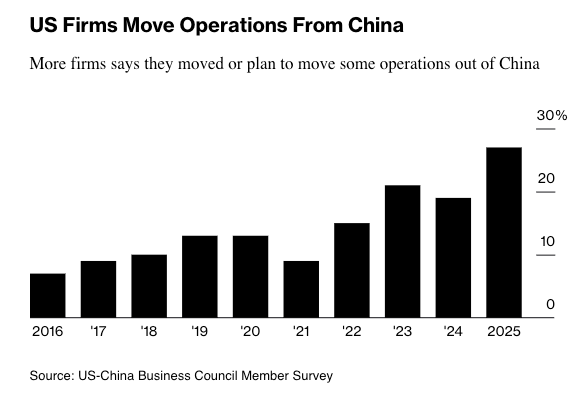
COMMENT – Great trajectory!
Let’s hope the shortsighted decision to lift restrictions on H20 chips doesn’t convince U.S. firms to reverse this trend.
China’s tightest rare-earths headlock is financial
Karen Kwok, Reuters, July 17, 2025
China Spy Agency Accuses Foreign Agents of Stealing Rare Earths
Bloomberg, July 17, 2025
China EV brands Zeekr, Neta inflated car sales using insurance scheme
Bloomberg, July 19, 2025
Janet Yellen on the Challenges of Dealing with China, Trump — and Biden
Bob Davis, The Wire China, July 18, 2025
The former Treasury Secretary and Fed chair discusses why tariffs won't work, her efforts to rebuild relations with China under Biden and her issues working within the administration.
COMMENT – I’m glad Bob Davis did this interview… I had almost forgotten how poorly Secretary Yellen had handled the Sino-American relationship. She spearheaded the dismantling of the China policy put together by Kurt Campbell and did more to undermine U.S. national security than any other official in the Biden Administration.
China-linked scam centers target U.S., congressional commission warns
Cate Cadell, Washington Post, July 18, 2025
Private Enterprise under Xiconomics: How Party Cells and Golden Shares Work – and What Europe Should Do
Kai von Carnap, China Observer, July 18, 2025
China’s tech champions often emphasize their independence, yet the party-state has installed mechanisms – party cells, golden shares, and pressure tactics – that make genuine autonomy doubtful. In Europe, the Chinese Communist Party’s far-reaching control over Chinese firms remains largely under the radar. Tools such as the FDI screening mechanism urgently need to incorporate political-influence indicators if they are to capture state-directed control accurately.
The “-ism” of Xi – akin to “Reaganomics” or “Thatcherism” – welds his name to an entire economic creed. Under the blueprint of “Xiconomics,” China’s economy was recast as state capitalism, characterized by deep intervention into private-sector structures and tighter limits on entrepreneurial autonomy. The Communist Party’s co-optation of private firms is nothing new, but under Xi Jinping –and his vision of “modern private enterprises with Chinese characteristics” – it has intensified dramatically.
The opaque nature of these political influence channels impedes realistic risk assessments for security-sensitive investments and technology partnerships. For example, authorities in Germany – and, by extension, Europe – will need to monitor the evolution of Chinese firms closely and recalibrate their regulatory toolkits. The new federal German government is duty-bound to do so, not only because the EU’s recently expanded NIS2 Directive, effective since 17 April 2025, imposes mandatory cybersecurity and incident-reporting rules on 18 critical sectors, but also because the 2025 coalition agreement pledges to implement the forthcoming Cyber Resilience Act.
How Party Cells Operate Inside Chinese Companies
Since 1993, China’s Company Law had governed the Communist Party representative units within private firms. A 2005 amendment made the establishment of such units – commonly known as “party cells” – mandatory. However, it was not until a series of policy initiatives in 2018 and 2020 under Xi Jinping that the expansion of these units significantly deepened.
Today, party cells are creative and multifaceted structures: at least seven different types of cells can be formed, often numbering several or even hundreds within a single company. Depending on the firm’s size and the number of party members on its payroll, these structures range from shopfloor “grass-roots” groups to board-level units.
The rollout of party cells is a core element of what Beijing calls “party construction work,” overseen by the party’s United Front apparatus and turbo-charged by Huawei’s “Smart Party Building” programs – IT-driven platforms for digitally managing and training cadres. The cells’ remit is broad: ensuring regulatory compliance, providing ideological instruction for the workforce, and policing loyalty to the party. In some cases, they create access to state capital or serve as levers to steer executive decisions.
By 2023, official figures reported 1.6 million party cells embedded in Chinese private companies. Penetration rates across sectors average above 90 percent; however, experts estimate that in the technology industry, the figure is close to 100 percent (see Table 1 for examples).
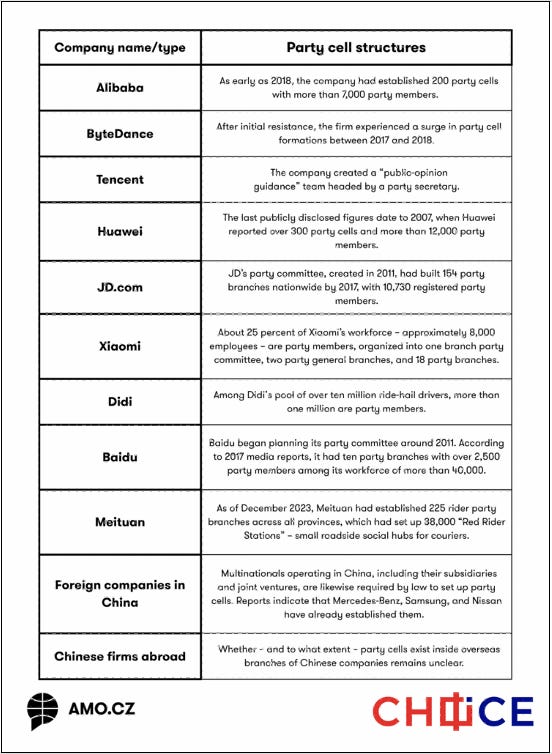
COMMENT – It is a bit cliché to say that there is no such thing as a private Chinese company, given the requirements to have Party cells inside companies and the way that the Party exercises control through ownership, it is accurate to say that for all intents and purposes, all Chinese companies are Party-owned Enterprises (POEs).
En conflit avec son actionnaire chinois, Henri Giscard d’Estaing, président du Club Med depuis 2002, claque la porte [In conflict with his Chinese shareholder, Henri Giscard d'Estaing, president of Club Med since 2002, slammed the door]
Ivan Letessier, Le Figaro, July 22, 2025 – ORIGINAL IN FRENCH
How China Built a Global Port Network
James T. Areddy, Daniel Kiss and Ming Li, Wall Street Journal, July 19, 2025
Chinese exports of two critical minerals plunge even as rare earths rebound
Lewis Jackson, Reuters, July 21, 2025
WTO reverses parts of previous decision in EU-China intellectual property dispute
Reuters, July 22, 2025
China's exports of rare earth magnets to the US surge in June
Reuters, July 21, 2025
China land sales in smaller cities hit lowest level in a decade
Thomas Hale and Haohsiang Ko, Financial Times, July 21, 2025
Daimler Truck considers China production exit as it faces ‘crazy’ down cycle
Kana Inagaki, Financial Times, July 21, 2025
China Stood Up to Trump, and It’s Not Giving Europe an Inch, Either
David Pierson and Berry Wang, New York Times, July 21, 2025
Donald Trump and Xi Jinping tipped to meet ahead of or during Apec summit in South Korea
Mark Magnieri and Alyssa Chen, South China Morning Post, July 20, 2025
China trade with North Korea jumps as neighbors rebuild economic ties
Kohei Fujimura and Yukio Tajima, Nikkei Asia, July 19, 2025
EU Expects Little from China Summit, Eyes Deeper Japan Ties
Bloomberg, July 21, 2025
‘Wahaha Princess’ Reveals China’s Uncommon Prosperity
Shuli Ren, Bloomberg, July 22, 2025
Cyber and Information Technology
U.S. greenlighted H20 chips export on its own initiative, China says
Zichen Wang, Pekingnology, July 18, 2025
US Must Limit Intel-Sharing with Spain Over Huawei Concern, Cotton Says
Kelcee Griffis, Bloomberg, July 17, 2025
Top Republican on China panel objects to resumption of Nvidia H20 chip shipments
Karen Freifeld, Reuters, July 21, 2025
Big Pharma is increasingly reliant on Chinese biotech advances
Patrick Temple-West, Financial Times, July 22, 2025
The Nvidia Chip Deal Trades Away the United States’ AI Advantage
Sam Winter-Levy, Foreign Policy, July 22, 2025
China’s smartphone champion has triumphed where Apple failed
The Economist, July 22, 2025
McKinsey bars China practice from generative AI work amid geopolitical tensions
Eleanor Olcott, Thomas Hale, Ellesheva Kissin, Financial Times, July 23, 2025
Military and Security Threats
‘All US forces must now assume their networks are compromised’ after Salt Typhoon breach
Ross Kelly, It pro, July 17, 2025
‘Eliminate toxic influences’: China’s military issues new political guidelines in wake of corruption wave
Vanessa Cai, South China Morning Post, July 21, 2025
China denies link to espionage group accused of attacking Singapore critical infrastructure
Reuters, July 21, 2025
The Chinese embassy in Singapore refuted claims that an espionage group accused of performing cyberattacks on Singapore's critical infrastructure was linked to China.
In a Facebook post published over the weekend, the Chinese embassy said such claims were "groundless smears and accusations".
"The embassy would like to reiterate that China is firmly against and cracks down all forms of cyberattacks in accordance with law. China does not encourage, support or condone hacking activities," it wrote on Saturday.
Last Friday, a Singapore minister said the espionage group UNC3886 was "going after high value strategic threat targets, vital infrastructure that delivers essential services" but did not give details of the attacks.
The minister did not link the group to China but Google-owned cybersecurity firm Mandiant has described UNC3886 as a "China-nexus espionage group" that has attacked defence, technology and telecommunications organisations in the United States and Asia.
Beijing routinely denies any allegations of cyberespionage, and says it opposes all forms of cyberattacks and is in fact a victim of such threats.
Singapore's critical infrastructure sectors include energy, water, banking, finance, healthcare, transport, government, communication, media, as well as security and emergency services, according to the country's cyber agency.
COMMENT – By staying silent, Singapore encourages the Chinese Communist Party to be even more aggressive in its interference in the internal affairs of Singapore. Singapore’s strategy seems to be that it will rely on the United States to serve as an offshore balancer against the PRC. But Americans are wondering why it is in their interest to assume the cost of standing up for others when they won’t take action themselves.
EU must strengthen Asian security ties despite US pressure, says Kaja Kallas
Henry Foy, Financial Times, July 21, 2025
BlackRock imposes restriction on use of company devices for China travel, Bloomberg News reports
Reuters, July 22, 2025
BlackRock has asked its staff visiting China for business trips to use temporary loaner phones and avoid using company laptops, Bloomberg News reported on Tuesday, citing an internal memo.
The world's largest asset manager told its staff that using company-issued employee devices, including iPhones and iPads, is not permitted, the report said.
BlackRock also barred the use of company laptops or remote access via virtual private networks, the report said, adding that employees will not have access to the BlackRock network during personal travel in China.
Reuters could not immediately verify the report. BlackRock did not respond to a request for comment.
The report comes as firms witness China's growing hold over access during travel to the nation.
On Monday, the U.S. State Department said that the Chinese government had blocked an unnamed U.S. Patent and Trademark Office employee visiting the Asian country in a personal capacity from leaving.
Earlier this month, a Wells Fargo banker was also blocked from leaving China. Beijing's foreign ministry said the banker was involved in a criminal case.
COMMENT – I wonder if this means that BlackRock let its employees use their laptops and smartphones during trips to the PRC?
If so, BlackRock is way behind its counterparts across the private sector, no company with any interest maintaining sensitive information should ever let their employees travel to the PRC with their laptops and smartphones.
China behind vast global hack involving multiple US agencies
John Sakellariadis and Dana Nickel, Politico, July 22, 2025
Taiwan firms unite to form next-gen cybersecurity alliance
Michael Nakhiengchanh, Taiwan News, July 18, 2025
One Belt, One Road Strategy
China’s Belt and Road investment hits record highs in 2025, driven by energy, mining and tech sectors
Jill Moriarty, Griffith University, July 17, 2025
China’s global investment and infrastructure initiative—the Belt and Road Initiative (BRI)—has reached new heights in the first half of 2025, with total engagement soaring to USD 124 billion, the highest level ever recorded for a six-month period. That’s the key finding from the China Belt and Road Initiative (BRI) Investment Report 2025, authored by Professor Christoph Nedopil, Director of the Griffith Asia Institute.
Released today by Griffith University in collaboration with the Green Finance & Development Center in China, the report reveals that Chinese entities signed USD 66.2 billion in construction contracts and USD 57.1 billion in investments across BRI partner countries—surpassing the total for all of 2024.
Key findings
2025 H1 saw the highest BRI engagement ever for any 6-month period, with USD 66.2 billion in construction contracts and about USD 57.1 billion in investments;
China’s energy-related engagement in 2025 was the highest in any period since the BRI’s inception, reaching USD 42 billion, an increase of 100 per cent compared to 2024 H1;
Oil and gas engagement surged to record highs of over USD 30 billion, higher than in all of 2024, particularly through oil/gas processing facilities construction contracts in Nigeria (USD 20 billion);
Green energy engagement reached new records with USD 9.7 billion in wind, solar, and waste-to-energy projects and an installed capacity of about 11.9 GW of green energy;
China continued to invest in coal-related activities through the construction of coal mine infrastructure;
The metals and mining sector reached new records, surpassing the full year of 2024 (which itself was a record year) in the first 6 months of 2025 with about USD 24.9 billion—mostly through investments and in minerals processing (about USD 10 billion into mining);
The technology and manufacturing also broke records and reached almost USD 23.2 billion with high-tech engagements in solar PV, EV batteries and in hydrogen (in Nigeria);
Africa and Central Asia topped the rank of BRI engagement, reaching USD 39 and USD 25 billion, respectively (unseating the Middle East);
BRI investments in 2025 were driven by private sector companies, dominated by East Hope Group, Xinfa Group and Longi Green Energy;
Since its establishment in 2013, cumulative BRI engagement reached USD 1.308 trillion, with about USD 775 billion in construction contracts, and USD 533 billion in non-financial investments;
For the rest of 2025, we see stabilisation of Chinese BRI engagement with a focus on BRI engagement in renewable energy, mining and new technologies;
Global trade and investment volatility will potentially spur further investment for supply chain resilience and alternative export markets for Chinese companies;
Potential future engagements remain in six project types: manufacturing in new technologies (e.g., batteries), renewable energy, trade-enabling infrastructure (including pipelines, roads), ICT (e.g., data centres), resource-backed deals (e.g., mining, oil, gas), high visibility or strategic projects (e.g., railway, ports).
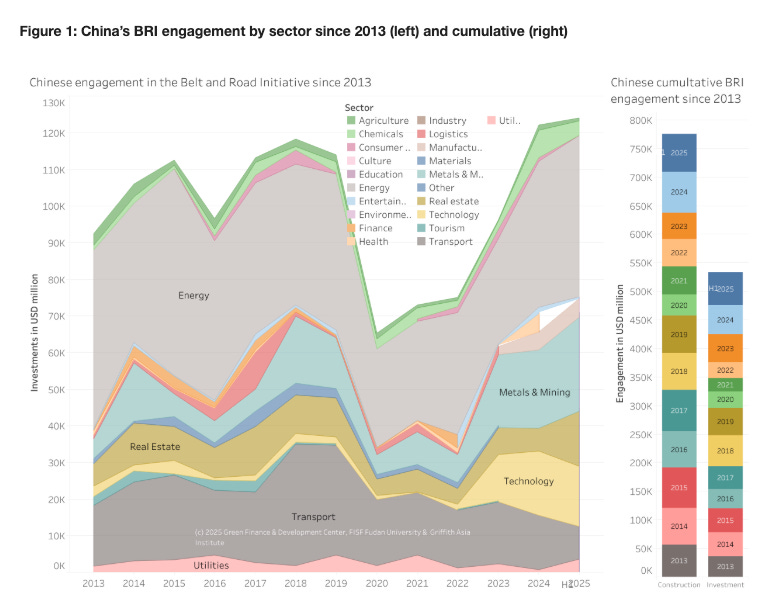
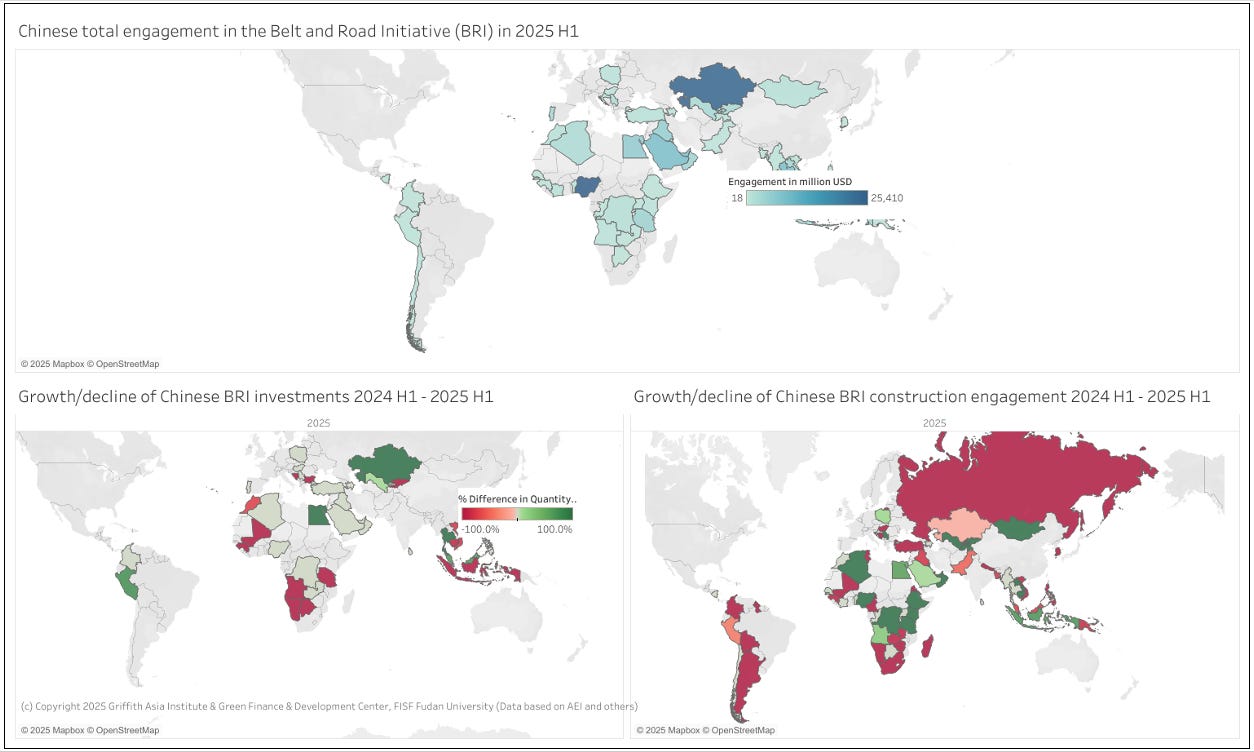
COMMENT - An interesting report.
It is hard to fathom how significant the CCP’s efforts to overturn the liberal economic order are.
Opinion
Remember the TikTok Ban? Does Anyone?
Glenn S. Gerstell, New York Times, July 25, 2025
Few noticed when President Trump postponed the deadline to enforce a statutory ban on TikTok, the Chinese-owned video-sharing app used by almost half of all Americans, for the third time. Even allowing for the torrent of other news, it’s astonishing how so little attention is being paid to what just months ago was deemed so serious a national security risk that both Democrats and Republicans demanded immediate and unprecedented action by adopting the ban.
Even more bizarrely, the risk — even if overhyped — hasn’t diminished. It has only grown as our relations with the People’s Republic of China become even more adversarial.
The TikTok saga is in many ways a microcosm of our erratic and unprincipled approach to the varied challenges presented by Chinese technology. We awaken to risks of a particular technology only after it has been widely adopted. The few laws we have to address Chinese threats target only specific apps or equipment, depend on discretionary action by the executive branch or are so broad that they have limited effect. On top of all of that, they are often thwarted or delayed by judicial challenges anyway. Politicians eschew even partial solutions for fear that any compromise might look weak to voters. It seems that as our exposure to invasive and risky Chinese technology expands, our paralysis to do anything about it deepens.
Launched in 2016, TikTok became the web’s fastest-growing app ever, with an astonishingly effective algorithm that showed users precisely the videos that they wanted (or perhaps didn’t realize they wanted). Almost two billion people use it around the world (though it’s banned in China itself), 170 million of them in the United States. That includes almost 65 percent of American teenagers. Like most social media platforms, it collects vast amounts of data about its users.
Export Controls Accelerate China’s Quantum Supply Chain
Elias Huber, RUSI, June 27, 2025
When export controls are seen as a tool to limit competitors’ technology advancements, they can have unintended consequences. Such is the case for quantum technologies, where export controls accelerate a localized quantum supply chain in China.
The development of quantum technologies is anticipated to bring both foundational capability advances to commercial and dual-use applications, including to computing, sensing, and the transfer of information. This makes quantum technologies a global political priority, including in the UK and the EU. Under the Biden administration, US leadership in quantum and other ‘force-multiplying’ technologies, such as advanced semiconductors, have become a key national security imperative.
The US has therefore intensified its export controls on quantum technologies aimed at China over the past year. These measures have resulted in disruptions to China’s quantum hardware and talent development, but they also accelerated China’s domestic quantum supply chain. By forcing leading laboratories and quantum start-ups to rapidly iterate with domestic suppliers in replacing foreign dependencies, export controls brought the demand side on board with Chinese localisation efforts.
On the supply side, the basis for a self-reliant Chinese quantum supply chain was created years ago by strong government support and indications of US quantum controls as early as 2018. Now, with a parallel quantum ecosystem rapidly emerging, it is only a matter of time until exports from Chinese suppliers arrive in Europe. This presents both risks and opportunities.
COMMENT – It does not logically hold that restricting an export necessarily “accelerates” a rival’s innovation. The author seems to be arguing that if the controls weren’t in place, the PRC’s innovation in quantum information science would be slower. That strikes me as magical thinking. I think is clear that if the PRC had greater access, their innovation would be even faster than it has been.
Beijing is deeply motivated to portray export controls by the United States as both ineffective and costly (for U.S. companies) in the desire to get them turned off. This is especially true in the field of advanced semiconductors.
Given the development of its own export control regime, it is clear that the PRC believes that export controls can be effective at protecting the position of their own companies, imposing costs on their rivals, and to use as a bargaining chip to get compromises from a rival in a negotiation.
Giving China Chips Derails Trump Decoupling
Michael Sobolik, Wall Street Journal, July 19, 2025
Those calling to allow access to Nvidia’s H20 chips are ignoring decades of experience.
Supporters of Nvidia’s Jensen Huang such as Aaron Ginn insist that selling Nvidia H20 AI chips to China will make Beijing reliant on Washington for this century’s most critical technologies (“Don’t Surrender China’s AI Market,” op-ed, July 18). They ignore decades of reality: in telecommunications, self-driving cars, cranes, and semiconductors, U.S. companies have accused Chinese firms of stealing their technology. These firms then sell the allegedly stolen tech abroad at below-market prices. This pattern, repeated in multiple industries over decades, has trapped America in a dependency on the Chinese Communist Party for some of the 21st century’s most critical technologies.
The Trump administration is rightfully enacting policies to break Chinese leverage over the U.S. Especially notable was the Pentagon’s recent investment in MP Materials to support America’s only active rare earth mineral mine that sells to the commercial market. It is an early but critical step toward eliminating Beijing’s control of elements on which civilian and military technology rely. This strategic challenge didn’t develop overnight. It is the product of decades of economic engagement with China, informed by the belief that trade would reform Beijing and reinforced by U.S. companies that cared more about accessing China’s market than the risks of equipping the People’s Liberation Army.
Why then, at the very moment Washington is cleaning up Wall Street’s mess, would policy makers allow Silicon Valley to hijack America’s China policy? Selling Nvidia chips to China won’t, as Mr. Huang argues, keep the country reliant on the U.S. It will supercharge the Chinese AI capabilities commercially and militarily. Measuring for inference speed—the relevant chip measure for AI—the H20 chip is significantly faster than Huawei’s Ascend 910C chip and edges out Nvidia’s H100 chip, which Washington has blocked China from purchasing. Unilaterally ceding America’s greatest AI advantage could render irrelevant the Trump administration’s laudable efforts to decouple from China.
COMMENT – Sobolik is absolutely right with this.
Why Rumors About China’s Political Elite Won’t Stop
Karishma Vaswani, Bloomberg, July 22, 2025