Hands on the Wheel
We are living through weeks where decades happen, so pay attention
Friends,
I don’t know about you, but I find myself thinking back to that quote attributed to Lenin that goes, “there decades where nothing happens; and there are weeks where decades happen.”
I feel like we are living through a couple of those weeks.
It got me thinking of a Willie Nelson song called “Hands on the Wheel” (the link is to his live performance at Austin City Limits in 1976… classic Willie).
At a time when the world seems to be spinnin’
Hopelessly out of control
There’s deceivers and believers and old in-betweeners
That seem to have no place to go
The song encourages us to concentrate on what’s important in our lives and accept that we can’t control everything.

The man is 93 and still exudes the outlaw country vibe. A few weeks ago, Dan Rather (who is no spring chicken himself) interviewed Willie. It is worth watching, he discusses the tragic loss of his son on Christmas Day 1991, his admiration for Frank Sinatra, and cheating country music stars at poker.
Covering up history…
Just before the holidays, I watch the PBS documentary, The Last 600 Meters: The Battles of Najaf and Fallujah, now airing on AppleTV and Amazon Prime. The documentary was released in November 2025 but entirely filmed and produced in 2008 based on what happened in these battles in 2004.
Why delay the release for 17 years?
Well according to the director, Michael Pack, in 2008 PBS didn’t want to release something they saw as “pro-military” or lacking in proper “political commentary” in an election year. In order words they didn’t want to release anything that didn’t conform with their partisan view of the Iraq War.
This is hardly a cheerleading documentary, and it does not paint the Bush Administration positively (though it does put their decisions in 2003 and 2004 in context). It shows how Marines and Soldiers perform under stress and disabuses the audience of any notion that war is easy, clean, and bloodless. It also contains an interview with a young-looking Marine Lieutenant Seth Moulton who is now a Congressman representing Massachusetts’ Sixth District and just announced his run for Senate.
It is absolutely worth watching as it presents a grunt’s view of the war and makes one appreciate the consequences of political decisions made far away from the action. When you wonder why so many veterans of Iraq and Afghanistan are skeptical of military adventurism and nation-building, this documentary helps provide some answers, it is a shame PBS buried it for so long. But the lessons from it are evergreen, so I’m glad it’s available now.
Commentary this week…
I want to cover three locations that are obviously in the news and are, at tangentially, related to the Sino-American rivalry.
Venezuela
What unfolded in Venezuela was a rebuke to Beijing and Moscow and it suggests to the world that Washington drives the agenda, not Xi and Putin.
The United States demonstrated that “support” from Beijing and Moscow is an empty promise, particularly when it comes to regime security. Beijing and Moscow will certainly play the card that America is acting hegemonically, but that is mostly to cover for the fact that their own hegemonic designs on Venezuela popped when Delta snatched Maduro hours after holding a three-hour meeting with Beijing’s senior envoy for Latin America.
The seizure of Russian flagged oil tankers simply reinforces the point that aligning with Beijing and Moscow won’t protect you.
The Trump Administration has been subjected to tons of criticism from its domestic political opponents and from allies, but I’m less skeptical of what the Administration has done with regards to Venezuela.
We’ve likely chosen the least bad option from a menu that did not contain great options or even good ones. Venezuela has a chronic case of Dutch disease and for the last quarter century it has been ruled by a bunch of corrupt kleptocrats who portray themselves as socialists and anti-imperialists while aligning themselves with Beijing, Moscow, Tehran, and Havana.
Getting rid of Maduro does not guarantee that Venezuela will stabilize or overcome its Dutch disease… BUT if Maduro were to stay in power, it is difficult to imagine either of these positive outcomes ever happening.
The Administration is criticized for not making the Nobel Peace Prize winner Maria Corina Machado the Venezuelan President and for not carrying out a de-Chavismo campaign. Some portray this as retribution for her accepting the Nobel Prize, but I think there is a strong realist rationale for the United States distancing itself from Machado at this point (and for Machado to distance herself from the United States).
First off, the Chavistas view Machado as an existential threat and it would likely require a significant and prolonged military intervention, on the ground in Venezuela, to even protect Machado as President. That U.S. military intervention would destroy her legitimacy as a Venezuelan leader, as she would invariably be seen as an American puppet. Far better for the existing Chavistas to be forced/persuaded to compromise with the United States and then create the conditions for a leader like Machado to emerge as a legitimate alternative to the compromised Chavistas. This is a multi-year endeavor.
If the United States were to de-Ba’athify (sorry de-Chavismo-ify) Venezuela, impose a leader favored by the West (and what else could show the favor of the West more than the Nobel Peace Prize), and push all the security forces and people with guns to the margins of society, those same Chavistas would have an excellent opportunity to portray themselves as the guardians of Venezuelan honor and sovereignty. Oh, and those Chavistas would pull on their connections to Beijing, Moscow, and Havana for support.
Better to feed on the greed of the Chavistas to line their own pockets dealing with the U.S. to further delegitimize them in the eyes of the Venezuelan people, so that a new generation of leaders can emerge. Perhaps that will include Maria Corina Machado or individuals we haven’t heard of yet.
I’m particularly leery of promoting Machado based on an earlier experience of a Nobel Peace Prize winner who the United States promoted strongly to become the leader of a country that had suffered under years of abusive rule.
The Story of Aung San Suu Kyi should serve as a cautionary tale.
In 1991, the Nobel committee awarded its Peace Prize to Aung San Suu Kyi for her leadership in the nonviolent struggle for human rights and democracy in Myanmar (Burma). She was in prison at the time and would not be released for two decades. In June 2012 she accepted the award in Oslo and then traveled to Washington in September 2012 to accept the U.S. Congressional Gold Medal and met with President Obama in the Oval Office. As Myanmar opened up, the Obama Administration pushed hard for her to become the country’s leader. Secretary of State Hillary Clinton made a visit to Myanmar to meet with her and in the 2015 elections her party won a sweeping victory which put her into the country’s leadership as the State Counsellor and Foreign Minister.
Unfortunately, that 2015 election was the high point of her domestic support and the 2017 massacre of Rohingyas in Rakine state convinced her Western supporters that she was not up to the task of governing. While Aung San Suu Kyi had enjoyed enormous support from Western leaders up until 2017, that support did not translate into the kind of domestic power that she or any other Burmese leader would have needed to overcome the stranglehold on power exercised by the security forces. In fact, by having her in the government, the security forces could delegitimize her opposition.
So where does this leave us with Venezuela? The first take-away is that “fixing” a failed state, particularly one that suffers from Dutch disease, is very difficult and costly. The outcome cannot be determined by actors from the outside, it will take hard work and effort by Venezuelans to turn their country around.
Removing Maduro, pursuing limited cooperation with the remaining Chavistas, and trying to revamp the Venezuelan oil industry and its broader economy could result in achieving some worthwhile objectives: stabilize Venezuela, improve the economic prospects of the country and its citizens, and pull Caracas away from Beijing, Moscow, Tehran, and Havana.
There is no guarantee any of this will work, but there is a chance and the Administration deserves cooperation from its domestic political opponents and its allies to try to achieve a positive outcome.
Iran
As I’m writing this on Sunday, January 11, it appears that the protests against the Ayatollah and his theocratic dictatorship are growing and that the regime is on the verge of collapse. Of course, we’ve seen this before (even if not at the scale), but it does feel like this time its different and the last two years has been particularly tough on the Iranian regime.
In May 2024, the Iranian President, Foreign Minister, and several other officials died in a helicopter crash. President Raisi had been considered a potential successor to the Supreme Leader, Ayatollah Khamenei, and his death at 63 after less than three years in office created a leadership void.
In September 2024, the Israelis dismantled the leadership of Hezbollah in Lebanon and Syria. Hezbollah had been Iran’s most potent and powerful proxy force on Israel’s border and across the region, but Operation GRIM BEEPER along with a series of air strikes disrupted the terrorist organization on Israel’s northern flank. That was followed up by an invasion of Lebanon in which Israel further destroyed Hezbollah and killed its leader, Hassan Nasrallah, as well as his immediate successor, Hashem Safieddine in Beirut. When the Iranians launched their largest ever ballistic and cruise missile attack on Israel in retaliation for the destruction of Hezbollah, the Israelis and its allies including the United States, blocked nearly all the missiles.
At the same time, the Israelis were advancing on Khan Yunis and Rafah in Gaza, completing the destruction of another Iranian proxy, Hamas. Obviously, this action in Gaza had started with the October 2023 massacre of Israelis in southern Israel, which Iran likely encouraged, and most certainly enabled, as a way to derail Israeli peace negotiations with Iran’s regional Arab adversaries.
In October 2024, Israel launched Operation DAYS OF REPENTANCE against 20 locations inside Iran, marking the largest attack against Iran since the Iran-Iraq War of the 1980s. The Israelis used over 100 aircraft in the operation and lost none of them. On the Iranian side, the Israelis almost completely destroyed the Iranian air defense system, which included some of the best technology from Moscow and Beijing.
In December 2024, the Assad regime in Syria collapsed after its long civil war. This robbed Tehran and Moscow of their closest partner in the region.
In about a year, Iran had gone from encircling Israel with powerful proxy forces, a regime in Syria, and its own extensive ballistic missile inventory with impressive air defense system, to having none of those.
If 2024 was a bad year for the Iranian regime, 2025 was worse.
Donald Trump’s return to office witnessed a tightening of sanctions on the Iranian economy and early American strikes against another of Iran’s proxies, the Houthis in Yemen under Operation ROUGH RIDER which took place between March and May 2025.
While Moscow and Beijing pledged their rhetorical support for Tehran against “American hegemonism,” neither country lifted a finger when the United States and Israel struck Iran in June 2025 to destroy their nuclear facilities. Perhaps more damaging to the legitimacy of the Iranian regime and their capacity to govern, was Israel’s killings of at least six of the country’s top generals, a senior politician, and at least five nuclear scientists (after more than a decade of killing a lot of other Iranian nuclear scientists on Iranian soil).
By killing individuals like Ali Shamkhani, one of Iran’s most influential politicians and a close advisor to the Ayatollah, Major General Mohammad Bagheri, Chief of Staff of the Iranian Armed Forces, General Gholamali Rashid, Deputy Chief of the Iranian Armed Forces, and General Hossein Salami, Commander-in-Chief of the Islamic Revolutionary Guards Corps, Israel demonstrated for everyone to see that the Iranian regime couldn’t protect its most senior military, intelligence, and political figures.
All of this seems to be coming to a head, as the Iranian people have concluded that their leaders are incompetent, weak, and corrupt… historically a combination that makes it nearly impossible for a regime to survive.
For Beijing (and Moscow) this is yet another example that their regime type and their preferred partners (keptomaniac dictators that try to rule by force and fear alone) are brittle and weak even as they try to assure their citizens and the world that they are strong. While I don’t think that either the Russian Federation or the PRC are close to the kinds of collapse we are seeing in Caracas and Tehran, I suspect that these things have to shake the confidence of Xi and Putin.
Almost three years ago, Xi and Putin met in Moscow and ended their meeting in front of cameras where a smiling Xi famously remarked to Putin:
“Right now, there are changes – the likes of which we haven’t seen for 100 years – and we are the ones driving these changes together.”
Putin, also smiling, said: “I agree.”
Both warmly shook hands and wished each other the best.
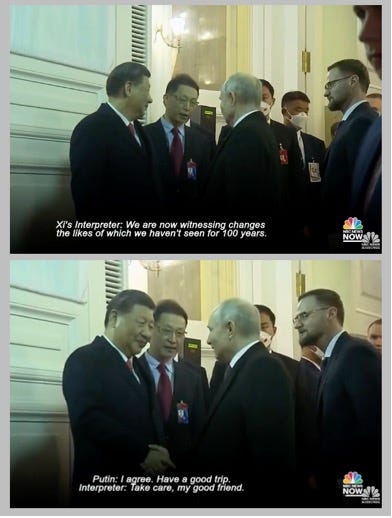
I suspect that after 2025 and as we look into 2026, Xi and Putin probably still believe that there are changes happening “the likes of which we haven’t seen for 100 years,” but I doubt that they are so confident that they are “the ones driving these changes together.”
What has happened in Venezuela, Syria, and Iran are NOT the outcomes that Xi or Putin would have desired, and it seems that they are bystanders in the dramas unfolding in countries where they have had enormous influence. It seems to me that Cuba is now very exposed, and I suspect that neither Beijing nor Moscow could do much to help Havana.
I suspect that leaders in Brazil, India South Africa, Egypt, Ethiopia, and Indonesia (other members of BRICS) are probably asking themselves whether siding with Beijing and Moscow has any real benefits.
Might the trajectories in Venezuela, Syria, and Iran turn back in favor of Beijing and Moscow? Sure, that could happen. Hell, we’re all reminded that we should be humble about predicting the future, I was feeling pretty confident last night at halftime that the Packers would beat the Bears. But at this point, things don’t look good for Beijing and Moscow across the Global South… the countries that they have put enormous effort into propping up have collapsed or are collapsing. Success has many fathers, failure is an orphan.
Greenland
Which brings us to the last location I want to address this week.
For good reason, folks are concerned about what the Administration might do over Greenland. Some readers might not be pleased with my thoughts on this but I’m going to share them anyway.
It makes no sense for the Administration to continue to dangle the potential use of military force to resolve its dispute with Denmark over Greenland (in fact it is debatable whether there is even a dispute). In this, I completely agree with my colleague and fellow Substacker, CDR Salamander, who published a great post on this topic last week.
The Unfortunate Greenland Kerfuffle ...we need a new approach... (January 6, 2025)
What we hear from the Administration…
Over the past year, we’ve heard two primary arguments for why Denmark should give/sell Greenland to the United States. I think it is helpful to examine these arguments and judge their validity.
The first argument is that the United States needs Greenland for national security reasons. The threat of ballistic missiles is growing and those missiles that would target the United States would almost certainly come over the North Pole and Greenland sits astride the approaches to the United States. In order to build an effective missile defense system (something the Administration has called “Golden Dome”), the U.S. would need to position military infrastructure in Greenland (radars, interceptors, etc.). Related to this national security argument is an acceptance that climate change is having an effect and the Arctic is becoming more important geopolitically. Sea lines of communication in the Arctic will become more important over time, meaning the United States should control Greenland as key terrain to prevent Beijing and Moscow from gaining a greater foothold in the Arctic.
The second argument we have heard from the Administration is that Greenland holds untapped resources like critical minerals and rare earth elements. The United States needs an assured supply of these resources given their geopolitical and industrial importance. Therefore, the United States must control Greenland for its own economic security as well as preventing Beijing and Moscow from gaining control of these resources.
These are spurious arguments.
On the national security side, the Administration is right, Greenland is important to U.S. national security. That is why we have had a treaty with Denmark since 1951 which permits that United States set up military bases in Greenland, conduct military operations there, and to build military infrastructure. In fact the United States is the only country that has a military footprint in Greenland. For almost nine decades, the U.S. military has operated in Greenland under Danish sovereignty. If the United States wants to do more in Greenland, the Danes have signaled for years that they would be open to renegotiating the existing agreement that was last signed in 2004.
Under the existing arrangement, the United States could likely get the Danes to fund the building of additional infrastructure to support U.S. military operations in Greenland as a part of Denmark’s own defense obligations to NATO. Having the Danes cover some of the infrastructure costs would reduce the burden on American taxpayers if we had to fund it all ourselves.
On the critical minerals side, the problem the U.S. in rare earth elements and critical minerals is not an access problem (the existing territory of the United States is well endowed geologically and we don’t currently tap those resources), it is a problem of market dynamics and the lack of processing facilities. The PRC dominates the production of rare earth elements because the CCP subsidizes the mining and processing of these commodities. PRC companies then sell these commodities at below markets prices which pushes commercial companies, in places like the United States, Europe, Japan, Canada, and Australia, out of the business of processing these minerals themselves.
Gaining additional access to rare earths and other critical minerals in Greenland doesn’t fix these problems. As it stands now, the U.S. taps only a tiny share of the critical minerals and rare earths in the United States already… and obviously it is cheaper to access those minerals at places like Mountain Pass, California or Wyoming or Northern Wisconsin than drilling through two miles of ice in Greenland above the Arctic Circle where there is no infrastructure to extract it. The only more impractical place to seek out rare earths would be the Moon or Mars.
There is another point against this. If Greenland were a part of the United States, then NEPA (National Environmental Policy Act) would apply. If the critical minerals in Greenland were absolutely necessary and couldn’t be found anywhere else, then it would likely be easier and cheaper to negotiate access to those deposits directly with Denmark than to overcome the bureaucratic and judicial obstacles that would arise if Greenland were a part of the United States.
So, if the national security and critical mineral arguments for Greenland are moot, then why is this a priority for President Trump?
The President’s primary objective is to be remembered for adding a significant chunk of territory to the map of the United States. Greenland is the world’s largest island.
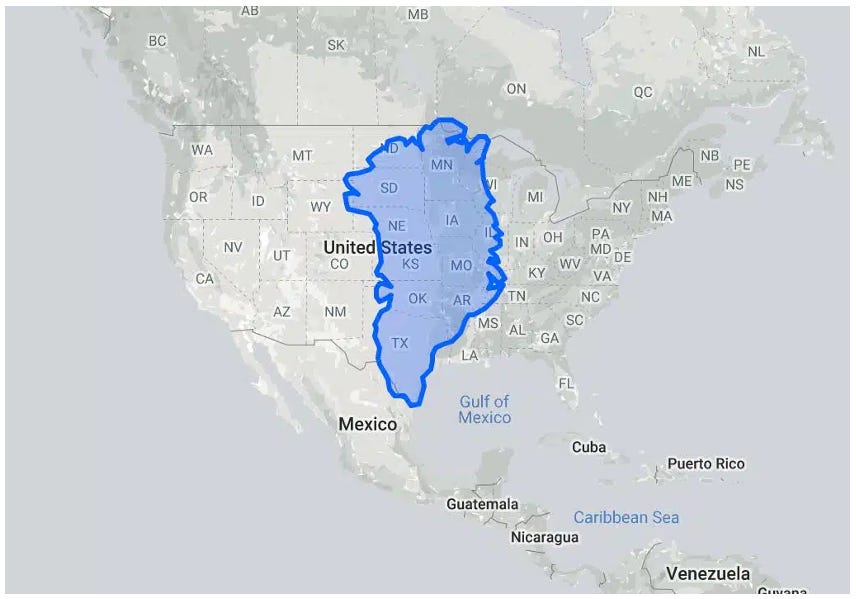
Greenland is 47% larger than Alaska, the largest U.S. state and it is three times larger than Texas, the second largest U.S. state.
Adding Greenland to the United States would increase the land area of the country by just under 25%. Some have compared this to when William Seward negotiated the purchase of Alaska from Russia in 1867. Alaska was certainly a considerable chunk of territory to add to the United States, but it was half the size of Greenland. If President Trump achieves his goal and acquires Greenland, it would be larger than President Jefferson’s Louisiana Purchase (territory of the Louisiana Purchase: 828,000 square miles; territory of Greenland: 836,330 square miles).
Adding Greenland would move the United States from being the fourth largest country by land mass (behind Canada #2 and the PRC #3) to the second largest country by land mass, just smaller than the Russian Federation (#1). Denmark’s possession of Greenland makes it the 12th largest country in the world, just behind the Democratic Republic of the Congo (#11) and Algeria (#10).
I think it is hard to overstate just how much this rationale likely drives this particular President and why he is unique in pursuing the acquisition of Greenland. While President Roosevelt and President Truman certainly wanted Denmark to sell Greenland to the United States during and after WWII, the negotiation of an agreement between the United States and the Kingdom of Denmark in 1951 achieved the goals that those leaders wanted to achieve for the United States, and it remained so for eight decades.
This particular President is unlikely to drop his desire to acquire Greenland (just as he is unlikely to drop his desire to win the Nobel Peace Prize). The question for European leaders (this issue goes beyond the Kingdom of Denmark) is: what should they do about this?
One thing that has started to come up as this issue has metastasized, is that if this President pushes too hard to acquire Greenland, then Denmark’s European allies and Canada would either push the United States out of NATO or dissolve NATO. I suspect that these leaders who allude to this countermove think that this threat is sufficiently severe as to dissuade President Trump from further action on Greenland.
I don’t think so.
I call your attention to Section 1250A of the 2024 National Defense Authorization Act which forbids the U.S. President from unilaterally withdrawing from NATO (here is a press release from Senator Tim Kaine (D-VA) who sponsored the bill with none other than Senator Marco Rubio (R-FL)). It requires a two-thirds vote by the Senate or a specific act by Congress to withdraw the United States from NATO. It is no secret that this legislation was adopted during the Biden Administration as a safety measure to tie President Trump’s hands should he return to office under the belief that President Trump wanted to withdraw the United States from NATO.
However, if the other members of NATO were to expel the United States or to dissolve NATO, then President Trump would achieve that goal over the heads of the members of Congress who overwhelmingly voted for Section 1250A.
Threatening someone with doing something that they want to do themselves but can’t, doesn’t seem like a persuasive threat to me. It seems likely that it would persuade that individual to push even harder.
So, what’s to be done?
Rather than hoping that President Trump will just forget about Greenland or threatening him with something he doesn’t consider to be a threat, perhaps the Europeans should think long and hard about what they would want in exchange.
One potential demand by European leaders on President Trump could be an iron-clad commitment to the defense of NATO’s eastern front and security guarantees to Ukraine. Also, that European leaders be included in any future negotiations with Russia over Ukraine. Perhaps an agreement could include lifting reciprocal tariffs on members of the European Union. It is possible that President Trump would agree to fulfill these European demands if he could portray this as a win for the United States by increasing the size of the U.S. by nearly 25%.
President Trump clearly wants Greenland, threatening him with kicking the United States out of NATO is unlikely to deter him from pursuing his goal of acquiring Greenland.
However, entering into a serious negotiation over what Europe wants from the United States in exchange for Greenland might either land at an acceptable outcome or persuade the President that the cost of acquiring Greenland is too high.
With all that being said, this is ugly business and I don’t think any of this would be happening under a different American leader.
Thanks for reading!
Matt
If you find this analysis helpful, please consider becoming a paid subscriber.
MUST READ
The Real Reason China and Russia Won’t Try a Maduro-Style Raid
Decker Eveleth, Foreign Policy, January 6, 2026
U.S. rivals aren’t deterred by norms so much as by the limits of their own militaries.
In the wake of the United States’ capture of Venezuelan President Nicolás Maduro, some observers and U.S. officials have warned that this may have given Moscow and Beijing a green light to pursue similar operations in Ukraine and Taiwan.
Just as the United States does not recognize the legitimacy of Maduro’s rule in Venezuela, Russia and China do not recognize the legitimacy of Ukraine’s and Taiwan’s respective independence. If China, for instance, were to seize Taiwanese President Lai Ching-te, or if Russia were to capture Ukrainian President Volodymyr Zelensky, on what grounds could the United States reasonably object?
Part of why this comparison is made so frequently is because the United States makes such operations look easy. To those unfamiliar with military planning, the capture of Maduro can look almost casual—helicopters fly in, extract the target, and depart without much difficulty. The apparent smoothness of the U.S. operation has even led some observers to doubt that there was any resistance at all, speculating instead that Maduro was given up by his own government in a back-channel deal.
It is often assumed that other countries refrain from certain actions because they are more respectful of international norms than the United States, which is seen as uniquely unhindered by moral concerns under U.S. President Donald Trump and thus does whatever it wants.
Such thinking is flawed in this particular context, for two major reasons.
COMMENT – This article makes some great points.
America’s Drone Delusion: Why the Lessons of Ukraine Don’t Apply to a Conflict with China
Justin Bronk, Foreign Affairs, December 15, 2025
After nearly four years of fighting, few aspects of Russia’s war in Ukraine have gained as much attention among Western militaries as the rapid expansion of drone warfare. Since 2023, both sides have deployed millions of cheap quadcopter-type drones across the battlefield. In some parts of the front, these small drones now account for up to 70 percent of battlefield casualties. Meanwhile, Russia is using thousands of Geran-2 and Geran-3 propeller-powered one-way attack drones in almost nightly long-range strikes on Ukrainian cities, and Ukraine has been using a wide array of its own one-way attack drones for regular strikes on Russian bases, factories, and energy infrastructure.
Watching these developments, many Western defense strategists have made urgent calls to shift military priorities. In June, U.S. President Donald Trump signed an executive order to accelerate drone production. Since then, the U.S. Department of Defense has made several policy changes to facilitate the rapid integration of low-cost drones into the U.S. arsenal, and U.S. Defense Secretary Pete Hegseth has called for the United States to establish “drone dominance.” In the private sector, meanwhile, software and AI companies that have bet heavily on developing uncrewed military technologies, such as Anduril, Palantir, and Shield AI, are racing to win lucrative new defense contracts. It is certainly the case that small uncrewed aircraft systems have fundamentally changed the way that infantry combat is fought, and that the U.S. Army and other parts of the force are behind on these capabilities—and, more concerning, on counter-UAS technologies—compared to Russian or Chinese forces.
But the assumption that large-scale acquisition of AI-enabled drones will strengthen U.S. defenses against China is misguided. For one thing, lessons from the war in Ukraine—an attritional, inconclusive struggle between two fundamentally land-centric armed forces—often do not apply directly to other kinds of conflicts. The realities of Beijing’s military arsenal and the likely nature of any potential confrontation in the Indo-Pacific mean that such a conflict would be decided by very different factors. Despite having the largest and most advanced drone industry in the world, China has actually been prioritizing crewed military hardware. Each year, the People’s Liberation Army receives eye-watering numbers of modern and highly capable combat aircraft, large warships, and cutting-edge ground-based, maritime, and air-launched missile systems. If the United States focuses too heavily on drone development and acquisition, it risks losing its slim remaining edge over the PLA in the high-end air force and navy capabilities that would dominate any Indo-Pacific conflict.
WHY DRONES DOMINATE THE DONBAS
Over the past few years, military analysts and defense industry executives alike have focused on the lessons that Western militaries should supposedly take from Ukraine’s remarkable defense against Russia. One result of this interest has been an oversaturation of new defense products and technologies that are being marketed to Western militaries as “transformational,” based on vaguely described combat use in Ukraine. In fact, many such systems, especially Western-made drones from tech startup firms, have proved ineffective or even failed outright on the battlefield in the face of omnipresent Russian (and Ukrainian) electronic warfare and hard environmental conditions.
COMMENT – Worth reading in full.
Seatbelts for Speeders: Why Beijing Ignores Washington’s Red Phone
Carla P. Freeman and Alison McFarland, War on the Rocks, January 2, 2026
In early November, after meeting China’s defense minister, U.S. Secretary of Defense Pete Hegseth performed a longstanding ritual in military relations between the United States and China: He announced that the two countries would “set up military-to-military channels to deconflict and de-escalate” problems between them. Like most rituals, this one is unlikely to have any practical effect. The pursuit of effective crisis communications channels between the American and Chinese militaries to mitigate the risk of crisis escalation has been a work in progress since President Bill Clinton was in office. Progress, however, has been halting and largely unproductive. Washington and Beijing, it is true, have managed to negotiate multiple agreements on crisis communications mechanisms, but when actual crises erupt, Beijing rarely uses these links.
Nevertheless, Washington persists in pursuing these connections — and for good reason. When, in 1950, Washington did not ask Beijing if it should take seriously indirect warnings that China would intervene in the Korean conflict if U.S. forces crossed the 38th parallel, the results were calamitous. In contrast, during America’s Cold War standoff with the Soviet Union, institutionalized crisis communications channels were critical to escalation prevention. After the Cuban Missile Crisis, Washington and Moscow set up a crisis “hot line” that the two nuclear-armed powers went on to use dozens of times as they worked to ensure that their war remained a cold one. In 1983, Secretary of Defense Caspar Weinberger described the direct communications link between the United States and Soviet Union as “invaluable in major crises.” The success of this tool inspired the creation of bilateral hotlines between other nuclear powers and crisis-prone countries.
Fifteen years later, in April 1998, U.S. Secretary of State Madeleine Albright and Chinese Foreign Minister Tang Jiaxuan announced the establishment of the first link for crisis communications between Washington and Beijing in the form of “a secure presidential phone-link … [that] will help our leaders to communicate rapidly, directly and candidly whenever the need should arise.” This followed the signing of the Military Maritime Consultative Agreement in January of the same year. In the early 2000s, U.S. defense officials proposed to the Chinese military that the two sides establish a hotline for crisis management and confidence building. In February 2008, the two sides reached an agreement to set up such a quick communication link in the form of a defense telephone link. The two countries expanded the defense telephone link in 2015 to include video teleconference communications. They also identified this link as a mechanism for conveying information under a 2014 bilateral understanding to notify each other of “major military activities.” In 2016, Beijing and Washington instituted a hotline on cybercrime and related issues.
Yet, when bilateral tensions between Washington and Beijing have spiked to risky levels, these carefully negotiated mechanisms have generally failed to function as the United States has anticipated. Experience with the U.S-Soviet hotline may have led U.S. officials to expect that messages sent by one side through a hotline would be seen as urgent and deserving of a swift reply. But Beijing evidently sees things differently.
COMMENT – I’ve covered this topic before particularly in my issue from July 21, 2024 titled “Beijing cancels military talks with the United States… again.”
China’s Russian Town Has Log Cabins and Cyrillic Signs, but No Russians
Andrew Higgins, New York Times, January 4, 2026
Enhe was once home to thousands of ethnic Russians. Under Xi Jinping’s push for ethnic unity, little remains beyond nostalgia and props for tourists.
President Vladimir V. Putin of Russia has been waging war for nearly four years on the western edge of his vast country to preserve what he sees as a vital part of the “Russian world,” citizens of Ukraine who speak Russian and have blood ties to Russia.
More than 3,000 miles to the east, however, Russia has already lost a centuries-old foreign outpost of its language and culture — a remote patch of northern China entombed in ice and snow.
Set up by the Chinese government, nominally to protect the folk traditions and identity of China’s tiny Russian minority, the “ethnic Russian township” of Enhe has lots of birch trees, thick snow, Siberia-style log cabins, Cyrillic script and vodka.
All it does not have is actual Russians.
The closest it gets are people like the township chief, Li Peng, a distant descendant of the Russians who, starting in the 17th century, once dominated the borderlands between Russia and what is now the Chinese region of Inner Mongolia.
After generations of intermarriage with Chinese, Mongolians and other locals, Enhe’s “ethnic Russians” have lost touch with the language, traditions and Orthodox Christian faith of their forefathers.
“In a few years, we will be just like every other place,” the village head said. A member of the Communist Party, he described the steady disappearance of a separate Russian identity as the happy result of the Chinese state’s policy toward ethnic minorities. That policy is aimed at fusing the country’s diverse ethnic groups into a single indivisible China united in obedience to President Xi Jinping.
COMMENT – Putin needs Xi, but it isn’t certain that a future Russian nationalist would see the PRC as a partner.
Peng Peiyun, Architect and Enforcer of the Murderous “One-Child Policy,” Dead at 95
Human Rights in China, December 30, 2025
Peng Peiyun was a senior CCP official who led China’s national family-planning system from 1988 to 1998, during the most coercive decade of the one-child policy. That policy was enforced throughout China with forced abortions, compulsory sterilization, detention, beatings, home raids, and collective punishment of families and entire villages.
Peng died in Beijing on December 21, 2025. China’s state media eulogized her as an “outstanding leader” in population policy and in womens’ and children’s work. Some international media, similarly, pointed to Peng’s later advocacy towards loosening and ultimately ending birth restrictions as China’s demographics shifted as evidence of her “complexity.” On Chinese social media, however, the response told a different story. One widely shared comment read: “The children who died naked are waiting for you on the other side.”
Peng spent a full decade at the apex of the family-planning bureaucracy, overseeing a target-driven system whose outcomes were achieved through coercion. Under Peng’s leadership, enforcement of the one-child policy intensified. Under the policy framework and “population red line” she spearheaded, the one-child policy systematically deprived women and families of their reproductive rights through institutionalized violence. Implementation methods included forced abortions at all stages of pregnancy, mandatory insertion of IUDs for women, and forced sterilization of men. For families attempting to evade the policy, extreme violent measures such as arrests, detention, beatings, and house searches were employed, along with a system of collective punishment. These practices gradually became part of the daily functions of the Family Planning Commission under Peng Peiyun’s leadership.
Senior local officials were made personally responsible for results, and failure could end careers. Compliance was mandatory. When localities resorted to extreme measures, they were not penalized if targets were met. The year after the “Hundred Days with No Children” campaign in Shandong, national authorities publicly promoted Shandong’s “experience.” Under the campaign in question, any woman found to be pregnant, regardless of whether the pregnancy was allowed under current family planning rules, the number of children she already had, or the stage of pregnancy, was arrested and forced to undergo an abortion.
Over four decades, China’s birth-control system forced the termination of several tens of millions of pregnancies, including documented cases of late-term abortions in which viable or live infants died. This was the outcome of a state system that treated reproduction as a political target, not a human right. In its scale & human cost, the one-child policy stands alongside the Great Famine as one of the gravest state-engineered catastrophes implemented by the CCP.
To place this in international context: while China hosted the 1995 UN World Conference on Women in Beijing and presented itself as a responsible global actor, women inside China were still being subjected to forced late-term abortions and compulsory sterilization to meet population targets. Political slogans from that period—hung prominently throughout villages or painted onto people’s homes—made the governing logic explicit: “One unauthorized birth: sterilize the whole village”, “Better 10 more graves than one more person”. These were not fringe messages; they were the language of the one-child policy.
COMMENT – Absolutely barbaric.
China buys more US soybeans, total purchases approach 10 million tons
Naveen Thukral and Ella Cao, Reuters, January 6, 2026
China’s state stockpiler Sinograin bought 10 U.S. soybean cargoes this week, three traders told Reuters on Tuesday, as the world’s top buyer continues purchasing from the United States following a late October trade truce.
The cargoes, totalling around 600,000 metric tons, are for shipment between March and May, the traders said, which is the peak shipping season for rival supplier Brazil.
China’s total purchases from the latest U.S. crop were now estimated at 8.5 million to nearly 10 million tons, according to traders and analysts, representing up to 80% of the 12 million metric tons that U.S. Treasury Secretary Scott Bessent said China pledged to buy by the end of February.
“There were more U.S. cargoes bought by Sinograin and total purchases are very close to 10 million tons,” said one of the traders with direct knowledge of the deals. “We think China will buy a couple of million tons more to meet the target.”
On Tuesday morning, the U.S. Department of Agriculture reported private sales of 336,000 metric tons of soybeans to China for shipment in the 2025/26 season that ends on August 31, bringing China’s total confirmed purchases since October to nearly 6.9 million tons. In addition, a sizeable share of the roughly 3 million tons in sales confirmed by the USDA to undisclosed buyers is thought to be to China.
COMMENT – Despite one of the largest Taiwan Arms Sales and the toppling of Maduro, Beijing still purchased 80% of what they committed to purchase by the end of February 2026, which stabilized the soybean market in the United States. Beijing did this even when they did not need the 10 million tons of soybeans given the glut the received from Latin America and reduced demand in the PRC.
We have been hearing for months that Beijing got the better of Washington in trade negotiations… this paints a different story.
US drops plan to deport Chinese man who helped expose abuse of Uyghurs in Xinjiang, say activists
The Guardian, December 22, 2025
Decision comes amid growing public support for Guan Heng – who secretly filmed detention facilities in China – after he illegally entered US by boat.
The Department of Homeland Security has dropped its plan to deport a Chinese national who entered the country illegally, two rights activists have said, after his plight raised public concerns that if deported the man would be punished by Beijing for helping expose human rights abuses in China’s Xinjiang region.
Rayhan Asat, a human rights lawyer who assisted in the case, said Guan Heng’s lawyer received a letter from the department stating its decision to withdraw its request to send Guan to Uganda. Asat said she now expected Guan’s asylum case to “proceed smoothly and favourably”.
Zhou Fengsuo, executive director of the advocacy group Human Rights in China, also confirmed on Monday that the administration had decided not to deport Guan. “We’re really happy,” Zhou said.
COMMENT – A great outcome.
Human Rights in China, January 5, 2026
On December 12, 2025, Human Rights in China reported that Guan Heng, a Henan native who in 2020 secretly filmed evidence of the Uyghur concentration camp system in Xinjiang, was seeking asylum in the United States. The report sparked widespread attention to both Guan Heng’s personal fate and the broader human rights situation in Xinjiang. After the story was reposted by “Teacher Li Is Not Your Teacher”, one of the most influential Chinese-language voices on X (Twitter) in the overseas Chinese information space, videos Guan Heng had filmed on the ground in Xinjiang quickly surpassed three million views.
Shortly thereafter, a group of social media accounts began a large-scale smear campaign against Guan Heng across overseas Chinese online communities. One of the most prominent voices was a user with the handle “Sunset Pirate”. The primary tactic of these accounts was to cast doubt on the authenticity of Guan Heng’s footage, while simultaneously accusing him of fabricating evidence in order to support an asylum claim in the United States, which they alleged was fraudulent. However, many of these accounts had covert motivations of their own. “Sunset Pirate” was initially exposed as a propaganda operative by the YouTube creator “Xu, Who Tells the Truth”, and subsequent open-source investigations by X blogger “Wall-Nation Frog Haha” revealed that “Sunset Pirate” was in fact Jin Liang, a former reporter for a CCP military-affiliated state media outlet. This episode reveals the latest evolution in China’s external propaganda strategy: infiltrating overseas information spaces through disguised, “gray-zone” identities in order to achieve political influence in a manner designed to be subtle, ambient, and difficult to detect—what Chinese officials themselves describe as “rùn wù xì wúshēng,” meaning influence that operates quietly and indirectly, without overt confrontation.
Malicious Attacks: From Doxxing to “Eyewitness Debunking”
Since Guan Heng uploaded his video to YouTube on October 5, 2021, malicious attacks against him have appeared in overseas Chinese online spaces and have continued uninterrupted for more than four years. Shortly after Guan Heng published the video under the pseudonym “Guan Guan,” a pro-Beijing YouTube blogger known as “Science Guy K One-Meter” conducted a doxxing operation against him. In one of his videos, the blogger publicly exposed Guan Heng’s personal information in full, including his real name, date of birth, university, and home address, an act known colloquially as “opening the box”. As a result, despite residing in the United States, Guan Heng continued to face threats to his personal safety as well as harassment of his family. He was forced to endure extreme psychological pressure for years and to live an unusually low-profile and constrained lifestyle.
The smear campaign against Guan Heng reached its peak following Human Rights in China’s initial report on December 12, 2025. On December 13, “Sunset Pirate” posted a series of tweets on X claiming to “debunk” Guan Heng’s video evidence documenting large-scale detention facilities in Xinjiang. Presenting himself as “a journalist who conducted in-depth reporting on the Xinjiang Military District,” “Sunset Pirate” selectively extracted only a tiny portion of Guan Heng’s 19 minute and 48 second video. He first laid rhetorical groundwork by invoking his own reporting experience on the “International Army Games” in 2017, then leveraged his ostensibly credible résumé to assert that the facilities Guan Heng filmed were PLA training bases, not internment camps. Using this form of selective generalization and deceptive reasoning, he questioned Guan Heng’s motives and implied that the video evidence itself was unreliable. In reality, Guan Heng explicitly stated in the video that the facility in question might be a military installation, but that the structures suspected to be internment camps were located behind the military compound. “Sunset Pirate” deliberately removed this crucial detail from the clipped footage he circulated, thereby creating the false impression that Guan Heng had intentionally misrepresented a military base as a concentration camp.
When “Sunset Pirate” posted these messages, Guan Heng was at a critical juncture—the eve of his appearance before a U.S. immigration court. Guan was scheduled to attend his asylum hearing on December 15. The sudden attempt at that moment to set the public narrative that “Guan Heng is not trustworthy” constituted a serious blow to his asylum case. If the court was influenced by this claim and ruled to deny asylum, and subsequently deported Guan Heng back to China, he would inevitably be subjected to harsh and potentially life-threatening treatment. The agenda-setting tweets posted by “Sunset Pirate” were widely reposted. Analysis shows a rare and previously unseen trend among those amplifying them: a group of accounts that have long exhibited clear pro-CCP leanings and routinely defend CCP policies, together with a small sub-group of accounts that usually present themselves as anti-CCP or “pro-democracy,” were brought together by “Sunset Pirate’s” posts. Overall, pro-democracy voices overwhelmingly support Guan Heng, but this small sub-group broke off from the majority, converged with the pro-CCP accounts, and jointly attacked Guan Heng.
A large volume of coordinated “troll army” commentary also appeared beneath posts related to Guan Heng’s case. Here, the attacks against Guan followed two main lines. The first echoed “Sunset Pirate’s” whitewashing narrative, asserting that what Guan filmed was a military base rather than an internment camp. The second smeared Guan by alleging that he intended to deceive the U.S. government in order to obtain fraudulent asylum, while praising U.S. immigration enforcement actions taken against him. This further corroborates the convergence phenomenon described above.
Recruitment Recording Exposes the CCP’s External Propaganda Strategy
On December 18, the well-known military affairs commentator “Xu, Who Tells the Truth” publicly released on X a phone recording between himself and “Sunset Pirate” (later identified through investigation as Jin Liang, recorded in August 2024. The full, unedited recording was uploaded to YouTube on December 20.
According to the recording, Jin Liang claimed to be a former intelligence officer with Beijing public security, and described himself during the call as an intermediary recruiting collaborators for the CCP’s external propaganda apparatus. He attempted to recruit “Xu” into the CCP’s overseas propaganda network at a rate of €40,000 per month, while taking a 30 percent commission for himself. In the recording, Jin Liang identified himself as a Christian and said he believed in the U.S. Declaration of Independence.
According to his explanation, the CCP no longer seeks overt, slogan-driven propaganda of the kind associated with figures like Hu Xijin or official state media, but instead aims for a strategy of subtle, low-visibility influence (rùn wù xì wúshēng). They prioritize influencers in overseas Chinese communities who maintain an appearance of “objective neutrality” and have relatively “clean” backgrounds—that is, those who have not deeply participated in anti-CCP political activities and have not been definitively labeled by the top leadership. In addition to “Xu,” Jin Liang claimed he had already secured cooperation from a music blogger in Italy, a food blogger in Japan, and an auto-repair blogger in Philadelphia—lifestyle influencers rather than overt political commentators.
Jin Liang instructed “Xu” to focus his military commentary on issues such as internal problems within the Ukrainian armed forces and equipment obsolescence, drawing implicit parallels to suggest that Taiwan’s military would likewise be ineffective, thereby fostering defeatist sentiment in Taipei. Regarding so-called “red lines,” Jin Liang stated that collaborators must adhere to the principle of “minor criticism to enable major assistance” (xiǎo mà dà bāngmáng): one could criticize the Communist Party, criticize pandemic policies, and even criticize government departments, but must never criticize the “Number One figure,” Xi Jinping. Jin Liang also emphasized that no instructions should ever be written down, that payments would be made through covert channels, and that no written contracts would be signed.
Within just a few hours of the release of Xu’s audio evidence, “Sunset Pirate” deleted both his X and YouTube accounts without offering any explanation (the X account was later restored but has shown no new posting activity). This abnormal “light-speed disappearance” runs counter to ordinary behavior and indirectly corroborates the authenticity of the recorded phone call released by “Xu.”
Based on the statements attributed to “Sunset Pirate” after his exposure, as well as the long-term behavioral patterns of CCP online influence operations, it is clear that the issues currently ranked as most sensitive—and therefore most rigidly enforced as “red lines” by the CCP—include Xinjiang (Uyghur-related issues), Tibet, Hong Kong, and Taiwan. These are framed by the CCP as matters involving so-called “separatist forces,” and repression and human rights violations in these regions are correspondingly more severe and more carefully concealed. Criticism directed at Xi Jinping personally constitutes another high-pressure red line. Beyond these areas, CCP-affiliated online actors and their overseas collaborators are afforded a certain degree of latitude to criticize the Communist Party as an institution and some of its specific policies. This style of commentary may, to some extent, serve as an indicator for identifying CCP collaborators operating covertly within overseas Chinese-language discourse. The convergence of ostensibly anti-CCP accounts and openly pro-CCP accounts in attacks against Guan Heng conforms to this pattern of disguised CCP online influence activity.
Authoritarianism
China Is Worried AI Threatens Party Rule—and Is Trying to Tame It
Stu Woo, Wall Street Journal, December 22, 2025China’s Communication Centers Stumble
David Bandurski, China Media Project, December 18, 2025
As Beijing rapidly expands local propaganda outposts to boost its global image, systemic problems are undermining the ambitious international communication push.
Dashed dreams and land grabs: The rise of rural protests in China
Amy Hawkins, The Guardian, December 18, 2025
Clashes over rural plots are increasing, as people whose big-city plans have evaporated return home to face local governments groaning under huge debt.
Standing inside the temple armed with buckets of rice, the villagers gaze out at police officers armed with riot shields and sticks, the sound of shouting audible over banging drums.
Then the tension erupts. A scuffle breaks out, some villagers throw handfuls of rice at the officers, a traditional custom for dispelling evil, while others hoist religious artefacts onto their shoulders and march away, past groups of police and other officials.
The showdown happened last month, apparently caused by the planned demolition of a small local temple in a village in Lingao county in Hainan, a tropical island province in south China. Underneath a video of the incident posted on Douyin, a video-sharing platform, one commenter wrote: “Oh, even their spiritual solace is gone. In such a vast world, can’t a single temple be spared?”
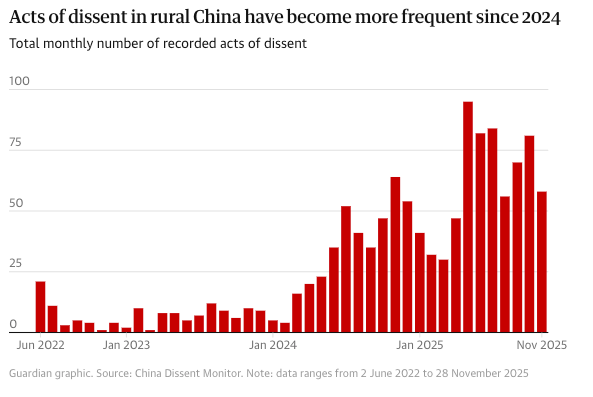
The protest in itself appears minor, but these scenes of anger are being repeated in one form or another across rural China, and the number of them is soaring. By the end of November this year, China Dissent Monitor, a protest-tracking project run by Freedom House, recorded 661 rural protests in China, a 70% increase on the whole of 2024.
Hong Kong: Prisons rife with violence and inhumane treatment, inmate testimony reveals
Amnesty International, December 17, 2025
Former Hong Kong prison inmates have told of inhumane and degrading conditions in new research published today by Amnesty International, as the organization called for authorities to urgently investigate the situation in the city’s correctional facilities.
Nine former inmates jailed between 2016 and 2023 reported physical violence, prolonged solitary confinement, poor sanitary conditions and dangerously high summer temperatures during their incarceration across 11 prisons in the territory.
“These accounts of Hong Kong prison life by former inmates reveal a pattern of ill-treatment that has caused significant mental and physical harm and demands immediate investigation,” Amnesty International’s Deputy Regional Director Sarah Brooks said.
“Subjecting inmates to extreme heat, filthy conditions and violent punishment amounts to cruel, inhuman or degrading treatment, and may amount to torture under international law. Hong Kong’s government must end this culture of abuse and ensure those responsible for human rights abuses in its prisons are held accountable.”
Hong Kong authorities responded to Amnesty to refute the claims as a “malicious smear”.
Teenager jailed for 3.5 years over Hong Kong independence group involvement
Kelly Ho, Hong Kong Free Press, December 17, 2025
A 16-year-old boy has been sentenced to three and a half years in prison for conspiring to commit secession by “actively participating” in a Taiwan-based group that advocates Hong Kong independence.
COMMENT – What was the “crime” of this autistic minor? He took part in six online meetings in early 2024 when he was 15.
James Lee, Hong Kong Free Press, December 17, 2025
A Hong Kong man has pleaded guilty to one count of criminal damage after being accused of vandalising election posters, saying that he had only torn off a piece of a poster the size of his fingertip.
Mo Chi-kit, 23, appeared before Principal Magistrate Don So at the West Kowloon Magistrates’ Courts on Tuesday over the criminal damage charge after he was accused of damaging two election posters in Mong Kok.
On November 19, he allegedly damaged two official government posters that bore a slogan calling on residents to cast their ballots in the “patriots only” Legislative Council (LegCo) elections.
A police officer discovered the damaged posters on November 22 on a footbridge in Mong Kok, The Witness reported. Mo was identified as the suspect after surveillance footage showed him in the act three days earlier.
He was accused of damaging the two posters without lawful excuse, with the intention to damage the property or acting recklessly as to whether it might be damaged.
The court heard on Tuesday that Mo admitted under police caution that he only damaged the posters “for fun,” while the defence argued that Mo had only torn off a piece from one of the posters about the size of a fingertip, while no text on the poster was damaged.
Magistrate So adjourned the case to January 28 for sentencing, pending probation and community service order reports, while Mo was granted bail.
COMMENT – The punishment for “damaging” a campaign poster can be up to 10 years in prison.
In China, a Debate About Political Power Ignites After Maduro’s Capture
New York Times, January 6, 2026
China Sanctions Boeing, Other U.S. Companies Over Taiwan Arms Sale
Stu Woo, Wall Street Journal, December 26, 2025
US Rare Earth Buyers Still See China Curbs Despite Trump Deal
Joe Deaux, Bloomberg, December 24, 2025
Five Takeaways from China’s Military Drills Around Taiwan
Joyu Wang, Wall Street Journal, December 31, 2025
See How a Chinese Attack on Taiwan Would Be Japan’s Problem
Niharika Mandhana and Daniel Kiss, Wall Street Journal, December 28, 2025
China’s Threat to Block Rare Earths Has Put Japan on High Alert
New York Times, January 6, 2026
Here’s How Japan Can Hit Back at China’s New Export Controls
Yoshiaki Nohara, Bloomberg, January 7, 2026
US Says China’s Taiwan Drills ‘Unnecessarily’ Upped Tensions
Nectar Gan and Eric Martin, Bloomberg, January 1, 2026
US affirms Taiwan commitments
Esme Yeh, Taipei Times, December 21, 2025
In response to Chinese criticism over recent arms sales, Washington urged Beijing to engage in meaningful dialogue instead of threats and intimidation.
Washington’s long-term commitment to Taiwan would not change, the US Department of State said yesterday, urging Beijing to stop pressuring Taiwan and engage in meaningful bilateral dialogues.
The remarks came in response to a backlash from Beijing about Washington’s latest approval of arms sales to Taiwan.
The US Defense Security Cooperation Agency said in a statement on Wednesday that the Taipei Economic and Cultural Representative Office in the US has asked to purchase an arms package, including Tactical Mission Network Software; AH-1W helicopter spare and repair parts; M109A7 self-propelled howitzers; HIMARS long range precision strike systems; tube-launched, optically tracked, wire-guided missiles; Javelin missiles; refurbishment kits for Harpoon missiles; and Altius-600M and Altius-700M loitering munition drones.
America’s raid on Venezuela reveals the limits of China’s reach
The Economist, January 5, 2026
China Needed Oil. Venezuela Needed Cash. Their Deal Faces a Turning Point.
Alexandra Stevenson, New York Times, January 5, 2026
The Collateral Checkmate: How China Built a Self-Executing Debt Machine That Makes Western Bondholders Structurally Subordinate
Shanaka Anslem Perera, January 6, 2026
U.S. Pressures Venezuela to Expel Official Advisers from China, Cuba, Iran and Russia, Officials Say
New York Times, January 6, 2026
Inside China’s Shadow LNG Fleet Offering a Lifeline to Putin
Stephen Stapczynski, Jin Wu and Christopher Udemans, Bloomberg, December 29, 2025
Environmental Harms
China’s green power in Angola: When clean energy comes with heavy debt
Vivian Wu and Jean Sovon, Global Voices, December 17, 2025
As Trump brings back coal to power AI, China moves on to clothe the world with it
Dannie Peng, South China Morning Post, December 30, 2025
Foreign Interference and Coercion
How new C100 chief plans to help Chinese-Americans strike the middle ground with China
Mark Magnier, South China Morning Post, January 1, 2026US tech enabled China’s surveillance empire. Now Tibetan refugees in Nepal are paying the price
Aniruddha Ghosal and Dake Kang, Associated Press, December 21, 2025
The white dome of Boudhanath rises like a silent guardian over the chaotic sprawl of Nepal’s capital, Kathmandu, crowned by a golden spire that pierces the sky. Painted on each of the spire’s four sides are the benevolent eyes of the Buddha — wide, calm, and unblinking — said to see all that unfolds below.
Those eyes have served as a symbol of sanctuary for generations of Tibetans fleeing the Chinese crackdown in their homeland. But today, Tibetan refugees are also watched by far more malevolent eyes: Thousands of CCTV cameras from China, perched on street corners and rooftops to monitor every movement below. This intense surveillance has stifled the once-vibrant Free Tibet movement that had resonated around the world.
Nepal is just one of at least 150 countries to which Chinese companies are supplying surveillance technology, from cameras in Vietnam to censorship firewalls in Pakistan to citywide monitoring systems in Kenya. This technology is now a key part of China’s push for global influence, as it provides cash-strapped governments cost-effective, if invasive, forms of policing — turning algorithms and data into a force multiplier for control.
The irony at the heart of this digital authoritarianism is that the surveillance tools China exports are based on technology developed in its greatest rival, the United States, despite warnings that Chinese firms would buy, copy or outright steal American designs, an investigation by The Associated Press has found.
For decades, Silicon Valley firms often yielded to Beijing’s demands: Give us your technology and we will give you access to our market. Although tensions fester between Washington and Beijing, the links between American tech and Chinese surveillance continue today.
For example, Amazon Web Services offers cloud services to Chinese tech giants like Hikvision and Dahua, assisting them in their overseas push. Both are on the U.S. Commerce Department’s Entity List for national security and human-rights concerns, which means transactions with them are not illegal but subject to strict restrictions.
Chinese city sues Missouri for US$50 billion in tit-for-tat Covid-19 litigation
Orange Wang, South China Morning Post, December 18, 2025
China Declares Missouri an Economic and Reputational Menace in New Legal Action
Catherine L. Hanaway, Missouri Attorney General, December 16, 2025
China’s influence in US backyard tested by Nicolás Maduro’s downfall
Ryan McMorrow and Joe Leahy, Financial Times, January 5, 2026
China’s Disinformation Campaign and the Implications for Japan
Sarah Soh, RSIS, December 26, 2025
How Japanese Scallops Became a Pawn in Diplomatic Tensions with China
River Akira Davis and Kiuko Notoya, New York Times, January 1, 2026
China initiates anti-dumping probe against Japan over key semiconductor chemical
South China Morning Post, January 7, 2026
China Courts South Korea as It Pressures Japan Over Taiwan
Soo-hyang Choi and Yoshiaki Nohara, Bloomberg, January 6, 2026
Korea’s Lee, in Beijing, says he seeks full restoration of China ties in 2026
Joyce Lee, Heejin Kim and Xiuhao Chen, MSN, January 5, 2026
As global scrutiny grows, Chinese firms look to call Singapore home
Xinghui Kok, Reuters, December 18, 2025
Crime Syndicates in Southeast Asia Go Global, Defying Crackdowns
Patpicha Tanakasempipat, Bloomberg, December 21, 2025
Behind Oklahoma Cannabis Farms, New Yorkers with Ties to Beijing
Jay Root, Bianca Pallaro and Michael Forsythe, New York Times, December 31, 2025
America’s New Enemy: The Chinese Crypto Cartel Buying States
Tom Wright, Whale Hunting, December 18, 2025
Inside China’s New Fentanyl Pipeline: From Mazatlán Through Vancouver to Los Angeles
The Bureau, December 18, 2025The Chinese Core of “Uganda’s ChatGPT”
Alex Colville, China Media Project, December 17, 2025
A government-supported deployment of China’s Qwen in the east-central African country seeks to harness the free technology to provide AI to the country’s multiple obscure languages. But what does this chatbot have to say?
Amnesty International, January 5, 2026
Ugandan security forces have unlawfully targeted opposition rallies with unnecessary and excessive force and arbitrary arrests, and subjected some attendees to torture or other ill-treatment, Amnesty International said today.
The organization has documented incidents in which security officers launched tear gas at peaceful crowds in Kawempe and Iganga, and pepper-sprayed and beat people. These actions were accompanied by undue movement restrictions aimed at disrupting the opposition party National Unity Platform’s (NUP) campaign rallies.
Amnesty International also received reports and verified digital evidence of such disruptions in other parts of the country.
“The authorities have launched a brutal campaign of repression against the opposition and its supporters, making it extremely difficult for them to exercise their rights to freedom of association and peaceful assembly,” said Tigere Chagutah, Amnesty International’s Regional Director for East and Southern Africa.
Irish intelligence warns its universities while engaging with China
Phayul News, December 31, 2025
Ireland’s military intelligence agency has cautioned the country’s universities about potential risks linked to academic and research engagement with China, according to recent media reports. The warning, delivered through confidential briefings to senior university officials, marks a rare public acknowledgment that Ireland’s security services are actively assessing foreign influence and espionage risks within the higher education sector, particularly in areas involving sensitive research.
The disclosures emerged from an interview given by a senior officer of the Irish Military Intelligence Service (IMIS) to The Sunday Times. In the interview, the officer stated that Irish intelligence had briefed university leaders on the dangers of certain collaborations with China, particularly research that could have “dual-use” applications, meaning work that may appear civilian but could also be used for military or security purposes. The official stressed that sharing advanced technical knowledge without sufficient safeguards could ultimately undermine the security interests of Ireland and its partners.
Human Rights and Religious Persecution
Björn Alpermann, Vanessa Frangville, and Rune Steenberg, Frankfurter Allgemeine, December 19, 2025 [ORIGINAL IN GERMAN]
Internet attacks, entry bans, calls for espionage: Three scientists report how Chinese authorities acted against their research on the oppression of Uyghurs in Xinjiang.
China’s Dark Hand Reaching into European Academic Research: Espionage, Threats, and Cyber Attacks
Turkistan Times, December 20, 2025
The methods employed by the Chinese government to conceal the genocide and human rights abuses in East Turkistan (referred to by China as the Xinjiang Uyghur Autonomous Region) have crossed borders, reaching universities and research institutions in Europe. A report published in the German press on December 19 revealed the nefarious tactics China is using to silence Uyghur studies scholars in Europe.
Three prominent European scholars—Professor Björn Alpermann from the University of Würzburg (Germany), Professor Vanessa Frangville from the Université libre de Bruxelles (Belgium), and researcher Rune Steenberg from Palacký University Olomouc (Czech Republic)—published a report on the German news site Tagesspiegel on December 19, 2025. Titled “Wie China versucht, Wissenschaftler zum Schweigen zu bringen” (How China is Attempting to Silence Scientists), the report detailed tactics such as espionage, cyber-attacks, and border restrictions used by Chinese security agencies to obstruct research on East Turkistan and the Uyghurs.
The Shadow of Espionage in European Classrooms
According to the authors, during a three-year research project titled “Remote Ethnography of XUAR,” funded by the EU and recently concluded, they faced direct and indirect harassment from China. The report notes that Chinese authorities have extended their reach into the lecture halls of European universities.
One Chinese student reported being summoned for a “chat” by Chinese state security officers while back home on holiday. The officers demanded that the student secretly record and hand over lectures regarding East Turkistan and Uyghurs given at the European university. Although this student refused to spy and informed their professors, the scholars suspect this is not an isolated incident and fear that some academic symposia may have been infiltrated by Chinese agents.
China threatens detention in Xinjiang over banned Uyghur songs
Simina Mistreanu, Associated Press, December 29, 2025
It is a soulful folk song, filled with feeling and history: A love-stricken young man tells God about his hopes and dreams of happiness. Generations of Uyghurs, the Turkic ethnic minority in China’s Xinjiang region, have played it at parties and weddings.
But today, if they download it, play it or share it online, they risk ending up in prison.
“Besh pede,” a popular Uyghur folk ballad, is among dozens of Uyghur-language songs that have been deemed “problematic” by Xinjiang authorities, according to a recording of a meeting held by police and other local officials in the historic city of Kashgar last October. The recording was shared exclusively with The Associated Press by the Norway-based nonprofit Uyghur Hjelp.
During the meeting, authorities warned residents that those who listened to banned songs, stored them on devices or shared them on social media could face prison. Attendees were also instructed to avoid phrases like “As-salamu alaykum,” the greeting common among Muslims, and to replace the popular farewell phrase “Allahqa amanet,” which means “May God keep you safe,” with “May the Communist Party protect you.”
Guangxi: Police Deploy Irritant Gas to Flatten a Temple
Liang Changpu, Bitter Winter, January 2, 2026
Longfu Temple in Hezhou, legally rebuilt in 2024, was destroyed despite local villagers’ protests and resistance.
On December 23, in Xinglongzhai Village, Zhongshan County, Hezhou City, Guangxi, the Chinese Communist Party once again demonstrated its unique interpretation of “religious management”: if it exists, demolish it; if villagers resist, gas them; if anyone films it, arrest them.
This time, the target was Longfu Temple, a modest folk‑religion shrine rebuilt by villagers with their own savings after decades of neglect. The temple had stood in the area for generations, long enough that locals cannot even remember when it first appeared. But in today’s China, longevity may be a liability.
As villagers reported, the local government dispatched more than 100 personnel, including police, firefighters, and medical staff, to carry out a “forced demolition operation.” One might think such a large team was preparing to rescue earthquake victims or contain a chemical spill. Instead, they were mobilized to destroy a village temple rebuilt with donations of a few hundred yuan from elderly farmers.
Longfu Temple had collapsed from age long ago. In 2024, villagers pooled their savings to rebuild it, completing the project in April 2025. At the time, the government raised no objections: no warnings, no notices, no bureaucratic thunderclouds on the horizon.
Then, suddenly, officials declared the temple an “illegal construction” and claimed it was “too close to the ring road.” The same ring road that had apparently posed no danger during the entire reconstruction process.
Villagers were stunned. One elderly resident wrote online: “It was here when I was a child. Now I am old, and only last year did we finally rebuild it. We all donated what we could.” But in China, nostalgia is no defense against a demolition order.
When the demolition team arrived, villagers organized themselves with the kind of tactical clarity CCP members usually reserve for military parades. Men formed the first line of defense outside the temple. Women barricaded themselves inside, guarding the entrance.
It was a scene straight out of a folk epic—except the heroes were unarmed villagers, and the villains carried riot shields.
Clashes erupted almost immediately. Police, wielding batons and shields, pushed forward; villagers were knocked to the ground. At least four villagers were arrested. Videos show bodies falling under police blows, a grim reminder that “maintaining stability” in China often means destabilizing the lives of ordinary people.
Inside the temple, women held the doors against repeated attempts by police to ram them open. When brute force failed, officers resorted to a tactic customarily reserved for hostage situations: they fired an unidentified irritant gas into the temple.
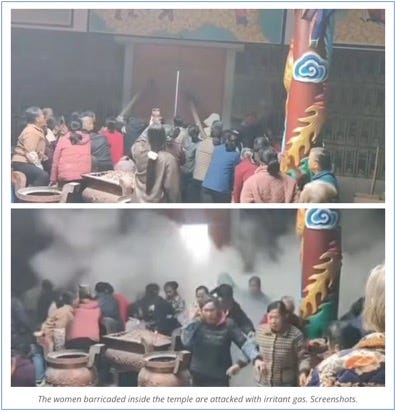
COMMENT – Attacking a bunch of old Chinese ladies who wanted to keep their temple is downright despicable.
Use ‘East Turkistan,’ not ‘Xinjiang,’ says Uyghur leader, calls China’s actions colonial genocide
The Tribune India, December 23, 2025
“Imprisoned Souls” by Aziz Isa Elkun: A Review
Ruth Ingram, Bitter Winter, December 22, 2025
China: New Arrests at Underground Protestant Churches
Human Rights Watch, January 6, 2026
Industrial Policies and Economic Espionage
Xi Says China Hit 2025 Growth Target Despite Economic Headwinds
Chun Han Wong, Wall Street Journal, December 31, 2025
China’s Sprint for Tech Dominance Can’t Hide an Economy Full of Holes
Brian Spegele, Wall Street Journal, December 22, 2025
Ten former Samsung employees arrested for industrial espionage charges for giving China chipmaker 10nm tech — executives and researchers allegedly leaked DRAM technology to China-based CXMT, resulting in trillions of losses in Korean Won
Jowi Morales, Tom’s Hardware, December 23, 2025
Trump Administration Delays Tariffs on Chinese Semiconductors
Ana Swanson, New York Times, December 22, 2025
US Holds Off on New Chinese Chip Tariffs Amid Trump-Xi Truce
Jordan Fabian, Bloomberg, December 23, 2025
U.S. Clamps Down on Investment in Chinese Tech Companies
Anvee Bhutani, Wall Street Journal, December 18, 2025
China Delays Plans for Mass Production of Self-Driving Cars After Accident
New York Times, December 23, 2025
China passes revised foreign trade law to bolster trade war capabilities
Reuters, December 26, 2025
‘You can’t see China now as a reliable supply-chain partner’: Graphite mines forsaken for 70 years come back into fashion
Michael Hill, Fortune, December 27, 2025
Regarding The Acquisition of Certain Assets of Emcore Corporation by Hiefo Corporation
The White House, January 2, 2026
Why economists got free trade with China so wrong
NPR, December 29, 2025
Why China is doubling down on its export-led growth model
Joe Leahy, Thomas Hale and Arjun Neil Alim, Financial Times, January 1, 2026
Italy and Pirelli try to end Chinese involvement in tyremaker
Silvia Sciorilli Borrelli, Financial Times, January 5, 2026
Honda postpones restart of Chinese plants over chip shortage
Shoya Okinaga, Nikkei Asia, January 6, 2026
Switzerland to vet Chinese investment, but some say law is too weak
Jens Kastner, Nikkei Asia, January 6, 2026
China Touts Hainan, Its Duty-Free Island, Amid $1 Trillion Trade Surplus
New York Times, January 7, 2026
Maduro’s ‘Perfect Union’ With China Hides Deep Economic Rupture
Bloomberg, January 7, 2026
China’s domestic procurement drive squeezes foreign companies
Shunsuke Tabeta, Nikkei Asia, January 7, 2026
Japanese industry braces as China tightens dual-use item export controls
Nikkei Asia, January 7, 2026
Cyber and Information Technology
U.S. grants TSMC annual licence to import U.S. chipmaking tools into China
Hyunjoo Jin, Reuters, December 31, 2025
U.S. approves Samsung, SK Hynix chipmaking tool shipments to China for 2026: Reuters
CNBC, December 30, 2025
How China built its ‘Manhattan Project’ to rival the West in AI chips
Fanny Potkin, Reuters, December 17, 2025
China blamed for UK government cyber attack
Jim Pickard and Robert Wright, Financial Times, December 19, 2025
China’s AI Chip Deficit: Why Huawei Can’t Catch Nvidia and U.S. Export Controls Should Remain
Chris McGuire, Council on Foreign Relations, December 15, 2025
Nvidia aims to begin H200 chip shipments to China by mid-February, sources say
Reuters, December 22, 2025
Nvidia CEO Says Chinese Demand for Its AI Chips Is ‘Quite High’
Robbie Whelan, Wall Street Journal, January 6, 2026
Nvidia steps up H200 chip production for Chinese market, Huang says
Michael Acton, Financial Times, January 6, 2026
China Tells Tech Companies to Halt Nvidia H200 Chip Orders
Qianer Liu, The Information, January 6, 2026Jowi Morales, Tom’s Hardware, January 7, 2026
China to Approve Nvidia H200 Buying as Soon as This Quarter
Bloomberg, January 8, 2026
Nvidia requires full upfront payment for H200 chips in China, sources say
Reuters, January 8, 2026
Nvidia’s Biggest Southeast Asian Partner Dogged by China Chip Smuggling Questions
Mackenzie Hawkins, Andy Lin, and Kari Soo Lindberg, Bloomberg, December 22, 2025
Chris Miller’s Warning Meets Nvidia’s H200 Moment in the US–China AI Race
Liang-rong Chen, CommonWealth Magazine, December 20, 2025
How China is shackling Trump’s cyber agenda
Sam Sabin, Axios, December 9, 2025
DeepSeek Touts New Training Method as China Pushes AI Efficiency
Saritha Rai, Bloomberg, January 1, 2026
Meta Buys AI Startup Manus for More Than $2 Billion
Angel Au-Yeung, Raffaele Huang and Kate Clark, Wall Street Journal, December 30, 2025
China reviews Meta’s $2bn purchase of AI start-up Manus
Ryan McMorrow and Zijing Wu, Financial Times, January 6, 2026
Military and Security Threats
China studying U.S. strike for lessons and opportunities, analysts say
Simon Elegant, Washington Post, January 6, 2026
Why U.S. and Chinese satellites are ‘dogfighting’ in orbit
Aaron Steckelberg, Washington Post, December 18, 2025
China Satellite Obliterates Starlink Using a Dim 2-Watt Laser Fired from 36,000 KM in Space
Evelyn Hart, Indian Defense Review, December 19, 2025
Letter to Secretary Hegseth on Airbus Activities in China
Congress of the United States, December 19, 2025
China’s Type 004 Nuclear Supercarrier Signals Beijing’s Leap Toward Global Naval Dominance
Defense Security Asia, December 17, 2025
China likely loaded more than 100 ICBMs in silo fields, Pentagon report says
Idrees Ali, Reuters, December 22, 2025
China expands nuclear warhead manufacturing capacity, research finds
Christian Shepherd, Washington Post, December 28, 2025
Chinese Cargo Ship Packed Full of Modular Missile Launchers Emerges
Tyler Rogoway, The War Zone, December 25, 2025
U.S. Bans New China-Made Drones, Sparking Outrage Among Pilots
Heather Somerville, Wall Street Journal, December 22, 2025
Chinese Military Drills Send ‘Stern Warning’ After U.S. Arms Sales to Taiwan
Joyu Wang, Wall Street Journal, December 29, 2025
The Pentagon’s New China Report: ‘Conventional’ ICBMs, more nuclear weapons and New Aircraft Carriers on the Horizon
Andrew Erickson, 19FortyFive, December 29, 2025
Chinese Navy Destroyer Tests Hypersonic Anti-Ship Ballistic Missile at Sea
Aaron-Matthew Lariosa, U.S. Naval Institute, December 29, 2025
Why China Stopped Publicly Urging for North Korean Denuclearization
Dasl Yoon, Wall Street Journal, January 5, 2026
The Chinese Military’s Rotten Core
Anushka Saxena, National Interest, January 5, 2026
One Belt, One Road Strategy
US capture of Maduro tests limits of China’s diplomatic push
Joe Cash, Reuters, January 5, 2026
A Tiny Pacific Paradise Is Gaming the U.S.-China Rivalry Over Minerals
Yusuf Khan, Wall Street Journal, December 26, 2025
China’s premier pledges deeper cooperation as Irish PM pushes on beef and dairy
Liz Lee, Reuters, January 6, 2026
How Beijing Builds Leverage for Indefinite Competition
Zongyuan Zoe Liu, Foreign Affairs, December 16, 2025
China Signals It Won’t Give an Inch to the U.S. in Latin America
James T. Areddy, Wall Street Journal, December 31, 2025
Thailand, Cambodia Agree to Immediate Cease-Fire in Border Clashes
Gabriele Steinhauser, Wall Street Journal, December 28, 2025
Belt and Road nations’ share of China trade surplus overtakes that of US
Kentaro Shiozaki, Nikkei Asia, December 1, 2025
Maduro’s Capture Threatens China’s Ambitions in Latin America
James T. Areddy, Wall Street Journal, January 5, 2026
China’s top diplomat tours Africa with focus on strategic trade routes
Joe Cash, Reuters, January 7, 2026
Opinion
China Seeks Power, Not Only Trade
Ram Charan, Wall Street Journal, January 1, 2026
To wipe out competition, it builds excess capacity, then floods the market with subsidized exports.
China’s trade surplus with the rest of the world will top $1 trillion for 2025. That isn’t merely a matter of selling goods to willing buyers. It is economic conquest on a scale the world has never seen. It has happened—and will continue to happen—because the Chinese have the power to crush any industry anywhere in the world.
Example: In October Beijing threatened to cut off magnet supplies to the U.S. Within days, American industries from defense to electric vehicles faced paralysis, and the chokehold affected several other critical sectors: semiconductors, pharmaceuticals, chemicals.
China’s power—which Xi Jinping can exercise at will—consists of 90% excess production capacity. That means it can identify a key industry, build the capacity to produce 90% of global demand, and then flood markets with subsidized exports, priced at marginal cost, backed by a 20% undervalued currency. That quickly wipes out competition.
President Trump needs to treat this less like a trade dispute and more like a war. Fighting back requires America to organize its allies the way Franklin D. Roosevelt built a winning coalition in World War II. Here are five steps he should take:
First, stop fighting alone. America and its core allies—Europe, Japan, South Korea, Israel and the United Kingdom—represent roughly $60 trillion in combined gross domestic product. China plus Russia, Iran, North Korea and others in its orbit total approximately $25 trillion.
Mr. Trump has been pressuring allies individually—tariffs on Europe and other allies, friction with Japan and South Korea. The partners we need are rattled. Mr. Xi is watching this and smiling. He knows if these countries ever coordinate on issues like tariffs, export controls and currency pressure, his industrial machine will break down.
Noah Smith, Noahpinion, January 2, 2026
…
If the U.S. cared about staying ahead of China in the AI race, why would we sell H200s to China? The obvious answer is that there is no reason we would, and that thus Trump does not care about staying ahead of China in the AI race — that for either personal or political reasons, Trump has decided to facilitate the rise of Chinese power rather than impede it.
Some people actually do argue that selling China H200s will maintain America’s technological advantage. They argue that if Chinese companies are allowed to buy H200s, they will remain dependent on American chip designs (and Taiwanese chip manufacturing), and will thus fail to build their own indigenous rivals to America’s AI chip industry. As Dmitri Alperovitch writes in the Wall Street Journal, this is a dangerous pipe dream:
Rather than grow dependent, China will take Nvidia chips while they are available, use them to train models to compete with American frontier variants and continue to invest heavily in domestic alternatives like Huawei’s Ascend chips. When those are good enough, the firms will drop Nvidia—and quickly.
The notion that restrictions “accelerate Beijing’s move toward alternatives” misses a critical reality: Technological self-sufficiency is a Xi Jinping mandate. He isn’t going to allow China to rely on an American tech stack. The Communist Party is already investing in an alternative supply chain and will limit Nvidia imports if needed to ensure sufficient domestic demand for Huawei. The question isn’t whether China pursues self-sufficiency; it’s whether we hand it advanced capabilities during its years-long catch-up period.
TikTok Deal Done and It’s Somehow the Shittiest Possible Outcome, Making Everything Worse
Karl Bode, Tech Dirt, December 19, 2025
There were rumblings about this for a while, but it looks like the Trump TikTok deal is done, and it’s somehow the worst of all possible outcomes, amazingly making all of the biggest criticisms about TikTok significantly worse. Quite an accomplishment.
The Chinese government has signed off on the deal, which involves offloading a large chunk of TikTok to billionaire right wing Trump ally Larry Ellison (fresh off his acquisition of CBS), the private equity firm Silver Lake (which has broad global investments in Chinese and Israeli hyper-surveillance), and MGX (Abu Dhabi’s state investment firm), while still somehow having large investment involvement by the Chinese:
“The new U.S. operations of TikTok will have three “managing investors” that will collectively own 45 percent of the company: Oracle Corporation, Silver Lake, and MGX. Another 5 percent will be owned by other new investors, 30.1 percent will be “held by affiliates of certain existing investors of ByteDance; and 19.9 percent will be retained by ByteDance.”
There’s also a smattering 5% of investors that may or may not include folks like right wing media mogul Rupert Murdoch. It’s worth noting that none of this was really legal; the law technically stated that TikTok shouldn’t have been allowed to exist for much of this year. Everyone just looked the other way while Trump and his cronies repeatedly ignored deadlines and hammered away at the transfer.
The deal purportedly involves “retraining the content recommendation algorithm on U.S. user data to ensure the content feed is free from outside manipulation,” but given you can’t trust any of the companies involved, the Trump administration, or what’s left of U.S. regulators, that means absolutely nothing. Oracle will be “overseeing data protection,” but that means nothing as well given Oracle is run by an authoritarian-enabling billionaire with a long history of his own privacy abuses.
COMMENT - The whole TikTok affair is a debacle.
The UK is falling into China’s trap Our institutions are exposed
Luke de Pulford, Unherd, December 15, 2025
Trump Is Doubling Down on His Disastrous A.I. Chip Policy
Ben Buchanan and Matt Pottinger, New York Times, December 17, 2025
The Case for a Grand Bargain Between America and China
Wu Xinbo, Foreign Affairs, December 31, 2025
The Venezuela Strikes Are the Beginning of a New Western Hemisphere
Eric Farnsworth, National Interest, January 3, 2026
The Indispensable Adversary: India’s Approach to China
Shantanu Roy-Chaudhury, War on the Rocks, December 29, 2025
Sharpening Policies to Deter China
Bishop Garrison, Real Clear Defense, December 22, 2025
China and Russia Bolster Their ‘No Limits’ Alliance
Seth G. Jones, Wall Street Journal, December 18, 2025
The U.S. Must Break China’s Chokehold on Our Economy
New York Times, December 22, 2025
The U.S. Can’t Get Xi Hooked on Nvidia Chips
Wall Street Journal, December 22, 2025
China is using American AI against the U.S. Here’s how to stop it.
Jack Crovitz, Washington Post, December 29, 2025