Hard Habit to Break
When dumping exports doesn’t fix your economic problems
Friends,
Beneath the headlines about technological breakthroughs, gleaming skyscrapers in Shanghai, and the competence of Chinese technocrats lies a growing problem… China’s economy is utterly dependent on forcing the rest of the world to accept more and more of the country’s exports.
As the Chicago song of 1984 put it, this is a “Hard Habit to Break.” While the original is good, personally I like the cover by the Australian band, Hindley Street Country Club (HSCC) which performed this version a short time ago.

The first couple articles this week dive into this problem for Beijing.
The main takeaway for me is that it is difficult to see how this is sustainable for the Chinese Communist Party into the future. They benefit the most from a global free trade system, yet their behavior all but determines that the global free trade system be dismantled as every country seeks to erect trade protections from what Beijing is doing.
It is the ultimately self-defeating policy and the completion of the Two Sessions and the release of the 15th Five-Year Plan suggests that Xi and his cadres have no intention of changing course.
This does not bode well for a major breakthrough during the Xi-Trump summit in a few weeks.
Talks in Paris and Multiple Section 301 investigations
Today, Treasury Secretary Bessent and Trade Representative Greer started meetings in Paris with Chinese Vice Premier He Lifeng that are scheduled to last through Tuesday. These trade talks will likely finalize the scope on the Xi-Trump summit in Beijing at the end of the month.
Just before Ambassador Greer left Washington, he dropped a series of Section 301 investigations on forced labor and “structural excess capacity and production in manufacturing sectors.” Each of these investigations cover dozens of countries. By not limiting the Section 301 investigations to just the PRC, the Administration can go into the Summit claiming that these investigations are meant to cover global problems, but Beijing also knows that the United States considers the PRC to be the worst offender in both forced labor and overcapacity.
Completing these Section 301 investigations will likely take months. As an example, when USTR announced a Section 301 investigation into the PRC’s practice of forced technology transfer in August 2017, the report wasn’t finished until March 2018, which gave the President the authority to impose broad tariffs on Chinese exports to the United States. These have largely remained in place to this day.
From my perspective, the opportunity to achieve a breakthrough between the U.S. and the PRC came with the announcements of the Two Sessions last week, as well as the release of the 15th Five-Year Plan. The Chinese Communist Party signaled that it was doubling down on economic and trade policies that the U.S. sees as harmful, and in response, the United States initiated two Section 301 investigations that are pointed directly at the PRC.
Needless to say, I’m not optimistic that the Xi-Trump Summit will result in a resolution to the Sino-American rivalry, which makes this next point even more important.
The Downside of Embracing the “One-War Standard”
During the First Cold War and the 1990s, the United States maintained a military strategy and posture of being able to wage two simultaneous major military conflicts. This meant that the United States possessed the force structure, an industrial base with stockpiles of munitions, and a robust logistical system to fight two simultaneous conflicts.
We did this because we faced multiple, well-resourced adversaries who could challenge us across the globe.
In the summer of 2001, the Bush Administration started the process of dismantling the “two-war standard” as an effort to economize. At the time, it appeared the United States could accept risk by further drawing down a costly set of capabilities given the geopolitical situation.
The attacks of 9/11 derailed that effort as the United States waged two wars simultaneously in Iraq and Afghanistan, even as the threats from North Korea grew larger and as the relationship with both Moscow and Beijing became more tense by the end of the Bush Administration (Putin invaded Georgia, an Iraq War coalition partner of the United States, in August 2008).
The effort to transition away from the “two-war standard” emerged again during the Obama Administration and became policy in January 2012 after President Obama ended the U.S. combat mission in Iraq in October 2011.
On January 5, 2012, Secretary of Defense Leon Panetta released “Sustaining U.S. Global Leadership: Priorities for 21st Century Defense,” which formally ended the “two-war standard” and directed the Department of Defense to be prepared for one major conflict while deterring opportunistic aggressors in other theaters. As that policy decision was being implemented, the effects of the Budget Control Act of 2011 were about to hit the Department as well. After assuring everyone for a year that sequestration would not take place, the bipartisan “supercommittee” failed to reach an agreement on deficit reduction and President Obama ordered sequestration on March 1, 2013. This order had huge impacts on federal spending and hit defense readiness and defense innovation programs particularly hard.
Given that the Department of Defense had already decided to abandon the “two-war standard,” defense officials and their military counterparts implemented sequestration in such a way as to make returning to a “two-war standard” extremely difficult. These cuts were extended multiple times over the next decade, further eroding U.S. military readiness and capacity to handle multiple, simultaneous conflicts.
It is under this self-imposed policy and resource constraints that the threats posed by Moscow and Beijing began to accelerate (Russia annexed Crimea and invaded Ukraine in February 2014 and Chinese aggression in the South and East China Seas ramped up at the same time as their military modernization accelerated). ISIS emerged in 2013 and established a caliphate across Syria and northern Iraq in 2014, even as the United States continued to fight in Afghanistan.
The opportunity to reverse these decisions came in 2017, but the Trump Administration kept the “one-war” approach with the National Defense Strategy of January 2018. The Biden Administration also had a chance to reverse this policy and resource decision in their October 2022 National Defense Strategy, but they failed to do so as well… eight months after Russia’s full-scale invasion of Ukraine, the largest war in Europe since 1945.
Which brings us to today and the limitations we face with the war in Iran. For over a dozen years and through four presidential administrations the United States has stuck to a strategy in which it will only prepare itself to fight one conflict at a time, even as it fights multiple simultaneous conflicts.
When we examine why we are in such a tough place with munitions and military units stretched thin, we have to examine the fateful decision we made to significantly constrain what the U.S. military would be prepared to do and how they would be resourced. When we made the decision to formally shift to a “one-war standard” in January 2012, the geopolitical landscape looked relatively benign… that isn’t the case today.
We are now more vulnerable than ever, inviting our adversaries and rivals to try a little harder to extend and expand conflicts in the hopes that we will be stretched too thin.
It is in this context that our decision to launch the Iran War appears foolhardy. Don’t get me wrong, I agree that removing the Islamic regime is a necessary move, my complaint is that for over a decade and in Democratic and Republican Administrations, we have conducted our defense strategy and our resourcing decisions (40+ continuing resolutions) as if we live in a benign international environment.
Our strategy and resources are not aligned with the reality our country faces.
Some will argue that we should just abandon those military adventures (no more forever wars) and they will get a lot of attention and support… but that assumes that we are the only ones with agency. That if WE stop using the military instrument of power, everyone else will do so as well… that is a terrible and unwise assumption.
Thanks for reading!
Matt
MUST READ
China Admits It Has an Economic Problem
Wall Street Journal, March 5, 2026
A new GDP target concedes Beijing can’t pretend much longer.
Economic reality comes for us all in the end—yes, even China’s Communist Party. So it is that officials this week reduced their economic growth-target for the coming year to the lowest level since 1991. They’ll still probably struggle to hit it.
Beijing’s target range for GDP growth this year, 4.5%-5%, is less a goal than a concession. Official economic data are notoriously prone to political monkeying by the Party, and there’s rarely any doubt that those data will show China achieved whatever goal the bosses have set. A lower target is thus an admission that not even President Xi Jinping thinks he can pretend growth will be faster.
A period of slower growth would be acceptable if the pain had a purpose. Since 2020 the economy has been rebalancing from overreliance on real-estate. That’s a difficult but necessary process that has destroyed much household wealth (especially for the middle class) and created significant credit stresses across the economy.
Mr. Xi could have ameliorated the damage by creating new avenues for productive private investment that would boost productivity and stimulate more domestic demand. Such a transition to higher productivity will be essential for China to manage its demographic decline, which is accelerating.
Instead, Beijing is attempting to consolidate control over the economy in Party-state hands. Mr. Xi’s tenure has been marked by hostility to entrepreneurial private firms, especially in industries such as tech and services. The next five-year economic plan (yes, they still produce them) is expected to focus heavily on industrial policy to support favored industries such as artificial intelligence.
Missing from all of this is any clear solution to China’s most pressing problems. Attempts to clean up trillions of dollars in off-balance-sheet debts owed by local governments proceed at a dilatory pace. Years of policy favoritism for manufacturing exports leave China dependent on the willingness of increasingly unwilling foreign markets to absorb its production. When it can’t export, unsold products pile up at home and contribute to deflationary worries.
Various trade-in programs to subsidize household upgrades of everything from appliances to mobile phones haven’t triggered a durable shift toward greater domestic consumption. And now Beijing has cut the budget on those subsidies in the latest fiscal plan.
China’s Best-Laid Plans Hit Reality
George Magnus, The Wire China, March 9, 2026
The turmoil in the Middle East has already put Beijing’s forecasts for 2026 in doubt, while the latest Five-Year Plan offers no fresh thinking on the country’s top challenges.
his year’s National People’s Congress in China has taken place against a troubled international economic and geopolitical backdrop. The fighting in Iran, a sharp rise in oil and gas prices, and the shipping freeze in the Straits of Hormuz — the chokepoint through which China gets over half its oil imports — has already put significant elements of the government’s largely sanitized economic thinking and forecasts at risk: not least for exports, which have been a key growth driver.
The new 15th Five Year Plan (FYP, 2026–2030) is predictably optimistic as it parades the government’s industrial policy and self-reliance priorities. Yet, the combination of a fractious external environment and stubborn structural problems at home beg the question as to whether the government’s messages for the year ahead, and over the plan period, count as confident — or cavalier.
The main macroeconomic projections and forecasts for 2026 appear unremarkable. The GDP target has been set at 4.5-5 percent, allowing a little slippage from last year’s 5 percent. But that target still exceeds China’s sustainable rate of growth of about 3 percent, and may only be attainable via more non-productive investment, and higher indebtedness. Other targets, including for unemployment, gross job creation, inflation and personal income were mostly unchanged but are also of little informational value. The normal optimistic tone, therefore, is worth checking against the caveats.
The Work Report itself, acknowledged that ‘the imbalance between strong supply and weak demand is acute’, an allusion to China’s chronic overcapacity and deflation. It recognized underlying problems in employment and income growth: some estimates are that informal or gig workers now account for almost a third of the labor force and over 40 percent of the urban workforce. It said that fiscal revenue-expenditure tensions in some localities are pronounced: but this understates the revenue crisis for local governments whereby their total inflows fell last year to just over 15 percent of GDP, compared with a peak of over 27 percent in 2015. Inevitably, the report said the real-estate market is ‘still adjusting’, which is a euphemism for a sector that is still in decline: prices haven’t been allowed to adjust properly, while consumer confidence and banks’ loan portfolios are still both at a low ebb.
The report from the National Development and Reform Commission, China’s economic planning ministry, was more strident. After having referred last year to ‘involution in some sectors’ and ‘some business difficulties’, this year it took the gloves off. It says, ‘The imbalance between strong supply and weak demand is acute; real-estate development investment continues to decline; infrastructure investment growth has turned from positive to negative; manufacturing investment growth has slowed further; overall investment faces mounting downward pressure; consumption growth lacks momentum; and the price level continues to run low’.
This is a much sharper assessment. It asks questions, implicitly, about policy options, and about the perennial issue of how, or if, to rebalance the economy towards higher consumption.
The government meanwhile says it intends to maintain a pro-active monetary policy, but this tool lost its leverage a long time ago. Interest rates are already low, but credit demand is weak, and banks’ loan and capital positions are under pressure. Additional easing moves are expected but necessary moves such as a radical change in the capital adequacy of banks, the discipline of hard budget constraints in credit allocation, and the orientation of the financial system away from local government and SOEs to private firms and efficient capital allocation are not even on the agenda.
The government’s scope to use its budgetary policy is also limited. Beijing’s plans are quite conservative on paper: the central government fiscal deficit remains at about 4 percent of GDP. But the actual deficit is nearer 8.5 percent, allowing for transfers from other funds, the regular issuance of special purpose bonds, and other off-budget entities. Adding in local government finance vehicles, the IMF thinks China’s augmented deficit is over 14 percent of GDP.
The central government’s balance sheet could be used more, and some of the new bond issuance this year will do that. There will be new issues to fund national strategies, security, consumer product and industrial equipment upgrades, large state bank recapitalization, and new consumer loan interest guarantees. Overall, though, the fiscal stance is only mildly stimulative.
Boosting consumption — which many economists, myself included, see as China’s top economic priority — figures prominently in official rhetoric meanwhile, but hasn’t figured in a significant fashion in practice. The government is planning to allocate additional funds to subsidize the consumer goods trade-in scheme, a new small fund to subsidize loans, measures to deal with the consequences of aging, and extra funding for childcare, pensions, education, and rural-urban income disparities. However, the scale of the fiscal transfers to households is small, the increases to social welfare programmes are limited, and there are no plans for any significant redistribution of assets or wealth.
There had been a widespread expectation that the new FYP would contain a commitment to raise the consumption share of GDP, but this was not included. There are references to raising consumption, but equally, there are also many references to investment in the context of 109 projects.
Xi’s Export Juggernaut Is Leaving China’s Factory Workers Behind
Bloomberg, March 9, 2026
Workers who powered a tariff-defying boom tell a grim story of falling wages and vanishing jobs.
Along a stretch of shopfronts in downtown Guangzhou, dozens of middle-aged day laborers linger in the winter chill, waiting for agents from nearby factories in southern China to offer some work.
For Sheng, 55, the goal is simply to earn enough to eat and pay rent: His income more than halved to less than 100 yuan (around $14) per day over the past few years. “Some people can’t find work for months,” said Sheng, who asked to use only his surname. “People are here looking for jobs 24 hours a day.”
The group immediately swarmed one factory manager who pulled up on an electric scooter. She offered 20 yuan an hour to sew trousers — less than half the federal US minimum wage — and quickly found a few takers. “Last year was the worst since I joined the industry a decade ago,” said the manager, who asked to be identified by her surname Yuan. Her clothing company made a loss for the first time in 2025, and profit margins dropped to less than a single yuan per item.
President Xi Jinping’s increasingly powerful export machine stunned the world last year by generating a record $1.2 trillion trade surplus even after US counterpart Donald Trump raised American tariffs to the highest in nearly a century. Leaders from Europe to South America have warned that unstoppable Chinese exports threaten to decimate local industries.
Official data on Tuesday showed Chinese exports surged almost 22% from a year earlier in the first two months of 2026, an increase that was more than expected and resulted in a record trade surplus for the period.
Yet in China’s sprawling Guangdong province, long the main engine driving the nation’s manufacturing prowess, ordinary workers have seen a sharp decline in their living standards. Interviews with some two dozen workers and business owners painted a bleak picture of falling salaries and disappearing jobs.
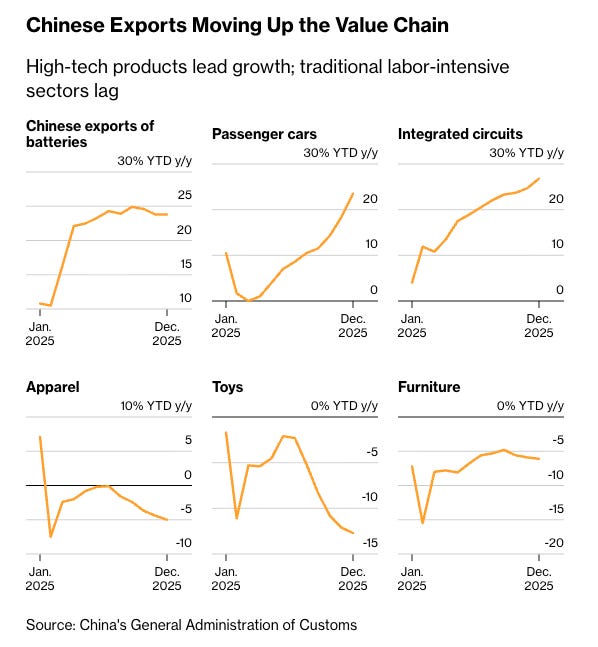
For the ruling Communist Party, the disconnect between China’s strong exports and strained households is a warning after Xi devoted years to pivoting his economy toward high-end manufacturing, a mission reinforced at this month’s annual parliamentary meetings. Future technologies such as batteries, cars and chips — deemed essential for competing with the US — are taking a larger share of exports, but those products are less labor intensive.
Perhaps more alarming for global trade, the trend only appears set to get worse in the short term as an explosion of AI and robotics spawns so-called dark factories that require no human workers. As AI fears spread, Guangdong provides a cautionary tale of the bumpy path to what could be either a new era of abundance or the dystopian future outlined last month in the Citrini Research report that rocked global markets.
“Right now, the Communist Party is stretching social stability ever thinner for the sake of economic growth,” said Chenggang Xu, senior research scholar at Stanford Center on China’s Economy and Institutions. “On the surface, China may be doing well and closing the gap with the US. But the cost is borne by society as a whole.”
Some workers in Guangdong blamed the wreckage on US tariffs that peaked at 145% last year, along with Trump’s elimination of duty-free perks on small parcels. Others cited domestic price wars as driving wage decline, worsened by a rise in robots replacing human labor. Few expected things to improve anytime soon.
“These days, even the food in the factory canteen is made up mostly of vegetables with only a tiny bit of meat,” said Chen Cuilian, a 42-year-old mother-of-two at a factory in Guangzhou, who spends 12 hours a day behind a sewing machine, with only Sunday evenings off. Her salary plunged by 40% to around 6,000 yuan during the trade war.
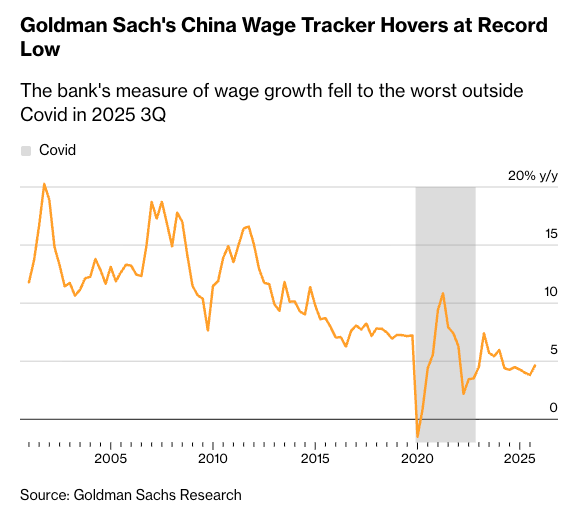
Employment data in China is politically sensitive, with the official jobless rate and income statistics often failing to capture the full picture. But even a recent central bank survey showed the problems with more than half those polled considering it “difficult” to get jobs in the third quarter of last year, a record high since data began in 2011. An alternative measure of China’s wage growth compiled by Goldman Sachs is hovering around the lowest level outside the pandemic in data going back to the beginning of the century.
Further masking the pain is gig work, which now accounts for about 40% of urban employment, leaving a large swathe of people without paid sick leave, medical insurance or holidays — benefits that underpin consumer spending.
As protests sweeping countries from Mexico to Indonesia in recent months, the instability infecting China’s labor market also risks stoking social unrest. While Beijing’s vast censorship apparatus makes nationwide demonstrations rare, the country did witness a 44% jump in protest activity led by workers last year, according to Freedom House’s China Dissent Monitor. Guangdong emerged as the top hotspot for the unhappiness.
If exports encounter headwinds, those protests “could erupt all at once on a larger scale,” said Xu, the Stanford scholar, adding that he sees the system getting “more and more fragile.”
Losing Streak
If Guangdong province was an independent country, it would be the world’s sixth largest exporter behind the Netherlands, having shipped some $880 billion in goods last year alone — more than any other Chinese region. Nowhere are the problems facing the nation’s legion of factories more apparent.
Long hailed as China’s largest provincial economy, Guangdong has now lagged the national growth rate for four straight years, an unprecedented streak. During a November visit, Xi indicated the slowdown was permissible, signaling top leaders don’t see a reversal of its fortunes anytime soon.
Part of what’s holding the province back is a half-decade-long crash in the housing market that once propped up factories and domestic demand. Property investment that accounted for 14% of Guangdong’s economy five years ago, is now contracting at a double-digit pace.
COMMENT – Of the 33 Provinces, Autonomous Regions, and Municipalities in the PRC, 22 have seen a significant increase in labor protests between 2023 and 2025.
China’s growth target is a global problem
Ruchir Sharma, Financial Times, March 8, 2026
Beijing’s export offensive could be more destabilising than Trump’s tariffs.
China is famous for pushing growth zealously, so much was made of its recent decision to lower its GDP target to 4.5-5 per cent. But this was a marginal change, and China’s irrational hopes for growth are an increasingly big problem for the world.
The target is not based in economics. It’s a political goal, reflecting Beijing’s ambition to surpass the US and become a developed economy by 2035. Pursuing that aim, Beijing has been overinvesting for years, but lately it has been dumping the excess output it can’t sell at home. In the past, China’s export volumes rose with prices; this decade, Beijing has dropped export prices by nearly 20 per cent, producing a 40 per cent surge in volume.
Booming exports along with weak imports increased China’s trade surplus last year by 20 per cent to a record $1.2tn. Net exports accounted for almost a third of its 2025 GDP growth, a bloated share even by China’s standards. As a share of global GDP, no nation has ever had a larger trade surplus, and that includes Japan during its 1980s heyday.
China’s dumping offensive is deindustrialising rival exporters the world over, idling car factories in Thailand and textile plants in Indonesia. Across Asia, nations where Chinese imports are rising fastest also tend to have the weakest job growth.
More than 50 of the world’s 70 largest economies have taken steps to defend themselves against Chinese dumping. The leaders of France and Germany have complained directly to Xi Jinping about Beijing’s trade practices. Yet the pace of new protective measures slowed last year — as many nations turned their attention to attacks from the US.
In my recent travels across Europe, the Middle East and Asia, policymakers in several countries said they can’t fight a two-front global trade war, so they have focused on managing the more volatile threat of Trump tariffs. This makes it easier for China to keep dumping its surplus production.
The root of the problem is the country’s growth target. Of the nearly 40 nations that rose into the developed ranks after the second world war, none faced the twin hurdles confronting China today: depopulation and massive debt. No other major nation in history has managed to sustain growth above 2 per cent with a shrinking labour force. And at 340 per cent of GDP, China’s total debts are higher than any other emerging economy by far.
Beijing is trying to engineer a historically implausible miracle. Given its demographic decline, China can hit its target only by raising output per worker, but maintaining overall productivity growth near 5 per cent would be an unprecedented feat at this stage of development.
Lately China has been moving in the opposite direction. Productivity growth includes contributions from labour, capital, and a critical “total factor” that aims to capture how much growth labour is squeezing out of the investment. The Conference Board estimates that this key third factor has fallen to near zero this decade, implying that China is generating growth only by investing more heavily.
China keeps pumping out credit to fund more investment, but mostly it’s getting a bigger debt pile. To generate $1 of GDP growth in China, it now takes $6 of new debt, up from $1 two decades ago.
Beijing is counting on investment in new technologies including AI to boost productivity, but it’s highly unlikely that boost will be big enough to sustain productivity growth near 5 per cent. China’s real potential growth rate is probably between 2 and 3 per cent.
For decades outsiders have told Beijing it could generate steadier growth and mollify trade partners in one stroke. Just shift focus from exports to domestic consumption. True, consumption is a relatively small share of China’s economy but not because it has been “suppressed”, as the received wisdom would have it.
Despite the recent weakening, consumer spending has grown at an annual pace of 5 per cent this decade — faster than in any other major economy. While Chinese consumers have increased their savings rate in recent years, this is more a reaction to their high debt burden and losses in the property market than a sign that they have ample room to raise their spending.
The real problem is that investment keeps growing faster than consumption, compelling China to flood the world with its excess production. Chinese exports, now $3.8tn a year, recently surpassed US imports for the first time, and the gap is growing.
If Team Trump believes America is being “ripped off” in global trade, it should focus less on battling its partners and more on China’s export offensive and the inspiration behind it: the growth target. That target is completely unrealistic, damaging for the world and self-destructive for China.
Why China’s critical mineral dominance is still disrupting US supply chains
Kandy Wong, South China Morning Post, March 9, 2026
Businesses hope US President Donald Trump’s visit to China in late March will ease bottlenecks.
American companies are grappling with a shortage of critical minerals used in daily operations despite China easing some of its export controls, according to industry insiders.
After Beijing and Washington agreed to a so-called trade truce last November, the Ministry of Commerce issued a notice suspending a ban on shipments of gallium, germanium and antimony to the US for one year.
But China’s dominant position in the global market for these vital raw materials, including heavy rare earths, continued to weigh on US companies, industry insiders said.
“There is no immediate broad-based solution except supply loosening in China,” said David Abraham, director of Three Legged Capital in New York, a specialist advisory firm focused on critical mineral supply chains.
“It’s not just that materials are dear; it’s that they are not getting to manufacturers,” he added, noting the current situation was creating “severe challenges” for the defence and tech industries.
Jesse Marks, CEO and executive director of Rihla Research & Advisory, a strategic consulting firm on diversifying critical mineral supply chains, said China’s blanket bans and export licensing regime had fuelled a global scramble for supplies since last April.
The industries “feeling this most acutely” were aerospace, defence, semiconductors and electric vehicles, as companies faced lengthy approval timelines for export licences while quarterly volume caps constrained their ability to plan, Marks added.
COMMENT – It’s a good thing we aren’t expending our stockpile of munitions that contain these critical minerals.
All kidding aside… my biggest concern is that we negotiate some broader relief for critical minerals with Beijing which then decimates the nascent industry that is growing in the United States that would resolve this problem and make Beijing’s dominance of rare earth processing moot.
Apple Now Makes About 25% of iPhones in India After China Pivot
Sankalp Phartiyal, Bloomberg, March 9, 2026
Apple Inc. increased iPhone production in India by about 53% last year and now makes a quarter of its marquee devices there, reflecting the US company’s efforts to avoid tariffs on China.
The company assembled about 55 million iPhones in India in 2025, up from 36 million a year earlier, people familiar with the matter said, asking not to be named because the numbers aren’t public. Apple makes about 220 million to 230 million iPhones a year globally, with India’s share of the total increasing rapidly.
Apple has accelerated its expansion in the world’s most populous country in recent years, bolstered by Prime Minister Narendra Modi’s production-linked incentives aimed at turning India into the world’s factory. The subsidies have helped offset some of the structural cost disadvantages that manufacturers face in India, including the lack of a China-like robust supply chain and logistics challenges.
In 2025, shipments from China, where Apple still makes the bulk of iPhones, faced headwinds as a result of US tariffs related to the two economic powers’ trade war. The levies pushed Apple and its suppliers to move a greater share of devices meant for the American market to alternative manufacturing destinations, with India emerging as a major brightspot.
An Apple spokesperson declined to comment.
Even though the gap has narrowed, electronics assembly and component manufacturing still costs more in India than in countries including China and Vietnam. That’s prompted Apple, Samsung Electronics Co. and others to seek more government support.
Companies are discussing with New Delhi another round of incentives to support export growth. India’s current production subsidies for smartphones expire March 31 and with the US Supreme Court striking down some of the duties affecting China, India needs to move quickly to remain cost competitive.
Cupertino, California-based Apple currently assembles all versions of the latest iPhone 17 lineup in India, including the high-end Pro and Pro Max models. Its suppliers in India, including Foxconn Technology Group, Tata Electronics and Pegatron Corp., also build older models such as the iPhone 15 and iPhone 16 for local sales and export.
The rising output in India highlights Apple’s long-term supply chain strategy to build a second major iPhone manufacturing base to serve global demand. The company is deepening and widening its local supplier partnerships to make components including lithium-ion cells, watch and phone enclosures and accessories such as AirPods.
Beyond manufacturing, Apple is targeting market share gains in a region where sales have surged past $9 billion. It’s preparing to launch Apple Pay in India later this year and its retail network now comprises six stores, underscoring the country’s growing importance as not just a production hub but also a fast-growing consumer market.
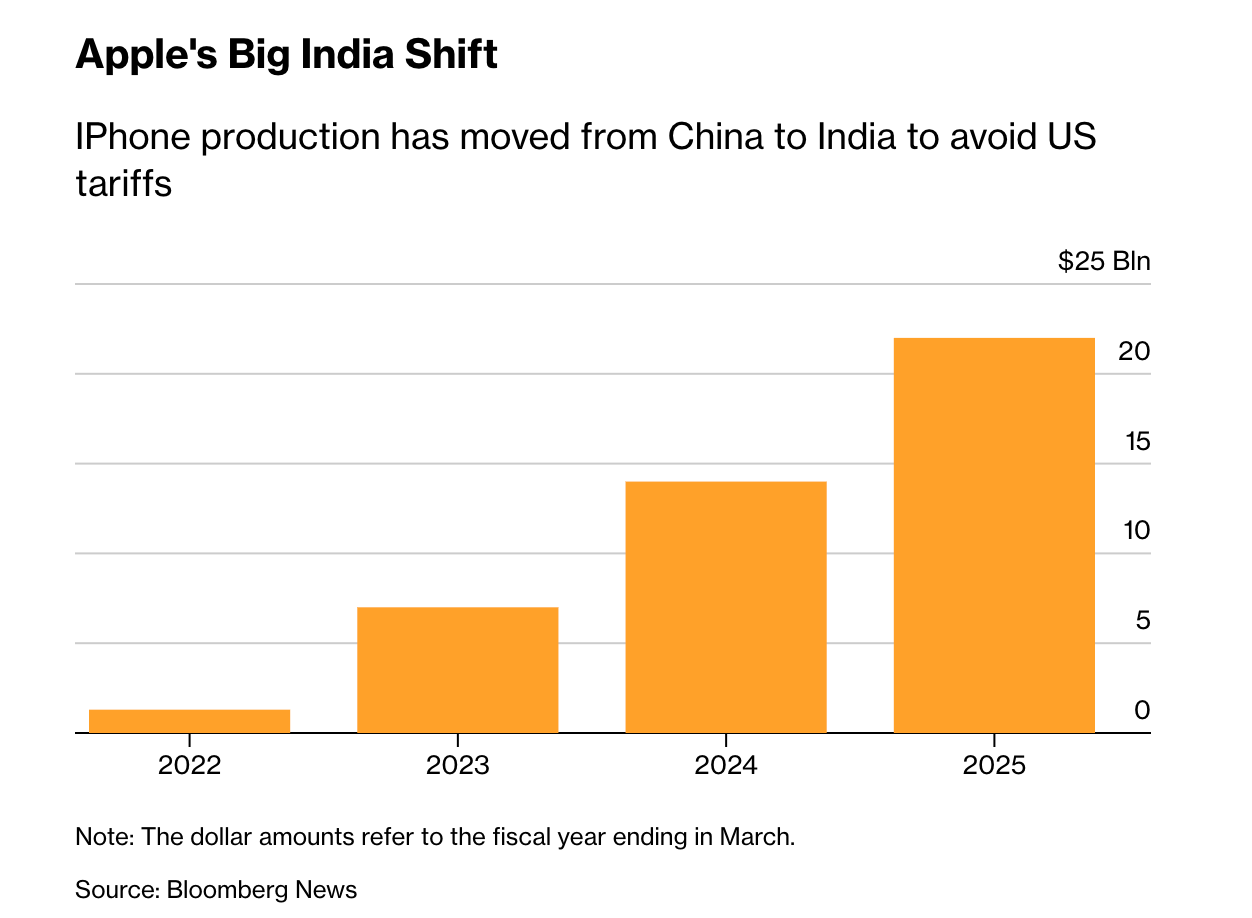
COMMENT – Without tariffs imposed in 2018, Apple would not have moved this production to India and it would have continued to make itself even more vulnerable to coercion from Beijing.
A Trump-Xi Summit Nears, but China Doesn’t Know What Trump Wants
Ana Swanson and David Pierson, New York Times, March 11, 2026
Trump’s agenda for the high-stakes meeting remains unclear to Beijing, Chinese analysts say, while American executives say they haven’t been invited along.
A summit between President Trump and the Chinese leader Xi Jinping that could extend their countries’ trade truce is less than three weeks away, yet a cloud of uncertainty hangs over it.
Chinese officials are frustrated by a lack of details from the White House about Mr. Trump’s agenda and what deals the two sides could agree on, Chinese analysts say. American business leaders, for their part, don’t know if they are being invited to join the U.S. president.
To some extent, that may be just what dealing with Mr. Trump looks like. He prizes being unpredictable and has said he thinks keeping the other side off balance is the secret to winning. The Chinese government, on the other hand, likes to script every detail of meetings with Mr. Xi well in advance.
“Usually, planning for this kind of visit would start months ahead. But this time, it started very late and it’s still very much in progress,” said Wu Xinbo, the dean of the Institute of International Studies at Fudan University in Shanghai, who last year was among a group of Chinese scholars attending unofficial talks in the United States.
“We still don’t know what this visit will achieve,” he said.
That includes what commercial deals may be announced during the visit and what else Mr. Trump wants to do, Mr. Wu said. Some of these questions might be ironed out when Scott Bessent, the U.S. treasury secretary, and Vice Premier He Lifeng of China meet in Paris later this week.
Concerns about the summit, which the White House says will be from March 31 to April 2, are also being aired in the United States. On Tuesday, the president of the U.S.-China Business Council, Sean Stein, said that the White House had yet to invite any business leaders to travel with him.
World leaders are often accompanied by chief executives on visits to China, in a reflection of the importance of the Chinese economy. Last month, Chancellor Friedrich Merz of Germany traveled to Beijing with roughly 30 executives; in January, Prime Minister Keir Starmer of Britain took nearly 60 businesspeople. Mr. Trump himself brought executives with him in 2017 during his first presidential term.
“It’s hard to imagine the president is not going to want to have a robust delegation,” Mr. Stein said. “But so far, again, invitations haven’t gone out.”
Mr. Stein said his understanding was that the Trump administration had not yet made a decision about whether chief executives should accompany the president.
COMMENT – I have no doubt the ChiComs are telling anyone who will listen (including every journalist) that they don’t know what Washington wants… but I find that unpersuasive.
The ChiComs know what the Trump Administration wants… balanced trade. Beijing just refuses to contemplate the kinds of domestic reforms that would make that possible, so instead the Party mobilizes itself and its friends to shape public opinion about the summit: blaming the Trump Admin for not making its demands clear. When and if the summit fails, Beijing is positioning itself to pass the blame for failure on to Washington.
Given what we’ve seen from the Two Sessions and the 15th FYP, I think it is clear that Beijing has refused to make the kinds of reforms that Washington wants, which means there isn’t much of a chance of success at a “grand bargain” in April.
As for businesses not being invited yet… I think that is a good call… the last thing we need is a German-like visit in which Beijing gets all its American cheerleaders to come along and put pressure on the Trump Administration to abandon its objectives.
I suspect that this effort to portray the Administration as disorganized is also coming from these business leaders, and their lobbying groups, who want to make sure that they get invitations to attend. Hopefully the President sees through this effort to undermine him, and he refuses to bring any business leaders along.
WAY BACK MACHINE – US special ops ‘intercepted Chinese military shipment heading to Iran’
Benedict Smith, The Telegraph, December 13, 2025
US officials say the cargo was bound for Iranian companies, which acquire parts for Tehran’s missile programme.
A US special operations team has seized a shipment of military equipment heading to Iran from China.
The interdiction was aimed at stopping Tehran from rebuilding its ballistic missile arsenal, which was heavily depleted during its 12-day war with Israel in June, The Wall Street Journal reported.
The ship, which has not been publicly identified, was off the coast of Sri Lanka when it was boarded by US special operatives who confiscated its cargo, which an official said comprised dual-use components capable of use as conventional weapons.
Chinese companies often provide measurement devices to improve the precision of Iranian missiles, such as spectrometers and gyroscopes, according to Behnam Ben Taleblu, the Iran director at the Foundation for Defense of Democracies.
A US special operations team has seized a shipment of military equipment heading to Iran from China.
The interdiction was aimed at stopping Tehran from rebuilding its ballistic missile arsenal, which was heavily depleted during its 12-day war with Israel in June, The Wall Street Journal reported.
The ship, which has not been publicly identified, was off the coast of Sri Lanka when it was boarded by US special operatives who confiscated its cargo, which an official said comprised dual-use components capable of use as conventional weapons.
Chinese companies often provide measurement devices to improve the precision of Iranian missiles, such as spectrometers and gyroscopes, according to Behnam Ben Taleblu, the Iran director at the Foundation for Defense of Democracies.
Donald Trump’s administration has taken an increasingly interventionist maritime strategy. The operation took place weeks before the US on Wednesday seized a sanctioned oil tanker near Venezuela, which had been used to transport oil to Iran.
Iran is attempting to rebuild its shattered ballistic missile arsenal, having bombarded Israel with around 500 during their 12-day war in June. Roughly 1,000 more are estimated to have been destroyed in Israeli strikes.
The UN imposed an arms embargo on Iran, and a ban on uranium enrichment and activity related to ballistic missiles capable of carrying nuclear weapons.
In Jan 2024, US Central Command confiscated ballistic and cruise missile components made in Iran and bound for Houthi rebels off the coast of Somalia.
The US seized Iranian oil shipments from several tankers in 2020 and 2023, claiming they were violating sanctions and that proceeds would be used to fund Iran’s Islamic Revolutionary Guard Corps, which the US and several other countries have named a designated terrorist organisation.
Laden Iranian ships depart Chinese port tied to key military chemicals
Meg Kelly, Washington Post, March 7, 2026
Experts said the vessels are probably carrying a key precursor for rocket fuel, making it notable that Beijing let them sail while the U.S. and Iran are at war.
Two ships owned by an Iranian company that the United States has accused of supplying material to Tehran’s ballistic missile program departed a Chinese chemical-storage port this week laden with cargo and headed for Iran, according to a Washington Post analysis of ship-tracking data, satellite imagery and Treasury Department records.
The vessels are part of the Islamic Republic of Iran Shipping Lines (IRISL), a state-owned company under U.S., British and European Union sanctions that has been described by the U.S. State Department as the “preferred shipping line for Iranian proliferators and procurement agents.”
The Shabdis and the Barzin — which can carry up to 6,500 and 14,500 20-foot-long containers, respectively — had docked at the Gaolan port in Zhuhai, a city on China’s southeastern coast. Experts told The Post that Gaolan is a loading port for chemicals including sodium perchlorate, a key precursor for solid rocket fuel that Iran desperately needs for its missile program.
A dozen other IRISL ships have visited the port since the start of the year. But experts said it would be notable for Beijing to allow any vessels to depart in this moment bound for Iran with weapons-related material as they expected China — America’s chief and most powerful strategic rival — to be wary of such an action while the United States and Iran are in direct combat.
“China could have held these vessels at port, imposed an administrative delay, invented a customs hold — any number of bureaucratic tools, but didn’t,” said Isaac Kardon, a senior fellow at the Carnegie Endowment for International Peace, to The Post. “That’s a deliberate policy choice made during an active war in which Beijing publicly calls for restraint.”
Although IRISL operates as a large commercial carrier, Kardon said the circumstances of these shipments strongly suggest the cargo is sodium perchlorate. “Given the track record, the most parsimonious explanation is that they’re loading the same commodity they’ve been shuttling for the past year-plus,” he said.
The Chinese Embassy in Washington did not respond to messages seeking comment.
Authoritarianism
How Communism Won China
Jonathan Chatwin, China Books Review, March 5, 2026
The CCP presents its victory in 1949 as historical inevitability, hard-won after years of struggle. A new book suggests it had more to do with the Soviets, luck and brutal tactics — but overlooks some other key context.
On October 9, 1911, a bomb exploded in a basement in the Chinese treaty port of Hankou. The detonation was accidental, but it drew the attention of the police, who discovered a list of those involved in an underground revolutionary plot to overthrow the Qing Dynasty. The rebels realized that they needed to act quickly, and the following day they launched their revolt. Within 24 hours, the city of Wuchang across the Yangtze River was in their hands, setting off provincial uprisings across the country that became known as the Xinhai Revolution. On January 1, 1912, China became Asia’s first republic, ending over two millennia of imperial rule.
The first provisional president of China was Sun Yat-sen, leader of the Tongmenghui, a nationalist party founded in exile that later became the Kuomintang. Yet in March 1912, Sun ceded the presidency to the military strongman of China’s north, Yuan Shikai. Yuan’s desire for unilateral power led to conflict with the Nationalists, and the assassination in March 1913 of Song Jiaoren, the leading candidate for prime minister after China’s first (and only) elections. By the end of 1915, Yuan had declared himself China’s new emperor — only to die of uremia the next year. In the aftermath, provincial military leaders (or warlords) ruled China from 1916 to 1928, during which the nation saw seven heads of state and 25 separate cabinets.
This politically fragmented landscape saw an extraordinary ferment of ideas about China’s future. One of the new political ideologies proposed was Bolshevism (the term “Communism” would not come until later), named after the October 1917 storming of St. Petersburg’s Winter Palace by Lenin and his “Bolsheviks” that ended Tsarist rule. There was a concerted effort by Soviet Bolsheviks to internationalize their revolution, particularly after the creation of the Comintern (Communist International) in March 1919. In China, operatives from Moscow cultivated contacts at Peking University, such as the librarian Li Dazhao (whose 25-year-old assistant was Mao Zedong) and Chen Duxiu, dean of the university and editor of New Youth magazine — who by February 1920 had become convinced that “nothing short of the establishment of a Soviet State will save China.”
It is here that Frank Dikötter’s new history, Red Dawn Over China: How Communism Conquered a Quarter of Humanity, picks up the story, delivering a brisk, dense account of the tactics by which the Chinese Communist Party (CCP) came to rule the nation by 1949. Neither Chen nor Li attended the First Party Congress of the CCP, which took place at the Bowen Girls’ School in the French Concession of Shanghai on July 23, 1921. The lavish museum that now stands on the site presents this meeting as a keystone in the building of the revolution, but only a dozen Chinese delegates were present, including Mao Zedong, alongside representatives of the Comintern. “They squabbled over numerous issues,” Dikötter writes, “but on one subject were agreed: membership was small.” Nationalism — spurred on by the injustice of the last 70 years of Chinese history — was in the vanguard; Bolshevism seemed to have made little impression on Chinese politics so far.
The marginality of the Communist Party is one of Dikötter’s recurrent themes. In his preface, he recounts how in the industrial city of Wuxi, near Shanghai, the Party had just 25 members in 1929. “Only after 1945 did the Party begin to grow meaningfully,” he writes. Yet Dikötter argues that existing literature on the CCP’s victory in the Chinese Civil War (1927-49) is dominated by the fairy tale that:
“the country [was] wracked by an unholy alliance of “imperialist powers” and “reactionary forces,” the Communists mobilise the “peasants” by taking the land from the rich and distributing it to the poor, then they gradually unite the people in their fight against the Japanese invader and the fascist Nationalist Party, their arch enemy led by Chiang Kai-shek.”
Dikötter acknowledges variations in this narrative, but notes that “at heart it follows the historical vision of the Chinese Communist Party.” The reality, he asserts, is that communism was marginal in China for much of the Republican period. There was no grassroots revolution, and the Party relied not on ideological appeal but on the systematic use of violence. Dikötter presents violence not as an unfortunate by-product but as the engine of the communist revolution, masked by an increasingly elaborate rhetoric of reform and the purging of those who dissented. He characterizes the CCP as embodying a morally bankrupt pragmatism. “They excelled,” he writes, “in a very traditional pursuit of power, prevailing over their opponents through the amoral application of military strategy … feign, lie, deceive, retreat, hit, run, sabotage; view everything as a means to achieving the end.” Documents such as Mao’s essay On New Democracy (1940), promising pluralism, civil liberties and protection of property, are treated as calculated fiction.
COMMENT – Another excellent review of Frank Dikötter’s book, Red Dawn over China: How the Communists Conquered a Quarter of Humanity. His book overturns the self-serving narrative the Chinese Communist Party tells about its founding and its victory in 1949.
The book is dense, but that shouldn’t deter you… I would like to see Dikötter write a punchy article or produce an “explainer video” that makes his arguments directly. Contesting Beijing’s narrative about itself and its history is essential. The Party has very little to be proud of and much to be ashamed of, we put ourselves at a huge disadvantage by not holding the CCP accountable for its horrendous crimes against the Chinese people.
The Totalitarian Gene
Minxin Pei, China Books Review, February 26, 2026
China’s petitioners battle to be heard
Joe Leahy, Financial Times, March 9, 2026
For Xi, Trump’s Embrace of War Proves China Needs More Power
David Pierson, New York Times, March 7, 2026
Trump’s China visit likely won’t yield breakthrough, aims to maintain stability
Laurie Chen, Reuters, March 8, 2026
China removes three retired generals from national advisory body
Kelly Ng, BBC, March 2, 2026
China has removed three retired military generals, including a former commander of the People’s Liberation Army ground force, from a top political advisory body just days before its largest annual political gathering.
The advisory body, the Chinese People’s Political Consultative Conference (CPPCC) voted to remove Han Weiguo, Gao Jin and Liu Lei, state media said on Monday.
Authorities gave no explanation for the removals but they come after purges of military top brass have picked up pace in recent weeks.
China’s leader Xi Jinping has regularly launched anti-corruption campaigns in since coming to power in 2012, but critics say it is a tool for removing political rivals.
Some 3,000 delegates from the CPPCC, an advisory body with no legislative power – and China’s rubber-stamp legislature the National People’s Congress – will gather in Beijing this week for the annual Two Sessions. The meetings begin tomorrow and will run for about a week.
Delegates of the CPPCC and NPC typically serve out their five-year terms, and their current terms are set to end in March 2028, which makes these mid-term removals unusual.
Han, 70, served as the PLA army’s commander from August 2017 until he retired in June 2021. His two successors, Liu Zhenli and Li Qiaoming, have also been removed from their respective roles in the last two months.
Liu Lei, also 70, served as political commissar of the army from December 2015 to January 2022, which includes the period during which Han was in command.
Gao, 67, was the inaugural commander of the now-dissolved Strategic Support Force when it was formed in 2015. He was most recently the commander of the Central Military Commission’s Logistic Support Department, until he retired in January 2022.
In addition to the three generals, several other CPPCC members were officially sacked, including Zhang Kejian, a senior official in the defence industry who is under investigation for corruption.
Monday’s removals follow a series of high-profile dismissals.
Just last Thursday, authorities announced they had sacked 19 officials, including nine from the military,
In January, China’s highest-ranking military general Zhang Youxia and his close ally Liu Zhenli were removed from their roles. Both generals are under investigation for “serious violations of discipline and law”, China’s defence ministry said.
China resumes military flights near Taiwan after seven-day hiatus
Arpan Rai, The Independent, March 7, 2026
The FBI said it has addressed ‘suspicious activities’ on its networks
Dustin Volz, Wall Street Journal, March 6, 2026
Why China’s anti-corruption drive in academia is vital to its science and tech ambitions
Dannie Peng, South China Morning Post, March 5, 2026
Ahead of country’s annual ‘two sessions’ meetings, scientists urge more institutionalised and effective mechanisms to curb abuses of power.
As science and technology become national priorities in China, Beijing has turned its sweeping corruption crackdown on academia, vowing to dismantle entrenched power at mainland universities amid questions over whether it can be fully eliminated.
A narrow funding pipeline, a highly centralised evaluation system and frequent overlap between administrative office and academic rank have all created a fertile ground for abuse in China, according to observers.
In recent months, the heads of several prominent mainland universities have been investigated for corruption, alongside “academic warlords” – senior scholars who hold high bureaucratic titles and control how research resources are allocated.
At a time when Beijing is doubling down on innovation to upgrade its economic structure and bolster its position in its tech competition with the West, systemic flaws in research governance carry mounting costs. Tackling misconduct in higher education has become an explicit political priority, as repeatedly highlighted in official statements.
This week, China’s political leadership will convene for the “two sessions” – annual meetings of the National People’s Congress and the Chinese People’s Political Consultative Conference – where policies to promote science and technology are expected to be discussed.
Ahead of the gatherings, scientists have called for more institutionalised and effective mechanisms to curb abuses of power and foster a healthier research ecosystem.
In January last year, the Central Commission for Discipline Inspection (CCDI), China’s top internal disciplinary and supervisory body, for the first time singled out higher education as a sector plagued by “concentrated power, intensive capital and rich resources” and urged stronger oversight.
And in December, Ren Yuzhong, a vice-president of Peking University and member of the university’s Communist Party Standing Committee, was expelled from the party and removed from public office for “serious violations of discipline and law”, a phrase commonly used to refer to corruption.
The CCDI said Ren had abused his position for personal gain, engaged in power-for-money transactions, failed to report personal matters as required and used his influence in staff recruitment and other areas to benefit others “with no regard for discipline or the law”.
The senior leader at one of China’s most prestigious universities was also found to have unlawfully held shares in unlisted companies, accepted “substantial sums of money and valuables”, and used his position to secure advantages for others in education, training, university admissions and employment.
Other university leaders similarly sidelined in recent months have included Wang Hanqing of Central South University of Forestry and Technology in Changsha, Hunan province, and Guo Xueyi from Central South University.
In a communique issued last month, the CCDI called for intensified anti-corruption efforts in the 15th five-year plan period (2026–2030), vowing to “resolutely crack down” on graft in key sectors. Higher education was again named, alongside finance, state-owned enterprises, energy and other areas.
Against this backdrop, a study has shed light on how authority operates, often subtly, within academic institutions and on how it distorts the distribution of resources.
COMMENT – It is amazing how the Hong Kong-based, English-language newspaper, the South China Morning Post, has gone from being a serious outlet for journalism to being a mouthpiece for the Chinese Communist Party. In this particular article, the “reporters” dutifully deliver the story that CCP leadership wants them to deliver: the Party is cleaning up corruption effectively and fairly.
There is another story to be told, that higher education in China is probably the one place where elites can interact with the outside world and the one place where folks can generate persuasive criticisms of Xi Jinping and his concentration of power.
I have no doubt that there is a degree of corruption in Chinese higher education, but the never-ending anti-corruption campaign that Xi has waged since taking power in 2013 isn’t about corruption, it is a tool for Xi to attack his rivals and critics.
If Xi were serious about addressing corruption, he would implement freedom of speech, freedom of the press, and policies of transparency, so that Chinese citizens could shine a light on corruption and follow it wherever it leads.
Why Xi can’t say no to Trump visit despite the Iran strikes
Katsuji Nakazawa, Nikkei Asia, March 5, 2026
China signals it wants a Donald Trump visit despite Iran war
Thomas Hale, Financial Times, March 7, 2026
China says US talks vital as Trump targets Beijing’s key partners
Liz Lee, Reuters, March 7, 2026
China warns Maersk and MSC over high freight rates from Iran war
Financial Times, March 10, 2026
China warns of global chip shortages as Nexperia dispute escalates again
Eduardo Baptista, Reuters, March 7, 2026
China’s commerce ministry on Saturday raised the possibility of another global semiconductor supply chain crisis due to “new conflicts” between Dutch chipmaker Nexperia and its Chinese subsidiary.
Production across the global auto industry was disrupted in October when Beijing imposed export controls on Chinese-made Nexperia chips after The Hague seized the company from its Chinese parent Wingtech. Nexperia’s chips are widely used in cars’ electronic systems.
While the chip shortage has eased after diplomatic negotiations, the conflict between Nexperia’s Dutch headquarters and its China-based unit has only intensified, with the former supporting the removal of Wingtech’s control and the latter demanding this be restored.
Beijing’s warning on Saturday came a day after Nexperia’s Chinese packaging arm accused Netherlands-based headquarters of disabling office accounts for all employees in China.
“(This has) provoked new conflicts and created new difficulties and obstacles for (company-to-company) negotiations,” China’s commerce ministry said in a statement published on its official website.
“Nexperia Netherlands has seriously disrupted the company’s normal production and operation, and if this triggers a global semiconductor production and supply chain crisis again, the Netherlands must bear full responsibility for this,” the ministry added.
In a statement on Friday Nexperia’s Dutch entity did not deny the IT action, but disputed the Chinese subsidiary’s allegation that this had affected production at the company’s assembly and testing facility in China’s Guangdong province.
Nexperia’s Chinese subsidiary responded to the removal of Wingtech’s control in September by declaring itself independent of its Dutch parent. Both entities have since traded accusations of bad-faith negotiating, while the Dutch headquarters has suspended wafer supply to the Guangdong plant.
Efforts from Beijing, The Hague, and Brussels to push both to a mediated resolution have done little to resolve the impasse.
Beijing has accused The Hague of not doing enough to force compromise from Nexperia’s Netherlands headquarters, or end court proceedings in Amsterdam that transferred Wingtech’s shares to a Dutch lawyer in October.
COMMENT – I love how this article frames the problem… if the Netherlands doesn’t capitulate to Beijing’s demands, then it is the Netherlands that will cause a global chip shortage. The article also (wrongly) portrays Beijing as one of the parties that is trying to find a “mediated resolution” instead of the antagonist using Wingtech to steal European technology and production capability.
I’m sure Beijing is happy with the way Reuters reported this one.
Google says spyware makers and China-linked groups dominated zero-day attacks last year
Jessica Lyons, The Register, March 5, 2026
Zero-day exploitation targeting enterprise tech products reached an all-time high last year, with China-linked cyber-espionage groups remaining the most prolific state-backed users, according to Google.
Google Threat Intelligence Group tracked 43 zero-days in enterprise software and appliances in 2025, representing 48 percent of all attacks against these previously undisclosed bugs. That’s up from 36 (46 percent) in 2024.
In total, the Chocolate Factory documented 90 zero-day vulnerabilities actively exploited last year, which is more than 2024’s number (78), but still not as many as 2023’s record high of 100.
And while end-user product attacks still slightly outpace those targeting enterprise software and appliances, this most recent report is yet another indicator of attackers’ shift since 2023 toward exploiting big orgs.
Security and networking devices were the hardest hit, comprising nearly half (21) of the enterprise-related zero-days last year. Google also noted that 14 enterprise tech zero-days in 2025 affected edge devices, such as routers, switches, and gateways, but added, “this figure likely underrepresents the true scale of activity due to inhibited detection capabilities.”
Many of these edge devices don’t run endpoint security tools - which is why they make very attractive targets for attackers.
Most of these enterprise attacks appear to be espionage related, and China-linked groups are the biggest offenders, Google’s security sleuths told The Register.
“Of the exploitation we were able to attribute, we identified a higher proportion of traditional state-sponsored espionage groups compared to CSVs or cybercrime groups,” cyber threat intelligence analyst James Sadowski said.
This is noteworthy because in 2025, for the first time since they started tracking zero-day exploits, Google’s threat intel group attributed more zero-days to CSVs - commercial surveillance vendors - than they did to traditional government-backed cyber snoops.
CSVs are private companies such as NSO Group, Intellexa, and Candiru that develop and sell spyware and exploits, ostensibly to government agencies and law enforcement for legal intel gathering and crime-fighting assistance. It’s not always used for these purposes, however, and spyware is sometimes found on devices belonging to journalists, protesters, and political opposition leaders.
Of the 90 total zero-days, GTIG was able to attribute 42 of them to a particular type of group: 15 of these were exploited by CSVs, plus another three by “likely CSVs,” 12 by state-sponsored espionage groups (seven from China), another three by “likely” government spies (also China), nine by financially motivated cyber criminals, and one by dual spies-slash-cybercriminals.
China Has Spent Years Preparing for the Iran Oil Crisis
Brian Spegele, Wall Street Journal, March 10, 2026
The turmoil in the global energy market from war in the Middle East is exactly the sort of emergency scenario that China has long been preparing for.
Worried that conflict in the region could wreak havoc on its economy by cutting off the supply of oil, Beijing has been spending lavishly to limit how much it needs to import, while building up large stockpiles and diversifying where it gets its energy from.
The Iran war has brought many of those fears to fruition, serving as the biggest test yet of China’s bid to fortify its economy against what it views as reckless behavior by the U.S.
So far, Beijing is weathering the storm.
Iran has sought to effectively cut off energy shipments through the Strait of Hormuz, a critical waterway linking producers such as Saudi Arabia to oil-importing nations in Asia and beyond. While China is the world’s largest importer of oil in terms of total barrels, it is less dependent on the Strait of Hormuz for energy than other economies such as Japan and South Korea.
Insulating China from energy shocks has been a priority for leader Xi Jinping. Core elements of its strategy include ramping up the use of electric vehicles to replace gas-guzzlers while simultaneously pumping more crude from inside China’s borders. A deepening energy partnership with Russia, meanwhile, has helped curtail Beijing’s reliance on the Middle East.
COMMENT – Wait… you mean to say that the CCP isn’t pursuing electric vehicles and renewable energy for climate reasons and views the world through a realistic lens of power and leverage?!? I’m shocked.
It almost helps explain why Beijing has massively expanded its reliance on coal-fired power plants to aid with electrification over the past decade since it has plenty of access to domestic coal deposits.
One might even suspect that Beijing has absolutely no plans to shutter those coal-fired power plants that make up almost two-thirds of the country’s energy supply.
Environmental Harms
Investigators Say Chinese Cobalt Plant Sickened Congo Town
Caroline Kimeu, Wall Street Journal, March 10, 2026
Emissions surged after the processing facility opened to produce critical mineral for electric-car batteries, an environmental group says.
Emissions from a Chinese cobalt-processing plant in central Africa sickened residents and workers as the company raced to increase production of a mineral critical to making electric-car batteries, according to an investigation released Monday by a Washington environmental group.
Health workers near CMOC Group’s cobalt-processing plant in the Democratic Republic of Congo told The Wall Street Journal they saw a surge of local townspeople coughing up blood, suffering recurring nosebleeds, and experiencing coughs and chest pain. Symptoms, which toxicology experts associate with sulfur-dioxide exposure, were worst among people living closest to the processing plant, the report from the Environmental Investigation Agency said.
The Chinese mining company is the world’s-largest cobalt producer. CMOC produced 41% of the world’s supply in 2024, thanks to two large mines in Congo’s copper belt, Tenke Fungurume and Kisanfu, and the processing plant, according to the Cobalt Institute, an industry association.
EIA investigators reviewed 1,200 records from a local hospital and found a 66% increase in respiratory illnesses among Fungurume residents in 2023, the year the plant opened. The hospital closed last year.
EIA, a nonprofit funded by U.S. and European foundations, has conducted environmental investigations for three decades. A physician specializing in public health and clinical toxicology, and trained in environment epidemiology, carried out the research for EIA and a Congolese environmental group, PremiCongo.
In response to questions, CMOC denied that its plant causes sulfur-dioxide pollution, or that its operations are behind local health issues.
“Based on available monitoring data and third-party assessments, no causal link has been established between [CMOC’s] operations and the health conditions alleged in surrounding communities,” said Peng Bin, head of sustainability at CMOC’s local subsidiary, Tenke Fungurume Mining.
COMMENT – Sure, there’s “no causal link” between the cobalt processing plant and the people coughing up blood who lived next to the cobalt processing plant… I’m sure it is just a coincidence… #ChinaLovesTheGlobalSouth
China’s Solar Industry Enters Painful Reset
Luo Guoping, Fan Ruohong and Wang Xintong, Caixin Global, March 5, 2026IUU Fishing and the Chinese Fleet: A Geopolitical Challenge to South American Maritime Sovereignty
Julieta Pelcastre, Dialogo Americas, March 10, 2026
Unseen and unaccountable: The growing threat of China’s squid fleet in the South Pacific
Environmental Justice Foundation, February 19, 2026
This report exposes the alarming environmental and human rights toll of China’s distant-water squid fleet in the Southeast Pacific. It draws on investigations that reveal widespread shark finning, marine mammal capture, abusive labour practices, and the unloading of deceased crew into Latin American ports.
The report also highlights major governance failures: despite early warnings of a decline in the squid population, and calls for urgent reforms to end IUU fishing and forced labour in the world’s most important squid fishery.
VIDEO – Unseen and unaccountable: the growing threat of China’s squid fleet in the South Pacific
Environmental Justice Foundation, February 24, 2026
Labour and fishing abuses widespread in China’s Pacific squid fishery: report
Francesco de Augustinis, Eco Business, March 12, 2026
Labour abuses, including violence, debt bondage and withheld wages and medical care, overfishing, shark finning, marine mammal killings: A new report exposes bad practices and a weak regulatory framework governing the jumbo flying squid fishery in the Southeast Pacific Ocean.
The report was launched on Feb. 19, just days before the annual meeting of the commission of the South Pacific Regional Fishery Management Organisation (SPRFMO), the intergovernmental body that manages the fishery.
The report drew on interviews with 81 fishers, mainly Indonesian sailors who worked between 2021 and 2025 on 60 Chinese vessels targeting jumbo flying squid in the region. “Our interviews revealed that these vessels are engaged in widespread fisheries abuses and labour abuses,” Dominic Thomson, head of the investigation for U.K.-based NGO the Environmental Justice Foundation (EJF), told Mongabay.
Jumbo flying squid, also known as Humboldt squid, are large-bodied animals averaging 50 to 80 centimetres (20 to 31 inches) in length. They concentrate in the South Pacific Ocean, off the coast of South America, where they play a key mid-trophic role in the marine ecosystem, serving both as a predator of smaller species and as prey for sharks, swordfish, sperm whales, dolphins and other marine life.
The species is among the most commercially important squid species, accounting for about 30 per cent of global squid landings. The fishery involves South American countries fishing mainly within their exclusive economic zones (EEZs): Ecuador, Chile and Peru. The latter has for decades been the world’s leading producer.
Foreign Interference and Coercion
Taiwan defence minister rejects opposition’s cut‑price budget and U.S. arms deadline
Yimou Lee, Reuters, March 6, 2026
China spy case exposes new electoral hazards of foreign policy
Stephen Bush, Financial Times, March 5, 2026
COMMENT – It seems unlikely that this latest spy scandal will shake UK Labour’s embrace of Beijing.
Labour MP’s partner among 3 arrested in UK on suspicion of spying for China
Lucy Fisher, Robert Wright and Jim Pickard, Financial Times, March 5, 2026
HSBC and Standard Chartered in spotlight after China spy scandal
Calum Muirhead, This Is Money, March 7, 2026
Pressure is mounting on HSBC and Standard Chartered to review their ties with a leading UK think tank after one of its directors was arrested on suspicion of spying for China.
David Taylor was head of programmes at Asia House, which promotes engagement between Asia, Europe, and the Middle East and counts both banks among its main backers.
HSBC, Standard Chartered and life insurer Prudential are some of its major funders. In 2024, each provided a £50,000 grant, according to accounts filed with Companies House. This followed similar donations in 2023, 2022 and 2021.
All three, which have big operations in China and the rest of Asia, also have senior staff in the think tank.
COMMENT – This spy scandal should be the least of the worries for folks concerned about HSBC and StanChart… those two banks are deeply compromised by Beijing.
Trump family-linked financial group probed by congressional committee over Chinese stock scams
George Steer, Financial Times, March 9, 2026
Republican-led House committee on China demands information from Dominari Securities and two other firms.
A Republican-led congressional committee has demanded information from a financial firm linked to the Trump family about its role facilitating the US IPOs of Chinese stocks implicated in pump-and-dump schemes.
Dominari Securities, whose parent company counts Donald Trump Jr and Eric Trump as members of its advisory board, is one of three US underwriters of initial public offerings that were sent letters on Sunday by the House committee on China, headed by Republican Congress member John Moolenaar.
The bipartisan letters said Dominari Securities, Revere Securities and D Boral Capital had underwritten the US IPOs of Chinese small-cap companies that were then involved in stock manipulation schemes orchestrated by “organised crime networks” in China and nations “aligned” with the Chinese communist party.
“These scam centers defraud American households through coordinated ‘ramp-and-dump’ stock manipulation schemes involving Chinese shell companies listed on American exchanges, which your firm appears to facilitate,” Moolenaar and the committee’s ranking member, the Democrat Ro Khanna, said in each of the three letters.
Dominari Securities, a brokerage firm based a few floors below the Trump Organization in New York’s Trump Tower, is owned by Dominari Holdings, in which the US President Donald Trump’s son Eric Trump is the fourth-largest shareholder. Eric Trump and Donald Trump Jr joined the company’s advisory board in December 2024.
Kyle Wool, Dominari president, previously worked at Revere. Last year, Wool told the FT he was introduced to the Trump brothers through charity events at Long Island golf clubs.
Dominari said it had received the letter and would respond “in due course”. Revere, D Boral, the Trump Organization and Wool did not immediately respond to requests for comment.
The committee’s inquiries mark an escalation of efforts by lawmakers and regulators to clamp down on suspected “pump and dump” or “ramp and dump” scams, in which people artificially inflate a company’s share price in order to profit by abruptly selling their own shares. These scams have proliferated on US capital markets in recent years.
“The scale of this CCP-enabled fraud is staggering,” Moolenaar and Khanna said. Dominari, Revere and D Boral have been given until this Friday to provide information regarding their work on the IPOs of potentially manipulated Chinese stocks.
COMMENT – I’m glad that Moolenaar and Khanna are pursuing this.
Pair ‘took law into their own hands’ in spying for Hong Kong, court told
Georgina Quach, Financial Times, March 4, 2026
Taiwan mulls measures after S Korea fails to correct Taiwan entry label
Matthew Strong, Taiwan News, March 3, 2026
The Ministry of Foreign Affairs is considering countermeasures after South Korea has not responded positively to demands to rectify its electronic arrival cards listing Taiwan as part of China, reports said Tuesday.
In December, travelers notified the ministry that drop-down menus for the cards listed Taiwan as “China (Taiwan)” in the fields for “place of departure” and “next destination.” After numerous requests to correct the designation, South Korea has not provided a clear response or made any changes, Ministry of Foreign Affairs Spokesperson Hsiao Kuang-wei said Tuesday.
On Monday, the Bureau of Consular Affairs raised the travel alert for South Korea to gray as a reminder, per CNA. South Korea uses an electronic arrival card and a paper version concurrently, so travelers can fill out the paper card only, the ministry said. It added that South Korea has said it has no timetable to end the printed arrival cards.
Hsiao said the ministry and the representative office in Seoul will continue to engage with the South Korean government on the issue. The ministry will also study reciprocal measures while hoping Seoul will quickly provide a positive response based on friendly ties between the two peoples, he said.
COMMENT – This kind of stuff pops up every few years as Beijing continuously coerces countries and companies to spread its Orwellian fantasy that Taiwan belongs to the PRC.
Taiwan No. 3 Makes First Japan Trip Since 1972, Irking China
Yian Lee, Bloomberg, March 7, 2026
Taiwan’s premier made a personal trip to Japan and appeared in public to watch the island’s baseball team in action, a rare visit that risks deteriorating Tokyo’s ties with China further.
Premier Cho Jung-tai said he was in Tokyo to watch the game between Taiwan and the Czech Republic on Saturday and paid for the trip out of his own pocket, he told reporters in Taipei on Sunday.
“My only arrangement there was to cheer for Team Taiwan with our compatriots,” Cho said, adding there was “no other objective” for the trip.
The visit marks the first time a premier from the self-ruled democracy has publicly visited Japan since Taipei and Tokyo severed diplomatic relations in 1972. Cho’s trip came as relations between Beijing and Tokyo remain at a low point after Prime Minister Sanae Takaichi said in November that Japan’s armed forces could theoretically be deployed in the event of a Chinese invasion of Taiwan.
China has since responded with countermeasures such as travel warnings and advisories, as well as export controls targeting Japan.
A Taiwanese Cabinet spokesperson didn’t respond to questions seeking further information on the visit. China’s Foreign Ministry didn’t reply to a request for comment outside regular business hours, while the Japanese foreign ministry was not available for comment on a Sunday.
Visits by senior officials from Taiwan to Japan are sensitive, and such trips, if any, are usually conducted discreetly.
COMMENT – I think we should be clear that a visit by a senior Taiwanese official to any country does not “risk” anything, there is nothing threatening about this trip. The correct way to portray this is that the Chinese Communist Party will likely lash out at something that they have no legitimate reason to be angry at.
The people of Taiwan, and their elected officials, have every right to travel as they please, to attend public gatherings, and to speak with whomever they want. The Chinese Communist Party has no right to say otherwise.
Taiwan baseball diplomacy throws curveball into China-Japan spat
Leo Lewis and Kathrin Hille, Financial Times, March 9, 2026
Wang Yi warns Japan on Taiwan ‘red line’, dashing hopes of ending diplomatic row
Laura Zhou, South China Morning Post, March 8, 2026
Invoking the legacy of WWII resistance, top diplomat cautions Tokyo against interfering in China’s affairs.
Beijing’s top diplomat issued a stark warning against any attempt to thwart reunification with Taiwan and reiterated its criticism of Tokyo, diminishing hopes that the diplomatic row sparked by Japanese Prime Minister Sanae Takaichi’s comments on Taiwan would come to an end any time soon.
The comments by Foreign Minister Wang Yi, delivered in a press conference on Sunday as part of the “two sessions”, were the latest in a series of strong criticisms by Beijing officials following Takaichi’s remarks in November, when she suggested Japan’s military might intervene in the event of a Taiwan conflict.
Takaichi, who extended her tenure in last month’s general election, is set to visit the US later this month, ahead of US President Donald Trump’s visit to China.
“As is known to all, the exercise of the right of self-defence is predicated on one’s own country being under armed attack. Let me ask, what gives Japan the right to interfere in Taiwan affairs, which are China’s internal affairs?” Wang said when asked about ties with Tokyo.
“If something happens in China’s Taiwan region, what gives Japan the right to exercise the right to self-defence? Does the so-called collective self-defence right mean that Japan intends to hollow out its pacifist constitution, which renounces the right of belligerency?” the Chinese foreign minister continued.
COMMENT – I find it hypocritical for Wang Yi to claim that Japan does not have a right to determine for itself what constitutes “self-defense” or “collective self-defense”… the CCP does NOT define its own self-defense as being “predicated on one’s own country being under armed attack.”
When the PRC attacked United Nations forces on the Korean peninsula in November 1950, the PRC wasn’t “under armed attack.” When the PRC invaded India during the Sino-Indian War of October 1962, the PRC wasn’t “under armed attack.” When the PRC invaded Vietnam in February 1979, the PRC wasn’t “under armed attack.” In each of these cases, the CCP portrayed their actions as “self-defense.”
Beijing portrays its own policy towards Taiwan as one of “self-defense” and reserves for itself the ability to use military force if third countries have a relationship with Taiwan. The CCP wants others to follow rules and abide by norms that it refuses to do itself.
The PRC is an aggressive and expansionist power that tries to portray others as the aggressors and seeks to delegitimize the defensive actions their neighbors take, as well as any efforts at collective self-defense, a concept that is enshrined in the United Nations Charter.
Human Rights and Religious Persecution
“The Patient Labor of Assimilation”: China’s Strategies to Create a New “New Territory”
Timothy A. Grose, China Leadership Monitor, March 5, 2026
With the so-called re-education camps closed, not only has media attention on Xinjiang waned but a troubling misconception seems to have taken hold: state violence targeting Uyghurs is over. In reality, the party-state’s infrastructure of repression has become more deeply entrenched in the region. Using open-source materials, especially government reports, official county-level blogs, and cadre diaries, this essay demonstrates that long prison sentences have replaced short-term internment, boarding schools increasingly separate Uyghur children from their families, and labor programs continue to relocate hundreds of thousands. These policies aim to weaken Uyghur attachments to their homeland and dismantle their social institutions, reshaping Uyghur identity and remapping the land as specifically Chinese.
In its White Paper “Historical Matters Concerning Xinjiang,” the State Council Information Office of the People’s Republic of China asserts that Xinjiang has been a part of “China’s territory” where many cultures have coexisted since “ancient times” and that by the end of the 19th century, thirteen ethnic groups had settled there. This simplified retelling flattens uneven and contested histories to stitch together a narrative of consistent Chinese contact, while implying continuous dominion. Further, this is a narrative that downplays the geographically specific distributions of these groups, particularly the concentration of Uyghurs in the southern oases of the Tarim Basin. Additionally, the exclusive use of Chinese terms such as “Xiyu” (Western Regions) and “Xinjiang” (New Territory)—the latter affixed to the region in the late 19th century—serves to officially erase local toponyms and ignore the distinct spatial imaginaries they produce. In doing so, the White Paper undermines Uyghur claims of indigeneity, thereby discursively contributing to the party-state’s colonial project.
Despite official narratives that frame Xinjiang as historically multi-ethnic and its people as eternally bound to Chinese culture—and long before these papers were drafted—Uyghur identity itself crystallized over time through local histories, intimate connections to place, and collective life. Anthropologist Jay Dautcher uses the term “chthonic” to describe how Uyghur attachment to their homeland has been perpetuated through shared cognitive maps and embodied social practices. Building on this spatially-centered understanding of Uyghur identity, Darren Byler employs the vernacular term yerlik, meaning “native” or “of the place.” Uyghurs use this term to communicate authenticity, belonging to a shared past and future, and their place within imagined transregional Uyghur and transnational Muslim communities.[3] As a Uyghur intellectual from Turpan explained to me: “Uyghur people are linked through social institutions that span outward from mähällä (neighborhood) to jäma’ät (mosque community), to [Friday] mosque, then mazar (sacred shrine), and finally bazaar.” These places and the practices associated with them solidified communal Uyghur identities.
The Chinese Communist Party actively seeks to uproot and remove these local institutions to wither the identities that blossom from them. Although the camps have closed, the party-state persists in efforts to physically relocate Uyghurs through mass imprisonment, assimilationist boarding schools, and state-organized labor programs. These far less spectacular, yet more durable, mechanisms of governance amount to a comprehensive colonial project determined to displace Uyghurs from their homeland.
Mass Incarceration
Mass incarceration has been a key instrument for removing Uyghurs from their communities. During the Chen Quanguo crackdowns from 2016 to 2019, parallel systems of incarceration operated in the region. Media coverage focused primarily on the “camps, or extrajudicial institutions euphemistically referred to in Chinese sources as “transformation through education training centers” and “vocational skills [and] education training centers” among many other phrases. Operating outside the court systems, detention in the camps was determined by neighborhood and village administration committees, which sent individuals to “training”. Others were held in pre-trial detention centers where they waited for police to gather “evidence” for their crimes before being sent to camps, in some cases released, or formally sentenced to prison, often on spurious charges.
Police and public security departments from other provinces who assisted in the region through the “Aid Xinjiang” campaign often reported their experiences in public fora. For example, a law enforcement officer from Jiangxi stationed at Maralbeshi County (Ch. Bachu) Detention Center noted that the facility—built in 2015 to accommodate 1,000 inmates—held 3,695 “endangering state security” individuals and more than 1,000 female detainees at the height of the “strike hard” period. Zhu Baoping, a police officer from Yangzhou who served in Aqsu, received a commendation for his role in security operations at the 19th National People’s Party Congress—held from October 18 to 24, 2017—during which he aided in the detention of more than 400 individuals. Officers from Shangrao, Jiangxi province described sorting through thousands of detainee dossiers with their Uyghur colleagues at the Yengisar Detention Center. Meanwhile, a police officer named Su Hongtian who was stationed in Keriyä (Ch. Yutian) county reported that the local detention center had as many as 4,000 inmates—the facility’s capacity in 2017 was around 1,000. In a final example, a report from Qizilsu indicates that over 600 farmer and herdsmen party members were either detained, imprisoned, or [re-]educated in government “purification” efforts.
Although it is impossible to ascertain precise incarceration numbers from 2016 through 2019, these social media posts help to substantiate broader estimates. Working with leaked Chinese public security documents indicating that 892,000 individuals from sixty-eight counties were detained in Spring 2018, Adrian Zenz has calculated a 12.3 percent detention rate in counties where non-Han groups were the majority. Extrapolating from these figures, he conservatively estimates that 10 percent of the region’s ethnic minority population—about one million people—had been interned in either a camp, pre-trial detention center, or prison. Independent investigations by the BBC, the Australian Strategic Policy Institute, and Agence France-Presse, which analyzed a combination of satellite imagery and open access government documents, deemed this estimate to be “credible.” Complementing these approximations, individual case documentation provides further evidence of the scale of detention. The Xinjiang Victims Database currently catalogs 60,000 detainees from 2017 onward. Taken together, these sources suggest that the one million—or 10 percent—estimate is plausible but remains unverifiable.
Don’t Forget Tibet on Anniversary of 1959 Lhasa Uprising
Maya Wang, Human Rights Watch, March 9, 2026
China said it ended poverty. Did it?
William Langley, Financial Times, March 8, 2026
The country has lifted more than 700mn people out of indigence, but some doubt Xi Jinping’s claim that the mission is complete.
By most measures Yang Nai Yan Qing lives a frugal life. A member of China’s Dong ethnic minority, the villager in her sixties resides in China’s Guizhou province, one of the country’s poorest, and reckons her monthly living expenses are less than Rmb200 ($29).
Except on special occasions, such as the spring festival when she buys meat if she can afford it, Yang eats only mustard greens, cabbage and sweet potatoes, almost all of which she grows herself in a field a long walk uphill. Her other expenses are limited to cooking staples, clothing purchases every few years and medicine.
Yang’s mode of living is supposedly a thing of China’s past. At a ceremony in Beijing five years ago, Chinese leader Xi Jinping announced that extreme poverty had been eradicated in the country, claiming a “complete victory” and predicting that the “miracle would go down in history”.
But today the question is whether the victory that Xi boasted of is sustainable, or even borne out by reality, and whether China, the country that has lifted more people out of indigence than any other in history, is now underestimating the poverty in its midst.
China has a relatively low threshold for what constitutes poverty compared with other middle-income countries. And some experts doubt whether one of Beijing’s key mechanisms for improving living standards — the relocation of millions of rural residents from their remote villages to urban housing — has achieved what was intended.
Xi’s speech signalled the end of an eight-year campaign to bring the last remaining 100mn Chinese people above the poverty line, defined as earning an income of Rmb2,300 per year (about $330) at 2010 prices. Accounting for inflation and purchasing power, the threshold is significantly higher in dollar terms.
The drive was designed to finish a job started decades earlier by the Communist Party, the lifting of China’s entire population out of destitution, a goal that saw more than 700mn people pushed over the poverty threshold in less than half a century.
In one of the signature campaigns of Xi’s early presidency, from 2013 to 2021 Beijing spent billions of dollars a year surveying citizens, tailoring anti-poverty strategies to tens of thousands of rural villages and building new infrastructure that transformed the appearance of China’s remotest reaches, including Congjiang county, where Yang lives.
A concrete road now connects Yang’s mountainside village to the rest of the county and many of her neighbours were relocated to newer apartment blocks downhill. But she says her life has barely changed.
“We grow all our own food, that way our expenses are minimal,” Yang says as she hand-binds silver links into decorative chains for traditional Dong clothing — a job that can earn her Rmb3 per day when work is available. To meet her larger bills, such as her housing costs, she relies on remittances from male relatives who work in China’s wealthier provinces.
COMMENT – The Chinese Communists did NOT eradicate poverty, they just changed the definition of what poverty is.
US investors push for special funds to avoid Chinese tech
Owen Walker and Arjun Neil Alim, Financial Times, March 5, 2026
Industrial Policies and Economic Espionage
JD.com Reports First Loss in Over Three Years
Tracy Qu, Wall Street Journal, March 5, 2026
China Tells Top Refiners to Halt Diesel and Gasoline Exports
Alfred Cang, Bloomberg, March 4, 2026
China Sets Its Lowest Economic Growth Target in Decades
Aaron Krolik, New York Times, March 4, 2026
Rare earth yttrium hits new high, up 140-fold in 1 year on China curbs
Shugo Yamada, Nikkei Asia, March 6, 2026
TikTok Gets Green Light to Stay in Canada, Reversing Earlier Ban
Thomas Seal, Bloomberg, March 5, 2026
Canada will allow TikTok to continue operating in the country, a complete reversal after the government had previously ordered the social media company to close its Canadian division for security reasons.
In November 2024, under former Prime Minister Justin Trudeau, Canada ordered ByteDance Ltd., TikTok’s Chinese-backed owner, to wind down its Canadian subsidiary. That wouldn’t have banned the app’s use but would have forced its offices in Toronto and Vancouver to close.
But in January, that order was set aside following a legal motion from the government — just days after Mark Carney became the first Canadian prime minister in more than eight years to visit China, where he announced a deal with President Xi Jinping to relax tariffs.
TikTok Technology Canada Inc. will now be allowed to operate under new legally binding commitments to enhance its security, Canadian Industry Minister Melanie Joly said in a statement on Monday, saying the decision followed a fresh security review.
TikTok will add “security gateways and privacy-enhancing technologies to control access to Canadian user data in order to reduce the risk of unauthorized or prohibited access,” Joly said. Her statement provided no details on how that will work.
COMMENT – I’d criticize this decision by Ottawa, but after Washington capitulated on TikTok, I can’t really expect the Canadians to do better than this.
Suit seeks to undo Trump approval of ByteDance TikTok US asset sale
David Shepardson, Reuters, March 5, 2026
Flying-Taxi Maker Archer Sues Joby, Accusing Rival of Playing Down Reliance on China
Christopher Kuo, Wall Street Journal, February 23, 2026
China’s Export Machine Keeps Pumping Ahead of Trump Visit
Peter Landers, Wall Street Journal, March 10, 2026
European freight truck makers brace for wave of low-cost Chinese rivals
Marie Mannes, Reuters, March 10, 2026
China’s property reset comes with a heavy price
Ka Sing Chan, Reuters, March 9, 2026
Japan’s Proterial eyes making magnets without heavy rare earths in North America
Arata Shigeno, Nikkei Asia, March 10, 2026
China Hails ‘Landmark’ Year in US Ties Despite Widening Iran War
Bloomberg, March 7, 2026
Cyber and Information Technology
China’s top chip bosses urge supportive policies to create ‘China’s ASML’
Laurie Chen, Reuters, March 5, 2026
US lawmakers raise concerns about Intel’s testing of tools from China-linked firm
Alexandra Alper, Reuters, March 4, 2026
US Considers Requiring Permits for Nvidia, AMD Global AI Chip Sales
Mackenzie Hawkins, Bloomberg, March 5, 2026
China’s AI Nightmare Is an Out-of-Control Welfare State
Daniel Ten Kate, Bloomberg, March 5, 2026
Nvidia stops production of chips intended for Chinese market
Zijing Wu, Financial Times, March 4, 2026
China Bets on Technology to Resist U.S. Pressure
Chris Buckley and Lily Kuo, New York Times, March 4, 2026
China pins hopes on society-wide AI push to add jobs, rejuvenate economy
Laurie Chen, Reuters, March 10, 2026
Military and Security Threats
China’s defense budget swells another 7% as military purges draw scrutiny
Kenji Kawase, Nikkei Asia, March 5, 2026
Beijing spends far more than Tokyo, which it claims is reviving ‘militarism’.
China’s military budget for this year is set to grow by 7% versus last year, according to a plan submitted to the National People’s Congress (NPC) which opened on Thursday morning in Beijing.
This marks another year of military spending outpacing the country’s economic growth target, which will be set at 4.5%-5%, according to the government work report delivered by Premier Li Qiang. The official defense budget outlay is to be nearly 1.91 trillion yuan ($276.9 billion).
The growth rate announced at last year’s NPC was 7%.
The size of China’s defense budget stands out among Asia-Pacific nations, apart from the U.S. In terms of size, Japan’s follows China’s, but it is far behind at 9.035 trillion yen ($57.6 billion) based on the budget plan for the coming fiscal year starting April. That puts Japan’s anticipated spending increase at a more modest 3.8%.
As the bilateral relationship between the East Asian neighbors sours, Beijing has been cranking up criticism of Japanese Prime Minister Sanae Takaichi, accusing her of leading the country on a path toward the “revival of militarism.”
As part of its military buildup, China is rapidly expanding its nuclear arsenal as well.
Its nuclear warhead count is still about 600, much smaller than the 3,700 in the U.S. arsenal and Russia’s 4,300, according to the latest tally by the Stockholm International Peace Research Institute (SIPRI). Yet “China’s nuclear arsenal is growing faster than any other country’s, by about 100 new warheads a year since 2023,” according to the institute.
SIPRI projects that China will have 1,500 nuclear warheads by 2035. But it could have as many intercontinental ballistic missiles, or ICBMs, by the turn of the decade, bringing its actual capabilities closer to par with the top nuclear powers.
Yoshihide Yoshida, who was chief of the joint staff of the Japan Self-Defense Forces between March 2023 and August 2025, recently expressed strong wariness of China’s accelerated nuclear weapons stockpiling without any international arms control framework.
“I have [a] very strong sense of crisis when China is expected to reach nuclear parity with the U.S. by the mid-2030s,” Yoshida told reporters in Tokyo, pointing to Beijing’s strategic nuclear weaponry and delivery systems.
COMMENT – Expect to see Beijing continuously accuse Tokyo of reviving militarism even as the PRC continues the most rapid and expansive militarization of any country in history. The PRC will of course portray all of its actions as “purely defensive” and portray any build up by its neighbors, particularly Japan, as a dire threat.
China to send Iran aircraft carrier-killing missiles
Akhtar Makoii, Telegraph, February 24, 2026
Fears over China’s intentions’ fuel Asian arms buildup: SIPRI
Kenji Kawase, Nikkei Asia, March 9, 2026
Why have China’s arms imports plummeted by 72% over the past 5 years?
Seong Hyeon Choi, South China Morning Post, March 9, 2026
Philippine resupply mission data leaked to Chinese intelligence, security official says
Karen Lema, Reuters, March 5, 2026
Eyes in the Sky
Philip Sheers, CNAS, March 3, 2026
Airborne Sensing and Battle Management in Indo-Pacific and Homeland Defense.
In the Department of Defense’s priority scenarios—a “defense by denial” of China and homeland defense—dedicated airborne sensing and battle management aircraft and their crew generate indispensable connective tissue and flexibility for the Joint Force.
For decades, U.S. airpower has been underpinned by air battle managers. From the Korean War to recent operations in the Middle East, air battle management platforms have identified threats from afar, retasked units in response to real-time developments, and coordinated across forces to accomplish missions. Although today’s evolving threats, novel technologies, and new priorities have cast uncertainty over the future role of air battle management aircraft, they remain indispensable to U.S. air operations, bolstering defense and deterrence across multiple scenarios and time horizons.
Airborne sensing and air battle management are distinct but intertwined tasks. Airborne sensing is the use of aircraft sensors to detect, identify, and track potential threats or targets for U.S. forces. Air battle management is the tasking and retasking of air units by air battle managers in response to live changes in the battlespace. For the purposes of this report, “air battle management” (ABM) inclusively refers to both the sensing and the battle management functions undertaken by dedicated aircraft and their crews
In a U.S.-China conflict, ABM assets make U.S. air operations more resilient and effective. By bolstering situational awareness and deftly redirecting air units in a rapidly changing battlespace, ABM aircraft help U.S. forces manage risks in real time and maintain unity of effort. The scale of expected threats and disruptions in such a conflict places a premium on this coordinating capability. While ABM aircraft will be at high risk in a U.S.-China conflict, these risks can be mitigated with operational adjustments to enable continued contributions.
In homeland defense, ABM assets bolster sensing capability, increase warning time, and accelerate response time against air-launched threats that would otherwise exploit gaps in American airspace. A likely role for ABM aircraft in homeland defense entails acting in a “surge” capacity to bolster coverage over critical areas or to address relative blind spots. Operating as “gap fillers” in moments of urgency, ABM assets can both provide more comprehensive coverage and complicate adversary planning.
As new adversary capabilities challenge the survivability and effectiveness of U.S. ABM aircraft, the Department of Defense (DoD) is exploring alternatives to traditional ABM concepts. Today, U.S. sensing and battle management capabilities are being employed or explored on satellites, fighter-based networks, and ground-based centers. These alternatives and their advocates suggest that dedicated ABM may be less relevant, and perhaps obsolete, in the United States’ future air battle management plans, and that space, fighter, or ground systems are natural successors.
To the contrary, these “alternative” capabilities should be seen as complements to, rather than viable near-term substitutes for, ABM. Although emerging technologies and threats pose new survivability challenges, these threats are mitigable. Moreover, proposed alternatives are either longer-term technological prospects, unproven at or incapable of battle management, highly vulnerable, or a combination of the three. Rather than replace ABM, these alternatives should complement ABM aircraft to create a more resilient and robust sensing and battle management architecture better suited to managing priority threats.
Why China wants stronger policing of disputed waters under new 5-year plan
Laura Zhou, South China Morning Post, March 6, 2026
Next Task for Xi Jinping: Rebuild the Military Command He Wiped Out
Chun Han Wong, Wall Street Journal, March 7, 2026
Ukraine Reaches a Milestone: Making ‘China-Free’ Drones
Maria Varenikova, New York Times, March 11, 2026
Iran war hits China’s sulphur imports as economic fallout from conflict grows
Mia Nurmamat, South China Morning Post, March 8, 2026
For China, Billions of Dollars Are at Risk from a Widening War
Alexandra Stevenson and Murphy Zhao, South China Morning Post, March 10, 2026
Two Iranian vessels depart Chinese port with suspected rocket fuel precursor
Iran International, March 8, 2026
One Belt, One Road Strategy
China’s $24bn global port push reveals supply chain security goals
Ck Tan, Nikkei Asia, March 5, 2026
Xi’s Central Asia Outreach Pays Off with a Fundraising Blitz
Kari Soo Lindberg and Nariman Gizitdinov, Bloomberg, March 8, 2026
China’s Cosco Halts Panama Port Operations as Tensions Rise
Shirley Zhao, Bloomberg, March 10, 2026
CK Hutchison Unit Demands $2 Billion After Panama Seizes Ports
Wang Xiaoqing, Caixin Global, March 9, 2026
China’s first railway project in the EU is open at last
The Economist, March 5, 2026
Opinion
Will China Overplay Its Hand?
Thomas J. Christensen, Foreign Affairs, March 6, 2026
How Beijing’s Confidence Could Shake Up the Trump-Xi Summit.
At the end of this month, U.S. President Donald Trump is scheduled to visit China for a major summit with Chinese leader Xi Jinping, the first of what may be as many as four meetings between the two leaders in 2026. The planned three-day summit comes on the heels of discussions the leaders held in October 2025 on the sidelines of the Asia-Pacific Economic Cooperation forum in Busan, South Korea, where they reached a fragile truce to calm the rising economic tensions in the U.S.-Chinese relationship. Trump and Xi agreed to forgo, for one year, many of the draconian measures their countries had imposed or threatened to impose on each other in the preceding months. The United States backed down from the threat of sky-high tariffs and suspended a large expansion of the roster of Chinese companies on the U.S. Commerce Department’s Entity List, which limits their access to American business on national security or foreign policy grounds. China, for its part, reversed its refusal to purchase U.S. agricultural products and dropped sweeping restrictions on exports of critical minerals on which the United States and many other industrial economies depend. The agreement left the two countries fairly close to where they started before the economic conflict began earlier in 2025.
Foreign capitals and global stock markets welcomed the outcome because the alternative of further escalation would have been much worse. But the talks left critically important economic issues untouched—including transshipment tariffs that the United States has threatened to impose on countries importing intermediate products from China for use in the final products they export to the United States. There were also no long-term agreements regarding the restrictions on exports of rare-earth elements from China or high-end semiconductors from the United States. Moreover, the durability of the truce is threatened by persistent frictions in other areas of U.S.-Chinese competition, including the tendency of each country to employ economic sanctions as a means of coercion over noneconomic issues and to push back hard whenever such penalties are leveled against them.
But perhaps the most significant factor that will shape the upcoming Trump-Xi meetings will be Beijing’s perception of its own apparent success in 2025 in responding to U.S. threats with resolute counterthreats. The process of escalation and de-escalation that led to the Busan truce bolstered confidence among Chinese elites about their country’s growing power and leverage. Many Chinese experts believe that Beijing, unlike other capitals subjected to Trump’s threats, managed to back Washington into a corner and that this outcome signaled China’s arrival as a global power on par with the United States.
The prominent Chinese international relations scholar Jin Canrong declared that the Busan summit’s outcome demonstrated that China and the United States had become “equal great powers.” After all, even before the meeting, Trump had boosted Beijing’s self-assurance by referring on social media to the impending talks as a convening of the “G-2”—a term U.S. officials had long avoided using because they did not want to treat China as a great-power peer and because U.S. allies and partners feared that such a framework would allow Beijing and Washington to make decisions affecting those countries’ interests without them in the room. The political scientist Zheng Yongnian wrote that Trump’s adoption of the G-2 language just before the summit “implicitly acknowledge[d] China’s pivotal global status”—in other words, its arrival as a peer of the United States. Some U.S. experts have also fed this perception. Rush Doshi, a former Biden administration official, called what happened in Busan an “unmistakable demonstration that China could now face America as a true peer.”
These conclusions are overblown. China is no doubt a great power, and it has long had the ability to cause major problems for the United States and its partners, both militarily and economically. This leverage is only increasing as China’s military, economic, and technological power continues to rise—a trajectory that should be taken seriously. But China is still no global peer of the United States. That U.S. efforts to coerce China in early 2025 were poorly conceived and therefore failed to produce many positive results does not mean that China can match the United States in comprehensive national power. Any Chinese perception to the contrary could lead Beijing to adopt assertive and potentially destabilizing policies in Asia.
Old Wine in a New Bottle: What is the CCP’s Overall Strategy for Solving the Taiwan Issue in the New Era?
Minxin Pei, CLM, February 28, 2026
How One Man’s Prediction Fueled Fears of a 2027 Taiwan Invasion
Austin Ramzy, Wall Street Journal, March 8, 2026
A U.S. conclusion about China’s military plans quickly became a deadline for battle preparations.
A single prediction delivered to Congress by a U.S. admiral five years ago has shaped military strategy and spurred billions of dollars in spending in preparation for a potentially catastrophic conflict. The deadline is now just one year away.
Adm. Philip Davidson, speaking to a Senate committee on March 9, 2021, suggested that China’s military advances and ambitions would threaten Taiwan “in the next six years.”
The year 2027 will be looming when President Trump meets Chinese leader Xi Jinping in Beijing in several weeks, given that China has been hoping to extract a concession on U.S. support for Taiwan.
But Davidson’s forecast was based on an American intelligence assessment that has received little outside scrutiny. After making its debut on Capitol Hill, the “Davidson window” quickly became Washington’s accepted truth—a belief that China’s military buildup puts Taiwan at risk of invasion as early as next year.
Xi, meanwhile, hasn’t publicly set any deadlines on Beijing’s longstanding quest to take control of Taiwan, whether peacefully or by force. Nor has China published any remarks from Xi that explicitly link the 2027 date with Taiwan-related military capabilities.
Gen. Mark Milley, then chairman of the Joint Chiefs of Staff, said in June 2021 that the date was based on a speech given by Xi that challenged the Chinese military to step up its modernization. Milley, in repeating the 2027 date, took pains to emphasize that the deadline was China’s target for military readiness, not a deadline to invade.
The distinction has often been ignored. The “Davidson window” created a sense of urgency from Capitol Hill to the Pentagon to Taipei, fueling fears of an impending conflict.
Some analysts and former officials say the U.S. emphasis on a 2027 deadline has stoked an arms race and stirred fear and pessimism in the region.
“Beijing’s goal is to wear down the psychological will of the people of Taiwan,” said Ryan Hass, director of the John L. Thornton China Center at the Brookings Institution and a senior adviser on China in the Obama administration. “The more that U.S. officials amped up their warning that doomsday would arrive for Taiwan in 2027, the more it securitized perceptions of Taiwan, scared away foreign capital and talent, and induced pessimism inside Taiwan.”
Since 2021, U.S. spending on Pacific infrastructure has surged as part of a strategy to counter China, said Jennifer Kavanagh, director of military analysis at Defense Priorities, a think tank that advocates for reducing military commitments abroad.
“You don’t build runways in the Pacific islands to compete with Russia, right?” she said.
Between 2012 and 2024, about $260 billion a year in U.S. military spending went toward militarized rivalry with China, according to a new paper by Kavanagh. That amounts to roughly 30% of total military spending over that period.
The Biden and Trump administrations have also approved about $19 billion in weapons sales to Taiwan since 2021.
Xi has stressed that the Chinese Communist Party prefers a peaceful resolution to the Taiwan situation, while declaring that Beijing wouldn’t rule out the possibility of using military force.
COMMENT – This is a pretty disappointing article, poorly researched, and really just an opinion piece labeled as “news and analysis.”