I'll Remember You
The USS Arizona Memorial and singer-songwriter Kui Lee
Friends,
Next Saturday is the nation’s 250th anniversary and I wanted to share two related stories from my last trip to Honolulu.
As I often do when I spend time in Honolulu, I visit the USS Arizona Memorial in Pearl Harbor.
On the morning of December 7, 1941, the battleship USS Arizona was struck by four bombs dropped from Japanese Kate bombers. The last of those four penetrated the deck near the number 2 gun turret, just above the ship’s main magazine. Seven seconds later, the bomb set off an explosion within the magazine that killed nearly 1200 of the ship’s 1500 sailors and marines. This was nearly half of the fatalities suffered during the attack on Pearl Harbor.
I’ve toured this monument many times and if you’ve ever visited it, you’ve likely experienced the same awe I feel every time I’ve climbed aboard that platform.

The Arizona Memorial from beside the USS Missouri. My photo.

Entering the USS Arizona Memorial. My photo.

From inside the USS Arizona Memorial. My photo.
The memorial was designed by Alfred Preis, a Vienna-born Jew who fled Austria in 1939 in the face of German annexation and settled in Honolulu. Just after the attack on Pearl Harbor, he was held for three months at the Sand Island Detainment Camp with other Japanese and German Americans.
After being released from internment, Preis started work for the Hawaii Territorial Department of Public Works as an architect and later opened his own firm. He would go on to design a number of mid-century modern landmarks in Honolulu, but the USS Arizona Memorial was the most iconic.
But the Memorial was almost never built.
In 1961, two decades after the attack on Pearl Harbor, the drive to fund a memorial above the wreck of the USS Arizona was petering out. Years before, Congress had set a budget of almost $500,000 but less than half had been raised by 1960. The public had begun to forget about the wreck of the USS Arizona, and it appeared that no memorial would be built.
Early that year, a musician, recently discharged from the U.S. Army, learned of the shortfall and decided to hold a charity concert in Honolulu to raise money for the memorial. The musician’s manager booked a venue and announced that tickets would be sold for between $3 and $100 with no complimentary tickets for VIPs so that maximum proceeds could be generated for the memorial.
On the morning of the charity concert, the musician flew into Honolulu airport from the mainland and was greeted by over 3000 fans. Also on the plane was the actor Jimmy Stewart and Grand Ole Opry star, Minnie Pearl, who were hardly noticed and believed that the musician might be torn apart by the young women pushing to get through the barriers. The concert held that evening would be the last live show the musician performed for over seven years.
On March 25, 1961, the musician performed at the Bloch Arena and raised over $50,000. The musician and his band kicked in another $10,000 and the news of the concert rekindled public awareness of the memorial and pushed the nation-wide fundraising effort over the hump.
Just over a year later, on May 30, 1962, the USS Arizona Memorial was dedicated by President John F. Kennedy.
That musician was Elvis Presley.
Here is a bootleg recording of the concert, he was in the islands to film the movie, Blue Hawaii.
That evening at the Bloch Arena, Elvis ended his 15-song set with a performance of “Hound Dog” (you can hear it as the last track on the bootleg recording). The song was originally recorded by Big Mama Thornton in 1952 (her version is here), but Elvis’ 1956 recording went to number one on the U.S. pop, country, and R&B charts simultaneously. It stayed in that position on the pop chart for 11 weeks, a record that stood for 36 years. [That record was broken by Boyz II Men in 1992 with their song “End of the Road” which held the number one spot for 13 weeks… and that record was broken later in 1992 when Whitney Houston’s “I Will Always Love You” from the movie The Bodyguard was number one for 14 weeks.]
But this wasn’t the only charity concert Elvis performed in Hawaii.
Before his death in 1977, Elvis would do a total of eight shows in Hawaii spread across three visits. His last performance was on January 14, 1973 and called Aloha from Hawaii Via Satellite, which was broadcast live across Asia and Oceania and later in Europe and the United States to an estimated 250 million viewers.

It was a charity event to raise money for the Kui Lee Cancer Fund, in honor of the Hawaiian singer-songwriter Kuiokalani “Kui” Lee who died of cancer in 1966.
Kui was born in Shanghai in 1936 while his parents were touring the Republic of China. He was of native Hawaiian, Chinese, and Scottish ancestry. He returned with his family to Hawaii as the war intensified in China and he grew up surfing and teaching himself to sing and write songs. As a young man, he joined the U.S. Coast Guard and served in the Caribbean. In the early 1960s, Lee joined up with Don Ho for their breakthrough hit “I’ll Remember You” in 1965.

Kui Lee
Just after the song came out, Lee was diagnosed with cancer, and he would pass away by the end of 1966.
During that 1973 charity concert, Elvis would perform “I’ll Remember You” to honor Kui Lee.
As we all reflect on the nation’s 250th anniversary, let’s remember that Americans come from every background, remember to donate and volunteer for our communities, and remember those serving in harm’s way to keep us safe.
Thanks for reading!
Matt
MUST READ
China Is Pulling Up the Ladder Behind It How Beijing’s Export Strategy Will Keep Poor Countries Poor.
Shoumitro Chatterjee and Arvind Subramanian, Foreign Affairs, June 18, 2026
China is increasingly embracing the mantle that comes with being a global superpower. Its rise is forcing the rest of the world to assess its credentials as a potential hegemon and a provider of public goods. And in one significant area, its strength may be a real weakness. Many poorer countries fear that China’s economic rise will not leave room for them to industrialize. Unlike the United States and European countries, which in the past helped facilitate the industrialization of poorer countries (including China), Beijing is currently on track to have the opposite effect.
China is not merely climbing the technological ladder; it is pulling up the ladder behind it. It dominates the new commanding heights of manufacturing—electric vehicles, solar panels, batteries, drones—but it has not vacated the older, labor-intensive sectors through which it and other rich and middle-income countries escaped poverty. In effect, China is trying to do what economic theory says no country should be able to do: retain comparative advantage in almost everything.
That gambit is all the more striking in an era when global imbalances are once again widening. China’s trade surplus measured as a share of world GDP is at a historic high. The International Monetary Fund has warned that external imbalances and the attendant trade consequences are generating negative spillovers for trading partners. As Brad Setser and Shahin Valée wrote recently in Foreign Affairs, Chinese currency manipulation is undermining the global trading system. The last great era of Chinese surpluses, roughly in the first decade of this century, produced what several scholars have called the first “China shock”: a surge of exports into the United States that hollowed out swaths of American manufacturing. That shock transformed American politics and helped create a rare bipartisan consensus against free trade and against China.
The new shock is different. It is landing less in the United States, where tariffs, bans, and national security restrictions have blunted Chinese import competition by fiat. It is more visibly affecting Europe, and especially Germany, whose industrial model was built around the internal combustion engine and its associated high-end engineering ecosystem. China’s rise in electric vehicles and green technologies has turned a commercial challenge into an existential one for many European industries.
But the focus on how China’s economic strategy affects the United States and Europe has obscured a larger problem. The most consequential victims of the current China shock are not workers in Detroit or Stuttgart, but future workers in places such as Addis Ababa, Dhaka, Lagos, Nairobi, Phnom Penh, Surat, and Tirupur. Their losses cannot be measured mainly in job cuts or factory closures, but rather in terms of factories never built, export markets never entered, capabilities never accumulated, and development paths never opened. That is the real toll of what is now called the “China squeeze.”
The stakes of the China squeeze are immense. The issue is not only hundreds of billions of dollars in forgone exports, it is whether latecomers to development still have access to the most reliable path of structural transformation the world has known. Historically, almost every country that escaped from poverty to prosperity did so by relying on manufacturing exports: garments, toys, footwear, furniture, electronics assembly, and other sectors that absorb large numbers of less-skilled workers while building firms, logistics, know-how, and state capacity. China benefited enormously from an open trading system that allowed it to lift hundreds of millions of people out of poverty through manufacturing for the global market. China’s own rise may now block that same path for countries poorer than itself.
COMMENT – The hypocrisy is that the Chinese Communist Party portrays itself as the champion and ally of the Global South.
China’s Cai Qi cements spot as Xi confidant as head of Communist Party school
Reuters, June 18, 2026
China officially appointed its fifth-ranked leader Cai Qi as head of the Communist Party’s central ideology school, cementing his position as one of President Xi Jinping’s closest and most trusted confidants.
Cai became part of the party’s seven-man Politburo Standing Committee, China’s pinnacle of political power overseen by Xi, in 2022. Cai is also director of the party’s General Office, making him Xi’s de facto chief of staff.
China’s two most recent leaders, Xi and Hu Jintao, had both served as head of the elite Central Party School before ascending to the top leadership position.
By taking the helm of the top party school, Cai, 70, unites the party’s organisational, doctrinal and administrative apparatus under a single Standing Committee member — a rare concentration of power.
Cai replaced Chen Xi, 72, as the new president of the National Academy of Governance, the human resources ministry announced on Thursday.
Established in 1994, the academy has operated jointly with the Central Party School since 2018 as one institution under party leadership and is responsible for training senior Chinese officials and shaping party ideology.
Thursday’s official statement follows a state media report earlier this month noting that Cai attended a spring semester graduation ceremony of the school and academy as president.
Cai has longstanding ties with Xi through overlapping careers in the provinces of Fujian and Zhejiang.
In 2017, Cai became part of the then 25-member Politburo, the party’s second-highest decision-making body, as Xi started his second term as leader of the Communist Party.
COMMENT – Hearing that Cai Qi was a assuming another new role only made me think of one meme…
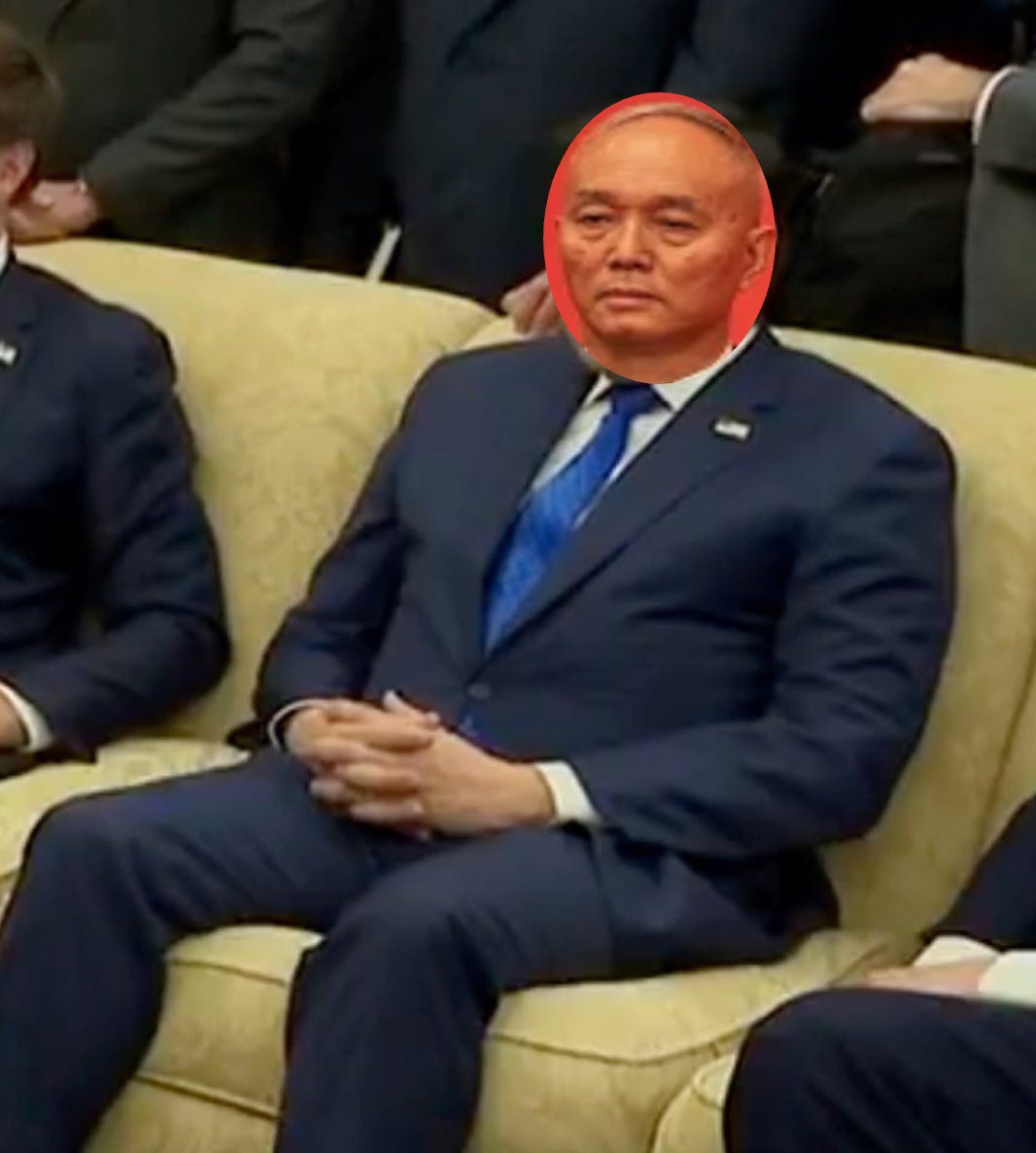
Here are my three observations:
First, under nearly any other system an official being sent to run a school for the political party would be a signal of that individual’s political irrelevance. In this case, we see how central and important ideology is to Xi Jinping’s Communist Party and more importantly, how “correct ideology” is a priority of Xi Jinping… only the most trusted insider can be given that task.
Second, if Xi Jinping dropped dead of a stroke tomorrow (in other words, he pulled a Joe Stalin), my prediction is that Cai Qi (70) would become the “first among equals” and de facto leader. He would likely move quickly to consolidate his power and ensure that any potential challenger to his assumption of leadership would be sidelined. His one challenge is that he is less than three years younger than Xi (73), so he is just as suspectable to failing health.
Third, Cai Qi’s competence and clear ability to fill Xi’s shoes will likely become a liability for him as Xi Jinping gets older and even more paranoid… especially if Cai Qi remains healthier than his boss. Cai Qi must know that at one time General Zhang Youxia (75) thought he had Xi’s confidence. This dynamic could create the scenario in which Cai acts preemptively if he suspects Xi might turn on him.
Do not forget that internal CCP politics is a bloodsport… just ask Lin Biao.
China as an absolute advantage economy
Yasheng Huang, June 22, 2026
The puzzle is not why China exports cars but why it is still exporting t-shirts.
In college, students are taught in an introductory economics class a famous theory about international trade, and the first thing to notice about it is that it contains no competition at all. The theory is David Ricardo’s comparative advantage, and his classic illustration uses two countries, England and Portugal, each making two goods, cloth and wine. Portugal, as it happens, can make both more cheaply than England. Ricardo’s incredible insight was that this does not determine economic welfare. What matters is relative cost. Portugal is better at wine than at cloth, so it should make wine; England is comparatively better at cloth, so it should make cloth; and the two countries trade with each other.
Notice what does not happen in this story. England and Portugal do not compete. They do not both fight over the wine market or both fight over the cloth market. Each specializes in one thing, gives up the other, and both end up supposedly better off. Comparative advantage is a theory about dividing up the work, not about competing for it. It also predicts that as a country grows richer and its wages rise, it will hand off the simple, labor-intensive goods such as textiles and shoes and move up into more advanced ones such as machinery and semiconductors.
To make sense of China, it helps to put Ricardo down and pick up Michael Porter. Where Ricardo’s theory has no competition in it, Porter’s theory of competitive advantage is about nothing else. It asks how the firms of a country come to beat their rivals and keep on beating them, through their suppliers, their skills, their infrastructure, and above all their scale. China is all about competition, in exactly Porter’s sense. It does not pick a few things to specialize in and trade the rest away. It competes, head to head, across the entire range of products, with everyone.
This is what I mean when I call China an absolute-advantage economy. The simplest way to define China’s absolute advantage is this: it competes with America and with Africa at the same time. At the top of the market it goes up against the United States, in artificial intelligence, electric vehicles, and electronics. At the bottom it goes up against the poorest countries in Africa, in textiles, clothing, and cheap household goods. Almost no economy in history that I know of has managed both at once, because the two ends of the market usually demand opposite things. Competing at the high end requires cheap and plentiful capital; competing at the low end requires cheap labor.
Understanding how China has arranged to have both unlocks the deepest mystery of that country. It somehow holds a capital-cost advantage and a labor-cost advantage at the same time. You can see the pattern plainly in the trade data. (I am working with a colleague on an academic paper on this topic.) A simple way to tell what a country is good at is to compare, industry by industry, how much it exports with how much it imports of the same product: China’s shoe exports against its shoe imports, its apparel exports against its apparel imports, its aircraft exports against its aircraft imports. Ricardo’s theory predicts that as a country grows richer this ratio should rise for advanced products and fall for simple ones, as the country climbs out of the bottom.
That is what happened in South Korea and Taiwan, but not in China. (By the way, the idea that China has pursued an East Asian model is plainly wrong. I will take up this issue in a book project I am starting to formulate.) Across ninety-eight industries, spanning every level of skill and labor intensity, the ratio rose almost everywhere between the mid-2000s and 2023, a stretch in which China’s income per person rose about sixfold. Between 2012 and 2023, aircraft became roughly seven times more competitive and motor vehicles three and a half times, just as one would expect of a richer country. But over the very same years knitted fabric also became about seven times more competitive, carpets nearly three times, and furniture and umbrellas rose as well. China pulled ahead of the world in jet engines and in umbrellas at once.
COMMENT – A spectacular post by Yasheng, I really respect his work and glad to see him start a Substack!
The Mirage of China’s Military Edge
Dennis Blair, Foreign Affairs, June 23, 2026
If China were to seize control of Taiwan by force, it would be a disaster, not only for Taiwan but also for the United States. A nearly $1 trillion economy would leave the free-market system and be incorporated into China’s state-directed, mercantilist one. A vibrant democracy nurtured and defended by the United States for many years would be snuffed out. American power and influence would be gravely diminished in East Asia, and China would become the region’s dominant power. Other governments there would be pressured to accommodate China’s political, economic, and even territorial demands. Beijing would certainly insist that they kick out U.S. forces. China’s global ambitions, meanwhile, would only grow.
Whether any of this might come to pass, however, hinges on China’s ability to take and hold Taiwan. The high-paced military buildup Beijing has undertaken over the past 30 years has yielded impressive improvements, and China’s interest in expanding its power and influence is obvious. But until China can be confident that an invasion of Taiwan would succeed—a lofty threshold to reach—improving capabilities and clear ambition are not enough reason for Beijing to use force. Military aggression short of a full-scale invasion would be foolhardy: it would not deliver the Chinese Communist Party the political ends it seeks, and it would risk the party’s grip on power.
The reality today is that China is not capable of conquering Taiwan. Nor is it likely to gain this capability any time soon. China’s buildup once threatened to shift the military balance in Beijing’s favor, but trends in military technology now favor Taiwan and the United States, not China. Recognition of China’s threat has motivated not just Taiwan and the United States but also Japan, the Philippines, and other countries both in the region and beyond to act to deter aggression by Beijing. Chinese leaders can still issue threats, run simulated attacks, and violate Taiwan’s maritime borders. For the foreseeable future, China can at any time inflict massive damage on Taiwan with military force. The danger is great enough to constrain Taiwan’s policies, deterring Taipei from declaring independence and compelling it to make the occasional political concession. Yet without the ability to conquer, China is constrained, too, and any rational Chinese government will avoid taking military action in the first place.
This stalemate has persisted for the past three-quarters of a century, since Chiang Kai-shek lost the Chinese Civil War on mainland China and fled to Taiwan. Maintaining it depends, in part, on understanding the current military balance. Alarmist predictions that China is outpacing the United States and will soon be able to win a war for Taiwan can encourage China and discourage combined action by Taiwan and its supporters. These pessimistic readings make it more difficult for Chinese leaders to accept the reality of the stalemate and return to their strategy of biding time when it comes to Taiwan.
COMMENT – The former Commander of U.S. Pacific Command and former Director of National Intelligence provides a much needed corrective on the true capabilities of the People’s Liberation Army.
China Makes New US Warship Target for Missile Tests, Images Show
Bloomberg, June 24, 2026
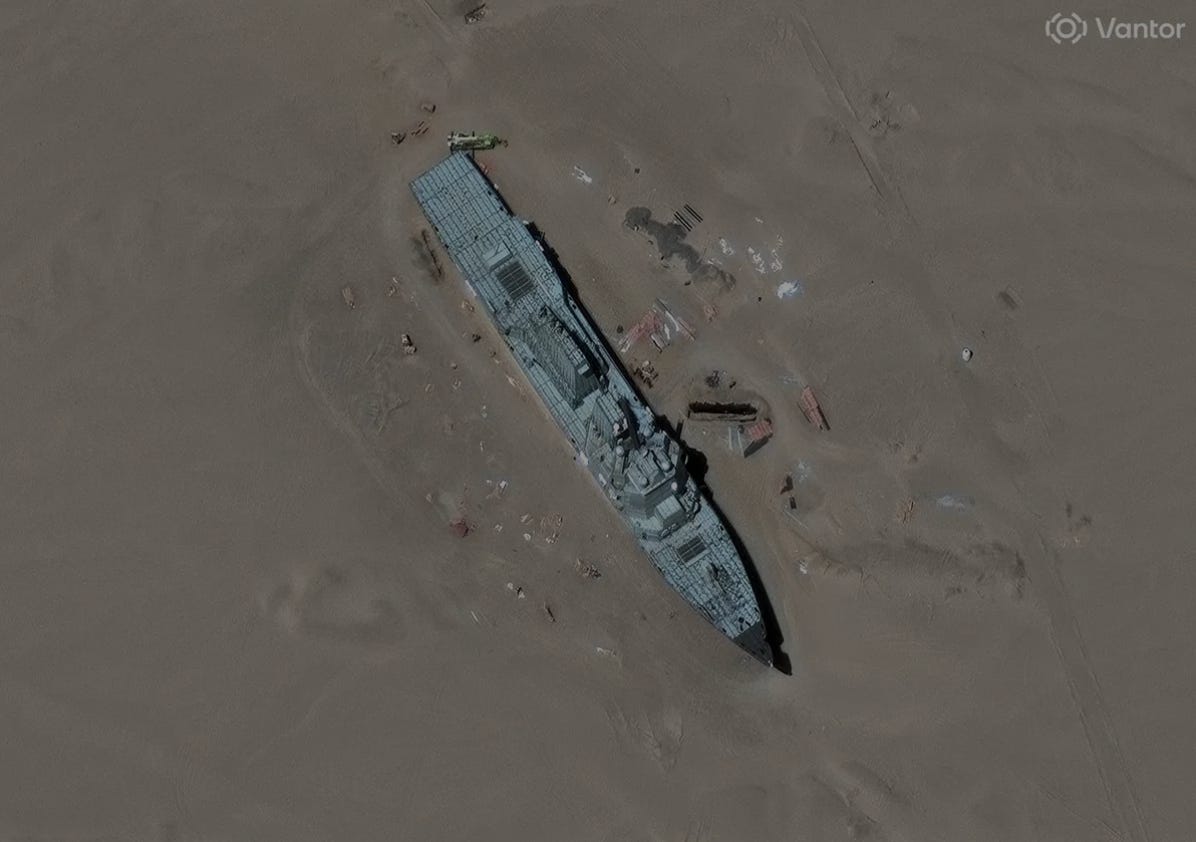
China has built a new US destroyer replica at a remote missile-testing site in its northwestern desert, satellite imagery shows, a target analysts say could be used to test anti-ship weapons.
Satellite images show a structure resembling a US Navy Arleigh Burke-class guided-missile destroyer in the Taklamakan Desert in far-western Xinjiang since at least June. The feature was first identified by Joseph Wu, co-founder of the Taiwan Defense Studies Initiative.
COMMENT – And I still hear former senior U.S. officials saying that the PRC never conducts military aggression.
China’s tribute system and the new world order
Ray Dalio, Financial Times, June 18, 2026
…
I have been visiting China for 42 years and am committed to mutual US-Chinese understanding. I believe it is essential to understand China’s perspective, which is rooted in lessons from history as reflected in Confucian culture, the tribute system and Beijing’s Art of War approach to conflict. Also, the century of humiliation in which foreign powers took control of large parts of China and exploited it — including Japan’s occupation of Taiwan from 1895 until its return to China in 1945 — has deeply affected China’s psychology and strategic direction.
The tribute system was informed by Confucian values — in particular the idea that order comes from having clearly defined hierarchical roles. Relations within it are not between equals, but between superiors and subordinates that recognise their relative positions. The more powerful ones in the hierarchy should treat the less powerful well, and the less powerful should treat the more powerful well, so that there is harmony. If a lesser power treats the greater power inappropriately, the more powerful one punishes it, typically not violently but through pressure and deception. As Sun Tzu wrote in The Art of War, “to subdue the enemy without fighting is the acme of skill”.
As an extension of these cultural beliefs, Chinese leaders do not seek to build empires to control other countries because they view doing so as ineffective. Their approach is quite different from what they see as the western approach of fighting to take over others’ territories and trying to control them.
…
COMMENT – I’ve never read a more cliché filled piece of Orientalism (Edward Said would be outraged). Ray Dalio effectively reduces all Chinese people and their vast and diverse culture to a caricature.
Dalio simply swallows whole the self-serving propaganda of his Chinese Communist Party hosts over the last 42 years.
In many ways, he personifies the Spillover Fallacy.
Authoritarianism
U.S. Senate, June 16, 2026
IN THE SENATE OF THE UNITED STATES, on October 9, 2025, Mr. Scott of Florida submitted the following resolution; which was referred to the Committee on Foreign Relations
On June 16, 2026, Committee discharged; considered and agreed to RESOLUTION
Condemning the dictator of the People’s Republic of China, Xi Jinping, for deceit, undermining prospects for peace and security, and orchestrating crimes against humanity.
Whereas Xi Jinping is the leader of the Chinese Communist Party, a criminal organization posing a grave threat to global stability and peace;
Whereas, under the control of General Secretary Xi Jinping, the Chinese Communist Party has engaged in systemic deception, warmongering, and crimes against humanity, the likes of which have few historical parallels;
Whereas, under the leadership of Xi Jinping, the Chinese Communist Party routinely lied about the origins of the SARs–CoV–2 virus, using international organizations like the World Health Organization to peddle falsehoods regarding the supposed limited transmissibility of the virus;
Whereas the number of individuals from the United States who have died from the coronavirus exceeds 1,000,000, representing the many lives needlessly lost as a result of the lies and deceit of the People’s Republic of China;
Whereas General Secretary Xi Jinping pledged to engage more fully in fentanyl cooperation with the United States in 2019 and again in 2023, only to see more than 70,000 individuals from the United States die from fentanyl overdoses in recent years, with the 2025 National Drug Threat Assessment stating that “fentanyl and other synthetic drugs … are the primary drivers of fatal drug overdose deaths nationwide”;
Whereas, from sewage garlic to broken magnetic chess pieces, the Chinese Communist Party maintains an appalling record on consumer product safety;
Whereas a 2015 study by the National Institutes of Health determined that human waste is used as an agricultural fertilizer in the People’s Republic of China;
Whereas Xi Jinping has doubled down on Communist China’s proud tradition of cheating in trade and purposefully ignoring World Trade Organization obligations;
Whereas the People’s Republic of China was granted entry into the World Trade Organization in December 2001, and pledged to transition to a more market-oriented economy by reducing state control over trade and investment, removing price controls, protecting intellectual property, and making numerous other promises;
Whereas, as of the date of the introduction of this resolution, the Chinese Communist Party continues to lie and fails to uphold many of their obligations on which their admission to the World Trade Organization was based;
Whereas, under the rule of Xi Jinping, Communist China has become the largest official debt collector in the world, with 80 percent of the overseas lending portfolio of the People’s Republic of China going to countries in financial distress;
Whereas the Belt and Road Initiative, developed by Xi Jinping, promises only the loss of sovereignty and long-term economic and environmental devastation;
Whereas the Sino Metals disaster, a story that the Government of the People’s Republic of China has worked to suppress in the international press, is yet another example of predatory lending practices by the People’s Republic of China;
Whereas, on February 18, 2025, a tailings dam failure at a major Chinese-owned copper mine in northern Zambia released more than 50,000,000 liters of toxic waste into the Kafue River, Zambia’s lifeline, devastating the ecosystem, destroying crops, and threatening the health and livelihoods of more than 60 percent of the Zambian population living within the river basin, many of whom depend on the river for drinking water, agriculture, and fishing;
Whereas the pH level, a quantitative measure of the acidity or basicity of aqueous or other liquid solutions, of the Kafue River was at least as low as 1.8 following the spill, transforming the substance of the river from water to something closer to stomach acid, which has a pH level of 1;
Whereas, in June 2025, Chinese nationals were charged in a criminal complaint with conspiracy, smuggling a dangerous biological pathogen into the United States, false statements, and visa fraud;
Whereas the Chinese Communist Party, under the rule of Xi Jinping, has accelerated espionage efforts, including through the 2017 cyberattack of the credit reporting agency Equifax, stealing the addresses, birth dates, Social Security numbers, and other data of 145,000,000 individuals from the United States;
Whereas, from February 2021 to December 2024, more than 60 Chinese Communist Party-related espionage cases have been documented across 20 States, including the opening and operations of clandestine “police stations” on United States soil;
Whereas the Chinese Communist Party, led by Xi Jinping, has increasingly compromised regional and international stability through its commitment to taking Taiwan by force, violating territorial integrity and Air Defense Identification Zone (ADIZ) of Taiwan, supporting state sponsors of terrorism, and aligning itself with the Russian Federation in the unjustified assault by the Russian Federation against Ukraine;
Whereas, according to data from the Ministry of National Defense of Taiwan, aircraft from the People’s Liberation Army conducted more than 3,600 flights into the ADIZ in 2024, setting a new record;
Whereas, in spite of any claim to Taiwan, the Chinese Communist Party, which has not ever ruled Taiwan, continues to cause enormous harm to the well-being of neighboring countries and allies of the United States;
Whereas, under the rule of Xi Jinping, Communist China has engaged in a pattern of harassment and intimidation against Philippine vessels in the West Philippine Sea, endangering Filipino maritime personnel, threatening freedom of navigation, and destabilizing regional peace and stability;
Whereas the People’s Republic of China accounts for an estimated 90 percent or more of the total trade of the Democratic People’s Republic of Korea, and purchases up to 90 percent of the oil exports of the Islamic Republic of Iran;
Whereas the Chinese Communist Party, under the rule of Xi Jinping, is pledging the expansion of the China-Pakistan Economic Corridor to Taliban-controlled Afghanistan;
Whereas, under the rule of Xi Jinping, the Chinese Communist Party is guilty of orchestrating a horrific, modern-day genocide of the Uyghur people and other Muslim populations in the Xinjiang Uyghur Autonomous Region, also known as East Turkistan;
Whereas, under the rule of Xi Jinping, the Chinese Communist Party holds upwards of 1,000,000 Muslim Uyghurs in prison and labor camps, and forces female spouses of Uyghur men in prison camps to share beds with Han Chinese males assigned by the state;
Whereas the designation of genocide against the Uyghur people was made by President Trump in 2021 and confirmed by the Biden Administration;
Whereas, during the tenure of Xi Jinping as General Secretary, Communist China has harvested the organs of political dissidents, most notably Falun Gong practitioners;
Whereas the Tiananmen Square Massacre of June 3 and June 4, 1989, even 36 years later, continues to serve as a stark reminder of the sheer evil and cowardice of the Chinese Communist Party and the inability of the Chinese Communist Party to squash the aspirations of the Chinese people;
Whereas, in 2020, the Chinese Communist Party significantly expanded mass forced labor in Tibet, and continues to engage in enforced disappearance, torture, cruel, inhumane, and degrading treatment of Tibetans, denying them of their unique cultural identity;
Whereas, in 2020, Communist China enacted a national security law, compromising the basic freedoms of Hong Kongers and unjustly imprisoning political prisoners of conscience, including Apple Daily founder Jimmy Lai;
Whereas, under the rule of Xi Jinping, Communist China has continued to send defectors from the Democratic People’s Republic of Korea back to that country, despite an elevated risk of execution and torture for defectors; and
Whereas Christians of all backgrounds are persecuted in the People’s Republic of China, especially Christians not adhering to the Catholic or Protestant state-sanctioned “patriotic religious associations”, which serve as propaganda arms for the Chinese Communist Party and Xi Jinping Thought on Socialism with Chinese Characteristics for a New Era: Now, therefore, be it
Resolved, That the Senate—
(1) condemns the dictator of the People’s Republic of China, Xi Jinping, for engaging in a pattern of deceit, undermining prospects for peace and security, and orchestrating crimes against humanity;
(2) stands in solidarity with the people of the People’s Republic of China, and all people around the world who have endured the consequences of rule by the Chinese Communist Party; and
(3) encourages the application of all applicable sanctions authorities against officials of the Chinese Communist Party, including sanctions authorized by the Global Magnitsky Human Rights Accountability Act
COMMENT – Worth reading in full what the Senate passed.
Tyler Durden, Zero Hedge, June 19, 2026
The Long Arm of the Chinese Academy of Sciences
Savannah Billman, The Wire China, June 21, 2026
News extortion is rife in China
The Economist, June 18, 2026
What the West Can Learn from China—Without Becoming It
Lingling Wei, Wall Street Journal, June 23, 2026
How China Undercuts the U.S. in Iran
Rory Jones, Austin Ramzy and Costas Paris, Wall Street Journal, June 23, 2026
China detains two Japanese nationals over alleged rare earth smuggling
Leo Lewis and Joe Leahy, Financial Times, June 24, 2026
China Detained 2 Japanese on Suspicion of Smuggling
Javier C. Hernández and Hisako Ueno, New York Times, June 24, 2026
The Japanese nationals were detained in May in the northeastern Chinese city of Dalian, Japan’s government said, amid tensions between the two countries.
China has detained two Japanese citizens on suspicion of smuggling banned products, the Japanese government said on Wednesday, adding to rising tensions between the two countries.
The Japanese nationals were detained in May in the northeastern Chinese city of Dalian, according to a statement by Japan’s government. Chinese officials have indicated that they are being held on “on suspicion of violating the law and smuggling goods that are prohibited from being imported or exported,” Minoru Kihara, a top Japanese cabinet official, said at a news conference in Tokyo on Wednesday.
He added that Japan is working to “respond appropriately from the perspective of protecting Japanese nationals.”
Guo Jiakun, a spokesman for China’s Ministry of Foreign Affairs, confirmed the detentions on Wednesday, saying at a regular news conference in Beijing that the Japanese nationals were being held for “violating Chinese law.”
He did not provide details, saying only that the Japanese government “should educate and remind Japanese citizens and enterprises in China to abide by Chinese laws and regulations.”
COMMENT – Don’t travel to the PRC. You never know when the CCP may decided to use you to make a geopolitical point or as leverage against another government.
China’s premier says competitiveness not down to subsidies
Thomas Hale and Eleanor Olcott, Financial Times, June 24, 2026
Beijing Unfazed by China Shock 2.0 as Premier Touts Openness
Bloomberg, June 24, 2026The US town, the Chinese company and the bankrupting battle over a battery plant
Khushboo Razdan, South China Morning Post, June 21, 2026
Environmental Harms
How to power data centres
Lucy Colback, Financial Times, June 24, 2026
Beijing’s Bullying of Taiwan Threatens Ocean Ecology
Yu-Tzu Lin, The Diplomat, June 19, 2026
China and the West are taking opposite paths on EV battery recycling
Indranil Ghosh, Rest of World, June 24, 2026
Foreign Interference and Coercion
In AI Pitch, Alibaba Chairman Urges Europe to Look Beyond U.S. Tech
Kelsey Cheng, Caixin Global, June 22, 2026
European companies should diversify their artificial intelligence (AI) technology suppliers so they are not too dependent on U.S. platforms, Alibaba Chairman Joe Tsai said, in an argument in favor of open-source Chinese models.
When asked at the VivaTech conference in Paris on Thursday whether Europe could trust China not to one day cut off access to its technology, Tsai responded that “you can’t.”

COMMENT – This is the same Joe Tsai who owns the NBA’s Brooklyn Nets and the WNBA team New York Liberty. This is the same Joe Tsai who led the campaign to fire Darryl Morey, the General Manager of the Houston Rockets, in late 2019 when Darryl tweeted in support of the Hong Kong pro-democracy activists. This is the same Joe Tsai who contributes funding to various U.S. universities for their China programs.
It might be time to look more closely at Joe Tsai.
Anthropic accuses Alibaba of obtaining illicit access to Claude
Demetri Sevastopulo and Cristina Criddle, Financial Times, June 24, 2026
AI company says the Chinese ecommerce giant used fake accounts to ‘extract’ chatbot’s capabilities.
Anthropic has accused Chinese ecommerce giant Alibaba of obtaining illicit access to Claude by creating fake accounts designed to access the AI model which the American company does not offer to Chinese groups.
In a letter to Congress, Anthropic said Alibaba had conducted the “largest campaign to illicitly extract Claude’s capabilities”. It said the Chinese company used 25,000 fraudulent accounts to generate over 28.8mn exchanges with Claude, which it said was a violation of its terms of service.
“Alibaba’s campaign targeted some of Claude’s most valuable capabilities, such as agentic reasoning, software engineering, and long-horizon tasks,” Anthropic wrote in a June 10 letter to the Senate Banking Committee.
Anthropic urged Congress to “close loopholes allowing PRC [People’s Republic of China] AI labs to access advanced US chips, and penalise PRC labs responsible for distillation attacks”, according to the letter, which was obtained by the FT.
The accusation comes as US pressure mounts on Alibaba, which is involved in businesses from ecommerce to cloud computing. The company this week asked a US court to remove it from a Pentagon blacklist of Chinese companies with alleged ties to China’s People’s Liberation Army.
The FT in November reported the White House had concluded that the Hangzhou-based group had provided technological support for Chinese military “operations” against unspecified US targets. The claim, which the company strongly denied, came in a White House memo obtained by the FT that was based on declassified “top secret” intelligence.
Alibaba has denied having any connection to the PLA. It did not respond to a request for comment about the accusations from Anthropic.
Anthropic has previously accused Chinese AI labs DeepSeek, Moonshot and MiniMax of so-called distillation, claiming they “illicitly” used Claude’s outputs to train their respective models. OpenAI has also accused Chinese groups of engaging in the same behaviour.
In its letter, Anthropic said Alibaba’s campaign to access Claude occurred between late April and early June. It said the distillation attack followed the same pattern as DeepSeek, Moonshot and MiniMax, which had generated a total of 16mn exchanges with Claude through 24,000 fraudulent accounts.
COMMENT – This is just a general observation from someone who admittedly is NOT an expert in the details of building AI models, but perhaps, just perhaps, the moat around these advanced AI models isn’t very deep.
While they are certainly very expensive to build, they appear relatively easy to copy, particularly in jurisdictions where the original company essentially has no ability to prevent it from happening, which makes these models much less valuable.
If models can essentially be commodified and provided for essentially free, why would folks pay a lot for the original?
Alibaba Files Lawsuit Against Pentagon Seeking Removal from Military List
Tracy Qu, Wall Street Journal, June 24, 2026
Alibaba Sues Pentagon Over China Military Label
Meaghan Tobin, New York Times, June 24, 2026
Australian Beef Exports Face 55% China Tariff as Quota Reached
Ben Westcott, Bloomberg, June 19, 2026
Australians Value China Ties Over US as Trump Confidence Slumps
Michael Heath, Bloomberg, June 22, 2026
China restricts trading with some US rare earth companies
Edward White, Financial Times, June 22, 2026
China Flexes Its Rare-Earth Muscle—Again
Christina Lu, Foreign Policy, June 22, 2026
China tightens indium export checks as AI demand increases
Solomon Cefai, Reuters, June 19, 2026
China Slaps Restrictions on Dozens of U.S. Companies
Katrina Northrop, Wall Street Journal, June 22, 2026
EU joins US pact to break reliance on Chinese AI supply chains
Demetri Sevastopulo, Financial Times, June 24, 2026
China’s Li-Ning banks on Stephen Curry in ‘partnership of a lifetime’
Yui Yamashita, Nikkei Asia, June 24, 2026
Human Rights and Religious Persecution
China says it has a right to target people overseas with new ethnic unity law
Reuters, June 24, 2026
China has a right to target people outside of its borders who contravene its new law on ethnic unity, a senior official said on Wednesday, adding that this was in line with international practice, and was legal and necessary.
China passed the law in March to create a “shared” national identity among the country’s 55 ethnic minority groups, which include Tibetans and Uyghurs, some of whom chafe under Chinese rule and have over the years often staged protests, some of them violent.
The new law, which goes into effect on July 1, includes a clause saying people and groups beyond the borders of the People’s Republic of China can be held legally accountable for undermining “ethnic unity and progress or inciting ethnic separatism”.
That has sparked alarm in Chinese-claimed Taiwan in particular that it could give Beijing another legal basis to go after Taiwanese it views as separatists. Rights groups have also complained that China has tried to used Interpol “red notices” to try and get foreign governments to arrest people abroad it wants for political offences at home.
Speaking at a news conference in Beijing about the law, Vice Justice Minister Hu Weilie said certain Western media, which he did not name, had “distorted and misinterpreted” the overseas provision.
“This provision is based on China’s national conditions, conforms to legal principles, and is consistent with international practice. It is a legitimate, lawful, necessary, and feasible legal provision,” he said.
“Countries around the world all have the right to prevent separatist and destructive activities, and to maintain social solidarity and normal order, through domestic legislation.”
The overseas provision targets illegal acts and uses rule-of-law methods to “guard against various unlawful acts involving ethnic affairs from outside the country”, he added.
Enforcing the law’s overseas provision will effectively safeguard China’s sovereignty, security, and development interests, as well as the lawful rights and interests of people of all ethnic groups, Hu added.
“It will not affect normal people-to-people exchanges between China and other countries, academic discussions, economic and trade cooperation, or other activities.”
UN rights chief censored by his own office on his remarks on China’s ethnic unity law?
Tibetan Review, June 20, 2026
The top human rights officer of the United Nations on Jun 15 expressed “serious concern” on China’s recently adopted Law on Promoting Ethnic Unity and Progress, saying it “could deepen existing restrictions on minority communities” and called for its repeal, said the Office of Tibet, Geneva, of the Central Tibetan Administration in a report posted on its Tibet.net website Jun 20. However, the audio-visual extracts of his speech posted on his official website, does not contain any mention of any portion this part of his remarks.
The occasion was Mr Volker Türk, the UN High Commissioner for Human Rights, presenting his Global Update on the human rights situation across the world on the opening of the 62nd session of the UN Human Rights Council in Geneva.
UNHRC commissioner warns China’s ethnic unity law threatens minority identities
Tribune India, June 22, 2026
China Pushes Ahead with the Sinicization of Buddhism Through Its Five-Year Plan
Dong Deming, Bitter Winter, Jun 24, 2026
The Sinicization of Buddhism is advancing with renewed intensity. On May 26, the Chinese Buddhist Association convened the directors and deputy directors of its nine specialized committees in Wuxi, Jiangsu. The meeting was presented as a routine gathering, yet its content indicates that the 2023–27 Five-Year Plan Outline for the Sinicization of Buddhism is being implemented and is almost complete. The agenda focused on the political tasks assigned to Buddhism in the current phase of the CCP’s religious policy, and the language used throughout the event reflected the Party’s priorities rather than the concerns of the Buddhist tradition.
The meeting opened with a reminder that the committees are expected to implement the religious directives of the current national planning cycle. The participants were told to deepen their study of Xi Jinping’s statements on religion and to apply the Party’s theory of religious work to every aspect of Buddhist activity. The emphasis on political alignment was constant. The committees were instructed to integrate the decisions of the Party leadership into all professional fields of Buddhist work and to ensure that the direction of Sinicization remains the guiding thread of their tasks.
Human Rights Watch, June 25, 2026
For women in China frustrated by sexism, female comics are offering a release
Amy Hawkins, The Guardian, June 19, 2026Lifechanyuan: Facing a New Wave of Repression in China
Massimo Introvigne, June 25, 2026
Justices Reject Lawsuit Claiming U.S. Company Helped China Target Spiritual Group
Abbie VanSickle, New York Times, June 23, 2026
Redirected Risk: Uyghur Forced Labor and the Enforcement Gap in Australia and Japan
Elijah Pockell-Wilson, Uyghur Human Rights Project, June 23, 2026
Tibet–Taiwan Roundtable in Geneva Highlights Human Rights, Democracy, and Regional Security Concerns
Central Tibetan Administration, June 25, 2026
Human Rights Watch, May 4, 2026
Industrial Policies and Economic Espionage
Alan Estevez on Why Export Controls Work
Noah Berman, The Wire China, June 21, 2026
The USMCA Review Will Be a China (and Asia) Policy Test for Mexico
Jorge F. Vuelvas Lomeli, The Diplomat, June 18, 2026
How China still outworks the West
The Economist, June 18, 2026
US Tells ASML It’s Concerned China May Have Top Chip Tool
Mackenzie Hawkins and Jenny Leonard, Bloomberg, June 19, 2026Netherlands Lobbies US to Drop Chip Curbs Targeting ASML
Patrick Van Oosterom and Sarah Jacob, Bloomberg, June 24, 2026
Xi Jinping wants China to boost demand. Why isn’t it working?
Thomas Hale, Financial Times, June 19, 2026
Kazakhstan enters rare earths, minerals race as China alternative
Joe Luc Barnes, Nikkei Asia, June 21, 2026
Chinese Steel Market Enters Long Plateau After Property Crash
Katharine Gemmell, Bloomberg, June 21, 2026
China’s CATL bets battery swapping will cut costs for Europe’s electric trucks
Kana Inagaki and Edward White, Financial Times, June 21, 2026
Chinese Export Flood Tests Europe’s Stomach for Trade War with Beijing
Kim Mackrael and Laurence Norman, Wall Street Journal, June 22, 2026
Europe Sees 6 billion Reasons for New Levy on Online Shoppers
Brendan Murray, Bloomberg, June 23, 2026
U.S. to Speed Up Early Drug Research to Better Compete with China
Liz Essley Whyte and Xavier Martinez, Wall Street Journal, June 22, 2026
China pays price for ‘Ponzi scheme’-driven property boom
Kensaku Ihara, Nikkei Asia, June 22, 2026
‘China Initiative 2.0’: US crackdown on Chinese scholars intensifies
Nayan Seth, South China Morning Post, June 24, 2026
Cyber and Information Technology
China’s 360 says it has developed tools to match Anthropic’s Mythos
Eduardo Baptista, Reuters, June 24, 2026
How Hackers Found a Back Door into the American Living Room
Robert McMillan, Wall Street Journal, June 17, 2026U.S. Bans Polestar, Chinese-Owned EV Maker, From Selling Cars in the U.S.
Ryan Felton, Wall Street Journal, June 25, 2026
Surrounding American AI from the South
Alex Colville, The Wire China, June 21, 2026Google exposes China espionage group that’s been lurking in networks undetected since 2023
Matt Kapko, Cyberscoop, June 15, 2026
China Takes Supercomputer Crown from U.S. for First Time Since 2017
Don Clark, New York Times, June 23, 2026
Robots will replace 700,000 delivery workers ‘sooner or later’, warns JD.com boss
Joe Leahy, Financial Times, June 22, 2026
This Megafactory Is a Test Case for the U.S.-China Tech Race
Ana Swanson, New York Times, June 23, 2026
China expo draws Nvidia, Apple, Micron as Beijing guards AI supply chain
Shunsuke Tabeta, Nikkei Asia, June 23, 2026
Nvidia’s banned AI chips double in price on China’s black market
Eleanor Olcott, Financial Times, June 24, 2026
Military and Security Threats
How China’s Navy Is Tightening the Noose on Taiwan
Wall Street Journal, June 22, 2026
Amid PLA pressure, Taiwan starts drill to simulate rapid deployment in a crisis
Lawrence Chung, South China Morning Post, June 22, 2026
How China’s Navy Is Tightening the Noose on Taiwan
Niharika Mandhana, Joyu Wang and Daniel Kiss, South China Morning Post, June 22, 2026
Taiwan says warning time for any China attack is shortening
Ben Blanchard, Reuters, June 24, 2026‘Salami slicing’: How China is trying to increase control in the Pacific
Brad Lendon, Sylvie Zhuang, and Wayne Chang, CNN, June 25, 2026
Philippines fears China may move to seize full control of disputed atoll
Demetri Sevastopulo, Financial Times, June 22, 2026
China’s Latest Tool to Control a Disputed Atoll: A Strange Floating Platform
Mike Cherney, Wall Street Journal, June 22, 2026
As Europe rearms, can it decouple its military supply chains from China?
Seong Hyeon Choi, South China Morning Post, June 22, 2026
China and Philippines have a rare naval stand-off near disputed Scarborough Shoal
William Zheng, South China Morning Post, June 23, 2026
One Belt, One Road Strategy
Is China’s risk tolerance reaching its limit with pause of African mine deal?
Dulue Mbachu, South China Morning Post, June 22, 2026
The real winner in Myanmar’s civil war is China
The Economist, June 22, 2026China’s bear hug won’t save Myanmar’s Min Aung Hlaing
James Shwe, Asia Times, June 24, 2026
China rolled out the red carpet for Myanmar’s Min Aung Hlaing, feting a general who can’t deliver what Beijing wants and needs.
When Chinese President Xi Jinping welcomed Myanmar coup-maker Senior General Min Aung Hlaing to Beijing on June 15 with full state-visit honors — Huawei phone gift included — the choreography was meant to read as consolidation.
Five days later, when UN Special Envoy Julie Bishop stood at the General Assembly and used the titles “President Win Myint” and “State Counsellor Aung San Suu Kyi” — the constitutionally legitimate officeholders deposed in a 2021 coup — the gap between Beijing’s ambition and its actual reach became the most important fact in Myanmar’s war.
China’s influence in Myanmar is real but it is also highly exposed. The 18 cooperation documents signed during the visit covered transport, public health and media. However, the two unsigned documents mattered more.
That is, there was no agreement on the Kyaukphyu deep-sea port, the flagship of China’s Indian Ocean access strategy, nor on the Muse–Mandalay railway, the spine of the China-Myanmar Economic Corridor.
Three years after Beijing first framed the CMEC as the deliverable of its Myanmar bet, and two months after Min Aung Hlaing’s staged December–January sham election produced his self-installed “civilian presidency,” those anchor projects remain unsigned exactly because Min Aung Hlaing cannot deliver the territory through which China’s hoped-for pipelines, rails and roads run.
Opinion
Hamilton Inspires Trump’s Economic Statecraft
Treasury Secretary Scott Bessent, Wall Street Journal, June 23, 2026
Don’t Let China Stack the Deck
Suzanne Nossel, Foreign Policy, June 22, 2026Why Xi is walling in China’s money – and why it won’t work
William Pesek, Asia Times, June 18, 2026
Beijing’s new crackdown on cross-border capital flows risks spooking the very investors China needs to restore confidence at home.
China’s latest fix for its ailing economy: build a better birdcage.
The metaphor runs deep in Chinese culture, where enclosures for pet birds have long captured the tension between freedom and control — the belief that markets, like captive creatures, need defined limits or they descend into chaos. But Xi Jinping’s attempt to cage Chinese citizens’ money movements abroad probably won’t fly as intended.
In recent weeks, Beijing has moved to seal off the channels through which its 1.4 billion citizens send capital overseas. On May 22, the China Securities Regulatory Commission cracked down on unlicensed brokers funneling investor money into foreign markets. Regulators are now pressing Hong Kong and Singapore brokerages to wind down their cross-border securities, futures, and fund businesses.
The CSRC is working on a two-year timeline and, officially, the target is “illicit” flows. But the shift in mood alone is likely to have an unintentional chilling effect on Asia’s largest economy.
The risk, says Ashwin Binwani, founder of Singapore-based Alpha Binwani Capital, is that the crackdown turns “significantly worse” — spreading into a broader, market-spooking clampdown. Economist Gary Ng at Natixis notes that the “biggest problem is that you never know how far the crackdown on cross-border capital flow can go,” which is sure to reverberate through Hong Kong’s financial sector.
China Could Win Taiwan Without Fighting
Richard Haass and David Sacks, Foreign Affairs, June 22, 2026
How America Lost Command of the Commons
Isaac Kardon, Foreign Affairs, June 9, 2026
The Coming Quantum National Security Crisis
Anne Neuberger, Foreign Affairs, June 17, 2026
Why “China First” Will Fail
Patricia M. Kim, Foreign Affairs, June 24, 2026China’s Scholars Do Not Deserve Equal Footing with Western Academics
Miles Yu, Hudson Institute, June 22, 2026
The greatest mistake American universities, think tanks and policymakers make when engaging scholars from the People’s Republic of China is assuming that both sides participate in the same intellectual system. They do not.
American academics operate within a culture that prizes free inquiry, open debate, dissent and the pursuit of truth wherever it leads. Chinese scholars operate within a political system that demands unanimity of opinion. Challenging the Chinese Communist Party on any matter, big or small, can end a career, deepen surveillance or trigger criminal punishment.
To treat these two groups as intellectual equals in a free marketplace of ideas is not enlightened but rather dangerously self-kidding.
The issue is not whether Chinese scholars are intelligent or capable. Many are. The issue is whether they are free.
Why sinodollars outweigh the petroyuan
Robin Harding, Financial Times, June 22, 2026
China’s Ambitious AI Blueprint
Walter Russell Mead, Wall Street Journal, June 22, 2026