Interlinked
Toto’s “Africa” and Vladimir Nabokov’s Pale Fire.
Friends,
First up, a correction from last week’s edition: Schrödinger’s Strait.
I wrote that France voted with Russia and the PRC against the UN resolution that would have permitted the Gulf States to defend themselves from attacks by Iran on their infrastructure.
That was wrong.
France did not vote with Russia and the PRC; France abstained from the vote. This was after French diplomats had successfully watered down what Bahrain had proposed, which raises the question why Paris would bother watering down the proposal if the country’s leadership intended to abstain from the vote.
I look forward to reading what future historians will write on this time period.
***
Speaking of history, today is the 40th Anniversary of the Chernobyl disaster, the world’s worst nuclear accident.
The lingering effects of Chernobyl can be seen in a lot of places, not least of which is the exclusion zone that straddles the Belorussian, Ukrainian, and Russian borders.
Chernobyl contributed to the end of the First Cold War and the collapse of the Soviet Union. Paired with to Soviet quagmire in Afghanistan, Chernobyl undercut the faith of Soviet citizens in their leaders. The scale and cost of the accident seriously setback the Soviet economy and it impacted the most productive region of the Soviet Union, the Ukrainian and Belorussian SSRs.
The accident also contributed to the rise of Green parties in Europe (particularly in Germany) which kneecapped nuclear power (the world’s most dependable and abundant zero carbon energy source). Around the time of the Chernobyl accident, just about 30% of German energy came from nuclear power, by 2023, it was zero.
In direct response to Chernobyl, West Germany created the federal environment ministry. That ministry became responsible for nuclear reactor safety and created the conditions in which nuclear power would be associated with pollution and a threat to the environment, as opposed to being an energy source with zero carbon emissions. In the 1990s, the Greens focused on the topic of nuclear safety as they carved out a political constituency in the newly unified Germany.
In 2000, a coalition government of the left SPD and the Greens took power and announced their intention to phase out nuclear energy. This government, under the Chancellorship of Gerhard Schröder, started shutting down nuclear power plants which were largely replaced with natural gas plants supplied by Russian natural gas from companies like Gazprom.
Perhaps unsurprisingly given his role in enabling Germany’s energy dependence on Russia, Gerhard Schröder would accept Gazprom’s nomination in 2006 to be the chairman of Nord Stream 1’s shareholder committee. Then in 2016, after the annexation of Crimea and invasion of eastern Ukraine, Schröder would become manager of Nord Stream 2 (which Gazprom was the sole shareholder). In 2017, Russia nominated Schröder to become an independent director of the board of Rosneft, Russia’s largest oil producer.
At the time, this raised eyebrows. Schröder’s policies in office and his effort to shutdown Germany’s nuclear industry was massively beneficial to Russia. One might even think that the Bush and Obama Administrations would have justification for surveilling the phone of the German Chancellor.
But rest assured, the SPD did their own internal investigation into Schröder and declared in March 2023 he did nothing wrong and could remain a member of the party.

Initially, Angela Merkel’s government reversed Schröder’s anti-nuclear decisions, but the Fukushima accident of March 2011 spurred a new round of protests in Germany (likely with plenty of Russian support and Schröder cheering them on). By May 2011, Chancellor Merkel announced that Germany would shut down all of its nuclear power plants by December 2022.
As Germany undertook this self-imposed energy transition, Europe’s largest economy made itself increasingly dependent on Russian natural gas, as well as “clean energy” technology produced and exported by the PRC.
Due to Germany’s dependence on Russian natural gas, Merkel was deeply reluctant to impose costs on Moscow following Putin’s annexation of Crimea and invasion of eastern Ukraine in 2014. This dependence on natural gas likely also contributed to Germany’s unwillingness to put significant pressure on Iran’s nuclear weapons program, given the threat that Iran posed to the Strait of Hormuz and the global natural gas market.
One could imagine an alternative history in which Germany embraced nuclear power in the 1990s and 2000s, making itself both carbon zero and insulating itself from Russian and Chinese coercion.
Ah the road not taken.
Between 2014 and 2022, Berlin refused to reconsider its decision to shutter its nuclear power plants and made the German economy even more dependent on Russian energy. Both the Obama and the first Trump Administrations pressured Berlin to change course and specifically to end its Nord Stream 2 project. This pipeline was designed intentionally to avoid the territory of Germany’s eastern neighbors who were also NATO allies and fellow members of the European Union. Berlin ignored those pleas from its ally and doubled down on enabling Moscow.
Berlin would consistently resist efforts to aid the Ukrainians during this time, fearing Russian retaliation, and placed all its faith in negotiating with Moscow.
Putin understood German fears and insecurities, and he decided to exploit those vulnerabilities, as you would expect a good KGB man to do.
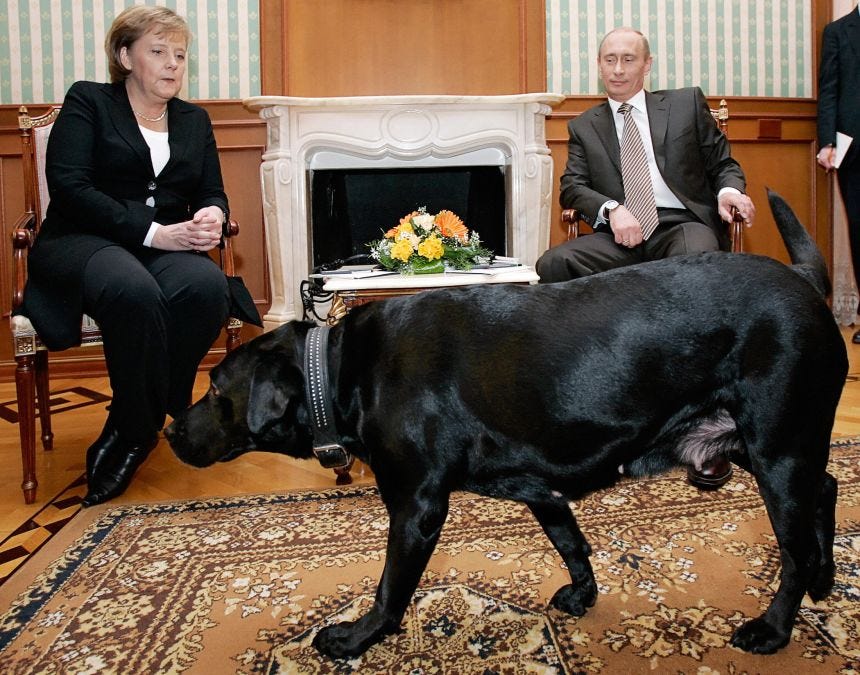
Putin brought his dog to a meeting with Chancellor Merkel in 2007 and claimed later to have known nothing about her well-documented fear of dogs following being attacked by one in 1995.
The folly of these decisions, along with the strategic malpractice of unilateral German disarmament following the First Cold War, was exposed in February 2022 when Putin launched his full-scale invasion of Ukraine and threaten the West with nuclear attacks should they intervene militarily. Putin judged at the time that German, European, and American leaders would largely turn a blind eye to his aggression as they had done in 2008 (against Georgia) and in 2014.
Putin was only partly right.
Germany did not, and still hasn’t, reversed its decision on nuclear power. Germany completed the plan to dismantle nuclear power in April 2023, a year after Putin’s full-scale invasion of Ukraine.
Nor has Germany ended its dependence on Russian energy, for example in February 2026, the month before Operation EPIC FURY, Germany and its EU partners bought 100% of Russia’s LNG output from the Yarmel production facility on the Arctic Ocean (something they have been doing for the last four years). Brussels claims that Europe will end these purchases in early 2027… five years after the full-scale invasion of Ukraine. I will believe that when I see it.
Only now, after more than four years of war, has Germany finally announced a significant military build-up. I’m assured by my European colleagues that this is for real, this time.
But one would be forgiven for pessimism.
I’d be willing to wager a tidy sum, that when the Ukraine conflict comes to an end, Lufthansa flights between Berlin and Moscow will return to normal and Germany will go right back to making itself dependent on Russian energy. I would also wager that the current commitment to rebuilding the Bundeswehr and the European defense industry will evaporate as well.
Believe me, I would be happy to be proved wrong on these predictions… but I wouldn’t bet on it.
I describe this series of events and decisions to highlight the title of this week’s commentary. My intention is to hammer home how issues that we often view as siloed are in many ways interlinked.
So that you remember this concept, I’ve chosen two references from popular culture, which on first blush don’t seem connected at all:
Toto’s “Africa” and Vladimir Nabokov’s Pale Fire.
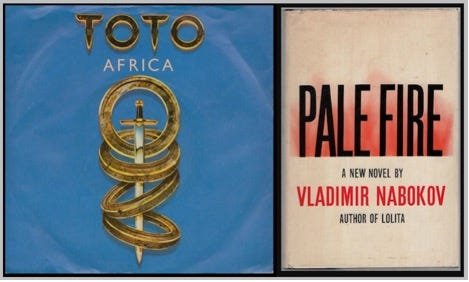
On June 25, 1982, the Los Angeles-based band Toto released the second single from their fourth album (Toto IV). The song was written by David Paich, the band’s keyboardist, and was rejected at first by his bandmates who wanted to cut it from the album, joking that Paich could “save it for his solo record.”
After much cajoling, Paich convinced them to keep it and Columbia Records released “Africa” on that Friday in late June 1982. The song would go on to hit #1 on the Billboard Hot 100 in February 1983 and remains a cultural touchstone… just try not singing along with the chorus.
That same day, Warner Brothers released a sci-fi movie from Ridley Scott starring Harrison Ford as Detective Rick Deckhard. The movie was Blade Runner and at first, it was a flop. Critics and viewers thought it was too slow and too cerebral (it was an adaptation of Philip Dick’s 1968 novel Do Androids Dream of Electric Sheep). But over time, audiences came to think of it as one of the best science fiction films, as well as the foundation of the cyberpunk genre. Given everything we are working through today with artificial intelligence and synthetic biology, Ridley Scott’s portrayal of 2019 Los Angeles still hits home.
[Fun Fact: June 25, 1982 was also the day that George Shultz replaced Alexander Haig as Reagan’s Secretary of State]
But the connection I want you to make is to the sequel released 35 years later, Blade Runner 2049. Directed by Denis Villeneuve and starring Ryan Gosling as K.
Interlinked
To jog your memory of this 2017 sequel, K (Ryan Goslings’ character) has to occasionally take an anti-empathy test for his job with the LAPD.
At the beginning he passes the test, but over the dramatic arch of the movie he fails the test as he develops feelings for the artificial humans (replicants), he is tasked with hunting and “retiring.”
Spoiler Alert: Officer K is a replicant (if you haven’t seen the movie by now, I don’t know how I can help you, perhaps stop living in a cave.)

“And blood-black nothingness began to spin.
A system of cells interlinked,
within cells interlinked,
within cells interlinked within one stem.
And dreadfully distinct against the dark,
a tall white fountain played.”
These lines are from Vladimir Nabokov’s 1962 novel Pale Fire, a dense and fantastical work that critics consider to be the Russian author’s finest. Personally, I find the book unreadable, but it is riddled with obscure references to other literary works, so it seems fitting that Denis Villeneuve would use it as an obscure reference in his own movie to show that humans are interlinked with their own humanlike creations.
Ponder that for awhile…
Interlinked
We live in a globalized and “interlinked” world. Unfortunately, we are ill-served by the narrow framing of the multiple, simultaneous geopolitical crises we experience.
Moscow’s war of aggression in Ukraine is interlinked with Europe’s energy dependence on Russia, which is interlinked with Tehran’s effort for a nuclear weapon to dominate the Middle East, which is interlinked with the world’s dependence on energy from the Middle East, which is interlinked with Beijing’s desire to annex Taiwan, which is interlinked with the world’s dependence on PRC manufacturing and increasingly PRC technology.
I am not arguing that these things are perfectly coordinated or that these regimes have formed some sort of highly formalized alliance structure, I’m arguing that they are connected. We put ourselves at a serious disadvantage when we isolate each of these regions and compartmentalize the challenges we face.
In July 2015, the United States and Europe persuaded Russia (and the PRC) to support the JCPOA in an effort to persuade Tehran to forgo building a nuclear weapon. The price of getting Russian support for the JCPOA was largely turn a blind eye to Putin’s annexation of Crimea and his war of conquest in Eastern Ukraine. Had the United States and Europe pushed hard to expel Putin from Crimea and Eastern Ukraine, it is unlikely that Putin would have supported American and European negotiations with Iran.
I’ll let you judge whether that was a good trade-off.
Starting in the spring of 2022, the United States and Europe sought to persuade the PRC to withdraw its support from Russia. While I’m sure Chinese leaders never said this so bluntly, the price Beijing was likely asking was dropping trade barriers, ending technology restrictions, and turning a blind eye to Beijing’s annexation of Taiwan.
Wisely, American and European leaders didn’t make that trade, but they also failed to make the connection that Beijing was fully committed to undermining their collective interests. It seems pretty clear that leaders in Washington, Brussels, Paris, Ottawa, Berlin, London, and Madrid have yet to internalize this.
What about the prospects of denuclearizing North Korea, what price would Russian and Chinese leaders demand today for their support?
Our rivals see these flashpoints as interlinked and the West largely refuses to see it that way.
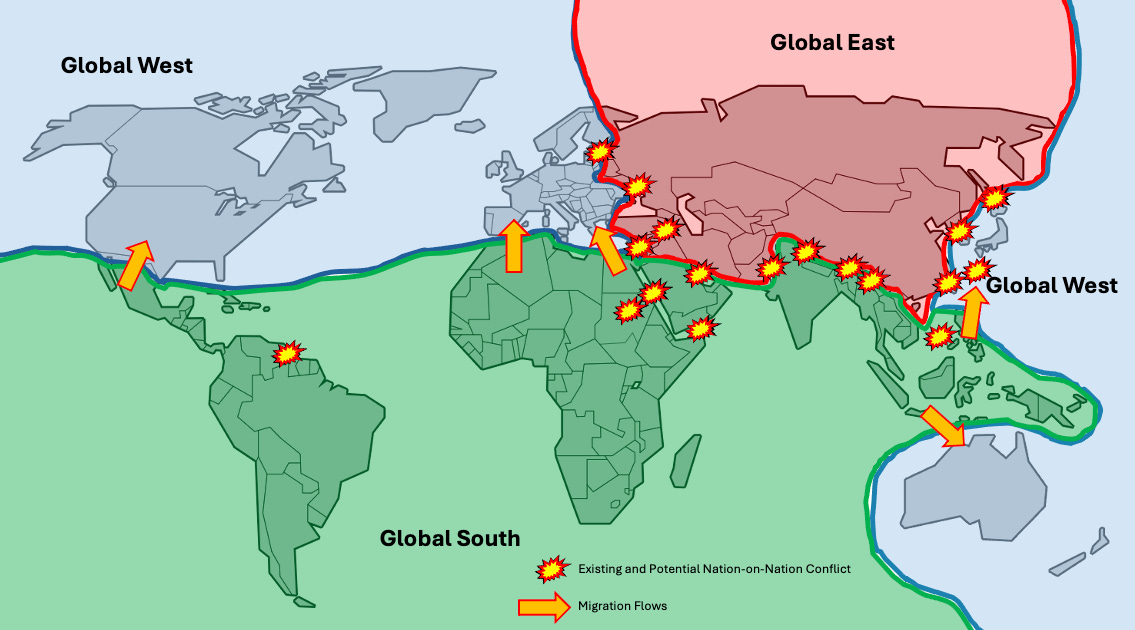
In August 2024, I created this map and graphic for my issue titled, “The Blocs are Back in Town: Apologies to the Irish rock band, Thin Lizzy” (August 18, 2024). I stand by that analysis and believe it is worth taking seriously today.
From my perspective, we should prevent Russia from conquering Ukraine AND prevent Iran from getting a nuclear weapon AND deter North Korea from attacking Japan and South Korea AND deter the PRC from annexing Taiwan.
If you sit down and ask Western leaders whether they support these objectives, you will get broad agreement. The problem arises from prioritization and how to do it.
We should face the stark reality that achieving these objectives cannot be done with a UN resolution or through negotiation and arbitration alone. Since these rivals are led by Beijing and Moscow, the United Nations will not be a forum in which we can build an international consensus with a clear UN mandate to challenge their interests.
This doesn’t mean the UN is irrelevant, it just means that as it was during the First Cold War, we cannot rely on the UN to safeguard our interests or provide for our prosperity. The UN is useful as a forum for dialogue, but that is about it.
We will need hard power to secure our interests, and hard power will enable diplomacy and negotiations.
Our refusal to link these things together is a huge impediment to mobilizing our own citizens and garnering the resources we need to achieve these objectives.
Better leadership would be able to stitch together a coalition to address these threats simultaneously. That coalition could then prioritize, coordinate its military, diplomatic, and economic warfare activities, and determine the objectives that the coalition would achieve.
Why Haven’t We Built the Coalition Yet?
The best opportunity to create that coalition was the spring of 2022, but Washington and its European partners refused to fully grasp the extent of the Sino-Russian alliance. After failing to deter Moscow, Washington and Brussels half-assed their response, expecting Putin to give up after he was turned back from taking Kyiv. They held out hope that they could isolate Moscow and entice Beijing to help them by pursuing a watered-down version of “derisking” from the Chinese economy. By the summer of 2023, Iran and North Korea joined this quasi-alliance by providing material support to Russia’s war effort guaranteeing that Moscow and Beijing would shelter them from future Western pressure.
Another opportunity to create this coalition presented itself in October 2023 when Hamas massacred 1200 Israelis (plus nearly 50 Americans, 8 Canadians, 35 French, a dozen Brits, and nationals from Germany, Italy, Spain, Portugal, and Austria).
Leaders from those countries could have decided to hold Tehran responsible for this horrific attack on Israel and its own citizens.
Instead, they largely ignored Tehran’s role and accepted Tehran’s propagandistic framing: Palestinians were fighting for freedom. The West could have connected Tehran’s involvement in this attack to Beijing’s support for Tehran (only weeks before the attack, Iran became a full member of the Shanghai Cooperation Organization (SCO)). In the weeks and months following the attack, the PRC turned its massive propaganda apparatus, which had been helping Russia in Ukraine, to helping Iran and its proxies demonize Israel and the United States.
Tehran was also happy to unleash another of its proxies, the Houthis, to shut down shipping in the Red Sea as it simultaneously worked with Moscow to support Assad in Syria and its proxy Hezbollah in Lebanon.
Europe and the United States could have seen the October 7th attack for what it was, an Iranian orchestrated raid designed to rape, mutilate, and kill as many civilians as possible to guarantee a lengthy and bloody Israeli occupation of Gaza. Iran had built an entire information warfare network, which included young activists in the West, to paint Israel as the villain and obscure Tehran’s involvement. Both Beijing and Moscow then aided this information warfare campaign by amplifying this propaganda across their own massive information warfare networks.
But instead of recognizing how these rivals were interlinked, we isolated the crisis to just the Gaza Strip, portrayed Netanyahu’s Israel as the villain, and fell into the trap Tehran set for us.
By late 2024, Europe and the United States were deeply involved in two simultaneous conflicts in separate theaters, waged by adversaries who had allied themselves together with interior lines of communication. Both relied on material, diplomatic, technological and economic support from the PRC, who they shared interior lines of communication with as well. By this point North Korea had joined in with troops in Ukraine and all four saw their efforts as interlinked.
Leaders in Europe and the United States refused to see these conflicts as interlinked, refused to see the PRC as the principal enabler for both, and refused to undertake a serious military rearmament.
This was absolute strategic malpractice.
The next best opportunity to stitch together this coalition was when Donald Trump returned to office in January 2025. An opportunity he completely failed to seize.
He failed to grasp the seriousness of the situation, underestimated how difficult the situation was, couldn’t figure out who our adversaries were and who our allies were, and blundered in the initiatives he decided to pursue.
Also strategic malpractice.
So, what the f&@% should we do now?
The answer seems pretty clear. Rid ourselves of the fantasy that we can address these interlinked rivals in isolation and form a coalition to handle them simultaneously.
If we had a time machine, then we could go back and do things differently, but we don’t, so we can’t. The best time to start this effort is today.
Leaders in North America and Europe (along with their counterparts in Tokyo, Seoul, Taipei, Canberra, and Delhi) need to swallow their pride and hammer out a coalition to deal with the Sino-Russian alliance.
Do I think this is likely to happen over the next 32 months? No.
But we still need to do it and the hard work of building that coalition should start now.
That new coalition needs to be focused on addressing all these threats in an interlinked and simultaneous way.
That new coalition needs to be focused on building a new economic and collective security commons, something to replace the sort of globalization that characterized the post-First Cold War order which pretended that great power rivalry would never return.
That means building a GATT 2.0 and a new collective security architecture in which ALL members pay their fair share. Bob Lighthizer’s Foreign Affairs acticle below provides a great place to start (#7, The New Trade Order: Restoring Balance to a Broken Global Economy).
No more letting the proverbial fox into the hen house.
No more wandel durch handel (change through trade).
No more free-riders dismantling their navies so they can subsidize healthcare and pensions. (London and Ottawa are you paying attention?)
No more climate and energy policies divorced from geopolitical realities.
No more economic and energy dependencies with our adversaries so you can boost your exports to the United States. (Berlin and Brussels, you got that?)
Americans will have to agree to elect responsible, trustworthy, and decent leaders (to both the Presidency AND Congress) who don’t wage ideological and culture wars on their own citizens and their allies, who don’t view themselves as social media influencers, who don’t demonize their fellow countrymen as threats to democracy (to be clear, I’m looking at both Parties here, there is plenty of blame to go around).
In return for electing leaders who are prudent and willing to compromise, Americans will get responsible and trustworthy allies, who pull their own weight and who stand beside us to maintain a system that benefits us all.
Deal?
There are a lot of reasons to be pessimistic about this approach, but there is one reason why I remain optimistic: we must do it and necessity is the mother of invention.
Eventually, we will have to come together to address these challenges and build a new international order that stands in opposition to the Beijing-Moscow axis, as well as their junior partners in Tehran, Pyongyang, and Islamabad.
Eventually, we will have to do this hard work, the rapture, the end of times, or some other utopian fantasy will not rescue us from this task.
The longer we wait, the costlier it will be.
Thanks for reading!
Matt
MUST READ
The National Security Case for Limiting China’s Access to Advanced U.S. Compute: Evidence from PLA Procurement Documents
Cole McFaul, Sam Bresnick, Emerging Technology Observatory, April 20, 2026
On Wednesday, April 22, the House Foreign Affairs Committee will discuss a package of bills aimed at strengthening restrictions on China’s access to U.S. AI chips, semiconductor manufacturing equipment, and broader AI technology. These bills constitute a small subset of the dozens of related measures that have been proposed—but not yet passed—by this Congress. The flurry of legislative activity comes at a time when the White House appears open to negotiating with China over access to advanced, U.S.-origin technologies; in December, the Trump administration opened a licensing pathway for the export of Nvidia’s H200 GPUs to China. Reports indicate that compute restrictions could be part of negotiations during next month’s summit in Beijing between presidents Donald Trump and Xi Jinping.
Many important questions underlie these policy debates, including those concerning economic trade-offs, China’s technological indigenization efforts, and the broader U.S.-PRC bilateral relationship, among others. While these are important considerations, this article addresses another critical question: will allowing China to access advanced U.S. compute help the People’s Liberation Army (PLA) develop and deploy military AI systems?
Our research suggests the answer is yes. We have analyzed thousands of AI-related procurement documents published by the PLA during the past three years, and this piece elucidating the stakes of the restrictions on U.S. compute is the result of both previously published analysis and ongoing research, the findings of which will be released in the coming months.
In this piece, we detail two distinct mechanisms through which access to advanced U.S. compute can enable the PLA’s adoption of military AI systems:
The PLA is procuring AI models trained on U.S. compute or distilled from U.S. models.
The PLA is acquiring advanced U.S. chips.
This analysis has led to three key takeaways relevant to the ongoing policy discussions:
Greater access to advanced U.S. compute will likely strengthen China’s military AI capabilities.
The PLA will benefit from advances in China’s civilian technology sector, including in AI.
The PLA’s adoption of advanced AI capabilities may be used to undermine U.S. military advantages.
The PLA is procuring AI models trained on U.S. compute and/or distilled from U.S. models
Chinese political and military leaders believe that AI could help the PLA narrow the gap with the U.S. military, or even surpass it altogether. Many Chinese strategists view AI as a critical enabler of future military capabilities that will allow for faster and better decision-making, as well as more precise and efficient operations. They argue that the force that better develops and adopts AI-enabled military systems will gain an advantage in tomorrow’s conflicts. Critically, previous CSET research has shown that Beijing’s “intelligentization” efforts increasingly rely on technologies developed by the civilian sector—for example, we have reviewed procurement documents soliciting DJI drones, Unitree robotic dogs, and iFlyTek algorithms.
Forthcoming CSET research examines the PLA’s procurement of large language models (LLMs) for military applications. Our analysis of procurement documents published by the PLA over the last three years shows that the Chinese military is actively adopting commercially available LLMs. We have reviewed requests for proposal (RFPs) for the deployment of AI models trained by some of China’s top AI labs, including DeepSeek, Alibaba, iFlytek, and others. Crucially, many of these models, including DeepSeek’s, were trained on U.S.-designed chips, illustrating the direct link between U.S. compute and Chinese military capabilities.
Although this brief is primarily concerned with the role of U.S. compute, we also note that LLMs developed by DeepSeek and other top PRC AI labs were also reportedly distilled from U.S. models. Distillation, a technique where one model is trained on the outputs of another, is an additional channel through which access to U.S. technology can ultimately bolster the PLA’s access to advanced AI capabilities. We do not, however, delve into the details of distillation below.
The applications of these models are expansive. Our analysis suggests that the PLA is experimenting with LLMs across a wide range of military tasks, including for data analysis, cyber offense, cognitive domain operations, and coordinating the activities of unmanned vehicles, among other applications.
In August 2025, for example, a PLA unit requested a system that used a DeepSeek model for “multilingual translation, key information extraction, intelligent Q&A, intelligent document generation, flight path analysis, and image comparison analysis.” A different document featured a request for a DeepSeek-enabled “unmanned [vehicle] cluster” command and control system. These systems could be useful for analyzing large volumes of data to inform military decision-making and coordinating drone swarms. Previous CSET research has examined China’s investments in AI-enabled command, control, communications, computers, cyber, intelligence, surveillance, reconnaissance, and targeting technologies, and these documents further illustrate the PLA’s focus on using AI for such tasks.
In March 2025, a military unit in Anhui Province published a procurement notice for a “Cybersecurity Professional Capability Generation Support System,” a cyber range that must, according to the document, “achieve intelligent integration with DeepSeek and other large models,” with capabilities including “intelligent attack” and “intelligent penetration.” While our open-source data offers limited visibility into the PLA’s offensive cyber capabilities, this document makes clear that the PLA is exploring the use of Chinese frontier models, including those trained using U.S. chips, to enhance its cyber operations.
Another RFP calls for a DeepSeek model for use with “psychological attack” and propaganda systems. Previous work has shown the PLA’s interest in using AI to enhance cognitive domain operations, including via the generation of high-end deepfakes. The PLA seeks to use these capabilities to manipulate and degrade its adversaries’ decision-making and thus gain military advantage. LLMs could prove especially useful for these and other kinds of influence operations.
While some have argued that U.S. export controls will not affect Beijing’s military modernization ambitions, these documents reveal that efforts to constrain China’s access to U.S. compute are still valuable for safeguarding U.S. national security interests. To our knowledge, China’s leading commercial frontier AI labs—not the Chinese government—are developing the country’s most capable AI models. Our findings, which show that the PLA is deploying those models for military use cases, therefore suggest that slowing China’s development of frontier AI through compute restrictions will ultimately also hamper the PLA’s use and adoption of advanced AI capabilities.
The PLA is acquiring advanced U.S. chips
The second mechanism through which U.S. compute can enable the PLA’s adoption of AI is through the direct use of U.S.-origin chips. In our review of PLA procurement documents, RFPs for direct acquisitions of chips were the most common avenue through which the PLA tried to access U.S. compute. These RFPs included requests for both controlled and non-controlled chips.
Some have argued that the PLA is not interested in using U.S. chips for military activities. Notably, Nvidia’s Jensen Huang has said that the PLA “simply can’t rely” on U.S. chips due to security concerns, and that China does not “need Nvidia chips, certainly, or American tech stacks, in order to build their military.” Our analysis, which relies on publicly available procurement documents published by the PLA, does not allow us to assess the scale of the PLA’s use of U.S.-origin chips. Many of the procurement documents in our dataset include requirements to use domestic technology, reflecting Beijing’s continued push for self-sufficiency. Beijing has also recently issued guidance that aims to limit Chinese AI labs’ use of foreign chips, and DeepSeek and Alibaba have committed to increase their utilization of domestic chips for inference, for example. Other companies, such as Zhipu, are reportedly using Huawei’s chips for LLM training.
At the same time, the documents in our dataset demonstrate that the PLA continues to request advanced U.S. chips for military applications. In May 2025, a PLA research laboratory requested sixteen Nvidia H100 GPUs, which are export controlled, to support research on electromagnetic-characterization modeling and infrared-characterization modeling using DeepSeek-70B and Alibaba’s Qwen-32B LLMs. An RFP published in July 2025 requested a high-performance server equipped with Nvidia H20s in order to simulate a “demonstration and verification system,” which could be useful for a wide variety of tasks, including weapons system modeling.
While most of the documents we have reviewed involve the procurement of AI chips for on-premises deployment, several RFPs include requests for access to cloud computing resources. One July 2024 RFP called for 10 million core hours of physical supercomputer cluster resources for use by a PLA unit, with an explicit requirement that the supplier “be able to provide NVIDIA V100 or A100 GPU compute resources.” That a PLA unit was soliciting access to controlled U.S. hardware through an intermediary illustrates the many pathways military end users will pursue to gain access to these chips.
The procurement documents analyzed in this brief are just a few examples of the hundreds of RFPs soliciting advanced, U.S.-designed AI hardware between 2023 and 2026. Forthcoming research will more comprehensively examine the PLA’s requests for compute resources.
Conclusion
In this piece, we refrain from analyzing specific ongoing legislative initiatives. Instead, we aim to provide more evidence of the national security imperatives for constraining China’s ability to access advanced computing technologies.
To be sure, our analysis of publicly available PLA procurement documents does not allow us to make comprehensive claims about the PLA’s adoption of military AI systems. Similarly, U.S. policymakers are currently making decisions with incomplete information about whether and to what extent U.S. AI compute will support the PLA in the short or long term.
Despite this uncertainty, we offer the following takeaways for U.S. policymakers:
Greater access to advanced U.S. compute will likely strengthen China’s military AI capabilities, either through the PLA’s deployment of AI systems trained using U.S.-origin technology or through the direct acquisition and use of advanced U.S. chips. China is working to develop a range of AI-enabled military capabilities, including decision-support systems and unmanned vehicle swarms, among myriad other applications.
The PLA will benefit from advances in China’s civilian technology sector, including in AI. The PLA can access dual-use technologies, such as AI, both through contracts with nontraditional vendors and through the adoption of open-source frontier models, like DeepSeek’s.
The PLA’s adoption of advanced AI capabilities may be used to blunt U.S. military advantages. For example, the Chinese military is already experimenting with AI systems to improve its maritime domain awareness and space capabilities, potentially degrading perceived U.S. advantages at sea and in space.
CSET’s analysis leaves little doubt that the PLA is moving quickly to develop and deploy military AI systems. Strengthened restrictions on China’s access to U.S. technologies may carry costs for industry, but inaction risks far graver consequences for U.S. national security interests.
COMMENT – Jensen Huang, Nvidia’s CEO, has been assuring the President, Congress, and the American people for months that none of this is true.
China’s Cyberspying Targets Western Defense Industry, Dutch Intel Chief Says
Kim Mackrael, Wall Street Journal, April 21, 2026
Military intelligence report warns China poses a growing threat, alongside Russia.
China’s cyber-espionage capabilities are now as sophisticated as the U.S.’s and are increasingly targeting Western defense industries, said the head of Dutch military intelligence.
Dutch Vice Adm. Peter Reesink said China is largely interested in gaining access to technologies from Western militaries and arms producers, and also in spotting vulnerabilities. He made the comments after his agency, known in Dutch as MIVD, released an annual report on Tuesday that said Beijing poses a growing threat to Europe alongside Russia and that the two countries’ increasing cooperation compounds the danger.
Chinese cyber-espionage operations are “very capable, and they are organized in a very complex way,” Reesink, the agency’s director, said in an interview. “We are vulnerable and we’re not always capable of seeing all the threats China produces.”
The Dutch report adds to a chorus of Western spy services flagging rising risks for the West—targeting both military and civilian assets—from Beijing and Moscow’s global ambitions. It comes as European officials worry that fractures in their relationship with the U.S. over the past year have left them more exposed to security threats.
Reesink said in a statement released alongside the agency’s report that a weakening international system puts Europe at greater risk, particularly “where rules become blurred and power becomes increasingly determinant.”
The report said Russia continues to pose the biggest and most direct threat to the continent’s peace and stability. Russia is already preparing for a possible military conflict with the North Atlantic Treaty Organization and could be ready within a year of ending hostilities in Ukraine, the report said—though it said a direct conflict with Europe was very unlikely while fighting in Ukraine continued.
China’s actions add to the threats Europe and NATO face, the report said. Growing ties between Russia and China are fueling Moscow’s ambitions, it said, adding that Russia can count on China as an ally. Both countries have geopolitical ambitions and oppose Western influence in the world, it said.
The report comes from one of Europe’s more outspoken countries on threats from Russia and China, and follows similar assessments from countries situated closer to Russia. But Europe’s approach to Chinese threats still falls short of responses from the U.S. and Indo-Pacific allies, analysts said.
“The European response is still very Russia-focused, and China is seen as an indirect threat,” said Oriana Skylar Mastro, a fellow at Stanford University’s Freeman Spogli Institute for International Studies who has recently taught in Italy. She said European countries are years behind allies such as Japan and Australia, and still see economic opportunities in China as outweighing security concerns.
“There’s definitely not a sense of threat from China” across Europe, she said.
COMMENT – I wonder if the Spanish Prime Minister and his staff will bother reading this or asking for a meeting with the Dutch? My speculation is no, Pedro Sanchez has bet his political future and Spain’s prosperity on becoming the PRC’s proxy in the European Union.
He has embraced a form of anti-Americanism that purposefully ignores the crimes of authoritarian regimes to demonize what Washington does.
White House accuses China of industrial-scale theft of AI technology
Alexandra Alper and Ruchika Khanna, Reuters, April 23, 2026
The White House on Thursday accused China of stealing U.S. artificial intelligence labs’ intellectual property on an industrial scale in a memo that threatens to strain relations ahead of a summit between U.S. and Chinese leaders next month.
“The US government has information indicating that foreign entities, principally based in China, are engaged in deliberate, industrial-scale campaigns to distil US frontier AI systems,” Michael Kratsios, director of the White House Office of Science and Technology Policy, wrote in a memo shared on social media on Thursday and first reported by the Financial Times.
“Leveraging tens of thousands of proxy accounts to evade detection and using jailbreaking techniques to expose proprietary information, these coordinated campaigns systematically extract capabilities from American AI models, exploiting American expertise and innovation,” he added.
The Chinese Embassy in Washington said it opposes “the baseless allegations,” adding that Beijing “attaches great importance to the protection of intellectual property rights.”
The memo, released just weeks before U.S. President Donald Trump is set to visit Chinese President Xi Jinping in Beijing, promises to raise tensions in a long-running tech war between the rival superpowers, which had been lowered by a detente brokered last October.
Trump Says He’s ‘A Little Surprised’ Chinese Ships Trying to Break US Blockade
Philip Wegmann, Wall Street Journal, April 21, 2026
President Trump voiced displeasure with Chinese President Xi Jinping after a cargo ship, which Trump suggested might have ties to China, tried to violate the U.S. blockade of Iran.
“We caught a ship yesterday that had some things on it, which wasn’t very nice. A gift from China perhaps, I don’t know. But I was a little surprised, because I have a very good relationship, and I thought I had an understanding, with President Xi. But that’s alright. That’s the way war goes,” Trump said during a Tuesday CNBC interview.
Trump said that the U.S. had used the two-week cease-fire, which is slated to expire Wednesday, “to restock” munitions. Raising the prospect of Iran importing Chinese weapons, Trump said, “they probably have done a little bit of restocking.”
The U.S. Navy seized the MV Touska last weekend after that ship visited the southern Chinese port of Zhuhai. It wasn’t clear if Trump was referring to the MV Touska or to another seized vessel.
Trump is expected to meet with Xi next month in China. They met previously in October in South Korea during the APEC summit, their first face-to-face meeting during Trump’s second term.
China hails countries for blocking Taiwan president’s flight
Natalie Muller, DW, April 22, 2026
Taiwan’s president canceled a planned trip to Eswatini after three African countries revoked permission for his plane to fly through their airspace. Beijing has denied pressuring the countries to block the flight.
China said Wednesday it had “high appreciation” for the African countries that denied overflight rights to the plane of Taiwanese President Lai Ching-te, forcing him to cancel a trip to Eswatini.
China claims self-governed Taiwan as part of its territory and opposes the island having diplomatic relations with other countries.
Lai was to visit Eswatini, Taiwan’s only remaining ally on the African continent, from April 22-26.
But that plan was shelved after Seychelles, Mauritius and Madagascar unexpectedly withdrew flight permits “due to strong pressure from the Chinese authorities, including economic coercion,” a Taiwanese official said Tuesday.
What did China say about the Taiwan president’s trip?
Beijing denied it had applied economic pressure to block Lai’s trip, but at the same time said it had “high appreciation” for the three countries’ actions.
“Relevant countries maintained support for the one-China principle, completely in line with ... the basic norms of international relations, China expresses high appreciation,” China’s Foreign Ministry said in a statement.
“No one can stop the historical trend of China’s eventual reunification,” the statement added, referring to Beijing’s claims over Taiwan.
Separately, a spokesperson for China’s Taiwan Affairs Office told reporters, “A just cause enjoys abundant support, while an unjust cause finds little support,” quoting the ancient Chinese philosopher Mencius.
COMMENT – Hmmm… isn’t Mauritius the country that has been waging a multiyear campaign (with Beijing’s support) to force the United Kingdom to surrender sovereignty its Indian Ocean Territory which includes Diego Garcia?
The Starmer Government and its obsession with so-called “international law” has gotten the UK in a really tough spot.
To get a better sense of this dynamic between the UK Prime Minister and his Attorney General, Richard Hermer, I recommend reading this piece by Tom Tugendhat:
Hermer and Starmer’s sinister legal cult has rotted our democracy
Tom Tugendhat, The Telegraph, April 26, 2026
Tom is on a roll this week… here is his OpEd in the Wall Street Journal from Tuesday.
The Price Beijing Pays for Backing Tehran
Tom Tugendhat, Wall Street Journal, April 21, 2026
While Iran supplies 11% of China’s oil. Saudi Arabia, Iraq, Oman and the U.A.E. account for 37%.
Mariners sweltering in the Gulf, waiting to pass the Strait of Hormuz, are part of a spider’s web of supply in which pressure at any point can be felt across the globe. Shipping companies have been unable to buy “forward fuel” at a negotiated price for delivery next month. They have no choice but to pay today’s high prices, raising cargo costs so dramatically that reliable routes for food and goods become unprofitable. Owners managing the crisis from offices in Singapore, Athens and London are recalculating routes and costs. For those in Shanghai there is an extra worry, one that hasn’t been fully priced in: Their government’s actions are threatening future relationships, not only today’s traffic.
Beijing has for decades promoted itself as a nonjudgmental alternative to the U.S. and the West. Present everywhere, committed to nothing, minding its own business and making money from all sides. In the Gulf, that posture is now collapsing under the weight of its own contradictions.
China, according to multiple reports, has provided Iran with satellite imagery, components and intelligence needed to attack infrastructure and shipping as well as U.S. targets in Gulf countries. Each part of the logistics chain has helped Iran destroy refineries and docks and even kill civilians. That hasn’t gone unnoticed in Riyadh and other capitals that, when combined, are far more important to China than Tehran.
In 2024, according to the U.S. Energy Information Administration, Russia supplied 20% of China’s oil, more than any other country. Iran contributed 11%, largely through shadow tanker networks to evade Western sanctions. Those figures speak to the importance of Persian oil to China’s power, but they don’t tell the whole story.
In the same year Saudi Arabia supplied 14% of China’s crude, Iraq 10%, Oman 7% and the United Arab Emirates 6%. Those four Gulf states accounted for about 37% of China’s oil imports. China’s enabling of Iranian aggression endangers suppliers that collectively matter more than three as much to the Chinese economy as Iran does.
Energy bound for China runs directly through the neighborhood that Chinese-assisted Iranian drones and missiles have been targeting. If Saudi Arabia and others decide they have had enough of the Chinese Communist Party’s backing Iran’s Islamic Revolutionary Guard Corps, that could see them divert their tankers away from China’s ports.
Beijing may think it has alternatives in pipelines it has financed across Kazakhstan and Myanmar specifically to reduce dependence on the Gulf. But it isn’t clear those workarounds would deliver enough fuel to support the world’s largest trucking fleet on roads from Guangdong to Xinjiang.
The Gulf Arab monarchies aren’t naive about great-power politics. They have survived for centuries by working carefully with larger powers. As Beijing’s influence expanded, they welcomed Chinese investment in ports, infrastructure and technology. They joined partnerships that Beijing prizes as evidence of its global reach. With studied ambiguity, they declined to line up too firmly behind Washington’s pressure campaigns. But their working assumption has been that China wouldn’t undermine their security.
That’s now in doubt. Riyadh and Abu Dhabi aren’t going to denounce Beijing in the United Nations or tear up contracts, but the relationships with China will change. Will intelligence-sharing endure? Will cooperation over sensitive infrastructure continue? In the gradual realignment of loyalties, Saudi Arabia’s acceleration of its defense relationships with Washington and the U.A.E.’s recently announced cooperation on defense with Ukraine reflect an understanding that neutrality can only get you so far.
Beijing stumbled into this awkward position through a logic that was locally coherent but ultimately self-defeating. Beijing’s support for Iran secured for China discounted oil from the regime, which it helped to evade sanctions. It sustained a disruptive partner to keep American attention fragmented. It showed others that China doesn’t abandon allies when the U.S. turns against them. Each reason had its own departmental sponsor in Beijing’s bureaucracy, presumably without considering the view from Riyadh or Abu Dhabi.
As the war toggles between negotiations and open conflict, China’s foreign-policy apparatus has to deal with the repercussions of its support for Iran. Reports of shared satellite data and dual-use technology have to be waved off or minimized as the evidence of Chinese military support becomes visible in impact craters across Arab Gulf states.
Beijing’s diplomatic energy will now turn to reassuring the Arab monarchies that the satellite data was misused, that the components were never intended for offensive deployment, that the IRGC went rogue, and that the relationship with Gulf states remains one of mutual respect. Perhaps some of these excuses will be accepted, but in palaces across the Arabian Peninsula, assumptions are already shifting.
China is no longer the indispensable partner unburdened by a history of war in the region. It has now backed one state against others, hoping those that supply more than a third of its oil will forget the transgression. If history is anything to go by, Beijing’s diplomats will be left sweltering in waiting rooms long after the ships’ crews have returned home.
The New Trade Order: Restoring Balance to a Broken Global Economy
Robert E. Lighthizer, Foreign Affairs, April 21, 2026
At the annual meeting of the World Economic Forum in Davos this past January, dozens of senior officials from around the world sat alongside multinational CEOs, fresh off their private jets, and applauded Canadian Prime Minister Mark Carney for what they saw as speaking truth to power. Carney gave an address inspired by a 1978 essay by Vaclav Havel, who was then a Czech poet and Soviet dissident and later served as his country’s first president in the postcommunist era. The essay, titled “The Power of the Powerless,” sought to explain how the communist system survived. In it, Havel imagined a greengrocer who, like all the shopkeepers around him, places a sign in his window that reads “Workers of the World, Unite!”—even though none of them believe in the communist system. Havel called this “living within a lie” and argued that the Soviet dystopia could come to an end when that archetypal shopkeeper decided he could no longer play along and took the sign down.
Carney was there to tell his fellow leaders that they, too, were living within a lie. For decades, they had advertised their belief in an American-led international order and a U.S.-dominated global economic system that they did not, in fact, believe in—and Canada was done pretending. “We are taking the sign out of the window,” Carney declared, claiming that “great powers”—and in particular the United States—had weaponized economic integration to the detriment of his country and others like it.
Carney was casting himself as Havel’s greengrocer, challenging an empty myth and shaking off an oppressive but dying system. But this got things exactly backward. In the current fight over the global economic order, the person who most resembles Havel’s protagonist is not Carney but rather the main target of his ire: U.S. President Donald Trump. It was Trump who called foul on the prevailing economic order a decade ago, riding into office on a wave of anger at the status quo. It was Trump who charted a new path built on a more balanced approach to trade. It was Trump who took the sign out of the window.
Trump’s agenda represents a necessary first step toward what should be Washington’s larger, more ambitious goal: replacing a defunct old trading system—predicated on illusions and vulnerable to abuse—with a new one built on the principles of balance, transparency, and sovereignty.
COMMENT – Replacing the global trading system established during the 1990s is probably the most important foreign policy objective that democracies should be focused on… it is a shame that much of the commentariat class seems obsessed with maintaining the WTO rather than starting over with the countries that actually respect the rule of law and build an institution that actually works.
Authoritarianism
More cyber-attacks from Beijing to come, says British security chief
Grace Theodoulou, Observing China, April 23, 2026
Medical data of British citizens listed for sale on Chinese website; China objects to US military overflight access in Indonesia.
China sends warships to Pacific as Japan tensions grow
Leo Lewis, Financial Times, April 21, 2026
China’s armed police mull riot control with zero human contact
Stephen Chen, South China Morning Post, April 20, 2026
China told Maersk and MSC to drop Panama port operations
Ryan McMorrow, Financial Times, April 21, 2026
European shipping groups took over canal concessions after Panamanian authorities ejected Hong Kong’s CK Hutchison.
China demanded Europe’s two largest shipping companies cease operating ports on the Panama Canal, just weeks after they took over from a Hong Kong-based group that was ejected from the terminals.
In a meeting with China’s state planner last month, Danish shipping group Maersk and Switzerland-based Mediterranean Shipping Company were told to withdraw from the Balboa and Cristóbal ports immediately, said two people familiar with the talks.
They were also told not to “engage in illegal activities that harm the interests of Chinese companies, and to uphold commercial ethics and international rules”, said a third person.
The warnings underscore Beijing’s growing willingness to use its economic leverage over foreign companies in areas it sees as critical to China’s supply chain security.
The move also signals an escalation in the dispute over the Panama port concessions. The US has been trying to increase its influence over the canal while Beijing is keen to defend investments by Chinese companies in the strategic waterway.
CK Hutchison, founded by Hong Kong’s richest man Li Ka-shing, negotiated a $23bn deal with a consortium led by BlackRock and MSC in March last year to sell its non-Chinese port operations, including those in Panama.
The deal immediately irked Beijing, which signalled it would subject the transaction to regulatory reviews and pushed for state-owned shipping group Cosco to join the consortium.
Tensions escalated in January when Panama’s top court ruled CK Hutchison’s concession to run the two ports unconstitutional and authorities later stripped the company of its rights.
Panama granted MSC and Maersk temporary operating rights. CK Hutchison has since taken Maersk to arbitration and filed a $2bn damages claim against Panama.
Early last month, officials at China’s powerful National Development and Reform Commission reacted by summoning the two European companies and demanding they pull out of the ports, said the two people familiar with the meeting.
The NDRC demands were delivered on the same day China’s transport ministry warned the two companies of the need to maintain supply chains amid disruption from the war in Iran.
COMMENT – I wonder if European Governments are going to stand up for their companies who are under significant pressure from the PRC to bend to a geopolitical demand?
I hope so… the Danish company Maersk and Swiss company Mediterranean Shipping Company are likely only to weather this if Europe unites and stands up against coercion.
China links tough new trade rules to Iran war and Panama port dispute
Joe Leahy, Financial Times, April 21, 2026
Beijing tightens its grip on AI firms that try to shed their Chinese ties
Lyric Li, Washington Post, April 21, 2026
A Chinese government probe of a Meta-acquired company, Manus AI, reveals what tech workers see as a new red line.
Facing fierce competition with the United States over artificial intelligence, Chinese authorities are taking stronger steps to try to stop rising AI start-ups from leaving the country to seek capital and markets in the West, according to a dozen people working in the sector inside and outside China.
Beijing sent its most overt warning shot last month when it ordered the Chinese founders of an AI company, Manus AI, not to exit the country while it investigates whether the company complied with export controls in the lead-up to its exit from China and sale to Meta.
Authorities have gone beyond Manus, however, directly warning at least one other prominent AI firm, MiroMind, not to send valuable talent and research out of China, according to two employees and a person close to the company, who like some others interviewed for this report spoke on the condition of anonymity for fear of government reprisal. MiroMind, which says it trains sophisticated AI programs capable of “deep reasoning,” did not respond to requests for comment.
The Chinese government’s efforts around MiroMind and some details about its pressure on Manus have not been previously reported.
The steps taken publicly and privately by Chinese authorities are reverberating through the Chinese AI sector. In interviews, tech workers in Singapore and China described what they see as a new red line drawn by Beijing against “China-shedding” — a practice in which homegrown companies sever ties with the country to compete for resources in the United States.
An engineer in Wuhan who worked with Manus until last July said he believed Beijing’s investigation was triggered not by possible legal violations but by the company’s closure of its Chinese operations and sale to an American firm. As part of the inquiry, Manus co-founders Xiao Hong and Yichao Ji have been barred from leaving China, people familiar with the situation said. Neither responded to requests for comment.
“Manus is a lesson learned,” said Kit Kuan Pan, an adviser to Chinese companies establishing offshoots in Singapore. “What we see is that you cannot sell your DNA away. You cannot dent the trust and pride of the Chinese government and expect them not to respond.”
In the face of U.S. export controls, Chinese tech companies adopted a model of moving to Singapore to “depoliticize” their Chinese identities, said Lizzi Lee, a fellow at the Asia Society Policy Institute’s Center for China Analysis. “The case of Manus makes that model look a lot more fragile,” Lee said. “It suggests that even if you’re trying to de-Chinese your company on paper, Chinese regulators can still reach back.”
China: Fears of a Further Crackdown on Netizens Illegally Accessing Foreign Sites
Tan Liwei, Bitter Winter, April 20, 2026
Italian mail blunder and mistrust hinder crackdown on Chinese gangs
Silvia Ognibene, Reuters, April 21, 2026
China’s formal reply to an Italian request for mutual legal assistance never made it past a Rome mailroom.
The documents, relating to the attempted murder of a Chinese businessman in Italy in 2024, arrived at the Justice Ministry in Rome in early February via the ordinary postal service as is often the case, requiring a payment-on-delivery charge.
No one in the ministry’s postal office knew the package was coming, so staff refused to pay, sending the envelope back to China unopened, said two people with knowledge of the blunder.
After the error was revealed, the Justice Ministry asked Chinese authorities to resend the material, but the documents have still not been received, one of the sources said.
The embarrassing episode reflects a wider sense of mistrust and paralysis within Italy surrounding Beijing’s efforts to provide cooperation with Rome. The impasse is frustrating some prosecutors who say it is hindering their fight against Chinese gangs running multi-billion-euro crime rackets in Italy.
Over the past decade Italian prosecutors have opened dozens of investigations into illicit banking, drug rings, extortion, labour abuses, illegal immigration, tax evasion, murder and mob warfare within the Chinese diaspora in Italy.
Only a few cases have made it through the courts.
Investigators say they need help from Beijing to penetrate gangs that work in tandem with counterparts in China, but securing such collaboration is meeting resistance at home.
That wariness is a product of tensions between different branches of Italian law enforcement, and also reflects wider concerns over cybersecurity incidents involving China, with political ties having cooled during Prime Minister Giorgia Meloni’s four years in power.
How China is reinforcing its ‘legal shield’ against foreign pressure
Xinlu Liang, South China Morning Post, April 21, 2026
Rules of Origin Set Up U.S.-China Clash in Asia
Lingling Wei, Wall Street Journal, April 20, 2026
How China’s Press Abandoned Its Readers
David Bandurski, Lingua Sinica, April 20, 2026
Will China get richer before it gets much, much smaller?
Toby Nangle, Financial Times, April 20, 2026
Environmental Harms
How China turns coal into urea
Anurag Rao, Reuters, April 20, 2026
While most countries rely on natural gas, China’s coal‑based urea industry has cushioned it from the Iran war and the price shocks rippling through global fertilizer markets.
China is largely self‑sufficient in urea production, with about 78% of its output coming from coal rather than natural gas, a key distinction from other major exporters such as Qatar, Russia and Saudi Arabia, which rely predominantly on gas. While the technical processes for converting coal or gas into urea are largely the same, there are some key differences at the beginning.
…
China is a large exporter of major fertilisers but has stopped due to the war
Last year, China accounted for roughly a fifth of fertiliser imports by Brazil, Indonesia and Thailand as well as a third of those by Malaysia and New Zealand, data from the International Trade Centre shows. For India, the share was about 16%, its trade data shows.
Between half and 80% of those exports are now restricted, according to a Reuters analysis of Chinese customs data.
“Buyers were hoping China would step in and fill the supply gap, but this decision will only tighten supplies further,” a New Delhi-based fertiliser company official said about the recent restrictions.
How China Is Building Its Next Outpost at Sea
Lily Kuo and Agnes Chang, New York Times, April 22, 2026
Foreign Interference and Coercion
China Lobbies Spain to Sink EU Plans to Boost Its Companies
Daniel Basteiro, Bloomberg, April 16, 2026
China Wind Turbine Maker Eyes Spain for Factory After UK Snub
Will Mathis and Thomas Gualtieri, Bloomberg, April 22, 2026
Move Over, Hungary: Spain Is China’s New Best Friend in the EU
Sam Goodman and Anouk Wear, The Diplomat, April 17, 2026
The CNI certifies 19 Huawei products for use in critical sectors such as defense
Marcos Sierra, The Objective, April 15, 2026
Sánchez to Push China to Hand Over Tech Secrets on Beijing Trip
Daniel Basteiro, Bloomberg, April 10, 2026
Chinese client of Mandelson firm ‘took intellectual property from US’
George Greenwood, The Times of London, April 19, 2026British data centres at heart of national security scandal part owned by Chinese arms manufacturer
UK-China Transparency, April 23, 2026
In October, UK-China Transparency (UKCT) exposed the apparent cover-up of a national security scandal surrounding Global Switch, which operates critical data centres in London.
UKCT compared the silence around the acquisition in the UK to the multi-year public saga in Australia, which included public admissions that Global Switch centres carried sensitive Australian government data, a multi-billion-dollar migration plan, and mitigation measures described by then Australian Prime Minister Scott Morrison as “24/7 Defence security presence, remote CCTV monitoring and regular security audits”.
It has been suggested by a former Downing Street advisor and a former security minister that Global Switch centres in the UK also carried or stored highly sensitive data.
In this, the second part of UKCT’s investigation, the question of precisely which Chinese actors bought Global Switch is addressed, as is the aftermath of the initial reporting late last year, and an update on UKCT’s work to secure more information from HM Government.
China turns Taiwan’s own voices against it in information war
James Pomfret, Reuters, April 17, 2026
Taiwan Abruptly Cancels Lai Trip, Citing China’s Interference
Yian Lee, Bloomberg, April 21, 2026
Beijing’s new Taiwan strategy runs through the ballot box
Robin Hu, Nikkei Asia, April 21, 2026
As the US steps out of UNESCO, China steps up
Emily Markovich Morris and Michael Hansen, Brookings, April 20, 2026
Human Rights and Religious Persecution
The Unhealthy China-Kazakh Rapprochement: Mass Imprisonment of Anti-China Protesters
Ruth Ingram, Bitter Winter, April 20, 2026Two Tibetan Monks “Disappeared” into the Chinese Jail System
Lopsang Gurung, Bitter Winter, April 22, 2026
Two monks from Chu Khama Monastery in Machu (Maqu) County, in the Gannan Tibetan Autonomous Prefecture in southern Gansu province, Samten Gyatso and Jamyang Samten, have been held incommunicado for over a year after their arrests by Chinese authorities, according to reports from Tibetan exile media. Their current condition, location, and legal status are unknown, leaving their monastery and families in deep anxiety. The lack of information about their cases reflects a broader trend in which Tibetan religious figures vanish into the security system without formal charges or access to legal help.
The monks were detained under different circumstances. One was reportedly taken directly from the monastery, while the other was told to go to the police station to get back a mobile phone that had been seized during a previous search. When he arrived, he was arrested and has not been released since. The exact dates of their arrests remain unclear as communication with those connected to the case has become increasingly difficult.
Although no official charges have been announced, sources suggest that the detentions may relate to material found on their phones, including images of the Tibetan national flag. Both monks had already faced repeated questioning before their disappearance, despite the lack of any formal accusations at that time.
Deng Huizhong, Bitter Winter, April 23, 2026
Industrial Policies and Economic Espionage
VW to export more China-made EVs in global sales drive
Kana Inagaki, et al., Financial Times, April 21, 2026
Audi’s Future Hinges on Winning Back China
Bloomberg, April 21, 2026
Chinese lidar maker building first overseas plant in Southeast Asia
Nikkei Asia, April 21, 2026
Trump trade chief urges US allies to pay more for critical minerals
Aime Williams, Financial Times, April 21, 2026
Chinese migrant workers return home as urban jobs grow scarcer
William Langley, Financial Times, April 18, 2026
Foreign carmakers turn to Chinese technology to remain relevant
Kana Inagaki, et al., Financial Times, April 19, 2026
China’s vast nuclear power sector now able to build 50 reactors at a time
He Huifeng, South China Morning Post, April 21, 2026
Cyber and Information Technology
How to Counter China’s Data Collecting
Savannah Billman, The Wire China, April 19, 2026
Anthropic’s ID Verification Imperils Chinese Founders
Juro Osawa, The Information, April 20, 2026
Competing AI strategies for the US and China
Kyle Chan, Brookings, April 16, 2026
Chinese tech workers are starting to train their AI doubles—and pushing back
Caiwei Chen, MIT Technology Review, April 20, 2026
China’s Agibot eyes multifold expansion of humanoid robot production
Watar Suzuki, Nikkei Asia, April 17, 2026
Military and Security Threats
China Maritime Report #52: Everything Everywhere All at Once: The Growing Complexity of PLA Amphibious Exercises
Jason Wang, Marvin Hamor Bernardo, Pei-Jhen Wu, Andrew S. Erickson, CMSI, April 22, 2026
In August 2025, the People’s Republic of China (PRC) conducted a large-scale exercise to simulate an invasion of Taiwan. This “capstone” amphibious exercise suggests that People’s Liberation Army (PLA) training and preparations for a future Taiwan campaign are becoming more focused, realistic, and sophisticated.
The exercise consolidated elements from previous years into a single simulated operation. It integrated a floating causeway system, anti-landing barriers and obstacles, and amphibious Landing Craft Tank (LCT) vessels that landed forces directly onto beachheads.
For the first time observed, the PLA conducted a phased exercise with simultaneous amphibious landings in three distinct locations. Exercise areas incorporated civilian aquaculture obstacles like those expected to be found along Taiwan’s coastline, increasing environmental and tactical realism.
The exercise occurred at simulated “landing locations” opposite Taiwan, particularly within the Zhangzhou-Xiamen-Quanzhou littoral zone. The locations were distributed at distance intervals comparable to likely wartime beachheads along Taiwan’s western coastline. The total distance between discrete exercise locations was approximately 360 kilometers, roughly the distance between Taipei and Kaohsiung.
Not merely hypothetical in nature, the exercise reflected a specific geographical and operational focus. It appears to be part of a larger trend whereby the PLA is mapping its exercises onto analogous geography that reflects envisioned targets.
Future research should explore the potential applications and implications of PLA efforts to train with similar distances and geometries as would be found in prospective conflict zones.
Starting this summer, observers should scrutinize future capstone amphibious exercises to better understand the PLA’s strengths, weaknesses, and underlying operational assumptions.
China teases new aircraft carrier in video, vows to build up islands
Ryan Woo and Xiuhao Chen, Reuters, April 23, 2026
China teased in a video an aircraft carrier that could be its fourth, and the first using nuclear power, while vowing to further build up its islands, as it looks to boost maritime power, secure resources and bolster territorial claims.
The video issued on the eve of the 77th founding anniversary of the Chinese People’s Liberation Army Navy featured fictional officers with names that are homophones of three commissioned aircraft carriers, the Liaoning, Shandong and Fujian.
Titled “Into the Deep”, it showed a 19-year-old named “He Jian” joining the group, unleashing public speculation that it was referring to a nuclear-powered aircraft carrier, as the navy recruit’s name is a homophone of “nuclear vessel” in Mandarin.
The three aircraft carriers now in service are all conventionally powered, carrying sequential pennant numbers 16, 17, and 18. The new recruit’s age, 19, suggests “He Jian” will conform to the numbering convention.
China’s defence ministry did not immediately respond to Reuters requests for comment on Wednesday’s video.
Beijing is spending billions of dollars to build a “bluewater navy” allowing it to project power far from its shores, a goal dating from 2012, when President Xi Jinping became leader of the ruling Communist Party.
Japan’s Defense Awakening and What It Means for Taiwan
Chien-Tong Wang, Commonwealth, April 14, 2026
China dials up pressure after Japanese destroyer transits Taiwan Strait
Yukio Tajima, Nikkei Asia, April 22, 2026
Chinese university student charged with illegally taking photos of US military planes
Lucy Quaggin, South China Morning Post, April 22, 2026
Japan to Sell More Weapons Abroad, Breaking With Postwar Pacifism
Javier C. Hernández, New York Times, April 20, 2026
One Belt, One Road Strategy
BRICS and the Persian Gulf Crisis: Lessons for ASEAN’s Strategic Coherence?
Nazia Hussain, RSIS, April 22, 2026
BRICS is often cast in extremes. When more than 30 countries expressed interest in joining after the 2023 Johannesburg summit, the grouping was hailed in some quarters as a prospective alternative to the Western-led order. However, when recent tensions in the Persian Gulf exposed its limits, sceptics were quick to dismiss it as strategically inconsequential.
Both framings miss the structural limitation the Gulf crisis has exposed – one that emerges in multilateral groupings when rhetorical alignment must translate into collective action amid divergent interests. A similar limitation is visible within ASEAN, where uneven economic exposure and strategic asymmetries among member states hinder collective responses.
China’s $4.5 Billion Headache: The Niger-Benin Pipeline and the Limits of Non-Interference
Alexandre Quéru, The Diplomat, April 21, 2026
Opinion
Iran Resisted a Powerful Attacker. Taiwan Can, Too.
Daniel Byman and Seth G. Jones, New York Times, April 17, 2026
A Quiet U.S. Favor for Xi Jinping
Wall Street Journal, April 20, 2026
The Unlikely Recovery of America’s China-Shocked Towns
Bob Davis, New York Times, April 20, 2026
China is not erasing Taiwan - we are
Chris Horton, Nikkei Asia, April 22, 2026
The Price Beijing Pays for Backing Tehran
Tom Tugendhat, Wall Street Journal, April 21, 2026The Iran War Is a Win for China: At a Meeting with Xi Next Month, Trump Will Be on the Back Foot
Andrew P. Miller and Michael Clark, Foreign Affairs, April 17, 2026
President Donald Trump was meant to meet with his Chinese counterpart, Xi Jinping, at the end of March to stabilize the world’s most consequential bilateral relationship. But as the Middle East burned, energy prices skyrocketed, and the bodies of U.S. service members returned to the United States, Trump reached the conclusion that a trip to Beijing for a high-profile meeting would not be a good look. On March 16, he postponed the trip until May. The fact that he failed to foresee this collision of crises when he originally announced the summit—just eight days before he launched his war of choice on Iran—exposes the administration’s inability to manage multiple global challenges, even those of its own making.
The Trump administration has bandied about a number of goals for its war in Iran, including regime change and destroying the country’s nuclear program. Some Trump boosters have even argued that bombing Iran will help the United States in its competition with China. Matt Pottinger, who served as deputy national security adviser in Trump’s first term, contended in an interview with Bloomberg that the Iran war challenges China’s “axis of chaos,” which also includes Iran, North Korea, and Russia. The Republican senator and Trump loyalist Lindsey Graham, for his part, said in a March interview with Fox News that U.S. military interventions in oil-rich Iran and Venezuela, which are friendly to Beijing, were “China’s nightmare.”
The reality, however, is far different. Despite relying on energy imports that pass through the Strait of Hormuz, China has insulated itself against a near-term disruption in energy supplies. With the U.S. military bogged down in the Middle East, China has a freer hand in East Asia. As Trump behaves erratically and violates international law, China can present itself as a responsible peacemaker. Even if the U.S.-Iranian cease-fire that was agreed to on April 7 holds, the United States has injured its reputation by acting unpredictably, betraying its allies, and starting a war that has done serious damage to the global economy.
COMMENT – I put this here not to recommend their analysis, which I think is critically flawed, but to highlight that this is what passes as common sense in Washington these days.
The Town That Reveals All of Trump’s Bad Economic Ideas
Bob Davis, New York Times, April 21, 2026