Japan is Back
Takaichi isn’t willing to accept Beijing’s status quo
Friends,
Thank goodness the Dodgers won last night… had it gone the other way, we would never have heard the end of it from our neighbors to the north.
I was curious just how many actual Canadians were on the Blue Jays and it looks like just one, their first baseman, Vladimir Guerrrero Jr. His parents are Dominican, but he was born in Montreal while his father played for the Expos, which, by birth, makes him Canadian. When interviewed last month, he said he considers Canada as his “second home”… not exactly someone who bleeds maple syrup.
So good try Canada… you didn’t quite go the distance in the world’s most important summer sport, but maybe you’ll have better luck in the world’s most important winter sport, basketball.
So far the Toronto Raptors are 2-4, perhaps they can turn it around, it’s early in the season.
While the World Series pitted America and Canada against one another, the real stars were the Japanese pitchers on the Dodgers.

LA Dodger pitcher Shohei Ohtani, pitcher Yoshinobu Yamamoto, and pitcher Roki Sasaki celebrate after their Game 7 win against the Toronto Blue Jays.
The World Series MVP was Yoshinobu Yamamoto, who joined the Los Angeles Dodgers in 2024 after playing for the Orix Buffaloes in Osaka for six years.

Yoshinobu Yamamoto
Yamamoto was pivotal in Game 2, Game 6, and last night in Game 7. Yamamoto is only the fourth pitcher in history to win Games 6 and 7 of the same World Series (Randy Johnson for the Diamondbacks in 2001, Harry Brecheen for the Cardinals in 1946, and Ray Kremer for the Pirates in 1925)… never has the Japanese-American relationship looked stronger!
Takaichi hits the ground running
Lost in all the drama surrounding the Trump-Xi meeting in South Korea was the coming out party for Sanae Takaichi, Japan’s brand-new Prime Minister who was sworn into office on October 21 and less than a week later was hosting President Trump for an official visit and then on to the world stage.
By all accounts, the visit went extremely well. The two leaders signed investment and technology agreements, signed a US-Japan shipbuilding agreement, signed a framework for mining and processing critical minerals and rare earths, and held an event aboard the U.S. aircraft carrier USS George Washington as it was docked in its home port of Yokosuka, Japan. Their entire visit seemed built to send a message of unity to Beijing.
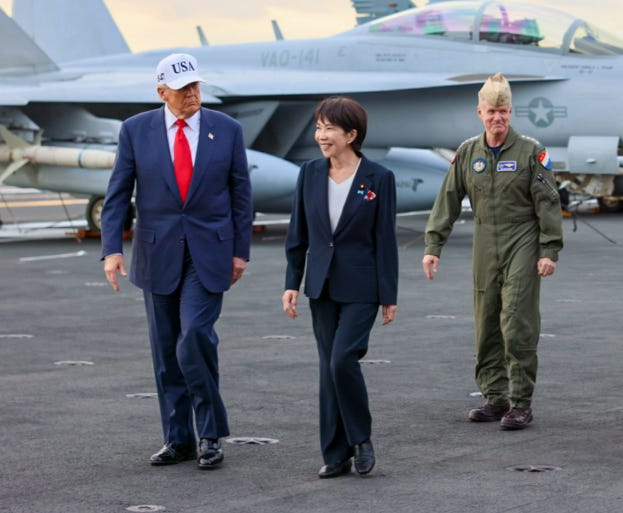
President Trump, Prime Minister Takaichi, and Admiral Paparo, Commander of U.S. Indo-Pacific Command aboard the USS George Washington in Yokosuka, Japan.
As soon as the U.S. President’s visit finished, Takaichi boarded a plane for South Korea and took part in her first major international event as Prime Minister, the APEC Summit (Asia-Pacific Economic Cooperation).
There she had her first meeting with Xi Jinping.
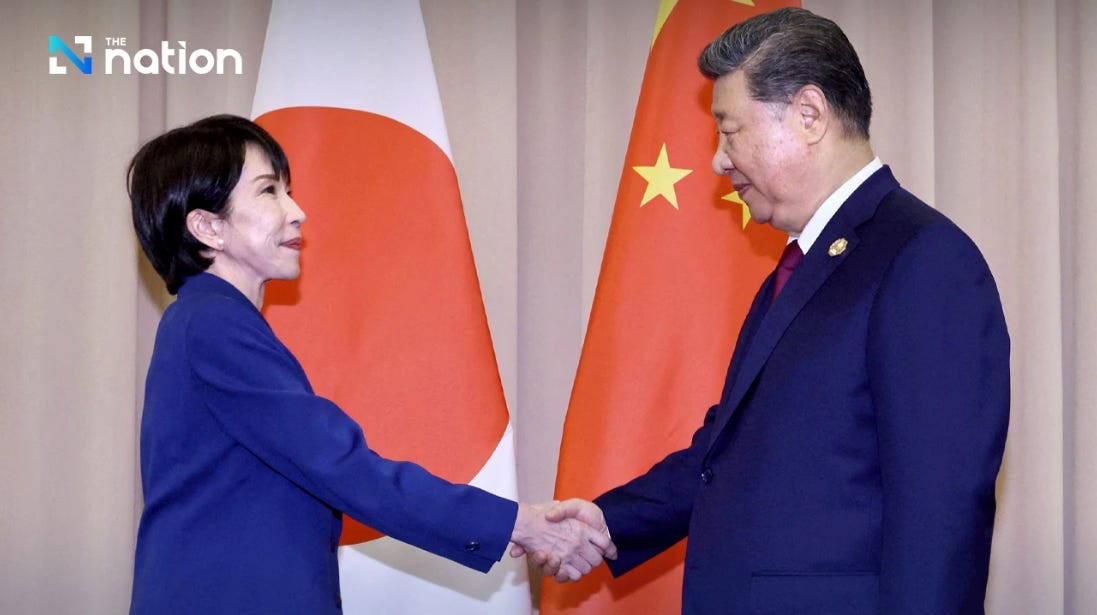
Takaichi and Xi in South Korea for the APEC Summit.
In her meetings with Xi, she raised concern over both Hong Kong and Xinjiang, as well as the PRC’s aggression in the East and South China Seas… and the very next day she met face-to-face with Taiwan’s representative to APEC, Lin Hsin-I, one of President Lai’s advisors.
And then met again with him the next day, in case Beijing missed the significance of the first meeting.
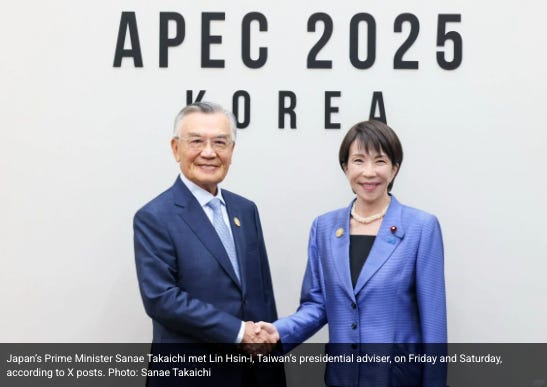
Lin Hsin-i, Taiwan’s presidential advisor, and Takaichi in South Korea for the APEC Summit.
Cue the Manufactured Outrage from Beijing
Takaichi went public with the criticisms she raised with Xi and then proudly posted photos of her meeting with Lin Hsin-i to her social media account and commented that she hoped that the “practical cooperation between Japan and Taiwan will deepen.”
With the predictability of a Grand Seiko watch, Beijing howled that Takaichi committed an “egregious” injury to the RelationshipTM by deliberately meeting with “personnel from the authorities of China’s Taiwan region… [and] hyped it on social media.” The PRC foreign ministry whined that these actions “severely violated the one-China principle, the spirit of the political documents between China and Japan, and basic norms of international relations, and sent a gravely wrong signal to the ‘Taiwan independence’ forces.”
The foreign ministry statement went on to urge the Japanese Government to “reflect on and address its wrongdoings, take concrete measures to undo the negative impact, stop interfering in China’s internal affairs, and act on its statement of building a constructive and stable China-Japan relationship fit for the new era.”
So, let’s examine what the Chinese Communist Party is so angry about.
According to Beijing, everyone in the world must accept and promote the CCP’s “one-China principle” and that to even take actions that suggest that Taiwan is an independent country (like meeting with its elected leaders and the representatives of those elected leaders), means that a country is violating a “basic norm of international relations.”
This form of unilateralism sits at the heart of the PRC’s foreign policy. According to the CCP, everyone must observe and abide by Beijing’s demands, but Beijing is NOT bound to fulfill international agreements it has made to other countries (just go read the Sino-British Joint Declaration of 1984 or the ruling from the Permanent Court of Arbitration in the Hague from 2016, “The South China Sea Arbitration,” or the PRC’s commitments to liberalize their economy when they entered the World Trade Organization).
Beijing loves to insist that others must follow “rules and norms” of its making, even as it thumbs its nose at rules and norms of international organizations or bilateral treaties with other countries.
As Japan normalizes its ties with Taiwan, the entire façade of one-China is starting to crumble.
Some will demand that Tokyo cease its so-called “provocations.” They will say that Prime Minister Takaichi is being dangerous… but that begs the question: why is it dangerous for countries to associate with Taiwan?
Is Taiwan some sort of infectious disease that risks escaping into the world? Are Taiwanese leaders advocating policies that will harm others?
The last time I checked, Taipei has neither the capability nor the intention to attack anyone else. Its foreign relations are based almost entirely on trade and commerce. It has a functioning legal system in which the country’s laws are enforced equally and consistently. Its military preparedness is directed at defending its borders, maritime rights, and its citizens… all actions that are completely aligned with the United Nations Charter.
Perhaps it would be better if we critically examined whether the PRC has a legitimate case for demanding that the world respect its one-China principle.
There are plenty of independent countries in the world that once belonged to a collapsed empire, just as Taiwan belonged to the Qing empire as a colony from 1683 up until 1895 when the Guangxu Emperor ceded Taiwan to Japan with the Treaty of Shimonoseki.
So, let’s recap: for about two hundred years the Qing Empire ruled Taiwan as a colony and then ceded that colony to another empire more than a century ago after the Qing lost a war. When that empire collapsed after another war, Taiwan was returned to the successor state of the Qing Empire. That first successor state was defeated by a second successor state in a civil war, but the first successor state has maintained control of Taiwan and has since transitioned into a liberal democracy, and it has become a self-governing country in which its elected leaders are natives of Taiwan.
Now the second successor state wants to annex Taiwan and rule the country from Beijing because Taiwan once belonged to the Qing Empire as a colony.
Is that about, right?
Let’s examine some other similar situations that unfolded during the same time period and judge whether we think the PRC has a legitimate claim based on “basic norms of international relations.”
Finland was once a part of the Russian Empire (and before that a Swedish Empire), but when the Russian Empire collapsed during the First World War, Finland became independent. Would it be legitimate for Putin to dig up some imperial justification for invading and annexing Finland (just as he is doing with Ukraine)? Would it be legitimate for Putin to demand that everyone respect his one-Russia principle and that no one have diplomatic relations with Helsinki because that would mean interfering with Russia’s internal affairs?
India was once a part of the British Empire, but as that empire collapsed after the Second World War, India became independent. Would it be legitimate for Starmer to dig up some imperial justification for invading and annexing India? Could Starmer demand that no one else have diplomatic relations with Delhi because they would be interfering with Britain’s internal affairs?
All of Ireland once belonged to the British Empire, would it be legitimate for Starmer to annex the Republic of Ireland as a way to achieve so-called territorial integrity?
Algeria became a department of France in 1848 under the French Empire, but during the age of decolonialization following the Second World War and under the French Fifth Republic, Algeria won its independence during a civil war. Would it be legitimate for Macron to dig up some imperial justification for invading and annexing Algeria because Napoleon III once ruled Algeria? Could Macron demand that the world respect his one-France principle and have no diplomatic relations with Algiers?
Guatemala was once a part of the Aztec Empire, would it be legitimate for Mexico (arguably the successor state to the Aztec Empire) to invade and annex Guatemala? Mexico certainly experienced more than a century of humiliation, does that make annexation of other countries legitimate? Or should we consider the Kingdom of Spain to be the successor state to the Spanish Empire that once spanned much of the Americas and the Philippines, does Madrid have a legitimate claim over Manila or Lima or Mexico City or Havana or Santo Domingo? Spain was certainly humiliated by other powers during the 19th and 20th Centuries.
The People’s Republic of China inherited portions of the empire that once belonged to the Qing dynasty… just as many other countries today trace their roots back to long-dead empires (the Ottomans, the Austrians, the Mughals, the Spanish, the Aztecs, etc.). We don’t consider it legitimate for the successor states to those empires to invade and annex their neighbors so that they can realize an imagined “territorial integrity” or to soothe their egos about imagined periods of humiliation.
So why should China be a special case?
Why do the PRC’s leaders deserve their own rules? Arguably, the 20th Century was a century of humiliation for Britain, France, and other Europeans as they lost their empires, just as the Chinese lost theirs in the 19th Century… does that give the Europeans an excuse to threaten others with invasion and annexation?
“Basic norms of international relations” would suggest that Beijing, not Tokyo, is out of line with the rest of the world. It is Beijing that is acting unilaterally. It is Beijing that is threatening peace and stability with their neo-imperialism, just as Moscow has done with its invasion and attempted annexation of Ukraine.
Taiwan is obviously an independent country; it has been so for 75 years.
The end of Japanese colonial rule in 1945, ended its colonial status. The outcome of the Chinese Civil War severed its relationship with what became the People’s Republic of China (regardless of the fantasies of Chiang Kai-shek to “retake” the mainland one day). The democratization movement in the 1980s and 1990s created the country we know today as Taiwan as even the KMT gave up its goals of reconquering China.
The only reason that Taiwan isn’t a member of the United Nations or recognized as an independent state by only 12 countries, is that the Chinese Communist Party uses its UNSC veto power to prevent it from joining the United Nations and Beijing bribes and coerces other countries to isolate Taiwan.
However, it appears that Beijing’s coercion is becoming less and less effective as countries around the world, not just Japan, strengthen their relations with Taipei. In September, the Taiwanese Foreign Minister Lin Chia-lung made a multi-country visit to Europe with stops in Prague, Rome, Vienna, and the Netherlands, and one of Germany’s Minister-Presidents made a trip to Taiwan that same month.
For years, we’ve allowed the CCP to define what constitutes legitimate and appropriate relations with Taipei. Folks have abided by this arrangement out of fear for what the PRC might do, not out of respect for principle. Prime Minister Takaichi is demonstrating that fears of CCP temper tantrums shouldn’t preclude pursuing a principled foreign policy when it comes to Taiwan.
It is time to be much more critical of Beijing’s position and to send a unified message that the era of imperialism and colonialism is over. Just as dozens of countries have become independent nations over the past century, we should apply the same principle to our interactions with Taiwan.
For that, Takaichi deserves respect and admiration. Beijing will attempt to paint her as a scary Japanese ultra-nationalist, but in reality, she is simply shining a light on the CCP’s hypocrisy and double standards.
The PRC claims that it stands against imperialism even as its seeks to rebuild its own empire through military conquest.
Thanks for reading!
Matt
MUST READ
Structure Trumps Agency in the U.S.-China Relationship: Why the Competition Is Here to Stay
Mira Rapp-Hooper, Foreign Affairs, October 29, 2025
In the United States, bipartisan consensus is painfully hard to achieve—except on the issue of China. Even as American political polarization has intensified over the last eight years, both Republicans and Democrats have agreed that an increasingly powerful Beijing poses an economic, technological, and security threat to Washington and its close allies.
This consensus is, in part, Donald Trump’s achievement. During the president’s first term in office, his officials raised alarms about Beijing’s growing technological prowess, its military buildup, and its dominance over the critical minerals industry. They slapped sanctions on Chinese entities, imposed tariffs on U.S. imports of Chinese goods, placed some restrictions on the country’s access to semiconductors, and even labeled Beijing’s actions in Xinjiang a genocide against the Uyghur people. Upon taking office, the Biden administration kept and, in many cases, expanded on these policies and positions. It took the Trump team’s diagnosis and built a government-wide strategy to comprehensively address the China challenge through domestic investment, cooperation with allies, and hard-nosed diplomacy. When Trump returned to office four years later, China was one of the only areas in which analysts expected continuity.
Yet Trump has dashed these expectations. In fact, since starting his second term, the president and his closest advisers appear determined to build a commercially based détente with Beijing. The president imposed crippling tariffs on China in April but then quickly lowered them. He has loosened multiple export restrictions at the behest of Beijing. And he has sought a leader-level meeting with Chinese President Xi Jinping in hopes of moving the two countries closer to a trade deal and overall rapprochement. The two are now set to talk this week, on the sidelines of the Asia Pacific Economic Cooperation conference in South Korea.
But those hoping for a major shift in U.S.-Chinese relations may be disappointed. Despite his attempt to court Xi, and Xi’s own desire to take maximum advantage of Trump’s overtures, any truce will probably be temporary. China is highly unlikely to adjust its global aims, and there are many ways an attempted détente could unravel. Trump and Xi may want to calm the waters in the short term. But structural realities mean that U.S.-Chinese competition is here to stay.
DECADE IN THE MAKING
Presidents before Trump worried about growing Chinese influence. Barack Obama, for example, began a pivot to Asia in part to address concerns about China’s assertiveness in the Indo-Pacific region. But it wasn’t until the first Trump administration that Washington’s long-standing effort to shape China’s behavior through engagement was replaced with an effort to check Chinese assertiveness where it impinged on American interests. After more than 15 years of American preoccupation with counterterrorism and the Middle East, Trump’s National Security Strategy and National Defense Strategy refocused U.S. policy on great-power competition. His officials at the time, including Secretary of Defense James Mattis, Secretary of State Mike Pompeo, and Deputy National Security Adviser Matt Pottinger, made Beijing their main priority. They called attention to China’s unfair trade practices, its use of economic and diplomatic coercion, its growing desire to dominate the Indo-Pacific militarily, and its troubling efforts to gain international leverage through foreign investment, theft of intellectual property, and state-directed technology strategies. Congress embraced this approach on a bicameral, bipartisan basis.
But although Trump gave his stamp to these China policies, his personal instincts lay elsewhere. The president valorized autocratic strongmen, including Russian President Vladimir Putin, North Korean leader Kim Jong Un, and Xi. After China’s president dismantled term limits in 2018, for instance, he praised the move as “great.” In fact, Trump’s gripes with Beijing were mostly limited to the amount of goods China purchased from the United States, and so much of his attention was spent on direct negotiations with Xi that tried to address the trade deficit. Beijing, meanwhile, gained control of Hong Kong.
In January 2020, Trump and Xi made a seeming breakthrough, striking their “phase one” trade deal. In this pact, China agreed to make large agricultural and energy purchases and strengthen commitments to protect intellectual property and technology. In exchange, the United States lowered some of its tariffs. But the Chinese side lagged on targets for the purchase of American goods and services. The president’s diplomatic efforts were further derailed by the outbreak of the COVID-19 pandemic, which Trump labeled the “China virus.” Tough-minded American policies toward China thus intensified over the course of 2020.
When Biden took office, he largely accepted the Trump administration’s geopolitical diagnosis, and his team built much of its foreign policy around the China challenge. The Biden National Defense Strategy and National Security Strategy were animated by competition with Beijing, and its Indo-Pacific Strategy laid out a blueprint for a more robust U.S. role in Asia. The White House also redoubled American attention on Indo-Pacific partnerships and alliances, such as the Quad (also known as the Quadrilateral Security Dialogue), the AUKUS alliance with Australia and the United Kingdom, and the U.S.-Japanese-Korean trilateral partnership. And it sharpened Washington’s ability to go toe to toe with China through a stronger military posture, targeted technology controls, and tough diplomacy. Congress supported all these measures and tried to boost the United States’ competitiveness through legislation such as the CHIPS and Science Act, which poured federal money into strategically significant industries. By the time Biden left office, the China consensus seemed so strong that it resembled something of a ratchet. With Xi’s China continuing to press its advantage around the world, the pressure for the United States to compete could only increase.
COMMENT – I think Mira Rapp-Hooper did a great job with this piece, she is right to point out that strategic competition between the United States and the PRC is here to stay.
China Pushes to Silence Victims of African Mining Disaster
Nicholas Bariyo, Wall Street Journal, October 27, 2025
Toxic waste from a Chinese mine in Zambia washed through homes and fields; compensation offers tied to nondisclosure.
The worst day of Bathsheba Musole’s life started with a deafening crash when the 30-foot wall around a toxic-waste pool collapsed at the Chinese copper mine above her village.
A poisonous river of a stinking yellow liquid rushed downhill, inundating homes and fields, including the one where she grew corn to feed her eight children. The floodwater, laden with cyanide and arsenic, rose chest-high. “I thought I would drown,” said Musole, 48 years old, in a recent interview.
In August, months after the Feb. 18 disaster, officials from Sino Metals, a unit of the state-owned China Nonferrous Mining Corp., showed up at Musole’s half-acre farm, which the Zambian government says is too toxic to sustain crops for at least three years.
They were there to make things right, she recalled them saying. Their offer was $150, but it came with a catch.
To get the money, she would have to agree never to talk about the spill, take legal action against Sino Metals or even reveal the contents of the nondisclosure agreement itself, according to documents presented to other spill victims, which were reviewed by The Wall Street Journal. Local environment activists said those terms were the same for all victims.
COMMENT – Looks an awful lot like colonialism and imperialism to me… this is the kind of stuff we would have expected to see from Europeans in Africa a century ago.
Dutch government took control of Nexperia over fears it was being gutted - sources
Reuters, October 27, 2025
The Netherlands’ decision to take control of chipmaker Nexperia in September was due to fears the company’s former CEO was already dismantling the company’s European operations and moving production to China, four sources in The Hague familiar with the government’s thinking said on Monday.
A monthlong standoff between China and the Netherlands over Nexperia has prompted carmakers in Europe, the U.S. and Japan to warn of possible production problems due to chip shortages. Although the chips Nexperia makes are very basic, they are used in large numbers in the electronic systems of cars.
The sources in The Hague said Nexperia former CEO Zhang Xuezheng, who is also the founder of Nexperia’s Chinese parent company Wingtech had planned to lay off 40% of staff in Europe and close a research and development facility in Munich.
Before Zhang was suspended from the CEO role by a Dutch court on October 1, he had already transferred secrets from the company’s plant in Manchester, Britain, to a Wingtech-owned plant in China, including chip designs and machine settings, they said. Physical equipment from the company’s Hamburg production plant was slated to be taken next, they added.
COMMENT – This is why you don’t permit the Chinese Communist Party to “buy” assets in your country through their commercial entities.
It is also why we should be pursuing an aggressive economic disentanglement from the PRC.
Visa Power: How China is Buying its Way into America’s Heart
Didi Kirsten Tatlow, Newsweek, October 28, 2025
New steel and solar plants and a transport terminal have become a godsend for the Mississippi River town of Osceola, now long past its heyday as a timber and grain hub where steamboats once called and blues music echoed.
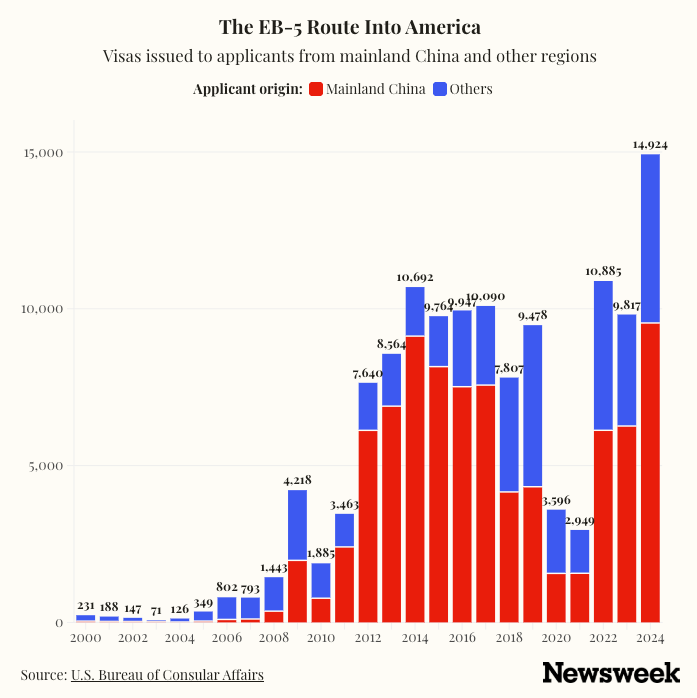
But crucial to the financing of the burgeoning industrial cluster in this rural northeastern corner of Arkansas, one of America’s poorest states, is a surprising set of investors: Chinese citizens who have secured residency in the United States—and potentially a path to citizenship—through an investment visa scheme that has been bringing in thousands of people a year, by far the biggest group of whom are from China.
A Newsweek investigation has revealed how the entry of potentially hundreds of Chinese citizens to the U.S. via this struggling town of around 6,800 is being facilitated by Chinese companies with links to the ruling Communist Party that market their ability to buy entry to the United States. Also involved is the immigration investment subsidiary of a nonprofit economic development corporation in Little Rock.
There is no indication of wrongdoing on the part of the Chinese and American companies or individuals involved in the Osceola cluster, but the scale of the immigration pipeline from the country described by U.S. security agencies as America’s main global adversary has raised concerns among some serving and former U.S. officials over possible security risks not only from the arrival of hundreds of new residents but also over the level of Chinese involvement in industrial centres of potential strategic importance.
“The fundamental question that needs to be asked is: ‘Would this transaction allow or facilitate the influence of an adversary state or adversary actor to the detriment of the United States, both from the economic health, you know, sustainability, resilience, as well as the national security of the United States?’” said a U.S. official with knowledge of the situation who was granted anonymity to speak as they were not permitted to discuss the issue publicly. “The answer is ‘yes.’”
The revelations also come amid FBI concerns that China may be targeting the Mississippi River system to access the U.S. interior from Louisiana’s southern ports northwards through St. Louis and into Chicago by establishing businesses and buying properties. China was aiming for “access to and control of supply chains, economic ties leveraged for political influence, ability to disrupt and collect intelligence,” agent Benjamin Dreessen told the Louisiana District Export Council in July, according to the minutes of the meeting which was first reported by The Center Square. The FBI and the council did not respond to requests for comment.
Both immigration and relations with China are among the most contentious issues of President Donald Trump’s second term. Hundreds of thousands of people have been deported for living in the United States illegally, a new charge of $100,000 has been imposed for foreign skilled worker visas, and Secretary of State Marco Rubio has said the government will “aggressively” revoke visas from Chinese students and especially those with ties to the Communist Party. But Trump has also said he would welcome 600,000 Chinese students and in September the White House announced plans for wealthy foreigners to acquire legal residency by purchasing a “Gold Card.” These mixed signals come amid an increasingly high-stakes, on-again off-again trade war with China.
The White House did not respond to a request for comment on Chinese immigration through the Osceola projects. China’s embassy in Washington, D.C., did not respond to a Newsweek request for comment.
Washington, D.C.-based national security experts have urged the Committee on Foreign Investment in the United States to review the industrial hub in Osceola, two sources familiar with the situation told Newsweek. But the committee had declined to investigate, without giving a reason, they said. In a statement to Newsweek, Brody Garner, a spokesperson for the congressional Government Accountability Office said that “EB-5” visa projects qualified for CFIUS scrutiny. Garner did not respond to an email requesting specifics of the Osceola situation.
The EB-5 visa has been popular with wealthy Chinese since its launch in 1990. In 2022, the scheme was reformed and reauthorized by Congress following years of fraud and national security concerns. Today, the visa costs either $800,000 or just over $1 million, depending on the location and investment which must create jobs in the U.S.
COMMENT – Given the recent developments around Nexperia, we should be very cautious about activities like this.
Be wary of US-China trade ‘deal’ déjà vu
Jamie McGeever, Reuters, October 28, 2025
The United States and China appear to have hammered out the framework of a trade deal in advance of Presidents Donald Trump and Xi Jinping’s meeting this week, removing the threat of an imminent collapse in trade between the world’s two largest economies. World markets have welcomed the news, but, far from a game changer, this just looks like déjà vu.
Remember this?
“OUR DEAL WITH CHINA IS DONE, SUBJECT TO FINAL APPROVAL WITH PRESIDENT XI AND ME,” Trump wrote on Truth Social on June 11, adding: “RELATIONSHIP IS EXCELLENT!”
As it turned out, the deal was not done, and the relationship was not excellent.
So much so, an emboldened Beijing earlier this month put extra controls on rare earth exports, and Washington responded with threats of 100% tariffs on U.S.-bound shipments of goods from China. U.S. Treasury Secretary Scott Bessent also publicly criticized top Chinese trade negotiator Li Chenggang as “unhinged”.
However, the two men appear to have put these differences aside following talks in Malaysia over the weekend, agreeing to the roots of a preliminary deal in which China will delay its expanded licensing regime for rare earths and the U.S. will drastically lower its threatened tariffs on Chinese goods.
Soundings from the White House are upbeat, while the Chinese side is taking a more cautious line.
But how should investors view the news?
‘PERILOUS NEW CHAPTER’
On the one hand, any deal that removes the worst-case scenario of a collapse in U.S.-China trade is good news. And all the evidence since the depths of ‘Liberation Day’ turmoil in April suggests that, if this doomsday threat is sidelined, the world economy will continue to muddle through, and markets will ‘melt up’ on policy stimulus, AI optimism and solid corporate earnings.
Cassandras say that’s a dangerously complacent view. Whatever face-saving deal Trump and Xi eventually agree to will merely kick the can down the road.
Grace Fan at TS Lombard on Friday warned that a “perilous new chapter in geopolitics and global trade” has been opened, regardless of how the Trump-Xi meeting goes. The stakes are high, neither side wants to be seen backing down, and both will feel they hold the ace cards.
Trump leads the world’s biggest economic, financial and military superpower, and every single trade deal he has signed so far this year has been in the United States’ favor.
Meanwhile, Xi has huge leverage with something the U.S. needs - rare earths, the elements used in everything from lithium-ion batteries and semiconductors to cell phones, aircraft engines, LED TVs, electric vehicles and military radars.
COMMENT – Nothing that happened in South Korea last week changed the underlying geopolitical realities that the United States and the PRC view each other as serious rivals and each is trying to build an international system that benefits them and disadvantages their rival.
China Against China
Jonathan A. Czin, Foreign Affairs, October 27, 2025
Thirteen years after Xi Jinping ascended to the top of China’s leadership hierarchy, observers in Washington remain deeply confused about how to assess his rule. To some, Xi is the second coming of Mao, having accumulated near-total power and bent the state to his will; to others, Xi’s power is so tenuous that he is perpetually at risk of disgruntled elites ousting him in a coup. Xi’s China is either a formidable competitor with the intent, resources, and technological prowess to surpass the United States or an economic basket case on the verge of implosion. Depending on whom one asks, China’s growth model is either dynamic or moribund, relentlessly innovative or hopelessly stuck in the past.
Attempts to analyze Xi’s project have become even more convoluted in the wake of China’s slow recovery from the COVID-19 pandemic. When Xi suddenly ended China’s draconian pandemic controls and reopened the country in late 2022, Wall Street did not debate whether China’s economy would come roaring back, but rather what letter of the alphabet—a V or a W—the graph charting the upward path of the recovery would resemble. When the economy sputtered, some in Washington concluded the opposite extreme: that China had peaked, its governance structure had failed, and that it would start to decline relative to the United States.
This analytic confusion has shaped U.S. policy toward China. At the start of the second Trump administration, officials claimed that China was the greatest threat to the United States yet seemed to believe that China’s economic strains were so severe that it would immediately cave in a trade war—a viewpoint reminiscent of Mao’s famous declaration that the United States was a “paper tiger” that appeared threatening but was in fact weak and brittle. The attempt to pressure China with tariffs failed. Beijing responded to Washington’s trade escalation in April 2025 by imposing retaliatory levies and cutting off the U.S. supply of rare-earth magnets. The Chinese economy’s ability to weather the trade shocks endowed Beijing with newfound confidence.
Since the weight of a closed, illiberal system dragged down the Soviet Union, the United States has attributed much of its own resilience to its political system’s ability to recognize problems, propose solutions, and correct course. The painful irony for the United States is that under Xi, China’s opaque polity, in which officials have every incentive to obfuscate rather than admit mistakes, has proved adept at frankly acknowledging many of its weaknesses and taking steps to remedy them—arguably even more adept than the supposedly supple and adaptive American system. China’s rise under Xi is challenging not just American power, but a foundational tenet of America’s open society—that openness to debate and inquiry is the foundation of a self-correcting system.
…
While strategists in Washington debate whether China has peaked, their counterparts in China are having an analogous debate about the United States—and reaching strikingly similar conclusions. China’s state media has diagnosed the United States with “hegemonic anxiety,” suggesting that Washington cannot cope with the possibility that it must face a multipolar world. And whereas U.S. thinkers such as Hal Brands have argued in their analyses of China that a power that has peaked is likely to lash out in violent ways, Chinese observers independently conclude that it is Washington that is anxious about preserving its position—and is increasingly willing to employ any means necessary to sustain its preeminence.
In the early years of the Cold War, the strategist George Kennan worried that the United States might lose confidence in its own system if the democracies of Europe succumbed to the Soviet Union. Today, the challenge is just the opposite: declining American confidence in its own system could be a cause rather than the result of the United States losing the competition with China. In contrast, Xi’s counterreformation—including the continuous purges and fallout from the property sector’s collapse—has not produced a crisis of confidence in China. Instead, if anything, Xi has gained confidence because he can point to tangible results in the form of technological breakthroughs. And Xi can afford to be patient because his is a long-term project, and he does not face the erratic fluctuations of an unstable political system swinging from one extreme to the other.
Indeed, a growing number of officials in Washington employ Cold War–style rhetoric when discussing China yet demonstrate little appetite to take on the difficult and expensive tasks, such as refurbishing the defense industrial base and shoring up key supply chains, that would help the United States outcompete China. If this dynamic continues, the United States will be left pursuing what might be called a “Reverse Roosevelt” strategy: speaking loudly about American power while wielding an ever-smaller stick. While Xi has been disciplined and methodical in his efforts to bolster China’s strategic position, the United States has been distracted and incoherent. Misreading Xi Jinping is, ultimately, part of the failure to address the problems facing the United States itself.
COMMENT – Jonathan Czin is not wrong.
Wall Street Journal, October 29, 2025
As President Trump prepares to meet with Chinese President Xi Jinping on Thursday, it’s useful to recall that Mr. Xi continues to attack American interests across the world. The latest evidence comes in new reports on China’s help for Russia’s military campaign against Ukraine.
Foreign Minister Wang Yi said this summer that China doesn’t provide lethal weapons to Moscow. But non-public reports prepared for the U.S. State Department and European governments cast doubt on Beijing’s denials by following the money and supply-chain trails from Chinese manufacturers to Russian drone makers.
The reports, which we reviewed, were written by the Center for Defense Reforms, a Kyiv-based think tank whose staff has previously worked for Ukrainian intelligence and the Ministry of Defense. They draw on customs data, corporate records and non-public military and intelligence information.
One brief looks at the so-called FPV drones Russia uses to attack Ukrainian troops and civilians near the front lines. Last year Russia imported more than 3.3 million motors from the Chinese company Shenzhen Kiosk Electronic Co, which likely sources them from other Chinese manufacturers, the report finds.
These engines can have nonmilitary uses such as washing machines, pumps or electric scooters. But the report says the “final recipient” is Rustakt LLC—a Moscow-based company identified by Ukrainian intelligence as a drone maker. In December 2024 the European Union sanctioned Rustakt for its support of Russia’s military.
The report finds that between July 2023 and February 2025, Rustakt imported nearly $294 million in various Chinese products, including more then $83 million in electric motors. This trade continued after the EU sanctions. “The scale and structure of the supplies” it imports “indicate that Rustakt is not only a manufacturer but a logistics centre” for other Russian drone makers, the report says.
Why Chinese Car Investments Are a National-Security Risk
David Feith and Chris McGuire, The Free Press, October 29, 2025
If the U.S. wants to win the competition for technology and security, it must distinguish between productive investment and Trojan horses.
As we all await the U.S.-China summit on Thursday, there is an Amy Winehouse test worth applying to Donald Trump’s approach. The test comes from an overlooked Fox News interview last March between Laura Ingraham and Howard Lutnick.
The Fox News host asked the commerce secretary: “Let’s say China comes in and they say, ‘Okay, we’re gonna build stuff in the United States. We want to build automobile companies, our automobiles, in the United States.’ Well, that would kill our car industry… Would you allow that?”
Lutnick didn’t hesitate. “No. That’s what I call an Amy Winehouse—which is no, no, no,” he said with a laugh, alluding to the late songstress’s famous refrain. He continued: “We’ve gotta watch ourselves with the Chinese, because the Chinese are dumpers. What they do is they try to make their industries crush ours, so they can have control of us.”
Lutnick’s answer reflected widespread concerns—in Washington and across U.S. industry—over the national- and economic-security threats posed by China’s galloping advance in the global auto market.
What it didn’t reflect, however, was Donald Trump’s stated views on the subject.
This issue first gained national attention in early 2023, when Virginia Republican governor Glenn Youngkin publicly rejected a proposed battery-plant venture between Ford Motor Company and Chinese battery giant CATL, branding the deal a “Trojan horse” for Beijing.
Authoritarianism
A “Correct” Perception of China
Michael Kovrig, Strategic Narratives, October 23, 2025
It’s not the one the Chinese Communist Party wants you to have. That’s why it’s crucial to decode what its diplomatic slogans really mean.
China’s officials are sweet-talking Canadians. Its Ambassador to Canada, Wang Di, has given smiling interviews calling for the two countries to “have a correct perception of each other.” His other catchphrases include “mutual respect,” “win-win cooperation,” and “positive energy.” Appearing October 12 on CTV’s Question Period, he assured that trade disputes would disappear if only Canada would drop its tariffs.
After enduring several years of China’s abusive “wolf warrior” diplomacy, Canadians — particularly Foreign Affairs Minister Anita Anand, who is visiting Beijing this week — may be tempted to look for comfort in this syrupy language. But they should be wary, because while the Chinese Communist Party (CCP) and its envoys have altered their tone, their hostile intentions and harmful policies remain unchanged. Their goals are to enhance economic ties selectively to create dependence and offload overproduction, while sowing political divisions, both among Canadians and between Canada and its allies.
So when Chinese officials talk, we should listen closely — and then decode the real implications of their words. Case in point: when Premier Li Qiang met Prime Minister Carney in September, he reiterated Ambassador Wang’s call for Canada to show a “correct perception of China” to “cement the political foundation for bilateral ties.”
Correcting Perceptions
The key phrase “correct perception” encompasses political demands rooted in decades of Communist Party discourse: never question the legitimacy of its authoritarian rule; respect “core interests” like the CCP’s entitlement to rule Hong Kong, Tibet, Xinjiang, and Taiwan; stop supporting American measures to constrain Beijing’s drive to dominate East Asia and reshape the international order; abandon the Indo-Pacific Strategy’s core premise that China is a “disruptive power”; and stop framing the Party-state as a national security threat, systemic rival and violator of international treaties.
“Correct perception” also reflects an ideological tradition that goes back to Vladimir Lenin and Mao Zedong that the CCP has a monopoly on truth. It’s binary. Either you understand it “correctly” and accept its political system and red lines, or you are wrong—and will suffer. General Secretary Xi Jinping has doubled down on this thought control doctrine to impose internal discipline and pump out propaganda narratives.
This is the language of diplomatic gatekeeping, not reconciliation. You want a meeting with Xi? There’s a price. You know what you need to do. First create the conditions.
When Ambassador Wang complains of “smearing and attacking on China” about its treatment of Hong Kongers, Uyghurs, Tibetans and Taiwanese, and “attacking and hyping up” its political interference, espionage, and transnational repression, and protests that this harms the foundations of friendship, and indeed “hurts the feelings of the Chinese people” — he’s gaslighting people for objecting to injustice, bullying and massive abuses of human rights.
This is rhetorical entrapment, not friendship based on mutual understanding. It’s an attempt to redefine the baseline of the relationship so that criticism is betrayal and the price of cooperation is silence and acquiescence.
Chinese diplomats routinely deploy such coded language. Their well-rehearsed calls for “pragmatic cooperation” and “seeking common ground while maintaining differences” are not proposals to politely disagree. They’re demands to ignore differences on values and national security concerns and prioritize business deals and market access, further enmeshing countries in economic dependency and elite complicity.
When Ambassador Wang says our two countries have “no fundamental conflicts of interest,” he’s insisting we forget about China’s decisive enabling of Russia’s invasion of Ukraine, support for Iran and North Korea, and adversarial behaviour toward other democracies.
Negotiating tip: when Chinese officials declare that two sides “need each other,” it usually signals that the CCP needs something. This year, it’s market access to dump its overproduction of electric vehicles, aluminum and steel.
These nuggets of Party-speak are also being dispensed to audiences in Australia, New Zealand, Japan, Europe, and elsewhere, who have experienced a superficial charm offensive since late 2022. (Canada’s was delayed until Justin Trudeau departed the scene.) By portraying China’s government as a responsible pillar of international order and blaming all problems on Washington, Chinese officials hope to benefit from America’s belligerent turn and lull other countries into complacency about their own drive for geopolitical primacy.
The message is that partnership with China requires accepting your place in a Beijing-centric global hierarchy. Unmentioned is that much of Donald Trump’s ire with the global trading system stems from the massive distortions forced upon it by China’s mercantilist, state-guided economic policies. Those same distortions are behind the PRC’s trade disputes with Canada.
COMMENT – It doesn’t appear that Prime Minister Mark Carney, or his Canadian Government, are listening to Micheal Kovrig.
Canada Set to Side with China on EVs
Eliot Chen, The Wire China, October 26, 2025
The Ottawa government is considering dropping 100 percent tariffs on imports of Chinese EVs, in a potentially major break with the U.S. approach.
China has become an automaking powerhouse, but thanks to steep tariffs on its electric vehicles, most North American consumers have yet to see its cars on their roads. That may be about to change.
Canada’s government is considering removing the country’s 100 percent tariff on Chinese EVs. The potential pivot comes as President Donald Trump’s trade war is wreaking havoc on the deeply integrated U.S.-Canada auto supply chain, and as Canada looks for ways to negotiate down trade barriers with China.
Last week, Canadian Foreign Minister Anita Anand visited Beijing, a trip that signaled warming ties with the country. Beijing has suggested it’s willing to drop its steep tariffs on Canadian canola and pork in exchange for relief on EVs. The leaders of at least two Canadian provinces support this quid pro quo; Canada’s agriculture minister says that Ottawa is considering the proposal.
Dropping the EV tariffs would mark a major split between Ottawa and Washington on China policy, at a time those two governments are also negotiating a volatile trade deal. Late Thursday night, Trump announced that he was “terminating” trade negotiations with Canada, blaming a television commercial sponsored by the Ontario government that featured Ronald Reagan criticizing tariffs. A split on EVs could deepen the rift further.
COMMENT – I suspect the United States can’t trust Canadian leaders on this issue.
China, Canada Leaders Meet for the First Time Since 2017 to Reset Ties
Brian Platt, Josh Xiao, and James Mayger, Bloomberg, October 31, 2025
Canadian Prime Minister Mark Carney hailed a “turning point” in his nation’s ties with China after a meeting with Chinese Xi Jinping that marked the first formal sitdown in eight years between leaders of the two nations.
“Very pleased with the outcome of the meeting,” Carney told reporters after meeting with Xi on the sidelines of the annual Asia Pacific Economic Cooperation summit in Gyeongju, South Korea. “We now have a turning point in the relationship — a turning point that creates opportunities for Canadian families, for Canadian businesses and Canadian workers.”
COMMENT – I’m sure Beijing sees that Canada now has the “correct perception” of the RelationshipTM.
Xi Delivers Veiled Warning to Nations Not to Take the U.S.’s Side
David Pierson and Berry Wang, New York Times, October 31, 2025
At an Asia-Pacific summit, the Chinese leader urged countries to “resist unilateral bullying,” an appeal that seemed at odds with his country’s recent actions.
China’s leader Xi Jinping, the de facto geopolitical heavyweight at an Asia-Pacific economic summit, on Friday courted countries for trade and investment, but also implicitly warned them not to join the United States in reducing the world’s reliance on Chinese supply chains.
President Trump’s departure from South Korea a day earlier meant that Mr. Xi was the sole superpower leader at the Asia-Pacific Economic Cooperation summit in the city of Gyeongju. At the opening of the meeting, Mr. Xi could be seen smiling and shaking hands with world leaders and economic and finance ministers who came up to greet him.
Mr. Xi seized his time in the spotlight to pitch China, the world’s second-largest economy and a manufacturing powerhouse, to a room that included the leaders of Japan, Canada, Australia and the host, South Korea. (But not everyone in the room was an easy sell.)
COMMENT - Maybe I missed it, but where are the ASEAN leaders telling Beijing to not ask them to take sides?
US government allowed and even helped US firms sell tech used for surveillance in China, AP finds
Garance Burke, Dake Kang and Byron Tau, Associated Press, October 29, 2025
Step by Step, How China Seized Control of Critical Minerals
Keith Bradsher, New York Times, October 27, 2025
Biggest-ever PLA purge: Do anti-Xi coup plots or fears explain it?
Francesco Sisci, Asia Times, October 26, 2025
Xi Jinping’s latest purge: paranoid or purposeful?
Economist, October 27, 2025
China upgraded missiles using UAE technology, Biden spies said
Demetri Sevastopulo, Financial Times, October 25, 2025
How Russia’s Sanctioned Arctic Gas Found a Chinese Loophole
Georgi Kantchev and Rebecca Feng, Wall Street Journal, October 26, 2025
Nexperia crisis: Sino-Dutch dispute over chipmaker puts car industry supply chain at risk
Xiaofei Xu, South China Morning Post, October 26, 2025
Beyond Trade War, China’s Xi Looks to Press Trump on Taiwan
Chris Buckley and Amy Chang Chien, New York Times, October 27, 2025
Any US-China trade deal will be a mirage
Miquel Vila, Unherd, October 27, 2025
German foreign minister cancels China trip amid mounting tensions
Laura Pitel and Anne-Sylvaine Chassany, Financial Times, October 26, 2025
US to probe China’s compliance with 2020 trade deal, New York Times reports
Reuters, October 23, 2025
China fills US void at ASEAN Summit with push for trade multilateralism
Xinghui Kok, Reuters, October 27, 2025
Environmental Harms
China Pushes Boundaries with Animal Testing to Win Global Biotech Race
Karoline Kan, Bloomberg, October 28, 2025
The research, including creating monkeys with schizophrenia and autism, would face layers of ethical reviews in the US and Europe.
The pig was only a few months old when its legs began to buckle. At first, the animal wobbled as if dizzy, struggling to stay upright on the smooth cement of the lab floor. Weeks later, it collapsed entirely. By the time it turned one, it was gasping for air.
For Jia Yichang, a tenured professor at Tsinghua University, watching these moments from his lab in Beijing was both heartbreaking and thrilling. He had been waiting years for this.
The 53-year-old neuroscientist had spent much of his career laboring with mice, trying to get them to replicate amyotrophic lateral sclerosis, or ALS, by inserting the disease into the rodents’ genes. In humans, the prognosis for what’s commonly dubbed Lou Gehrig’s disease is cruel: the neurodegenerative illness strips away muscular control, eventually leaving its victims paralyzed. Most patients survive only three years. But the mice never developed symptoms. The pig did. And its collapse was proof that the disorder could be modeled in a larger animal.
COMMENT – It is called regulatory arbitrage… where the lack of the most basic regulatory safeguards becomes a competitive advantage for multinational companies.
Philippines Conducts Rare Interdiction Targeting Chinese Fishermen
Maritime Executive, October 29, 2025
In a rare intercept and boarding operation, Philippine personnel seized alleged illegal fishing equipment from a Chinese boat near the BRP Sierra Madre, the decaying WWII landing ship that serves as a makeshift outpost at Second Thomas Shoal.
The Sierra Madre is a longtime flashpoint between Chinese and Philippine forces: China claims Second Thomas Shoal as its own, and has demanded that Manila withdraw and remove the wrecked landing craft from the reef. Chinese forces have repeatedly attempted to blockade the outpost, and in years past, water-cannoning and close-quarters maneuvers were tactics of choice for the China Coast Guard when encountering a Philippine supply convoy near the Sierra Madre. In June 2024, the site saw the most violent confrontation between China and the Philippines yet: during a supply drop, China Coast Guard personnel attacked a group of Philippine Marines in small craft alongside the base, costing one Filipino soldier his thumb and injuring others.
Last week’s interaction was initiated not by China but by Philippine forces, a rare occurrence in a conflict marked generally by restraint from Manila’s side. On October 24, Chinese fishing boats were operating “unauthorized” near Second Thomas Shoal, as is common in an area patrolled heavily by China’s “maritime militia” state-sponsored fishing enterprises. This time, AFP forces intercepted the boat and confiscated illegal fishing gear - an unusually assertive response.
Chinese fishing fleet raises alarm in northern Chile
Macarena Hermosilla, UPI, October 10, 2025
The presence of a large Chinese fishing fleet off northern Chile has raised concerns among small-scale fishermen and maritime authorities amid suspicions of illegal fishing and the depletion of Humboldt squid -- one of the most valuable resources for small-scale fisheries in the region.
The Chinese vessels are said to be operating just a few miles from the boundary of Chile’s Exclusive Economic Zone. Their presence has caused a sharp drop in catches in recent months, local fishermen say.
China Tries to Cover Up Toxic Mining Disaster
Micah McCartney, Newsweek, October 30, 2025
Foreign Interference and Coercion
Telegraph sale in turmoil after lead bidder linked to China’s politburo
Simon Goodley, The Guardian, October 29, 2025
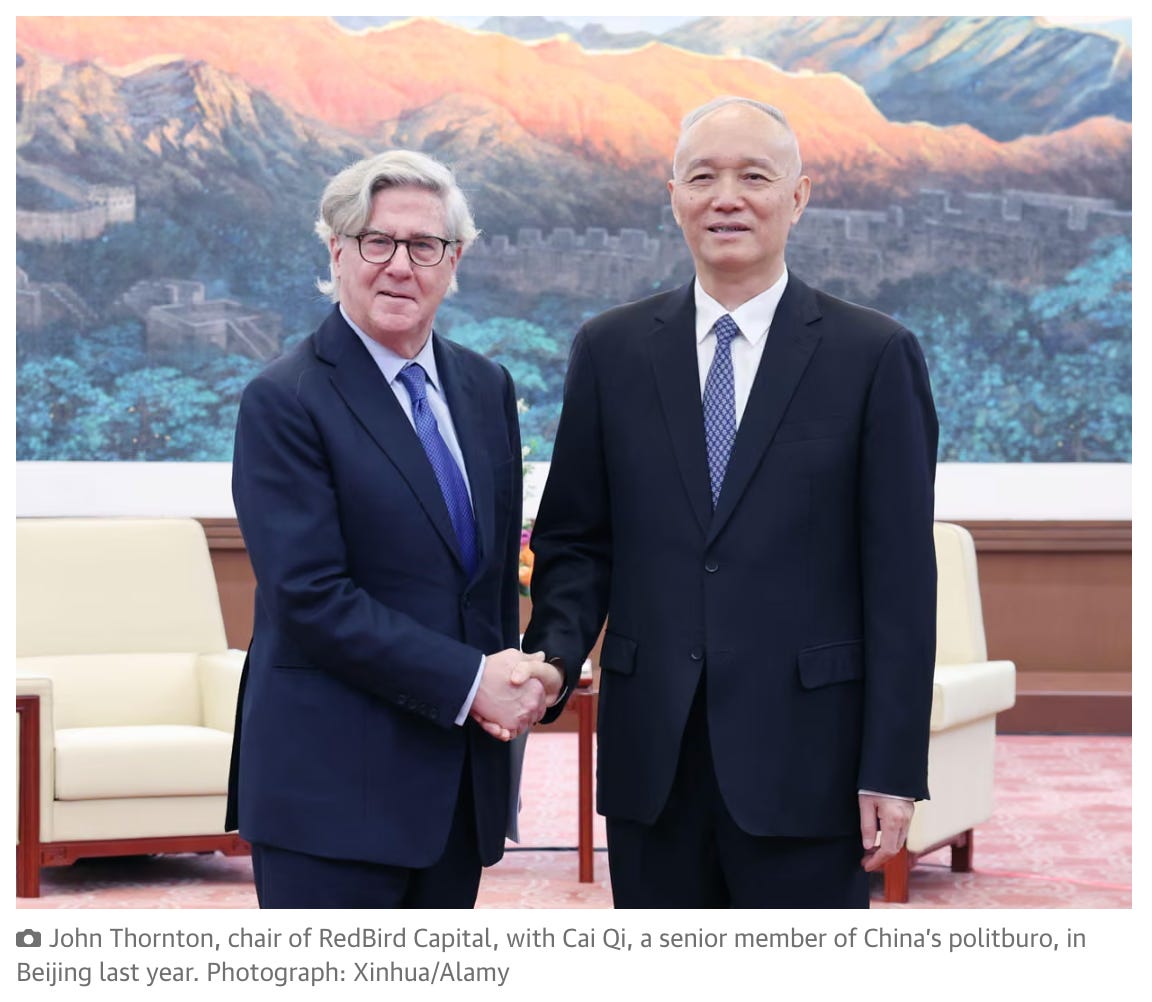
Media group’s own paper publishes photograph of RedBird Capital chair with alleged spy ring chief.
The sale of the Telegraph Media Group has been thrown into fresh turmoil after the company’s own newspaper linked its presumed new owner to the suspected ringleader of the alleged Chinese spy ring in Westminster.
Wednesday’s edition of the Daily Telegraph published a 2024 photograph of the financier John Thornton shaking hands with Cai Qi, a senior member of the Chinese Communist party’s ruling politburo, raising questions as to whether the British title is being weighed as a means for China to exert foreign influence.
Thornton is the chair of RedBird Capital Partners, the private equity firm bidding for control of the media group. Cai has been described as the top lieutenant of China’s president, Xi Jinping, and has been revealed as the suspect receiving British political intelligence that formed part of the collapsed Chinese spying prosecution.
Iain Duncan Smith, the MP and former leader of the Conservative party who has been pressing for the government to launch a fresh investigation into the latest Telegraph takeover, wrote on X: “Let me put it plainly. The meeting between John Thornton and Cai Qi is a red flag and a serious one.
“It demands that the culture secretary, @lisanandy, trigger an investigation into RedBird’s bid for the Telegraph under our media freedom laws.
“The risk of undue Chinese influence here is overwhelming and that’s not just my view; it’s supported by formal legal opinion, given Thornton’s deep and well-documented connections with senior figures in the Chinese Communist party.”
The development is the latest piece of intrigue in a long-running Telegraph takeover saga.
RedBird Capital – which holds various investments, including a stake in the parent company of Liverpool Football Club – is in the process of acquiring Telegraph Media Group from a connected organisation, RedBird IMI.
RedBird IMI was forced to put the titles up for sale in spring 2024 after the then Conservative government passed a law blocking foreign states or associated individuals from owning newspaper assets in the UK.
While a quarter of RedBird IMI’s funding came from RedBird Capital, the remainder was sourced from International Media Investments (IMI) – which is controlled by Abu Dhabi’s Sheikh Mansour bin Zayed Al Nahyan, the vice-president of the United Arab Emirates and owner of Manchester City FC.
The Labour government eased the ban on foreign governments owning stakes in UK newspapers this year by allowing them to hold up to 15% of titles, which paved the way for the RedBird Capital offer that would lead to IMI retaining a 15% Telegraph stake.
The deal, however, has continued to be viewed with suspicion.
In the House of Lords this month, the Liberal Democrat peer Christopher Fox said: “My Lords, as we know, a fund with Abu Dhabi money and probably Chinese money is acquiring what in global terms is a small player, relatively small, but the Telegraph is significant in the UK.
“The best explanation for their motives that I can come up with is that they’re buying influence.”
COMMENT – In case you want to hear John Thornton’s views on the PRC, or have any doubts of his admiration for the Chinese Communist Party, I recommend watching this lecture he gave at the University of Texas back in May 2023.
Tinker, tailor, soldier, Politico?
Euractiv, October 23, 2025
Taiwan debunks rumored Chinese ‘defection’ app
Taiwan News, October 27, 2025
As Hong Kong waged shadow war in Britain, ex-Royal Marine became a casualty
Greg Miller, Washington Post, October 28, 2025
Britain Needs China’s Money. It Fears What Comes with It.
Adam Goldman, New York Times, October 27, 2025
Human Rights and Religious Persecution
China: Dubious Criminal Investigation of Taiwanese Legislator
Human Rights watch, October 31, 2025
Takaichi airs serious concerns over human rights in China’s Xinjiang, H.K.
Kyodo News, October 31, 2025
Hong Kong Free Press, October 31, 2025
A UN conference can’t hide China’s discomfort with women’s rights
Amnesty International, October 13, 2025
China and Russia repeatedly tried to defund UN human rights work, report says
Emma Farge, Reuters, October 22, 2025
A small group of countries led by China and Russia has repeatedly tried to block funding for human rights-related work at the United Nations over a five-year period, according to a report by the non-profit International Service for Human Rights.
The report cited proposals for major cuts to the U.N. Human Rights Office and for the elimination of funding for some U.N. investigations, in what it called a weaponisation of the budget process.
Hong Kong woman, 19, pleads guilty to sedition over videos promoting ‘subversive’ shadow legislature
James Lee, Hong Kong Free Press, October 31, 2025
It was revealed in court that the defendant Lan Fei was the ex-girlfriend of Tony Lam, one of the individuals wanted by Hong Kong’s authorities for their links to the unofficial parliament.
A 19-year-old Hong Kong woman has pleaded guilty to sedition after appearing in videos promoting a “shadow legislature” that the city’s government deems subversive.
Appearing before Chief Magistrate Victor So at the West Kowloon Law Courts on Friday, Lan Fei pleaded guilty to one count of sedition. She was remanded after the hearing, as So scheduled her sentencing for November 13.
Lan stands accused of filming promotional videos for the “Hong Kong Parliament,” a group that held unofficial polls to form a shadow legislature outside the city, as well as encouraging people to vote in the polls through social media.
It was revealed in court that Lan was the ex-girlfriend of Tony Lam, one of the individuals wanted by Hong Kong’s authorities for their links to the unofficial parliament.
According to case details, the parliament’s goals included achieving Hong Kong independence, the destruction of the Chinese Communist Party (CCP), and designating the CCP as a transnational criminal organisation.
Under Hong Kong’s homegrown security law, the maximum penalty for sedition is seven years behind bars, or 10 years if the offender is found to have colluded with an “external force.”
The two promotional videos were posted on April 9 and May 10 this year on wanted activist Elmer Yuen’s YouTube channel. In both videos, Lan encouraged Hong Kong residents to participate in the election online, while explaining voting procedures.
Hillary Leung, Hong Kong Free Press, October 31, 2025
Judge Ernest Lin told the 16-year-old defendant that his offence was “serious.” He will be sentenced in November.
The defendant, whose name is not disclosed as he is a minor, appeared at the District Court on Friday.
According to the case details read out by the prosecution, the teen contacted the founder of the Hong Kong Democratic Independence Union in November via WhatsApp and asked to join the group. He told the founder he wanted to establish an “intelligence department” to collect information about Hong Kong police officers.
The defendant attended six online meetings with the group between January and March, the prosecution said. He also circulated three posts on social media relating to Hong Kong Parliament, a shadow legislature comprising overseas activists that local authorities have described as “subversive.”
The period of his offence was between November 2024 and July this year, the prosecution added.
He was charged alongside two other men, also involved with the Hong Kong Democratic Independence Union. Their cases will be heard separately later next month.
COMMENT - When a country is terrified of what 16-year olds do online, you know they have a tenuous grip on power.
James Lee, Hong Kong Free Press, October 30, 2025
Activist Ted Hui, who was granted asylum in Australia in August, called the December legislative race “a sham election utterly detached from the public” and said it “deserves to be boycotted.”
Hong Kong’s security chief has lambasted wanted activist Ted Hui for urging a boycott of the upcoming legislative elections, warning that encouraging blank ballots may violate the city’s national security law.
Talking to journalists on Thursday, after an event promoting national security education in kindergartens, Secretary for Security Chris Tang listed the charges the self-exiled activist faces in Hong Kong. These included an arrest warrant issued by the city’s anti-graft watchdog over his calls for a boycott of the 2021 Legislative Council (LegCo) elections.
“It’s your own business that you’re wanted for breaking the law, but you still want others to follow your example. I hope everyone can see the truth and not be deceived by him into engaging in illegal acts,” Tang said, referring to Hui.
He warned that Hui’s remarks could violate national security laws and the Elections (Corrupt and Illegal Conduct) Ordinance.
‘Sham election’
Hui, who was granted asylum in Australia in August, called the December legislative race “a sham election utterly detached from the public” and said it “deserves to be boycotted.”
Industrial Policies and Economic Espionage
China to Make ‘Substantial’ US Soybean Purchases, Bessent Says
Hallie Gu and James Mayger, Bloomberg, October 26, 2025
China’s Two-Speed Economy
Noah Berman, The Wire China, October 27, 2025
China’s secret stockpiles have been a great success—so far
The Economist, October 26, 2025
Trump’s Rare Earths Deal with Australia to Fight China
Bloomberg, October 27, 2025
USTR Initiates Section 301 Investigation of China’s Implementation of the Phase One Agreement
Office of the U.S. Trade Representative, October 24, 2025
Trump to Investigate Whether China Abided by 2020 Trade Deal
Ana Swanson, New York Times, October 24, 2025
U.S., China Sound Confident Note After Trade Talks
Hannah Miao and Chun Han Wong, Wall Street Journal, October 26, 2025
US expects China to delay rare earth export controls as trade deal nears
Demetri Sevastopulo, et al., Financial Times, October 26, 2025
The ‘Sleeper Issue’ at the Heart of Trump’s Trade War on China
Alexandra Stevenson, New York Times, October 25, 2025
As Trump-Xi trade talks near, investors turn to history as a guide
Saqib Iqbal Ahmed, Reuters, October 27, 2025
China-linked battery company abandons plan to build Michigan plant, state says
David Shepardson, Reuters, October 24, 2025
China Vows to Significantly Boost Household Consumption Rate
Wall Street Journal, October 28, 2025
Trump’s China Deal May Avert a Crisis of His Own Making
Ana Swanson, New York Times, October 27, 2025
Rare Earths Producers Look to US-Led Boom to Blunt China’s Power
Bloomberg, October 27, 2025
Trump, Xi to Discuss Lowering China Tariffs for Fentanyl Crackdown
Lingling Wei, Hannah Miao and Gavin Bade, Wall Street Journal, October 27, 2025
China Advisor Expects US to Ease Export Curbs for Magnet Relief
Bloomberg, October 27, 2025
Cyber and Information Technology
How China could use DeepSeek and AI for an era of war
Eduardo Baptista, Reuters, October 27, 2025
China Gears Up for More Tech Confrontation with U.S.
Yoko Kubota, Wall Street Journal, October 23, 2025
China Dives in on the World’s First Wind-Powered Undersea Data Center
Anna Lagos, Wired, October 28, 2025
Chinese Auto Giant BYD Posts Fivefold Sales Surge in Europe
Mauro Orru, Wall Street Journal, October 28, 2025
Chinese Robotaxis Race Waymo to Take Driverless Cars Global
Linda Lew, Bloomberg, October 26, 2025
Chinese robotaxi companies outnumber Waymo in global push
Linda Lew, Los Angeles Times, October 27, 2025
Should the US sell Blackwell chips to China?
Georgia Adamson, et al., IFP, October 27, 2025
Military and Security Threats
What the U.S. Might Expect from South Korea in a Taiwan Crisis
Jihoon Yu, Real Clear World, October 27, 2025
U.S. Navy Aircraft Go Down in South China Sea
New York Times, October 27, 2025
A new Triple Entente between India, Russia and China
Aparna Pande, GIS Report, October 27, 2025
Asia, caught in the Middle, Faces Trump and Xi’s Tug of War
David Pierson, New York Times, October 25, 2025
Will Trump push south-east Asia towards China?
Owen Walker and A. Anantha Lakshmi, Financial Times, October 27, 2025
One Belt, One Road Strategy
Indonesian order of Chinese fighter jets raises strategy issues
Joseph Rachman, Nikkei Asia, October 27, 2025
‘We Are Geopolitically Polygamous’
Ravi Agrawal, Foreign Policy, July 17, 2025
Former Indonesian diplomat Dino Patti Djalal on how his country views Trump and a new world order.
COMMENT – When you stand for everything, you stand for nothing.
China deepens ties with ASEAN ahead of Xi-Trump talks
Kentaro Takeda, Nikkei Asia, October 28, 2025
Opinion
Trump is poised to end Washington’s Decade of the China Hawks
Ben Smith, Semafor, October 28, 2025
The news of a US-China trade framework emerging out of Kuala Lumpur this weekend harkens back to how diplomacy used to work: negotiators hammering out the terms of a complex deal before the principals fly in for the ceremony.
This all marks, The Washington Post dryly noted, a “significant de-escalation.”
No kidding. In fact, it represents something much more significant: the end of an anti-China moment in Washington that really began with Donald Trump’s election in 2016, intensified through the Biden presidency, went viral on Capitol Hill, and crested on “Liberation Day.”
This was, in retrospect, the Decade of the Hawks, the Washington-based China experts who forcefully made the case for confrontation.
This bipartisan group — ranging from former Trump aide Matt Pottinger and former trade adviser Robert Lighthizer to much of President Joe Biden’s circle, including China experts and Washington policy hands who have never set foot in the Middle Kingdom — shaped US policy. It found structure in the House Select Committee that, under former Rep. Mike Gallagher, became a pillar of the Washington discourse, but has faded since his retirement last year. Its goal was a re-ordered world, a decoupling between key US and Chinese spheres, and what its members saw as clear-eyed engagement in a new Cold War that had already begun.
Many in that group are holding their tongues in public. Everyone looking to do business in Trump’s Washington seems to be, these days. But key figures among them are reeling, and are privately saying that Trump’s dealmaking has cost the US its last, best opportunity to confront the People’s Republic.
The Malaysia talks “suggest Beijing may have gotten the better end of the bargain while our efforts with allies and partners continue to struggle,” a former China specialist on Biden’s National Security Council, Rush Doshi, wrote Sunday.
America and China Can Have a Normal Relationship: How to Move Past Strategic Competition
Da Wei, Foreign Affairs, October 30, 2025
In the repeated cycles of confrontation and détente that define U.S.-Chinese relations, a paradox has emerged. Economic relations between the two countries are more fraught than ever: in early October, for the second time in just six months, the United States and China launched a trade war, imposing prohibitive export restrictions and threatening to raise tariffs to previously unthinkable levels.
Yet the U.S.-Chinese relationship also appears increasingly resilient. Although leaders in both Washington and Beijing have seemingly shrugged their shoulders at the rapid decoupling of the world’s two largest economies, the first bout of trade escalation in April and May gave way to a period of relative calm. Over the past ten months and even during the final two years of the Biden administration, U.S.-Chinese relations have been showing signs of rebalancing. Each time a crisis has arisen, such as when a Chinese unmanned high-altitude balloon flew into American airspace in 2023, U.S. and Chinese leaders have sought to quickly stabilize ties, suggesting that the world’s two largest economies still share a structural need for a broadly steady relationship.
These contradictory trends signal that the U.S.-Chinese relationship might be at an inflection point. Neither Washington nor Beijing harbors any illusions that the two countries can return to the pre-2017 era, in which interdependence and engagement, rather than decoupling and strategic competition, were its defining features. But short-term economic spats and tactical maneuvering for potential deals should not obscure the possibility that the United States and China can move beyond an era of adversarial competition toward a more normal relationship—one in which they can coexist peacefully in a state of cool but not hostile interactions. The meeting between U.S. President Donald Trump and Chinese leader Xi Jinping this week in South Korea presents a narrow but important opportunity for the United States and China to enter a new phase of bilateral relations.
AMERICA VERSUS THE WORLD
The possibility of an inflection point stems in part from changes in U.S. foreign policy. From Beijing’s perspective, Trump’s first term marked the onset of a period of strategic competition in which the United States, viewing China as its most serious adversary and competitor, sought primarily to contain or slow China’s economic and technological rise. It was, in other words, the United States versus China. Under President Joe Biden, Washington maintained the same goals but sought to do so in concert with its allies—the West versus China. For strategists and policymakers in China, both Trump and Biden believed that American and Chinese interests were fundamentally at odds, and therefore the only option was unyielding competition that left no room for compromise.
Although Trump has continued to pressure China in his second term, U.S. foreign policy has shifted. Trump has recalibrated the United States’ economic and security relations with the entire world. His so-called Liberation Day tariffs in April, for instance, targeted more than 100 countries, including many U.S. allies. The Trump administration has repeatedly pressured longtime U.S. partners in Europe to pay for more of their own security, even at the cost of straining ties. Trump’s approach can no longer be characterized as the United States or its allies versus China, but rather the United States versus the rest of the world.
In previous eras, the United States and China found ways to build a foundation on which the two countries could work together despite their disagreements. In the 1970s and early 1980s, they cooperated to counter the Soviet Union. After the Soviet collapse and the end of the Cold War, Beijing and Washington promoted economic integration and shared in the gains of globalization. In the past decade, however, as countries have turned away from globalization, the grounds of cooperation between the United States and China have eroded. But by more fully rejecting the entirety of the old model of globalization—and reorienting its foreign policy strategy away from targeting only China—the Trump administration has created an opportunity to establish a new basis for improved relations.
AFTER GLOBALIZATION
Although strategists and policymakers in Washington and Beijing alike tend to blame the deterioration in U.S.-Chinese relations on hostile policies from the other side, an alternative explanation is that the old model of globalization became unsustainable. Growing friction is a function of structural shifts as much as individual leaders.
China rose spectacularly in the post–Cold War era of liberal internationalism led by the United States. But by relying on a political and economic model distinct from Western liberalism, China’s rise effectively stretched the liberal order to its breaking point. The United States also benefited greatly from a liberal, unipolar world, but it failed to address the dislocation that globalization brought to its own economy and society, leading to intense domestic backlash.
The United States is now dismantling the system it built and led. Many Democrats and Republicans alike have pushed back on liberal internationalism and have instead embraced industrial policy and economic nationalism. Neither the United States nor China now accepts economic efficiency as a justification for dependence on the other side’s financial systems, critical goods, and advanced technologies. Countries cannot halt this process of deglobalization. They can only adapt to it.
China’s growing confidence may make that task easier. In recent years, the United States has imposed significant restrictions on China’s development through export controls on industries such as semiconductors. Yet China has continued to achieve technological breakthroughs. China’s growth rate has slowed, but the economy continues to expand. And Beijing has now found ways to pressure Washington, most notably by controlling the supply of rare-earth magnets on which many U.S. industries rely. A confident China can focus more on implementing sound economic policies at home and less on how U.S. pressure might hinder its goals. By doing so, China will continue to develop and may even improve its global standing relative to the United States.
In this context, policymakers and strategists in both China and the United States have a rare opportunity to temper their attitudes toward each other. Beijing could reconsider whether the United States is intent on thwarting China’s rise. Washington could reassess the dominant perception that China seeks to overthrow U.S. global leadership. A change in narratives will help move past the hostility that has prevented the two sides from working together more productively.
A REBALANCING ACT
The United States and China do not have to be friends, but they do have to avoid being enemies. A new type of relationship requires rebalancing how the two countries depend on each other. For decades, their economic ties were asymmetric: China relied on the United States’ monetary and financial systems, as well as its advanced technology, to fund its growth and provide the know-how it needed to develop its economy. The United States, in turn, depended on Chinese manufacturing to produce low-cost goods to consume. The fierce competition of the past decade has shattered that old pattern. The Trump administration has made clear that the United States will no longer accept a massive trade deficit with China, and Chinese leaders have expressed their uneasiness about reliance on U.S. financial and technological tools. Even before the trade war that broke out in 2018, the two countries had already started to decouple some parts of their economies.
In a relationship characterized by levelheaded stability, competition between the United States and China would endure. But both countries would need to regulate the intensity of the competition and establish clearer lines to demarcate where their economies and societies should interact and where they should be independent. Large-scale Chinese investment in the United States in electric vehicles and batteries, for instance, would make both countries more equally reliant on each other in manufacturing, technology, and finance. But investment should be limited to certain sectors in which both countries agree that collaboration is mutually beneficial. This type of interdependence is more stable—and likely more sustainable—than one in which the United States provides high-value inputs and China produces low-value outputs. Both sides would be more likely to feel they are benefiting from the economic relationship and seek to preserve the balance.
The two countries also need to recalibrate their geopolitical relations in the Indo-Pacific. The U.S. military routinely conducts reconnaissance missions and freedom of navigation operations near China’s coastline, insisting on its legal right to do so and the necessity of reassuring its regional allies of its security commitments. But these actions risk provoking a dangerous conflict between the world’s two largest military powers. The United States could lower regional tensions by reducing the frequency of these politically provocative actions. Instead, the United States could employ other technological means, such as satellites, to gather military intelligence, which would reduce the risk of military confrontation while allowing it to uphold its security commitments.
U.S. and Chinese leaders can also de-escalate tensions around Taiwan. The Trump administration could reassure Beijing of its position on the island’s future by formally opposing Taiwanese independence. In response, Beijing could reduce the frequency of military exercises and increase cross-strait exchanges. If leaders in Beijing believe there is hope for peaceful reunification, there is less urgency to use military force to resolve the question of Taiwan’s status. This arrangement aligns with Trump’s global vision of trying to broker peace in areas of long-standing conflict.
From the 1990s until this year, the United States prioritized a universal outlook, whereas China focused on nation building. Now, for the first time in decades, the U.S.-Chinese relationship involves two nationalist powers. Trump’s call to “Make America Great Again” and Xi’s vision of the “great rejuvenation of the Chinese nation” are both nationalist goals. Such nationalist visions are not necessarily in conflict. Instead, the United States and China can support each other’s rejuvenation, or at the very least, avoid impeding the other’s progress toward that goal. Trump’s “America first” approach suggests this is possible: when the United States focuses on itself in its foreign policy, it is often more restrained toward China, as has been the case in the South China Sea in the first year of Trump’s second term.
Neither the United States nor China can fully hobble each other’s economy, but each side has economic tools that can inflict real damage if adversarial competition continues unchecked. As Trump and Xi head to the negotiating table, the conditions are ripe for an inflection point in U.S.-Chinese relations that could set a path toward a more stable and effective relationship. Such a course correction is far from guaranteed. But it is a possible and worthy goal.
COMMENT – An interesting argument by Da Wei, the former director of American studies at the Ministry of State Security’s think tank, CICIR (China Institutes of Contemporary International Relations). Washington should abandon its “strategic competition” against the PRC, while Beijing expands and intensifies its “strategic competition” against the United States.
The U.S. Must Beware of Taiwan’s Reckless Leader
Lyle Goldstein, Time, October 23, 2025
With all the news out of the Middle East and the ongoing war in Ukraine, it’s easy to forget that Taiwan is the world’s most dangerous flashpoint. China has long laid claim to the island and acting on those claims could lead to a spiral where Washington and Beijing come to blows over the issue—and nuclear use would remain a terrifying possibility.
Now, a confluence of factors have made the situation in the Taiwan Strait even less stable. The U.S. has been burned badly by Asian nationalism more than a few times in the past, and so should act with utmost prudence today.
At the heart of this growing storm is the brash, new leader of Taiwan, President William Lai of the nationalist Democratic Progressive Party (DPP). Instead of taking a low profile and playing down any claims to Taiwan’s independent status like his more cautious DPP predecessor Tsai Ying-wen, Lai has lurched toward formal independence with a succession of speeches making the case for Taiwanese nationhood.
One columnist at Taipei Times succinctly summarized Lai’s first address: “Never before has a Taiwanese president devoted an entire speech to laying out clearly, point-by-point, and unequivocally how Taiwan is unquestionably a sovereign nation.”
Not surprisingly, Beijing has reacted to Lai’s address with a string of invective. A June 26 editorial in the state-run Chinese newspaper the Global Times said that he “once again exposed his radical ‘Taiwan independence’ stance” and accused him of “pushing cross-strait relations and Taiwan’s development to the edge of more conflict and risk.”
The political milieu on Taiwan is polarized, with islanders in July rejecting an unprecedented recall vote of opposition lawmakers from the Kuomintang (KMT), which controls the legislature and opposes formal independence. When the KMT this week elected a new chairperson, Cheng Li-wun, the party was accused of falling victim to an influence campaign orchestrated by Beijing.
When Taiwan held its annual Han Kuang military exercises earlier this year, it involved numerous innovations meant to address the growing Chinese military threat. The exercises lasted longer than usual, involved the extensive use of reservists, showcased new weaponry, and practiced urban warfare.
But it was another sign of Taipei misdirecting its defense efforts. That money would be better spent, as military experts have long said, on asymmetric weapons like mines given that Taiwan’s ports and air bases would be the main targets for China’s initial air and missile campaign. Shifting the focus to more affordable and widely dispersed ground combat systems makes sense for Taiwan.
COMMENT – I’ve never understood Lyle Goldstein’s perspective.
Somehow in his mind, Taipei is responsible for making the PRC threaten them with invasion and annexation. For Lyle, the Chinese Communist Party isn’t responsible for their own actions and threats… Taiwan, the victim of these threats, is the one who is at fault for not capitulating.
For 75 years, Taiwan has been an independent and sovereign country, the Chinese Communist Party wants to snuff out Taiwanese culture and identity because a democracy on the island of Taiwan might tempt Chinese citizens to want something similar for themselves.
Instead of acknowledging these dynamics, Lyle stays completely silent on the issue of who is threatening who with invasion, death, and destruction. In Lyle’s imaginings, the reason why a war might start is because of Taiwanese “nationalism,” as opposed to Chinese imperialism. I get the sense that Lyle believes the Taiwanese people should just capitulate because that will prevent the Chinese Communist Party from getting angry.
He doesn’t say this specifically, but Lyle seems to suggest that the Chinese Communist Party is completely justified in threatening the Taiwanese people and that elected Taiwanese leaders have no business in defending themselves.
I’m sure Beijing is very appreciative this piece in Time Magazine.
Miles Yu offers a much better explanation of what is happening than Lyle’s apologia for the CCP.
Why China’s ‘Taiwan Reunification’ shibboleth is a hoax
Miles Yu, Washington Times, October 27, 2025
Taiwan is a living refutation of communist determinism.
China’s “reunification” slogan is a hoax sustained by fear, ideology and deception. Taiwan is not a rebellious province but a living refutation of communist determinism, a society that chose freedom over fear. Here are the 10 most salient reasons:
Taiwan has never been part of the People’s Republic of China
Not a single inch of Taiwan’s territory has ever been governed by the Chinese Communist Party. Since the founding of the People’s Republic of China in 1949, Taiwan has remained entirely outside its control politically, legally and militarily. The claim of “reunification” is therefore a deliberate falsehood: One cannot “reunify” with what was never unified.
Taiwan’s sovereignty is not an extension of the KMT-CCP civil war
Taiwan’s sovereignty and independence are not byproducts of the Kuomintang-Communist struggle. Nor are they rooted in ethnolinguistic connections with China. To claim otherwise mirrors the logic of Vladimir Putin’s aggression against Ukraine: invoking shared language and history to justify invasion. Taiwan’s modern sovereignty emerged not in 1911 with the fall of the Qing, nor in 1949 when the KMT fled to the island, but in the late 1980s when it democratized and ceased claiming to represent “China.” Like Ukraine after 1991, Taiwan’s statehood stems from its political awakening, not from the collapse of an empire.
International law rejects historical justifications for conquest
The 2016 Hague tribunal ruling against China’s South China Sea claims decisively refuted the use of “historical rights” as grounds for territorial claims. China’s “nine-dash line” was deemed legally baseless. The same principle applies to Taiwan: Ancient ties, migration or dynastic rule cannot justify modern annexation. Yet Beijing continues to weaponize history to justify expansion, pressuring neighbors such as India, Bhutan, Vietnam and Japan. Its behavior is that of a neo-imperial power, not a postcolonial victim.
The CCP’s motivation is ideological, not territorial
The CCP’s fixation on Taiwan is not about “national reunification.” It is about completing the unfinished communist “liberation” of 1949. Taiwan’s continued autonomy stands as an ideological wound, a reminder that the communist revolution never conquered all of “China.” The party’s military, the so-called People’s Liberation Army, still defines its mission in terms of “liberating” Taiwan. This obsession reveals not patriotism but revolutionary revanchism, an unyielding drive to prove the infallibility of the party and its founding myth.
The CCP has never cared about historical borders
If territorial integrity were the true motive, Beijing would not have willingly ceded vast tracts, many times larger than the small island of Taiwan, of historically Chinese land to its ideological allies. The CCP recognized Mongolian independence in 1945, handed large land areas to the Soviet Union, and settled boundaries with socialist Burma and communist North Korea. The party’s history of giving away “Chinese” lands exposes the hollowness of its Taiwan rhetoric. Ideology, not geography, has always guided its choices.
U.S. policy does not recognize Taiwan as part of China
None of the U.S.-China diplomatic and legal instruments, including the Three Communiques, the Taiwan Relations Act and the Six Assurances, accepts Beijing’s claim that Taiwan belongs to China. America’s One China Policy merely acknowledges that the PRC claims Taiwan, without agreeing or disagreeing. Washington opposes any attempt to alter the status quo by force and insists that any settlement must have the consent of the people on both sides of the strait.
Poll after poll shows that the overwhelming majority of Taiwanese support the status quo, i.e., de facto independence, and identify as Taiwanese, not Chinese, just as more than 75% of the ethnic Chinese in Singapore identify as Singaporeans, not Chinese.
As for U.N. Resolution 2758 of 1971, it only transferred China’s seat from Taipei to Beijing; it did not declare Taiwan part of the PRC. U.S. administrations, Republican and Democratic alike, have consistently affirmed this interpretation, most recently in August. Beijing’s distortion of the resolution is propaganda, not international law.
Taiwan as a convenient distraction
Beijing’s obsession with Taiwan conveniently diverts domestic and international attention from the CCP’s real transgressions: its role in global fentanyl trafficking, the origins of COVID-19, systemic human rights abuses, religious persecution, and serial violations of trade and treaty obligations. By inflaming nationalist fervor over Taiwan, the CCP deflects scrutiny from its own crimes and manipulates international discourse. The “Taiwan issue” is less about sovereignty than about scapegoating.
Fear of freedom: Taiwan as the CCP’s existential threat
What terrifies the CCP is not Taiwan’s geography but its example. Taiwan’s success as a free, democratic, ethnically Chinese society demolishes Beijing’s central lie that Chinese culture is incompatible with liberty. With vibrant elections, protected property rights and the rule of law, Taiwan embodies what China could be without the party’s tyranny. The CCP’s fear is existential: A prosperous, democratic Taiwan proves that the Chinese people are fully capable of self-government.
Hence, the party’s crusade to “eliminate” Taiwan is also an effort to extinguish hope for freedom among 1.4 billion mainland Chinese.
The machinery of disinformation and its Western proxies
To reinforce its false narrative, Beijing has spent decades cultivating a sophisticated disinformation network in the West. Its proxies include business elites entangled in Chinese markets, globalist opinion-mongers and columnists who echo CCP talking points, past and incumbent federal bureaucrats with a passion for diplomatic harmony and bilateral tranquility, blame-America-first academics, university research centers funded by the CCP’s United Front Work cash and think tanks bankrolled by corporate interests. These apologists cast Taiwan as the provocateur, its elected leaders as “reckless” and the United States as the “instigator.” This ecosystem of influence, rooted in greed, ideological sympathy, self-seeking sycophancy and willful ignorance, serves the CCP’s ultimate goal: to erode Western moral clarity and normalize authoritarian aggression.
The final hoax: ‘Reunification’ as imperial restoration
The word “reunification” masks a project of imperial restoration. The CCP’s claim to Taiwan is not about restoring Chinese unity but reasserting one-party dominance over all Chinese-speaking peoples. It is the same logic that drives its repression in Xinjiang, Tibet and Hong Kong: that no alternative political model may exist within the “Chinese nation.”
“Reunification” is thus not a national project but a totalitarian one. It demands submission, not cooperation, erasure, not harmony. To call it a matter of “internal affairs” and “national reunification” is to grant legitimacy to conquest and to betray the universal principles of sovereignty and self-determination. The question before the world is not whether China and Taiwan are “one” but whether truth and tyranny can coexist.
History suggests they cannot, and that is precisely what Beijing fears most.
Is Trump Getting Played by Xi? If so, America’s agrarian past may be its future.
Matt Pottinger, The Free Press, October 29, 2025
In a matter of hours, President Donald Trump will sit down with Chinese leader Xi Jinping for the first time in six years to determine whether America will remain a technological superpower or, if Xi gets his way, becomes an agrarian commune beholden to Beijing.
The stakes really are that high. Allow me to explain.
In November 2017, I accompanied President Trump on his state visit to Beijing, serving as his senior Asia staffer. One of our meetings was with then-Premier Li Keqiang, who delivered a pointed message that his boss, Communist Party General Secretary Xi Jinping, apparently preferred not to deliver himself.
Addressing Trump from across the table, Premier Li painted a menacing picture of the not-so-distant future. China, he said, would completely dominate this century’s most important technologies, including artificial intelligence. The world would become more dependent on China than ever before. The United States, Li said, was destined to export little more to China than soybeans and corn. To add insult to injury, Li said Beijing would purchase substitutes for U.S. agriculture if the Communist regime was unhappy with Washington for one reason or another.
Li’s vision of the United States as an agrarian backwater was a clever bit of psychological warfare. It was China’s Communist rulers saying “We own the future, so you might as well surrender now.” Li’s message provoked resentment on the American side of the table—including perhaps with Trump himself, though I never heard him mention the meeting again.
Losing the Swing States: Washington Is Driving the BRICS to Become an Anti-American Bloc
Richard Fontaine and Gibbs McKinley, Foreign Affairs, October 27, 2025
In the battle to shape the global order, the BRICS—a ten-country group, which is named for its first five members (Brazil, Russia, India, China, and South Africa)—has become increasingly important. The bloc represents roughly a third of global GDP and nearly half the world’s population. It exists to give countries that belong to the so-called global South more sway on the world stage.
That might make the BRICS seem like an inherently anti-Western group. It was, after all, founded in part by Beijing and Moscow. But for most of its 16-year history, the BRICS has not positioned itself in opposition to the United States and its allies. Several BRICS members have even been close U.S. partners. Washington has built a strong trade relationship with Brazil, for instance, and cooperates with India and Indonesia on matters of defense.
But much of that picture now appears to be changing. Over the past decade, China and Russia have ramped up their efforts to steer their fellow BRICS members toward a worldview contrary to Washington’s interests. China has become Brazil’s top trade partner and supports the country’s efforts to reduce its dependence on the U.S. dollar. Russia has been selling massive amounts of oil to India. And both China and Russia have courted South Africa as a partner in resisting what Russian President Vladimir Putin has described as the “colonialism” of the U.S.-led order. Meanwhile, the United States has strained its relations with friendly BRICS members. The U.S.-Indian relationship has not been this chilly since 1998, when the United States sanctioned it for testing nuclear weapons. In September, Deputy Secretary of State Chris Landau said that the U.S.-Brazilian relationship was at its “darkest point in two centuries.” And ties with South Africa are the most tenuous they’ve been since the end of apartheid in 1994.
The causes of the deterioration are different in each case, and some of Washington’s grievances against Brazil, India, and South Africa—global swing states that will help dictate which country leads the world—are legitimate. But in each instance, the Trump administration has made relations significantly worse than they should be, and for reasons hard to square with U.S. national interests. As a result, there is a new risk on the horizon: the emergence of the BRICS as a more active, anti-Western bloc that is increasingly dominated by China and Russia. Unless the United States changes policy in the short term, it will pay for this realignment in the long term.
COMMENT – Hmmm… my sense is that Beijing and Moscow are the ones making BRICS an Anti-American bloc, not Washington. Brasilia, Delhi, and Pretoria have largely spent the last decade acquiescing to what Putin and Xi want. Lula is deeply Anti-American and Cyril Ramaphosa is a puppet of Beijing. Delhi is likely the ONLY one who could have changed this trajectory, but it would have required the Indians to have threatened a break with their long-time ally, Russia. So far, Indian leaders are unwilling to contemplate this, which means that the BRICS belongs to Xi and Putin… and Modi has relegated himself to the second rank.
My main gripe with this article is that it seems to presume that only the United States has agency and that other countries aren’t responsible for their own decisions.
A one-year reprieve from Chinese rare earth blackmail
Washington Post, October 26, 2025
Weekend talks eased tensions, but deep mistrust will continue to define the relationship.
Has there been a breakthrough with China on trade? An apparent win-win compromise has emerged from tense negotiations in Kuala Lumpur, Malaysia, but don’t pop the champagne quite yet. A final deal can only come during a meeting between Presidents Xi Jinping and Donald Trump in South Korea on Thursday.
The announced “framework” for an agreement sounds more like a temporary truce than a full reconciliation, let alone anything approaching a grand bargain that redefines the relationship between the world’s two largest economies.
Last week saw fresh brinkmanship from the United States. In addition to 100 percent across-the-board tariffs threatened to go into effect in November, a response to China saying it would restrict the export of rare earth minerals, the Trump administration put out word that it was preparing a comprehensive set of measures to curb exports made with U.S. software. This would target everything from laptops to jet engines.
Backfire: Export Controls Helped Huawei and Hurt U.S. Firms
Rodrigo Balbontin, ITIF, October 27, 2025The New Eurasian Order: America Must Link Its Atlantic and Pacific Strategies
Julianne Smith and Lindsey Ford, Foreign Affairs, October 21, 2025
On October 28, 2024, a group of South Korean intelligence officials briefed NATO members and the alliance’s three other Indo-Pacific partners—Australia, Japan, and New Zealand—on a shocking development in the war in Ukraine: North Korea’s deployment of thousands of its troops to Russia’s Kursk region to aid Moscow’s war effort. The fact that Seoul sent its top intelligence analysts to Brussels for the briefing was nearly as stunning as North Korea’s decision to enter the war in Ukraine.
Both developments reflected a new reality. The United States’ adversaries are coordinating with one another in unprecedented ways, creating a more unified theater of competition in Eurasia. In response, U.S. allies are coalescing. For a few years, the United States led that effort. In 2021, it formed AUKUS, a security arrangement with Australia and the United Kingdom. In 2022, NATO began inviting Asian countries to participate in its annual summits. And in 2024, Japan, South Korea, the United States, and the EU created a coalition to loosen China’s grip over pharmaceutical supply chains.
Today, however, the United States appears to be dispensing with a transregional approach to great-power competition. In May, Elbridge Colby, the undersecretary of defense for policy, dissuaded British officials from sending an aircraft carrier on a scheduled deployment to the Indo-Pacific. The gist of Colby’s position, according to an anonymous source quoted by Politico, was simple: “We don’t want you there.” He urged them to focus instead on threats closer to home—namely, Russia.
Washington is now encouraging its Asian and European allies to stick to their neighborhoods—a throwback foreign policy that is ill suited to the current moment. China and Russia are synchronizing their transgressions and sharing weapons and know-how. Together, they pose a threat more formidable than any the United States has faced in decades. The lines between Asia and Europe are blurring, and crises on one continent have spillover effects in the other. The United States should try to influence the new networks its allies are crafting, not resist them. Otherwise, Washington may find itself on the fringes of a new global order.
COMMENT - The US has to adopt a global strategy… it cannot afford to have 3-4 for separate regional strategies that compete for limited resources.
Trump Lost the Trade War to China
Nicholas Kristof, New York Times, October 29, 2025
After the United States-China summit planned for Thursday, President Trump may crow about his deal-making skill. Aides may suggest that he deserves a Nobel Prize for negotiation — but I invite you to roll your eyes.
The most important bilateral relationship in the world today is between the United States and China, and Trump has bungled it. He started a trade war that Washington has been losing, and if a truce is formalized this week, it will likely be one with China holding power over America and leaving our influence diminished.
When Trump rashly announced his “Liberation Day” tariffs in April, he badly miscalculated. He seemed to think that China was vulnerable because it exported far more to the United States than it purchased. He apparently didn’t appreciate that much of what China purchased, like soybeans, it could get elsewhere — while Beijing is now the OPEC of rare earth minerals, leaving us without alternative sources. China controls about 90 percent of rare earths and is the sole supplier of six heavy rare earth minerals; it also dominates rare earth magnets.
Rare earths and rare earth magnets are essential ingredients of modern industry. They are necessary for the manufacturing of drones, automobiles, airplanes, wind turbines, many electronics and much military equipment; without them, some American factories would close and military suppliers would be severely affected. A single submarine can require four tons of rare earths.
The U.S. Is on Track to Lose a War with China
Phillips Payson O’Brien, The Atlantic, October 28, 2025