Life Ain't Fair
and the World is Mean
Friends,
I had considered titling this week’s issue, “Blue Falcon: How Beijing treats its “allies”,” but to be honest that hits a little too close to home these days considering everything that is unfolding in the transatlantic relationship.
So instead, I picked one of Sturgill Simpson’s greatest hits, “Life Ain’t Fair and the World is Mean,” as it captures a bit of the Zeitgeist.
That’s the Way It Goes
Life Ain’t Fair
And the World is Mean
If I had to describe Sturgill Simpson I’d say he plays indy country with a Bakersfield sound, some Bluegrass, and mixes it with pinches of psychedelic, hard rock, synth-pop. He even has a series of music videos to accompany his Sound and Fury album done in the style of Japanese Manga with a serious post-apocalyptic Akira vibe (watch “Good Look” or “Sing Along”).
In The Promise, he covers the 1987 synth-pop hit by the band, When in Rome, and his In Bloom is a cover of the 1991 grunge hit by Nirvana.
His eclectic mixing of genres has even resulted in others continuing the trend with artists like Post Malone covering Sturgill Simpson’s “You Can have the Crown.”
Born and raised in Kentucky, he joined the Navy in the 1990s and served in Japan. He got out of the service after a few years, felt rudderless and bounced around Seattle through a haze of drugs and aimlessness.
Relatively late for a musician, Sturgill broke through after having an epiphany when he heard Bill Monroe’s “Wayfaring Stranger” on the radio while driving his pickup truck. You will recognize it when you hear it, it is that haunting song that features late in the movie 1917.
If you really want to go down the Sturgill Simpson rabbit hole, then listen to Joe Rogan episode #564 from October 2014.

Sturgill Simpson playing on NPR’s Tiny Desk Concert
Trump Goes to Davos this Week
On Wednesday, President Trump is scheduled to give the keynote address to the World Economic Forum in Davos, Switzerland.
If you think that Vice President Vance’s speech at the Munich Security Conference last year produced a pearl clutching moment, then Trump’s speech will be like turning the volume up to 11. I predict he will be shouted at and that individuals will either boycott or walk out.
Just in the past 24-48 hours, a bipartisan Congressional delegation went to Copenhagen to reassure nervous Europeans that the American Congress wouldn’t let Trump take Greenland. The President posted on his social media platform that China and Russia posed a threat to Greenland and that the United States would impose tariffs on select European countries for resisting his efforts to acquire Greenland. And there are indications that European leaders are meeting now and will use the Anti-Coercion Instrument (ACI).
The ACI was first envisioned as a tool against Trump, and so it should not be a surprise that European leaders are inclined to use it… which will further justify the actions the President wants to take.
All of this is intentional by President Trump. Nothing bolsters Trump’s legitimacy more with his base than the loathing and disdain of elites, particularly European elites. He is teaching a Masterclass on how to build drama before he travels to their liar and faces his most dreaded opponents. What he craves is for European elites to either cancel his invitation or to hurl insults at him when he attends their conclave.
Let me state this again: Donald Trump’s legitimacy is built on the disdain and loathing of elites; it is his reverse kryptonite. The more disdain and criticism elites heap on him, the stronger he believes he becomes.
If you haven’t read the Martin Gurri’s Revolt of the Public and the Crisis of Authority in the New Millennium first published before Brexit and the 2016 election, but re-released in 2018, then you must. In particular, you should read his epilogue.
Gurri describes the phenomenon we find ourselves in clinically and analytically and it amazes me that the President’s opponents act so predictably which allows his tactics to work so well. The entire drama around Greenland (a drama the President created), his amplification of it in the weeks before his speech to Davos, the threats to impose tariffs and refusal to take military force off the table, and the entirely predictable rage and counter-threats by European and American elites, all appear calculated to bolster the President’s legitimacy with the voters he depends on.
The President gains and maintains legitimacy from his supporters by producing a steady stream of Heros, Villains, and Drama. The President casts himself as the primary protagonist and Western elites are the primary villains. When there isn’t sufficient drama in the world naturally, the President manufactures it and feels confident his opponents will participate willingly in his production because they can’t help themselves.
Without this drama, the President would be forced to deal with the rising dissatisfaction of his supporters that he hasn’t “solved” the problem of affordability… the problem he used so effectively to bludgeon Democratic Party elites in the run up to the 2024 election.
I think this broader thesis of how the President gains and maintains legitimacy explains his relatively muted efforts to rally the Free World against Xi Jinping and the People’s Republic of China. During his first term, President Trump was a maverick in calling for action and taking on the Chinese Communist Party. He portrayed himself as taking the action that Western Elites refused to do because they were either too afraid and weak or they were too corrupt.
Fast forward to his second term and it is much more difficult for President Trump to portray himself as standing against Western Elites on the issue of China. The Biden Administration largely adopted and accelerated his efforts against the CCP. European, Canadian, Japanese, Australian, and Indian political leaders had largely either agreed with Trump’s assessment of the CCP or had moved closer to his position of the first term.
There isn’t much drama to manufacture if your villains, the Western Elite, largely agree with you and are offering to work with you on a common problem. Had he chosen to align himself with Western Elites, he would likely be seen as a sellout by his supporters.
With all that being said, the CCP is still a potent issue for the President and becomes more so as leaders like Canadian Prime Minister Mark Carney embrace the PRC as a counter to the United States under President Trump.
Thanks for reading!
Matt
MUST READ
Annual Wealth Estimates for China
Derek Scissors, AEI, January 7, 2026
Key Points
Though widely used, GDP has drawbacks as an indicator of an economy’s performance. China’s GDP, in particular, is obviously manipulated when the Communist Party deems it necessary. National wealth data for China would provide valuable information.
Publicly available wealth data for China have serious limitations, in particular because they are modeled rather than data-generated. In this report, I create a national wealth series using Chinese government data, based on the Federal Reserve’s method of deriving net wealth.
The wealth series shows a pivot in 2015. For at least a decade prior to that, Chinese wealth grew far more rapidly than official GDP and American wealth did. Since 2015, however, Chinese wealth gains have been uneven, and the American wealth lead has expanded.
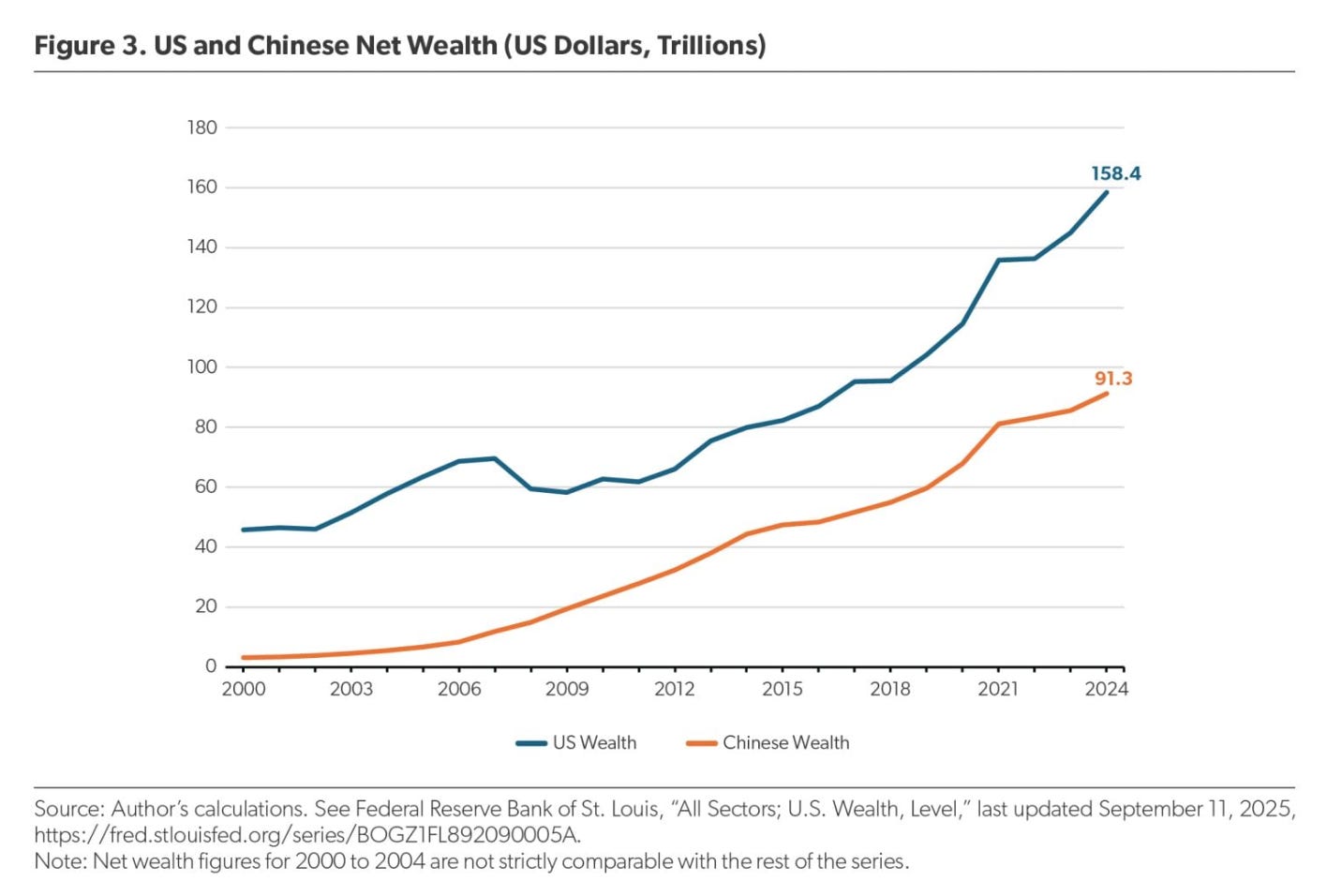
COMMENT - Deflation and wasteful spending on capacity and infrastructure China doesn’t need will only make Chinese citizens poorer.
Beijing’s view of China–India relations
Chietigj Bajpaee, The Interpreter, January 8, 2026
While there is much discourse on the China–India relationship in New Delhi, such debates are rarely heard in Beijing. Hence, a visit to Beijing last month to discuss China’s role in South Asia was revealing.
The bilateral relationship between China and India has been undergoing a reset since October 2024, when a border agreement was announced following clashes in 2020. Since then, leaders of the two countries have had several interactions – notably, Prime Minister Narendra Modi’s visit to China in August to attend the Shanghai Cooperation Organization summit, his first to the country in seven years. This will likely be followed by President Xi Jinping visiting India this year for the BRICS summit.
People-to-people ties have strengthened with resumed direct flights, relaxed visa rules, and the revival of a Hindu pilgrimage to Tibet. The Special Representatives framework, resumed in December 2024, has renewed efforts to resolve the longstanding border dispute.
And yet a competitive and confrontational dynamic remains. My visit to China came days after the detention at Shanghai airport of an Indian national from the state of Arunachal Pradesh, which Beijing claims as “South Tibet”. Other faultlines include a dispute over China’s construction of the world’s largest hydroelectric power project across a river that traverses both countries, and China’s “all-weather/iron-clad” relationship with Pakistan in the context of recent India–Pakistan hostilities. Several interlocutors in Beijing noted that China would not abandon its relationship with Islamabad, with one saying Pakistan, as a bridge to the Islamic world, was more important to Beijing than its relations with India. Tibet is also a point of renewed friction, one interlocutor calling it a “live issue” amid growing discussion about the succession of the Dalai Lama, who turned 90 last year.
Beijing tends to see China–India relations through the prism of its more consequential relationship with the US. One interlocutor said the “changing logic of the US–India relationship” (a reference to the recent deterioration in relations between New Delhi and Washington) presented an “opportunity” to improve China–India relations. New Delhi does not see its relations with Beijing and Washington in such zero-sum terms. Interestingly, Washington embraces the idea of an India–China–US triangle, and the Pentagon’s most recent annual report on China refers to Beijing’s efforts to “capitalize on decreased tension” with New Delhi to “prevent the deepening of U.S.-India ties”.
One of my Chinese counterparts noted that the “changing global context” offered an opportunity for India to “re-embrace strategic autonomy” in its foreign policy, even though India has never abandoned strategic autonomy. While the 2020 border clashes prompted New Delhi to tilt more towards the US, India has avoided being seen as too closely aligned with the US-led regional and global architecture. It has not participated in US-led freedom of navigation patrols in the South China Sea and Taiwan Strait, for example.
Most surprising was that my Chinese counterparts felt differences between the countries had deeper philosophical roots. One located the root of misunderstanding in their “differing understandings of modernisation”, with China seen as a more rational actor than “emotional” India. This patronising language was supplemented with a view that China sees India through the prism of three “isms” – Buddhism, colonialism, and opportunism – amid claims that New Delhi was to blame for periods of hostility including the 1962 war and 2020 conflagration.
All this indicates entrenched friction in the China–India relationship, despite the ongoing reset.
China raises the cost of Indonesia’s neutrality
Aniello Iannone, The Interpreter, December 10, 2025
Far from mere choreography, Beijing is shaping Jakarta’s growth agenda to suit its future core interests.
Wang Huning, chairman of the Chinese People’s Political Consultative Conference (CPPCC) and a close associate of Chinese leader Xi Jinping, visited Indonesia on an official mission last week aimed at strengthening bilateral ties and expanding parliamentary and political cooperation. Although framed as part of China’s parliamentary diplomacy, the visit carried broader strategic weight. Wang arrived with a heavyweight delegation, among them CPPCC vice-chair and secretary-general Wang Dongfeng, to discuss cooperation on industrial development, downstream processing, digital infrastructure, and investment corridors, all areas central to Indonesia’s economic ambitions.
From a distance, China’s latest high-profile engagement with Indonesia looks like another choreographed moment in Indo-Pacific diplomacy: firm handshakes at Merdeka Palace, invocations of “win-win” development, assurances of enduring friendship. Up close, it is something more consequential.
What’s being shaped is not a headline but a trajectory. Beijing isn’t demanding an alliance; it is building a pathway. By tying Indonesia’s growth agenda, often framed around a 2045 horizon, to capital, technology, industrial parks and logistics corridors provided by China, Beijing steadily raises the price of any future move that would cut across China’s core interests. In parallel, Jakarta’s public reaffirmation of the one-China principle functions as political currency: Indonesia offers legitimacy on a defining issue for Beijing and, in return, receives the recognition, financing and access that keep its modernisation on track.
Indonesia is not a spectator to this process. The new administration has refined strategic ambiguity into method: cultivate Chinese markets and investment; maintain exercises, defence cooperation and technology links with the United States, Japan, Australia, India and the European Union; and avoid instruments that would submit policy to alliance discipline.
Yet as rivalry consolidates, the corridor for equidistance narrows. Every rail line, smelter, port and supply-chain node stitched into China-centred demand does not remove freedom of choice, but it does increase its cost. The question for Jakarta isn’t whether it can keep talking to all sides – it can – but whether it can still say “no” when doing so carries real penalties. That is the quiet argument taking shape beneath the protocol.
As China sales slow, Germany’s carmakers look to India
Andreas Becker, Deutsche Welle, January 11, 2026
For decades, German cars symbolized engineering perfection and economic power. Now, sales are down as China, a key market, goes electric. India could fill some of that gap for German carmakers. But will it be enough?
COMMENT - If I had to make a prediction, I doubt India will fill the gap for German auto companies… their best hope is dropping an artificial EV transition, doubling down on the European market, and pushing for a protective tariff.
Why 2026 Could Prove as Important as 1989
Matt Pottinger and Roy Eakin, The Free Press, December 26, 2025
The year the Berlin Wall came down marked the end of one epoch and the start of another. This year could do the same.
If its first days are anything to go by, 2026 may end up the most pivotal year in geopolitics since 1989, a hinge point that began in a moment of geopolitical calm but ended with the collapse of the Iron Curtain.
Within a few years the Soviet Union had fallen, the European Union had been born, and an era of hyper-globalized trade took off on the wings of NAFTA and the WTO (World Trade Organization). This year could be equally pivotal—only this time with a vaster range of possible outcomes for world order.
It is possible to hear echoes of the late Cold War, and imagine regime change in Tehran, Caracas and Havana—which would strike a heavy blow to the ambitions of Beijing and Moscow. It is also possible Donald Trump will detonate NATO unity by coercively annexing Greenland, and that Beijing will wage war to subjugate Taiwan and seize its semiconductor plants, toppling a century of American-led Western technological dominance.
Authoritarianism
“Stop Dreaming That China Will Take the Bullet for You...Iran Must Stand on Its Own”
Tuvia Gering, Discourse Power, January 12, 2026
Just weeks after Iran’s designated Islamic Revolutionary Guard Corps (IRGC) led a “counterterrorism” drill with China, Russia, and other Shanghai Cooperation Organization (SCO) members, the same force is being deployed at home against Iranians it considers “terrorists.”
As the death toll mounts, likely in the thousands, and US President Donald Trump considers military action against Iran, Tehran’s ambassador in Beijing, Abdolreza Rahmani Fazli, told reporters on Wednesday that Iran would safeguard Chinese businesses and nationals, and hopes to receive help from China and other “friendly countries,” per state-owned Phoenix TV.
The response translated below shows how such appeals have landed in one corner of China’s nationalist discourse. Zhanhao, one of China’s most widely read WeChat public accounts, written by multiple authors under the pen name of Hu Zhanhao (a government adviser in Hubei), offers a scathing, crude rebuttal: China will not “take the bullet” for Iran, and Iran should stop expecting it to save its hide.
While it should be noted that Zhanhao is a for-profit outfit, for which veracity and conviction appear secondary to selling snake oil and cheap liquor, but due to its reach and proximity to officially tolerated nationalist discourse that it remains worth paying attention to.
The piece provides insight into an unusually sharper tone from Chinese analysts toward a bona fide “Global South” partner and an “anti-hegemonic” bastion in the Middle East, which has become more pronounced since the 12-day Israel-Iran war in June. It confirms what some Iran-China watchers have warned for years: Tehran and Beijing do not see the relationship in the same way, and they certainly differ from the CRINKers in the West, who describe it as an “axis.”
The article’s jingoistic machismo keeps it from addressing China’s deeply transactional and risk-averse approach to Iran, including its fear of secondary sanctions. Beijing has helped prop up Iran’s economy by absorbing the overwhelming majority of its oil exports. However, as Iran’s near-sole buyer, it has done so at steep discounts, while flooding the Iranian market with Chinese technology and manufactured goods in ways that have further hollowed out Iran’s domestic industrial base.
Seen from this angle, Zhanhao’s contempt is an unvarnished articulation of a broader worldview, one that prizes strength, punishes weakness, and measures partnership almost entirely in terms of cost, risk, and immediate utility.
COMMENT - The Chinese Communist Party is a Blue Falcon.
China-Venezuela Fact Sheet: A Short Primer on the Relationship
U.S.-China Economic and Security Review Commission, January 13, 2026
Key Takeaways
Venezuela has been one of China’s closest partners in Latin America. China’s relationship with Venezuela grew rapidly after Hugo Chavez was elected in 1998. In 2023, the two countries elevated their relationship to an “all-weather strategic partnership,” a high-level diplomatic designation that signals long-term cooperation across politics, trade, energy, and other areas.
Beijing has developed deep economic ties with Venezuela over the past two decades. Chinese policy banks loaned more to Venezuela than any other Latin American country; at least $10 billion in Chinese bank loans is outstanding. China also purchases most of Venezuela’s oil, which accounts for over half of Venezuela’s fiscal revenue, despite U.S. sanctions.
Venezuela is the largest purchaser of Chinese military equipment in Latin America. China has also constructed and retains access to two satellite tracking stations within Venezuela. While the “all-weather” partnership reflects deep ties, it does not create formal security guarantees.
A High-Seas Gambit Humiliates Putin
Simon Shuster, The Atlantic, January 8, 2026
Trump has pushed Russia out of Latin America and seized tankers while conceding nothing in Europe.
Over the past two weeks, Russian authorities tried hard to protect an oil tanker that the Americans wanted to seize. On Christmas Eve, Moscow permitted the ship to fly the Russian tricolor, a symbolic warning for U.S. forces to keep their distance. The Russian foreign ministry then issued a demand for the Americans to leave the ship alone, and the Russian navy provided an escort, which reportedly included a submarine. None of it did any good.
Yesterday, as President Vladimir Putin celebrated Orthodox Christmas on a military base near Moscow, U.S. troops descended from helicopters onto the deck of the tanker, dealing the Kremlin a humiliation such as it has seldom faced on the high seas. Some Russian commentators called the raid an act of war, though the official response from Moscow sounded a lot more cautious: The foreign ministry urged the United States to respect the rights of the Russian citizens on board and to “put no obstacles for their soonest return to the motherland.”
The standoff, reminiscent of the tensest moments of the Cold War, deepened the dilemma Putin faces. The Trump administration kicked off the year with a series of belligerent moves, first sending troops into Caracas to arrest Nicolás Maduro, the leader of Venezuela, then threatening a takeover of Greenland. Putin kept silent as the U.S. brought Maduro, his ally, to New York to face charges of trafficking drugs. While the Russian foreign ministry called on the U.S. to avoid “any further escalation,” some analysts speculated that the U.S. moves against Venezuela might offer benefits for Putin, heralding an era of great-power politics in which the U.S., Russia, and China carve up the world into their spheres of influence. But the American seizure of the tanker, known as the Marinera, was a reminder that between Moscow and Washington, a vast power differential remains.
The U.S. under Donald Trump has aggressively pushed Russia out of Latin America while giving no apparent ground in Europe. That dynamic could change if Trump makes good on his threats to take Greenland from Denmark, a NATO ally. Several European leaders, including Danish Prime Minister Mette Frederiksen, have warned that such a move could spell the end of NATO, granting Putin his long-held wish to dismantle the alliance. In a post on social media yesterday, Trump sought to give his European allies at least a modicum of reassurance. “We will always be there for NATO,” Trump said. The United States under his leadership, he added, is the “only Nation that China and Russia fear and respect.”
A Shadow Fleet Smuggles Illicit Oil Across the High Seas. This Is How It Works.
Rebecca Feng, Matthew Dalton and Daniel Kiss, Wall Street Journal, January 8, 2026
Here’s how the shadow fleet works
Russia, Iran and Venezuela have amassed a fleet of old tanker ships to move sanctioned barrels of oil products around the world—or use as floating storage at sea.
Ship operators go to elaborate lengths to disguise the origin of their cargo and avoid detection, changing vessel names and spoofing their locations. They do the latter by falsifying GPS coordinates, using fake vessel names and duplicating transmissions to create ghost ships. On Wednesday, U.S. forces also boarded a tanker near the Caribbean that was broadcasting its location as being close to Nigeria at the time.
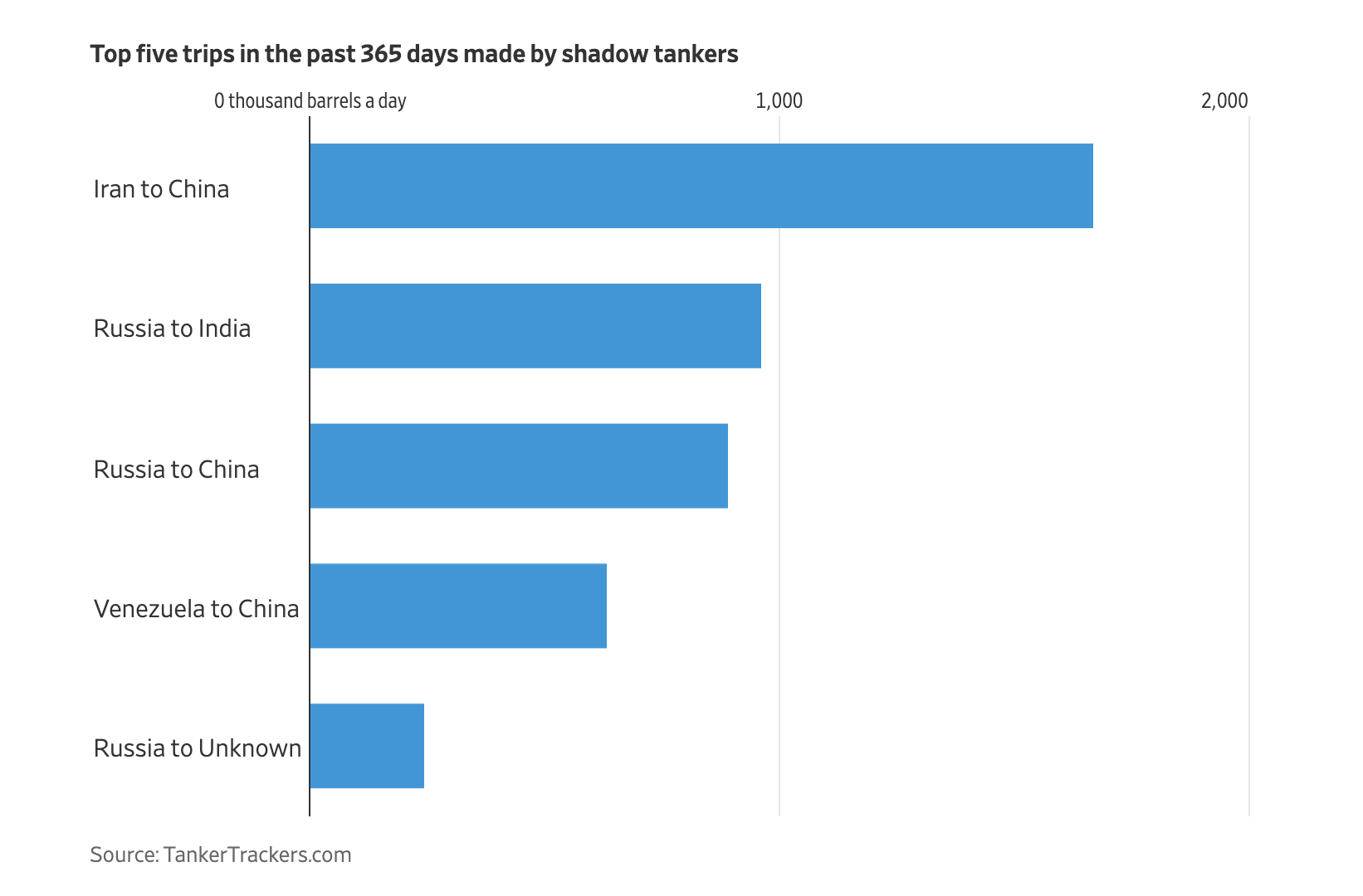
COMMENT - Important to remember that the biggest beneficiary of the Shadow fleet is the PRC and as the U.S. dismantles that fleet, it is Beijing that suffers.
An Isolated Iran Finds China’s Friendship Has Limits
Austin Ramzy, Wall Street Journal, January 14, 2026
Cuba’s Long-Suffering Economy Is Now in ‘Free Fall’
David C. Adams and Frances Robles, New York Times, January 6, 2026The Double-edged Sword of China’s Export Control Application in Southeast Asia
Xue Gong, RSIS, January 13, 2026
Beijing Accelerates Clearance of ‘Naked Officials’ from Top Ranks
Youlun Nie, Jamestown, September 1, 2025China notches historic $1.2 trillion trade surplus despite Trump tariffs
Simone McCarthy, CNN, January 13, 2026
China’s exports to the US, historically China’s largest single market, were down 19.5% overall in 2025 versus the previous year.
But while Beijing’s resilience in the face of US President Donald Trump’s trade war will be heralded as a victory inside China, globally, the surplus risks further inflaming trade tensions among nations who fear being overwhelmed by lower-cost Chinese imports.
COMMENT – The title of the article suggests that the purpose of the Trump tariffs was to reduce China’s trade surplus globally… but of course the pursue was to reduce China’s trade surplus with the United States which happened.
China’s fight against corruption is a battle we can’t afford to lose, Xi Jinping warns
Dewey Sim, South China Morning Post, January 12, 2026
Targeting Tiandy
Craig Singleton, FDD, December 1, 2022
China remains the undisputed leader in developing and fielding technologies that enable government control and manipulation of foreign and domestic populations, otherwise known as techno-authoritarianism. The firms that produce these technologies consist of both Chinese state-owned companies and China-based private entities susceptible to Beijing’s pressure to censor and surveil. One of those private firms is Tiandy Technologies Co., Ltd., based in Tianjin province in northern China. Both Tiandy testimonials and Chinese government press releases advertise the use of the company’s products by Chinese officials to track and interrogate Uyghur Muslims and other ethnic minorities in China’s Xinjiang province. According to human rights groups, Chinese authorities also employ Tiandy products, such as “tiger chairs,” to torture Uyghurs and other minorities.
The Chinese firms that equip Beijing’s surveillance state market facial recognition software, emotion-detecting artificial intelligence (AI) technologies, surveillance drones, and closed-circuit television (CCTV) capabilities to other autocratic regimes, including Russia and the Islamic Republic of Iran. According to Tiandy Iran’s website and Instagram account, the company has sold surveillance equipment to Iran’s security, police, and military services.4 The Internet Protocol Video Market (IPVM), a U.S.-based security industry research group and trade publication, also obtained documents that report such sales. The products reportedly sold to Iran include network video recorders that digitize and store surveillance videos, using microchips that Tiandy produced in partnership with U.S. manufacturer Intel.
At present, Tiandy is not subject to U.S. sanctions or export controls. In light of Tiandy’s operations in both Xinjiang and Iran, policymakers should consider moving quickly to target Tiandy’s global operations to cut the company and its owner, Dai Lin, off from the international financial system and global supply chains.
In particular, Washington should examine whether Tiandy’s conduct meets the criteria for imposing sanctions under Executive Order 13818, which implemented the Global Magnitsky Human Rights Accountability Act, targeting persons who are “responsible for or complicit in, or to have directly or indirectly engaged in, serious human rights abuse.”7 U.S. allies, such as Britain and Canada, that have comparable global human rights sanctions regimes should also determine whether Tiandy meets criteria for sanctions. The U.S. government should consider sanctions and punitive actions pursuant to other laws and executive orders that specifically target the perpetrators of human rights abuses in Iran and China.
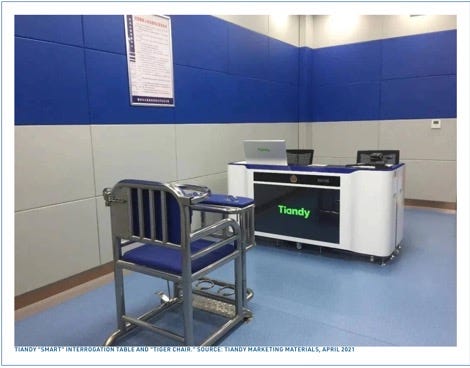
COMMENT – Along with surveillance technology, Tiandy also makes torture chairs tied to smart technology.
Pensions a new front for US clampdown on Chinese investment
Danielle Myles, FDi Intelligence, August 15, 2026
Environmental Harms
The Chinese War on the Planet Goes to Sea...something actionable smothered with greed
CDR Salamander, January 14, 2026
Foreign Interference and Coercion
Former U.S. Navy Sailor Gets Nearly 17 Years in Prison for Spying for China
Neil Vigdor, New York Times, January 12, 2026
Jinchao Wei sold technical manuals for American warships to a Chinese intelligence officer who had recruited him on social media.
A former U.S. Navy sailor was sentenced on Monday to nearly 17 years in prison, federal prosecutors said, after he was convicted of spying for China and using his security clearance to sell secrets about the capabilities of American warships, including their vulnerabilities.
The onetime sailor, Jinchao Wei, known as Patrick Wei, 25, was a machinist’s mate aboard the Essex, an amphibious assault ship moored at Naval Base San Diego.
A jury in U.S. District Court in San Diego found Mr. Wei guilty in August on six of seven criminal counts he faced, including two spying charges brought under the Espionage Act, and four conspiracy counts in violation of the Arms Export Control Act.
The Navy characterized some of the information sold by Mr. Wei, for a total of $12,000, as “critical technology.” He was dishonorably discharged from the military late last year.
India plans to scrap curbs on Chinese firms bidding for government contracts
Nikunj Ohri, Reuters, January 8, 2026
China’s Growing Media Footprint in Indonesia
Dalia Parete, Lingua Sinica, January 8, 2026
China urges Canada to break from US influence as Carney visits Beijing
Ken Moritsugu, Toronto Star, January 14, 2026
Italy and Pirelli try to end Chinese involvement in tyremaker
Silvia Sciorilli Borrelli, Financial Times, January 5, 2026
China pressing European countries to bar Taiwan politicians or face crossing a ‘red line’
Helen Davidson, The Guardian, January 13, 2026
Two Canadian members of parliament end Taiwan trip ahead of Carney’s China visit
Wa Lone, Reuters, January 12, 2026
Continuing parliamentary diplomacy. MP Loperfido speaks from Taiwan
Francesco De Palo, Decode39, January 12, 2026
The Battle Over Who Runs the Panama Canal Ports Is About to Be Decided
Santiago Pérez, Wall Street Journal, January 13, 2026
Human Rights and Religious Persecution
Giving Voice to the Persecuted Chinese Christians in Los Angeles
Feng Reng, Bitter Winter, January 12, 2026Human Rights Watch, January 14, 2026
Three Centuries After His Death, China Is Still Afraid of the Sixth Dalai Lama
Marco Respinti, Bitter Winter, January 13, 2026
China, Chengdu’s Early Rain Church: Yet Another Wave of Arrests
Feng Reng, Bitter Winter, January 12, 2026
China Labubu factory uses ‘underage workers,’ rights group says
Pak Yiu, Nikkei Asia, January 13, 2026
China births seen sinking under 9m, a decade after end of one-child policy
Kentaro Shiozaki, Nikkei Asia, January 12, 2026
Industrial Policies and Economic Espionage
Trump demands Venezuela kick out China and Russia, partner only with US on oil: Exclusive
ABC News, January 7, 2026
Supertankers sailing to pick up Venezuelan oil for China make U-turns, ship data shows
Marianna Parraga, Reuters, January 12, 2026
China Has Been Gorging on Black-Market Oil. That’s Now Getting Harder.
Carol Ryan, Wall Street Journal, January 12, 2026Trump appears to pull plug on USMCA as Canada attempts reset with China
Steven Chase, The Globe and Mail, January 14, 2026
The uncertainty Mr. Trump’s trade agenda has created for Canada’s auto industry is likely to weigh on Mr. Carney as he arrives in China on Wednesday. Among the topics he is expected to discuss with Chinese officials, including President Xi Jinping, is Canada’s 100-per-cent tariffs on Chinese electric vehicles, introduced in co-ordination with then-president Joe Biden as part of a strategy to defend the continental auto industry from inexpensive imports.
Lifting the tariffs could help revive trade with China, which has imposed countertariffs on Canadian agricultural exports, and provide a useful counterbalance to Mr. Trump’s protectionist economic policy.
But such a move could also endanger Ottawa’s delicate relationship with Mr. Trump, who has sent signals he expects allies to support his tough-on-China agenda. And it could layer more pressure on a domestic auto industry already under threat from Canada’s largest trading partner, the U.S.
Navarro Sees US Ending Chinese Dominance of Critical Minerals
Courtney Subramanian and Mishal Husain, Bloomberg, January 8, 2026
US Commerce Department drops plan to impose restrictions on Chinese-made drones
David Shepardson, Reuters, January 9, 2026
China’s domestic procurement drive squeezes foreign companies
Shunsuke Tabeta, Nikkei Asia, January 7, 2026
Trump Plays Venezuelan Oil Card Against China
Micah McCartney, Newsweek, January 7, 2026
China’s dual-use export ban on Japan a decisive escalation
Francis Tang and Gabriel Dominguez, Japan Times, January 7, 2026
China blinks again following dual-use export threat earlier in the week
Francis Tang, Japan Times, January 9, 2026
China telegraphed moderation for a second day running after issuing a trade threat earlier in the week that shook Japan and raised international concern about crucial global trade flows.
“It must be emphasized that China does not wish to see strained bilateral relations,” China Daily quoted a researcher from a Commerce Ministry-affiliated think tank as saying in an article Friday about a ban on dual-use exports to Japan announced Tuesday.
The publication — which is owned by the publicity department of the Communist Party of China and is routinely used to express official views — also quoted Chinese Commerce Ministry spokesperson He Yadong, who said on Thursday that civilian endeavors will not be affected by the restrictions, and that parties engaged in civilian trade “have absolutely no need to worry.”
China’s EV Dominance at Home Is Squeezing Out Foreign Carmakers
Yoko Kubota, Wall Street Journal, January 9, 2026
‘Soft landing’: China, EU see progress in EV trade dispute with price floor option
Ji Siqi and Xiaofei Xu, South China Morning Post, January 12, 2026
Europe and China Take Step to Resolve Dispute on Electric Vehicles
Keith Bradsher, New York Times, January 12, 2026
Japan sets sail on rare earth hunt as China tightens supplies
Yuka Obayashi, Reuters, January 12, 2026
Honda diversifies chip supply to lower China dependency
Shoya Okinaga, Itsuki Miyake and Ryo Mukano, Nikkei Asia, January 12, 2026
China Turns to Big Data and Public Shaming in Hunt for Tax Evaders
Bloomberg, January 12, 2026
China’s Other Olympics
Eliot Chen, The Wire China, December 21, 2025
China’s Trade Surplus Reaches Record, Defying Expectations of Tariff-Driven Slowdown
Hannah Miao, Wall Street Journal, January 13, 2026
Lynas Could Gain from China’s Curbs on Rare Earths Supply to Japan
Rhiannon Hoyle, Wall Street Journal, January 13, 2026
BYD burns profit chasing global dominance over Tesla
Kinling Lo and Ananya Bhattacharya, Rest of World, January 13, 2026
G7, other allies discuss ways to reduce dependence on Chinese rare earths
Maria Martinez and Kanishka Singh, Yahoo, January 12, 2026
Why China Is Suddenly Obsessed with American Poverty
Li Yuan, New York Times, January 13, 2026
Cyber and Information Technology
GOP effort to thwart chip sales to China gains steam
Maria Curi, Axios, January 9, 2026
Vivek Ramaswamy Changes His Mind on TikTok and Social Media
Jim Geraghty, National Review, January 7, 2026
TSMC Plans U.S. Expansion in Proposed Taiwan Tariff-Relief Deal
Robbie Whelan and Amrith Ramkumar, Wall Street Journal, January 12, 2026
China hacked email systems of US congressional committee staff
Demetri Sevastopulo, Financial Times, January 7, 2026
China AI Leaders Warn of Widening Gap with US After $1B IPO Week
Bloomberg, January 11, 2026
Chinese AI leaders warn the US’ lead is widening
Semafor, January 11, 2026
Trump Administration Enacts Security Rules for Nvidia’s China Chip Sales
Amrith Ramkumar, Wall Street Journal, January 13, 2026
US Clears Path for Nvidia to Sell H200s to China Via New Rule
Maggie Eastland and Ian King, Bloomberg, January 13, 2026
US approves Nvidia H200 chip exports to China with some conditions
Karen Freifeld, Reuters, January 14, 2026
Nvidia says no upfront payment needed for its H200 chips
Reuters, January 12, 2026
China Restricts Nvidia Chip Purchases to Special Circumstances
Qianer Liu, The Information, January 12, 2026
Military and Security Threats
China grows its air-to- air refueling capacity with an eye to Taiwan
David Vallance, Lowy Institute, January 8, 2026
Exploring an under-appreciated aspect of China’s military modernisation.
An army marches on its stomach. Amateurs talk tactics, professionals talk logistics. Infantry wins battles, logistics win wars.
These are clichés for a reason: they are true.
They are doubly so for any country wishing to project power far from its borders. For long-range air-power projection, a large-scale aerial refueling capability is fundamental. It is a key logistical enabler that allows strategic bombers, for instance, to conduct operations faster and at greater distances. This capability has been a crucial part of the American power projection. In the aftermath of the September 11 attacks on New York and Washington, for instance, aerial refueling allowed B-2 bombers based in the continental US to fly missions over Afghanistan without having to land once – a 44-hour bombing run.
The US operates the majority of air-to-air refuelers in the world today, with more than 550 in service as of 2025. This is a gap that the People’s Liberation Army Air Force (PLAAF) wants to close, and quickly.
Today the PLAAF operates around 35 refuelers, a mix of old Russian planes (IL-78 Midas), converted H-6 bombers (H-6U, H-6DU) and newer tankers evolved from its Y-20 transport planes (YY-20A). For the PLA to truly transform itself into a “world-class” military, as Xi Jinping has repeatedly stated is the intention, this capability must get closer to that of the US.
And it is doing exactly this.
China’s Gray-Zone Tactics at Sea: Taiwan’s Top Maritime Official Sounds the Alarm
Silva Shih, CommonWealth Magazine, July 17, 2025
Five Red Flags in China’s Latest Saber-Rattling Over Taiwan
Shu-ren Koo and Chih-Wei Chuang, CommonWealth Magazine, January 5, 2026
Latest Pentagon Report: China’s Military Advancing Amid Churn
Andrew Erickson, War on the Rocks, January 9, 2026
South Africa Risks Angering Trump by Hosting Navies of Iran, Russia, China
Alexandra Wexler, Wall Street Journal, January 11, 2026
China applies to put 200,000 satellites in space after calling Starlink a crash risk
Victoria Bela, South China Morning Post, January 11, 2026
The big ambitions of China’s private space industry
The Economist, January 11, 2026
Civilian or military? China turns to merchant fleet to boost military power.
Gabriel Dominguez, Japan Times, January 12, 2026
Chinese arms exporters may be the big winners in any Pakistan-Saudi JF-17 talks
Seong Hyeon Choi, South China Morning Post, January 12, 2026
One Belt, One Road Strategy
Trump Is Making a Power Play in Latin America. China Is Already There.
New York Times, January 9, 2026
With Venezuela raid, US tells China to keep away from the Americas
Michael Martina, Reuters, January 11, 2026
Opinion
China Drifts Closer to Its Own Lost Decade
Joseph C. Sternberg, Wall Street Journal, January 8, 2026
China Isn’t Just After Taiwan — But the South Pacific, Too
Hal Brands, Bloomberg, January 6, 2026
China’s economic challenges — in Chinese experts’ eyes
Andy Browne, Semafor, January 8, 2026
Trump Declared a Space Race with China. The US Is Losing
Noah Shachtman, Wired, January 13, 2026
The US Sphere of Influence Is Bigger Than It Looks
John Authers, Bloomberg, January 9, 2026
China is already the economic Goliath it does not want to be seen as
Henny Sender, Nikkei Asia, January 13, 2026