Now it’s time to disentangle
What we’ve learned from the Trump-Xi Summit
Friends,
Before we jump into some Summitry analysis, let’s first ask ourselves a question that rose to prominence in 2024:
Are you Team Drake or Team Kendrick?
If you don’t fully grasp the question, that’s alright.
Not everyone pays close attention to the rivalry between the most important rappers in the industry today. However, I’m deeply suspicious of folks who understand the question and pretend they have no opinion on the matter.
I bring this up because on Friday Drake dropped his latest album, Iceman, which included the song “Make Them Remember” (this song was leaked under the title “1 AM in Albany” but now we have the real title). This track is bound to reignite the feud that Kendrick dominated in 2024 with his single “Not Like Us” and the album GNX. I think it’s only a matter of time before we see a response by Kendrick. [Of note, Drake simultaneously dropped two companion albums, Habibti and Maid of Honour, so a total of 43 songs and 149 minutes of music… Drake is trying too hard.]
Some of you might be asking yourselves:
“Matt, the Eurovision Song Competition held its Grand Finale on Saturday, why aren’t you discussing that?”
Well, because I think it is cute that Europe holds its own song contest that purposefully excludes the United States, but allows countries like Australia, Azerbaijan, Armenia, and Israel to participate.
It suggests that our European friends recognize that America would dominate the contest if you let us in… with that said: congrats to Bulgaria!
Back to the real music news.
I’m unapologetically Team Kendrick (sorry Canada).
So, this week is probably a good opportunity to download Kendrick’s November 2024 album, GNX, and specifically his song “TV Off.”
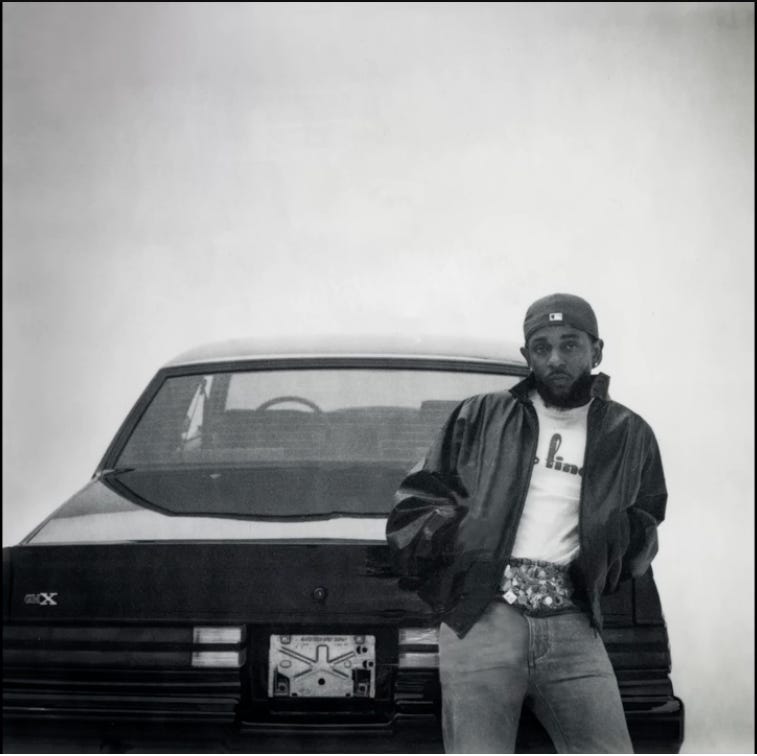
Cover of Kendrick Lamar’s 2024 album, GNX.
The song “TV Off” starts with the line:
“All I ever wanted was a Black Grand National.”
What does that refer to?
It’s the car on the cover of the album and it refers to the 1987 Buick GNX or Grand National Experimental.
This was a heavily modified Buick Regal, that the company produced over the objections of its parent corporation, General Motors.
Yes, a Buick Regal, perhaps the most forgettable car ever made. The kind of car your Uncle Gus in Kenosha would drive to Polka night at the bowling alley in the 1980s.
Buick wanted to see what kind of performance they could engineer, and GM wanted them to stay in their lane of producing boring sedans.
So, in 1987, Buick disobeyed orders and created just 547 of these monsters in all black, nicknamed the Dark Side or Darth Vader’s car, for obvious reasons.

The team at Buick put in a turbocharged 3.8-liter V6 which gave the car over 300 horsepower and 400 lb-ft of torque. Buick deliberately understated its horsepower and torque to avoid too much blowback from GM. It installed a purpose-built racing automatic transmission and redesigned the back axle to put all the power into the back wheels, something that drag-racers still study today.
On the track, it routinely beat Ferrari F40s, Ferrari 308s, Porsche 911s, and, most embarrassingly to its parent GM, the Corvette.
Internally, within Buick, engineers said the X in GNX stood for Grand National X-Rated because its was too nasty for polite company.
It was the OG of “if you know, you know.”
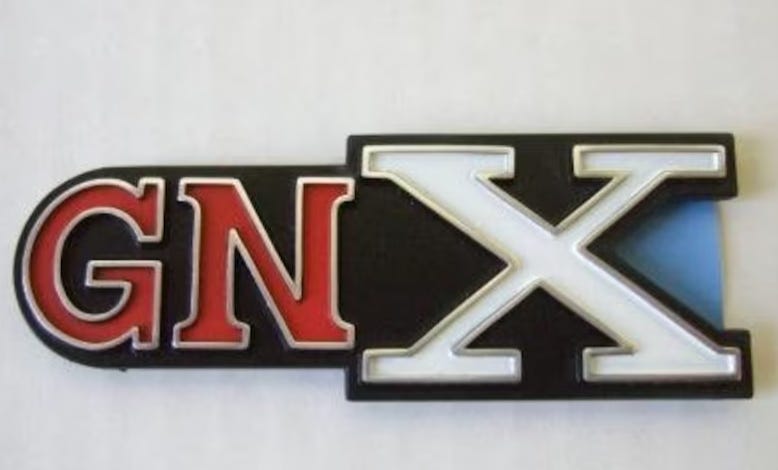
That car, produced over the objections of its corporate overlords, showed the world that Detroit could crush its competitors with one hand tied behind its back, if it wanted to.
Today, a mint GNX will cost you $300,000.
MUSTARD!!!!
[Go listen to “TV off”]
***
On to the Main Thing
Nothing summed up the summit better than this headline from Joe Mazur at Trivium China.
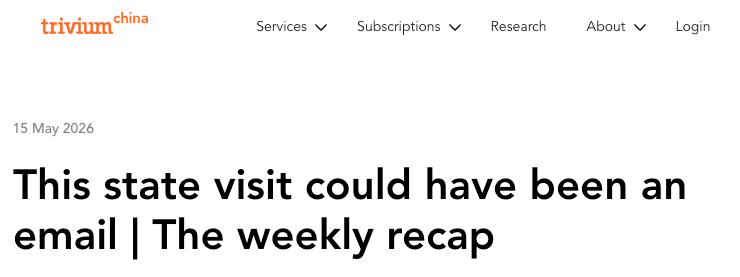
I think it should be obvious to everyone that no “grand bargain” between Washington and Beijing is possible, particularly one that addresses the underlying harms caused by the PRC’s economic structure.
Trump gave it his best shot and now we should pursue another approach.
Xi Jinping is committed to an economic model that suppresses his own citizens spending (and agency), plows their savings into infrastructure, manufacturing, and high technology, so that the PRC can push other countries out of the most important industries and businesses.
The objectives of this economic model are primarily geostrategic: make the rest of the world dependent on the PRC, so that Beijing can coercion the rest of the world into doing its bidding. The Party isn’t trying to create an economic system that maximizes global prosperity… it isn’t even trying to create an economic system that maximizes prosperity for its own citizens.
The Chinese Communist Party is interested in achieving market dominance for non-economic purposes.
It is worth going back seven months and re-reading Robin Harding’s OpEd in the Financial Times, “China is making trade impossible.”
Negotiating with the CCP to address these issues in a rational and constructive way is a dialogue of the deaf. What American (and European and Japanese and South Korean) leaders see as a “bug” of the PRC economic system is, for the Chinese Communist Party, its most important “feature.”
So, what is the way ahead?
Step 1 – Developed economies should institute some form of “managed trade” with the PRC with the purpose of reducing imports from the PRC over time. This starts with abandoning the fantasy that the CCP can be persuaded to fulfill its obligations to the World Trade Organization (WTO). Set quotas that shrink over time as you build out new structures and industrial capacity under Steps 2 & 3. The PRC will undoubtably retaliate by reducing its imports from these countries… but it was doing that already. We must collectively realize that the promise of increased exports to the PRC is a mirage given the stated policies of the Chinese Communist Party.
There will be a number of folks in Europe who think this is just a problem for the United States and that it is being overblown by Trump. So, I won’t use data from the U.S.-PRC trade relationship to make my point, I will use EU-PRC data.
This will be tough to internalize, since we are all led to believe that trade with the PRC is mutually beneficial. I just want everyone to look at the trendlines that have been playing out for Europe over the past decade.
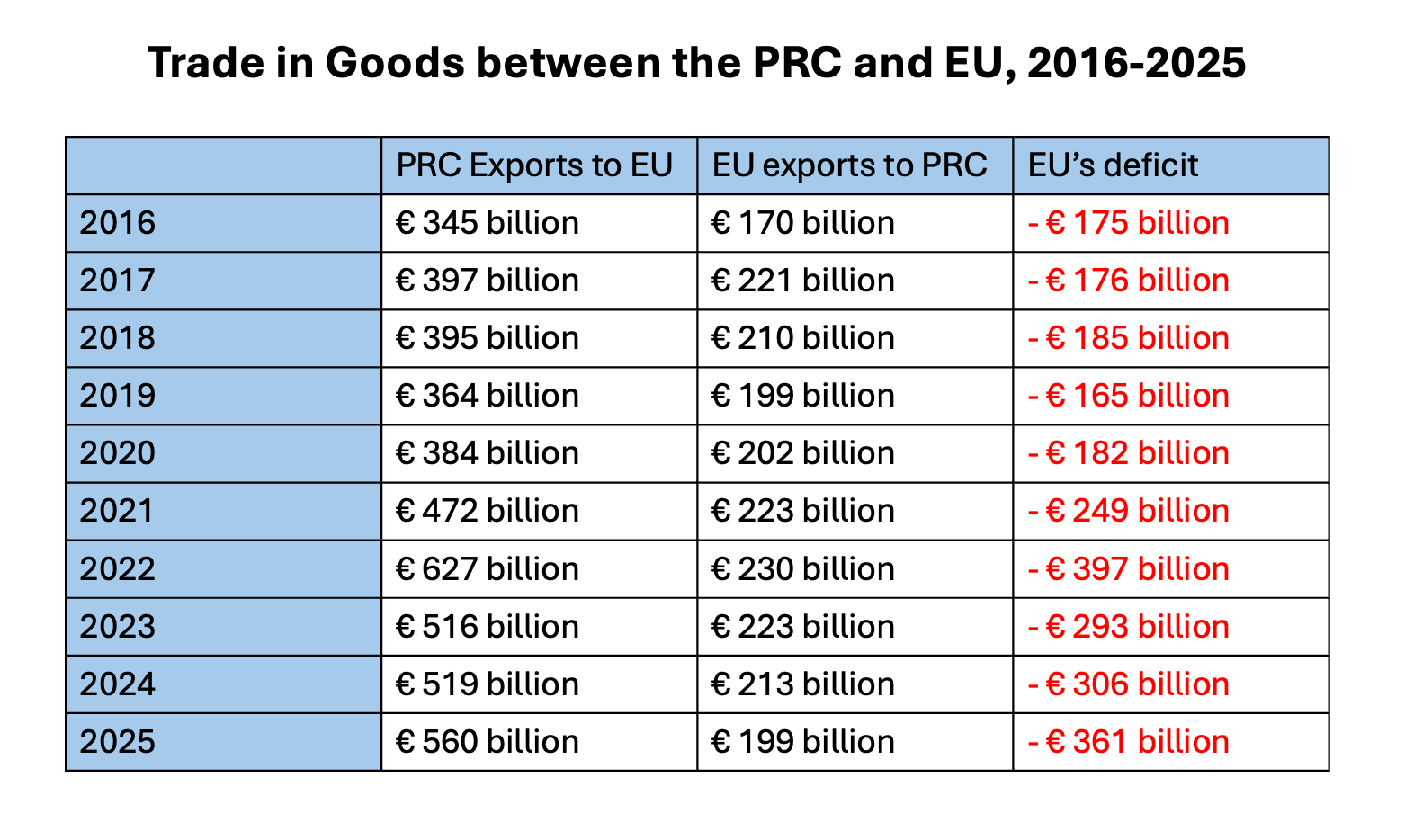
This is what we call a persistent trade deficit.
Now I can hear folks object:
“but Matt, this doesn’t include the surplus Europe has in services!!!”
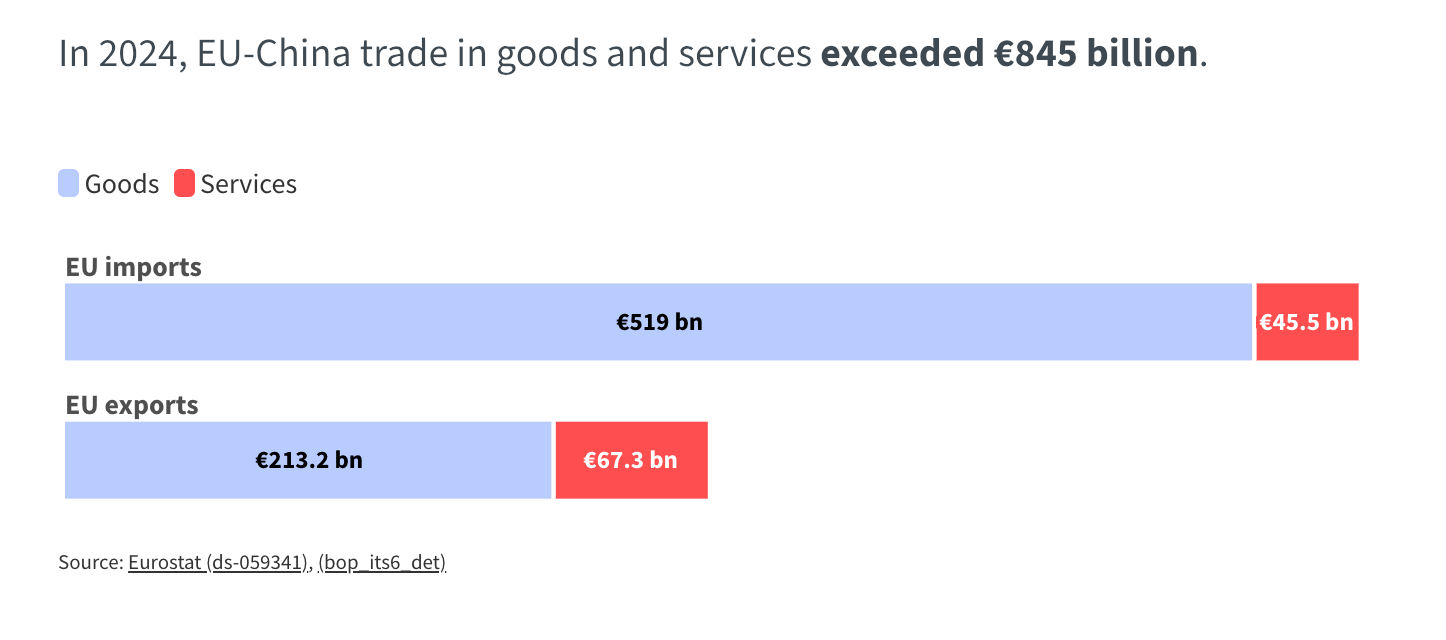
Well, here is the chart with goods and services… as you can see it doesn’t materially change the dynamic because trade in services is a tenth of the trade in goods.
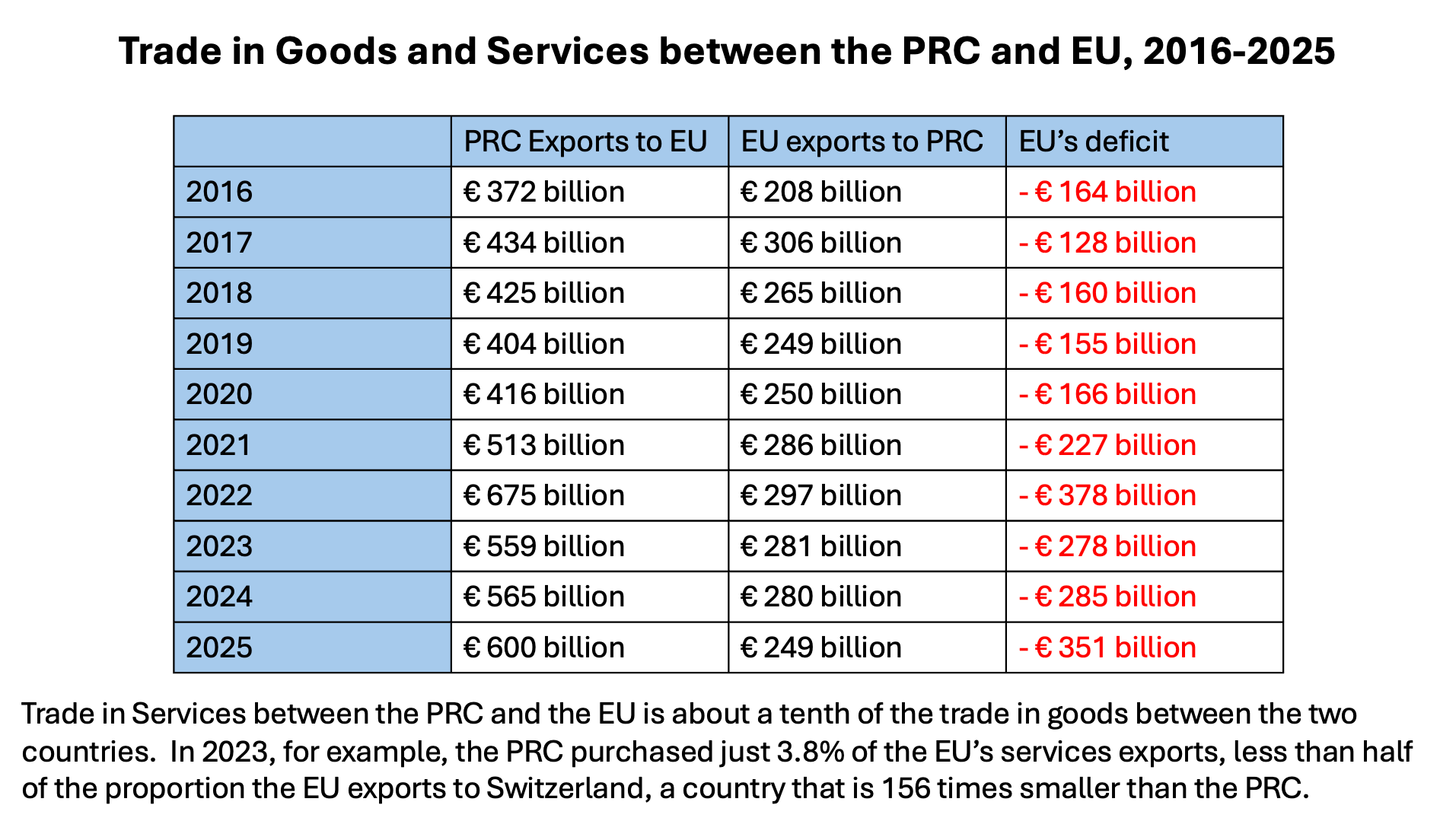
Theoretically, there is a lot of room for growth in EU services exports to the PRC.
But we don’t live in a theoretical world, we live in the real world. We all know that services are much more localized and run up against language and cultural barriers. It is unrealistic to believe that EU services exports will ever balance what the PRC can export in terms of goods. Nor should we believe that Beijing would ever want to accept that kind of swap as it seeks to move up the value chain and grow their own services industries as well.
To provide a better visual of how services doesn’t materially change the trade imbalance, here is a chart from the European Council’s own website explaining “EU-China trade: facts and figures.”
Let’s also consider the flows of investment between the EU and the PRC.
Here is the chart, produced by the European Commission, showing FDI flows in 2023, which is representative of what these flows have been like for a decade.
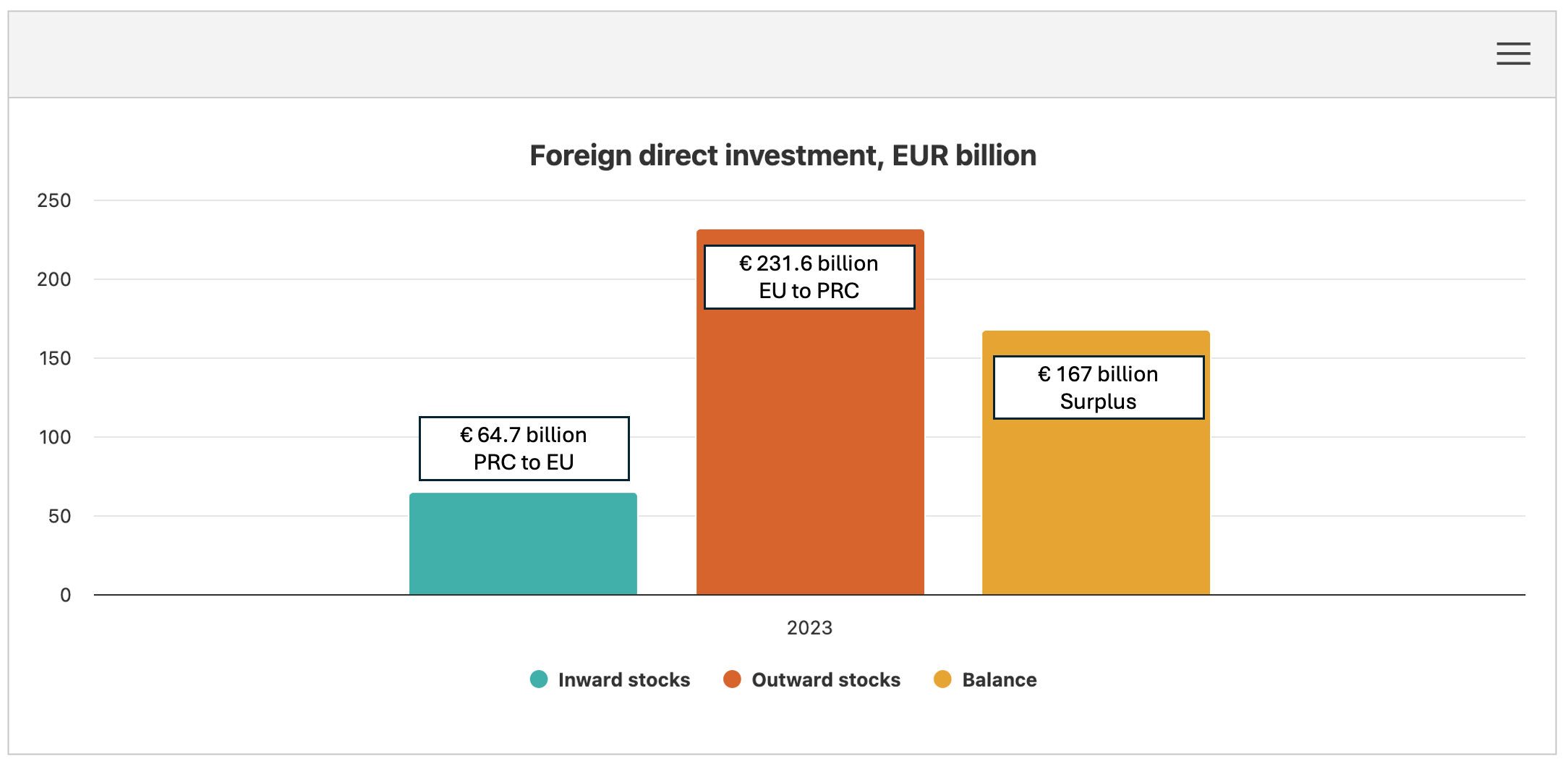
I know this will sound crazy… but, stick with me here… what if European companies and investors that had put € 231 billion into the PRC, invested that money into Europe, so that Europeans could produce some of those goods that the PRC exports to them, for themselves? Perhaps they could use that nearly a quarter of a trillion Euros to build infrastructure and provide energy to make producing goods in Europe for Europeans more affordable.
Crazy huh?
One of the excuses that we often hear from European leaders on why they can’t pushback on Beijing is because it might jeopardize all the enormous Foreign Direct Investment that the PRC is making in Europe… I hope everyone can see just how ridiculous that fantasy is… Europeans invest far more in the PRC than the PRC invests in Europe.
Step 2 – Countries that want to form a fair and reciprocal trading system should withdraw from the WTO. The PRC’s presence within the WTO makes it impossible to implement the reforms that are necessary for a functioning trade body and the WTO’s existing structure cannot enforce its own rules, meaning that no one is incentivized to follow the rules. The existing structure of the WTO simply prevents rule of law countries from defending themselves from the PRC’s mercantilist behaviors. The longer that political leaders fail to take this action the worse the political backlash will be and the longer it will take to implement Step 3.
Step 3 – Countries that want to form a fair and reciprocal trading system should create a new body, something along the lines of a GATT 2.0. Participating countries in this new body must share general economic and security interests. Rather than trying to enable “global trade” and “globalization” as the WTO has been focused on, this new body would recognize that not all countries are willing to play by the rules and that you can’t let your geostrategic rivals into the “hen house.” This new body would NOT be a vehicle for “Wandel durch Handel” (Change through Trade), it would be an entity that provides advantages and benefits to those countries that uphold the rule of law and want to actually conduct trade… not mercantilism.
I see these three steps as constituting a long-term policy of “disentanglement” from the PRC.
I doubt that President Trump will be able to conceptualize this kind of approach, he is far too committed to the idea that he, though his own personal charm and strongarm tactics, can get a “deal” with Beijing to resolve these problems.
He can’t and this summit should prove that to him.
So, it will be left to others to organize this policy of disentanglement… the longer we wait, the costlier it will be.
Who might those “others” be?
Well, it is clear who those others are and I have a bone to pick with a piece published two weeks ago in Foreign Policy by my friend Agathe Demarais.
The EU Is the New Go-To Middle Power (Agathe Demarais, Foreign Policy, April 29, 2026)
The European Union is the second largest economy in the world and the third largest by population. It is a nuclear power and has a seat as a permanent member of the UN Security Council. One hundred years ago, Europe dominated the planet… and now it is only a “middle power”?!?
Listen to your friends from across the Atlantic for a moment… if all Europe does is strive to be a “middle power” we are collectively screwed.
We need a responsible ally that exercises power equal to its size and heft in the international system. The time for oikophobia and being ashamed of your history is over. One of the most important reasons that the liberal international order has collapsed is because Europe has decided to act like a collection of midgets, instead of being a Great Power.
I think Agathe Demarais does excellent work. I thought her book Backfire: How Sanctions Reshape the World Against U.S. Interests was thoughtful and well considered. But this celebration of being a “middle power” is ridiculous. It essentially argues that the United States must continue to stand alone and shoulder the burdens of maintaining an international order that favors democracies as our rich and populous European friends sit on the sidelines and cluck their tongues.
We see headlines like this, which suggests that Europe should further devolve power to member states and it makes me want to scream.
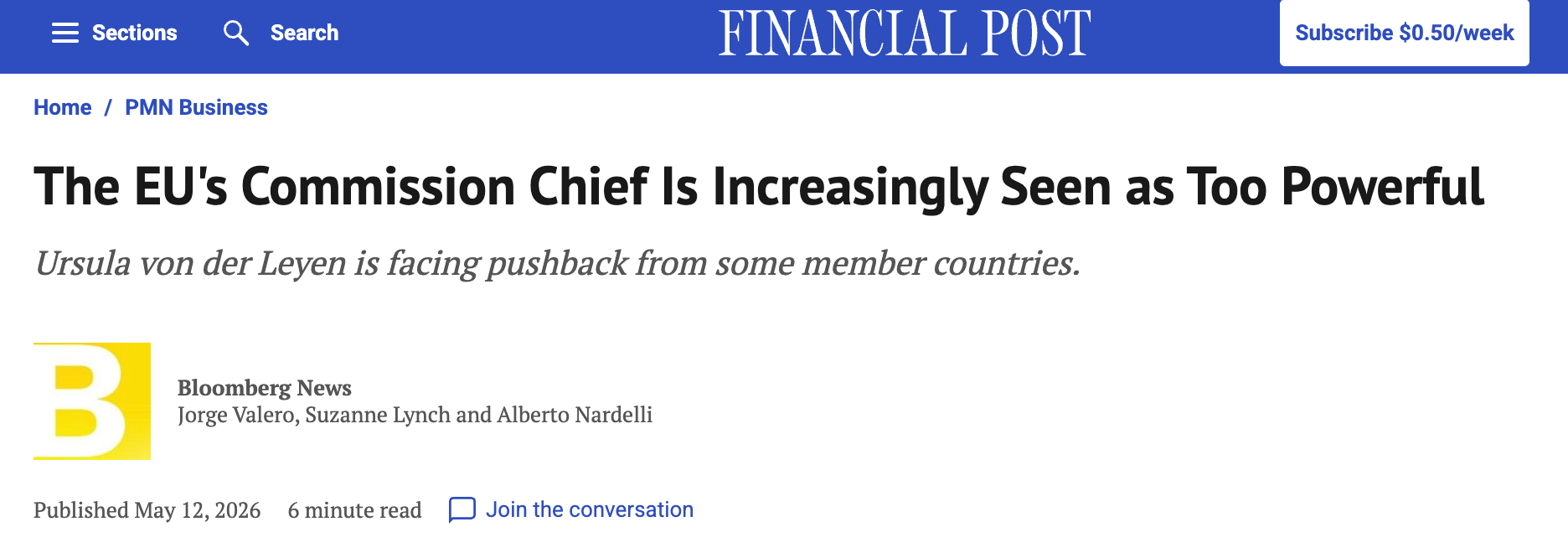
Europe needs to consolidate MORE responsibility and accountability in Brussels… it cannot afford to let the centrifugal forces of its provincial member states sap the continent of the power it needs to protect its citizens’ interests and to create an international order which provides for their prosperity.
This would mean that Paris, Berlin, Rome, Warsaw, and Madrid (etc.) would pull back from being independent actors on the world stage and let Brussels exercise sovereignty for them. It would mean that Europe would have to put together comprehensive energy, security, and foreign policies, rather than let individual member states pursue their own selfish goals at the expense of their neighbors.
I, for one, wouldn’t mind having the European Union punch in its proper weight class.
Perhaps the Russians might be a little scared of their giant and wealthy neighbor, that has a population more than three times as large as Russia and an economy 10 times as large.
Perhaps the Middle Eastern autocracies might be deterred from acts of terrorism in Europe or of shutting down Europe’s avenues of trade.
Perhaps the Chinese Communists would have to bide their time a bit longer.
If the Russians, Iranians, and Chinese were at least a little afraid of the Europeans, it would probably make the world safer and more stable.
America is stretched thin and we need your help.
I think C. Raja Mohan had a fairly good rebuttal, even if he didn’t mean it to be one, with his latest article in the same publication, “Trump’s War Exposes the Weakness of Middle Powers,” (Foreign Policy, May 4, 2026). The subtitle from this former member of India’s National Security Advisory Board says it all: “Collective action by lesser powers will not shape the global order.”
Europe has a $23 trillion economy with 450 million citizens; it is time to act like “Great Power” and help us create a new international order that protects our shared interests and values and creates an engine for our citizens’ prosperity.
***
Next week I’m traveling in Asia, so there won’t be a newsletter on Sunday, May 24.
Thanks for reading!
Matt
MUST READ
How Iran’s Energy Exports Are Still Headed Toward China
Adina Renner and Jenny Gross, New York Times, May 15, 2026
The U.S. blockade has intercepted dozens of vessels since mid-April. But a small number of ships with Iranian cargo are still sailing.
The conflict in the Middle East provided a painfully awkward backdrop to this week’s meetings between President Trump and China’s leader, Xi Jinping.
Mr. Trump, waging war on Iran, is also trying to cut off Iran’s income from oil exports. China is by far the world’s biggest customer for that oil. Mr. Trump’s Treasury secretary, Scott Bessent, has accused China of effectively financing terrorism by purchasing Iranian oil.
So last month, the U.S. Navy deployed a vast sea blockade, starting in the Gulf of Oman, giving it the power to decide which ships get through to China and other destinations in Asia.
U.S. officials say the blockade has been very effective, having intercepted more than 70 vessels. Ships have been stopped off Iran’s coast and even far beyond. One China-bound ship carrying Iranian oil, the Majestic X, was recently seized in the Indian Ocean, more than 2,000 miles from the Gulf of Oman.
A complete picture of ship traffic in the region is difficult to ascertain. Ships routinely turn off their location trackers, use spoofing to falsify positions and sail under false flags. Or they transfer Iranian oil from one ship to another smaller ship, making its origin hard to detect. Sometimes vessels deploy all of those tactics together. Between April 19 and May 3, there was a 600 percent increase in the number of ships engaged in deceptive tactics, according to Windward, a maritime intelligence firm.
But what is clear, according to a New York Times analysis of satellite images and other shipping data, is that some ships carrying Iranian oil that left around the time or after the U.S. blockade was implemented are now nearing East Asia.
Xi Jinping tells Donald Trump that US and China are ‘partners not rivals’
Joe Leahy, James Politi, Edward White, and Demetri Sevastopulo, Financial Times, May 14, 2026
Xi Jinping told Donald Trump that the US and China needed to be “partners, not rivals” while the American president said the relationship is “going to be better than ever before” as the pair kicked off a long-awaited summit in Beijing on Thursday.
Sitting down for talks that are expected to focus on the Iran war, Taiwan, trade and opportunities for US business, President Xi said the US and China needed to “create a new paradigm for relations between major countries”.
“The two countries should be partners, not rivals. We should help each other succeed . . . and find the right way for major countries to coexist,” Xi said.
In his opening comments, Trump praised what he said was the two countries’ “fantastic relationship” and called Xi “a great leader” before touting his accompanying business delegation.
“We have the greatest businessmen in the world . . . and they’re here today to pay respect to you, to China.”
Trump and Xi Want to Stabilize U.S.-China Ties. Now Comes the Hard Part.
Alexander Ward, Brian Spegele, Annie Linskey, and Lingling Wei, Wall Street Journal, May 15, 2026
Tightly choreographed visit masks big differences between U.S. and China.
At the end of President Trump’s state visit to China on Friday, with Air Force One lifting off through the haze at Beijing’s airport, both sides hailed a reset in relations—though each has a starkly different idea of what that means.
For Trump, it is about opening China’s market to American business and reciprocal trade, reviving a U.S. policy he scrapped in his first presidency, when he had adopted a more hawkish attitude toward Beijing.
Chinese leader Xi Jinping, meanwhile, wants “strategic stability”—a predictable relationship in which Washington doesn’t impede Beijing’s economic and geopolitical rise.
The shared desire for stable relations is a change after years of mutual antagonism.
After annexation: How China plans to run Taiwan
Richard McGregor, Jude Blanchette, Lowy Institute, May 10, 2026
Beijing needs to do more than just take Taiwan; it needs to govern it as well, a task that its scholars admit will be a fraught, decades-long project.
Beijing’s thinking on Taiwan has shifted decisively from peaceful accommodation to absorptive control. As Taiwanese identity and democracy have become entrenched, Xi Jinping’s unification terms have hardened, demanding full political integration rather than offering genuine autonomy. Drawing on PRC academic and policy literature, this paper finds that Chinese scholars see a form of phased subjugation for the island: an immediate security crackdown neutralising political opponents; institutional restructuring beyond what has taken place in Hong Kong; and a decades-long psychological re-engineering project so Taiwanese come to identify with the CCP’s China. Millions of Taiwanese would be excluded from public life and many current political leaders would be jailed.
Yet PRC thinking on integration is riddled with unresolved contradictions. Autonomy without credible guarantees generates no trust; coercion achieves stability but not legitimacy; economic integration cannot substitute for consent. Beijing understands the scale of the challenge it would face — governing a consolidated democracy against its will — but remains ideologically constrained from resolving it.
COMMENT – I doubt the Taiwanese would accept this kind of domination without fighting.
China’s Long Arm in Lusaka
David Bandurski, Lingua Sinica, May 8, 2026
Whether China pressured Zambia to cancel RightsCon, the world’s largest digital rights summit, remains an open question for some. But recent history suggests a pattern.
The abrupt cancellation last week in Zambia of RightsCon, the world’s largest digital rights summit, has ignited a discussion about who bears responsibility — and the answer to that question has major repercussions for global civil society.
If, as the organizer, Access Now, reports, the decision by the Zambian government resulted from Chinese diplomatic pressure over planned participation by researchers and civil society representatives from Taiwan, this is a serious application of sharp power by China, and a woeful precedent. “We see this unilateral decision, and the way it was taken, as evidence of the far reach of transnational repression targeting civil society,” Access Now said in its statement.
Others have cautioned against taking the facts presented by the digital rights organization at face value, including the claim that Zambia’s Ministry of Technology and Science, the group’s primary government partner, relayed that “diplomats from the People’s Republic of China (PRC) were putting pressure on the Government of Zambia.” Eric Olander of the China Global South Project wrote that human rights groups were “quick to blame China for the event’s cancellation, despite providing no evidence to support the claim.” Zambian scholar Sishuwa Sishuwa went further on social media, arguing that the Chinese pressure narrative was too convenient — a pretext, he suggested, that allowed the government of President Hakainde Hichilema to conceal domestic political motivations.
The facts of the RightsCon debacle are crucial to get right. More than 2,600 participants from over 150 countries and 750 institutions had planned to attend in person, with another 1,100 joining online. For many smaller civil society organizations and individual activists, the last-minute cancellation meant unrecoverable costs — flights, accommodation, and event bookings that cannot easily be written off. The costs to global civil society engagement and solidarity are even higher, and the unfortunate situation could point to similar forms of transnational repression in the future.
But the broader context of China’s engagement on speech issues in Zambia is also informative. In fact, this is not the first time that pressure connected to the interests of the Chinese state has been brought to bear on critical voices in Zambia. The case last year involving News Diggers, one of Zambia’s first multimedia outlets dedicated to investigative journalism, offers a telling precedent.
After News Diggers shared a teaser on social media on May 20, 2025 for a documentary examining the consequences of Chinese commercial activity in Zambia, the Chinese Chamber of Commerce in Zambia filed a defamation complaint against the outlet. The Lusaka High Court issued a gag order on May 22 — the day before the film was due to air, and without notifying News Diggers.
The injunction held for two months, through a June 26 hearing in which News Diggers was able to present its case, and a July 18 ruling, before being revoked. The court found that the chamber had not even been directly targeted by the alleged defamation. In a report on the case, Reporters Without Borders noted that this was apparently the first documented case of “a Chinese entity attempting to silence critical reporting through strategic lawsuits against public participation (SLAPPs) in the country.”
COMMENT – In addition to this, Zambia is the victim of one of the worst environmental disasters by a PRC company and it appears that Zambian officials have been working for over a year to hide the full scope and culpability of Beijing.
In February 2025, a tailings dam collapsed at a copper mine owned by a PRC state-owned enterprise and dumped 13 million gallons of highly toxic waste into the Kafue River system which serves as the primary water source of Zambia, providing water to 60% of the country’s population.
Over the past year, the PRC Government has taken enormous steps to cover up what happened and silence criticism.
Zambia is essentially a PRC colony.
No Country for American Reporters
Eliot Chen, The Wired China, May 10, 2026
The number of journalists working for U.S. news organizations in China is dwindling fast, making it ever harder for outsiders to get a full picture of what is happening on the ground.
When President Donald Trump travels to China next week for his summit with Xi Jinping, a swarm of reporters will accompany his entourage. More than 260 journalists applied to join the trip, according to a person who has reviewed the list. Inside China, however, the thinnest ranks of full-time foreign correspondents in decades will be there to greet them.
Six years after a U.S.-China tit-for-tat cycle of journalist expulsions decimated the foreign correspondent corp in China, the situation remains dire. Through attrition and at least one expulsion, U.S. bureaus are losing reporters, and Beijing has not approved their replacements.
The result is that, even as the leaders of the world’s two largest economies meet next week, it has become harder than ever to get a full picture of what is happening in China — a problem that shows no signs of abating.
“The U.S. has never had so few foreign correspondents in China at any period since diplomatic relations were normalized in the 1970s as now,” says Ian Johnson, a longtime China reporter who was expelled in 2020. “Two correspondents among the big three newspapers [the New York Times, the Wall Street Journal and the Washington Post] is a completely outrageous situation.”
In February, the Chinese government expelled New York Times correspondent Vivian Wang, according to six people familiar with the matter. Wang was one of two remaining Times correspondents in China until this year. Her expulsion is the first from a U.S. media outlet since 2020, and came after the newspaper invited Taiwanese president Lai Ching-te to its DealBook Summit in December.
COMMENT – If U.S. journalists can’t operate in the PRC then we certainly should not be sending American students there and we shouldn’t have U.S. universities operating joint venture campuses there.
The Imagination Technologies case and Lord Mandelson’s vetting
Charles Parton, Observing China, May 12, 2026
Whatever the root causes of the controversies surrounding Lord Mandelson’s recent security vetting and diplomatic appointment, His Majesty’s (HM) Government must not miss the broader lesson: a lack of clear strategic thinking regarding the United Kingdom’s (UK) relations with the People’s Republic of China (PRC) continues to compromise national security.
It is notable that recent public scrutiny of Lord Mandelson’s vetting – and the past PRC-related client roster of Global Counsel, the advisory firm he co-founded, which has entered administration – coincided with a tribunal ruling on the case of Imagination Technologies. Ron Black, its Chief Executive Officer (CEO), blew the whistle on an operation to transfer sensitive technology to the PRC, after HM Government had allowed a Chinese venture capital company, Canyon Bridge, backed by a state-owned company, China Reform, to buy Imagination Technologies in 2017.
This is a prime example of how the Chinese Communist Party (CCP), through its companies – both state-owned and private – sets about filling important gaps in its technology inventory. The threat is not just the acquisition of dual (military) use technologies, but also forcing British, American, and European competitors from the market, thus creating long-term and dangerous dependencies.
The controversial transfer of assets belonging to Imagination Technologies, Britain’s second largest microchip design company, was carried out under the eyes of HM Government. To help navigate the UK’s regulatory and political landscape, Canyon Bridge engaged the services of Global Counsel to reassure British stakeholders and smooth the process.
Details of the Imagination Technologies case are laid out in an excellent report and follow-up article published by UK-China Transparency, an organisation that has exposed a number of instances of CCP interference in Britain. In essence, HM Government allowed Chinese investment in Imagination Technologies on the condition that Intellectual Property (IP) and accompanying know-how remained in the UK. The United States (US) Government had already specifically withheld this technology from the PRC. It had also banned Canyon Bridge from acquiring an American technology company.
COMMENT - The fact that Peter Mandelson and his firm Global Counsel helped the PRC engineer this undermining of UK security and technology leadership is completely unsurprising.
I Ran the N.S.A. This Is How to Defeat China’s Hacker Army.
Timothy D. Haugh, New York Times, May 11, 2026
Behind the pageantry that will be on display during President Trump’s meeting with President Xi Jinping of China this week is a less pleasant reality. For at least the last decade, Beijing has been actively targeting America’s telecommunications networks, intellectual property and electrical and water utilities in a sustained campaign of intrusion.
The summit provides an opportunity to raise the issue more forcefully with Mr. Xi than American leaders have in the past. But America also has its own unpleasant reality to face: Protecting the country from bad actors in cyberspace is a job for Americans, and we haven’t been doing enough to defeat China’s efforts.
The good news is that the United States has a huge advantage in today’s cybercompetitions: the extraordinary concentration of technical capability, network reach and institutional knowledge embedded in American industry. Our cybersecurity companies monitor billions of devices globally, observing adversary activity faster and more precisely than any intelligence service. American cloud and telecommunications providers power the preponderance of global commerce. U.S. technology firms operate at a scale no government entity can replicate.
Part of the challenge has been engaging American technology companies in the fight. The tech industry can no longer accept the status quo of vulnerabilities across its networks. But the government can take steps to fix things, too, by rewriting opaque laws, helping states and municipal systems patch vulnerabilities, and investing in countermeasures to defend against the most dangerous emerging cyberthreats.
5 Things to Know About China’s Wartime Support for Iran
Craig Singleton and Jack Burnham, FDD, April 30, 2026
China is Iran’s top trading partner and one of the regime’s most important economic lifelines. Beijing is not seeking a wider Middle East war, especially one that threatens energy flows through the Strait of Hormuz. But it has provided Tehran with support that helps the regime absorb pressure, generate revenue, and sustain parts of its military-industrial base. This includes oil purchases, diplomatic cover, sanctions-evasion assistance, and reported dual-use transfers tied to Iran’s missile program. China’s approach is opportunistic: Beijing seeks to preserve Iran as a useful anti-American partner while limiting the risk to China’s own interests, especially the risk of provoking stronger U.S. action that could undermine the current U.S.-China trade truce.
Authoritarianism
The four red lines in U.S.-China relations must not be challenged
PRC Embassy in the United States, May 12, 2026
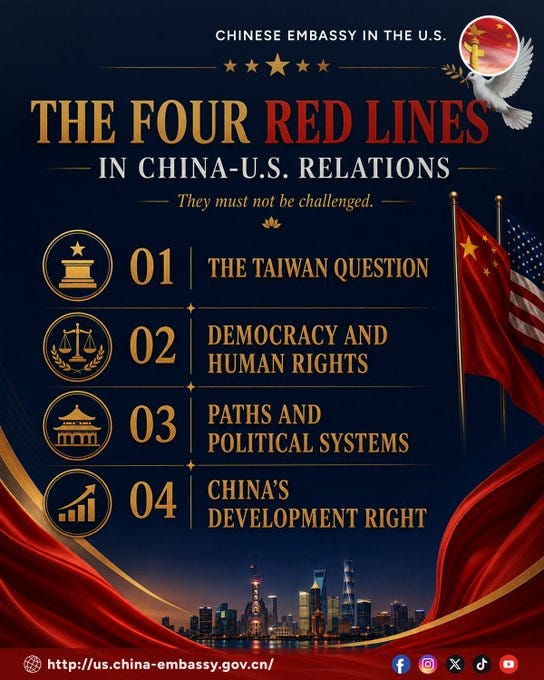
COMMENT – Ballsy by the Chinese Embassy… I for one reject their four so-called Red Lines and find their insertion of a peace dove in the top right corner to be the height of hypocrisy.
Silencing University Voices
Lingua Sinica, April 21, 2026
Across China, student publications are disappearing, one deleted account at a time.
Earlier this month, Beijing Normal University quietly deleted the social media account of Jingshi Scholars, a student-run publication that had operated on campus for twenty years. No announcement was made to readers or former members as between 600 and 700 articles disappeared overnight. The account was listed as “voluntarily closed” — a bureaucratic formality that, according to former members, was not what had actually happened.
Student newspapers and other outlets in China have long occupied a rare and contested space. Operating nominally under university party committees, they have sometimes managed, within narrow limits, to report on subjects that official outlets dare not touch. Jingshi Scholars tended to cover such issues as labor rights and the lives of migrant workers in the capital city, topics that can sit uneasily with the Party’s preferred narratives.
The move this month is just the latest in a series of moves against the publication. In November 2017, the editorial team was summoned by university authorities after publishing a sensitive article and forced to hand over editorial authority. The office space used by the publication was reclaimed by the university. The public account stopped updating, until the final deletion this year.
COMMENT – I wonder when Chinese students will finally say: “enough is enough.” When will they organize against their corrupt government, just as Mao and Deng and other CCP revolutionaries did when they were students in the 1920s.
I suspect that this is what keeps CCP elites awake at night… that somewhere, on some campus, there is a young Chinese student who is outraged by the corruption and brutality of the Chinese Communist Party and is beginning to organize against it to bring about its downfall.
The Party knows this is happening because it is how they came to power.
When a regime crushes political activity by everyone other than themselves, they simply push that activity into the shadows where it grows more extreme and realizes that since it cannot compete for power in any legitimate way, it must plot to bring about the overthrow of the country’s aristocracy.
The advantage of democracy is that it provides a relief value for these human tendencies and encourages everyone to participate in the existing political structure for influence and power.
By trying to hold power monopolistically and suppress the most basic elements of human nature, the CCP creates the conditions for its own demise.
Student’s alleged jailing in China over Australian pro-democracy protests sparks calls for inquiry
Wing Kuang, The Guardian, April 29, 2026The Deeper Pattern Behind China’s Military Purges
Christopher Nye and Charles Sun, Foreign Policy, May 1, 2026
Xi’s new commanders are the men his last generals blocked.
On April 8, China’s Central Military Commission (CMC) convened a “rectification” training session for the remaining senior officers in the People’s Liberation Army (PLA). Chairman Xi Jinping delivered the opening speech. On the dais beside him at the National Defense University in Beijing sat a single colleague: Zhang Shengmin. The CMC’s discipline inspection chief had become, alongside Xi, the only other member of China’s top military body, after two of its most powerful generals were placed under investigation in January.
Most outside readings have treated this scene as a purity ritual, another turn of the screw in Xi’s decade-long campaign to make sure the army is under the total control of party leadership. The content of his speech, which urged officers to maintain “the purity and glory of the people’s armed forces,” invited that reading. But the more interesting text that day was not the speech. It was the seating chart. In past sessions of this kind, the front row overflowed with full generals. This time, only two sat there, flanked by lieutenant generals.
Chinese Firms Plot Secret Arms Sales to Iran, U.S. Officials Say
Julian E. Barnes, Mark Mazzetti, and Dustin Volz, New York Times, May 13, 2026
Chinese companies have been discussing arms sales with Iran, plotting to send the weapons through other countries to mask the origins of the military aid, according to U.S. officials.
The United States has gathered intelligence that Chinese companies and Iranian officials have discussed the arms transfers. It is not clear how many, if any, arms have been shipped or to what degree Chinese officials have approved the sales.
The new disclosure is likely to intensify pressure on President Trump to raise the issue while he is in Beijing this week. But whether Mr. Trump will remains a question. While he has pressured leaders of smaller countries during their visits to the White House, Mr. Trump seems intent on resetting the relationship with President Xi Jinping during his meetings in China.
Mr. Trump said on Tuesday that he planned to have a “long talk” with Mr. Xi about the conflict in the Middle East and added that the Chinese leader had been “relatively good” on Iran.
Penalized by China, Rubio Enjoys a Trip to Beijing
Edward Wong, New York Times, May 15, 2026
There has been rampant speculation online about whether the Chinese government changed the transliteration of Marco Rubio’s name to overlook sanctions. But that theory is wrong.
No one seemed to enjoy being in the Great Hall of the People more than Secretary of State Marco Rubio. There he was, walking around and pointing and marveling at the ceiling while his colleagues stood at a long wooden table getting ready for a summit meeting on Thursday with their Chinese counterparts.
Mr. Rubio remarked on a few things about the ceiling to President Trump’s other aides, though a video recording did not capture his words.
But there had been a chance Mr. Rubio might not have made it to Beijing at all.
Since he is both the top American diplomat and the White House national security adviser, it was obvious he would try to accompany Mr. Trump once the trip began coming together. However, it was less obvious whether Mr. Rubio would be allowed in: When he was a senator representing Florida, the Chinese government had imposed sanctions on him and several other American lawmakers and officials known for their outspoken criticism of the Chinese Communist Party.
That happened in 2020, as a tit-for-tat retaliation against sanctions the first Trump administration had imposed on Chinese officials. The State Department said those officials were involved in repression in the region of Xinjiang, home to Uyghur and Kazakh Muslims. That same summer, the Chinese government imposed additional sanctions on Mr. Rubio and other lawmakers to retaliate against U.S. sanctions on Hong Kong officials.
It turns out the Chinese government’s solution to overlooking those sanctions and allowing Mr. Rubio to enter China was simple: Officials said the sanctions had been imposed on Senator Rubio and not the man who is now a cabinet official.
“The sanctions are aimed at Mr. Rubio’s actions and rhetoric on China when he served as a U.S. senator,” Liu Pengyu, the Chinese embassy spokesman in Washington, said in a statement to The New York Times on Thursday, when asked about the inconsistency.
A spokesperson for China’s foreign ministry, Guo Jiakun, gave the same answer when asked about Mr. Rubio at a news conference in Beijing. Neither official answered a question about whether China had dropped the sanctions.
COMMENT – I am certain that Marco Rubio considers the CCP’s sanctions on him as a badge of honor, just as any person who cared about human rights and holding dictators responsible would.
Trial Begins for Man Accused of Running Secret Police Outpost for China
Santul Nerkar, New York Times, May 6, 2026
Stealing the Farm: China Continues Raid of US Agriculture by Theft and Agroterror
Chris Bennett, AG Web, May 5, 2026
The Factory Town Known as China’s Furniture Capital Is Fighting to Survive
Hannah Miao, Wall Street Journal, May 10, 2026
Family of imprisoned Chinese journalist pleads for his release over health concerns
Huizhong Wu, AP News, April 8, 2026
What is China’s anti-sanctions law and how does it work?
John Power, Al Jazeera, May 7, 2026
VIDEO – Former White House China director Matt Turpin on Trump’s trip to Beijing
ASPI Stop the World, May 12, 2026
China Threatens EU With Retaliation if It Bans Huawei Gear
Gian Volpicelli, Bloomberg, April 29, 2026
China said it would retaliate against the European Union if it proceeds with a proposal to ban Huawei Technologies Co.’s equipment across the continent, escalating tensions in the long-running clash over national security and the communications company’s products.
China’s mission to the EU has asked that the commission erase language that would declare Chinese equipment a cybersecurity concern or label companies from the country as “high risk” suppliers in a proposal from Commission Executive Vice President Henna Virkkunen.
COMMENT – Oh the hypocrisy… the PRC blocks foreign components and foreign platforms from its country routinely and claims national security as the justification.
The Canadian Who Spent Over 1,000 Days in Chinese Prison Warns Ottawa Is Walking into Beijing’s Trade Trap
Sam Cooper, The Bureau, May 5, 2026
Don’t Swat the Scholars
China Media Project, April 28, 2026
China’s marriages drop to decade low, deepening demographic concerns
Reuters, May 11, 2026China Primer: U.S.-China Relations
Susan V. Lawrence, Congressional Research Service, May 11, 2026
Environmental Harms
China’s fishing fleet raises concerns off Argentina
Leila Miller, Adolfo Arranz, Farah Master, and Han Huang, Reuters, May 13, 2026
S. Korea seizes 2 Chinese boats over illegal fishing
Korea Herald, May 9, 2026
More solar than any other country, but can China quit coal?
Stuart Braun, DW, May 14, 2026
China Produces More Coal Than the Rest of the World Combined
Jeff Desjardins, Visual Capitalist, May 5, 2026
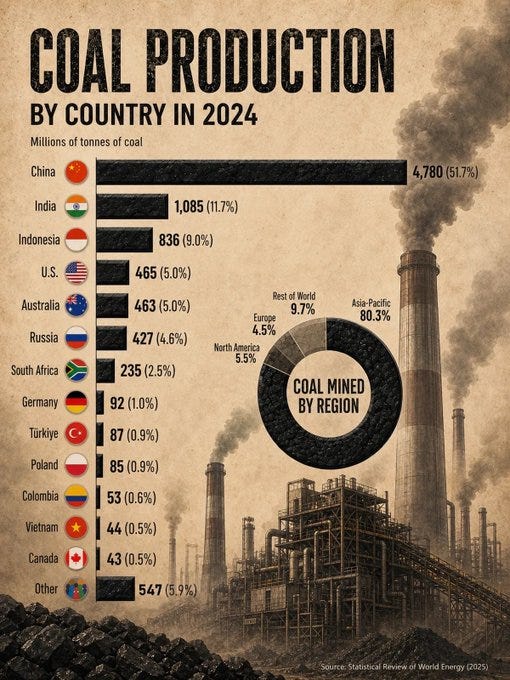
COMMENT – If this chart were about which countries actually burn the coal produced, then China’s share would be even higher as Indonesia, the United States, Australia, Russia, and South Africa all export significant amounts of their mined coal to the PRC.
The PRC burns about 60% of all the coal consumed in the world. This is about six times as much as the next largest consumer of coal, India. India burns about 10% of the world’s coal and its consumption exceeds the combined consumption of both Europe and North America.
Electrification does NOT automatically mean a country will shift from coal to renewables.
No matter how many solar farms and windmills that Beijing builds, the PRC’s reliance on coal is not going away. Beijing is NOT replacing coal with renewables; it is adding renewables to its expanding stock of coal-fired power plants. Just like solar and wind, coal produces electricity.
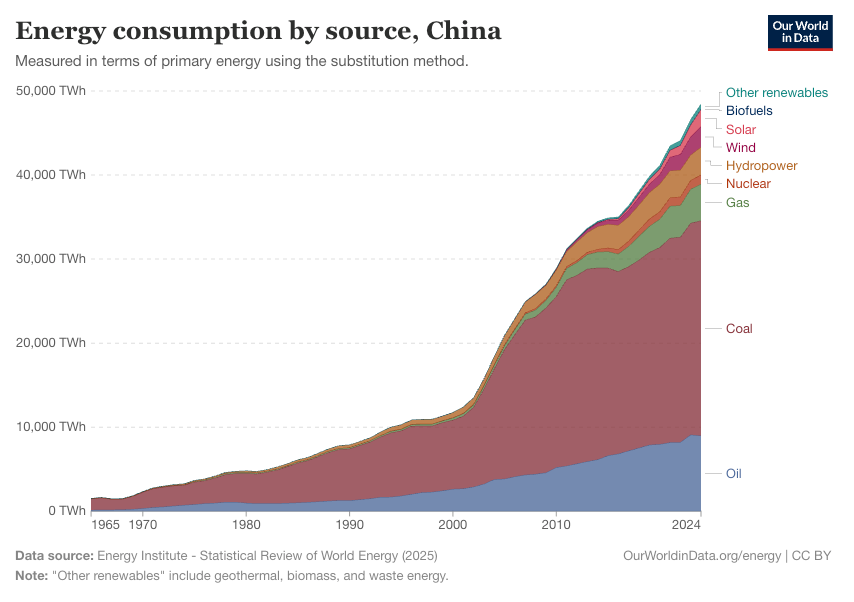
These coal-fired power plants… that produce electricity… release about 9 billion metric tons of CO2 into the atmosphere each year… that is just under 20% of the entire world’s annual CO2 emissions, just from the coal that the PRC burns. And the PRC will continue to burn that amount each and every year.
The PRC has the world’s fourth largest reserves of coal, about 145 billion tons, at its current consumption that could last 50-75 years. That is another 5-7 decades of releasing 9 billion metric tons of CO2 into the atmosphere each year.
To put that 9 billion metric tons of CO2 into perspective. The TOTAL amount of CO2 released by the United States AND Europe each year is less than just what the PRC releases from coal.
This next chart shows total annual emissions for the PRC, the U.S. and Europe (not just coal) and gives you a sense of the trajectory that each has been following… even with Donald Trump in office.
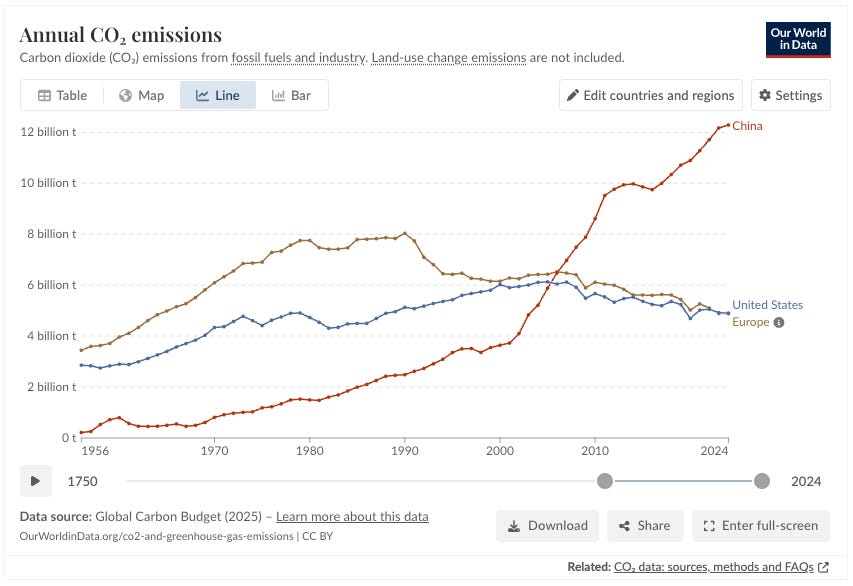
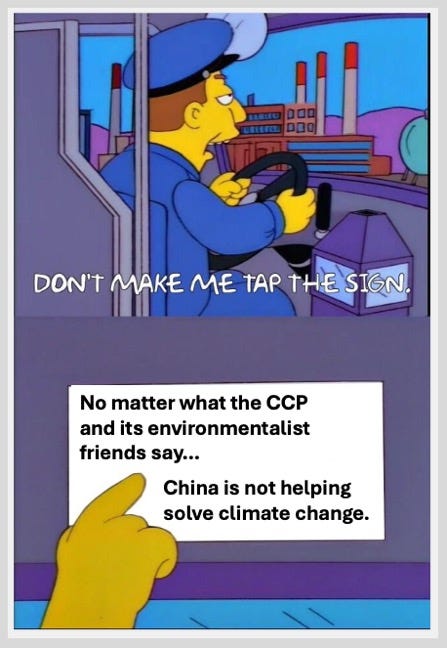
The irony is that much of the world’s climate activists (who predominantly live in Europe and North America) portray the PRC as their hero for this shift to electricity and for producing Greentech.
To illustrate this, here is a short video from The Australian that amplifies this narrative that the PRC is abandoning coal for renewables. According to this short explainer video, “the economics of coal are collapsing” and that the PRC is “dismantling” its’ coal industry. Nothing could be further from the truth.
It says there is a paradox, with coal trucks on the highways “hauling yesterday’s fuel and they are being overtaken by Teslas and BYDs racing towards tomorrow.” Zero understanding that when coal is burned in coal-fired power plants the result is electricity for the grid to recharge those Teslas and BYDs. Renewables aren’t replacing domestically mined coal, renewables are replacing imported oil and natural gas.
Or we see narratives like this from Carbon Brief (Analysis: Coal power drops in China and India for first time in 52 years after clean-energy records). The report leads readers to believe that the PRC is cutting back on burning coal… but when you read it carefully, the “drop” they are referring to is a drop in “growth” of coal power as a proportion of other energy sources from the previous year NOT an actual reduction of the amount of coal burned.
So long as the PRC is the world’s factory and run by a regime that can silence its critics, the PRC will burn all the coal it has… and there is nothing that climate activists and the IPCC can do about it.
Coal Is Rising in China’s Clean Energy Transition
Deborah Lehr and Ruihan Huang, The Diplomat, April 14, 2026
China is not moving from coal to renewables in a linear transition. Instead, it is attempting to expand both simultaneously.
Foreign Interference and Coercion
California Mayor Will Plead Guilty to Working as Agent of China
Pooja Salhotra, New York Times, May 11, 2026
Eileen Wang, the mayor of Arcadia, Calif., resigned on Monday after federal prosecutors announced they had charged her with acting as an illegal agent of the Chinese government. She will plead guilty to the charge, according to a plea deal unsealed the same day.
The felony charge comes with a potential sentence of up to 10 years in prison.
The court document outlined Ms. Wang’s efforts, beginning in late 2020 and continuing until at least the end of 2022, to operate a purported news website called U.S. News Center that circulated pro-China content at the direction of Chinese government officials. Ms. Wang covertly worked with a man in Southern California named Mike Sun, a Chinese national, to disseminate the information.
Mr. Sun, who is also known as Yaoning Sun, was sentenced in February to four years in prison for his role in the operation. He was previously engaged to Ms. Wang and had worked on her election campaign as the treasurer, according to public records. Ms. Wang, 58, was elected in November 2022 to the Arcadia City Council, and the mayor is selected from the five-person council on a rotating basis.
“Individuals in our country who covertly do the bidding of foreign governments undermine our democracy,” Bill Essayli, the first assistant U.S. attorney for the Central District of California, said in a statement. “This plea agreement is the latest success in our determination to defend the homeland against China’s efforts to corrupt our institutions.”
COMMENT – I suspect she isn’t the only local or state official compromised in this way.
Calif. mayor Eileen Wang admits acting as Chinese spy, resigns after shocking plea deal
Joe Burn and Ben Chapman, New York Post, May 11, 2026
Arcadia Mayor Federally Charged with Acting as Illegal Agent of the People’s Republic of China
U.S. Attorney’s Office, Central District of California, May 11, 2026
‘Thank You Leader’: The California Mayor Who Took Orders From Beijing, Denied Xinjiang Slave Labor, and Helped China’s Intelligence Networks Infiltrate American Democracy
Sam Cooper, The Bureau, May 12, 2026
He Offered a Lawmaker’s Aide Quick Cash. Was He Spying for China?
Dustin Volz, New York Times, May 9, 2026
A staff member on the House China Committee was promised $10,000 for U.S. policy insights, on issues like Venezuela and rare-earth minerals.
When a man identifying himself as Chris Chen reached out this winter to an aide on a House committee focused on threats from China, he came armed with a lucrative offer.
The staff member, Mr. Chen proposed, could earn $10,000 or more by barely lifting a finger. All he would need to do is agree to phone calls every other week to share information about the committee’s work and U.S. foreign policy about China.
Insights into U.S. trade or national-security issues, including the Trump administration’s plans for Venezuela in the aftermath of the January military operation there, would be especially valuable, Mr. Chen said. To sweeten the pot, Mr. Chen repeatedly promised to send the aide $2,000 up front.
The offer seemed too good to be true. Instead of quietly accepting the deal, the aide, whose identity The New York Times agreed to withhold because he works on sensitive policy issues related to China, reported it to his bosses on the House Select Committee on the Chinese Communist Party. The panel quickly concluded Mr. Chen was not the Singapore-based business consultant he claimed to be, but instead likely a Chinese intelligence officer or contractor seeking a new recruit.
How Chinese Actors Use Impersonation and Stolen Narratives to Perpetuate Digital Transnational Repression
Rebekah Brown, Maia Scott, Marcus Michaelsen, Emile Dirks, and Francesca Thaler, Citizen Lab, April 27, 2026
No spring thaw for Japan-China diplomacy 6 months after Taiwan spat
Kouta Ohyama, Nikkei Asia, May 7, 2026
Honduras Reviews China Deals, Mulls Restoring Taiwan Ties
Michael D McDonald and Erik Schatzker, Bloomberg, May 7, 2026
Honduras’ new president is reviewing his predecessor’s agreements with China, a process that could help the US push to reduce the Asian nation’s influence in the region and lead to recognition of Taiwan.
In an interview, Nasry Asfura said that before Honduras can make a “final decision” on its relationships in Asia, the government needs to look over commitments and accords signed by predecessor Xiomara Castro’s administration, which recognized China over Taiwan in 2023. Telecommunications equipment from Chinese firm Huawei Technologies Co. is part of the review, and Honduras is in talks with the US government on using technology from Cisco Systems Inc., he said.
The government wants communications equipment with the latest anti-fraud and anti-terrorism systems and sees its friendly relations with the US as “very interesting in the analysis of those technologies,” he said.
During the 2025 campaign, Asfura said Honduras needed to break diplomatic relations with Beijing and recognize Taiwan because the country received more in aid and trade when the country had formal ties with Taipei. Asfura, who took office in January, received Donald Trump’s endorsement ahead of last year’s vote and was invited to the US president’s Shield of the Americas summit in March alongside other conservative Latin American presidents including El Salvador’s Nayib Bukele and Argentina’s Javier Milei.
“We are seeking to strengthen the best possible relationship with ally countries that is most beneficial for Honduras,” Asfura said Wednesday in an interview at the Milken Institute Global Conference in Beverly Hills. “As president, it is my duty to seek out ally countries where we can have greater trade and investment.”
COMMENT – This strategy by the CCP has some serious problems. It has to keep bribing foreign government leaders to keep them from switching sides. Those bribes then become political liabilities for the incumbent leaders as their domestic political opponents use the evidence of these brides to challenge the incumbents. Then those incumbents turn to the CCP for support in suppressing their domestic rivals, which creates a vicious cycle for the CCP of having to prop up increasingly unpopular leaders.
America has a serious Chinese spying problem
Ian Williams, The Spectator, May 16, 2026
President Donald Trump struck a conciliatory tone during his trip to China. He returned from his Beijing summit with Xi Jinping yesterday full of praise for the “great leader,” who is, in Trump’s estimations, “an incredible guy.” The summit was “very successful, world-renowned, and unforgettable,” according to the President, who insisted that “a lot of different problems were settled.” But there’s one problem that hasn’t been addressed: the growing number of Chinese operations on US soil.
Last week Eileen Wang, the mayor of the southern Californian city of Arcadia agreed to plead guilty to acting as an illegal agent of China. She was once regarded as a rising political star, named “woman of the year” in 2024 by Californian Congresswoman Judy Chu, who applauded her “strong voice, leadership, and dedication to serving her community.” Her plea came just two days before a New York man was found guilty of acting as a Chinese agent, having been accused of operating a “secret police station” on behalf of Beijing.
Inside the Secret Mission to Fly Taiwan’s President to Africa
Chris Buckley and Amy Chang Chien, New York Times, May 14, 2026
From satellite phone check-ins to a borrowed royal plane, new details show how Taiwan’s leader’s team outwitted China and pulled off an audacious journey to southern Africa.
There were no heavy suitcases aboard the borrowed jet that secretly carried President Lai Ching-te of Taiwan toward Africa. Instead, to save fuel for a secret, 15,000-mile journey to get around restricted airspace, his entourage brought only carry-on bags.
The stripped-back, high-stakes mission, revealed by Taiwanese officials who had been on the flight, and who showed documents to back up their account of what happened, was aimed at outmaneuvering Beijing’s latest attempts to isolate Taiwan.
China had been gloating earlier after it dealt an embarrassing blow to the president of Beijing’s rival, Taiwan, and his government’s efforts to preserve the island’s standing on the global stage.
President Lai Ching-te of Taiwan had been invited by the tiny southern African kingdom of Eswatini to attend celebrations in April marking King Mswati III’s 40 years on the throne. Eswatini is the only African country that still maintains official diplomatic relations with Taiwan and not China.
China says it won’t allow Taiwan to attend WHO’s annual assembly
Reuters, May 11, 2026
COMMENT – It would be awesome if European countries joined together to escort their Taiwanese counterparts into this meeting… or boycotted it until the WHO staff relented.
How does the staff of the WHO look at themselves in the mirror when their organization accepts this nakedly political overreach by Beijing?
The entire UN apparatus is broken.
Human Rights and Religious Persecution
China vs. God: Ezra Jin and Beijing’s War on Christianity
Frannie Block, The Free Press, May 11, 2026
Underground churches, middle-of-the-night arrests, and an alleged drugging: Frannie Block investigates a pastor’s fight for freedom and the plight of China’s Christians.
The 20-foot-tall image of Mao Zedong looks down at the line of people snaking through the vast square in the heart of Beijing. On the busiest days, they stand four or five people wide, waiting hours for their chance to get inside the gold and white marbled hall that holds his embalmed corpse. Draped across his body, which sits in a clear crystal coffin, is a red flag imprinted with a hammer and sickle in the top corner.
More than 50 years after Mao’s failed economic and social policies thrust his country into poverty, famine, and chaos, any image, any reference to him, is still revered. Mao Zedong Thought, his version of communism, still forms the foundation of China’s constitution.
Neither famine, chaos, nor coup attempts could bring down Mao’s reign in China. What could possibly threaten the power and legacy of a man—and an ideology—elevated to such a god-like status?
The answer, according to the Communist Party, is God himself.
Deaths and Torture of Prisoners of Conscience amid Delayed UN Scrutiny
Chinese Human Rights Defenders, April 30, 2026President Trump’s Opportunity to Bring Home Jimmy Lai
Katie LaRoque and Jamie Fly, National Review, May 11, 2026
China Never Actually Removed Homosexuality from Its Official List of Mental Disorders
Darius Longarino and Suisui Wang, The Diplomat, May 2, 2026
HRW report warns China’s preschool policy accelerating erosion of Tibetan language and identity
Tenzin Nyidon, Phayul, May 6, 2026
Uyghur Forced Labor Imports from China to Canada Must Be Blocked
Rushan Abbas, The Bureau, May 7, 2026
“Sinicizing” Tibetan Buddhism, One Inspection Tour at a Time
Tashi Dhargey, Bitter Winter, May 8, 2026
Catholic Training in Beijing Centered on Xi Jinping, Not the Pope’s Magisterium
Zeng Liqin, Bitter Winter, May 7, 2026
Keeping Uyghur Stories Alive: Q&A with Exiled Uyghur Journalist Tahir Imin
Uyghur Times, May 6, 2026
Industrial Policies and Economic Espionage
Leica Swaps Japan for China: A Bold New Sensor Era
China Business Spotlight, May 8, 2026
Leica is realigning its sensor partnership, shifting its focus away from Japanese suppliers and towards China. In doing so, the manufacturer is making a significant change to a key technological component of its cameras.
The focus is on a new partnership with the semiconductor specialist Gpixel, which goes far beyond a traditional supplier relationship. In future, development, fine-tuning of image quality and aspects of production preparation will be carried out jointly, forming the basis for future generations of cameras.
COMMENT – Another German business moving in the wrong direction.
There’s No Need to Fear China’s Economy
Theodore Bunzel, Foreign Policy, May 13, 2026
Beijing can’t easily afford to escalate any economic struggle with Washington.
The United States appears to be on the ropes in trade negotiations with China. After taking office, the Trump administration threw down the gauntlet with Beijing, briefly imposing 145 percent tariffs in April 2025 and more than doubling its effective tariff rate on China to around 40 percent for much of the past year. Washington’s theory was that depriving China of the U.S. consumer would force Beijing to concede on market access and bringing down the bilateral trade deficit. At one point, Treasury Secretary Scott Bessent crowed that China was “playing with a pair of twos” given its dependence on exports to the United States, which clocked in around $500 billion in 2024.
However, unlike most of President Donald Trump’s hapless trade war victims, Beijing punched back hard. It raised equivalent tariff barriers and leveraged China’s overwhelming dominance in the production of rare-earth minerals to choke off supply of these critical industrial inputs, threatening U.S. production of everything from autos to aircraft and weaponry. The United States then, in effect, cried uncle, backing down from its most severe tariff threats. This week, Washington limped into trade discussions with Beijing on May 14 seeking an extended reprieve on China’s rare-earth export controls and headline pledges to buy more U.S. agricultural goods and energy.
China’s Economy: Current Trends and Issues
Karen Sutter and Michael D. Sotherland, Congressional Research Service, May 8, 2026
Evergrande Group and China’s Debt Challenges
Karen Sutter and Michael D. Sutherland, Congressional Research Service, May 12, 2026
China’s Next-Generation Industrial Policy
U.S. Chamber of Commerce, May 11, 2026
China expanding its industrial dominance, warns US business group
Demetri Sevastopulo, Financial Times, May 10, 2026
Apple’s next chief John Ternus confronts break from China playbook
Michael Acton, Financial Times, April 28, 2026
German union urges caution on allowing Chinese carmakers to use VW plants
Christina Amann and Rachel More, Reuters, May 11, 2026
France presses EU to crack down on platforms like Shein and Temu
Ian Johnston, Financial Times, May 11, 2026
How the U.S. Is Trying to Ensure the Dollar’s Dominance During Economic Turmoil
Alan Rappeport, New York Times, May 11, 2026
Will investors embrace China’s humanoid robot champion?
William Langley, Financial Times, May 11, 2026
Cyber and Information Technology
The Chinese whiz kids of Silicon Valley
Viola Zhou, Rest of world, May 11, 2026
The Son Who Refuses to Give Up: A New Appeal for Chang Yuchun
Tao Niu, Bitter Winter, May 11, 2026
US communications regulator targets Chinese tech for security risks
Demetri Sevastopulo, Financial Times, May 11, 2026
China Seeks A.I. Independence, Weakening Trump’s Leverage
Meaghan Tobin, New York Times, May 12, 2026
China Earns $500 Million an Hour from Exports Supercharged by AI
Bloomberg, May 12, 2026
Military and Security Threats
Brawner: PH already facing ‘political’ and info war amid WPS tensions
Gabryelle Dumalag, Inquirer, May 15, 2026
Armed Forces of the Philippines (AFP) chief of staff Gen. Romeo Brawner Jr. warned Thursday that Filipinos should adopt a wartime mindset amid what he described as ongoing political, economic and information warfare linked to tensions in the West Philippine Sea and broader security threats facing the country.
In a speech delivered by Lt. Gen. Arvin Lagamon, commander of the Civil-Military Operations Command, Brawner said the Philippines was already confronting “political war,” “economic war,” and “informational war,” even if no kinetic conflict had broken out.
“Not yet a kinetic war, but a political war, an economic war, and more importantly, disinformation and informational war is already going on,” the military chief said in a speech delivered during a forum organized by Stratbase Institute in Makati City.
America’s Pacific Allies Train to Face Down China Together
Mike Cherney, Wall Street Journal, May 4, 2026
After Months of Arguing, Taiwan Lawmakers Approve $25 Billion for U.S. Arms
Chris Buckley and Amy Chang Chien, New York Times, May 8, 2026
The Island-Chain Allies
Chris Horton, The Wired China, May 10, 2026
China confirms it helped Pakistan’s air force during war with India last year
Seong Hyeon Choi and Phoebe Zhang, South China Morning Post, May 8, 2026
Engineers tell state media they offered technical support during conflict that saw an Indian-owned Rafale downed by a Chinese-made fighter.
China has confirmed for the first time that it provided on-site technical support to Pakistan during its war with India last year.
During the conflict, a Chinese-made fighter shot down at least one of India’s French-made fighters.
On Thursday, China’s state broadcaster CCTV aired an interview with Zhang Heng, an engineer from the Aviation Industry Corporation of China’s (AVIC) Chengdu Aircraft Design and Research Institute, a key developer of China’s advanced fighter aircraft and unmanned aerial vehicle design.
Zhang had provided technical support to Pakistan during the four-day war last May.
Pakistan’s air force operates a fleet of Chinese-made J-10CE jets, which are produced by an AVIC subsidiary. One of the jets is reported to have shot down at least one French-made Rafale fighter jet during the conflict with India.
It was both the first time that the Chinese model was reported to have downed an enemy aircraft, and the first time a Rafale had been brought down.
COMMENT – This might say more about the quality of French military aircraft than of PRC aircraft.
Led by industry, Japan and Taiwan plant seeds of drone cooperation
Thompson Chau, Nikkei Asia, May 10, 2026
One Belt, One Road Strategy
China’s Long Arm in Lusaka
David Bandurski, Lingua Sinica, May 8, 2026China’s Rare Earth Supply Chain Is Expanding into Laos: The Structural Logic Explains Why – Analysis
Arman Sidhu, Eurasia Review, May 15, 2026
China’s near-total dominance of heavy rare earth processing depends on a supply architecture that is more fragile than commonly understood. The extraction zones that feed Chinese refineries are concentrated in politically unstable or legally ambiguous jurisdictions where enforcement capacity is weak and Chinese capital fills governance vacuums. Myanmar’s Kachin and Shan states have served this function for years.
Laos is now serving it as well. Satellite imagery analysis by the Stimson Center identified 27 rare earth mines that opened across Laos since 2022, with 23 located in protected areas. A December 2025 mapping exercise expanded the total to 517 suspected mining sites along the country’s rivers. The expansion is not incidental. It reflects a deliberate diversification of supply by Chinese state-linked enterprises operating in a country that lacks both the institutional capacity and the political leverage to constrain them.
Why Laos: Debt, Geology, and Governance Gaps
The expansion into Laos follows a discernible pattern. Chinese rare earth firms seek jurisdictions where three conditions converge: favorable geology, weak regulatory enforcement, and structural leverage that discourages the host government from pushing back. Laos meets all three. A 2022 geological study led by Lü Liang identified ion-adsorption clay deposits in Laos’s northern provinces (Xieng Khouang and Houaphanh) with rare earth concentrations of 400 to 700 parts per million, geologically comparable to southern China’s well-documented systems. These deposits contain heavy rare earths, specifically dysprosium and terbium, which are essential for permanent magnets used in electric vehicle motors, wind turbines, and precision-guided weapons. China processes approximately 98 percent of the global supply of these two elements.
The leverage dimension is equally important. Laos’s cumulative deferred debt to China totals $3.23 billion, roughly 19 percent of projected 2025 GDP. Total national debt exceeds 100 percent of GDP, with China holding approximately half of all external obligations. In 2021, Laos surrendered majority control of its national power grid transmission company (EDL-T) to China Southern Power Grid through a 25-year lease valued at $625 million. This debt architecture functionally limits Vientiane’s willingness to enforce its own laws against Chinese commercial interests. Laos banned rare earth mining in 2017 under Law No. 291, but that prohibition has had no observable effect on the proliferation of Chinese-funded extraction operations, which secure access through local-level permits classified as exploration rather than mining.
COMMENT – Laos is not an independent country; it is a satellite of the PRC.
Opinion
I Ran the N.S.A. This Is How to Defeat China’s Hacker Army.
Timothy D. Haugh, New York Times, May 11, 2026Trump actually started to decouple America from China
Noah Smith, Noahpinion, May 13, 2026
The “economic divorce” between the two countries is proceeding slowly, but it is proceeding.
A Warning from Zambia About China’s Reach
Karishma Vaswani, Bloomberg, May 10, 2026
China Believes America Will Flame Out
Ryan Hass, The Atlantic, May 11, 2026
Why China Waits
Amanda Hsiao and Bonnie S. Glaser, Foreign Affairs, May 8, 2026
Europe should behave more like China does if it wants to survive this age of chaos
Mark Leonard, The Guardian, May 11, 2026
China Increasingly Views Trump’s America as an Empire in Decline
Li Yuan, New York Times, May 12, 2026
Who will drive the driverless car revolution?
John Thornhill, Financial Times, May 11, 2026
Trump and Xi need to master a new art of the deal
Minxin Pei, Nikkei Asia, May 12, 2026
China Is Squandering a Golden Opportunity
David Shambaugh and Steven F. Jackson, Foreign Affairs, May 12, 2026
China Is Becoming Dangerously Overconfident
Yanzhong Huang, New York Times, May 10, 2026
Trump Heads to Beijing With a Strong Hand
Thomas J. Duesterberg, Wall Street Journal, May 11, 2026
BYD and peers make strides in every market but their own
Financial Times, May 11, 2026
A weakened Trump arrives at Xi’s court
Gideon Rachman, Financial Times, May 11, 2026
The Shared Feeling of Being Harvested by the Future
Yi-Ling Liu, New York Times, May 12, 2026The US Is Running Dangerously Low on China Expertise
Mercy A. Kuo, The Diplomat, May 6, 2026
Is the Iran War Pushing Southeast Asia into China’s Arms?
Alejandro Reyes, Foreign Policy, May 6, 2026