“Preparing for war while engaging in struggle”
From the Party’s latest communiqué… that isn’t at all ominous
Friends,
First of all, I’m writing this on Thursday evening and have it set to go out on Sunday morning because I’m traveling this weekend.
If something happens in the next 72 hours and you’re like: why didn’t he include that?!?
You have your answer.
AUKUS Forever!
Before we dive into our favorite subject, I want to give a shout-out to my friends Down Under and the successful visit by their Prime Minister to Washington this week. It appears that AUKUS and the nuclear-powered submarine program is on firm ground, we have a new agreement on rare earth mining and processing, and the spirit of mateship is strong…

I’m not gonna lie, I was a teensy bit concerned that things would go sideways…
I had my fingers crossed and even bought a bag of Albanese Gummi Bears for good luck (they really are the World’s best).
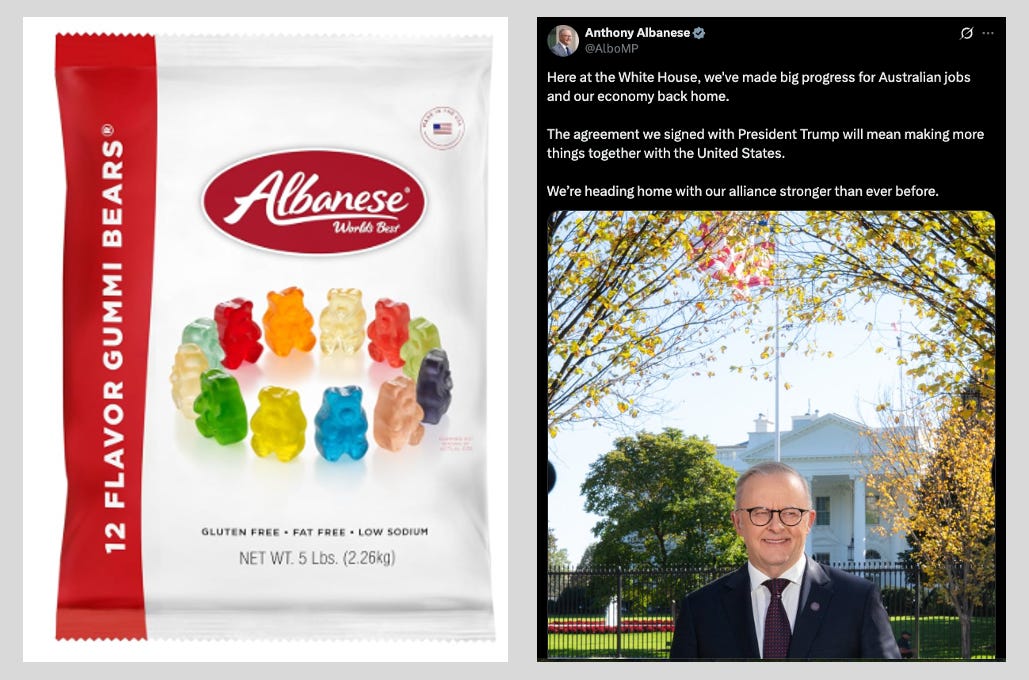
I watched the live broadcast of Prime Minister Albanese arriving at the West Wing, saw President Trump greet him at the car door, and held my breath as the meeting unfolded in the Cabinet room. Aside from the President’s remark about Ambassador Rudd, things went about as smoothly as one who values to U.S.-Australia relationship could hope.
I mark that one up as a win!
Hot Takes on the Fourth Plenum…
The Chinese Communist Party’s Central Committee is wrapping up its annual plenary session (something called a plenum). There is a requirement to have at least one plenary session of the Central Committee of the CCP in a calendar year and there are “usually” seven plenums during a five-year Party Congress (Beijing is in the middle of their 20th Party Congress and this is the fourth plenum of that Congress).
On Thursday we started to get some of the plenum communiqués and so this is as good a time as any to give some ‘hot takes’ based on the translations floating around the interwebs.
#1 — Everything depends on high tech innovation and pursuing it independently
Technological self-reliance and strength form the backbone of the Party’s plan for the field of science and technology, but also the broader economic plan in which technological development and leadership will result in generating new-quality productive forces. This faith in technology to solve the PRC’s problems is even more pronounced than in earlier Party documents.
This suggests that as other aspects of the Chinese economy and society look bleak, the Party is re-doubling its faith that technology, specifically self-reliant technology leadership, is the path to achieving the Party’s long-term goals for the nation.
Party leaders perceive that a “new round of scientific and technological revolution” is underway, that there is a new industrial transformation happening, and that the PRC has the opportunity to “seize the commanding heights of technological development.”
Chinese leaders see themselves in a technology war and they are calling on their cadres to mobilize the nation to win that war.
Given this language, no one should come away believing that Chinese leaders want to pursue collaborative technological development or that they would respect norms and rules around IP theft or other aggressive actions. Their goals are explicitly ultra-nationalistic and communicate a zero-sum view of the world. They are waging this technology war to benefit the Chinese Communist Party and the PRC, so that they can gain “manufacturing power, aerospace power, transportation power, and cyber power” over the rest of the world.
#2 – Stimulating domestic demand will be achieved by… making more stuff and building more infrastructure.
In a development that should surprise no one, the Party thinks that the way they should solve the problems that have been accumulating for the past three decades and accelerated since the pandemic is to do more of the same… make more stuff and build more infrastructure.
It appears that the liberalizing tendencies that flashed a 10-15 years ago which saw talk of rebalancing the economy, making the market decisive, and of allowing Chinese citizens to take home more of what they earned (i.e. the most logical way of stimulating demand) is dead and buried.
The Party did make some references to improving the skills and education of its citizens (develop its human capital) but the PRC already has a massive oversupply of college graduates, and they can’t find jobs. This isn’t a human capital problem, the problem is the Party’s desire to control and engineer the Chinese economy to achieve their own ends, rather than letting Chinese citizens make their own decisions.
My prediction is that this effort to stimulate domestic demand will go about as well as all the earlier efforts to stimulate domestic demand which didn’t work. This approach will simply lead to more overcapacity, more infrastructure that isn’t economically productive, and more college graduates who are unemployed or underemployed which will only exacerbate the problems facing the Party.
In many ways this fits Einstein’s definition of insanity.
#3 – The main mission of the PLA is “preparing for war while engaging in struggle.”
The job of modernizing the People’s armed forces is not complete and requires “the new three-step strategy for modernizing national defense and the military, advance the endeavors to build the military through political work, reform, science and technology, talent, and law-based governance.”
边斗争、边备战 – “Struggle and Prepare for War”
Despite the removal of multiple high ranking PLA members from the Central Committee, Xi appears confident in pressing forward with military reforms and demanding more of his military as it prepares to challenge the United States in the Western Pacific.
#4 – Rumors of Xi being sidelined were greatly exaggerated and ideology remains as important as ever to the Party
“The plenary session emphasized that, in economic and social development during the 15th Five-Year Plan period, we must uphold Marxism-Leninism, Mao Zedong Thought, Deng Xiaoping Theory, the important thought of the “Three Represents,” and the Scientific Outlook on Development; fully implement Xi Jinping Thought on Socialism with Chinese Characteristics for a New Era; and thoroughly implement the guiding principles of the 20th National Congress of the Communist Party of China and the plenary sessions of its 20th Central Committee.”
Those magic words “Xi Jinping Thought on Socialism with Chinese Characteristics for a New Era” provide proof that Xi is very much in control.
As Xi has done since the start of his rule, ideology plays a critical role in organizing Chinese society around Marxism-Leninism with the expanding goal of using that ideology to “exert international influence.”
***
After Xi…
This week I highlighted two recent articles on the debates around Xi Jinping and his succession plan (or more accurately the lack of one). I think this is a really important topic as all too often we get fixed on the tyranny of the immediate as opposed to looking out at the horizon and anticipating what opportunities and risks will arise in the not-too-distant future.
Clearly our Chinese colleagues are unable to have an open and fulsome discussion of the “world after Xi,” but of course that will happen at some point. He will be 74 tears old when the 20th Party Congress comes to an end and the 21st begins, which means he will be close to 80 when the 21st Party Congress ends.
Those of us who aren’t directly under the stifling embrace of the Party, should explore what might be possible when Xi is a “former” leader.
My advice to the Trump Administration is that barring Xi’s death in the next two years (a statistically real possibility) or his removal from power (something I think is less of a possibility), then Washington can achieve very little in negotiating with Xi. Xi Jinping has a worldview and he has decided on a strategy and he is executing it. That worldview sees the PRC locked in a death struggle with the United States, Xi believes that the side that wins the tech war will prevail, and that once the PRC gains the upper hand it must aggressively remake the world into something that advantages the Chinese Communist Party.
We are not going to talk Xi out of this worldview or his strategy.
I would recommend beginning a comprehensive disentanglement effort with a simultaneous effort to build an alternative economic order that excludes the PRC. When Xi passes and we have some idea of who will follow, then we can re-examine the wisdom of re-engagement, an effort that should be drawn out over years and decades. Under Xi, these negotiations that Washington is pursuing are a dead end… but under someone else, there *might* be a chance
***
In Tokyo, we have a new Prime Minister… and her polls are strong
On Tuesday, Sanae Takaichi assumed the office of Japanese Prime Minister after getting Ishin no Kai (the Japan Innovation Party) to join her coalition government. Tobias Harris, author of the excellent book The Iconoclast: Shinzō Abe and the New Japan and the Substack column Observing Japan, provided a great run down of Takaichi’s strong polling numbers in his post on Wednesday (With strong polls, Takaichi gets to work, Tobias Harris, Observing Japan, October 22, 2025).
[Note: I recommend subscribing to Tobias’ publication… he will tell you all you need to know about the ins-and-outs of Japanese domestic politics]
Kyodo News gave Takaichi’s government a 64.4% approval rating (23.2% disapproval).
Yomiuri Shimbun gave even stronger numbers with 71% approval rating (18% disapproval). That would be the fifth best for a new prime minister going back to 1978.
The important thing to watch is whether these opinions are sticky or whether the public quickly sours on her.
Prime Minister Takaichi and President Trump are scheduled to have their first phone call on Saturday and Trump arrives in Tokyo on Monday for an official visit, leaving on Wednesday for his trip to South Korea (and potential meeting with Xi Jinping?).
If Trump’s visit to Tokyo is seen as a success with positive economic news for Japan, she might get an even bigger bounce.
***
In Taipei, the KMT has a new Chairperson… and it has many concerned.
This week, Cheng Li-wun was elected Chairperson of the KMT, Taiwan’s main opposition party. She is the second woman to lead the Party and rumors are swirling whether she will pursue the presidency in 2028 as the KMT’s candidate, whether Lu Shiow-yen, the mayor of Taichung, will be the candidate (she is under fire for her city’s poor response to recent natural disasters), or whether a third individual will emerge.
Commonwealth Magazine has a good article describing the challenges Cheng faces (Cheng Li-wun Elected KMT Chair Amid Three Major Challenges, Chun-Chieh Yang, Commonwealth Magazine, October 20, 2025) and the Jamestown Foundation released a great report on the KMT race early this month that is worth reading (‘Mainlander’ Narratives Dominate Kuomintang Leadership Race, Peter Mattis, Jamestown Foundation, October 4, 2025).
Chen has gone through quite the political transformation since she first stepped on the political scene in the early 1990s as a pro-democracy protester and member of the DPP. Now she is seen as a pro-Mainland voice, using the CCP’s rhetoric to describe the 1992 Consensus instead of her Party’s approved language.
It appears that the KMT is fracturing into conflicting factions and few have faith that Chen can fix this situation, much less form a coalition with the TPP to challenge the DPP effectively. Her big test will come next fall in 2026 with Taiwan’s local elections. The KMT historically has done well in local elections, so if the Party performs better than expected, Chen may find herself in a competitive position as the candidate. If the KMT doesn’t do well, I would expect another shuffling of leadership ahead of the January 2028 Presidential and Legislative elections.
Thanks for reading!
And please consider supporting this newsletter with a paid subscription.
Matt
MUST READ
In China, a Forbidden Question Looms: Who Leads After Xi?
Chris Buckley, New York Times, October 20, 2025
Xi Jinping seems to believe that only his continued rule can secure China’s rise. But as he ages, choosing a successor will become riskier and more difficult.
Behind closed doors in Beijing this week, China’s top officials are meeting to refine a plan to secure its strength in a turbulent world. But two great questions hang over the nation’s future, even if no one at the meeting dares raise it: How long will Xi Jinping rule, and who will replace him when he is gone?
Mr. Xi has led China for 13 years, amassing dominance to a degree unseen since Mao Zedong. He has shown no sign of wanting to step down. Yet his longevity at the top could, if mismanaged, sow the seeds of political turbulence: He has neither an heir apparent nor a clear timetable for designating one.
With each year that he stays in office, uncertainty deepens about who would step in if, say, his health failed, and whether the new leader would stick to or soften Mr. Xi’s hard-line course.
Mr. Xi faces a dilemma familiar to long-serving autocrats. Naming a successor risks creating a rival center of power and weakening his grip, but failing to settle on a leader-in-waiting could jeopardize his legacy and sow rifts in China’s political elite. And at 72, Mr. Xi will likely have to search for a potential heir among much younger officials, who must still prove themselves and win his trust.
If Mr. Xi eventually chooses a successor, loyalty to him and his agenda will almost surely be a paramount requirement. He has said that the Soviet Union made a fatal mistake by picking the reformer Mikhail Gorbachev, who oversaw its dissolution. On Friday, Mr. Xi made his intolerance for any disloyalty clear when the military announced that it had expelled nine senior officers, who face prosecution on charges of corruption and abuse of power.
“Xi almost surely realizes the importance of succession, but he also realizes that it’s incredibly difficult to signal a successor without undermining his own power,” said Neil Thomas, a fellow at the Asia Society Policy Institute’s Center for China Analysis. “The immediate political and economic crises that he faces could end up continually outweighing the priority of getting around to executing a succession plan.”
Speculation about Mr. Xi’s future is highly sensitive and censored in China, and only a handful of officials may be privy to his thinking about the issue. Foreign diplomats, experts and investors will be looking for clues from the four-day meeting of the Communist Party’s Central Committee that started on Monday, bringing together hundreds of senior officials.
The meeting, usually held behind closed doors in the specially built Jingxi Hotel in Beijing, is expected to approve a plan for China’s development over the next five years. Mr. Xi has made securing a global lead in technological innovation and advanced manufacturing a priority, and that goal is likely to feature heavily. He and his officials have expressed confidence that their approach can prevail over President Trump’s tariffs and export controls.
“At the heart of strategic rivalry among the great powers is a contest for comprehensive strength,” senior Chinese lawmakers said in a report that they issued last month on the proposed plan. “Only by vigorously upgrading our own economic power, scientific and technological strength, and overall national power can we win the strategic initiative.”
In theory, the meeting this week could offer a window into China’s next generation of leaders, if Mr. Xi chooses to elevate younger officials into more prominent roles. But many analysts expect him to delay any major moves, at least until after his likely fourth five-year term begins in 2027, and perhaps well beyond that.
“Then I think it has to start looming larger, if not in his own mind, then in the people around him,” said Jonathan Czin, a researcher on Chinese politics at the Brookings Institution who has written about Mr. Xi’s succession scenarios and the Central Committee meeting. “Even if the people in his immediate orbit don’t start jockeying for position for themselves, they’re going to be jockeying on behalf of their own protégés.”
Mr. Xi has seen firsthand how succession struggles can shake the Communist Party. His father, a senior official, was ousted by Mao. As a local official during the 1989 pro-democracy protests, Mr. Xi witnessed how divisions at the top helped tip China into upheaval; ultimately, Deng Xiaoping purged the party’s general secretary, Zhao Ziyang, and installed a new heir apparent, Jiang Zemin.
“Especially as someone who spends so much time studying the lessons of China’s dynastic cycles and the history of the Communist Party of the Soviet Union, Xi knows that the succession is a major issue he must think through,” said Christopher K. Johnson, the president of China Strategies Group, a consulting firm, who previously worked as a U.S. intelligence official focused on China.
Forever Xi Jinping? Perhaps Not
Chris Johnson, Sinocism, October 20, 2025
…
That walk down memory lane is intriguing in a more big picture sense, too. As in those earlier periods, we have reached just beyond the halfway point in the 20th Central Committee’s lifespan. As such, the minds of CCP elites, as well as the regime’s foreign observers, are beginning to fixate on the 21st Party Congress in 2027 and its attendant reshuffling of the top leadership. That, of course, raises the question of whether Xi Jinping will embark on a fourth term then and, if he does, whether he will start to give some indication of his plans for the succession.
The conventional wisdom says Xi will rule for life. His chitchat with Russian President Vladimir Putin on a hot mic at last month’s military parade in Beijing calling septuagenarians like them children and referencing living to 150 obviously did little to challenge that conviction. And yet, there is a certain schizophrenia in the commentariat’s discussion of Xi and the succession. For example, his silence on a handover strategy was declared a looming crisis back in 2021, but China watchers still axiomatically claim he wants another term in 2027 with no transition plan in mind.
Unless Xi is a pure narcissist, however, that level of alarm seems unmerited. Like his overegged “bromance” with Putin, it partly derives from foreign hyperbole about Xi as another Mao or Stalin, two proper megalomaniacs. Analysts frequently suggest he is mirroring their smothering personality cults and capricious purges, making dying in office a next logical homage. Never mind that Xi follows smooth policy lines while theirs veered sharply. He is calculating where they were whimsical. His leadership philosophy was forged by tumult and disgrace when theirs took shape in triumph—and the list of dissimilarities goes on and on.
The “forever Xi” crowd also claims he ditched the practice of fixed decadelong tenures for the top leader out of personal ambition, but he—and initially the CCP barons who gave him power—instead viewed it as a regime-threatening crisis. The previous succession playbook offered certain benefits like a modest level of predictability and a false veneer of institutionalization. For Xi, though, the cost in Leninist accounting was too high. Without a strongman at the top to discipline it, the Party’s cohesion dissolved in the acid of rampant corruption. Worse, the regime’s hard power stalwarts, the military and security services, were borderline independent kingdoms jealous of their power and of uncertain reliability in a crisis. In short, what took twenty years to metastasize could not disappear in ten, as Xi’s expanding purges of his high command show.
Against that backdrop, the latest convulsions atop the PLA are of the utmost import. It is an iron law of CCP politics that a leader cannot make it to—to say nothing of staying—top leader without demonstrating an ability to at least work with, and preferably to control, that institution. It therefore is a critical player in any succession drama, as it demonstrated very clearly after Mao’s death with the arrest of his Cultural Revolution henchmen, the Gang of Four, and, in a subtler way, following the 1989 Tiananmen crackdown.
…
In the end, of course, we are left to guess what Xi will do. The black box of Chinese elite politics is even more opaque under him. One thing is certain, however; searching for obsolete succession cueing is a dead end. In the old pattern, for example, the designated heir served as the sitting leader’s apprentice for five years. But Xi spent that time watching his feckless predecessor fiddle while the party burned, invalidating the practice for him. Demolishing such patterns then became his political signature as paramount leader, so his handover approach surely will follow suit.
In fact, Xi’s latest disruptive maneuver may offer a clue to his succession strategy. The Central Committee, as the CCP’s nominal top decisionmaking body, holds seven plenums during one of its typical five-year lifespans. For unknown reasons, Xi withheld this round’s third session until last year. That leaves the Fourth Plenum occurring when a usual cycle would be convening its fifth. This time, therefore, he could combine the agendas of the standard fourth (party affairs and ideology) and fifth (adopting the new five-year plan) meetings into one “super plenum.” Failing that, he could retain a “spare plenum” to deploy anytime between now and 2027, as the CCP Constitution mandates the Central Committee meet at least annually but sets no other firm constraints. That gives Xi a fair amount of flexibility to decide when, if it at all, he wants to show his cards on the succession. The point is that Xi frequently is more creative—and might even prove more magnanimous—than his foreign students often give him credit for.
US mulls curbs on exports to China made with US software, sources say
Alexandra Alper, Reuters, October 22, 2025
The Trump administration is considering a plan to curb a dizzying array of software-powered exports to China, from laptops to jet engines, to retaliate against Beijing’s latest round of rare earth export restrictions, according to a U.S. official and three people briefed by U.S. authorities.
While the plan is not the only one being deliberated, it would make good on President Donald Trump’s threat earlier this month to bar “critical software” exports to China by restricting global shipments of items that contain U.S. software or were produced using U.S. software.
On October 10, Trump said in a social media post that he would impose additional tariffs of 100% on China’s U.S.-bound shipments, along with new export controls on “any and all critical software” by November 1 without further details.
To be sure, the measure, details of which are being reported for the first time, may not move forward, the sources said.
But the fact that such controls are being considered shows the Trump administration is weighing a dramatic escalation of its showdown with China, even as some within the U.S. government favor a gentler approach, according to two of the sources.
Australia Says Chinese Fighter Jet Released Flares Near Its Military Plane
Yan Zhuang, New York Times, October 20, 2025
The incident in the South China Sea on Sunday highlights tension in a region where China is demonstrating its growing military capabilities.
Australia’s defense department said on Monday that a Chinese fighter jet released flares dangerously close to an Australian Air Force aircraft that was conducting patrols over the South China Sea.
The incident occurred as Prime Minister Anthony Albanese of Australia was scheduled to meet with President Trump in the White House for the first time later on Monday. Australia is trying to navigate between its close alliance with the United States and its economic dependence on China, its largest trading partner.
The South China Sea incident is the latest confrontation in a region where China has been asserting its growing military power. That has alarmed Australia and forced it to take a hard look at its heavy military dependence on the United States.
Australia doubled down on that dependence by signing a nuclear submarine deal with the United States and Britain during the Biden administration. The Trump administration said in June that it was reviewing whether the deal was aligned with Mr. Trump’s America First agenda.
COMMENT – Interesting to compare and contrast Australia and Canada at this point in time… here is the Canadian Foreign Minister pursuing a reinvigoration of Ottawa’s “strategic partnership” with the Chinese Communist Party.
Anand says Canada is in a ‘strategic partnership’ with China
Dylan Robertson, National Newswatch, October 23, 2025
Just three years after Canada called China a “disruptive global power,” Foreign Affairs Minister Anita Anand says Canada now views Beijing as a strategic partner in a dangerous world.
Anand told The Canadian Press on Monday that a strategic partnership with China means going beyond allowing individual irritants to strain the entire relationship and permitting Canada to advance its economic and security interests.
“It’s necessary for us to lay the foundation, if we are going to find areas where we can further co-operate,” she said.
“There are going to always be challenges in any relationship. The key is to be able to have the dialogue necessary to address the issues of Canadian concern.”
She spoke after visiting senior officials in China, India and Singapore -- and just days before Prime Minister Mark Carney departs on his first visit to Asia since taking office, with stops in Malaysia, Singapore and South Korea.
Her visit marks a shift away from the federal government’s 2022 Indo-Pacific strategy, which branded China as “an increasingly disruptive global power” that holds “interests and values that increasingly depart from ours.”
Anand said she is seeking a balance between alleviating economic stress and pursuing Ottawa’s security and human rights priorities.
“We must be nuanced in our diplomacy. We must stress our concerns relating to security and public safety on the one hand, and we must seek to build additional supply chains on the other. That is pragmatism,” she said.
While she did not name U.S. President Donald Trump directly, his tariffs have hit numerous Canadian sectors and hindered foreign investment, even after Ottawa emulated American restrictions on Chinese vehicles.
In Beijing last week, both countries agreed to revisit the strategic partnership they signed in January 2005. Anand said both sides will have the agreement “renewed and refocused” to meet today’s needs.
“What we are aiming to do is to recalibrate the relationship, so that it is constructive and pragmatic,” Anand said.
Canada and China have been at odds for months over Ottawa’s move to match U.S. tariffs on Chinese electric vehicles, which led China to slap tariffs on Canadian canola, in addition to seafood tariffs.
“We are going to be seeking to ensure that foreign policy serves the domestic economy,” Anand said. “Let’s not make any mistake that China is a major global economic player.”
Canada’s bilateral merchandise trade with China totalled $118.7 billion last year. That makes China Canada’s second-largest trading partner after the United States, which recorded $924.4 billion in bilateral merchandise trade with Canada last year.
Anand said Carney’s promise to build the strongest economy in the G7 is part of a longer-term effort to diversify trade.
She said Canada’s foreign policy now rests on the three pillars she outlined at the United Nations this fall: strengthening defence, building economic resilience and advancing core values such as human rights.
Carney said last month Canada could “engage deeply” with China on commodities, energy and basic manufacturing, but with guardrails that “left off to the side” anything that could “bridge into national security, privacy” or other matters.
During an election debate back in April, Carney called China “the biggest security threat” facing Canada.
Asia Pacific Foundation vice-president Vina Nadjibulla said “selective engagement” with China is tricky to pull off.
“China doesn’t like to compartmentalize,” she said. “Normally, China likes to have much more linkages between issues.”
Canada and China must work together to beat Trump at his own game
David Olive, Toronto Star, October 22, 2025
China might be Canada’s biggest opportunity to diversify its trade away from the U.S.
The thaw in Canada-China relations that Ottawa is promoting recognizes that China is already Canada’s second-largest trading partner.
China’s goods imports from Canada have more than doubled in the past five years, to about $65 billion in 2024.
China buys Canadian oil, natural gas, coal, wheat, wood products, canola, seafood, beef, copper, iron ore and other essentials, many related to China’s priorities of food and energy security.
Prime Minister Mark Carney plans to meet Chinese President Xi Jinping in coming weeks. Carney has cited opportunities for greater collaboration with China in energy, climate change, commodities and basic manufacturing.
“There is a very broad range of commercial relationships that already exist and a much larger range of opportunities for both countries,” Carney said last month after meeting with Chinese Premier Li Qiang.
More recently, Anita Anand, Canada’s foreign affairs minister, was in China last week to meet with government officials on restoring relations that have been strained for several years.
“We will co-operate with China where we can, but challenge them where we must,” Anand said.
Challenges include China’s human rights abuses and Chinese dumping of below-cost steel in the Canadian market.
The potentially historic rapprochement takes place when both Canada and China seek to partially disengage from the U.S. economy.
Canada wants to boost its exports to China and extend its credibility as a reliable trading partner across the Indo-Pacific region, home to some of the world’s fastest-growing economies.
And China is determined to reduce its energy purchases from the U.S., Russia and the Middle East.
Canada’s growing export capacity in crude oil and liquified natural gas (LNG) makes it an attractive alternative supplier.
“As U.S.-China trade tensions deepen and their economies decouple, Canada has an opportunity to fill gaps left by the U.S.,” the Conference Board of Canada said in a report last spring on Canada-China relations.
The most immediate challenge is to end the trade conflict between Canada and China, which began last year when Ottawa imposed steep tariffs on imported Chinese electric vehicles (EVs), steel and aluminum.
China retaliated this year with high tariffs on imported Canadian canola, pork and seafood, which is costing Prairie farmers and Atlantic and Pacific fishers more than a billion of dollars in lost revenues on an annual basis.
Canada’s trade war with China has fractured national unity, with protection of Ontario’s auto sector from cheap Chinese EVs seen to be at the expense of Prairie farmers and coastal fishers.
As this space has argued, Canada’s trade war with China doesn’t make sense. It was launched in lockstep with a Biden administration since replaced by a Trump administration that is attacking Canada’s economy.
China has pledged to lift its tariffs on Canadian imports if Canada rescinds its tariffs.
Beijing has also been suggesting for months that it wants to resume the free-trade talks it held with Canada in 2017 that were sidetracked by U.S. trade assaults on Canada and China by the first Trump administration.
Carney has met Xi Jinping several times, most recently last year to discuss global finance when Carney was chair of media firm Bloomberg LP’s board of directors.
The Carney government has had the Trudeau-era tariffs on Chinese goods under “review” for several months.
Meanwhile, the trade dispute hasn’t diminished China’s interest in Canadian energy products.
China has been among the first buyers of Alberta oil supplied by the new Trans Mountain pipeline (TMX) that went onstream last year, and of B.C. natural gas from LNG Canada’s plant on the West Coast, which began operations this year.
China presents Canada with its biggest moral challenge in trade, given Beijing’s repression of Uyghur Muslims, its continued crackdown on Tibet and on dissidents in Hong Kong, and its attempts to isolate and intimidate Taiwan.
Earlier this year, Carney seemed to rule out strengthening Canadian ties with China because of its lack of shared values with Canada.
But a major policy shift is underway as Canada strives to match a traditionally Eurocentric foreign policy with a more robust commercial presence across Indo-Pacific economies.
China’s $24.3-trillion economy accounts for about 20 per cent of the world’s middle class. Tim Hortons, Lululemon and Canada Goose are among the Canadian brands that have succeeded in China’s burgeoning consumer economy.
And in China’s agricultural, energy and industrial sectors, Canadian firms can make greater inroads in exporting advanced farm equipment, engineering services and environmental technology.
Disputes between Canada and China in the past decade have held back the potential of both countries for too long.
Anand’s formula of co-operation and continued pushback on Chinese human rights abuses will be difficult to execute. But in this era of U.S. hostility that many experts believe will outlast Donald Trump, it’s a challenge we must embrace.
COMMENT – There seems to be a sizeable chunk of Canadians who wish to ally themselves with authoritarian regimes to undermine the United States. They want an “offshore balancer” of their own and see the PRC as their best option.
Least you think this is just a conclusion this commentator has come to just because of Trump’s actions over the past 10 months, here is the same guy making these arguments in August 2024, or here in June 2024, or here in January 2024, or here in February 2023, or here in November 2022 (I stopped searching the Toronto Star archives after that… figured the pattern was obvious enough).
Certainly, President Trump’s actions have given permission for these Canadians to speak louder, but anti-Americanism and a desire to triangulate against the United States is a deeply ingrained characteristic in our neighbors to the North (as well as plenty of our “allies” in Europe). While folks bemoan how Washington treats its allies poorly, it should be remembered that many of its allies have been pursuing policies for decades to undermine the United States economically and militarily… even as they simultaneously criticize Washington for not doing enough to protect them and the liberal international order from the same folks they are establishing “strategic partnerships” with.
TikTok Revamps Management Team to Empower Chinese Executives
Juro Osawa, The Information, October 23, 2025
TikTok is implementing drastic leadership changes that pull the video app closer to the orbit of its parent ByteDance, just as Washington and Beijing are on the cusp of reaching a deal over the app’s future in the U.S.
TikTok’s global content and distribution partnership teams, both led by Western executives, will be moved under Fiona Zhi, a Bytedance veteran who has been TikTok’s product chief since 2023, according to an internal staff memo viewed by The Information. The restructuring, which will become effective next Tuesday, means the vast majority of TikTok will be overseen by ByteDance veterans and almost completely unravels TikTok’s earlier efforts to empower Western executives.
TikTok’s personnel has been in turmoil for the past 18 months, since President Joe Biden signed a law mandating the app cut ties with its Chinese parent or face a U.S. ban. This year, newly installed President Donald Trump has repeatedly waived implementation of the law, as he sought a deal to move TikTok U.S. into U.S. hands. At the same time, however, the company has seen an exodus of western executives. Some vacant positions were filled by Chinese leaders.
The administration recently announced a deal under which TikTok’s American operations would be sold to a joint venture controlled by U.S. investors for $14 billion. Details of the joint venture remain scarce. Chinese media outlet Caixin and Reuters both reported that ByteDance will continue to handle the commercial and operational aspects of TikTok, with the new joint venture handling user data.
Combined with previous reorganizations, the latest changes put almost all of TikTok’s business operations under Chinese executives who are ByteDance veterans and trusted lieutenants of founder Yiming Zhang. Two of TikTok’s longest-serving Western executives, James Stafford and Isaac Bess, will start reporting to Chinese executives under Zhi, according to the memo. Stafford is the global head of content, while Bess is the head of distribution partnerships who mainly handles partnerships with telecom carriers. Both had stints at YouTube before joining TikTok, according to their LinkedIn profiles.
Previously, Stafford and Bess both reported to Adam Presser, who was appointed in July as the head of U.S. Data Security, a TikTok subsidiary in charge of managing and safeguarding the app’s U.S. user data. Presser completed his transition to the new role in mid-August, according to the memo. The latest reorganization shows Presser will now focus solely on USDS.
USDS is likely to be the backbone of the new American TikTok joint venture President Donald Trump announced last month, and current and former TikTok executives view Presser as a likely candidate for the CEO of the new joint venture, The Information reported previously.
TikTok said in the staff memo that the decision to integrate the operations teams into the product group is aimed at “further enhancing our efficiency and accelerating the growth of high-quality content and key verticals.” Some non-Chinese managers who work on teams that are moving under Zhi are concerned about being part of her division, where many executives are Chinese who previously worked at ByteDance’s China operations, the people said.
TikTok didn’t immediately respond to a request for comment.
Since TikTok stepped up its expansion into Western markets around six years ago, the app has recruited many Western executives and promoted some of them to senior roles. When Washington’s lawmakers called for a TikTok ban, the app downplayed the influence from its Chinese parent and pointed at the diversity of its global leadership team.
COMMENT – I hate to say I told you so… but rumors that ByteDance would not have operational control of TikTok in the United States appear to be greatly exaggerated. So much for that Executive Order a few weeks age which declared that a “qualified divestiture” had taken place.
Authoritarianism
China Media Project, October 20, 2025
China’s Ministry of State Security, the country’s principal civilian intelligence and counterintelligence agency, has found a fresh-faced recruit for its public messaging campaign: Agent 012339, an AI-generated anchor who appears in full MSS uniform to deliver cautionary tales about national security threats. The youthful digital spokesman, complete with badge number prominently displayed, is the agency’s effort to shift from faceless bureaucratic warnings to personable, social media-ready content — if you find AI personable, that is.
The MSS WeChat account deployed its AI anchor today to narrate the story of “Dong”, an employee at an unnamed major corporation who allegedly leaked sensitive commercial data to foreign entities. The post detailed how Dong used a VPN to send information about export cargo, shipping routes, and transaction values to foreign authorities, eventually causing what the ministry described as “major economic losses” when foreign parties intercepted company vessels and imposed sanctions.
Today’s warning emphasizes that citizens with access to “core information” — a term deliberately left undefined in Chinese law to give authorities maximum interpretive flexibility — must maintain vigilance. The post frames workplace dissatisfaction as a national security vulnerability by linking Dong’s resentment over performance reviews directly to his decision to leak data that “harmed national interests”.
The MSS urged the public to report suspicious activity through its 12339 hotline and online platforms. That’s right. You guessed it. The badge number for the new MSS AI poster boy is the same number as the ministry’s longstanding security hotline, which for the past decade has been used to report the spies and subversives living amongst ordinary Chinese. With its new AI makeover, informing on your co-worker in the next cubicle never looked so congenial.
Senior Chinese General Is Ousted on Corruption Charges
Chris Buckley, New York Times, October 17, 2025
What Does the Fall of He Weidong Mean for the PLA?
Zi Yang, The Diplomat, October 20, 2025
China expels No. 2 general and 8 others from the Communist Party in anti-corruption drive
Ken Moritsugu and Kanis Leung, Associated Press, October 10, 2025
Translations: “How Can a Country That Blocks the Nobel Website Hope to Win a Nobel Prize?”
Cindy Carter, China Digital Times, October 20, 2025
China Seeks Sensitive Data from US Firms in Semiconductor Probe
Debby Wu and Felix Tam, Bloomberg, October 20, 2025
Silicon Valley Has China Envy, and That Reveals a Lot About America
Li Yuan, New York Times, October 22, 2025
Li Yuan argues Valley admiration for China’s fast execution—big bets, standardized builds, fewer veto points—reveals U.S. governance and delivery-state gaps. The piece says copying Beijing is neither feasible nor desirable, but America must streamline permitting and rebuild capacity to actually build things at speed.
China Gangs Exploit US Gift Cards to Move Stolen Cash, DHS Says
Myles Miller, Bloomberg, October 19, 2025
China replaces key negotiator Li Chenggang at WTO, UN
Wataru Suzuki, Nikkei Asia, October 20, 2025
Nexperia’s China unit says staff can ignore orders from Dutch headquarters
Ryan McMorrow and Andy Bounds, Financial Times, October 20, 2025
How China Armed Itself for the Trade War
Zongyuan Zoe Liu, Foreign Affairs, April 29, 2025
The China Model’s Fatal Flaw
Lizzi C. Lee, Foreign Affairs, October 20, 2025
China is going after American firms to hit back at Donald Trump
The Economist, October 14, 2025
China tries shock-and-awe on Donald Trump
The Economist, October 12, 2025
Ambassador Greer Issues Statement Responding to China’s Attempted Coercion Against Companies that are Helping Revive American Industry
United States Trade Representative, October 20, 2025
How China Took Over the World’s Rare-Earths Industry
Jon Emont, Wall Street Journal, October 20, 2025
How China weaponized soybeans to squeeze U.S. farmers — and spite Trump
Lyric Li, Washington Post, October 19, 2025
Environmental Harms
Chinese Fishing Swarm Raises Alarm in South America
Ryan Chan, Newsweek, October 13, 2025
China has defended itself as a “responsible fisheries country” after the unusual presence of its large fishing fleet off Chile raised concerns over declining catches in recent months.
Chilean fishermen accused Chinese fishing vessels of depleting Humboldt squid, one of the region’s most-valuable resources, describing them as “termites” in the ecosystem.
In a statement on Friday, the Chinese Embassy in Chile said that China strengthens supervision of the country’s deep-sea fishing by conducting 24-hour monitoring of its vessels and requiring them to report their positions hourly, far exceeding international standards.
Chinese fishing in West Africa: Responding to the environmental and social impacts
Ebimboere Seiyafa, Awa Niang Fall, Ellis Adjei Adams, et al, Atlantic Council, October 6, 2025
In May 2025, the China Global South Initiative (CGSi), a collaboration between the Keough School of Global Affairs and the Atlantic Council Global China Hub, convened a group of twenty-two African environmental experts at the Peduase Valley Resort in Ghana for a three-day workshop on China’s environmental impact in West Africa. This policy workshop, hosted with the support of the Ford Foundation, included representatives from eleven West African countries—Benin, Burkina Faso, Cameroon, Cote d’Ivoire, Ghana, Liberia, Mali, Nigeria, Senegal, Sierra Leone, and Togo—and South Africa.
Amid three days of comradery and collaboration, these experts worked together to draft policy memorandums on China’s environmental impact across the region. In the months following the workshop, we worked closely with the authors to curate three briefs—on mining and resource extraction, timber and wildlife, and fisheries and water resources—that identify the challenges and offer actionable policy solutions. We would like to recognize the excellent work of the co-authors who contributed their time and expertise to creating these briefs. In particular we would like to thank the group leaders Abosede Omowumi Babatunde, Ebagnerin Jérôme Tondoh, and Ebimboere Seiyafa and Awa Niang Fall, respectively, for their diligent work.
China Steps Up to Fight Climate Change
Chen Xiaojing, China US Focus, October 22, 2025
Beijing is imposing high standards on itself, while the United States seems to be overpromising and underdelivering. It should shoulder its responsibility, along with Europe to lead emissions reductions and provide developing countries with the necessary financial and technological support to succeed.
A video speech by Chinese President Xi Jinping was delivered at the United Nations Climate Summit in September. He said that on the 10th anniversary of the Paris Agreement, it’s important for all countries to firm up their confidence, live up to their responsibilities and deepen their cooperation.
In addition, Xi announced China’s new Nationally Determined Contribution target for 2035. At a time when the U.S. is backsliding on its climate policy and the European Union is lowering the priority of its green transition agenda amid frequent extreme weather events, China’s new round of NDCs has injected confidence into global climate governance.
The world is currently facing grave challenges in tackling climate change. A study found that implementing the previous round of NDCs submitted by parties to the Paris Agreement would lead to warming of 2.8 C, far below the goals of the agreement. Brazilian President Luiz Inacio Lula da Silva and Simon Stiell, executive secretary of the United Nations Framework Convention on Climate Change, believe that China’s updated NDCs will bring hope to global climate governance.
Meanwhile, there are voices of criticism. Some observers claim that China lacks ambition and that its reduction targets are set from an undefined carbon peak. The questions emerge because these critics ignore the common but differentiated responsibilities and zoom in on China with a magnifier. They even expect China to singlehandedly get global warming back onto the 1.5 C pathway.
COMMENT – This would be laughable if this propaganda wasn’t so effective.
“Beijing is imposing high standards on itself…”. yeah right, I guess that is only accurate if they mean high CO2 emissions.
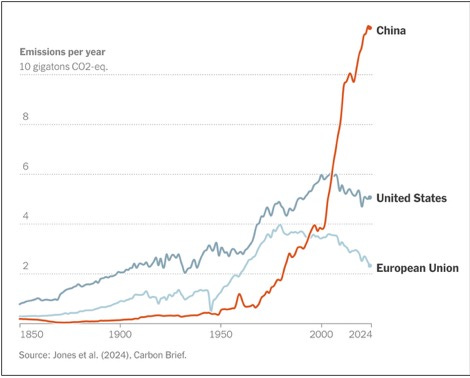
Between the PRC and the United States, one country has spent the last two decades LOWER its CO2 emissions… and one country has TRIPLED theirs… guess which one is which.
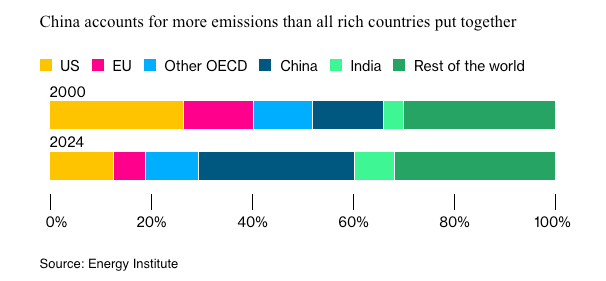
This chart shows the relative distribution of CO2 emissions, which shows that Beijing is the largest contributor to climate change.
And the next chart shows an even more important set of figures, the absolute emissions, which also shows that Beijing is BY FAR the largest contributor to climate change.
The reason why the Party’s propagandists keep publishing this stuff which purports to show that the PRC is a responsible environmental actor is because a LOT of people are foolish enough to believe it.
I’ve resisted the urge to use this meme, but I’ve been pushed too far…
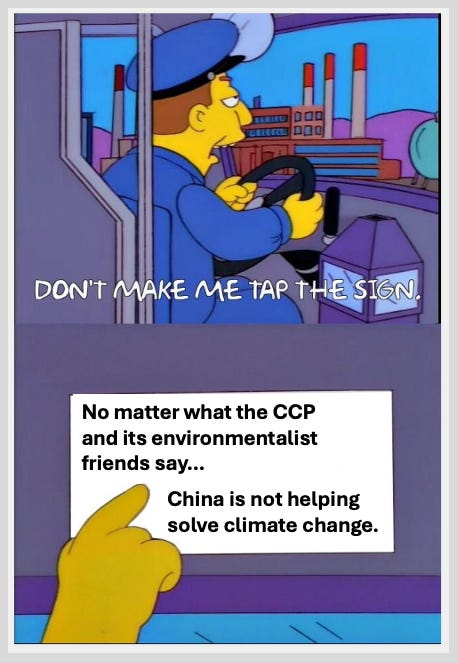
I suspect I will be forced to use this many times in the future.
Foreign Interference and Coercion
Foreign Voices for Xi’s Global Vision
David Bandurski, China Media Project, October 17, 2025
Continuing its push to portray Xi’s “Four Great Global Initiatives” as a boon for a multipolar world, the CCP’s flagship newspaper features a headline mention of the quartet by an African parliamentarian.
Yesterday the front page of the CCP’s official People’s Daily pushed strongly on Xi Jinping’s global quartet of signature policy initiatives ahead of next week’s Fourth Plenum and the anniversary of the founding of the United Nations. Today, the paper followed with a common propaganda tactic — quoting foreigners to rubber stamp the party’s wisdom and genius.
The piece, titled “The Four Great Global Initiatives: A Clear Roadmap to a Multipolar World”, appears on page three under the “International Forum” column — a typical and oft-used feature showcasing foreign voices that validate Beijing’s narratives. The byline belongs to Abdelkader Berrich, identified as an Algerian member of parliament and economist. His commentary faithfully echoes the framing from Xi’s Qiushi article, praising China’s “responsible major power role” in reshaping the international order. Berrich argues that each initiative “precisely responds to global challenges in specific domains,” together forming “a complete vision for pushing the world toward balanced development.”
This deployment of foreign voices is standard propaganda practice. By featuring ostensibly independent international commentators — particularly from the Global South — Chinese state media seek to demonstrate that Xi’s vision enjoys legitimacy beyond China’s borders. The timing of the “Four Great Initiatives” push is deliberate — coming ahead of next week’s plenum and the UN anniversary, as China tries to emphasize its role as a responsible, global power, and signal legitimacy internally within the party.
Echoing the language of yesterday’s promotional read-out on Xi Jinping’s featured article in the Party journal Qiushi, the text of today’s article describes the “decline of the unipolar order” — a reference to the United States — as “an irreversible historical trend.” It positions China’s initiatives as the inevitable alternative.
The track record of the People’s Daily on foreign voices — in bylines as well as in direct quotes and paraphrases — urges caution around such examples of validation. Last month, the paper published a commentary under the byline of NBA star LeBron James, praising Chinese “enthusiasm and friendliness” and framing basketball as “a bridge that connects us.” Representatives for James quickly disavowed the piece, saying he had only ever conducted interviews with Chinese media. The People’s Daily issued no correction. When politics trump professionalism at the Party’s flagship newspaper, foreign endorsements — whether fabricated or faithfully rendered — serve the same propaganda purpose.
COMMENT – Maybe this Algerian parliamentarian did write this piece… but of course the People’s Daily published a fake LeBron James article just a few weeks ago.
China really is a threat to Britain
Sam Olsen, Spectator, October 17, 2025
Starmer’s Sisyphean task of keeping China happy
Grace Theodoulou, Observing China, October 23, 2025
China Hacked South Korea’s Government, But Was It Really North Korea?
Raphael Rashid, The Diplomat, October 7, 2025
Baidu expands robotaxi push to Switzerland in PostBus deal
Reuters, October 22, 2025
Inside the Sudden Collapse of a U.K. Spy Case Against China
Stephen Castle and Lizzie Dearden, New York Times, October 17, 2025
China’s Xi calls for ‘reunification’ in message to new Taiwan opposition leader
Reuters, October 20, 2025
China to hold celebration for contested Taiwan ‘retrocession’ anniversary
Laurie Chen, Reuters, October 21, 2025
UK Hongkongers rue the rockiness of their ‘lifeboat’ after threatened visa changes
Robert Wright, Financial Times, October 21, 2025
BNO visa holders in the UK fear a proposed shift from five to ten years before settlement, jeopardizing plans for citizenship, pensions access, and tuition status. The story profiles communities like Sutton and argues rule changes mid-stream would undercut trust in the “lifeboat” the UK offered after Hong Kong’s security law.
PRC Shift Signals ‘Reverse Constrainment’
Matthew Johnson, Jamestown Foundation, October 22, 2025
China Gathers Foreign Firms in Bid to Reassure on Rare Earths
Foster Wong, Bloomberg, October 21, 2025
China says U.S. and Australia ‘should play a proactive role’ to bolster rare earth supply chains
Sam Meredith, CNBC, October 19, 2025
Human Rights and Religious Persecution
CCP Launches Nationwide Crackdown on Zion Church
Human Rights in China, October 13, 2025
On October 9, 2025, Chinese authorities launched a coordinated nationwide crackdown against the unregistered Zion Church —one of the country’s most prominent urban house churches.
Police in Beijing, Shanghai, Zhejiang, Shandong, Guangdong, Guangxi, Fujian, and Hainan detained or disappeared at least 30 pastors, preachers, and congregants, searching homes and confiscating personal devices. Senior pastors Jin Mingri and Yin Huibin were arrested in Guangxi and have not been heard from since, while Wang Lin was taken at Shenzhen Bao’an Airport. Authorities accuse them of “illegal online religious activity”, a charge increasingly used to punish those who hold Bible studies, prayer meetings, or livestreamed sermons outside state control.
The Zion Church’s leadership published an Emergency Statement on October 12, condemning the arrests as unconstitutional and appealing for international attention. Founded in 2007 and forcibly closed in 2018 for rejecting Party oversight, the church now faces its most serious repression to date.
China detains prominent ‘underground’ pastor in sweeping crackdown
Hong Kong Free Press, October 13, 2025
Police arrested Jin Mingri, who founded the unregistered Zion Church, at his home in the southern region of Guangxi on Friday along with several pastors in other cities including Beijing were taken into custody overnight.
US calls for China to release 30 leaders of influential underground church
Kelly Ng, BBC, October 13, 2025
The US has called for the release of 30 leaders of one of China’s largest underground church networks who were reportedly detained over the weekend in overnight raids in various cities.
The list includes several pastors and Zion Church founder Jin Mingri who was arrested in the early hours of Saturday after 10 officers searched his home, US-based non-profit ChinaAid said.
The Chinese Communist Party promotes atheism and tightly controls religion - still, some Christian groups are calling this the most extensive crackdown against the faith in decades.
Christians have long been pressured to join only state-sanctioned churches that are led by government-approved pastors and toe the party line.
Detention of Zion House Church Leaders in China
U.S. Secretary of State Marco Rubio, U.S. State Department, October 12, 2025
The United States condemns the Chinese Communist Party (CCP)’s recent detention of dozens of leaders of the unregistered house Zion Church in China, including prominent pastor Mingri “Ezra” Jin.
This crackdown further demonstrates how the CCP exercises hostility towards Christians who reject Party interference in their faith and choose to worship at unregistered house churches.
We call on the CCP to immediately release the detained church leaders and to allow all people of faith, including members of house churches, to engage in religious activities without fear of retribution.
China’s crackdown on unregistered churches angers US
William Langley, Financial Times, October 17, 2025
Human Rights in China, October 13, 2025
Lu Miaoqing, a female lawyer originally from Guangdong, has submitted a formal proposal to the Standing Committee of the National People’s Congress (NPC), urging lawmakers to incorporate gender sensitivity and substantive equality into the ongoing revision of the Prison Law of the People’s Republic of China. Her recommendations call for protecting the dignity of incarcerated women and preventing gender-based violence. Lu also advocates for increased funding for women’s prisons and a stronger role for female police officers.
Recently, the NPC Standing Committee released the Second Draft of the Prison Law Revision for public comment. Now based in New York, Lu Miaoqing noted that the current draft overlooks the rights of female prisoners. Lu Miaoqing has represented numerous women’s rights cases, including China’s first administrative lawsuit against compulsory sterilization, the first case challenging the “social maintenance fee” under the family planning policy (known as the “One-Child Policy”), and Guangzhou’s first case on gender discrimination in employment. Drawing on her years of legal practice, Lu points out that women—particularly political detainees—often face additional forms of abuse in prison, such as invasive searches and medical exams without privacy, male guards monitoring showers and toilets, a lack of sanitary products, insufficient hot water and toilets, forced labor, mother–child separation, and restrictions on communication.
A UN Conference Can’t Hide China’s Discomfort with Women’s Rights
Sarah Brooks, The Diplomat, October 10, 2025
China touts its progress on gender equality, but its approach to feminist activism tells a different story.
Thirty years after the landmark Beijing Declaration and Platform for Action, adopted at the Fourth World Conference on Women in Beijing in 1995, promised to advance women’s rights and empowerment worldwide, governments are once again gathering in Beijing to mark the special anniversary.
For China, the U.N. summit on October 13-14 is the final, triumphant act of a yearlong show of force from its diplomatic and media mouthpieces seeking to center its “historic achievements in women’s development” and position China as a global model for women’s rights protection.
Yet as officials trumpet their “30 years of progress” to assembled dignitaries, the voices of the country’s own feminists will be conspicuously absent.
That’s because many are in prison, while others face threats and harassment intended to keep them silent – whether they still live in China, or have had to flee abroad.
China’s self-congratulatory narrative on women’s rights has been pushed not just at home, but also abroad: from the halls of the United Nations to the pages of local embassies and media markets in, for example, South Africa, Tanzania, Liberia, Ghana and Grenada. Last month, state-run press even published two compilations of Xi Jinping’s speeches in English for the explicit purpose of “help[ing] international readers gain a deeper understanding of Xi’s views” on women’s rights and much more ahead of the U.N. meeting in Beijing.
COMMENT – The fact that the UN held their Conference on Women Summit in Beijing just goes to show how compromised that institution is to manipulation by the Chinese Communist Party and other anti-liberal powers. I’m certain Elenor Roosevelt, the Chairperson of the drafting committee of the UN’s Universal Declaration of Human Rights and later the first Chairperson of the UN Commission on Human Rights, is spinning in her grave.
Speaking of UN officials who have abandoned the values of the United Nations to embrace the Chinese Communist Party…
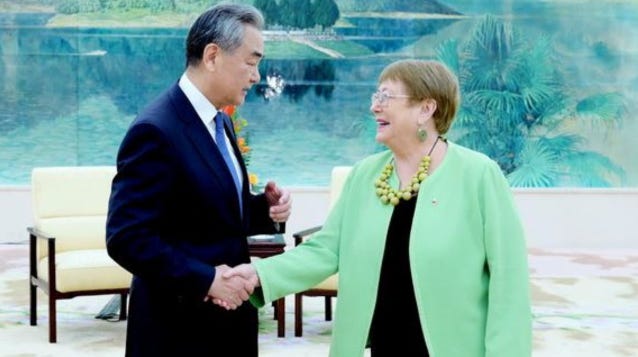
Michelle Bachelet at the Court of Communist China
Marco Respinti, Bitter Winter, October 23, 2025
A new photo opportunity with the CCP for the former UN High Commissioner for Human Rights, who failed to confront the regime on the Uyghurs’ cultural genocide.
On October 14, 2025, former Minister of Health and former President of Chile, Verónica Michelle Bachelet Jeria, commonly known as Michelle Bachelet, met with Foreign Minister of the People’s Republic of China’s (PRC) and member of the Political Bureau of the 20th Central Committee of the Chinese Communist Party (CCP), Wang Yi, while in Beijing for the “Global Leaders’ Meeting on Women” (October 13–14, 2025), co-organized by the PRC and the United Nations Programme for Gender Equality and the Empowerment of Women, succinctly known as UN Women.
It is already ridiculous that the PRC should organize and host such an event with such a pompous title on the 30th anniversary of the highly controversial “Fourth World Conference on Women,” held in Beijing in 1995, which adopted the “Beijing Declaration and Platform for Action.” What speaks for itself, in fact, is the infamous treatment reserved for women in the PRC—from the criminal days of the “One-Child Policy” to today’s equally criminal routine of forced sterilizations, coercive birth control, violence, and rape inflicted upon females belonging to persecuted ethnic and religious groups.
But judging from the pictures and the tone used by the PRC’s Ministry of Foreign Affairs, it would be even more absurd to see Bachelet and Wang smiling and shaking hands—if it were not utterly tragic.
Bachelet served as the seventh United Nations High Commissioner for Human Rights from September 1, 2018, to August 31, 2022. In that capacity, she was responsible for the Office of the High Commissioner for Human Rights (OHCHR) report entitled “Assessment of Human Rights Concerns in the Xinjiang Uyghur Autonomous Region, People’s Republic of China,” published on August 31, 2022, the very day she left office.
Readers will recall that the long-overdue report’s publication was mysteriously delayed. It finally took place after much lamentation and pressure from the Uyghur diaspora and the civilized world on the last day in office of its ultimate author and drafter. Thus, the report was left in a sort of practical limbo, its force de facto depleted and reduced to little more than a sheet of paper, occasionally—and indeed quite rarely—quoted in what amounts to no more than lip service.
The political reasons for that delay were quite evident. It is indeed true that the report contains serious indictments of the situation in Xinjiang—called East Turkestan by its non-Han inhabitants—and explicitly qualifies certain acts as crimes against humanity. Yet it carefully avoids any suggestion of a possible cultural genocide in the region, while effectively preventing any serious investigation into that matter and thus postponing the problem indefinitely.
Uyghurs who have endured the cultural genocide perpetrated by the PRC had two main reactions to that long-delayed report. They strongly lamented both its late publication and its avoidance of the word “genocide.” Yet, in due course, they made a virtue of necessity by embracing the insufficient—yet still useful—denunciation of “crimes against humanity” to provoke some reaction. The problem, however, is that such responses were few and low-profile. The OHCHR could have been a powerful instrument for justice and truth; instead, its text remained another document added to the immense pile of UN papers.
Bachelet—whom the PRC’s Ministry of Foreign Affairs now calls “[…] a long-time friend of the Chinese people”—bears direct responsibility for this debacle. Yet the Chinese Ministry says that “[d]uring her tenure as UN High Commissioner for Human Rights, she upheld justice, viewed China’s development objectively and rationally, and promoted equal and friendly exchanges between the two sides.”
In her turn, Bachelet, the Ministry reports, “[…] congratulated China on successfully hosting the Global Leaders’ Meeting on Women, stating that the friendship between Chile and China has a long history. Chile was the first South American country to establish diplomatic relations with the People’s Republic of China and the first Latin American country to sign a free trade agreement with China.”
Many may forget that Chile established diplomatic relations with the PRC on December 15, 1970, under its newly elected president, Salvador Guillermo Allende Gossens (1908–1973), who had taken office on September 3 of the same year. While remembered and respected by many for his tragic death during the 1973 military coup in Chile, Allende, a medical doctor turned politician, was a hardcore socialist animated by eugenic and racist sentiments, and his government even protected a former Nazi German criminal. It is all documented by Víctor Ernesto Farías, a Chilean retired academic, in his 2005 book “Salvador Allende: Antisemitismo y eutanasia.”
One of the most striking aspects of this story is that Bachelet herself, while serving as Chile’s Minister of Health, implemented a eugenic law devised by Allende, aimed at sterilizing all “deviant” citizens.
On her visit to Beijing, the PRC Ministry of Foreign Affairs concludes: “Michelle Bachelet said she fully agrees with President Xi Jinping’s proposal to bear in mind the goal of a community with a shared future for humanity and jointly create a better future for the human race.” While Bachelet and Wang smile, those who shiver—not only Uyghurs—have good reasons.
COMMENT – Shameful.
China using ChatGPT for ‘authoritarian abuses’, OpenAI claims
Anthong Cuthbertson, The Independent, October 8, 2025
OpenAI has said that some China-based ChatGPT users have been using the AI chatbot for “authoritarian abuses”.
In the company’s latest threat report, OpenAI revealed that it had banned several accounts that appeared to be linked to various government entities in China after they violated policies relating to national security uses.
“Some of these accounts asked our models to generate work proposals for large-scale systems designed to monitor social media conversations,” the report stated.
COMMENT – Shocking, just shocking… who could possibly have imagined that the PRC would use its access to ChatGPT for “authoritarian abuses”?
Hong Kong is silencing and isolating political prisoners
Frances Hu, The Hill, October 14, 2025
The People’s Republic of China celebrated its founding on Oct. 1, and the leader of Hong Kong — a city that prides itself on being a global financial center — has set his sights on “high-quality development with high-level security” under Chinese Communist Party rule.
But Hong Kong Chief Executive John Lee’s National Day speech and the red-flagged celebrations that accompanied it hide the fact that Hong Kong is now a city where dissent is silenced, and political opponents languish behind prison walls.
Industrial Policies and Economic Espionage
China’s economy expands at slowest pace in a year
Thomas Hale, Financial Times, October 19, 2025
EU urges China to agree ‘prompt resolution’ of export curbs
Andy Bounds, Financial Times, October 21, 2025
Global investors edge back into China just as trade risks resurface
Laura Wang, Nikkei Asia, October 20, 2025
When a Trade War Becomes a Food Fight
CSIS, October 20, 2025
China’s New Shipbuilding Orders Drop Amid U.S. Fees
Bao Zhiming, Caixin Global, October 20, 2025
US and Australia sign rare earths deal to counter China’s dominance
Natalie Sherman, BBC, October 20, 2025
Trump, Australia’s Albanese sign critical minerals agreement to counter China
Ernest Scheyder, Reuters, October 19, 2025
Albanese at the White House: Trump endorses Aukus, signs $8.5bn rare earths deal and calls PM ‘great leader’
Josh Butler, The Guardian, October 20, 2025
Trump Sees Successful Xi Meeting, But Allows It Might Not Happen
Jennifer A Dlouhy, Bloomberg, October 21, 2025
US Considers Broad Software Curbs on China, White House Says
Catherine Lucey, Bloomberg, October 22, 2025
The Trump administration is weighing export restrictions against China that would bar the purchase of a wide swath of critical software, a White House official said Wednesday.
The acknowledgment, given on the condition of anonymity to detail internal deliberations, came after Reuters reported that the US was weighing efforts similar to the curbs implemented against Russia following the invasion of Ukraine if China did not backtrack from its threat to restrict rare-earth exports.
China’s ‘New Three’ Exports Jump as Consumer Goods Falter
Feng Yiming, Caixin Global, October 20, 2025
Rare earths shares soar as US and China battle over export controls
Jamie Smyth and Camilla Hodgson, Financial Times, October 19, 2025
China’s investment push in Europe hits a wall
Peter Foster, et al., Financial Times, October 19, 2025
Nexperia standoff with China shakes global auto supply chain
Kenji Kawase, Nikkei Asia, October 22, 2025
China’s economy risks sitting on hold for too long
Ka Sing Chan, Reuters, October 20, 2025
Cyber and Information Technology
The Sovereignty Tax: What the TikTok Deal Means for the Digital Order
Marina Yue Zhang and Wanning Sun, The Diplomat, October 11, 2025
China set to push high tech in 5-year plan as tensions with US intensify
Joe Leahy, Financial Times, October 19, 2025
Carmakers gear up for chip battle after China curbs Nexperia exports
Kana Inagaki, et al., Financial Times, October 19, 2025
China accuses US of carrying out cyberattacks on national time centre
Zhang Tong, South China Morning Post, October 20, 2025
Military and Security Threats
The First 48 Hours of A War with China ‘Could Be Ugly’
Andrew Latham, National Security Journal, October 17, 2025
Taiwan Eyes a Role in Europe’s Drone Supply Chain
David Shen, Commonwealth Magazine, October 23, 2025
Taiwan to launch ‘drone diplomacy’ initiative to aid allies
Focus Taiwan, October 22, 2025
China Expands Missile Forces in Tibetan Plateau
Aadil Brar, The Diplomat, October 17, 2025
China Expands Missile Forces in Tibetan Plateau
Aadil Brar, The Diplomat, October 17, 2025
Chinese military targets RAAF aircraft with flares in ‘unsafe’ incident over South China Sea
Andrew Greene, The Nightly, October 20, 2025
One Belt, One Road Strategy
DeepSeek’s Push into Africa Reveals China’s AI Power Grab
Saritha Rai, Loni Prinsloo, and Helen Nyambura, Bloomberg, October 22, 2025
By making AI cheaper and less power-hungry, DeepSeek has put the technology within reach of millions of people.
China–India Rapprochement and Its Strategic Implications for Afghanistan
Imran Zakeria & Scott N. Romaniuk & László Csicsmann, Geopolitical Monitor, October 20, 2025
New copper demand drivers from US, India as China juggernaut slows
Pratima Desai, Reuters, October 19, 2025
China’s Global Network of Shipping Ports Is Too Big for Trump to Unravel
Peter Martin, et al., Bloomberg, October 20, 2025
Opinion
Trump Resists the Isolationists
Matt Pottinger, Freedom Frequency, October 6, 2025
Shortly after President Trump’s second inauguration, I published an article exploring whether a “Trump Doctrine” might emerge in his second term that would entail two things: the reassertion of US dominance in the Western Hemisphere, and a US retreat from the Eastern Hemisphere and its nettlesome flashpoints like Ukraine, the Middle East, and Taiwan.
The first part certainly appears to be coming true.
Minutes into his inaugural address last January, Trump was already throwing his weight around in the Americas. His regional policies so far include military strikes on alleged drug runners in the Caribbean; gunboat diplomacy aimed at Nicolás Maduro’s dictatorship in Venezuela; an (as-yet-unresolved) attempt to push China out of the Panama Canal; punitive tariffs on Brazil, Mexico, and Canada; and (mostly unwelcome) entreaties to Canadians and Greenlanders to transfer their national sovereignty to Washington. Clearly, the 200-year-old Monroe Doctrine (a policy justification for US regional hegemony) has been resurrected by Trump in his first year back in office.
But the second part—US retreat from the Eastern Hemisphere—so far hasn’t come to pass. Indeed, Trump has bucked the isolationist wing of the Republican Party (and key members of his administration) to bomb terrorists in Yemen, crater Iranian nuclear facilities, strengthen NATO, and keep the pipeline of American arms flowing to the front in Ukraine. These are sound policies that have kept wars from metastasizing and strengthened US security.
How then to reconcile Trump’s actions with the reportedly isolationist thrust of the Pentagon’s draft national defense strategy? In short, some of the president’s staff want a different foreign policy from their boss’s.
This is especially true in the Pentagon, where most of the newly appointed civilians are unknown to the president. Many come from isolationist traditions and organizations at odds with Trump’s foreign policy successes in his first and second terms.
Trump, like his Pentagon civilian staff, relishes homeland defense and a strong hemispheric posture. But unlike some of those staff, Trump doesn’t believe it should come at the expense of America’s status as a global superpower.
Yet the Pentagon’s draft national security strategy would reportedly do exactly that: weaken America as a superpower. According to the Washington Post, senior-level uniformed officers (whose instincts seem closer to the president’s) have “raised serious concerns” about the draft strategy for “narrowing” America’s ability “to deter and, if necessary, defeat China in a conflict.” They also objected to the strategy’s reported goal of weakening US power in Europe and the Middle East, the Post reported.
No question, Trump believes US allies must rapidly strengthen their own defenses rather than rely solely on US protection. But unlike some of his subordinates, Trump understands that deterrence also requires American military strength and presence far from America’s shores. Nowhere, including in his remarks last week to hundreds of US flag officers, has Trump called for a weaker, less capable, and less global US military. In his second term, the president has repeatedly called upon a strong military to bolster diplomacy, deter adversaries, and apply force.
The Miseducation of Xi Jinping
Orville Schell, Foreign Affairs, October 20, 2025
Taiwan Is Not for Sale
Marvin Park and David Sacks, Foreign Affairs, October 22, 2025
Trump has moved the Middle East’s tectonic plates. It’s a nightmare for Putin and Xi
Charles Lipson, Telegraph, October 16, 2025
Trump, China, and Declining US Influence in Asia
Robert Sutter, The Diplomat, October 14, 2025
Asia’s Trump Problem
Michael J. Green, Foreign Affairs, October 17, 2025
Thérèse Shaheen, National Review, October 19, 2025
The U.S. has plenty of leverage — we shouldn’t be blinded by Chinese propaganda.
When President Trump and his team climbed down from the first round of high tariffs that were imposed on China back in April, I cautioned that capitulating without tangible results would be bad for the administration and for America.
The president’s recent announcement of 100 percent tariffs on imports from the People’s Republic of China, beginning November 1, following China’s export controls on rare earth metals, also plays into China’s hands.
Beijing wants, above anything else, to project strength and to have the world focus on its supposed dominance of the tech economy rather than on its macroeconomy, which is quite weak. By responding to the challenge of China’s export controls on key high-tech enablers rather than pushing harder on the enduring soft spots of the Chinese economy, Trump is actually encouraging Xi to become more belligerent.
China spy case has an aroma of appeasement
Charles Parton, Financial Times, October 17, 2025
America’s rare earth delusion
Rana Foroohar, Financial Times, October 19, 2025
China’s Big London Spy Platform
Wall Street Journal, October 20, 2025
How to Escape China’s Rare-Earth Chokehold
Liza Tobin and Brady Helwig, Wall Street Journal, October 22, 2025
Your editorial is right that countering China’s weaponization of rare-earth supply chains requires technological breakthroughs and allied coordination (“Allies United Against China on Rare Earths,” Oct. 17). Yet whereas you consider President Trump’s tariffs to be obstacles, we see them as tools. Offering targeted relief to nations that erect barriers to Chinese exports and join a U.S.-led coalition can help thwart Beijing’s rare-earths power grab.
During his first administration, Mr. Trump defied economic orthodoxy by imposing tariffs on China, recognizing U.S. market access as a powerful source of leverage. President Biden accepted this strategy by keeping the tariffs in place and raising them higher. This term Mr. Trump is taking the approach global, using tariffs to press countries and corporations for such concessions as lower trade barriers and investment commitments.
Now is the time to double down, using the levies to reduce allied dependence on China. The emerging pattern is tiered: steep tariffs on China, moderate rates on Southeast Asian transshipment hubs, lower tariffs for democratic allies like Japan, South Korea and the European Union and the lowest for our neighbors, Canada and Mexico.
Such an approach recognizes that markets alone can’t counter China’s holding supply chains hostage. Allied governments must shoulder some risk. As Treasury Secretary Scott Bessent said last week, “When you are facing a nonmarket economy like China, then you have to exercise industrial policy.” Providing tariff relief to countries that join our moonshot effort can help pool investment and create an integrated market for end products.
Breaking Beijing’s chokehold on rare-earth supply chains requires resolving three bottlenecks: the concentration of heavy rare-earth feedstock in Myanmar and China; catching up in rare-earth processing; and rapidly scaling permanent magnet production. Price floors and offtake agreements are essential to protect against Beijing’s dumping and ensure stable demand. (The U.S.-Australia Critical Minerals Framework announced Monday is a good start.) Public loans and grants can crowd in private capital. Subsidies can support firms that risk China’s ire by stockpiling materials or supplying democratic nations’ militaries. Above all, the U.S. and its allies must solve the talent issue by training thousands of materials scientists, metallurgists and mining engineers.
Trump Strikes a Good Rare-Earth Deal
Wall Street Journal, October 22, 2025
The cooperation with Australia shows the value of allies to unite to counter Chinese mercantilism.
China is using its dominance in rare-earth mineral production as a political and economic weapon, and the U.S. needs alternatives. President Trump took an important step to getting them this week with an agreement with Australian Prime Minister Anthony Albanese to increase cooperation on mining and production. See how trade allies can be useful, Mr. President?
Beijing has spent decades building its dominance in rare-earth production, with the goal of increasing its military and economic leverage against the West. During a 2010 confrontation with Japan over the Senkaku Islands, Beijing restricted rare-earth exports. This month China escalated, saying it will now require manufacturers worldwide to get its permission to export goods that use even trace amounts of Chinese rare earths. This includes electronics, computer chips, defense equipment, autos, medical devices and more.
China mines about 70%, and refines 90%, of the world’s rare earths. Beijing has achieved this dominance by heavily subsidizing its rare-earth industry. This includes purchases of mines in developing countries as part of its Belt and Road initiative.
Chinese companies spent $22 billion last year acquiring overseas mines, often outbidding Western competitors. China’s lax environmental standards mean it can process rare earths at lower cost and larger scale than Western countries that have rules against dumping hazardous byproducts.
Refining rare earths requires 22 times more water and energy than mining the ore. By flooding global markets with low-priced rare earths, China has made it difficult for producers in developed countries to compete. Given China’s stranglehold and the high national-security stakes, this is a (rare) example when U.S. government support may be needed to develop alternative sources.
Enter Australia, which is a natural partner with the U.S. as the world’s fourth largest rare-earth producer. (The U.S. is second and Myanmar third). Australia was also the world’s top destination for rare-earth exploration last year and accounted for about 45% of global investment, according to the Center for Strategic and International Studies. Oz hosts 89 active rare earth exploration projects, compared to 12 in the U.S.
The U.S. and Australian governments on Monday announced several joint rare-earth investments. Alcoa and Sojitz Corporation will develop a gallium plant in Western Australia with the backing of the Japanese, Australian and U.S. governments. The U.S. Export-Import Bank will provide $2.2 billion to boost mineral supply chains in Australia.
Another goal of the deal is to create more pricing certainty for producers to encourage more investment. The deal floats an alternative system for free-trading countries that agree to minimum environmental standards. Price floors would help producers recoup their investment, which often takes 30 to 40 years.
Price intervention is dangerous in any private market because it gives politicians a chance to meddle. But a price floor to encourage production is better than the price cap that politicians usually want. The trick will be ending the price interference once more abundant rare-earth supply comes on stream. The U.S. and Australia also plan to use diplomatic tools to deter more foreign mine sales to China, as Washington has sought to do for other Belt and Road projects.
Chinese mercantilism poses a unique threat to the West, and one way to counter its predatory behavior is to join with free-market democracies to oppose it. This is one reason Mr. Trump’s tariffs on allies are so counterproductive. The Aussie rare-earth deal is one example of the better way to go.