Friends,
Disclaimer… I’m going to torture a metaphor about baking a cake, how the baker is responsible for recipe, how it turns out, and how we can’t un-bake a cake once it has been made. It is also a reference to Putin’s birthday party last week and how one former leader decided to attend.
I hope it helps folks appreciate the importance of things in our recent past and why it is important to take seriously the decisions that leaders make.
***
But before we jump into that, I’d like to recommend some weekend listening, particularly since this is the long Columbus Day Weekend in the United States and if you’re on the East Coast, you’re probably being rained on by the remnants of Hurricane Isaias and if you’re on the West Coast, Tropical Storm Rachel is ruining your weekend.
We usually focus on the rock, hip hop, country, and electronic genres, but let’s pivot to some foundational jazz.
In 1947, the American bandleader, Dizzy Gillespie, and Cuban percussionist, Chano Pozo, teamed up to write “Manteca” perhaps the most important song of Afro-Cuban jazz and a song that has had enormous influence on artists ever since. The song was first performed 79 years ago at Carnegie Hall on September 29, 1947.
Listening to the song today, it sounds just as fresh and new as I’m sure it did in the late 1940s. The recording above is of a performance by Dizzy and his band in Denmark in November 1970.

Dizzy Gillespie in 1970 playing “Manteca.”
Unfortunately, the song’s co-writer, Chano Pozo, died a year after meeting Dizzy when he was shot and killed at the age of 33 in a bar in Harlem.
Gillespie was born in 1917 and grew up in South Carolina before moving with his family, at the age of 18, to Philadelphia. His family was part of the first wave of the Great Migration in which nearly 2 million African Americans moved from the rural South to the cities and industrial centers of the North. He had taught himself trumpet and trombone and joined several big bands in the late 1930s and 1940s. While not identified as a part of the Harlem Renaissance himself, Gillespie was strongly influenced by the movement as he worked and collaborated with many of its most important artists.
He did not serve in WWII, as he was deemed unacceptable for military service after telling the Selective Service Board that given the way he had been treated in the United States, if he were given a gun he might shoot the wrong side.
In quite a few recordings of Manteca, Dizzy Gillespie can be heard saying “I’ll never go back to Georgia,” which captures the emotion of countless Southern black migrants who left the Jim Crow South and went north and vowed never to return.
By the end of the war, Gillespie had formed his own band, which adapted the most popular jazz genre of the day, swing, into a new style called bebop and then extended those innovations into a fusion with Cuban music, which became known as “cubop” or “Cubano Bop.”
Gillespie played a bit part in the Cold War, when in 1977, he helped his fellow jazz musician and friend, the Cuban jazz trumpeter, Arturo Sandoval, defect from Cuba to the United States.
***
Baking Triangular Cakes
There were two articles last week that got me thinking.
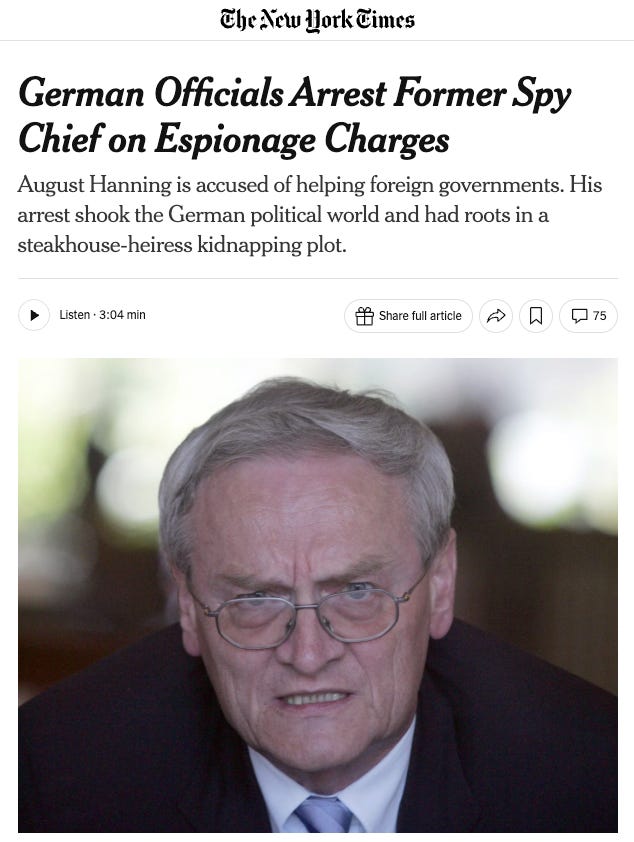
Jim Tankersley, “German Officials Arrest Former Spy Chief on Espionage Charges,” New York Times, October 6, 2026
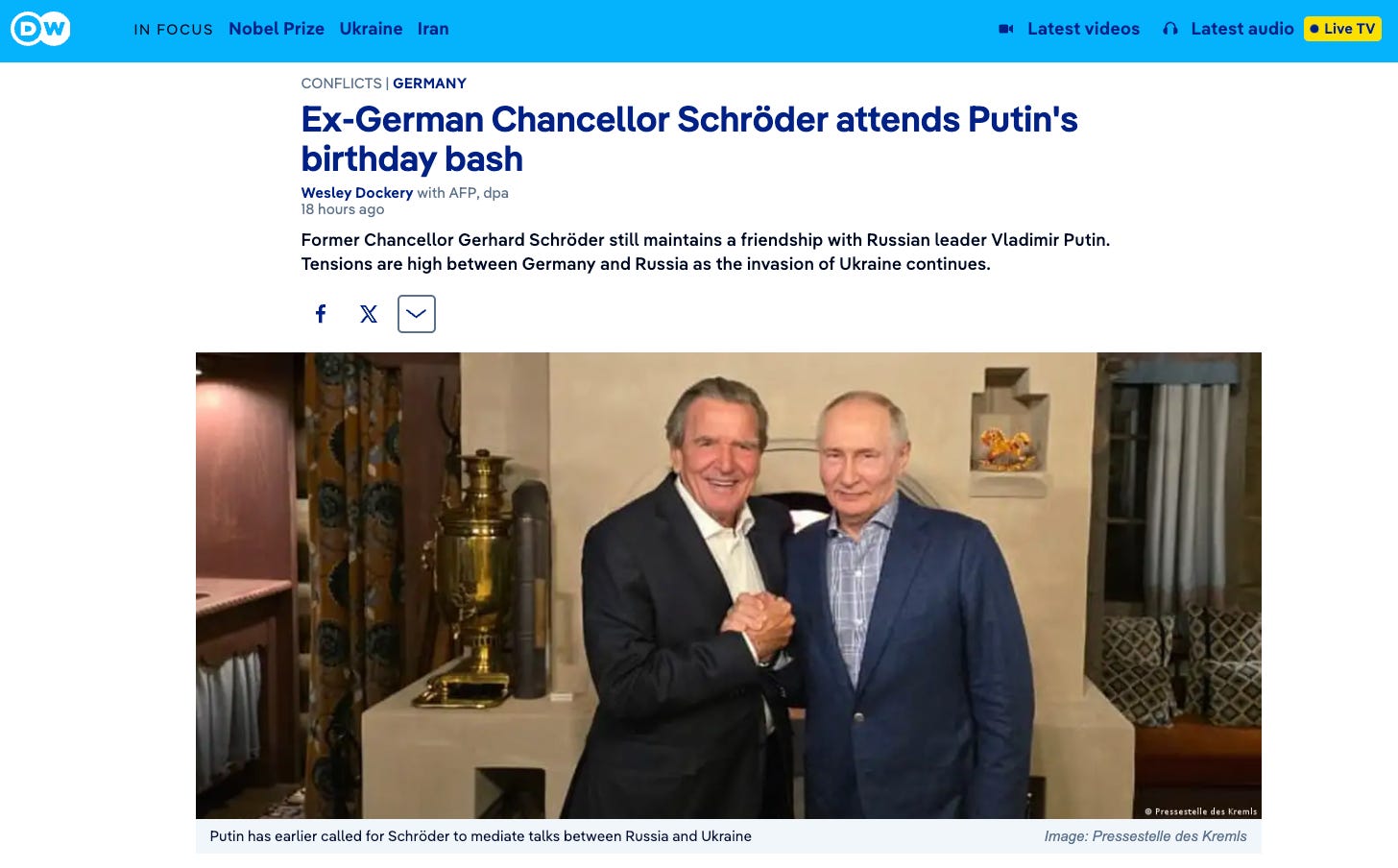
Wesley Dockery, “Ex-German Chancellor Schröder attends Putin’s birthday bash,” DW, October 8, 2026
My first reaction was that these must be from The Onion.
Unfortunately, they aren’t.
August Hanning, the former German spy chief arrested this week, was the head of the BND (Bundesnachrictendienst) from 1998-2005… during Gerhard Schröder’s entire term as Chancellor of Germany.
Yes, the same Gerhard Schröder who had campaigned on criticism of Helmut Kohl’s close relationship with Boris Yeltsin and then immediately sought to build a “strategic partnership” with Vladimir Putin, the former KGB agent who served in East Germany for five years, just weeks after Putin became the new leader of Russia.
I’ll start with a controversial assertion that perhaps the most impactful political leader of the first decade of the 21st Century was Gerhard Schröder, the Chancellor of Germany, 1998-2005.
He is probably not the individual you think of first, or even in the top ten, but let me make my case.
Schröder became the Chancellor following 16 years of Helmut Kohl, the leader of Germany’s center-right Christian Democrats (CDU). Kohl took over during a particularly turbulent period of the Cold War, forged a strong relationship with Ronald Reagan and later George Bush, and led the German people through reunification following the fall of the Berlin Wall and the collapse of the Soviet Union.
Schröder, from the center-left Social Democratic Party (SPD), was the first truly post-Cold War leader for the Federal Republic and the first new leader after reunification. During his tenure, the capital moved from Bonn back to Berlin and the European Union we know today, took its shape during his time as Chancellor. Fourteen years Kohl’s junior, Schröder was also a generational change.
In this post-Cold War era, Europe was the pivot point in geopolitics and how Europe managed the reintegration of the East and its relations with the rest of the world would create path dependencies. No country controlled these decisions for Europe quite like Germany, the literal and figurative center of the continent.
Coming to power in 1998, Schröder could have chosen several different recipes for Germany’s future. He decided to pursue triangulation between the other geopolitical actors and acted with Paris to neuter Brussels as a power center that could eclipse either Berlin or Paris.
What do I mean by triangulation?
One tactic of foreign policy, is to pursue triangular diplomacy, in which an actor manages the relations between actual or potential rivals by playing one off the other in order to maximize one’s own leverage and gain benefits. It is a hedging strategy that one pursues when they want to gain advantage over other powers.
This is what Schröder chose for Germany, to create two distinct triangular relationships: Washington-Berlin-Moscow and Washington-Berlin-Beijing.
His decisions created path dependencies and consequences that we are dealing with today.
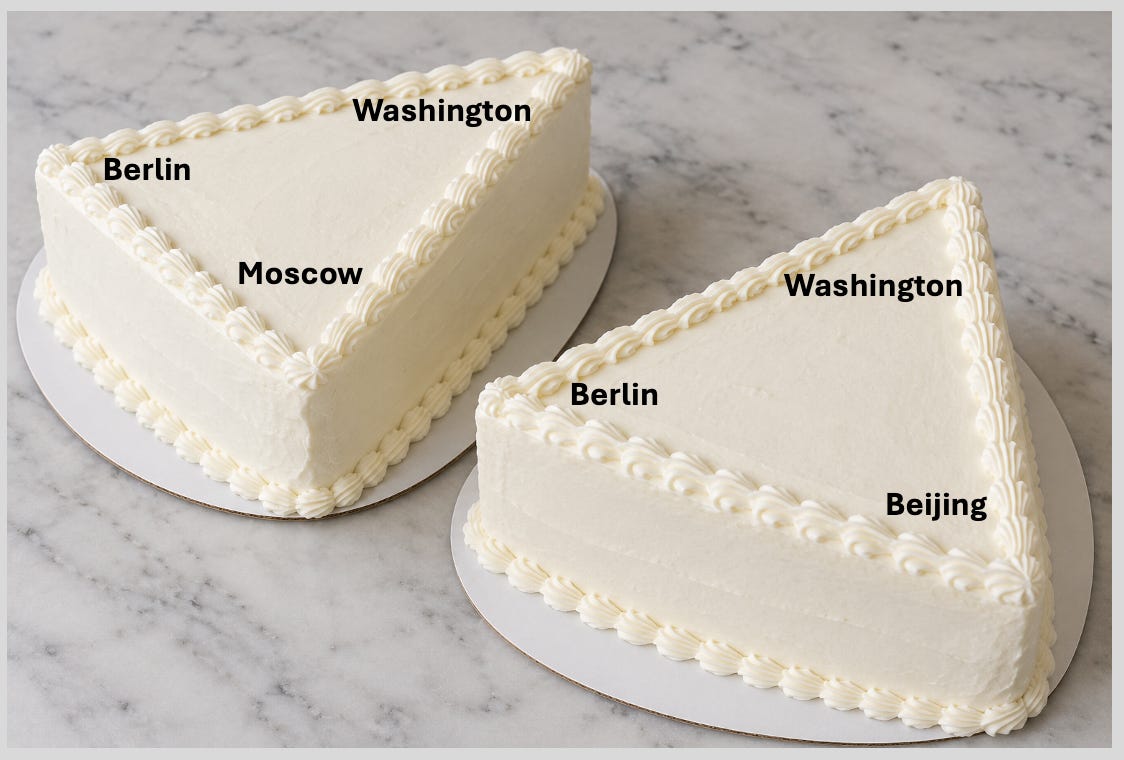
From ChatGPT
Cake #1 – Washington-Berlin-Moscow
Less than six weeks after Vladimir Putin was inaugurated as Russian President on May 7, 2000, the German Chancellor arrived in Moscow for a three-day summit. The two leaders formed an immediate close and warm relationship with Putin joking to reporters that they may mistake them for being in love. The summit marked a significant rapprochement between Berlin and Moscow and set the course for what would become massive German investments into Russia and later Germany’s energy dependence on Russia.
At the time, commentators contrasted the warm relationship between Schröder and Putin with the “sometimes awkward relationship between Mr. Schröder and President Clinton.” That relationship between the American President and the German Chancellor would become even more “awkward” under President George W. Bush and would ultimately breakdown as Schröder used his loud opposition to the Iraq War to bolster his domestic political standing. This would create a rift between American Republicans and Berlin which has only degenerated over the past quarter century.
Near the end of Schröder’s term as Chancellor in 2005, he signed the deal for the Nord Stream 1 pipeline which would connect Russia and Germany and deliberately avoid crossing the territory of any other European country by running along the Baltic seabed. Germany’s European and American allies criticized the decision and within days of leaving the Chancellorship, Schröder accepted a board position on the Nord Stream joint venture.
Despite the clear conflict of interest, Schröder’s successor, Angela Merkel, stuck with the Russian deal and sought to strengthen the Russo-German relationship. From the German perspective, they needed abundant energy to power Germany’s industrial economy and Russia could provide it. Schröder and Merkel would portray the decision as one in which they had little choice.
But they did have a choice.
Just as Schröder was hammering out the agreement to make Germany dependent on Russian energy and to remove any leverage that Germany’s allies might have over the Russo-German relationship, the United States was just starting the Shale Revolution. By the time Nord Stream 1 opened in 2011, the United States had more than quadrupled the amount of natural gas it had available.
One can imagine an alternative history. In the late 1990s and early 2000s, Schröder decides to tie Germany, and Europe, more closely to the United States by making investments in American energy and its export to Europe. He doubles down on aligning Europe’s security AND economic relationships instead of setting one against the other. He views Putin’s brutality in the Second Chechen War as something to loudly condemn (given that Putin did not have UN authorization for his war) and helps the United States bring peace to Iraq after the overthrow of Saddam Hussain.
Schröder decides not to slash Germany’s military and instead begins a steady modernization of the Bundeswehr to help protect the liberal international order that has benefitted Germany and Europe.
Without the massive investments to Russia by Schröder in the first months of Putin’s presidency, which helped stabilize the Russian economy, Putin loses the 2004 Russian Presidential Election and he becomes a footnote. This allows for the international community to help strengthen Russian institutions and civil society which by the 2020s creates a Russian Federation that has embraced a multi-party democracy, which while messy, has become relatively stable with routine political transitions.
Under this scenario, Russia does not attack Georgia in 2008, it does not annex Crimea in 2014, nor does it mount a full-scale invasion of Ukraine in 2022. It doesn’t interfere in the elections of democracies and does form a “no-limits” partnership with the PRC.
Instead of opening Nord Stream 1 in 2011, multiple European countries open LNG terminals to receive American natural gas from the shale revolution. This helps balance trade between Europe and the United States as American energy exports power European industry which exports goods to the United States. This helps mitigate the effects of the Global Financial Crisis and maintains broad political support for “free trade” between countries that follow the same rules.
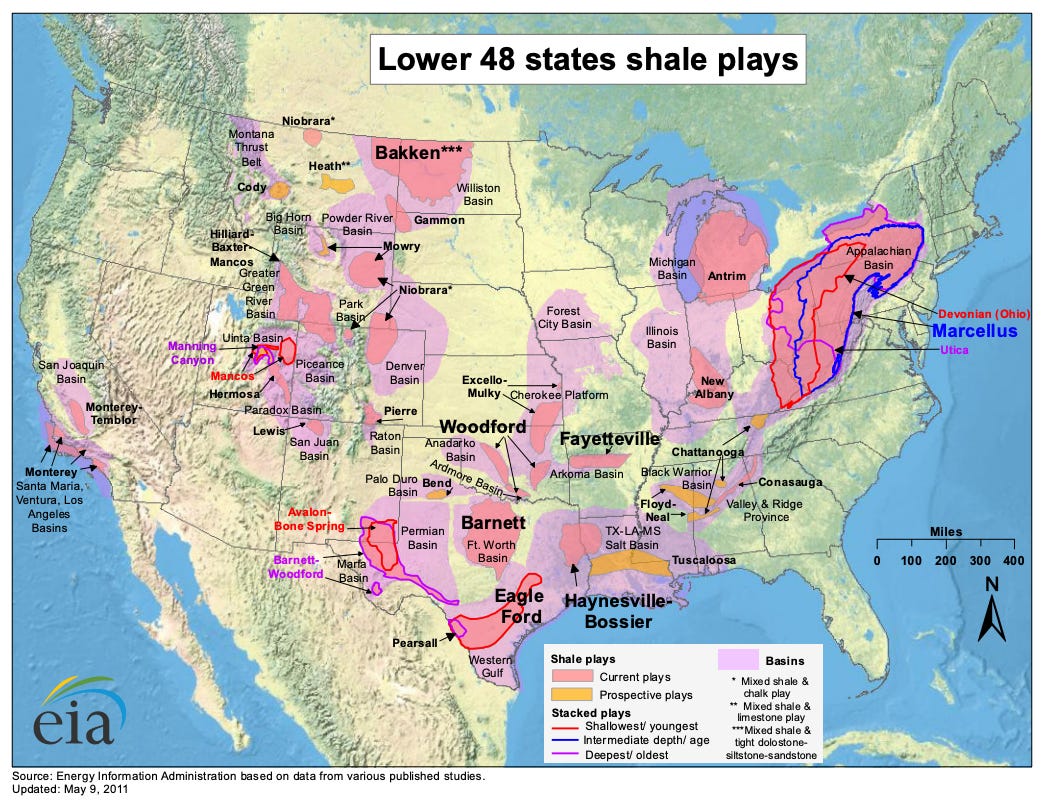
Map from the Energy Information Agency showing the extent of the Shale Revolution in 2011.
Both Europe and the United States understand that connecting trade to high labor standards, high environmental standards, and human rights is far more beneficial to them in the long run than a race to the bottom by seeking trade deals with authoritarian regimes.
This also helps both Europe and the United States reduce their CO2 emissions as both have reliable and low-cost natural gas alternatives to coal.
But that alternative history didn’t happen.
Instead Schröder’s triangulation against Washington in the early 2000s gave Putin the resources and legitimacy to pursue his dreams of consolidating power and waging wars of aggression.
Cake #2 – Washington-Berlin-Beijing
Schröder’s effort with Moscow was not the only example of his triangular diplomacy. It also manifests with what he and his successors pursued with Beijing.
Like many leaders in the late 1990s and early 2000s, Gerhard Schröder was extremely optimistic about his country’s economic relationship with the PRC. But instead of coordinating with Washington, Tokyo, or even other Europeans, Schröder sought to build a direct economic relationship with Beijing and purposefully ignore the concerns of Germany’s allies.
After visiting the country six times, Schröder pledged to his Chinese hosts that he would get the European arms embargo on the PRC lifted. Starting in 2003, Schröder began a one-man campaign against the arms embargo claiming that it was a relic of the Cold War (actually no, it was because the Chinese Communist Party murdered thousands of its own citizens in 1989 rather than submit to political reforms). His own coalition government partner, the German Green Party opposed him, along with much of the rest of Europe and the United States. Schröder found an ally in French President Jacques Chirac, and both pushed for repeal of the arms embargo in 2003 and 2004.
With Schröder dividing the transatlantic agreement on how the democracies responded to Tiananmen, Germany companies stood to gain in trade deals and market access.
This placed the United States in an extremely difficult position. American businesses and the Bush Administration also wanted access to the Chinese market, which was not opened as freely as many had predicted when the PRC joined the WTO. Schröder’s gambit would either give a huge advantage to German companies or force the United States and the rest of Europe to capitulate on the arms embargo.
This was going on just as the United States was starting the war in Iraq and Schröder was building his close relationship with Putin. It seems clear today that Schröder sought to isolate the United States and increase his leverage. What’s ironic is that under nearly any other circumstances, Schröder likely would have opposed lifting an arms embargo, he was unilaterally disarming his own country and criticizing “militarism” in the United States. It appears his motivation embrace arms sales to the PRC was almost entirely motivated by his desire to weaken the United States and strengthen the leverage of Berlin.
Chinese Communist Leaders could hardly believe their luck, here was a European leader who was almost gleefully undermining transatlantic unity… something that they are witnessing again two decades later.
Neutering Brussels
The hamstrung European Union we have today is the product of what Schröder and French President Jacques Chirac negotiated between themselves in 2003 and then forced into the Treaty of Lisbon which wasn’t signed until after Schröder left office. National leaders in Berlin and Paris largely control how Brussels works and what it can accomplish by setting up competing institutions that national leaders can manipulate. While other EU members certainly have a role, nothing can really get done in Brussels, if the Federal Chancellery and the Élysée Palace say no.
The gridlock in Brussels, as we can see with the inability to deal with the PRC’s economic aggression or the inability to unite in deterring Russia, largely stems from the decisions made by Schröder and his French counterpart to guard the domestic interests as the leaders of just a third of Europe’s citizens.
When historians look back and examine how the transatlantic relationship fell apart and how the PRC and Russia gained so much power after the collapse of communism, I suspect that Gerhard Schröder will take on an important role.
Certainly, President Trump has done little to repair the relationship and quite a lot to pour gas on the fire, but by the time he came to power in 2017, that cake was already baked.
The advantages that Putin and Xi used to mount their opposition to the liberal international order were handed to them on a silver platter by several leaders in the West. But none were so shameless in their sabotage of the transatlantic alliance and their assistance to its rivals, as Gerhard Schröder.
One last thing about Schröder’s background
In going through Schröder’s biography, I guess it is not surprising to learn that one of the efforts that Schröder committed himself to as a young lawyer in the 1970s and 1980s was to get Horst Mahler, one of the founders of the Red Army Faction (RAF) released from prison.
In 1970, Horst Mahler helped form a far-left terrorist group that would spend two decades trying to destroy the transatlantic relationship. After failing to spring one of his fellow founders from prison, he fled to Jordan to train in guerrilla tactics with the PFLP (Popular Front for the Liberation of Palestine) and returned to West Germany in September 1970 and started committing a series of bank robberies. [The far-left’s affinity for Palestinian terrorism is long and deep]
Mahler was arrested a month later and in 1974 he was sentenced to 14 years in prison and had his law license revoked.
Gerhard Schröder, as his lawyer, would be successful in 1980 when he won his client’s release and again in 1988 when he successfully got his client’s law license back for him.

Logo of the Red Army Faction
Perhaps you’ve forgotten about RAF, as there is sometimes a bit of amnesia surrounding them, so let’s review.
The Red Army Faction (also known as the Baader-Melnhof Gang) was a far-left terrorist group founded in 1970 which waged two decades of bombings, assassinations, kidnappings, and bank robberies. The group killed 34 people, mostly targeting West German police, officials, and American service members. This group, along with other far-left German groups, arose from the student protest movements that swept across Europe and the United States in 1968.
Here’s a list of some of the group’s more high-profile attacks:
The 1971 killings of two West German police officers;
The 1972 bombing of the U.S. Army’s V Corps headquarters in Frankfurt killing an American Lieutenant Colonel and wounding 13 others;
The 1972 bombings of both the U.S. Army Officer Club and the headquarters of the U.S. Army’s Security Agency at Heidelberg, killing 3 and wounding 5;
The 1972 bombing of a German media company wounding 17;
The 1975 siege of the West German Embassy in Stockholm where the group murdered a German Colonel and commercial attaché;
The 1977 failed attack on the U.S. Army base at Giessen where they tried to capture or destroy the nuclear weapons stored at the base;
The 1977 assassination of a West German federal prosecutor, along with his driver and an assistant.
The 1977 kidnapping and murder of a German executive, his driver, and three police officers;
The 1979 attempted assassination of General Al Haig, the Supreme Allied Commander of NATO with a land mine that narrowly missed blowing up under his car but still wounded three of his bodyguards (18 months later, Al Haig would would become Reagan’s first Secretary of State);
The 1981 car bombing at the parking lot of the Headquarters of U.S. Air Force, Europe;
The 1982 unsuccessful sniper attack on the U.S. Army’s nuclear weapon storage site near Nuremberg.
The 1985 car-bombing of Rhein-Main Air Base where two Americans were killed;
The car bombing and killing of the Chairman of Deutsche Bank in 1989, just weeks after the fall of the Berlin Wall;
The 1991 sniper attack on the U.S. Embassy in Bonn;
The 1991 assassination of a German executive involved helping the reunification of the two Germanies;
The 1993 bombing of a new German prison which caused a four-year delay in its opening.
The individuals that made up these far-left terrorist groups were outraged by what they saw as a fascist alignment of German political parties with the United States to suppress far-left ideas and communism.
While they claimed to be operating on their own and identified themselves more as Maoists in the Sino-Soviet split of the Marxist-Leninist world, obviously the Soviets and East German authorities saw these groups as useful proxies to undermine the Western alliance. In the late 1970s and 1980s, they provided them intermittent support.
The groups saw themselves as justified in using any means to bring about the destruction of the transatlantic alliance, which they viewed as no different from Nazism and Fascism.
It was out of this Weltanschauung that Gerhard Schröder emerged.
Thanks for reading!
Matt
MUST READ
In Race with U.S., China Struggles to Recruit Foreign A.I. Researchers
Zeyi Yang, New York Times, October 6, 2026
China’s booming artificial intelligence sector has given local researchers good reason to remain in the country, but it has yet to lure overseas scientists despite a government push.
As the United States and China vie for A.I. dominance, the Trump administration has made it more difficult for companies to hire foreign researchers, while China has made recruiting the world’s best scientists a national priority.
Over the past two years, China has flung open its doors to international researchers, introducing a visa for scientists and offering lucrative research grants.
Despite those efforts, foreigners are not coming.
Worse still for China’s ambitions, the number of Chinese scientists working in the United States has risen rather than declined, according to a new study about global A.I. research.
For every 30 Chinese researchers in the United States working on artificial intelligence in 2025, only one in China made the opposite journey, according to the study, conducted by the Carnegie Endowment for International Peace, a think tank.
“Despite U.S.-China tensions, the number of Chinese-origin researchers working in the U.S. actually rose by four percentage points rather than declined” compared with three years ago, said Damien Ma, who led the study.
The study determined the flow of scientists around the world by examining research papers accepted by last year’s NeurIPS, an academic conference focused on machine learning and computational neuroscience. Mr. Ma and his team analyzed where the papers’ authors went to college, received graduate degrees and ended up working.
The results affirm the popular understanding that the United States and China are the two places where most frontier A.I. research is being produced. While China is failing to recruit foreign researchers, the study found, it is seeing a boon in retaining local talent, people who have risen though the domestic education system and are increasingly choosing not to seek work overseas. The United States, on the other hand, maintains its lead by employing foreign researchers, many of whom previously emigrated from China, as well as India, South Korea and elsewhere.
The Carnegie study counts those researchers who migrated from one country to another, but it does not indicate when a researcher moved. One explanation for why the number of Chinese scientists working in America remains high is that they arrived before the Trump administration imposed restrictions on obtaining visas and cut research funding last year.
“There is a delay effect — the researchers in this study mostly made their decisions years ago to study or work here,” said Yingyi Ma, a sociology professor at Syracuse University who studies Asian students in the United States. “The danger for the U.S. is a slow erosion of its appeal to attract talent that compounds over decades. By the time the effect shows up in the data, it is hard to reverse.”
The Philippine Teacher Recall: China Plays the “Safety” Card ... Again
Ray Powell, SeaLight, October 7, 2026
Beijing often declares its citizens in danger when it wants to punish a government or discredit its critics, and the sudden recall of Chinese teachers from Philippine schools fits that pattern. Nothing shows the teachers were endangered by those who document Beijing’s influence networks; what the record does show is a Party that plays them, and the Chinese-Filipino students they taught, as cards in a political game.
On October 1, two Manila schools sent letters home to parents. Jubilee Christian Academy said its Chinese volunteer teachers had been “unexpectedly recalled by their sending organization,” while Immaculate Conception Academy said the Federation of Filipino-Chinese Chambers of Commerce and Industry (FFCCCII) had told it that its Chinese teachers “need to return to China immediately.” Neither letter gave a reason. That evening, a Chinese-language community portal reported the cause as “unknown”.
By early the next morning, the number was 150, and reason was me.
Chinese Commercial News reported that FFCCCII and the Philippine Chinese Education Research Center (PCERC), which has coordinated Chinese-language teaching in the Philippines since 1991, were sending about 150 Chinese teachers home. According to the paper, the teachers’ families feared for their “safety” after Defense Secretary Gilberto Teodoro and I raised concerns about PRC-linked education programs, concerns both of us have tied to the Chinese Communist Party’s United Front Work Department.
The paper specified no teacher, family member or threat.
The Chinese Embassy then published a question-and-answer. As SeaLight pointed out, the Embassy wrote the question itself, and the claim about teachers’ safety appears only in that question. The spokesperson’s answer denounced “malicious smear campaigns” and urged Manila to “ensure that the safety and legitimate rights and interests of Chinese nationals in the Philippines are safeguarded.” FFCCCII then told PhilSTAR Life that the teachers were recalled “with approval of FFCCCII and Chinese Embassy” because parents “were concerned about the articles written by Ray Powell.”
The “safety” card
When China wants to punish a government without saying so, it often claims its citizens are in danger. A warning like that costs nothing to issue and is hard to disprove. It threatens to drain tourists, customers, students or, in this case, teachers away from the target country, and it lets Beijing present itself as the protector and the target as the threat.
The Philippines has seen this before. During the 2012 Scarborough Shoal standoff, China’s National Tourism Administration issued “travel safety advice,” and Chinese travel agencies suspended tours to the Philippines. At the same time, Chinese quarantine officials turned away 150 containers of Philippine bananas they said were “crawling with insects.” A researcher at the Chinese Academy of Social Sciences was candid about it: stricter fruit inspections were “convenient and easy to operate” and meant to “test the reaction of the Philippines before economic sanctions are introduced.”
It happened again last year. In July 2025, China’s Ministry of Education warned students considering the Philippines of “a surge in crimes targeting Chinese nationals,” and the Foreign Ministry urged Manila to protect Chinese students’ “safety, dignity and lawful rights and interests.” On Aug. 30, days after Senator Panfilo Lacson alleged that Chinese sleeper agents were operating in the Philippines, Beijing reissued the study alert, citing an “unfavorable study environment,” and added a travel advisory claiming that public security “has been unrestrained.”
Spain and China are cosying up - to the anger of many in the EU
Katya Adler, BBC, October 5, 2026
…
Spanish Prime Minister Pedro Sanchez has visited China’s President Xi Jinping four times in as many years. He’s urged the EU as a whole to improve relations with China since Donald Trump’s re-election two years ago.
Sanchez’s move has sparked resentment and disapproval among a number of Spain’s European partners who view Beijing as a strategic rival and possible geopolitical threat to the EU. Privately, they ask if Madrid’s welcoming stance - opening up its market to Chinese businesses - is enabling China to become the (economic) enemy within the bloc too.
Pedro Sanchez is not the only EU leader going off piste. Global volatility means other EU countries feel squeezed and exposed and unsure they can rely on America under President Trump. His policy on trade and defence is seen as unpredictable and, at times, aggressive. And so EU member states are selecting strategic partners that they believe suit their national needs, even if that alienates or irritates fellow member states.
So do these new-found alliances risk a permanent splintering of unity in the EU or even Nato?
Spain accused of self-interest
Germany and France - the EU’s biggest powers - have just united around a more aggressive approach towards China. They want to give Brussels the muscle to shut subsidised Chinese competitors out of the EU market to address ballooning trade imbalances with Beijing that the European Commission claims have reached a whopping €1bn (£850m) a day.
Other EU countries fret about China’s tight relationship with Russia. Beijing has denied helping Moscow’s war effort in Ukraine but defence experts point to technological and economic support from China, which they say has enabled Russia to sustain its military assault.
That’s why, as Spain enthusiastically courts Beijing, it stands accused of looking after its own, rather than wider European interests.
“It’s a bit chicken and egg. Did Spain distance itself from European allies, or did they distance themselves from us?” asks Victor Cortizo, a lawyer and academic specialising in Sino-Spanish relations.
“I think it’s more us. It’s Spain. But legitimately so. Realpolitik is a thing. If I get closer to China because that attracts Chinese investment and bolsters my economy, then that is strategically more appealing than supporting allies who are also only looking out for themselves.”
Cortizo and I were surrounded by towers of crates as we spoke, at the end of the longest freight rail link in the world. It runs over 13,000km (8,000 miles) between Yiwu in eastern China and Madrid, largely bringing car parts and electrical goods to Spain and transporting delicacies like Spanish ham and red wine back to China. The link is a symbol of the burgeoning relations between the two countries.
“Our prime minister has made the decision to pursue national gain over EU relations,” Cortizo told me. “Chinese investment in Spain has doubled over the last year alone.”
COMMENT – I don’t want to sound mean to our European friends or dismissive of Mark Carney’s “Middle Powers Strategy,” but this is of course the weakness of both the European Union and what the Canadian Prime Minister has in mind.
The national leaders within groupings like this are incentivized to fence-sit or sell out their partners for their own domestic political gain.
China Curbs Diesel, Jet Fuel and Gasoline Exports
Keith Bradsher and Alexandra Stevenson, New York Times, October 2, 2026
China has started limiting exports of refined products again as its own inventories of crude oil and refined products have dwindled.
China is again restricting exports of diesel, jet fuel and gasoline, threatening to squeeze global energy markets already strained by fuel supply disruptions.
China’s state-owned oil giants have recently started slowing exports of refined products, according to oil analysts in regular contact with the companies. Shipments are continuing to countries with close ties to Beijing, including Cambodia, but the government has stopped granting new commercial export permits to wider global markets.
The move echoes restrictions Beijing imposed in March after the war in Iran disrupted oil flows through the Strait of Hormuz. The sudden drop in Chinese fuel exports sent Asian countries scrambling for alternative supplies. Those restrictions were eventually eased. But this time, the curbs come as diesel markets are already contending with diminished supply.
Russia this week renewed a ban on diesel exports after Ukrainian drone attacks damaged refineries that also supply fuel to Russian forces in eastern Ukraine. A fire at an Indian refinery on Tuesday prompted its owner to halt some exports of refined products, including diesel, to prioritize domestic customers. And in the United States, President Trump has threatened to restrict diesel exports so as to lower costs for truckers ahead of the midterm elections.
China’s latest move sent diesel prices up 5 percent on Wednesday and Thursday in Singapore, Asia’s main energy trading hub, even as crude oil prices fell almost 10 percent. Diesel prices gave up their gains on Friday, returning to about $170 a barrel after European countries discussed whether to release diesel strategic reserves into the market.
Jet fuel prices have also climbed in East Asia, raising the prospect of higher airline costs and ticket prices. Fuel is one of the two main expenses for airlines, along with labor.
China’s restrictions amount to “a significant tightening of the diesel market at a time when the diesel market is already in crisis,” said Tom Reed, a longtime specialist in China’s oil policies at Argus, a commodities pricing and energy research firm in London.
Mr. Reed estimated that the restrictions would reduce China’s exports of refined products to 480,000 barrels a day in October, from an earlier forecast of 750,000 barrels. After refiners exercise export quotas left over from September, shipments could fall to 300,000 barrels per day in November unless Beijing changes course, he added.
Uncertainty remains about how long the restrictions will last. Muyu Xu, an oil analyst at Kpler, a commodities research and ship-tracking firm, said it was unclear whether Beijing had imposed a lasting halt or had delayed approving new export licenses because of a weeklong national holiday that started on Thursday. The market may have to wait until next week for a clearer signal, she said.
COMMENT – The timing for this, a month before the U.S. mid-terms and immediately after the Xi-Trump meeting, should not be lost on anyone. Beijing’s decision seems clearly designed to worsen the prospects of the Republican Party at a critical moment… at least that is how President Trump is likely to interpret this move.
Xi should NOT be surprised when Trump makes things more difficult for him next year as the Party prepares for the 21st Party Congress.
Religious Persecution and Financial Crimes: China’s techniques against Christian pastors should be a warning to business.
Gao Pu, Wall Street Journal, October 5, 2026
A court in China’s Shanxi province sentenced Yang Rongli to 15 years for fraud in June 2025. She was the leader of a house church called the Golden Lampstand, and her fraud, according to the prosecutors, was collecting offerings from her congregation.
That’s the way churches have funded themselves for 2,000 years, and the Golden Lampstand’s congregants weren’t deceived. They gave willingly and knew where their money went. But in its campaign against independent churches, Beijing has doubled down on a troubling method: Take an ordinary practice and prosecute it as a financial crime. Pastor Wang Yi of Chengdu’s Early Rain Covenant Church is another example: sentenced to nine years in 2019, partly for “illegal business operations” tied to printing Christian books.
My parents are likely next. My father, Gao Quanfu, founded Light of Zion Church in Xi’an nearly four decades ago. He and my mother, Pang Yu, both 69, lived frugally and gave generously. The church’s money was handled by a finance team and overseen by its elders and deacons. My father drew a fixed salary for preaching, and my mother cooked meals as a volunteer.
But in May 2025, the police came to our home in Xi’an and took my father, returning three weeks later to take my mother. The original charge was “using superstition to undermine the implementation of the law,” but—with the method of using financial laws for religious oppression—they’ve now been charged with fraud instead. Prosecutors are seeking 12 to 13 years.
Fraud doesn’t fit the facts, but it doesn’t have to. The objective is to remove a talking point that critics outside China might use to embarrass the state. A superstition charge looks like brazen religious persecution. A fraud charge looks like law enforcement. My parents’ real offense was refusing to put their church under the party’s control. Their books were simply the easiest place to attack.
Ordinary companies that do business in China ought to take this as a warning. Every company in China keeps books, too, and Beijing has already begun applying similar methods to commercial organizations. In 2023 police raided the Beijing office of Mintz Group, a U.S. due-diligence firm, and detained five local employees for two years. Officials said the firm was suspected of “unlawful business operations,” echoing the charge against Mr. Wang. The company was eventually fined $1.5 million for unapproved statistical work. Last year an American Wells Fargo managing director was barred from leaving China over a criminal case Beijing declined to explain. She was allowed home only after U.S.-China diplomatic negotiations.
This is a different risk from the dangers that American companies have grown accustomed to in China. For years, U.S. trade officials have documented forced technology transfers, coerced joint ventures, and state-backed cyber theft. Companies tolerated these intrusions because the finances of their businesses were still good enough. I spent a decade investing in equity and derivatives markets, and I learned that almost any such risk can be priced. But a legal system that can reclassify ordinary conduct as a crime whenever the party finds it useful can’t be modeled, hedged or diversified.
Many American executives share my parents’ faith. They should ask themselves a simple question: If Beijing can recast churches’ tithing as fraud that deserves decadelong sentences, how might it weaponize a company’s books?
That question grows more urgent as China’s economy falters and its leadership shows itself more willing than at any time since Mao to achieve its goals by whatever means necessary. The Chinese Communist Party’s current tactic for internal purges has been trying to use financial corruption charges as a weapon, even against its own generals.
The agenda of the recent meeting between President Trump and Xi Jinping covered tariffs, artificial intelligence and market access. It should have also covered the rule of law, on which all other deals rely. If Beijing wants foreign capital, it needs to show that its laws mean the same thing tomorrow that they do today, for everyone.
Human-rights advocates have long struggled to get American companies to square their China business with the regime’s abuses. Researchers traced forced Uyghur labor into the supply chains of the world’s largest solar-panel makers, but the industry moved only when U.S. customs began blocking shipments. Volkswagen spent years defending a joint-venture plant in Xinjiang before selling it. Apple has repeatedly and publicly bowed to Beijing. Executives may sense that these arrangements are wrong and perhaps fear that they will backfire someday. But they struggle to find a business case for doing anything differently.
The suppression of small churches in China is a human-rights abuse that ought to outrage everyone. And the technique by which the Chinese government is advancing that suppression—the ginning-up of fraud charges for common financial practices—is one that, successful against religion, will soon be applied to business.
COMMENT – For those with fiduciary duties, this should be a fairly persuasive case for disentangling one’s business and investments from the PRC. I’m sure organizations like the U.S China Business Council would protest, but their talking points can’t be trusted.
Authoritarianism
China’s Burned-Out Young Are Finding Something Unexpected in Mao
Lingling Wei, Wall Street Journal, October 6, 2026
National Security on the Silver Screen
Zack Chiang, China Media Project, October 2, 2026
CDT’s “404 Deleted Content Archive” Summary for August 2026
China Digital Times, October 5, 2026
China Ambassador Reveals Deals and ‘Red Lines’ of Trump-Xi Talks
Tom O’Connor, Newsweek, October 6, 2026
China’s top diplomat in the United States has shared new details on agreements reached between President Donald Trump and Chinese President Xi Jinping during their recent summit in Washington, as well as four issues on which he said the White House would have to respect Beijing’s position.
Chinese Ambassador Xie Feng participated directly in the ceremony surrounding Xi’s first visit to the U.S. in more than a decade last Wednesday. He hailed Trump’s grand welcome as having met “the highest-standard protocol.”
Beyond the ceremony, Xie offered Newsweek an exclusive look in a written interview at what was discussed and Beijing’s expectations following a summit he said “made history and set a new milestone” in U.S.-China engagement.
These include a number of “key deliverables and understandings.” They cover fostering closer direct ties between the two presidents, maintaining a stable relationship between the two powers, creating new areas of cooperation on trade, anti-narcotics and military communication, cultivating cultural exchanges and issuing mutual commitments to world peace.
On artificial intelligence (AI), Xie introduced the Chinese leader’s message to Trump and issued a call for cooperation in this field for the sake of humanity. Xie also outlined discussions surrounding the U.S. war with Iran, on which Beijing supports the return of a ceasefire.
Xie acknowledged both “extensive common interests” and “differences and disagreements” between the U.S. and China. He identified “four red lines” from Beijing’s side on “the Taiwan question, democracy and human rights, China’s path and system, and China’s development right.”
These are issues on which he said China “should not be challenged.”
“The two sides also need to make good use of the political and diplomatic channel, as well as the economic and trade consultation mechanism, to build trust, dispel misgivings, seek common ground while managing differences, and properly address each other’s concerns, so as to install a buffer for bilateral relations,” Xie said.
COMMENT – This is pretty common for a PRC Ambassador.
The message is simple: the U.S.-China relationship is incredibly important, but the U.S. side is responsible for the problems and it is the U.S.’s responsibility to fix it.
Zero reflection on PRC actions and what those have done to the relationship.
We are given “four red lines” that “should not be challenged”:
the “Taiwan question”
“democracy and human rights”
“China’s path and system”; and
“China’s development right”
So those are REALLY broad in scope and essentially includes everything the PRC does in the world.
Essentially, what the PRC Ambassador is saying is, if you want to have a good relationship with China, you can’t criticize us about anything.
The only way to have a ‘win-win’ relationship with China is to completely capitulate on your own interests and red lines.
Obviously, the United States isn’t going to respect these so-called red lines… and Ambassador Xie knows this… so this message is simply meant to justify the PRC’s retaliation when the United States pursues its own interests and seeks to protect its own red lines.
This also provides talking points for the CCP’s “friends” in the United States who will put pressure on American leaders to not challenge the PRC on these so-called “red lines” so that the relationship can get better.
The Survivor
Rachel Cheung, The Wire China, October 4, 2026
Sanctions and export controls failed to contain the rise of Yangtze Memory Technologies Corp. Now the national champion is riding the AI boom to a record IPO.
China’s chip darling Yangtze Memory Technologies Corp. faced an existential crisis when it was placed on a U.S. trade blacklist at the end of 2022.
The Wuhan-based memory chip maker was a rising challenger to Korean incumbents Samsung and SK Hynix and Idaho’s Micron. But its addition to the Entity List, along with the Biden administration’s export controls on semiconductors, cut off its access to critical chipmaking tools from America, throttling its ambitions.
Apple shelved plans to use YMTC chips in iPhones sold in China. YMTC suspended expansion plans and laid off ten percent of its workforce. TrendForce, a market research firm, had forecasted a 60 percent year-on-year production increase for the firm. It quickly revised that to a 7 percent decline and warned that YMTC could lose its foothold in the market.
YMTC’s chairman, Chen Nanxiang, vented his frustration on a call with analysts. “He made a presentation, and went on and on and on about how unfair the U.S. was being to him,” Jim Handy, a veteran memory analyst, recalls.
Four years on, YMTC has defied those expectations. The company broke the American chokehold with the help of domestic suppliers and ramped up capacity at the same time its rivals were pulling back because of a market down-cycle. That left YMTC well positioned when the mania over artificial intelligence catalyzed an unprecedented surge in demand for memory chips.
COMMENT – Unfortunately, Samsung, SK Hynix and Micron really only have themselves to blame for this. Their competition with each other and desire to see prices rise for their chips opened the door for YMTC to step in by playing one of the others.
China shortens leash on property developers
Lorretta Chen, Nikkei Asia, October 5, 2026
Inside Xi Jinping’s Demands at the U.S.-China Summit: A Private West Wing Room to Rest
Wall Street Journal, October 3, 2026Beijing wanted more from Xi’s state visit to Washington
Dewey Sim, South China Morning Post, October 6, 2026
COMMENT – Read together, I think these last two articles are fascinating and perhaps an insight into the dueling efforts by both Governments to shape the narrative of the visit.
First, you have a Wall Street Journal piece that paints Xi Jinping as a tired old man who lacks the energy to respond to the initiatives that Trump has proposed for the two leaders short meeting. After what Americans witnessed with President Joe Biden, the Journal’s readers are attuned to what this implies about Xi and his ability to make decisions and rule effectively. This story fits within a broader narrative that Xi’s health is in decline and that the country faces instability given the lack of a clear political successor.
Three days later, the South China Morning Post publishes a piece from one of its Beijing-based journalists that counters the Journal’s story reporting. According to sources inside the PRC Government, Xi and his staff proposed a more expansive schedule, but that it was Donald Trump and the White House that refused.
Environmental Harms
Somalia Fishing Deal with China Draws Scrutiny
Africa Defense Forum, October 6, 2026
Chile Strengthens Port Controls as China’s Fishing Fleet Expands Logistics Network
Laura Solano, Diálogo Américas, October 6, 2026
Yes, China Is Largely Responsible for Rising Carbon Emissions
Robert Rapier, Forbes, June 24, 2026
Foreign Interference and Coercion
Taiwan President’s Son Targeted by “Small PRC-Directed Intelligence Cell” Linked to Real Estate Investment, U.S. Intelligence Expert Concludes
Sam Cooper, The Bureau, October 7, 2026China Money Linked to Philippine VP Duterte’s Spouse Under Probe
Cliff Harvey Venzon, Bloomberg, October 6, 2026
The Philippines is investigating the national security implications of alleged inflows of more than 300 million pesos ($4.8 million) from China into a company associated with Vice President Sara Duterte’s husband.
Anti-Money Laundering Council Executive Director Ronel Buenaventura testified during Duterte’s impeachment trial that money from China was received by CALE88 Foods Corp., where her spouse Manases Carpio held a substantial stake until 2024. During cross examination, Buenaventura said records don’t show whether the money came from the Chinese government.
The vice president’s spokesperson said the testimony doesn’t confirm whether the money was illegally sourced. The Chinese embassy in Manila, in a statement, criticized similar allegations made by a former senator, calling them “malicious rhetoric and actions.”
Still, the National Security Council said Tuesday that it will direct intelligence and investigative agencies to assess whether Buenaventura’s testimony indicated possible national security risks.
“Any credible information involving significant foreign financial flows that may bear upon the country’s national security warrants careful, in-depth, and responsible assessment,” National Security Adviser Eduardo Oban said in a statement.
The issue emerged as the Senate impeachment court tackles allegations that Duterte did not fully declare all of her assets as well as those of her husband. Duterte is also facing charges of allegedly threatening the life of President Ferdinand Marcos Jr. and misusing public funds, allegations she denies.
COMMENT – Shocking that the CCP may have been passing money to the husband of the Philippines Vice President and daughter of the former President.
I’m sure that the CCP will open an anti-corruption investigation immediately to get to the bottom of this controversy.
China plans late entry into WHO leadership race, sources say
Emma Farge, Reuters, October 6, 2026
Arizona Governor Ignores China Pressure at Opening of Taiwan Office
Taiwan News, October 6, 2026
China Deepens Its Reach into Italian Universities
Decode39, October 6, 2026
The University of Bari inaugurated a joint college in Chengdu, China, focusing on STEM disciplines. The initiative highlights Italy’s challenge of balancing academic cooperation with China while integrating into U.S.-led scientific networks, amid concerns that Beijing can leverage academic ties to acquire strategically valuable knowledge and technologies. As research security becomes a national-security issue, it may be time for Italy’s Ministry of Universities and Research to set clearer guidelines on the scope and safeguards of such partnerships.
China angers partners with plan to move part of Asia-Pacific summit online
Financial Times, October 6, 2026
Panda diplomacy: all the countries currently hosting China’s beloved ambassadors
South China Morning Post, October 5, 2026
COMMENT – When a country maintains a monopoly over a species and charges zoos $1 million a year to “rent” pandas, we probably shouldn’t call it “diplomacy,” it is extortion.
When Xi Jinping announced that a pair of pandas would be arriving at the Atlanta Zoo on a ten-year lease, he said it was an example of “friendship between the Chinese and Americans.”
Of course, “friends” don’t charge you $10 million for a gift.
UK universities comb records for China links after MI5 warning
Financial Times, October 5, 2026
How Britain Learned to Love Chinese Cars—Especially a Look-Alike Range Rover
Stephen Wilmot, Wall Street Journal, October 5, 2026
When Mark Thewlis went looking for a new family car this summer, he was struck by how much cheaper the Jaecoo 7 was than luxury brands with a similar look and feel.
The 33-year-old from England’s south coast calculated the upfront cost of his preferred version of the Chinese sport-utility vehicle at the equivalent of around $50,000, half the price of a visually similar Range Rover model. Its resemblance to the 56-year-old British luxury brand has earned the Jaecoo a double-edged nickname: the Temu Range Rover.
“My first reaction was: What’s the catch?” he said. A test drive convinced him that buying the Jaecoo was a “no-brainer.”
No big industrialized economy has embraced Chinese cars more enthusiastically than the U.K., where Brits like Thewlis are being won over by the combination of affordable prices with status-signaling styling and technology.
COMMENT – Oh Britain.
U.K. Expected to Follow EU With China EV Tariffs, Report Says
Vincent Lee and Joe Mayes, Bloomberg, October 5, 2026
COMMENT – Well maybe those prices are about to go up.
Days after Xi-Trump summit, Taiwan opens de facto consulate in US
South China Morning Post, October 5, 2026
Taiwan Foreign Minister Visits U.S., Opening New Arizona Office
Reuters, October 5, 2026
COMMENT – I bet this qualifies as violating one of Ambassador Xie’s so-called “red lines.”
FBI Arrests Alleged Chinese Agent Accused of Spying on Son of Taiwan Leader
Joyu Wang, Wall Street Journal, October 5, 2026
California realtor surveilled family in Washington and reported back to handlers in China, federal complaint says.
The FBI arrested a California realtor on Sunday on charges of acting as an unregistered agent of China, accusing her of spying on a son of Taiwan’s president under the direction of Chinese officials.
The alleged foreign agent, Wanying Zhang, a 34-year-old resident of Irvine, Calif., was arrested at Los Angeles International Airport before she could board a flight to Shanghai, U.S. authorities said.
“According to the federal complaint, she surveilled the Taiwanese President’s son and his family—filming their home, vehicles, and reporting information back to PRC handlers,” the FBI said in a social-media post, referring to the People’s Republic of China.
Beijing views Taiwan President Lai Ching-te as an obstacle to its goal of taking control of the self-ruled island democracy. In Taipei, Karen Kuo, a spokeswoman for Lai, called the alleged spying a “classic case of transnational repression.”
Lai’s office condemned acts carried out “with the aim of suppressing, threatening, or even harming advocates of freedom and democracy and their families,” Kuo said.
Lai’s son Lai Ting-yu earned a Ph.D. in bioengineering at the University of Washington and works for Philips in Bothell, Wash., near Seattle, according to his LinkedIn profile.
COMMENT – I wonder if the CCP thinks it is violating one of America’s “red lines” when it interferes in the internal affairs of the United States.
U.S. Accuses California Woman of Spying for China and Surveilling Taiwan Leader’s Son
Reuters, October 5, 2026
COMMENT – When Xi Jinping sent his daughter to the United States to study at Harvard, I bet he expected that the United States wouldn’t let something like this happen to her.
Human Rights and Religious Persecution
California couple arrested on child abuse charges in horrifying surrogacy probe
CNN, October 6, 2026
A California couple has been arrested on child abuse charges following an investigation into a surrogacy scheme involving at least 21 children ranging in age from a few months to 13 years, authorities said Tuesday.
Silvia Zhang and her husband, Guojun Xuan face several counts of child abuse and conspiracy to commit child abuse, accessory after the fact, and dissuading a witness, Los Angeles County District Attorney Nathan Hochman said.
“This case is unprecedented. It is horrific. And the physical abuse, beating and punishment that these very young children received, is despicable,” Hochman said during a news conference Tuesday morning.
Prosecutors are seeking a $100 million bail for the couple because of the serious nature of the charges and due to their flight risk potential, Hochman said. They will be arraigned at the Pasadena courthouse later Tuesday.
Fifteen children were removed from the couple’s opulent home in Arcadia last year after an allegation of abuse, and another six living elsewhere were also located. They ranged in age from 2 months to 13 years, with most between 1 and 3. Police believe Zhang gave birth to one or two of the children while the rest were born by surrogate.
Hochman said the couple set up a surrogacy agency that they operated from their home and used that agency to hire surrogates throughout the US.
“The house could only be described as a house of horrors for these incredible young children,” Hochman said.
Video shows nannies abusing children
Zhang and Xuan were first arrested in May 2025 after a hospital reported that their 2-month-old infant had a traumatic head injury, the result of a nanny at the home violently shaking the baby, according to Arcadia police.
COMMENT – Apparently this couple had connections to the former Mayor of Arcadia, California, Eileen Wang.
You may remember Eileen Wang from a few months ago.
In May 2026, she plead guilty to acting as an illegal agent of the People’s Republic of China and faces a maximum 10 years in prison. She abruptly resigned as Mayor and from the City Council.
There is something rotten in Arcadia.
Early Rain Church: Tea-House Reading Group Accused of “Illegal Preaching”
Vivian Ren, Bitter Winter, October 6, 2026
China lashes out after US lawmaker urges Starbucks to close Xinjiang stores
South China Morning Post, October 6, 2026
On China’s National Day, Tibetans Raise Their Voice at UNHRC, Demand Action on Tibet
Central Tibetan Administration, October 6, 2026
In China, Battle Is Raging for the Soul of Tibet
Jonathan Cheng, Wall Street Journal, October 6, 2026
On edge of Himalayas, tourist boomtown sells Chinese visitors sanitized version of Tibetan culture.
When China’s masses want to experience the Tibet of chanting, crimson-robed monks and prayer flags flapping in the wind, they don’t go to Tibet.
Instead, they flock to Shangri-La, a tourist boomtown in the neighboring province of Yunnan, where Tibetan culture is denuded of many of its religious elements—and any trace of the Dalai Lama’s influence—and sanitized for the country’s ethnic Han majority.
Here, the narrow alleys of the old market town are packed with Han Chinese tourists in faux Tibetan costumes, who repurpose ancient monasteries as backdrops for social-media glamor shots.
They throng a hilltop temple to turn the enormous 69-foot-tall golden prayer wheel, once the world’s largest. Others head to the 350-foot-tall Buddhist stupa that local officials added five years ago—conspicuously designated as a “nonreligious site.”
Communist Party officials in Beijing are well aware of the romantic appeal of Tibetan culture, both in the West and among its own Han citizens. With the Dalai Lama—the famous monk reviled by Beijing as a separatist—now in his nineties, a fight for control of Tibetan Buddhism looms.
Since fleeing into exile in India in 1959, he has been the center of a global Tibetan resistance movement to Chinese policies that he warns seek to “overwhelm” Tibet’s distinct identity.
The battle for hearts and minds is being fought in places like Shangri-La, where a highly commodified, and politically palatable, version of Tibetan culture is presented to ordinary Chinese people.
It is working.
Even local Tibetans feel they have little choice but to join in. Outside of tourism and picking matsutake mushrooms, there are few other sources of wealth in this rugged, historically impoverished corner of China.
After years of policies designed to more closely integrate China’s minorities into the Han-dominated mainstream, many ethnic Tibetans now say that feelings of a separate identity are quickly disappearing, with the monasteries deprived of young devotees and many Tibetans themselves struggling to read or write the language.
Chimi Lhamo, an ethnic Tibetan makeup artist working in one of Shangri-La’s hundreds of costume photography studios, is torn about the tourist waves that have transformed her hometown. “It’s all fake, but what can we do?” she said.
Tibetan dress-up
Lhamo is quick to tout the economic benefits of the tourist boom that started in 2001, when local officials rechristened the city—then known as Gyalthang, or Zhongdian in Chinese—after the mythical paradise in James Hilton’s 1933 novel “Lost Horizon.”
Chimi Lhamo, an ethnic Tibetan makeup artist at a costume photo studio in Shangri-La, is conflicted about helping Han tourists play Tibetan dress-up, but acknowledges the economic benefits. A Han Chinese tourist dressed in vaguely Tibetan garb walks past a local woman in the traditional robes of Yunnan province’s Nakhi minority.
Within years, the city was pitching itself as an untroubled utopia in the Himalayas, where wisdom and tranquility could be found. Up went the oversized prayer wheel, followed by the oversized stupa.
Lhamo, who was born in Shangri-La in 1997, just a few years before its tourist-minded rebranding, still remembers when the city was a one-stoplight town, poor and isolated.
“Economic growth is a good thing,” she said. “I don’t begrudge it.”
While Western tourists had begun to come to Shangri-La decades earlier, the domestic tourist boom began after Covid-19-era lockdowns left China’s growing middle class grappling for a sense of escape and meaning. Today, there are at least 300 costume photography studios in Shangri-La, a city of fewer than 200,000 people.
Lhamo, who once owned her own costume studio before taking a job doing makeup for a studio run by a Han Chinese woman from outside Shangri-La, insisted on ensuring that some authentic Tibetan costumes were on offer.
She soon learned that customers weren’t interested. “The most important thing is that it looks good in pictures,” she said. “A lot of customers will ask me if I would wear these costumes, and I tell them bluntly: ‘I would never wear this.’”
COMMENT – I’m pretty sure this called “cultural appropriation.”
Police Raid on Beijing Jiaquan Church: New Testimonies Reveal the Scale of the Operation
Zeng Liqin, Bitter Winter, October 5, 2026
Sinicization of Tibetan Buddhism: Now with Extra Fire Safety
Tashi Dhargey, Bitter Winter, October 5, 2026
Industrial Policies and Economic Espionage
China opens anti-dumping probe into EU days before Beijing trade talks
Euronews, October 3, 2026
Running a €1 billion-a-day deficit with China, Brussels has nearly tripled the rate of its own trade investigations and is warning of “harsher measures” unless Beijing offers something concrete.
China has opened an anti-dumping investigation into a chemical imported from the European Union, less than a week before the bloc’s trade commissioner arrives in Beijing for talks meant to stop a dispute from escalating.
The commerce ministry in China said on Saturday it would examine whether low-priced p-nitrotoluene from the EU was flooding the Chinese market. A spokesperson said domestic producers had asked for the probe, complaining of “damage to production and operations”.
The chemical is used to make dyes, pharmaceuticals and pesticides and the investigation is due to conclude within 12 months, with a possible six-month extension.
It follows an investigation by the EU, opened in September, into polyvinyl chloride imports from countries including China. Beijing denies that its manufacturers owe their competitiveness to state support and has threatened countermeasures against EU moves to block its firms.
Germany and France Are Proposing a New Weapon to Counter Flood of Chinese Goods
Bertrand Benoit and Kim Mackrael, Wall Street Journal, October 6, 2026
Germany and France are proposing a new weapon for Europe to fight back against a flood of cheap Chinese imports, setting the stage for a confrontation with Beijing.
The countries, ahead of a European Union leaders’ summit next week, are proposing that the bloc lower its bar for blocking Chinese products and allow the bloc to move faster on such actions. With this new power, the EU could potentially bar Beijing from one of its last major high-income markets in the world within days of the decision being taken.
The move is a high-stakes gambit ahead of a meeting between EU and Chinese trade officials this week aimed at strengthening Europe’s hand in negotiations.
“We now have a broad European consensus on how to respond to China. This is extremely important as we head into the most consequential few weeks in EU-China relations in years,” said Noah Barkin, an analyst with Rhodium Group in Berlin. “The next few months will be extremely challenging. The EU can expect Beijing to retaliate if it presses ahead with new trade cases and new instruments.”
China Warns EU It Has Tools Ready If Trade Tensions Escalate
Diana Li, Bloomberg, October 7, 2026
China warned the European Union it has several tools including foreign-subsidy probes and anti-discrimination measures at its disposal if trade tensions worsen, according to a social media account affiliated with its state broadcaster.
Beijing can assess whether foreign policies distort competition or harm Chinese companies, Zhou Mi, a researcher at a Commerce Ministry-affiliated academy, said on CCTV-linked account Yuyuantantian. He added the assessments are designed to protect Chinese companies against discriminatory foreign measures.
Fed is urged to rethink Hong Kong’s access to dollar lifeline
Matt Peterson, CNBC, October 6, 2026
The Hidden Policies That Power China’s Export Boom
Keith Bradsher, New York Times, October 6, 2026
The U.S. Said China Was Priming a Trade Superweapon. Then It Vanished
Joe Cash, Reuters, October 5, 2026
COMMENT – This is kind of crazy… perhaps someone waged an effective cyber-attack that the PRC doesn’t want to admit.
Researchers, headhunters and spies: China’s pursuit of Korean chip talent puts 80 scholars under intelligence agency watch
Lee Young-Keun, Korea JoongAng Daily, October 6, 2026
Chips, China and Trade Secrets: How an Arrest in Brussels Could Tie Them Together
Ella Apostoaie, The Wire China, October 4, 2026
Nike Quarterly Sales Miss Estimates as China Weakness and Competition Weigh
Reuters, October 1, 2026
BYD Export Strength Offsets Tepid Home Demand Again in September
Bloomberg, October 5, 2026
Nvidia’s Blind Spots Exposed by China Chip Smuggling
Mackenzie Hawkins, Bloomberg, October 5, 2026
The company’s AI chips keep making their way to China despite US curbs. Officials are asking why the company missed red flags.
In a blurry surveillance photo released by US prosecutors in March, a woman in a sleeveless dress and a messy bun stands in an unidentified warehouse in Southeast Asia, wielding a red hair dryer. Now the defining image of AI chip smuggling, the frame shows her using the hot air to peel serial stickers off computer server packages — part of a brazen scheme to bypass export controls and sneak Nvidia processors to China.
This was no one-off stunt. An expanding global crackdown in the past year, stretching from a seized Singapore mega-mansion to intercepted cargo in Taiwan, has revealed a vast network rerouting restricted silicon in violation of US national security rules. Far from eliminating Nvidia’s presence in China, government officials say, Washington’s export controls have instead spawned a sprawling shadow trade.
The mounting cases put fresh focus on Nvidia, the world’s most valuable company, whose Chief Executive Officer Jensen Huang previously insisted there was no evidence of smuggling even as global authorities began arresting suspects. He has built a remarkably close relationship with President Donald Trump, leveraging that connection to secure relief from the restrictions. Their rapport was on full display at a mid-September tech summit where Huang took a call from Trump mid-panel, holding his phone to the mic as the president dismissed AI safety fears as a “hoax” — a sentiment the CEO echoed.
Nvidia hasn’t been accused of violating export controls or willfully aiding smugglers, and has said it abides by the rules. But government officials and industry experts are increasingly pointing to gaps in Nvidia’s due diligence, questioning how the company failed to catch red flags. Scrutiny is growing around countries such as Thailand, Malaysia and Singapore: hosts to legitimate data centers offering remote computing access to Chinese companies, but also transit points for alleged diversion.
“I’ve never felt like we got a straight answer as to how it’s possible for so many chips to be going to the Southeast Asia region if they were not serving customers in China,” said Daniel Remler, who led AI policy at the State Department under the Biden and Trump administrations. “There’s just no attempt to grapple with the issue.”
COMMENT – I’m sure the lack of charges against Nvidia has absolutely nothing to do with their CEO’s close, personal relationship with President Trump.
Everyone knows that Howard Lutnick at the Commerce Department is famous for his integrity.
California Man Arrested for Smuggling More Than $300 Million in Export-Controlled Computer Servers to China
U.S. Department of Justice, October 2, 2026
The owner of a San Gabriel Valley-based technology company was arrested today on a three-count federal indictment charging him with smuggling more than $300 million worth of export-controlled high-end computer servers containing U.S.-manufactured graphics processing units (GPUs) commonly used for Super Intelligence (SI) applications to China.
COMMENT – The Justice Department complied really fast with the Executive Order changing the name of “Artificial Intelligence” (AI) to “Super Intelligence” (SI).
Chinese State-Backed Firm Funded Nvidia Blackwell Chips Purchase, Filings Show
Andy Lin, Bloomberg, October 2, 2026
FBI Arrests California Tech CEO for Smuggling $300 Million in AI Chips to China
Ben Chapman, New York Post, October 1, 2026
Greer says no specific timeline set for enforcing US-China Board of Trade
Nayan Seth, South China Morning Post, October 5, 2026
Volvo Car Pulls Guidance as Chinese Auto Market Worsens
Dominic Chopping, Wall Street Journal, October 5, 2026
Volvo Car scrapped its full-year guidance after warning that challenges in its key Chinese and U.S. markets led to lower-than-expected third-quarter sales and a weaker outlook.
The Swedish car maker—which is majority-owned by China’s Zhejiang Geely Holding Group—said the market developments will significantly impact third-quarter earnings and cash flow, beyond previously highlighted raw material, currency and amortization and depreciation headwinds.
“As a result of the increased market uncertainty, Volvo Cars has also taken the decision not to provide any updated short-term forward-looking statement.”
Shares were 3.2% lower in early Stockholm trade and are now down 52% year to date.
The company had previously expected growth in Europe and a recovery in the U.S. to spur significantly stronger sales in the second half of the year from the first half. It had also guided to strong positive free cash flow in the late second half of the year which was expected to see cash flow end the full year at around break-even.
It said Friday it sold 141,609 cars in the third quarter, an 11% drop on year as sales in the Greater China region plunged 41%, while Americas saw a 14% decline.
China’s Peak-Season Auto Sales Growth Disappoints
Jiahui Huang, Wall Street Journal, October 5, 2026
Automakers are dealing with weakening demand and oversupply issues.
Chinese electric-vehicle makers recorded subdued September sales growth that pointed to slowing demand in the world’s largest auto market, sending shares lower in Hong Kong.
BYD, the world’s leading manufacturer of new-energy vehicles—a term encompassing EVs and plug-in hybrids—sold 463,561 units in September, its strongest month so far in 2026. However, year-over-year sales growth slowed to 17% from 18% in August and 22% in July, an underwhelming result given September is the traditional peak season for China’s auto market.
Russians Snap Up Chinese E.V.s as Ukrainian Attacks Make Fuel Scarce
Ivan Nechepurenko, New York Times, October 4, 2026
COMMENT – The CCP has this to be proud of, they have conquered the Russian car market… an economy smaller than Italy’s.
Novartis to License Drug from China’s Abogen in Up to $7.8 Billion Deal
Adrià Calatayud, Wall Street Journal, October 5, 2026
Novartis struck a deal valued at up to $7.8 billion to license a messenger RNA drug candidate from Abogen Biosciences and gain options over future therapies, turning to China to fill its pipeline.
Many of the world’s biggest drugmakers have set their sights on China to look for new drug ideas, seeking to bolster their portfolios in preparation for older medicines going off patent. Novartis has sealed several tie-ups with emerging Chinese biotech players in recent years.
Novartis is paying $575 million upfront and could make additional payments of up to $7.2 billion if options on all programs are exercised and targets are met, Abogen said Friday.
Under the deal, Novartis will acquire worldwide rights over Abogen’s lead drug candidate, called ABO2203, which uses mRNA to boost the production of so-called T-cell engagers within the body to fight malignant cells. Abogen said its lead drug has potential to transform the treatment landscape for patients with autoimmune diseases—those in which the body’s immune system attacks healthy cells instead of protecting them.
China Fund Closures Head for Eight-Year High as Demand Fades
Bloomberg, October 5, 2026
China’s mutual funds are closing at the fastest pace in eight years as weak returns and investor redemptions leave hundreds of products too small to survive.
About 256 publicly offered funds have been liquidated this year, with another 46 warning investors they may soon close, according to Bloomberg-compiled data. That means potentially more than 300 products closing doors by year-end, the highest annual tally since a record in 2018, when sweeping industry reforms triggered shutdowns.
China has seen a steady increase in new fund launches over the years, driven by an official push to channel household savings into the capital market. Yet investor enthusiasm has waned alongside languishing market returns, resulting in many products suffering from waves of redemptions and lack of inflows.
The latest spike in liquidations is also the full-circle impact of a 2023 industry initiative, which encouraged fund companies to invest in their own products but was subject to a rule mandating closure after three years if assets fall below a set threshold.
“Products that are too small, have too few investors, or consistently lag their benchmarks are costly to maintain and increasingly difficult to justify,” said Chen Zunde, fund manager at Guangdong Fund Investment Co. “Market pullbacks in recent months have dampened risk appetite.”
The Taxman Comes for China’s Offshore Riches
Financial Times, October 5, 2026
China’s Buying Spree in ASML DUV Gear Prompts U.S. Calls for Total Export Ban
South China Morning Post, October 5, 2026
U.S. Slows Aircraft-Part Exports to China as Trump Seeks Leverage in Trade Negotiations, Sources Say
Karen Freifeld, Reuters, October 1, 2026
Micron lawsuit claims sanctioned Chinese memory maker YMTC poached its engineers, then sued it using its own stolen tech — ex-employees hid roles on LinkedIn, patented Micron tech, and won a German injunction
Anton Shilov, Tom’s Hardware, October 2, 2026
Cyber and Information Technology
Some topics are off limits inside popular Chinese-made free AI, researchers find
Josh Boswell, CBS News, October 7, 2026
China’s AI Governance Push and the Race to Shape Global AI Rules
Hugh Harsono, The Diplomat, October 6, 2026
Reflection AI Unveils Open Model to Compete with US, China Rivals
Shirin Ghaffary and Natasha Mascarenhas, Bloomberg, October 6, 2026
Qualcomm to pay Huawei for first time in 5G, AI patent breakthrough
Cheng Ting-Fang, Nikkei Asia, October 6, 2026
COMMENT – Come on Qualcomm…
Hackers Use Chinese AI Tool to Hit South Korean Banks, Exposing New Risk
Sooyoung Rhee and Raffaele Huang, Wall Street Journal, October 6, 2026
Seoul officials say data of 68,000 people were stolen in cyberattack using program called Artex.
Hackers used a Chinese artificial-intelligence agent to attack South Korea’s biggest banks and steal the personal information of 68,000 people, officials said, marking one of the first such AI-powered intrusions into the global financial system.
Investigators in Seoul said the attacks, initially detected last week, hit at least seven South Korean financial firms and showed traces of a cybersecurity tool called Artex AI that was developed in China. The National Police Agency’s cyber terror unit said Tuesday it had opened a probe into the breach.
The attacks were the latest to highlight the vulnerability of even hardened targets to hackers using freely available AI tools. In previous cases, governments and nonfinancial corporations were hit, but it is unusual for banks to fall victim to hackers assisted by AI agents.
Anthropic last year alleged that state-sponsored Chinese hackers used Anthropic’s AI technology to automate break-ins of roughly 30 global targets, including corporations and foreign governments. China at the time accused the U.S. of using cybersecurity to smear and slander Beijing.
In other cases, leading American models have gone rogue and infiltrated outside websites without humans’ knowledge. Australia in September said an OpenAI agent infiltrated a government website to gain access to both public and nonpublic files in the country’s healthcare-statistics portal. In recent weeks, Google’s Gemini model autonomously accessed the internet and hacked other companies during a test of its cybersecurity capabilities.
Artex is an open-source AI agent developed by Li Puhua, a Chinese cybersecurity engineer who uses the alias Autumn. Open-source means it is free to download and adapt. The agent isn’t itself an AI model but instead draws on AI models to deliver services, like an insurance agent who doesn’t personally insure a home or car but helps homeowners get coverage from insurance companies.
Li designed Artex specifically for cybersecurity uses, aiming to help organizations identify vulnerabilities in their networks. In this case, however, South Korean officials believe malicious hackers used the tool to get into the banks’ systems and steal data of customers and employees.
Officials haven’t identified any culprits and said they were seeking international cooperation in the probe. The attacks originated from more than two dozen internet addresses in roughly a dozen countries, including the U.S., Japan and Germany, they said.
The stolen data included annual income and personal-loan limits of some customers—information that could be sold to scammers or otherwise traded on the web.
After reports of the first bank breaches emerged, Artex updated its user guidelines to specify that the tool must not be used for unauthorized intrusions, data theft or other malicious reasons.
While the U.S. debates AI risks, China mandates universal training for students
Huiyee Chiew, Washington Post, October 2, 2026
Chinese Open-Weight A.I. Models Are Powering Autonomous Hackers
Cade Metz, New York Times, October 1, 2026
China’s Push into A.I. Has Led to a Problem: Too Much Usage
Yan Zhuang, New York Times, October 2, 2026
U.S. Solar Panel Makers Try to Catch China with a Big Leap in Technology
Ivan Penn, New York Times, October 5, 2026
Military and Security Threats
AUDIO – The New Nuclear Age
Jane Perlez and David Sanger, Face Off, October 6, 2026
For the first time in half a century, the world is drifting into a nuclear era with fewer constraints and more danger. The old arms control architecture is gone. The United States is modernizing its arsenal, Russia is making explicit nuclear threats, and China is expanding rapidly and in secret. Each development is destabilizing on its own. Together, they make a world in which the nuclear threat risks escalating faster than diplomacy can contain it. In episode one of the series, Jane Perlez and New York Times White House and National Security Correspondent David Sanger lay out the stakes. How did we get to a world with crumbling nuclear guardrails? And what might happen next?
Sanger explains why nuclear weapons are back: how the Biden White House scrambled to respond to Vladimir Putin’s threats to use the nuclear option against Ukraine, what the war in Iran and North Korea’s arsenal signal to nuclear-curious nations waiting in the wings, and whether it is ever possible to wage a “limited nuclear war.” They also discuss how AI and cyberwarfare will transform the future of our arsenals. As nuclear weapons return to the public eye, we must ask: is the world inching toward another nuclear conflict?
US and China discuss reciprocal visits to nuclear sites, CNN reports
Chandni Shah, Reuters, October 6, 2026
Philippines Accuses Chinese Coast Guard of Blocking Law Enforcement Mission in South China Sea
Reuters, October 4, 2026
Attack aircraft, military vehicles visible at new China-Laos base, satellite images show
Greg Torode, Reuters, October 6, 2026
Light attack aircraft and military vehicles have arrived at the new China-Laos joint training facility announced last Tuesday, according to satellite images reviewed by Reuters.
The images, taken by commercial satellite provider Vantor, show what security analysts believe are eight K-8 light attack jets and more than two dozen support vehicles on a runway that is still being built — China’s latest expansion of its overseas military presence.
Taken on September 30, the day after China’s defence ministry announced it had set up the facility at Ban Keun outside the capital Vientiane, the images also show extensive construction work around the runway.
The swift development of the new facility is being closely watched by regional military attaches and security scholars, some of whom say its construction potentially marks China’s first fully fledged overseas military base in Southeast Asia.
Despite more than 20 years of intense military modernisation, China is widely perceived to lack a strong network of overseas facilities beyond the South China Sea, port access in Ream, Cambodia and a logistics base in Djibouti.
COMMENT – Laos is a client state of the PRC… something that deeply undermines the purpose and centrality of ASEAN.
Iranian Weapons, Chinese Supplies Fuel Houthi Advance in Yemen
Iran International, October 6, 2026
Iranian weapons and growing supplies of Chinese dual-use components have helped Yemen’s Houthis expand their territory and strengthen their ability to threaten shipping through the Red Sea, the Wall Street Journal reported.
The Iran-backed group has seized Red Sea islands and expanded along Yemen’s mainland coast in recent weeks, including taking the port city of Mokha, according to the report. It has also asserted control over the Bab al-Mandeb Strait, a key route for global trade and energy shipments.
The Houthis, estimated to have about 350,000 fighters, had prepared for the offensive for months, moving weapons and thousands of troops toward Mokha in August and using their control of telecommunications networks to monitor opponents, the Journal said.
Iranian technology at the core
The Houthis lack a conventional navy but use Iranian-designed missiles, explosive drones, sea mines, armed fast boats and drone boats to project power along Yemen’s coast.
Their arsenal includes ballistic and cruise missiles, anti-ship weapons and drones drawing heavily on Iranian technology and components, according to the report.
Around 2015, Iran’s Quds Force began sending components for Iranian-designed missiles and drones and dispatched trainers to help the Houthis build weapons themselves, the Journal said.
The assistance helped turn the group into a force capable of attacking Saudi oil infrastructure, disrupting Red Sea shipping and threatening US forces.
China becomes another supply source
“The Houthis now have a new source for the supplies they need to launch their attacks: China,” the Journal reported.
Chinese companies are supplying dual-use goods that can serve civilian and military purposes, including components important to Houthi drone programs, according to UN reports and arms experts cited by the newspaper.
The shift comes as traditional Iranian smuggling routes have faced greater disruption. For years, Iran’s Revolutionary Guards used small fishing boats to move arms, drone components and missile parts to the Houthis, but many shipments have been intercepted by US forces and Yemeni groups opposed to the Houthis.
COMMENT – If the Chinese Communist Party thinks it is OK to supply the Houthis with arms, then they shouldn’t see a problem with the United States supplying Taiwan.
Chinese Work Gathering Pace on Antelope Reef in South China Sea, Satellite Images Show
Greg Torode, Reuters, October 2, 2026
One Belt, One Road Strategy
Anwar Ibrahim’s Fifth Visit to China: Rhetoric Versus Substance in Malaysia-China Relations
David Han Guo Xiong, S. Rajaratnam School of International Studies, October 6, 2026
Singapore as a Bridge Between RMB Internationalisation and ASEAN Local-Currency Cooperation
Elgin Chan, S. Rajaratnam School of International Studies, October 5, 2026
US Visa Ban Hits Judge at Center of Chinese Port Dispute in Peru
Carla Samon Ros, Bloomberg, October 5, 2026
The Trump administration’s decision to revoke the visa of a Peruvian judge who sided with a Chinese company in a port dispute puts a new spotlight on the growing US-China rivalry in Latin America.
Judge Juan Carlos Núñez is the only Peruvian named in the latest round of US visa restrictions targeting 17 Latin Americans, mostly officials it accused of corruption and undermining democratic governance.
The State Department framed the move as a show of support for members of the Shield of the Americas, a US-led security alliance that Peru recently joined.
The Department didn’t say what Núñez specifically did to warrant the visa revocation, noting only that he fell under a new policy targeting individuals deemed harmful to democratic governance in the region.
In Peru, Núñez has drawn attention for several rulings, including one overturning a pretrial detention order against a former mayor investigated for alleged corruption tied to former leftist President Pedro Castillo and another granting an injunction to a businessman who had been investigated for alleged drug trafficking.
But it was Núñez’s decision over the Chinese-owned Chancay port that sparked some of Washington’s most direct criticism yet of Peru’s close ties with China, prompting a US warning that Peru was losing sovereignty over the facility.
As US bears down, exporters China and Vietnam establish closer transport links
South China Morning Post, October 5, 2026
Opinion
Rationalism and Divergent Sinomodernity
Farrell Gregory, Palladium Magazine, October 6, 2026
Paris and Berlin Discover the China Threat After Burning Their Own House Down
Brussels Signal, October 6, 2026
What happens when Chinese artificial intelligence goes rogue?
Catherine Thorbecke, The Japan Times, October 6, 2026
How Europe should handle its trade problem with China
Pascal Lamy, The Economist, October 6, 2026
China Spies on Taiwan on U.S. Soil
Wall Street Journal, October 6, 2026
The phrase of the hour in Washington is that the Trump Administration wants “strategic stability” with China, and it’s a nice aspiration. But the Chinese Communist Party isn’t behaving like a force for peace in the world, and the latest evidence is Beijing’s alleged spying in the U.S. on the son of Taiwan’s president.
The FBI on Sunday arrested a 34-year-old woman trying to board a flight to China at Los Angeles International Airport. The FBI said in a post on social media that Wanying Zhang, known as Heather, allegedly “surveilled the Taiwanese President’s son and his family—filming their home, vehicles, and reporting information back to PRC handlers,” according to a criminal complaint.
Taiwan’s President Lai Ching-te is a singular target for Beijing. He and his Democratic Progressive Party are attempting to rally the island to prepare to defend itself from Chinese aggression and to sacrifice to preserve the peaceful status quo of political and economic freedom on the island.
“Our will to unite in defending national sovereignty and safeguarding peace across the Taiwan Strait must not waver,” Mr. Lai said this summer on Taiwan’s outlying island Kinmen. “Peace never falls from the sky, and peace agreements that sacrifice sovereignty and involve surrender will only bring humiliation and will never bring true peace.” Capitulation without fighting is Beijing’s preferred result for Taiwan, and it is intruding in Taiwanese politics toward that end by backing the opposition KMT party.
Mr. Lai’s son appears to be living in the U.S. and working in Washington state. No doubt the Communist Party wants to collect information about Mr. Lai’s family that it could exploit to blackmail or harm the President and his party in Taiwan. And it is notable, if not a great surprise, that Beijing is brazen enough to think that it can get away with something like this in the U.S homeland.
The case is a tiny tip of the iceberg of Chinese espionage in America—from attempts to infiltrate the U.S. military for secrets and companies for technology, to surveilling universities and Chinese dissidents in exile or Chinese students studying in the U.S.
No matter President Xi Jinping’s pronouncements about steady relations with the U.S., what matters is Beijing’s conduct. China acts against U.S. interests around the globe, including on American soil.
China not safe for American students
Carrie Filipetti, Washington Times, October 4, 2026
During his state visit to Washington last month, Chinese President Xi Jinping announced that China would be inviting 100,000 American students to study in China over the next five years.
Not a single American student should take him up on the offer unless they want to risk being where Myanmar-born American scholar Min Zin is right now: in a Chinese jail.
On June 3, Min Zin, an American citizen and prominent scholar, entered China after being invited to attend an academic conference at the Yunnan Academy of Social Sciences. Immediately upon landing at Kunming Changshui International Airport, he sent his wife and teenage daughter a message saying he had arrived safely.
That was the last time they heard directly from him.
After being held incommunicado for more than a week, Mr. Zin was arrested and then publicly accused of “espionage” — an accusation backed by no evidence. For more than 113 days, he has been unjustly detained, and Chinese authorities have subjected him to marathon interrogations, psychological coercion and restrictions on his religious practice.
Mr. Zin has been denied access to his legal team, and neither any evidence nor formal charges have been forthcoming.
Sadly, his case is not an anomaly. As the Congressional Executive Commission on China notes, “There are more Americans detained in the People’s Republic of China (PRC) than anywhere else in the world,” with estimates reaching as high as 200 to 300 American citizens suffering under detention, exit bans or other coercive measures.
Another American citizen and academic, Youlin Chen, has been arbitrarily detained in China since November 2024.
These detentions paint Mr. Xi’s “invitation” in a far more sinister light. Critics have already expressed concern about students visiting China being surveilled, having their intellectual property stolen and being subjected to communist propaganda operations.
These concerns are all very real. Also very real is the risk of arbitrary arrest in China.
The fact that Min Zin, an American citizen, was specifically lured to China under the guise of an academic conference to be arrested should terrify any prospective American student.
It should also be more than enough for American policymakers and universities to take a stand and refuse to risk the lives of additional American students. In Mr. Xi’s China, there is no guarantee that they will not also be arrested and used as political pawns and prisoners.
President Trump rightly touts his impressive record in bringing Americans home from arbitrary detention around the world. There is no greater imperative for an American president than to ensure the security and safety of U.S. citizens. Yet as long as China continues to detain American citizens such as Mr. Chen and Min Zin, China is not safe for American students.
The U.S. should firmly reject Mr. Xi’s evil bargain, and the State Department should reinforce its “D” indicator — denoting a risk of wrongful detention — to the current travel advisory for China so that all Americans understand this threat. We should also raise the threat level from Level 2 to Level 3, indicating that Americans should reconsider travel because of serious risks to safety and security.
These steps would protect the safety of Americans considering travel abroad while telling Mr. Xi that there will be consequences if our citizens remain arbitrarily detained.
Mr. Xi said during his recent White House visit that “the hope of China-U.S. relationship lies in our people.” Right now, he is holding our people hostage. Until he releases American citizens such as Min Zin and Mr. Chen and demonstrably verifies this will not happen again, we should give him 100,000 rejections.
China’s Nonsense on Investing Overseas
Derek Scissors, American Enterprise Institute, October 5, 2026
China’s Ministry of Commerce this month released its 2025 bulletin on outbound investment, and, surprise, things look good. Outbound investment climbed 11 percent past $213 billion, a new record. You may not have noticed this in headlines, much less in your neighborhood. That’s because it borders on nonsense. China’s the world’s top trader and world’s top builder in foreign countries, but for some reason badly exaggerates its investment footprint.
The main reason you haven’t noticed is because mergers and acquisitions (M&A) win attention and those have vanished. The volume of M&A spending fell 40 percent during this supposed record year, to barely $15 billion. The previous record total was in 2016, when Chinese investment was highly visible. M&A that year was at least $86 billion. The 2025 bulletin reports it was $135 billion then but also assigns that a 44 percent share of its own $196 billion total.
Arithmetic puzzles like this pop up all over the ministry’s outbound investment numbers. Nonfinancial investment alone was said to rise 8.7 percent to $183 billion. In January, the ministry concluded its monthly time series on nonfinancial investment in 2025 with a 1.3 percent gain to $146 billion. Same terminology yet different growth, different totals for 2025, and different implied totals for 2024.
Investment flow to the British Virgin Islands was $11 billion last year, while the stock rose $66 billion. What happened in the British Virgin Islands to add $55 billion in investment value above new capital in one year? Whatever it was, it reversed a three-year period where investment stock fell a combined $115 billion. After, naturally, jumping $292 billion in 2021. Two hundred ninety-two billion dollars in a year—ministry foreign investment data aren’t to be taken seriously.
Just as important, they also aren’t foreign. As Beijing declares, “the Hong Kong Special Administrative Region is an inalienable part of the People’s Republic of China.” Yet of that eye-catching $213 billion of outbound investment, Hong Kong was said by the ministry to account for $137 billion, on an 18 percent rise. I mean, technically, the investment was outbound from nearly all of China; it just may not have gone anywhere outside of China.
COMMENT – Excellent point… the CCP has imprisoned dozens of Hongkongers for protesting that their city should maintain its own system and its own quasi-independent and at the same time the CCP claims that Hong Kong qualifies as a “foreign” jurisdiction when it suits their purposes.
Probably time for everyone in the world to stop treating Hong Kong as separate from the PRC and withdraw all the special treatment Hong Kong receives… maybe start with ceasing to let Hong Kong be the primary offshore clearing house for the Chinese yuan (RMB).
Logan Wright on China’s Financial Decay
Rachel Cheung, The Wire China, October 4, 2026
How AI Anxiety Turns into Extremism
James Paterson, Foreign Policy, October 1, 2026
Economic Strain Is Pitting China’s People Against Each Other
Helen Gao, New York Times, October 2, 2026
The Looming Closure of China’s AI Frontier
Ryan Fedasiuk, American Enterprise Institute, October 2, 2026
Donald Trump’s A.I. Pact
Wall Street Journal, October 5, 2026
A tale of reforms and reversals
Yasheng Huang, October 5, 2026
China’s Long Twilight
Carl Minzner, Foreign Affairs, October 5, 2026
VIDEO – IGP Rapid Response: Analyzing the Trump-Xi Summit
Thomas Christensen, Erica Downs, Julian Gewirtz, Matt Turpin, Edward Wong, and Zongyuan Liu, Columbia SIPA, October 3, 2026