Dirty Laundry
The Commerce Department hung theirs out this morning
Friends,
In 1982, Don Henley released “Dirty Laundry” which is what I immediately thought of when I saw what the Commerce Department’s Bureau of Industry and Security (BIS) published this morning.
Before we dive into the details of this embarrassing Sunday morning release, let’s cover the song.
“Dirty Laundry” was the second single off the album, I Can’t Stand Still, and the song went on to hit #1 on Billboard the month it came out. This was Don Henley’s first solo album after the Eagles broke up in 1980.
The song is about the brazen disregard that television news has for common decency, how it monetizes the pain and suffering of others to attract viewers. It condemns the industry for being too negative, for obsessing over scandals.
But don’t get too sympathetic for Don Henley.
He is hardly a hero in this story.
Much of his anger at sensationalist network news came from the way they covered his own arrest in 1980, a few months after the Eagles broke up.
On November 21st, 1980, Henley called paramedics to his home near Los Angeles and when they arrived, they found an overdosed and naked 16-year-old girl, as well as a 15-year-old girl under the influence of drugs. The paramedics called the LAPD’s Sexually Exploited Child Unit and arrested Henley. He was charged with contributing to the delinquency of a minor and possession of marijuana, cocaine, and quaaludes.

From the Los Angeles Times, November 30, 1980.
Needless to say, and justifiably, this generated a lot of media attention.
What seems outrageous today, is that this didn’t diminish Henley in the eyes of the entertainment industry which still treats him as a respected musician.
He would later win two Grammy Awards (1986 and 1990), two MTV Video Music Awards (1985 and 1990), and would be awarded an honorary Doctorate of Music from the Berklee College of Music (2012). In 1998, he was inducted into the Rock and Roll Hall of Fame.
Apparently, the entertainment industry doesn’t have a problem with a 33-year-old man doing hard drugs with 15 and 16-year-old girls.
The Commerce Department’s Dirty Laundry
This morning (Sunday, May 31, 2026), the Bureau of Industry and Security (BIS) at the U.S. Commerce Department issued “Guidance Regarding Enforcement of License Requirements for Advanced Computing Items for Entities Headquartered in Country Group D:5 and Macau.”
You might first ask yourself: how common is it for the Commerce Department to issue guidance like this on a Sunday morning?
Well not at all common… I would be willing to bet that this is the first and only example.
At first glance, this document appears innocuous.
The guidance simply reminds folks that the license requirement for “advanced computing items” that was first introduced in November 2023, as a part of the Biden Administration’s “AI Diffusion Rule,” is still in place, even though BIS had announced in May 2025 that it wouldn’t enforce the “AI Diffusion Rule’s new compliance requirements.” The guidance says that the provision that had prevented the export of advanced AI semiconductors to the PRC had been transferred from one section in the Export Administration Regulations (EAR) to another section in January 2025.
According to BIS, this guidance is just clearing up some questions that were raised recently.
So hey, no problems at all, nothing to see here.
My friend Chris McGuire provided some explanation for why this guidance was released in such a hurry (here is Chris winning a debate against Paul Triolo a few weeks ago at the U.S. Chamber of Commerce a few weeks ago).
Apparently, BIS had NOT been enforcing this restriction for the past year. Meaning that PRC companies have been legally buying hundreds of thousands of Nvidia Blackwell chips through their overseas subsidiaries and BIS has not required a license nor have they blocked the sales.
So, if all of this is true, it means that for a year, BIS has in fact NOT been enforcing its own restrictions, which they now say are in force. Folks in the industry and in the media had discovered this and BIS rushed out an announcement saying it was now restricted again.
BIS created loopholes in May 2025 that one could sail ships though and had hoped that no one would notice (other than the company that was the primary beneficiary).
So, for the last year, as U.S. AI companies scrambled to get access to enough Nvidia Blackwell chips, Nvidia was selling a sizable proportion of their chips directly to PRC companies… even as it led Congress and the public to believe that it wasn’t doing that.
All of this has happened under the watch of Under Secretary of Commerce for Industry and Security Jeffrey Kessler who was sworn into office on March 13, 2025. He and his team apparently dismantled the rules, provided tacit approval which then permitted both Nvidia and TSMC to provision PRC companies with the advanced AI chips that Commerce has told the public and Congress it wouldn’t permit the PRC to have.
The one individual that would likely have spotted this failure by the Commerce Department and forced a reckoning was David Feith, in his role as the NSC Senior Director for technology and National Security… but he was fired on April 3, 2025 just after he was targeted by the activist Laura Loomer and just as Nvidia was starting its government influence campaign to dismantle the “AI Diffusion Rule” which restricted the company’s sales of advanced AI chips to the PRC.
If all of this is true, both Secretary Howard Lutnick, and his Under Secretary Jeffrey Kessler, have been misleading Congress and the public for over a year to enable Nvidia to provision PRC companies with some of the most advanced AI chips.
If Congress cannot act on this to replace the leadership at Commerce and to ensure that U.S. Export Control Laws are properly enforced, then it suggests that the Legislative Branch has completely surrendered its Constitutional responsibilities.
Both Chairman Tim Scott (R-SC, Chairman of the Senate Banking Committee) and Chairman Brian Mast (R-FL, Chairman of the House Foreign Affairs Committee) have direct jurisdiction over export controls. Both should summon Lutnick and Kessler to answer questions under oath and should subpoena the communications between Commerce Department officials and the representatives of Nvidia, and other companies involved with this scandal.
This investigation should be done publicly… the companies involved cannot be allowed to hide behind claims of confidential business information. Depending on what is found, the appropriate officials should be held responsible. My sense is that these companies exported these chips legally because Commerce decided not to require a license which they now are saying is required under this new guidance.
We need to know where these chips went, who is using them, and what did the Commerce Department do through acts of omission and commission to enable this transfer of advanced semiconductors to the PRC.
When the PLA fields an advanced AI military platform and uses it to kill American service members, we should all remember how officials in the Commerce Department failed to do their duty in protecting U.S. national security.
This development really bothers me, and it should outrage members of Congress in both parties.
Before this came out Sunday morning, I had planned to write primarily on the speech that Secretary Hegseth gave in Singapore. I think it is an important speech that is worth examining.
Hegseth at the Shangri La Dialogue in Singapore
On Saturday morning, Singapore time, Secretary Pete Hegseth delivered his speech at the annual Shangri La Dialogue. This was his fourth official visit to the Indo-Pacific region in less than 18 months.
You can read the full speech here, but this is my ten-bullet point summary:
1) The world is dangerous and maintaining peace and stability requires being prepared for war.
2) Just behind protecting the U.S. homeland and the Western Hemisphere, the most important region for the United States is the Indo-Pacific region.
3) The United States is committed to maintaining peace and stability in this region and will do so by speaking and walking softly while carrying a big stick.
4) China poses the greatest threat to this region through its massive military buildup and effort to become a hegemon that dominates the region. China is the only threat mentioned by name.
5) The U.S. seeks a stable relationship with China, that is fair, reciprocal, and respectful, but will also defend its interests and the interests of its allies and partners who share in the burden of maintaining a favorable balance of power.
6) Achieving this favorable balance of power requires collective security, and that can only be achieved by shifting away from a model of security dependency on the United States to a model of true partnership.
7) Allies and partners in the region are already doing this with South Korea, the Philippines, Japan, Australia, Singapore, Indonesia, Thailand, Malaysia, Vietnam, and India cited as examples.
8) The United States is “undergoing a historic national manufacturing mobilization of our defense industrial base” and is increasing its defense spending.
9) The U.S. expects its allies and partners to reach 3.5% of GDP on defense. For countries that meet that level the U.S. will move them to the front of the line with expedited arms sales, industrial collaboration, and intelligence sharing. But for those who refuse to match the U.S. commitment, the U.S. will shift how those allies are treated.
10) “[O]ur approach is not one of isolation. America first does not mean America alone, but it means realist engagement with a clear eye towards defending our most vital national interest. It’s an approach that values actions over words and sees alliances as true partnerships measured by the sovereign strength and capabilities brought to bear by each member. Practical interest-driven models of partnership is not a cynical compromise, but instead the most realistic and reliable foundation for enduring peace in the Pacific. Our approach asks Pacific nations to do what many are already eager to do: invest seriously in their own defense, contribute more to collective security, and work with the United States in pragmatic ways that advance our shared interests.”
I think it is important to read this speech in the context of the broader American strategy as well as what has happened over the last few months. Despite the desire for a peaceful and stable Sino-American relationship, the U.S. views the PRC as the number one threat to peace and stability in the most important region outside of the Western Hemisphere. The Trump-Xi Summit in mid-May did not change this dynamic.
The U.S. military is committed to collective security in the region, and it expects that its allies and partners will take collective security just as seriously. The U.S. will not needlessly antagonize the PRC, but it also won’t apologize or back down from defending its interests or the interests of its allies and partners.
The Secretary recognizes that the PRC poses a persistent threat to the region. He also recognizes that the United States cannot “solve” the threat by the PRC through negotiations or through changing China, all the United States can do is ensure a favorable balance of power that protects commonly held interests and ensures that Beijing does not become a regional hegemon. In order to achieve this favorable balance of power, Washington expects that its allies and partners will pull their own weight and that that those partners are already doing so.
Of note, New Zealand isn’t mentioned as an ally or partner that is doing a good job of this, but nearly every other country is commended on their actions.
Plenty of folks have and will continue to criticize Hegseth on this speech, and will claim that the United States isn’t doing enough to reassure its allies and partners in the region… but I found this speech (along with the actions the Department has taken in the region) as sufficiently reassuring.
The fact that the United States conducted the largest ever Exercise BALIKATAN just a week before the Trump-Xi Summit, should be sufficient evidence.
The exercise, held in the Philippines, involved 17,000 troops from 17 countries and focused on a scenario of defending against an amphibious invasion. I can remember when the BALIKATAN exercises could only cover disaster assistance for fear of angering Beijing.
For the first time, it included Japan as a full participant with over 1400 troops and it was the first deployment of Japanese troops to the Philippines since WWII. Japan also deployed a sizable naval contingent, including a landing ship, a destroyer, and what Japan calls a “Hyūga-class helicopter destroyer”… and what everyone else in the world would call a light aircraft carrier.

Photo of JS Ise (DDH-182)
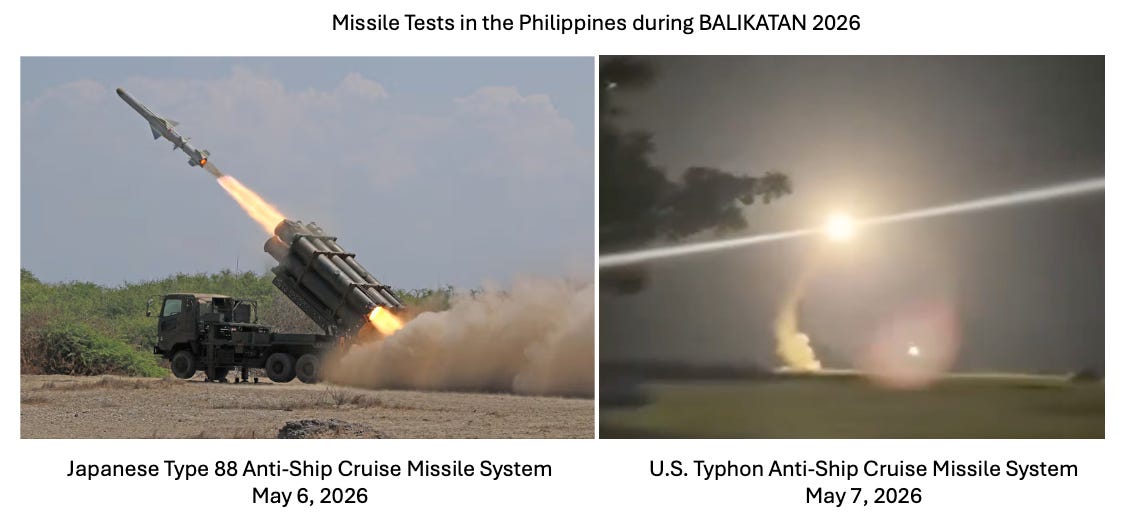
The Japanese fired their Type 88 surface-to-ship cruise missile system in the Philippines during the exercise just as the United States test fired their anti-ship Typhon missile system for the first time in the Philippines (the U.S. Army had deployed the Typhon to the Philippines during the Biden Administration… see my September 15, 2024 post about it: “Behold, the Typhon! Ode to the humble HEMTT”)
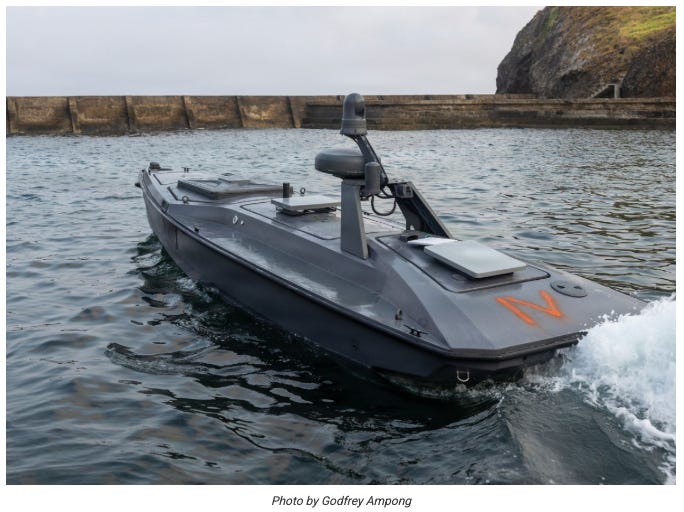
Also during the exercise, Green Berets from the 1st Special Forces Group tested what appeared to be a Ukrainian-made unmanned surface vessel off the west coast of the Philippines by delivering a shaped charge to disable a target vessel.
This was all meant to send a very clear message to Beijing… you aren’t the only ones who can impose Anti-Access, Area-Denial (A2AD) within the First Island Chain.
This was being done as a clear show of force, a demonstration that the United States and its allies could defend against a PLA amphibious assault, and it was important for two reasons.
First the timing. An exercise of this size and scale requires months of planning and preparation. At least since Trump’s meeting with Xi in October, it was known that this exercise would take place either just after a Trump-Xi Summit or just before it. It does not appear that the U.S. military was forced to pull any punches during this exercise in order to create a “friendly atmosphere” for the summit… I’ve personally seen how summit preparations between Chinese and American leaders have forced the U.S. military to scale back exercises during other Administrations.
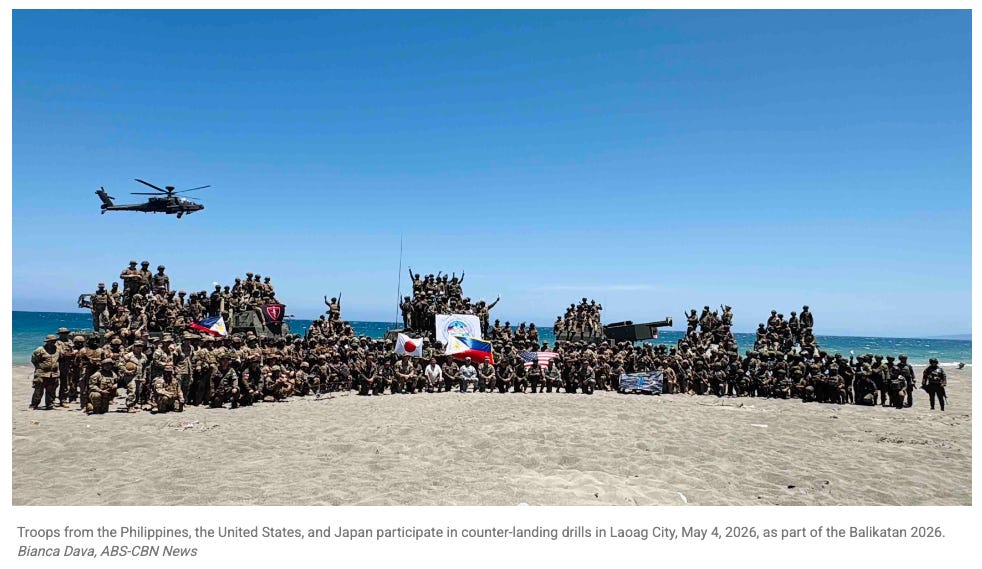
The second is the large involvement of Japan. As mentioned above, this was the first major deployment of Japanese troops to the Philippines since the Second World War. This was especially significant given that the Japanese Prime Minister has publicly committed that Japan would be forced to get involved militarily if the PRC attacked Taiwan. By involving Japan at such a scale and so publicly, six months after her statements invoked outrage from Beijing and retaliation, it comes across as quite clear that the United States welcomes Japan’s military involvement. I’m certain that Xi complained bitterly to Trump about so-called “Japanese militarism,” but this picture should serve as proof of America’s position on the matter.
So, what’s my assessment of where we are?
I feel confident that the Trump Administration is taking the military threat from the PRC seriously and is effectively working with its allies and partners to deter against an attack by the PRC against its neighbors, including Taiwan. This does not mean that the PRC will give up. Beijing will continue to rely on so-called “grey zone” activities to gain an advantage or to put pressure on their neighbors. Beijing will also use economic and political coercion to punish those who stand-up for their own interests. However, over time these tactics by Beijing should only strengthen the collective security architecture arrayed against them.
I believe that Secretary Hegseth and his military commanders have clear guidance from the White House to pursue this approach and that they will be resourced effectively by Congress.
I also think that Deputy Secretary Steve Feinberg is quietly rebuilding the U.S. defense industrial base and that the United States will be in a much stronger position over time, regardless of the outcome in the Strait of Hormuz.
I believe that the State Department under Secretary Rubio is delivering complimentary messages to allies and partners that the U.S. is committed to collective security and cooperation, but that those partners must be equally committed to common interests and be willing to invest their own blood and treasure as well.
I also believe that the Treasury Secretary and the U.S. Trade Representative are serious and focused on addressing the harms caused by the PRC to the United States and are working with other countries to curb Beijing coercive power. They are tough on allies and partners, but they both understand that the principal harm to the global economy emanates from the PRC, a mercantilist, non-market economy that abuses the global trading system for its own benefit.
But it looks like the Commerce Department, under Howard Lutnick’s leadership, is working at cross-purposes with the rest of the Administration. They appear to have been captured by one segment of the technology industry and have been enabling the PRC’s advancement in artificial intelligence and other high-tech fields. Perhaps this springs for guidance from the President, but I suspect it emerged more from disfunction rather than design. Congress needs to mount a serious and sustained investigation into the Commerce Department and its Bureau of Industry and Security.
***
If you find this newsletter useful, please consider becoming a paid subscriber below.
Thanks for reading!
Matt
MUST READ
Beijing’s ‘Industrial Policy of Everything’ Leaves Rest of the World in the Dust
Greg Ip, Wall Street Journal, May 15, 2026
Government support encompasses the old, the new, goods and services, micro and macro. Nothing Trump elicits in China will change this.
In the decades since China joined the world economy, U.S. presidents have traveled to Beijing with a predictable list of demands: stop stealing American intellectual property, don’t force technology transfer, open your markets. Donald Trump followed the script on his previous visit in 2017.
Whether he does so again this week, it would be pointless. Those demands reflect a view of Chinese industrial policy (broadly, government support for favored sectors) that is woefully out of date.
Xi Jinping has elevated Chinese industrial policy into something the world has never seen. It targets almost every industry and region, demand as well as supply, services as well as goods, the sophisticated and the mundane. Its goals are economic, technological and strategic. Its tools are microeconomic and macroeconomic.
There is no obvious solution. Trump has reportedly secured agreements by China to purchase soybeans, energy and aircraft, withhold military equipment from Iran, and open up more to American business. But none of this will stop China from swallowing ever more global market share.
Rhodium Group, a research organization, in a sobering new report prepared on behalf of the U.S. Chamber of Commerce and released this week, identifies the key features of what it calls China’s “industrial policy of everything.”
Prioritize everything
Many Chinese products now match or beat Western competitors on quality and price without government help. Yet rather than dial back support, Beijing keeps broadening it. The country’s five-year plan issued in 2021 listed 19 priority sectors. The latest, released in March, lists 24, adding “brain-computer interfaces” and “nuclear fusion energy.”
While sexy products such as smartphones and electric vehicles hog the limelight, China’s ambitions also cover the mature and the mundane.
The “Made in China 2025” plan released in 2015 that caused so much consternation in the West earmarked 10 industries for self-sufficiency. The update issued in 2023 dropped one and added seven, including mature industries such as household appliances and textiles.
Chemicals are a good example: Global exports of tetrachloroethylene, used in dry cleaning, have risen 25-fold since 2019. Exports of o-Xylene, used in plastics and coatings, have climbed 12-fold.
Chemicals also illustrate the emptiness of China’s promises to cut back on overcapacity (dubbed involution), which has depressed prices and profits. Rhodium reports that a 2025 directive promised to address petrochemical overcapacity, but only plants more than 20 years old were targeted, accounting for 5% to 6% of capacity. Far from shrinking output, the plan aimed to shift the industry from bulk to high-value chemicals and boost output 5% a year.
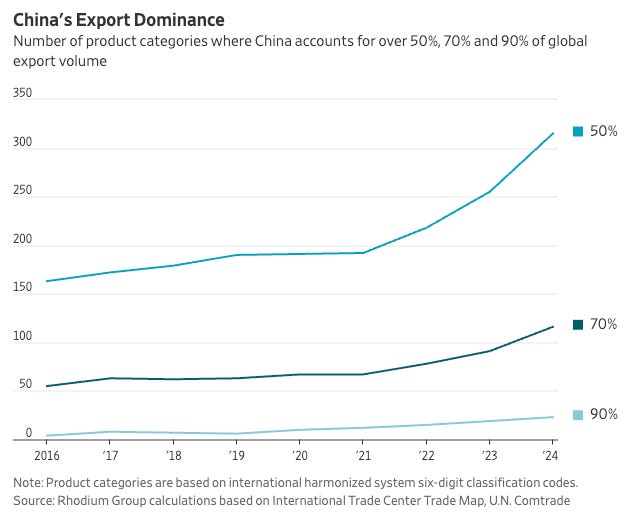
Rhodium reports that once Chinese firms reach technological parity with their competitors, they take market share at breathtaking speed. The result: In 2016, Rhodium estimates, China controlled more than 50% of export volumes in 163 industries, out of about 2,000 for which data is available. By 2024, that had risen to 315.
Managing demand, not just supply
China’s massive trade surpluses are often attributed to chronically weak domestic demand. Yet China can create demand when it wants. To nurture its drone industry, Beijing encourages numerous sectors, including agriculture, local government and tourism, to integrate drones, “complemented by public investment in enabling infrastructure, including the use of local government special bonds,” Rhodium writes.
Xi once regarded services as inferior to the “real” economy. Not any more. A series of state directives since 2024 have singled out high-value services such as biopharma contracting, which conducts testing, research and development and manufacturing for multinational drug companies. It saw sales double between 2018 and 2022, and they are projected to double again by 2027, Rhodium concludes.
Chokepoints targeted
National security is integral to Xi’s industrial policy. Eliminating imports makes China less vulnerable to foreign pressure, while increasing export market share makes others more vulnerable to Chinese pressure.
Thus, Xi prioritizes “chokepoint” products that are critical to larger supply chains, such as organic chemicals and machinery, Rhodium reports.
China routinely retaliates against unfriendly governments by weaponizing its market—that is, shutting out their exports. Weaponizing chokepoints is more potent, with the potential to shut down entire production lines. Even the U.S., the only economy large enough to resist Chinese pressure, sought a trade-war truce when China imposed export controls on rare earths and critical minerals. “As dependence on China increases, the capacity of foreign governments to mitigate that dependence diminishes,” Rhodium warns.
The pervasive nature of China’s industrial policy makes it difficult for competitors to counter. Trump’s tariffs, for example, have driven down the U.S. trade deficit with China. But China has redirected exports to other markets. And because Chinese inputs are omnipresent in global supply chains, the value of Chinese content entering the U.S. can remain steady even as imports drop.
This could be addressed through tariffs on Chinese content, regardless of where the product originated, or through tighter rules of origin, a particular thrust of Trump’s trade negotiators.
But that wouldn’t solve the competitive threat. The U.S. could ban every Chinese-made product, but those products would keep gaining market share abroad, threatening American leadership. For example, Chinese electric vehicles may incorporate Chinese software and artificial intelligence. As those EVs gain market share abroad, Chinese software and AI may supplant U.S. rivals as the global standard.
This calls for a joint response by all market-based democracies to Chinese industrial policy. But U.S. allies’ willingness to coordinate with the U.S. on China, never high to start with, has eroded further under Trump.
Waiting for China to fail
The Achilles’ heel of Chinese industrial policy is its cost and waste. China runs bigger budget deficits relative to economic output than the U.S. Outside advanced manufacturing, the economy is moribund, weighed down by debt, deflation and aging demographics.
Many critics thus expect, even hope, that Chinese industrial policy will eventually implode under the weight of its own contradictions.
But there is no guarantee that will happen soon. To paraphrase an adage about markets, China can stay irrational longer than foreign competitors can stay solvent.
COMMENT - Great analysis from Greg Ip.
Europe Is Edging Closer to a Trade War with China. Here’s Why.
Jeanna Smialek and Alexandra Stevenson, New York Times, May 29, 2026
As cheap goods pour in, threatening the continent’s manufacturing sector, a search for solutions is becoming increasingly urgent.
Kaja Kallas, the top European Union diplomat, recently suggested that ending the continent’s dependence on China was like trying to cure a disease. “Chemotherapy” might be needed, she said, and it was likely to be painful.
The comments were an example of the tone Europe is increasingly taking on China, the second-largest goods trading partner for the 27-nation European Union, after the United States.
As Beijing adopts more aggressive trade policies and as imports from China into Europe soar, European leaders and companies are fretting over their reliance on Chinese products — and debating how to pull back. With China only growing more dominant in manufacturing, Europe sees an existential threat to its own industries.
“The tone is basically panic,” said Jeromin Zettelmeyer, director of Bruegel, an economic think tank in Brussels. “There’s a sense of imminent collapse of industry, of imminent danger.”
Anxiety in Brussels is being met with hostility in Beijing, where officials warn that China will hit back at any protective measures. The sparring is likely to heat up further in the coming weeks.
World leaders will talk about global economic imbalances at a Group of 7 meeting in Evian, France, next month. China is then expected to be on the agenda at a meeting of the European Union’s 27 top leaders shortly after.
On Friday, the European Union’s executive arm is expected to have an early debate on policies toward China that could help to set the tone for the coming discussions.
European officials still express hope that they might be able to work cooperatively with China to alter trade imbalances, which have become more pronounced as Beijing has dialed up exports to juice economic growth. But they are also mulling more powerful trade and industrial measures to curb China’s growing dominance in sensitive fields.
Cutting back on China could prove profoundly tricky for Europe. Politicians and businesses fear retaliation, and consumers are hooked on what China is selling. Europeans continue to snap up cheaper Chinese goods, especially electric vehicles, which the European Union has already tried, unsuccessfully, to stop from flooding their market.
COMMENT – This is a rhetorical question, but why are European leaders so scared to do what they must obviously do at some point in the near future?
After the Trump-Xi Meeting in Beijing: a Fragile “Strategic Stability”
François Godement, Institut Montaigne, May 20, 2026
In today’s world, where so much interpretation depends on media communication, the Trump-Xi meeting of May 14-15 is a prime example of how some events can be misunderstood. The principals themselves have communicated sparingly - least of all, China, which is par for the course, but also Donald Trump. He has been more restrained than usual, even including a Fox interview and the few juicy quotes he made aboard Air Force One on the flight back to Washington.
Overall, the biggest surprise is the absence of surprises. Xi gave all the proper signs of decorum to the U.S. president, including a visit to his inner-sanctum residence at Zhongnanhai. Donald Trump, for his part, did not depart from his official speech at the state banquet, and exhibited gushing praise for Xi. There were no speeches or huddles with any crowd, large or small. The only minor recorded incident was an isolated security scuffle. Human rights were absent from the agenda, save a mention ofJimmy Lai (”a tough one” for Xi, Trump added), and of a pastor who had been released.
The Western press had emphasized Trump give ins, but China’s main strategic partners exhibit worry
Of course, other heads of states and governments, including from allied countries and close partners, may feel they are treated far more harshly by the U.S. president than autocratic rulers are. Yet China’s quasi-allies, from Russia to Iran and North Korea, must be looking over their shoulder for signs of a letdown by China, their number one houtai (a backstage supporter, as the Chinese customary saying goes).
The Western press had emphasized Trump give ins, but China’s main strategic partners exhibit worry.
Some of them are reacting preemptively. Iran seized a Chinese tanker in the Hormuz Strait on May 8 and attacked a Chinese armory supply ship on the first day of Trump’s visit, May 14. For good measure, a Shahed drone supplied by Iran was reportedly used on May 18 in an attack against a Chinese ship bound for Ukraine in the Black Sea. On May 15 - only hours after Trump said that Xi had promised not to supply weapons to Iran - an Iranian spokesman cited an Arabic proverb: “He who betrays in secret will be exposed in public”. Iranian discontent may extend as much to China’s increasing weapon sales to Saudi Arabia and the UAE as to the outcome of its meeting with Donald Trump. But these actions should not be dismissed as random. Iran has also targeted French and Indian ships immediately after the first convening in Paris on April 17 of an international group of nations (prominently including India) seeking a negotiated and defensive solution to reopen the Strait of Hormuz; Iran is signaling that it does not welcome pressure by third parties.
Russia, whose ruler is likely coming for reassurance to Beijing on May 19-20, has also let out some public anxiety about China’s behavior. On May 16, RT, the official Russian network and media, published a criticism of China: “China still often behaves as though it can enjoy the benefits of strategic partnership without fully committing itself to the burdens that come with it”. It’s indeed very rare for Russia to acknowledge such sentiments publicly, which apply so well to China’s lesser partners such as Venezuela, Cuba or Iran.
These signs should caution us against the current wave of comments according to which the U.S. has given away the store, without extracting concessions from China. China has its own calculus, certainly very different from the current U.S. negotiating style. It looks very carefully at trade-offs and does its best to assess the exact weight and punch of every partner. It is in fact better at gauging similarly authoritarian regimes than fickle democracies, including the United States. Iran and Russia seem to have their own suspicions.
COMMENT – Great analysis by François Godement.
Weaponizing Interdependence
Brad W. Setser, Council on Foreign Relations, May 25, 2026
China’s stunning rise, and its global lead in manufacturing, have raised questions about both the nature of economic power and the United States’ continued economic preeminence. In one sense, there is not much reason for debate: the U.S. share of global output has been remarkably constant over the last forty years. China’s rise, though extraordinary, has statistically come at the expense of the other Group of Seven (G7) countries. And U.S. financial markets, or at least its equity market, account for a larger share of any global stock index than at any point in the last fifty years.
But that misses enormous changes in how sources of economic leverage are conceived and defined. Ten years ago, conventional wisdom held that economic power flowed from creating rules and influencing global institutions. The central argument, at least in Washington, was that the United States could leverage its 20 percent share of the world economy to write nearly 100 percent of global economic rules and simultaneously maintain controlling stakes in the key international financial institutions.
But China had no intention of playing by rules it did not write. Beijing, therefore, ignored the rules and played by its own, achieving significant industrial and technological successes. An outstanding example is its creation of a world-leading electric vehicle industry, shielded by a tariff wall and nourished by large state subsidies. Even in the United States, political support for many of the established rules has been weakened by the sense that they were written primarily to benefit a narrow slice of the U.S. population.
The old thesis of sources of economic power has lost intellectual dominance. Now, economic power is instead largely conceptualized through the logic of weaponized interdependence. There have been lively debates over when interdependence becomes dependence, when dependence needs to be reduced or simply managed, and whether states can deter other states from weaponizing their economic chokepoints.
As those debates played out, President Donald Trump started his second term by weaponizing access to the U.S. consumer market. Traditional trade deals—where both parties reduced barriers—were shunned, and the constraints of legacy trade agreements were cast aside. The goal of Trump’s second-term tariffs was not to negotiate new global rules for trade, but to compel U.S. trading partners to accept unequal terms. The United States raised tariffs, and other countries agreed, albeit reluctantly, not only to refrain from raising their own tariffs in retaliation but also to reduce their own tariffs. The European Union, though, argues it did so because of its dependence on the United States for security, rather than its dependence on the U.S. market.
The most important development of 2025, though, was that China did not accept a deal akin to the one the United States hashed out with the EU in Turnberry, Scotland, where the Trump administration forced Europe to accept high tariffs in exchange for access to the U.S. market. Beijing pushed back forcefully against Washington’s demands and ultimately was able to convince the administration both to roll back its tariffs and to narrow certain proposed export restrictions. China did so by walling off its market to U.S. goods, counting on pressure from the farm states that rely on the Chinese export market to moderate U.S. demands (its playbook from Trump’s first term). It also weaponized its dominance of the supply chains needed to produce rare earths and other critical minerals, laying out comprehensive export controls that threatened to shut down the U.S. auto industry and complicate military production. This Chinese action established a precedent that in many ways is more important than the Trump administration’s decision to disregard the United States’ WTO tariff commitments and raise tariffs to levels not seen since the 1930s.
It is worth noting that China’s response to U.S. tariff threats came through its control of key supply chains, not through its weaponizing of U.S. bond holdings. That fact alone suggests that transforming finance into leverage to achieve strategic goals is harder than often assumed. Further evidence can be seen in the great difficulty that China has had in converting its Belt and Road lending into enduring influence. Ecuador, for example, took a great deal of Belt and Road money to build hydroelectric dams without ending up permanently in China’s orbit. And when Zambia defaulted on loans from China’s Export-Import Bank and other state banks, it ended up reducing China’s leverage over the country, rather than increasing it.
The relative weakness of finance as leverage could also be seen following the financial sanctions that G7 countries imposed on Russia after its 2022 invasion of Ukraine. Even though those were among the strongest possible financial sanctions, they did not hinder Moscow’s ability to fight. Rather, its aggression against Ukraine continues four years after its reserves were frozen and its access to new international lending entirely cut off.
The reality is that most countries do not depend on either U.S. financial markets or the U.S. government for funding. Instead, the global flow of capital is overwhelmingly into the United States, not from the United States to the rest of the world. Wall Street’s core work is mobilizing global funds to invest in the U.S. economy, not mobilizing U.S. funds to invest globally. Countries that fund the United States aren’t necessarily going to be deterred by the prospect that they cannot raise funds in the United States, and the United States has been less willing to impose sanctions limiting new inflows into the U.S. bond market than to try to raise a toll for access to the U.S. consumer market.
One reason Russia survived heavy Western sanctions is that it did not need access to either its accumulated foreign currency reserves or new U.S. or European financing to prosecute its war against Ukraine. So long as there were buyers for Russian oil exports, the Kremlin would be fine. China is in a similar position; its industrial, technological, and strategic goals can be financed entirely out of the country’s large domestic savings. Its state banks fund the rest of the world out of domestic savings, not the other way around.
The United States still has unrivalled influence over the global economy. But U.S. leverage is not unlimited. The United States faces a determined rival with many cards of its own to play. It isn’t in a position to use its economic leverage to impose any vision of a global economic order on China, let alone use its economic pull to integrate China into a strategic order. Nor have the consequences of a world where the two leading economic powers have weaponized supply (as China has) and demand (as the United States has) been fully digested by the rest of the global economy. The old global economic order is dying; a new one has yet to be born.
COMMENT - Over time, we are likely to get a two-tiered trading system. Some sort of GATT 2.0 adopted by the countries that would like to benefit from a reciprocal trading system and one for the PRC and those in the PRC’s orbit.
New Chinese surveillance leaves foreigners nowhere to hide
De Zheng, DW, May 24, 2026
A Chinese cybersecurity expert has revealed to DW details of China’s new high-tech policing. From ski resort facial recognition to seats on a train, the system can track anyone and compile a “holistic profile.”
When a cybersecurity researcher known by the pseudonym NetAskari recently clicked on a tab labeled “Inquiry for journalist files” on an unsecured Chinese web dashboard, he expected to see a jumble of auto-generated mock data.
Instead, familiar faces popped up on the screen. It was a comprehensive database of almost every foreign journalist based in Beijing around 2021, including official passport photos taken at the entry/exit bureau, private cellphone numbers, visa details and dates of birth. He also found his own exact personal information lying dormant on this Chinese police watch list.
“It was more interesting than shocking,” NetAskari told DW. “When you work as a journalist in China, you basically assume you are always on their radar. But what surprised me was simply how easy it was to access this highly sensitive system.”
China’s granular system of social control
What NetAskari had stumbled upon is part modern China’s emerging system of “holographic profiles.”
He had unwittingly accessed a demonstration version of a remote tracking system designed for the Public Security Bureau in Zhangjiakou, the Hebei province city that hosted the 2022 Winter Olympics.
Though it was only a test panel, it was populated with real datasets, clearly outlining the trajectory of China’s state surveillance machine, which is rapidly evolving from a network of simple street cameras into a data-fused, 24/7, predictive social control behemoth.
For years, China has operated the world’s most extensive CCTV network. A massive initiative known as the “Xueliang” (Bright Eyes) project aims to merge these isolated islands of surveillance spread across the country.
But the data on the Zhangjiakou police dashboard shows the granular detail with which authorities can track an individual.
This system no longer relies solely on police cameras on street corners; it accurately records the specific train carriage and seat number a target occupies when arriving from Beijing or Shanghai, for example.
It even synchronizes photos taken by facial-recognition ticket gates at local ski resorts directly into its tracking mechanism. The movements of the researcher’s acquaintances who recently skied in Zhangjiakou were precisely flagged and mapped out with detailed trajectories in the system.
“The idea is simply to process as much data as possible from as many sensors as possible in real time,” the researcher noted.
The system logs daily behaviors like gasoline consumption, regular shopping locations and whether an individual frequently visits “petition areas.”
This massive data-fusion effort attempts to stitch together a person’s physical whereabouts, consumption habits and digital footprints into a flawless “holistic personnel archive.”
Tracking foreign journalists
Within this increasingly airtight net, foreigners — especially journalists and other citizens from Western countries — are being looked at more by authorities.
The system’s “smart report” statistics shows Chinese security agencies disproportionately focus on citizens from the “Five Eyes” countries, comprising the US, the UK, Australia, New Zealand and Canada.
Deep in the backend, certain foreign journalists are assigned a special real-time tracking tag called “trackable.” The moment they step into a jurisdiction, the system can automatically trigger early warnings for the police.
For independent journalism in China, this is an existential threat.
In the past, foreign reporters traveling to sensitive regions such as Xinjiang often relied on experience to shake off plainclothes police trailing them in the rearview mirror. Now, algorithmic upgrades to the policing system render this traditional cat-and-mouse game obsolete.
“They don’t need to send two or three cars to follow you anymore,” NetAskari said.
Because the system has access to your mobile payments, ticket purchases and social networks, authorities can perfectly anticipate your itinerary, ensuring you only see what they want you to see upon arrival.
If the data network detects you interacting with certain individuals, police can simply call and intimidate your sources behind the scenes. In this perfectly closed surveillance loop, the concept of an “under-the-radar investigation” is being systematically eradicated.
System knows where you’ll be
What truly transforms this surveillance is the system’s capability for group analysis and relationship modeling.
Traditional tailing requires immense police resources. But modern “smart policing” attempts to visualize interpersonal relationships through algorithms.
In the dashboard’s core, the system automatically generates intricate network graphs based on how frequently targets are captured interacting on camera, revealing exactly who knows who, and how much time they spend together.
This technology has been in development for years. In 2019, Chinese tech giant Hisense filed a patent for “holistic relationship models for people involved in cases,” which aimed to map out travel, call records and vehicle usage. In 2025, the Shanghai Putuo Public Security Bureau awarded a $200,000 contract for a “Holistic Personnel Archive System.”
The high error rates and manpower bottlenecks of past manual surveillance methods are rapidly being replaced by cold, highly efficient and tireless automated algorithms.
State Media Control Influences Large Language Models
Hannah Waight Eddie Yang, et al, Nature, May 25, 2026
Millions of people around the world query large language models for information. While several studies have compellingly documented the persuasive potential of these models, there is limited evidence of who or what influences the models themselves, leading to a flurry of concerns about which companies and governments build and regulate the models. We show through six studies that government control of the media across the world already influences the output of large language models (LLMs) via their training data. We use a cross-national audit to show that LLMs exhibit a stronger pro-government valence in the languages of countries with lower media freedom than those with higher media freedom.
This result is correlational so to triangulate the specific mechanism of how state media control can influence LLMs, we develop a multi-part case study on China’s media. We demonstrate that media scripted and curated by the Chinese state appears in large language model training datasets. To evaluate the plausible effect of this inclusion, we use an open-weight model to show that additional pretraining on Chinese state-coordinated media generates more positive answers to prompts about Chinese political institutions and leaders. We link this phenomenon to commercial models through two audit studies demonstrating that prompting models in Chinese generates more positive responses about China’s institutions and leaders than do the same queries in English. The combination of influence and persuasive potential across languages suggests the troubling conclusion that states and powerful institutions have increased strategic incentives to leverage media control in the hopes of shaping large language model output.
China is building launch pads near its nuclear missile silos
Greg Torode, Laurie Chen, and Vijdan Mohammad Kawoosa, Reuters, May 29, 2026
In a remote Chinese desert, a vast military complex is taking shape that some security scholars say appears built to ensure no American first strike on China’s nuclear arsenal could reliably knock out Beijing’s ability to hit back.
China’s nuclear missiles can already reach any city in the United States. Now, satellite images reviewed by Reuters show Beijing is building a sprawling web of launch pads, bunkers and communications nodes near the isolated nuclear silos that hold the Chinese military’s longest-range missiles.
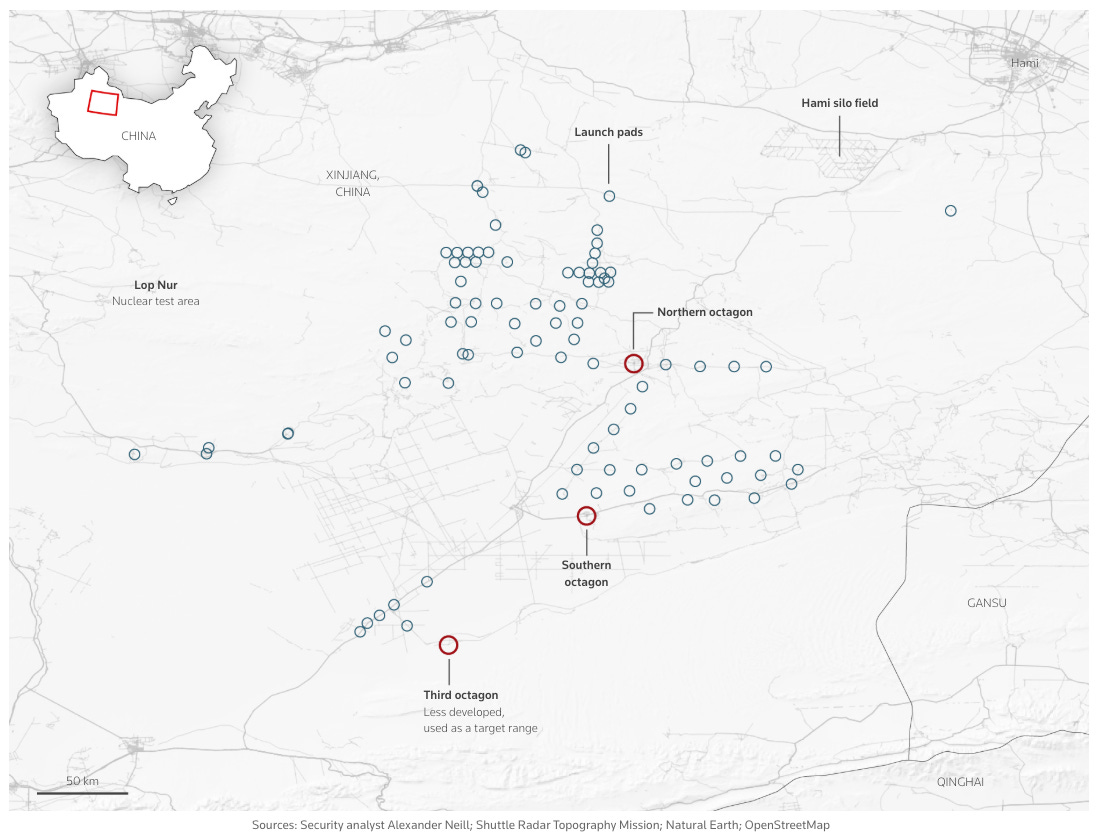
The images reveal more than 80 pads for possible use by China’s expanding fleet of mobile missile launchers and air-defense batteries. They also show facilities that may serve electronic warfare, satellite communications and command operations, according to three security analysts, who assessed the imagery for Reuters.
The scale of the construction, which hasn’t been previously reported, points to a sweeping expansion of hardened infrastructure designed to protect and operate China’s land-based nuclear forces. Taken together, the network signals a significant upgrade in Beijing’s efforts to ensure second-strike capability, underscoring intensifying nuclear competition with the United States as tensions rise over issues such as Taiwan’s sovereignty.
“We can see this infrastructure is being built on a grand scale, covering thousands of square kilometers of desert beyond the silo fields,” said Alexander Neill, an adjunct fellow at Hawaii’s Pacific Forum think tank. Depending on the precise capabilities, he said, “we’re looking at a very considerable enhancement and diversification of China’s strategic nuclear deterrent.”
The ability to protect its desert silos is key to China’s stated goal of forging a minimal but credible nuclear deterrent — a policy grounded in the capacity to retaliate if it is struck first. While the People’s Liberation Army can fire nuclear weapons from submarines and aircraft, the silo fields in the northwestern Xinjiang region and Gansu province are the core of its nuclear forces.
China’s nuclear build-up is among the most scrutinized facets of President Xi Jinping’s military modernization because of what some foreign diplomats describe as Beijing’s lack of transparency and failed efforts by the United States to engage the Chinese leadership on its evolving nuclear capabilities and intentions.
A cornerstone of China’s doctrine is its “no first use” policy, meaning its forces wouldn’t initiate a nuclear exchange. But some senior Western diplomats and analysts say China would possibly resort to nuclear coercion to limit outside involvement in a conflict over Taiwan.
Xi this month warned U.S. President Donald Trump that mishandling of their countries’ disagreements over Taiwan, which China claims as its territory, could lead them to a “dangerous place.” Taiwan’s government rejects China’s sovereignty claim.
China’s defense ministry didn’t respond to questions about its nuclear program and the developments revealed in the satellite imagery. The Pentagon said it wouldn’t comment on intelligence-related matters.
OCTAGONS IN THE DESERT
The new desert infrastructure is centered on two octagon-shaped installations built over the past six years in eastern Xinjiang. Both are southwest of the Hami nuclear silo fields – one is about 140 kilometers away, the other some 230 kilometers.
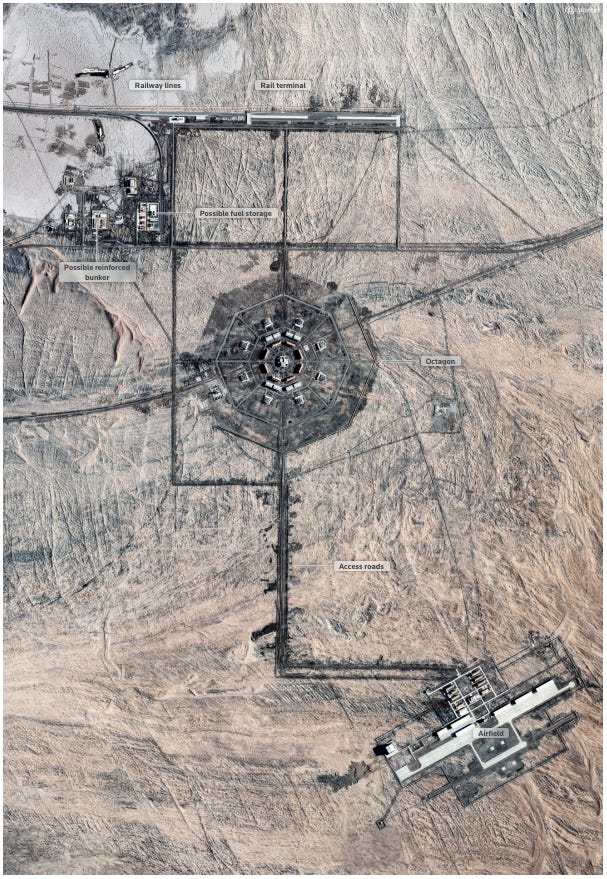
Satellite images show the octagon structures contain housing for personnel and large military vehicles.
They are flanked by armored bunkers and fortified weapons-storage areas, as well as airfields and railheads that link the octagons to the Hami silos.
Exercises involving large military vehicles occurred around the northern octagon this month and during April, the images show. Also evident in recent images are large tents and what two analysts said appear to be camouflaged launch sites cut into the desert, some with air-defense missile batteries.
COMMENT – Just so we are all clear about what these things are for. These are being constructed by Xi Jinping to incinerate American cities and to kill tens of millions.
Authoritarianism
China’s Xi gives Putin a red-carpet welcome – and makes a veiled jab at the US
Simone McCarthy, CNN, May 20, 2026
The Supplicant and the Sovereign
Alicia García-Herrero and Elina Ribakova, The Wired China, May 21, 2026
China and Russia: the uneasy couple
Francesco Sisci, Asia Times, May 21, 2026Putin’s China Visit Long on Words, Short on Wins
Micah McCartney, Newsweek, May 22, 2026
The nearly 10,000-word joint statement released after this week’s Russia-China summit projected a partnership of growing depth and ambition.
Yet despite the document’s sweeping scope and dozens of agreements, Russian President Vladimir Putin left Beijing with few major new deliverables in hand, analysts said.
‘Multipolar world’: What Xi and Putin announced after Beijing summit
Sarah Shamim, Al Jazeera, May 20, 2026
How China quietly helps Russia in Ukraine
The Economist, May 14, 2026Verity Bowman, The Telegraph, May 29, 2026
Deep in the Russian republic of Tatarstan, far from the front line and away from scrutiny, a factory complex has quietly become the engine of the most intensive drone war in history.
The Alabuga Special Economic Zone has grown to the size of a small city, with dozens of new buildings, housing for tens of thousands of workers, and production lines running 24 hours a day.
In 2023, the zone was producing around 10 Shahed-136 drones a day. Today, that figure is 404.
But while the drones are made in Russia, the country making that growth possible is China.
Beijing has been supplying Russia with the majority of the components needed to build Shahed drones, including microchips that function as the drone’s brain.
And the scale of China’s support has allowed Russia to break records in drone production and strikes on Ukraine.
“China is effectively the number one backer of Russia’s military-industrial complex,” Spencer Faragasso, a senior fellow with the Institute for Science and International Security, said.
“It has enabled Russia, and provided it with the means to build its weapons. In effect, from my point of view, China is absolutely part of this war, and it cannot fully distance itself from it.”
Every night, Ukrainians wake to the sound of what they have come to call the “flying moped”, the distinctive lawnmower-like sound of a Shahed-136 drone hunting for a target.
Cheap enough to produce in the thousands and slow enough to evade radar by flying low, the drones are designed to saturate Ukrainian air defences, overwhelming interception systems so that the ballistic and cruise missiles flying alongside them can reach their targets.
Russia launched more than 8,000 of them last month alone, the highest monthly total since Vladimir Putin launched the invasion of Ukraine in February 2022.
China Expands Travel Curbs to Top AI Talent at Private Firms
Bloomberg, May 26, 2026
China is restricting overseas travel for top AI professionals in private firms such as Alibaba Group Holding Ltd. and DeepSeek, suggesting an escalation in measures intended to safeguard its technology and catch up to the US in a pivotal sphere.
Government agencies have begun imposing restrictions on individuals involved in advanced AI work and considered strategically important to the country, people familiar with the matter said. That means they need approval from relevant authorities before embarking on overseas travel, the people said, asking for anonymity to discuss a sensitive issue.
COMMENT – I can’t imagine a better way for the CCP to encourage that their best and brightest flee the country.
Why the era of the 3 joint US-China communiques may be ‘completely’ over
Orange Wang, South China Morning Post, May 25, 2026
‘Unrealistic’ to expect Beijing and Washington to reach comprehensive understanding on Taiwan, prominent mainland analyst says.
The era when the three joint communiques set the terms of US-China relations may have “completely come to an end”, a prominent Chinese analyst has warned.
Zhu Feng, dean of Nanjing University’s School of International Studies, also said that it might be “unrealistic” to expect Beijing and Washington to reach a comprehensive political understanding on Taiwan, given US domestic politics.
Following Chinese President Xi Jinping’s highly anticipated summit with US counterpart Donald Trump earlier this month, Beijing announced that the leaders had agreed to build a “constructive relationship of strategic stability”, calling it a major milestone.
The White House later echoed the phrase, adding that it should operate “on the basis of fairness and reciprocity”.
China lifts peacekeeping budget share amid warnings bodies like UN may be sidelined
Seong Hyeon Choi, South China Morning Post, May 25, 2026
Germany urged to stop admiring Beijing and wake up to ‘China Shock 2.0’
Lisa O’Carroll, The Guardian, May 20, 2026China Threatens to Launch Trade Probes Against the European Union
Wall Street Journal, May 29, 2026
The heating up of rhetoric comes as European officials are scheduled to discuss ramping up the bloc’s trade defenses.
Beijing threatened to launch trade probes against the European Union if the 27-member bloc pushes ahead with a proposal to curb imports of heavily subsidized foreign products.
Chinese authorities could initiate anti-discrimination and supply-chain security investigations into the EU’s “overcapacity instrument,” a social media account run by China’s state broadcaster said Friday, citing unnamed sources.
If the EU advances the tool, China will take immediate action and deploy comprehensive countermeasures, it added.
The heating up of rhetoric comes ahead of European officials meeting for closely watched talks on Friday to discuss ramping up the bloc’s trade defenses—a move widely seen as aimed at shielding critical industries from Chinese rivals.
European leaders hold the view that China’s global industrial dominance is a result of decades of government subsidies and non-reciprocal market access. In a joint paper seen by Dow Jones Newswires foreshadowing the talks, five EU member states including France, Spain and the Netherlands called for the bloc’s executive arm to launch more probes into potentially unfair trading practices, be proactive when disputing alleged breaches at the World Trade Organization, amend existing rules to prevent businesses from circumventing them, and allocate more resources to its trade policy unit to tackle a surge in investigations into dumping and subsidies.
COMMENT – Why does the PRC so aggressively threaten Europe with retaliation? Because, based on years of experience, it works!
Designated protest area at Hong Kong legislature being used as car park
Tom Grundy, Hong Kong Free Press, May 20, 2026
Tom Grundy, Hong Kong Free Press, May 19, 2026
CCP-Linked Transnational Crime and the Rise of a Distributed Threat to U.S. National Security
U.S. House Select Committee on the CPP, May 21, 2026
Leaked: The secret Chinese surveillance programme tracking people like me
Sophia Yan, The Telegraph, May 19, 2026Chinese authorities arrest 97 Tibetans in the name of “Cybersecurity Law”
Tenzin Lhadon, Tibet Post, May 12, 2026
U.S. Warns of Growing Russian and Chinese Spying in Cuba
Alexander Ward and Vera Bergengruen, Wall Street Journal, May 22, 2026
China Was Ready for the Age of Anarchy
Sam Chetwin George, Foreign Affairs, May 14, 2026
Xi Jinping railed against Japan’s ‘remilitarisation’ at Donald Trump summit
Demetri Sevastopulo, Joe Leahy and Leo Lewis, Financial Times, May 24, 2026
Trump to speak with Taiwan’s president in a new challenge for US-China relations
Bo Erickson, Reuters, May 20, 2026
Trump’s Pursuit of a Partnership with China Raises Concerns in India
Edward Wong, New York Times, May 23, 2026
Did breakthrough in US fentanyl crisis start in China?
Thomas Graham, The Guardian, May 13, 2026
How China’s Population Stopped Noticing Their Country Had Been Sealed
Guang Yang, The Diplomat, May 15, 2026
Why China Is Tightening Controls on Overseas Stock Trading
Bloomberg, May 25, 2026
China cracks down on illegal cross-border securities trading
William Sandlund and Cheng Leng, Financial Times, May 22, 2026China squeezes Japan over rare earths in repeat of 2010 showdown
Solomon Cefai, Reuters, May 22, 2026
Environmental Harms
China’s change in maths on carbon emissions masks growth, report says
Edward White, Financial Times, May 25, 2026China Energy and Emissions Trends – April 2026 snapshot
Qi Qin, Centre for Research on Energy and Clean Air, May 19, 2026
April saw coal power generation continue to rebound after its 2025 decline, as Hormuz Strait shipping disruptions weighed on China’s energy imports. Industrial value-added growth slowed markedly, solar cell production remained weak, while new energy vehicles stood out as a bright spot.
Key findings
April saw coal power rebound further despite continued growth in wind and solar. Total power generation is estimated to have risen 6.6% year-on-year, but weak wind conditions, subdued solar performance, and extended nuclear refuelling outages pushed coal power up for the fourth consecutive month. Hydropower provided some support, while gas-fired generation fell amid disruptions to gas supply linked to the Strait of Hormuz.
Weak clean power growth this year reflects not only poor weather, but also grid congestion and rising curtailment affecting wind, solar, and even nuclear output. This is exposing the structural tension between continued coal expansion and clean energy growth during a fossil fuel crunch.
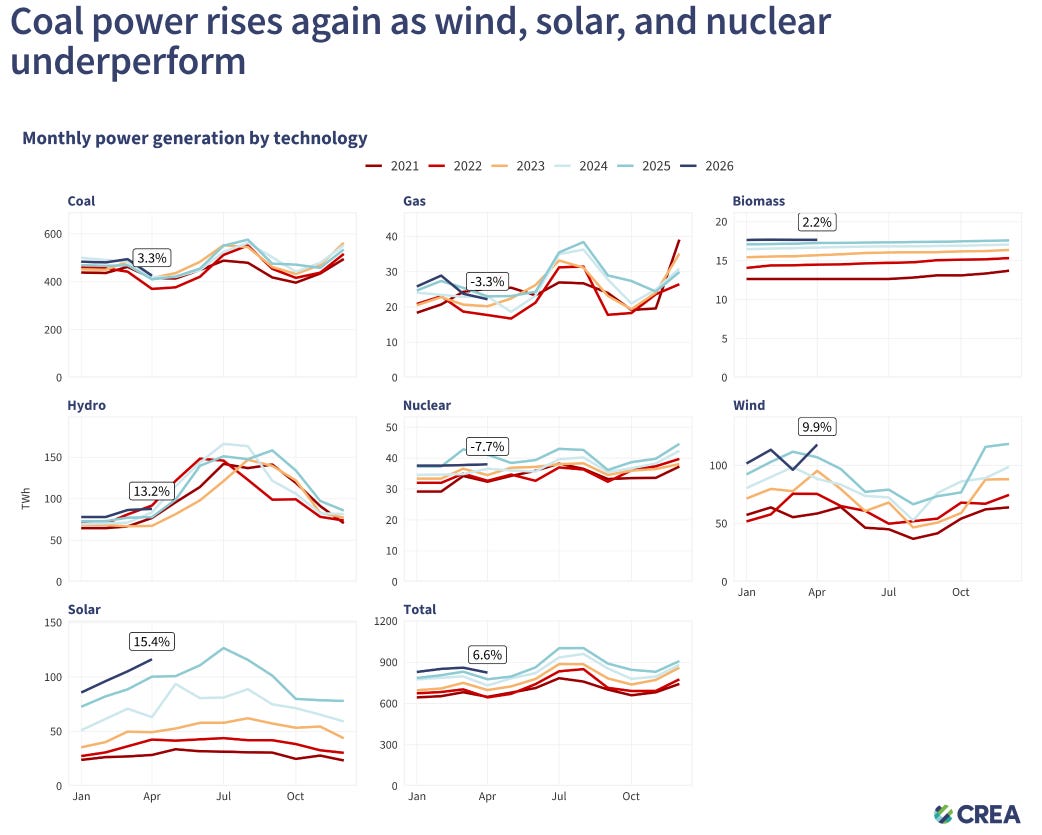
COMMENT – Power generation from burning coal outmatches every other source by an order of magnitude.
China Burns More Fossil Fuels for Power as Coal Production Slips
Bloomberg, May 17, 2026
Death toll reaches 25 in China rain, 20 more missing
Gulf Today, May 20, 2026
China Coal Mine Explosion Kills at Least 82
Raffaele Huang, Wall Street Journal, May 24, 2026
China Coal Mine Blast Tests Limits of Xi’s Energy Security Push
Bloomberg, May 23, 2026
Foreign Interference and Coercion
UK spy chief: Time is running out for the West to confront threats from Russia and China
Chloe Taylor, CNBC, May 27, 2026
Nvidia chief Jensen Huang to join board at prestigious Beijing university
Zijing Wu and Cheng Leng, Financial Times, May 28, 2026
American journalist charged with serving as unregistered agent for China
Josh Gerstein and Jacob Wendler, Politico, May 25, 2026
Why China Spies on the Suburbs
Mary Julia Koch, Wall Street Journal, May 21, 2026
The Former Air Force Pilot Who Was Allegedly Recruited to Train China’s Military
Chun Han Wong, Wall Street Journal, May 23, 2026NSB identifies thousands of ‘cognitive warfare’ posts following Trump-Xi summit
Taipei Times, May 26, 2026
Germany, Spain Push Back on European Plan to Ban Huawei Gear
Paule Doenecke, Rodrigo Orihuela, and Michael Nienaber, Bloomberg, May 27, 2026
Germany and Spain are leading opposition to European Commission plans to ban Chinese technology suppliers from telecom networks as part of new cybersecurity rules, according to people familiar with the negotiations.
Officials from the countries want to keep state-level control, and have expressed concerns that banning products from Huawei Technologies Co. and other Chinese suppliers at the EU level risks retaliation from Beijing, the people said, asking not to be identified as the discussions aren’t public. The states also warned that a ban risks making the bloc’s plans to build out artificial intelligence infrastructure more expensive, they said.
Germany Arrests Married Couple Suspected of Chinese Espionage
Laura Alviz, Bloomberg, May 14, 2026
Four of the World’s Largest Container Manufacturing Companies and Seven of Their Executives Indicted for a Global Conspiracy Affecting Billions of Dollars of Commerce
U.S. Department of Justice, May 19, 2026
Not just commercial litigation: China is trying to keep Darwin Port
Geoff Wade and Justin Bassi, The Strategist, May 15, 2026
Taiwan Seeks to Detain Three in Nvidia Smuggling Crackdown
Mackenzie Hawkins and Yian Lee, Bloomberg, May 21, 2026
Chinese ship leaves after tense standoff near Taiwan-controlled islands
Yimou Lee, Reuters, May 24, 2026
Human Rights and Religious Persecution
Hans Tse, Hong Kong Free Press, May 19, 2026
Numbers of Tibetan exiles plummet as China tightens grip
Saransh Sehgal, DW, May 20, 2026
For decades, the steady flow of Tibetans escaping across the Himalayas into India and Nepal served as a barometer of conditions inside Tibet.
From the late 1990s through the mid‑2000s, several thousand Tibetans sought exile every year, bringing firsthand accounts of political restrictions, cultural pressures and daily life under Chinese rule.
But data from the Central Tibetan Administration in Dharamsala, the de facto capital of Tibetans in exile where the 14th Dalai Lama also resides, has revealed a collapse in the number of newly arrived Tibetans
Between 1995 and 1999, more than 12,000 Tibetans successfully sought exile. In the past five years, that number has plummeted to just 81.
With fewer Tibetans able to leave, independent information is becoming scarcer. That has made Beijing’s policies, like religious regulation, language reforms, or rural relocation, more opaque to the outside world.
This comes as Beijing is increasingly promoting its own narratives on development and stability in Tibet.
Lobsang, a middle-aged man who left Tibet in 2010, said the drop in the number of exiles comes as China has tightened its grip.
“Since 2008, the security architecture within Tibet has undergone a total transformation,” he told DW.
“What we see now is a high-tech surveillance web where every village, every monastery and every household is monitored. Reaching the border is now nearly impossible for the average Tibetan,” he added.
China, Christian Prisoners of Conscience Denied Access to the Bible
Wang Yichi, Bitter Winter, May 28, 2026
Voice of Tibet, May 25, 2026
China Is Throwing Christians in Jail, but This Pastor Refuses to Back Down
Brian Spegele, Wall Street Journal, May 19, 2026Tahir Imin, Uyghur Times, May 25, 2026
Prominent Uyghur religious scholar, businessman, imam, and public speaker Abdushukur Rahmatulla Hajim has reportedly been detained by Chinese authorities.
Chinese state media outlet Xinjiang Daily announced on May 21 that Abdushukur Rahmatulla had officially been stripped of his position as a member of the 13th Xinjiang Uyghur Autonomous Region Committee of the Chinese People’s Political Consultative Conference (CPPCC), citing suspected “illegal and criminal activities.”
The statement read:
“In view of the fact that Abuduxike’er Rehemudula is suspected of violating laws and committing crimes, according to the decision of the Autonomous Region Party Committee and in accordance with relevant provisions of the Charter of the Chinese People’s Political Consultative Conference, the 15th Standing Committee Meeting of the 13th CPPCC Xinjiang Uyghur Autonomous Region Committee has decided to revoke his qualification as a member of the 13th CPPCC Xinjiang Uyghur Autonomous Region Committee.”
Abdushukur Rahmatulla Hajim previously served as vice chairman of the so-called Xinjiang Islamic Association, vice chairman of the Ürümchi Political Consultative Conference, and as a delegate to the regional political consultative body.
Denied Even the Minimum: A Falun Gong Prisoner Stripped of Basic Rights in Shandong
Song Baozhai, Bitter Winter, May 21, 2026Voice of Tibet, May 25, 2026
US Department of State calls on China to release 11th Panchen Lama of Tibet
Yangchen Dolma, Tibet Post, May 19, 2026
Industrial Policies and Economic Espionage
China Is Exporting Its Factories Across the World and Spooking the Competition
Hannah Miao and Stephen Wilmot, Wall Street Journal, May 27, 2026
More Chinese companies could be coming to the U.S. after Trump and Xi agreed to establish ‘board of investment’
Pentagon’s ‘Deal Team Six’ Aims to Challenge China’s Grip on Rare Earth Power
Kate O’Keeffe, Bloomberg, May 14, 2026
Global buyout funds to exit China’s data centres with final $1bn deal
Zijing Wu and Arjun Neil Alim, Financial Times, May 21, 2026Taiwan Suspects Nvidia Chips Smuggled to China Via Japan
Mackenzie Hawkins and Debby Wu, Bloomberg, May 26, 2026
Chinese wireless firm Quectel sues US over military designation
David Shepardson, Reuters, May 11, 2026
EU countries press for trade crackdown on China
Andy Bounds, Financial Times, May 24, 2026
China Inc goes shopping for western consumer brands
Thomas Hale, Arjun Neil Alim, Adrienne Klasa, and William Langley, Financial Times, May 22, 2026
No one wins a trade war. Or do they?
Soumaya Keynes, Financial Times, May 22, 2026
Why export restrictions have always been the best, and the worst, weapons to bring to global trade battles.
In the cold trade war between the US and China, Donald Trump is not obviously leading the winning side. When he met with President Xi Jinping last week for a much-heralded summit, trade nerds were expecting more. The two sides shared promises to co-ordinate on tariffs and swap agricultural products, but overall there was an awful lot of pomp and not very much substance.
The summit underlined that although the US may have demands of China, the Chinese no longer feel the need to placate their American partners publicly. Gone are the days when a Trumpian tariff threat can unlock a signing ceremony celebrating massive Chinese purchases. Having spent years building a mighty manufacturing machine, the Chinese have economic weapons of their own. Hit them too hard, and they’ll kneecap your industry by cutting off supplies of the critical components you rely on them to provide.
That threat is echoing around the world. The Japanese and the Europeans have their own battle wounds inflicted by China. And if America seems cowed by China’s threats, what hope do the other, punier players have? For now, the situation seems stable — calm, even — as each player holds fire. But such is the latent danger that further from the front lines trade warriors are hard at work.
At the centre of the conflict are export controls. They’re simple, really: government limits on what can be sold to foreign buyers. They can be used as a defensive weapon — for example, they might keep food or medicines at home when there’s a shortage. Or they can be used to stop an adversary’s army from benefiting from your cutting-edge tech. (Who wants to be blown up by the weapons they helped design?) They can come in the form of licensing regimes, taxes, bans or blockades. And they can apply to any trade flow you can think of.
We are living through a boom period for them. According to data compiled by the monitoring group Global Trade Alert, the 2020s have seen a steep rise in the use of such controls, partly triggered by a series of emergencies. Most obviously, the Covid pandemic led to a global scramble to secure enough masks and medical devices to keep citizens safe, and triggered a wave of trade controls, even within the EU. Most recently, Iran restricted energy exports to the rest of the world by closing the Strait of Hormuz, pushing others to restrict outward flows of fuel and fertiliser to make sure their own citizens didn’t run short.
Generics drugmaker Sandoz calls for EU to probe alleged China dumping
Aanu Adeoye, Financial Times, May 21, 2026
Chinese rivals push GoPro from pioneer to takeover target
Itsuro Fujino, Nikkei Asia, May 24, 2026
China’s $3 Trillion of Hidden Bad Debt Prolongs Economic Pain
Bloomberg, May 12, 2026
Cyber and Information Technology
Nvidia says it has ‘largely conceded’ China’s AI chip market to Huawei
Lee Ying Shan, CNBC, May 21, 2026
Nvidia CEO Urges Super Micro to Tighten Up on Compliance
Debby Wu, Bloomberg, May 23, 2026The CCP is using AI platforms to further digitize and intelligentize its control over Tibet.
Voice of Tibet, May 20, 2026
Qualcomm Strikes AI Chip Deal with TikTok Owner ByteDance
Ian King and Haze Fan, Bloomberg, May 26, 2026
China and Russia: Tech Partnerships and Geopolitical Leverage in Latin America
Klara Vlahčević Lisinski, Delphi Global, May 22, 2026
Huawei Says It Has Workaround to Match Leading Chips
Hannah Miao and Raffaele Huang, Wall Street Journal, May 25, 2026
Inside Huawei’s chip comeback: The woman taking on US sanctions
Cheng Ting-Fang and Lauly Li, Nikkei Asia, May 26, 2026
Huawei says new Kirin chip for phones overcomes US clampdown
Cheng Ting-Fang and Lauly Li, Nikkei Asia, May 25, 2026
Governments May Shape What AI Chatbots Say by Shaping the Web They Learn From
Christine Clark, UCSD, May 13, 2026
Military and Security Threats
Jacob Stokes and Ryan Claffey, CNAS, May 28, 2026
Uncrewed US craft transits the Taiwan Strait
Fion Khan, Taipei Times, May 29, 2026
US uncrewed surface vehicle completes 1st autonomous Taiwan Strait transit
Lai Jyun-tang, Taiwan News, May 28, 2026
Seasats says vessel encountered Chinese navy ships during five-day mission
A US uncrewed surface vessel called “Lightfish” has completed what its maker described as the first autonomous trip through the Taiwan Strait, according to a Seasats press release Wednesday.
The San Diego-based company, said the Lightfish traveled more than 1,000 nautical miles (1,852 kilometers) during the mission. The company said the vessel crossed the full length of the Taiwan Strait over five days while monitoring ship traffic.
Seasats said the vessel was launched and monitored from hundreds of kilometers away. The company said the mission showed that long-range drone boats can operate in busy and sensitive waters without people on board.
During the voyage, the Lightfish encountered several Chinese military ships, Seasats said. The company said one of them was a Type 056 corvette, a small Chinese navy warship.
Seasats said the Chinese vessels were operating in waters it described as Taiwan’s “exclusive economic zone.” It said the vessels were not sending identification signals through the Automatic Identification System, a tracking system used by ships.
The company said the Lightfish tracked the vessels and took photos showing their type and origin. Seasats CEO Mike Flanigan said the location and timing of the encounter made it important.
China Says It Drove Off Dutch Warship Sailing in South China Sea
Josh Xiao, Bloomberg, May 27, 2026
Japan Builds Rare Earth Supply Chains in Southeast Asia to Counter China
Yun Ye-won, Chosun, May 18, 2026Japan, Philippines to discuss information sharing pact to ease arms exports
Tim Kelly, Reuters, May 28, 2026
Japan and the Philippines said on Thursday they would begin talks on an agreement to share classified information to allow Tokyo to step up transfers of military equipment to Manila, including warships.
Tokyo and Manila have been steadily upgrading defence and security ties in response to China’s growing assertiveness in the South China Sea and around Taiwan. Japan recently scrapped longstanding restrictions on combat equipment exports, a change expected to benefit the Philippines.
“In order to respond to the increasingly severe strategic environment in the region, we will continue to deepen cooperation with the Philippines,” Japanese Prime Minister Sanae Takaichi said at a press announcement in Tokyo with Philippine President Ferdinand Marcos Jr. after they agreed to elevate ties to a “Comprehensive and Strategic Partnership.”
Japan is considering providing naval destroyers and patrol aircraft to Manila under a new framework for defence equipment cooperation.
For Marcos, closer alignment with Japan dovetails with his push to shore up security partnerships with the United States and its allies as the Philippines contends with repeated confrontations with Chinese vessels in disputed waters.
Takaichi and Marcos also agreed to cooperate on energy security, including an initiative by Takaichi to help Asian countries better cope with energy shocks in the wake of the U.S.-Israeli war on Iran.
Chinese Firms Plot Secret Arms Sales to Iran, U.S. Officials Say
Julian E. Barnes, Mark Mazzetti, and Dustin Volz, New York Times, May 13, 2026
China and the Middle East: On the Eve of and During the War with Iran
Ori Sela, INSS, May 19, 2026
Former University of Michigan researcher accused of hiding Chinese military drone ties
Daniel Terrill, Military Times, May 18, 2026
One Belt, One Road Strategy
China’s diplomatic successes are broad but shallow
The Economist, May 25, 2026Serbian president deepens ties with China while facing pressure from protests at home
Associated Press, May 25, 2026
The Other Border Problem: How Russia and China’s Lawfare Threaten the Arctic
Jill Goldenziel, Kathy Paradis, and Kathryn Bryk Friedman, War on the Rocks, May 12, 2026
China Eliminates Tariffs on Africa to Outmaneuver Trump
Alexandra Wexler, Wall Street Journal, May 26, 2026
Opinion
Germany Needs to Confront China’s New Reality
Elisa Hörhager, The Wire China, May 27, 2026
Germany and its Western peers must urgently understand the nature and sheer scale of China’s advances if they are to withstand the growing pressure on their key industries.
Germany has spent more than half a decade talking about its need to de-risk from China’s economy. Since 2023, this has been its official policy.
Meanwhile, numerous German companies have been expanding their operations in China’s market, while remaining heavily reliant on Chinese suppliers. Even where a company’s share of revenue from China has declined compared to other markets, their absolute exposure has often increased, such as in automotive manufacturing and semiconductor equipment.
The de-risking implementation gap is widely acknowledged in Germany. A lack of strategic action and resource constraints are mostly cited as its causes — the argument being that factors such as administrative lethargy, and a mismatch between the costs and benefits of de-risking, have caused a gap between knowledge and action.
But what if an outdated analysis is part of what is holding back Germany‘s de-risking efforts?
Failure to update our understanding of the China challenge to accurately represent Beijing‘s current economic ambitions will make diversification even harder than it already is. Germany’s de-risking strategy was based upon an understanding of risk as an overconcentration of dependencies in specific areas of the industrial supply chain.
Rajiv Bhatia, Gateway House, May 28, 2026
The Quad Foreign Ministers’ Meeting, held in New Delhi on May 26, highlighted both the progress and uncertainties surrounding the grouping. Significantly, it reaffirmed U.S. engagement. While the Quad has expanded its agenda and provided some concrete outcomes, the all-important Leaders’ Summit is still not visible – a worry for India’s prolonged chairship since 2024.
The G-2 Reality: America and China Cannot Dominate or Exclude Each Other
Zheng Wang, Foreign Affairs, May 26, 2026
Dimitar Bechev, Foreign Policy, May 22, 2026
“No limits partnership.” Chinese President Xi Jinping and Russian President Vladimir Putin used this phrase in February 2022, striking a celebratory note just weeks before Russia launched its full-scale invasion of Ukraine. More than four years later, the countries’ ties indeed appear to be thriving. Putin’s recent trip to Beijing, his first international visit in 2026, was the latest reminder of this relationship.
But the visit also put on display how asymmetric the Beijing-Moscow relationship has grown. With Russia entangled in an unwinnable war and burdened by a stagnating economy, China is deciding what partnership looks like and what “no limits” actually means. It is Xi, not Putin, driving the proverbial bus.
COMMENT - Putin has made Russia subservient to a new Chinese empire.
China Won’t See the Iran War as a Green Light for Aggression
Michael Poznansky and Michael O’Hanlon, Wall Street Journal, May 21, 2026
How the US and China can ensure their board of trade is effective
Wendy Cutler, South China Morning Post, May 25, 2026