Escuchando Música Bailable
The World Cup Final is all Latin Music
Friends,
Congrats to both Spain and Argentina for making it to the Final of the World Cup today. Both countries have an intertwined history in culture, geopolitics, and sport. Adam Tooze gives a great rundown of that history in the latest episode of his podcast, Ones & Tooze.
The final game today provides a great segue to the music for this week.
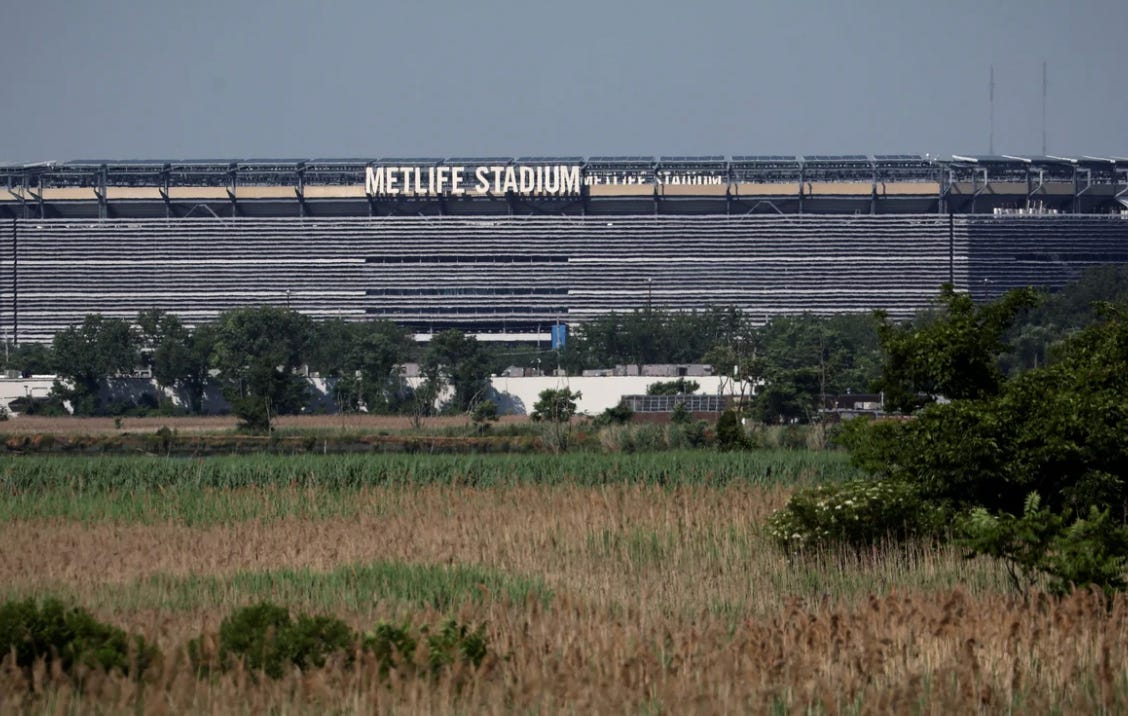
MetLife Stadium, East Rutherford, New Jersey.
As I’m sure you have heard, each World Cup team selected music to represent themselves and their country during the tournament. Walk-on songs, songs for goals scored, and songs for victory. This afternoon, we will get to hear what the Spanish and Argentinian teams picked… both are their versions of Música Bailable (dance music).
The song for Spain is Despechá by Rosalía, the Catalonian artist who has won two Grammys and eleven Latin Grammy Awards, making her one of the most successful Spanish singer-songwriters of all time. The song was released in 2022 and blends mambo with merengue. The former is a genre of Cuban music, while the latter comes from the Dominican Republic.
The Argentinian song is La Cumbia De Los Trapos by Yerba Brava, a football anthem released in 2000 and played routinely in stadiums across Latin America. The group is from the suburbs of Buenos Aires and formed in 1998. They are a cumbia band, a style that originates from the Caribbean coast of Colombia and has a distinctive rhythm. Each region of Latin America has its own unique style of cumbia and Yerba Brava performs the quintessential Argentine version of the sound.
While neither country borders the Caribbean, I think it is fascinating that their musical identity is tied so close to that region. Six months ago, another style of Caribbean dance music featured prominently during the halftime of Super Bowl LX. Bad Bunny’s 14-minute set was a celebration of Puerto Rican reggaeton. He kicked off that performance with his hit, Tití Me Preguntó, a song associated more with New York City than San Juan (just watch the video).
To the fans out there, enjoy the game in New Jersey, even if you are tuning in from the other side of the world. I’ll speak for a broad swathe of people here, but Americans, Canadians, and Mexicans have really enjoyed hosting this year and we are glad you came to visit.
Back to the main thing…
More Wrongful Detentions in the PRC
The first two articles cover an issue we’ve seen too much of, the Chinese Communist Party wrongfully detaining Americans of Chinese and Asian ancestry to silence their work and to send a message to the broader diaspora. That message is “you are either with us or against us.”
This week, Reuters reported on the case of Youlin Chen, a Chinese born American citizen who was seized nearly two years ago by PRC security forces while he was visiting family in China and lecturing at two universities. Since then, he has been interrogated more than 100 times. In March, Secretary Rubio designated him as “wrongfully detained” and it appears that President Trump brought up his case with Xi Jinping during the Summit in May.
The common wisdom you hear from China experts is that these cases should be handled behind the scenes and between the two governments, so as not to embarrass Chinese leaders and force them to dig their heals in and refuse to cooperate.
I think that is rubbish advice.
PRC leaders know exactly what they are doing when they take Americans prisoner, or Canadians, or Australians, or Japanese, etc.
They are using the detentions as a tool to silence critics and those who would work with the United States and its allies. They are using the detentions as leverage with the United States and other governments… by having a hostage, they can demand foreign governments compromise on issues that Beijing cares about in order to get their release. They are using the detentions to normalize transnational repression by keeping families silent for fear that Beijing would impose even worse conditions on their loved ones, if they speak out.
By staying silent and handling these cases behind the scenes, we provide the Chinese Communist Party all the benefits of their hostage diplomacy, while failing to impose any serious reputational or economic costs.
The United States and other countries have to change course on this.
Rather than staying silent, make these wrongful detentions very public. Rather than negotiating behind the scenes, publicly impose costs for these detentions and refuse to lift them until the PRC stops these practices. Stop making excuses for the CCP. Lastly, stop pretending that the PRC is a jurisdiction that Americans and citizens from other democracies can travel to safely. This is sinking in on the Japanese. The State Department and other foreign ministries, have a duty to their own citizens to impose strict travel advisories on the PRC, Macau, and Hong Kong. The CCP (and domestic business leaders) will howl in protest, but stick to your guns and demand not only the release of your citizens but also keep the restrictions in place for a period to ensure the pattern doesn’t repeat itself.
Trump Capitulates on Hong Kong
On Tuesday, July 14 Executive Order 13936 expired… just as President Trump was finishing up the remarks that he would make during primetime on Thursday, July 16, which accused the PRC of interfering in the 2020 U.S. Presidential election in which Trump lost to Biden.
So you’d be forgiven for not having 13936 memorized but it was the executive order that President Trump signed on July 14, 2020 which eliminated preferential treatment for Hong Kong. That preferential treatment had existed since the signing of the Hong Kong Policy Act of 1992. Under that law , Hong Kong would receive preferential treatment compared to the People’s Republic of China because the jurisdiction was judged to be autonomous with its own courts, laws, political system, and freedoms. This special treatment allowed Hong Kong to carve out a place for itself as a financial and business center that could connect the PRC to the outside world.
However, when the Chinese Communist Party crushed Hong Kong’s autonomy in 2019 and 2020 (in violation of its international agreement with the United Kingdom), Congress passed the Hong Kong Human Rights and Democracy Act of 2019 and the Hong Kong Autonomy Act of 2020, which threatened to pull this preferential treatment from Hong Kong (and by extension, the PRC) if Hong Kong lost its autonomy.
Executive Order 13936 was the instrument that President Trump used to declare that Hong Kong was not autonomous, thereby withdrawing the preferential treatment. When he signed it during that first summer of COVID, it was effective for one year, meaning that if the Executive Order wasn’t renewed the next year, those preferential benefits would return to Hong Kong and the PRC.
On July 7, 2021, President Biden renewed EO 13936.
On July 11, 2022, President Biden renewed EO 13936.
On July 11, 2023, President Biden renewed EO 13936.
On July 11, 2024, President Biden renewed EO 13936.
On July 10, 2025, President Trump renewed EO 13936.
However, this week President Trump failed to sign a renewal for his own Executive Order.
Apparently, some parts of the original EO remain in place, but by failing to sign a new EO or put in place a more permanent revocation of Hong Kong’s preferential treatment, the President’s inaction has turned back the clock to 2019.
Now Congress could act (and potentially get a veto-proof majority) to permanently end these beneficial preferences for Hong Kong, but I don’t see any movement on that.
What is most striking, to me at least, is to go back to the President’s primetime remarks on Thursday, July 16… just two days after he let his own EO, that punished the CCP for its actions in 2020, expire… President Trump was at the podium telling Americans that the PRC had interfered in the 2020 Presidential election and had taken actions to cause his defeat.
This is some really odd split-screen-ness.
On the one hand, President Trump is telling Americans that Xi Jinping and the Chinese Communist Party actively interfered with the 2020 U.S. Presidential election and caused his defeat… while in the same week, President Trump let his own executive order expire that sought to punish Xi Jinping and the Chinese Communist Party for interfering in the autonomy of Hong Kong in 2020.
One would think that if the President took his own remarks seriously on Thursday, he would have, at the very least, renewed his own executive order that sought to punish the CCP.
Instead, he handed them an enormous gift.
Almost immediately, the PRC Ministry of Commerce welcomed the decision by the Trump Administration to let the Executive Order expire and claimed that it was part of the trade negotiations, even as the PRC has refused to follow through on its own commitments at Busan.
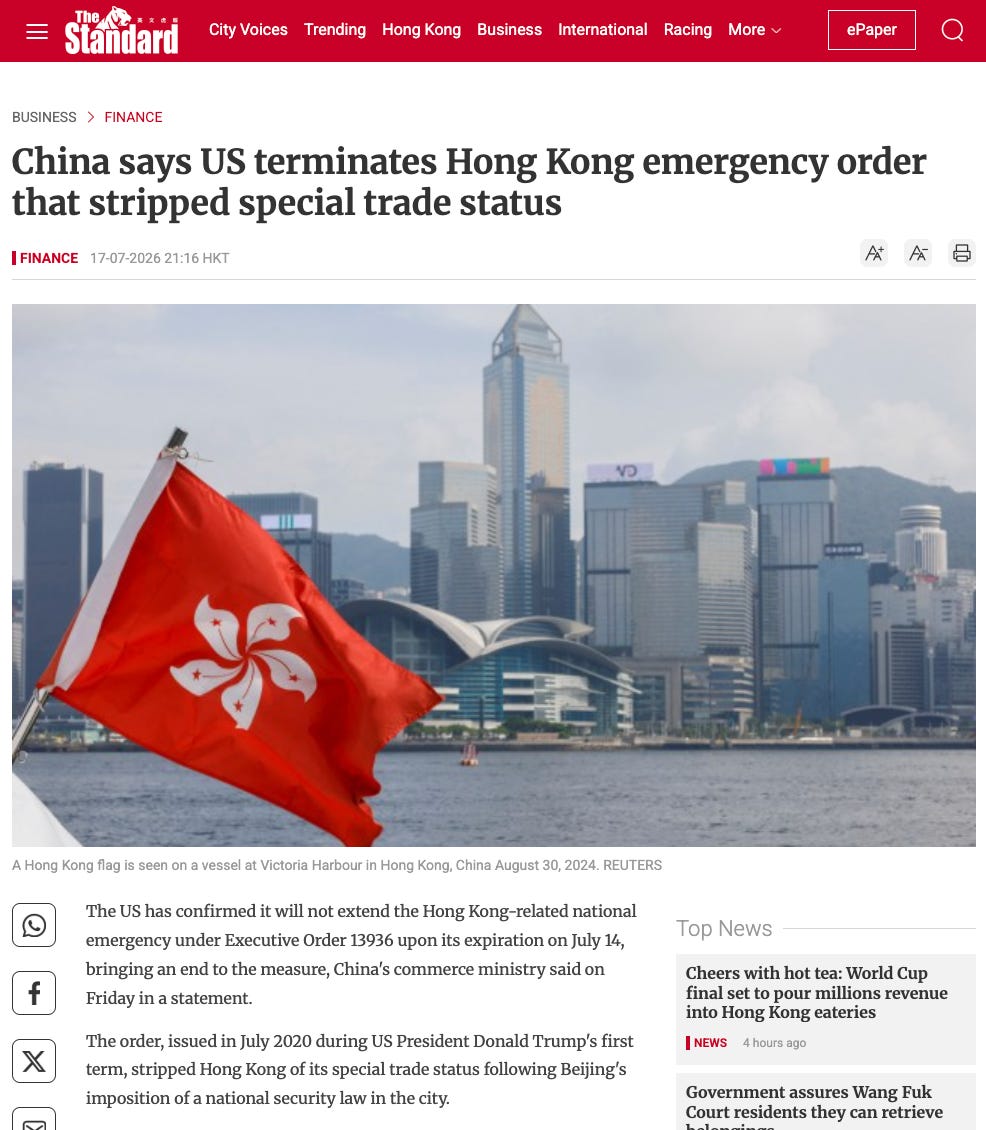
If this is what first-class deal-making looks like, I’d really hate to see what bad deal-making looks like.
I’m scratching my head on what exactly the President got for this gift, particularly as he tries to make the domestic case for his SAVE America Act based on protecting the country against hostile interference by the PRC. Is he hoping that folks will ignore this stuff?
More below under article #15.
Whether other people put these pieces together or not, I suspect that there are plenty of folks in the Administration who are equally confused by the President’s obvious contradictions.
Thanks for reading!
Matt
MUST READ
China detains US seismologist who has studied North Korean nuclear tests
Jonathan Landay, Reuters, July 13, 2026
A Chinese-born American seismologist who has published U.S.-funded work on detecting North Korean nuclear tests has been detained in China for nearly two years and faces trial on spying charges, according to his wife, U.S. lawmakers and two hostage advocacy groups.
The case of Youlin Chen, reported here for the first time, adds an irritant to the tense relationship between the nuclear-armed rivals and comes as President Donald Trump seeks to keep the relationship steady following last year’s trade war.
Secretary of State Marco Rubio on March 19 designated Chen, 54, as “wrongfully detained,” making his release a top U.S. priority. The Trump administration has withheld a public announcement to allow space for high-level diplomacy aimed at securing his freedom, according to his wife, Yufang Rong.
A U.S. source familiar with Chen’s case said the administration was “focused on gaining his release from his unjustifiable detention.” The source spoke on condition of anonymity to discuss sensitive diplomatic talks.
Chen, who became a U.S. citizen in 2011 and lives in Boston, Massachusetts, is the only American currently held in China designated as wrongfully detained, according to his wife and hostage advocates.
Rong said she has been told by the White House and the State Department that during a state visit to Beijing in May, Trump raised her husband’s detention with Chinese leader Xi Jinping, who promised to look in to it. Xi’s government, however, has taken no action, she said.
The U.S. source did not directly confirm that Trump discussed Chen with Xi. But the source said the pair have a “very good personal relationship. This is one of many facets in the U.S.-China relationship. No one issue is defining.”
In a Reuters interview, Rong expressed concern that Beijing has decided even before putting Chen on trial to find him guilty of espionage, a crime that in China carries a possible sentence of up to life in prison or even the death penalty for cases deemed especially grave.
“I believe they will convict him no matter what and the trial will be behind closed doors,” said Rong, who is also a seismologist but does not collaborate on her husband’s work.
China’s judicial organs handle cases according to the law and “there is no so-called wrongful detention,” foreign ministry spokesperson Lin Jian said at a regular briefing on Tuesday.
The Foley Foundation, a hostage advocacy organization that has been tracking Chen’s case, believes that Chen is among at least 12 Americans unjustly held in China, including people under exit bans, said Elizabeth Richards, the group’s director of hostage advocacy.
“President Trump has been clear that he wants every American detained abroad to return home, and he has reunited over 100 individuals with their families since taking office this term,” said deputy White House press secretary Anna Kelly.
The Office of the U.S. Special Presidential Envoy for Hostage Affairs did not immediately respond to requests for comment.
INTERROGATED ABOUT NUCLEAR TEST STUDIES
U.S. embassy officials have visited Chen several times, but Chinese officials are always present, preventing him from speaking freely, said Rong. She retained a Chinese lawyer, but he was allowed to see Chen only after he had been detained for more than 13 months.
Chinese officials have interrogated her husband more than 100 times about his work on the seismographic signatures of North Korean nuclear tests, said Rong.
Eric Lebson, a former U.S. national security official whose hostage advocacy organization, Global Reach, is advising the family, said he believes China wants to use Chen’s expertise to improve its ability to conceal underground nuclear weapons tests through a technique called decoupling.
Lebson said a similar concern was expressed by experts on nuclear testing consulted by his group.
The Trump administration in February accused China of trying to mask a low-yield underground nuclear test blast on June 22, 2020, using the technique in which a device is detonated inside a large underground chamber to reduce the magnitude of the shock waves it produces.
China, which like the U.S. has signed but not ratified the 1996 Comprehensive Nuclear-Test-Ban Treaty, denies conducting the test.
Lebson said that Chen is employed by a U.S. government contractor, and has never had a U.S. security clearance or performed classified work.
His research on North Korean test blast seismic waves has been funded by the State Department and the Air Force Research Laboratory, said Lebson. He added that it was done in collaboration with Chinese academics, it used publicly available Chinese data and is viewable on the internet.
A December 2020 paper by Chen reviewed by Reuters examined the magnitude of North Korea’s six known nuclear test blasts and ways to differentiate their seismic signatures from those of earthquakes.
The cover page states that the paper was written for the State Department’s arms control bureau and “approved for public release.”
Human-rights groups have argued that under China’s state-secrets law, Chinese authorities retain broad powers to retroactively classify public data, such as official statistics, as national security secrets, potentially implicating anyone who possessed or shared previously open-source information.
ARRESTED BEFORE RETURNING TO BOSTON
Chen was arrested by Chinese state security officers on November 5, 2024, at Beijing International Airport as he prepared to fly home to Boston after visiting family and lecturing on his work at two universities, according to Rong and Lebson.
At the beginning of his detention, said Rong, Chen was subjected to “harsh conditions,” including being forced to sit all day on a hard stool without being allowed to stand, read or exercise, and was unable to obtain medications for his diabetes and other health problems.
Since then, she said, it has been difficult to learn the conditions of his confinement, but she added that he has lost 30 to 40 pounds (13.6 to 18.1 kg), is given insufficient food with little protein, fruits or vegetables, and receives only poor-quality medications.
He was charged with espionage on May 1, 2025, but has not yet stood trial. The case likely will come up again during a visit that Trump has said Xi will pay to Washington in September.
U.S. Senator Ed Markey, a Massachusetts Democrat who led two other senators in a December 17, 2025, letter urging Rubio to designate Chen as wrongfully detained, said he was “deeply concerned about Dr. Chen’s safety and wellbeing.”
“It is my hope that increased attention on his unjust detention will force the Chinese government to do the right thing and release Dr. Chen,” Markey said in a statement.
COMMENT – Last week, I discussed in the commentary about Min Zin, the wrongfully detained U.S. citizen in the PRC who was lured to China by Chinese university professors for an academic conference.
This week, we have the story of another American citizen and academic who was wrongfully detained in the PRC two years ago.
Are you seeing a pattern here?
State Department: it is time to change that travel advisory back to level 3 (“Reconsider Travel”), or even better, level 4 (“Do Not Travel”).
China’s Transnational Repression Is Being Met with a Deafening Silence
Joshua Kurlantzick, Council on Foreign Affairs, July 13, 2026
The detention of U.S. citizen Min Zin on dubious espionage charges is the latest evidence that Beijing’s campaign to silence dissidents and critics abroad is expanding in scope and audacity. Without a forceful U.S. response, China’s willingness to target academics, activists, and diaspora communities on foreign soil is likely to grow.
Here is what we know about how U.S. citizen Min Zin ended up in a Chinese detention cell: He accepted an invitation to attend an academic conference in Kunming, the capital of Yunnan province in southwestern China. This was nothing unusual, as Min Zin is a doctoral candidate at the University of California, Berkeley, who has spent years writing about the politics of Myanmar—where he is from—and the country’s thorny relationship with China. The think tank he co-founded in 2016, ISP-Myanmar, has regular contact with Chinese academic institutions. He had traveled to China multiple times without incident.
None of that mattered. According to Scholars at Risk, which monitors attacks on academic freedom worldwide, Min Zin vanished on June 3, while traveling to the conference in Kunming. For more than a week, his family and colleagues had no idea where he was or whether he was safe. Then, on June 11, The New York Times reported that he had been arrested in Kunming. Hours later, the Foreign Ministry in Beijing confirmed Min Zin’s arrest on suspicion of “engaging in espionage and endangering Chinese national security.”
The espionage charges do not appear to hold up. Min Zin had a history of activism against Myanmar’s military. He took part in Myanmar’s 1988 pro-democracy uprising as a high school student—a movement the military crushed with lethal force. The activism got him expelled from school. He spent years in hiding to avoid arrest, eventually crossing into Thailand in 1997. He made it to the United States, applied for asylum, and rebuilt his life.
More recently, Min Zin’s research covered civil-military relations, democratization and ethnic conflict—the standard portfolio of a political scientist specializing in Myanmar and Southeast Asia. His think tank, which was located in Myanmar during the country’s democratic opening, moved to Thailand after the 2021 military coup that ushered military rule back in.
But ISP-Myanmar also ran a dedicated China Desk publishing detailed analyses of Chinese infrastructure investments in Myanmar and Beijing’s backing of the military government. That last part, along with his history of activism, is almost certainly what got him arrested. Not espionage, but scholarship that Beijing found inconvenient.
In an earlier period, this arrest would have been shocking. Today, it remains troubling but is sadly unsurprising. The reach of Chinese authorities has become so extensive, and the costs Beijing bears for detaining foreign citizens and operating beyond its borders have become so low, that cases like Min Zin’s are now the norm, even for U.S. citizens.
China is far and away the world’s leading practitioner of transnational repression. Freedom House has confirmed 319 physical incidents linked to Beijing since 2014—nearly a quarter of all documented cases worldwide. And those are just the cases with a verifiable paper trail; the real number is much higher. Beijing’s expansive toolkit includes digital surveillance of diaspora communities and threats against exiled dissidents’ family members who are still in China. Beijing’s Operation Fox Hunt, a campaign nominally aimed at rooting out corruption, has been used to pressure exiled dissidents into returning home—or, in some cases, into taking their own lives.
A 2022 investigation by the nonprofit Safeguard Defenders identified over 100 covert Chinese police “service” stations operating in more than 50 countries, including the United States, which are used to monitor and intimidate overseas Chinese communities. The report found that some 230,000 people were pressured to return to China between April 2021 and July 2022.
Indeed, what is happening to Min Zin is not unusual: It is one piece of a large and sophisticated system. Last year, the International Consortium of Investigative Journalists published an investigation that painted a detailed picture of how Beijing’s transnational repression operates. ICIJ researchers reviewed internal Chinese security documents and interviewed more than 100 people who had been targeted by Chinese authorities in 23 countries. The people reported that Chinese police had gone after their family members back in China after they spoke out overseas. Sixty of them believed they were under surveillance. Twenty-two said they had received physical threats or had been assaulted by people linked to the Chinese Communist party.
One of the main engines of this persecution is the United Front Work Department, a CCP body that, among other things, monitors Chinese students abroad and tries to ensure that diaspora organizations stay aligned with Beijing’s positions. The United Front’s reach into foreign universities has been extensively documented. A 2024 Amnesty International report found that roughly 900,000 Chinese students studying abroad live under persistent pressure, including being photographed at protests, watched on campus and sometimes reported on by fellow students—with the implicit threat that stepping out of line could bring trouble for their families back home.
China has also turned Interpol’s Red Notice system, the global police alert mechanism, into another tool for hunting critics abroad, getting foreign law enforcement to arrest dissidents on Beijing’s behalf under the cover of legitimate legal requests. The ICIJ has documented how Beijing pressured Malaysia to detain and deport Abdulhakim Idris, a U.S. citizen who heads the Center for Uyghur Studies, during a trip to promote a book about China’s persecution of the Uyghurs.
The ICIJ also found that China has packed the U.N. human rights system with dozens of fake civil society groups. These government-organized NGOs, or GONGOs, pose as independent civil society groups, but in reality they are charged with monitoring activists attending U.N. sessions and to shout down or disrupt criticism of Beijing.
When it comes to Min Zin’s arrest, the timing suggests that China wanted to test the White House and showcase its leverage against Washington. Min Zin disappeared just weeks after Donald Trump met with Xi Jinping in Beijing. Since then, the U.S. president has taken steps to accommodate Beijing. He has publicly called China a peer superpower, handing Xi a status that Beijing has spent years angling for. And Trump left the summit having raised serious doubts about U.S. commitments to Taiwan, keeping a $14 billion arms package for the island on hold and telling reporters that the fate of the weapons “depends on China.” That was a break from 40 years of bipartisan U.S. policy under which arms sales to Taiwan are not discussed with Beijing.
To be sure, China is not the only offender—just the biggest. Transnational repression is worsening around the world. According to a report published earlier this year by Freedom House, there were 126 new incidents of physical transnational repression in 2025 alone, bringing the total since 2014 to 1,375 confirmed cases across 107 countries. The number of governments doing this has jumped from 38 to 54 in just a few years. Six countries turned up as first-time offenders in 2025: Afghanistan, Benin, Georgia, Kenya, Tanzania and Zimbabwe.
Transnational repression used to be something only powerful states did. Now, even smaller states are doing it too, mainly because they have seen others do it with impunity.
In many cases, authoritarian governments are working together to hunt down exiles and dissidents. For instance, Thailand has turned itself into a regional clearinghouse, with its security services coordinating with Chinese, Cambodian, Laotian and Vietnamese counterparts to detain and deport people.
Democracies have pushed back in some ways, and those efforts deserve recognition. The G7 issued its first formal statement against transnational repression in June 2025, and Canada rewrote its criminal code to specifically target these operations.
But the Trump administration has done almost nothing to address the broad sweep of China’s actions, much less the specific case of Min Zin. There appears to have been no real conversation at the Trump-Xi summit in May about China’s operations against U.S. citizens. Real Clear Politics has reported that the administration has tasked White House Deputy Chief of Staff Stephen Miller with ensuring that other federal agencies don’t take action, such as addressing human rights issues that could derail the U.S-China trade truce.
When asked by media outlets about Min Zin’s case, the State Department has only said it is “aware of reports regarding a U.S. citizen detained in China.”
What more can the United States do? Washington should demand Min Zin’s release via a public, explicit statement that arresting an American scholar for his research is unacceptable and will have consequences. More broadly, the United States needs to put transnational repression on the table in every serious exchange with China. After all, the FBI has said repeatedly that China’s covert operations on U.S. soil are genuine national security threats.
Washington also needs to start working with allies to impose actual costs for transnational repression. A good starting point would be targeted sanctions against the Chinese officials running these programs, tools the U.S. is already using against Iran and Russia. Finally, the U.S. government should give American academics and researchers honest guidance about what travel to China now means, especially for those studying topics that Beijing finds sensitive.
None of this has to mean starting a new Cold War or walking away from trade talks. There is a wide range of leverage that Washington could be using to protect its own citizens from the long arm of Chinese repression. Unfortunately, the United States is instead choosing to remain mostly silent.
COMMENT – Here is a letter to President Trump and his Administration calling for a determination that Min Zin is “wrongfully detained” and that the President should advocate for his release.
I would ask every American that has interactions with Chinese counterparts to bring up the detention of both Min Zin and Youlin Chen. Make your counterparts aware of what has happened to American citizens visiting the PRC and ask them to work for change inside their country.
This Satellite Imagery reveals just how advanced China’s military is
The Telegraph, July 15, 2026
In China’s remote Taklamakan desert, Xi Jinping’s forces are secretly building exact replicas of US warships and fighter jets.
Satellite images analysed by The Telegraph reveal this 3D model of a US Arleigh-Burke class destroyer under construction in February this year.

Three months later, the ship appears to be nearly finished. But being 2,700km away from water, it’s unlikely to be going out to sea.
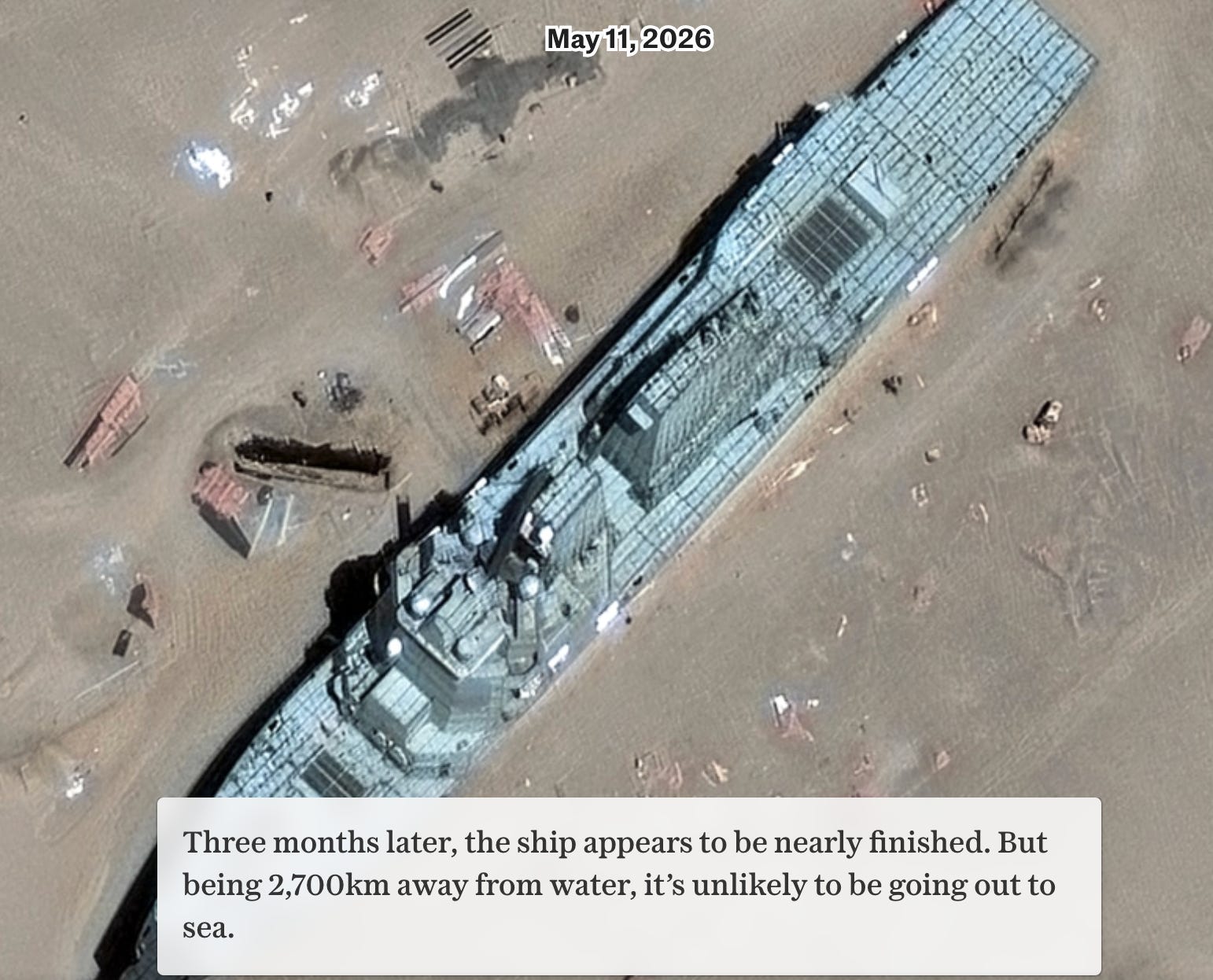
Instead, it’s part of Beijing’s tactics preparing for a war against Taiwan – and the US if it comes to the rescue.
The three-dimensional model, completed within six months, includes many of the components of the original, including a full mast and even some of its radar equipment.
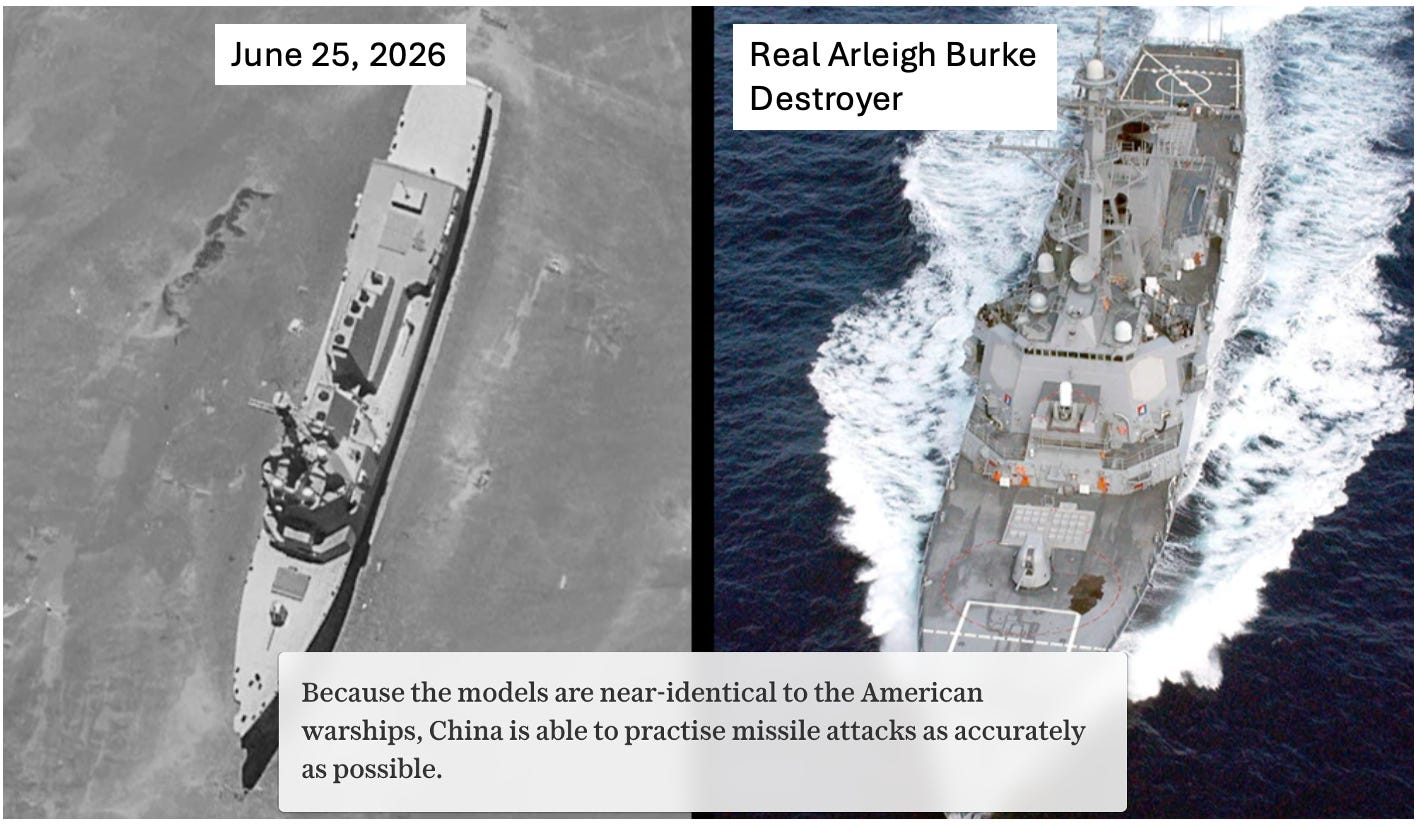
Because the models are near-identical to the American warships, China is able to practise missile attacks as accurately as possible.
COMMENT – To all those American business leaders, bankers, and investors who travel to the PRC, make money there, and advocate on behalf of the CCP… just remember that over 300 American sailors serve aboard an Arleigh Burke-class destroyer. Their purpose in the Western Pacific, the reason why those young men and women are on the front-line of freedom, is to deter the PRC from attacking its neighbors and seizing their territory, whether that’s the Philippines, Taiwan, or Japan.
Just imagine how your actions and behaviors will be perceived by your fellow countrymen when Xi Jinping orders the PLA to sink those vessels with ballistic and cruise missiles, killing hundreds of America’s sons and daughters.
No one is forcing you to make money there, that is on you.
The next time you think it’s necessary to go to Beijing, Shanghai, Shenzhen, or Hong Kong, remember what Xi Jinping and his Communist Party has ordered the PLA to do in the Taklamakan desert.
China exportiert seine Probleme [China exports its problems]
Sabine Gusbeth, Handelsblatt, July 15, 2026 – Original in German
[GOOGLE TRANSLATE] The world’s second-largest economy is growing more slowly than expected. New growth drivers cannot compensate for the decline in traditional industries.
China’s economy is faltering. With official growth of 4.3 percent in the second quarter, it missed the growth target set by the government. Only the sharp increase in exports prevented worse results, but they can hardly mask the underlying problems anymore.
The image of China as a successful tech superpower, so often cultivated by the government, is beginning to crack. For a long time, China was described as experiencing two-speed growth: rapid expansion in future-oriented industries like batteries and robotics, and slower development in traditional sectors. But the truth is: many of the once-crucial sectors, such as construction, are not slowing down, they are shrinking.
Economists now speak of a K-shaped development. But this picture is also misleading, as it suggests that growth in future-oriented sectors can compensate for declines in other areas. This is far from the truth.
The government likes to boast about its successes in future-oriented industries. But from a macroeconomic perspective, these are still fragile, albeit rapidly growing, seedlings that cannot compensate for the decline in many traditional, often labor-intensive industries.
COMMENT – Great to see this is a major German publication, though time is running out for Berlin to act with purpose. My fear is that commentary like this only encourages German leaders to sit back and avoid making tough decisions in the hope that the PRC’s internal economic problems will make it so that Berlin doesn’t have to make any tough decisions.
I think that is a huge mistake.
Berlin needs to act with haste to implement the kinds of “derisking” that they know they must do.
China Is Sabotaging the World That Enables Its Rise
Enrico Fardella and Sergey Radchenko, Foreign Affairs, July 15, 2026
Following the back-to-back state visits to China in May by U.S. President Donald Trump and Russian President Vladimir Putin, many U.S. and European commentators noted that the summit meetings yielded little of real substance. But from a Chinese perspective, that didn’t matter. What mattered were the visuals, broadcast in the Chinese state media: like the emperors of old, Chinese leader Xi Jinping was receiving tribute missions from the most important foreign potentates. In symbolic terms, the visits reinforced Beijing’s narrative that China has overtaken its rivals and is once again at the center of the world.
Underlying this triumphant vision is the Chinese claim that where the Soviets mismanaged socialism and the Americans corrupted capitalism, only China has discovered the formula capable of reconciling state authority with market dynamism and restoring international harmony. But this nationalist story risks obscuring a fundamental historical reality: China’s rise has not happened outside the systems its rivals built, but through Beijing’s skillful exploitation of them. In its early decades, Communist China relied on the Soviet Union to help construct its foundations. And ever since Deng Xiaoping’s “reform and opening” policies connected China to the world economy in the late 1970s, China has used its access to Western markets to forge itself into an economic and military superpower.
Yet Beijing seems strikingly unaware that its continued success depends on the U.S.-led order. In recent years, Beijing has consolidated its control over supply chains and acquired unprecedented leverage over its trade partners. It has also become increasingly brazen in its bid for industrial dominance, brushing off complaints in Europe and the United States that its overproduction is undermining their industries. For example, at the World Economic Forum session in Dalian in June, instead of acknowledging that China relies on the willingness of (mainly Western) countries to continue absorbing the Chinese surplus, Chinese Premier Li Qiang asserted that China is simply more competitive because it invests in innovation. Beijing’s failure to acknowledge, let alone address, its overcapacity problem has driven China’s key trading partners—all of them major Western economies—to the point of exasperation.
For now, it may seem that China has the upper hand, having secured a dominant position in a number of key global industries and supply chains. European countries in particular have been weakened by Chinese competition, and the failure of the EU to muster a unified strategy toward Beijing risks eroding its internal economic, and even political, cohesion. But the long-term outcome may be very different from what China’s leaders assume. Growing frustration with China is already prompting the United States and Europe to take stringent countermeasures to protect their industries. Beijing is thus overlooking the defining paradox of its own success: China’s rise remains tied to the openness of the economies it hopes to surpass. Its road to a post-Western order still runs through the West.
COMMENT – Great article by Enrico Fardella and Sergey Radchenko
I know both authors and really enjoy their work, in particular Radchenko’s 2013 book, Unwanted Visionaries: The Soviet Failure in Asia at the End of the Cold War. He tells the story of Gorbachev’s “Pivot to Asia” in the 1980s, which was meant to reinvigorate the Soviet Union, but fails in the face of rising contradictions inside the Soviet Union.
China urges Europe to stop backing ‘illegal’ South China Sea ruling to avoid harming ties
Xiuhao Chen and Liz Lee, Reuters, July 14, 2026
China’s foreign ministry on Tuesday called the European side to be cautious in its words and deeds on the South China Sea and stop endorsing the “illegal ruling” to prevent impact on China-EU ties and cooperation.
“Europe is not a party to the South China Sea issue and has no right to comment on China’s legitimate territorial sovereignty and maritime rights and interests in the South China Sea,” foreign ministry spokesperson Lin Jian told a daily press briefing.
The comments came after a joint statement issued on Sunday by countries including some European nations said China’s expansive maritime claims in the South China Sea have no legal basis, followed by a relevant statement from the EU.
China has also summoned officials of the embassies of relevant countries in China and the EU delegation to China and lodged serious representations with them, Lin said.
COMMENT – Last week, I gave some commentary on the EU’s “statement” about the 10th Anniversary of the ruling by the Permanent Court of Arbitration on the case brought by the Philippines against the PRC. [“Born to be Alive”, July 12, 2026]
I was pretty critical of Brussels for issuing such a watered-down statement that doesn’t actually denounce Beijing for its refusal to abide to its obligations under international law and to go so far as to paint the PRC’s efforts to avoid its obligations by negotiating with ASEAN as being responsible and something that the EU supports as being “in line with UNCLOS,” when clearly to be “in line with UNCLOS” requires Beijing to follow the PCA’s ruling.
So, it is interesting that the PRC foreign ministry would criticize Brussels for issuing its statement.
It suggests to me that Beijing is very much aware of the fractures and fissures within the European Union and among its member states. This denunciation of the statement is yet another effort to isolate those voices in Brussels that are pushing for greater EU unity against the PRC. Those individuals are painted as being “anti-China” and when Beijing denounces their activities, they are reminding folks in Europe that these “anti-China” people will only bring further cost on European countries because some of their folks show belligerence to Beijing.
This is classic United Front Work, which seeks to isolate those who criticize Beijing, while rewarding those it considers to be “friends of China.” Beijing then imposes collective punishment for the actions of the “anti-China” factions, while telling its so-called “friends of China” that they must do a better job of sidelining those people who “forced” Beijing to retaliate.
Unfortunately, Europe and its institutions have made themselves vulnerable to this kind of manipulation and coercion. We have seen for years now that these tactics work and I think it is clear that until Europe responds forcefully, the CCP will continue to employ these tactics.
VIDEO – What Americans Need to Understand About China
Kevin Rudd and Ezra Klein, The Ezra Klein Show, July 15, 2026
You can’t understand China today without understanding its president, Xi Jinping.
Since coming to power in 2012, Xi has doubled down on communist ideology and significantly consolidated his own power while transforming China into an industrial juggernaut unrivaled in the world. And Xi’s ambitions for China go far beyond that.
So what does Xi want for China in the coming years? And how should the United States respond?
Kevin Rudd has a unique perspective on these questions. He first met Xi in the 1980s, when Rudd was a China analyst in Australia’s foreign service and Xi was a local party official. Decades later, when Rudd was the prime minister of Australia and Xi was China’s vice president, the two men got to know each other better. And after leaving office, Rudd decided to really try to understand Xi; his latest book, “On Xi Jinping: How Xi’s Marxist Nationalism Is Shaping China and the World,” is built off the doctorate he pursued at Oxford after his time as prime minister. Rudd recently finished a stint as Australia’s ambassador to the United States and is now the global president and chief executive of the Asia Society.
In this conversation, Rudd explains Xi’s ideology and the forces that shaped it, his ambitions for China and strategy for achieving them, and what Xi thinks of the United States and Trump.
COMMENT – A really good interview with Kevin Rudd.
TWEET OF THE WEEK – Elite Pakistani bomb disposal squad operator killed while defusing IED, after Chinese bomb defusal kit turned out to be fake.
July 14, 2026

COMMENT – Here is the reporting in the Pakistani outlet, Dawn, which makes no reference to the fake Chinese bomb defusing kit.
What’s the old saying: with friends like this…
Authoritarianism
Suspected Chinese espionage group used a Roundcube exploit chain to burrow into universities
Matt Kapko, Cyberscoop, July 7, 2026
Translation: Euphemism and Censorship Surround Guangxi Flooding, Dam Breach News
China Digital Times, July 13, 2026Enabling Iran: A Timeline of China’s Role During and After Operation Epic Fury
U.S.-China Economic and Security Review Commission, July 15, 2026
The conflict involving the United States and Iran has renewed attention on Iran’s military capabilities and regional activities, but China’s role in enabling Iran often receives less scrutiny. Over the past several decades, the China-Iran relationship has evolved from one of limited cooperation into a broad strategic partnership spanning economic, diplomatic, and security ties.
Although China has largely refrained from selling weapons directly to Iran since the mid-2000s, Beijing’s support for Tehran has continued in other forms. China has provided significant economic, technological, and diplomatic support that has helped Iran mitigate international sanctions, sustain oil exports, and acquire dual-use technologies necessary for Iran’s drones, ballistic missiles, and other weapons.
At the same time, China has calibrated this support to preserve its broader political and economic interests in the Middle East. As one of Iran’s most important international partners, Beijing plays a critical—though often overlooked—role in sustaining Iran’s capacity to destabilize the region and in attempting to shape the strategic environment surrounding the conflict.
Iranian missiles are defeating US soft-kill defences using Chinese guidance
Tom Sharpe, The Telegraph, July 15, 2026
Tehran’s widest single-night barrage targeted facilities in five countries after Beijing reportedly shared encrypted sat-nav keys.
Early this Sunday, Iran launched its widest single-night attack of the war so far: mixed salvos of Zolfaghar ballistic missiles and drones simultaneously targeting US facilities in five countries – Al Udeid air base in Qatar, Ali Al Salem in Kuwait, US Fifth Fleet headquarters in Bahrain, Prince Hassan air base in Jordan and Duqm harbour in Oman.
As ever, damage reports vary, but it does seem that casualties were light. The significance, however, lies in one of the reasons the missiles got through. Many had reportedly been upgraded to make use of China’s encrypted BeiDou-3 satellite-navigation system. This made them significantly harder to stop and much more expensive to do so.
This is because there are basically two ways to stop a missile which is coming at you, or at something you are trying to protect. “Hard kill” involves hitting the incoming threat with a projectile of some sort, usually an interceptor missile of your own, sometimes a cannon shell or a bullet. That’s spectacular, filmable and – in the case of interceptor missiles – typically very expensive.
“Soft kill” defeats the enemy missile without touching it: jamming or spoofing its seeker head or navigation, or seducing it away from the target with active or passive decoys, flares or chaff. This typically costs a fraction of a hard kill and, depending on the type of weapon heading your way, can often have a higher probability of kill (pKill). When I was last doing this for real, soft-kill techniques often had a better success rate than shooting missiles down.
Those stats have been reversed because interceptor missiles are much more capable than they were back then. Conversely, missile seeker heads and navigation methods are better at seeing through attempts to distract them. Nevertheless, for the highest pKill against a range of missiles and drones fired at you, you want a mixture of both hard and soft and then the principal warfare officer (in the case of a warship on the defence) determines which method to use against which weapon and at what range.
He Called Out China’s Economy. Then He Went Silent—for Good.
Lingling Wei, Wall Street Journal, July 13, 2026James Lee, Hong Kong Free Press, July 15, 2026
Former Hong Kong law student gets nearly 3 years after riot acquittal overturned
Brian Wong, South China Morning Post, July 15, 2026
A former law student has been jailed for nearly three years for taking part in a riot during the 2019 anti-government protests in Hong Kong, after a judge overturned her acquittal and found her guilty based on “overwhelming” circumstantial evidence.
Alice Tong Ka-yan, 27, was sentenced at the District Court on Wednesday to two years and 10 months’ imprisonment for rioting. Her lawyers had said in mitigation that she had acted under peer influence and the prevailing social atmosphere.
Judge Edmond Lee Chun-man described the sentence as the most lenient available for a defendant who had pleaded not guilty to taking part in a riot involving serious violence during the unrest.
Lee agreed to reduce Tong’s sentence from a starting point of four years in light of her good background, the stress she had endured during the seven-year proceedings, her decision to return from overseas to face the consequences, and the increased difficulty for her to become a lawyer following her conviction last month.
The court heard Tong had been studying law at Lancaster University in the United Kingdom when she briefly returned to Hong Kong during the summer break and took part in a protest in Wan Chai on the night of August 31, 2019.
She was cleared of rioting in August 2021 on the grounds that prosecutors failed to prove she had either committed a violent act or abetted violence during a 30-minute stand-off between protesters and police on Hennessy Road.
Tong subsequently resumed her study in the UK and graduated, but returned to Hong Kong after the Department of Justice lodged an appeal against the verdict.
In July 2024, the Court of Appeal ordered Lee to reconsider his verdict which it said was “perverse”.
The appellate court, while upholding Tong’s acquittal of possessing a laser pointer as an offensive weapon, said the cumulative effect of the timing and location of her arrest, her black outfit and attempt to flee strongly suggested that she was not at the scene for innocent reasons.
In a judgment last month, Lee accepted those findings and ruled that Tong had taken part in the riot by encouraging others through her presence.
COMMENT – It appears that President Trump has failed to renew Executive Order 13936 and let it expire on July 14.
EO 13936 was the action that President Trump took during his first term (July 14, 2020) which stripped Hong Kong of its differential treatment as an autonomous jurisdiction within the People’s Republic of China.
President Biden extended the Executive Order each year during his presidency and last year, on July 10, 2025, President Trump signed a 1-year extension.
By letting the EO lapse, it appears that Hong Kong will now be afforded all the benefits it gained as an autonomous region through the United States-Hong Kong Policy Act of 1992, as well as undercut the Hong Kong Human Rights and Democracy Act of 2019 and the Hong Kong Autonomy Act of 2020.
This is a big disappointment, as Hong Kong is obviously NOT autonomous.
The failure to renew EO 13936 seems to fit with this article from Bloomberg this week:
Trump’s Aides See China Cheating on Trade, But Shun Retaliation
Jenny Leonard, Bloomberg, July 15, 2026
Unless I’m missing something, President Trump is making huge compromises which benefit Xi Jinping and the Chinese Communist Party and has gotten nothing in return. So much for reciprocity.
It seems clear that President Trump prefers to live in his own alternative reality.
China expels Politburo member Ma Xingrui in Xi’s anti-corruption campaign
Ken Moritsugu, AP News, July 15, 2026The Foreign Correspondents’ Club of China, July 13, 2026
Nearly all foreign correspondents working in China say reporting conditions fail to meet international standards, according to the Foreign Correspondents’ Club of China’s (FCCC) 2025 Media Freedoms Report, which says pressure, surveillance and intimidation have become “the new abnormal” for journalists covering the country.
The survey found that 94% of respondents said reporting conditions in China do not usually, or almost never, meet international standards. Nearly two-thirds (64%) reported being obstructed by police or other officials while reporting, while 77% said sources had declined interviews because they were not permitted to speak to foreign media.
The report points to growing pressure beyond China’s long-established political red lines. Almost half of respondents said new topics had become more sensitive over the past year, including the economy, demographics, trade tensions and emerging technologies. Many also described increasing difficulties persuading sources to speak and said economic reporting has become significantly harder.
Foreign correspondents also reported growing pressure on Chinese colleagues. Four in ten respondents said their local staff had experienced harassment or intimidation, while almost one-third said sources had faced questioning or other repercussions after speaking to foreign media. Respondents also raised concerns over digital surveillance, visa delays and legal threats linked to their reporting.
The report concludes that restrictions on reporting are no longer experienced as isolated incidents but as a routine feature of life for foreign journalists in China.
COMMENT – Here is the link to the PDF of the full report.
This stuck out to me:
38% of the respondents say reporting conditions in China “almost never” meet international standards
56% of the respondents say reporting conditions in China “usually do not” meet international standards
6% of the respondents say reporting conditions in China meet “just about” international standards
0% of the respondents say reporting conditions in China “usually” or “almost always” meet international standards
2 men sentenced for roles in trafficking fentanyl analogues from China to the US
Lucy Quaggin, South China Morning Post, July 10, 2026
How Xi Went from Admiring Putin to Managing Him
Emma Tucker, Wall Street Journal, July 14, 2026
Environmental Harms
Storm Causes Mass Evacuations, Floods and Flight Disruptions in China
Lily Kuo and Pei-Lin Wu, New York Times, July 12, 2026
China tried to clean up its air pollution. Then came the rebound
Steven Bernard, Eleanor Olcott and Haohsiang Ko, Financial Times, July 14, 2026
Report on IUU Fishing, Bycatch, and Shark Catch
NOAA Fisheries, July 14, 2026
In its 2026 Report, NOAA Fisheries identified six nations for illegal, unreported, and unregulated (IUU) fishing; two nations for the production of seafood-related goods through forced labor; six nations and entities for shark catch without having a regulatory program comparable to that of the United States; and two nations for bycatch of protected living marine resources without a regulatory program comparable to that of the United States. Some nations or entities are identified for multiple issues. Identifications are based on actions or issues from the preceding 3 years. The 2026 Report was prepared in 2025; therefore it is based on activities in 2022, 2023, and 2024.
Costa Rica, Grenada, Mexico, Morocco, the People’s Republic of China, and the Russian Federation were identified for IUU fishing;
Burma and the People’s Republic of China were identified for forced and child labor in seafood supply chains;
Ghana, Japan, Mexico, Namibia, the People’s Republic of China, and Taiwan were identified for shark catch without a regulatory program comparable to that of the United States; and
Indonesia and Papua New Guinea were identified for bycatch of protected living marine resources without a regulatory program comparable to that of the United States.
Chinese Fishing Fleets Squeeze Local Economies from Peru to Sierra Leone
China Global South Project, July 7, 2026
Foreign Interference and Coercion
Ex-Fed advisor gets over three years in prison for lying about China ties
Anniek Bao, CNBC, July 15, 2026
A former senior advisor to the Federal Reserve Board of Governors was sentenced to over three years in prison for lying to federal investigators about sharing restricted central-bank information with Chinese intelligence operatives, according to the Justice Department.
John Harold Rogers, 64, was found guilty in February of making false statements to investigators when he denied sharing restricted information on monetary policy, U.S. Attorney Jeanine Pirro said in a statement Wednesday. The same jury acquitted him of the more serious charge of conspiracy to commit economic espionage.
“John Rogers spent years secretly funneling sensitive Federal Reserve information to Chinese spies, then looked investigators in the eye and lied about it. And when that wasn’t enough, he lied again under oath at trial,” Pirro said.
The sentencing comes at a time when the Trump administration has intensified its pursuit of alleged economic espionage by Beijing.
U.S. District Judge Dabney Friedrich also ordered Rogers to serve additional 12 months of supervised release. Defense lawyers had asked for no additional jail time beyond the roughly 18 months he had already spent in custody, which will be credited toward his sentence.
Rogers, a U.S. citizen who holds a Ph.D in economics, worked as a senior advisor for the Federal Reserve Board’s division of international finance from 2010 to 2021, with access to nonpublic material on monetary policy and Federal Open Market Committee deliberations.
Prosecutors argued that sharing advance knowledge of Fed interest-rate decisions could have allowed Beijing to generate “enormous profits” from trading its roughly $1.5 trillion in U.S. Treasurys, according to the Justice Department.
Rogers had allegedly begun a clandestine relationship in 2017 with Hummin Lee, a Chinese intelligence operative he met at a conference in China, and conveyed Fed information during meetings in Chinese hotel rooms held under the guise of teaching academic classes.
He printed restricted documents before traveling to China, emailing materials to his personal account after stripping classification markings, and forwarded sensitive information to a professor at Fudan University, the Justice department release said. In exchange, he received university professorships and financial benefits, prosecutors said.
Asked directly in a February 2020 inspector general interview whether he had ever shared restricted Fed information outside the board, Rogers answered “never,” according to the Justice Department.
Chinese ministry of foreign affairs did not respond to CNBC’s request for comments.
US National Science Foundation to ban projects with flagged Chinese institutions
Lucy Quaggin, South China Morning Post, July 14, 2026
Raising security fears, NSF moves from case-by-case approval to full ban on working with restricted entities and their employees.
The United States’ National Science Foundation (NSF) is set to ban collaborations with Chinese research institutions designated as restricted entities, as well as their employees, under a new policy that moves away from seeking to balance security risks with the benefits of international collaboration.
The policy reflects a broader congressional push by House Republicans to curb academic partnerships between China and the US, amid lawmakers’ concerns that such ties could contribute to Beijing’s military and technological development.
The public notice, posted on the NSF website last week, notified the American research community that agency funds would no longer be used for collaborations with entities on US restricted-party lists, including Chinese universities and research institutions.
John Moolenaar, chairman of the House Select Committee on the Chinese Communist Party, called the policy “commendable and commonsense” in a statement following the announcement, adding that it “will protect taxpayer-funded research and innovation”.
“Prohibiting federal funding from being used to collaborate with Chinese entities that are national security risks or human rights abusers is straightforward and all federal agencies should follow the lead of the Pentagon and NSF,” Moolenaar said.
The NSF, a federal agency established by Congress in 1950 that funds scientific research through grants, said the US government determined that these entities warrant restrictions on national security and other foreign policy grounds.
The Chinese embassy in Washington did not immediately respond to a request for comment.
The new policy marks a pivot from just two years ago, when the NSF announced a risk mitigation process called the Trusted Research Using Safeguards and Transparency (TRUST) framework, which guided assessments of potential national security risks of grant proposals.
At the time, Rebecca Spyke Keiser, NSF’s chief of research security, spoke about balancing risks while preserving international scientific collaboration to further American innovation.
In 2024, Keiser, who is now also NSF’s acting chief of staff, called the TRUST framework “a major step in pivoting from a compliance culture to a research security culture”.
“But we cannot continue to lead the world in science and innovation if we are fixated on achieving zero risk related to research security,” she added.
Keiser said the US needed to invest in science domestically while continuing to encourage principled, mutually beneficial international collaboration.
The Select Committee highlighted that the forthcoming policy prohibits senior and key personnel on NSF awards from “holding appointments or positions at, receiving research support from, or collaborating on NSF-funded research with these restricted entities”.
The change reflects a shift from managing national security risks on a case-by-case basis to wholly prohibiting NSF-funded collaboration with entities the federal government has deemed to be too risky.
The move puts the agency in line with a broader push by the Trump administration’s Department of Defence, which has increasingly treated collaboration with China as threatening US national security.
COMMENT – True to form, the Hong Kong-based South China Morning Post reports on this with a bias that leans towards their overseers in the Chinese Communist Party… no mention at all the PRC imposes far more stringent restrictions on its research institutions and their collaborations or anything about the decades of malign behavior by researchers on behalf of the PRC.
This is a great move by NSF and will go a long way to restoring trust and confidence that taxpayer funded research isn’t just benefiting the PRC through these one-way research collaborations.
Ten days later, Pacific Islands Forum still can’t reach agreement on China missile tests
Anneke Smith, The Post, July 15, 2026
More than a week after China’s surprise launch of a nuclear-capable missile into the South Pacific, the Pacific Islands Forum (PIF) remains silent.
Some of its 14 member states (New Zealand, Australia, Fiji, Papua New Guinea, the Solomon Islands, Tuvalu, Palau, Vanuatu and the Marshall Islands) have issued individual statements condemning the test - China’s second in two years.
While the PIF did not issue a joint statement after the 2024 test - the comments being made by some members this time around are unusually strong - “this is a threat to regional peace”, ”don’t threaten us“ and “this is not something a friend does.”
COMMENT – ASEAN is susceptible to this same kind of pressure.
China does not seek ‘sphere of influence’ in ties with Pacific island nations, foreign minister says
Reuters, July 14, 2026
China “has no geopolitical intentions and does not seek a so-called ‘sphere of influence’” in its dealings with Pacific island nations, Foreign Minister Wang Yi told his counterpart from the Solomon Islands in Beijing on Tuesday.
China’s cooperation with the Solomon Islands “comes with no political strings attached” and is not forcibly imposed, Wang told Rick Houenipwela, an official summary released by China’s foreign ministry showed.
Pacific island nations are independent and sovereign nations, “not someone’s ‘backyard’”, Wang said, adding that China’s ties with these nations “should not be subject to interference from any third party”.
The meeting came a week after China’s military test-fired a missile with a dummy warhead from a nuclear-powered submarine into the South Pacific, which drew criticism from regional countries, including the Solomon Islands.
The test fire coincided with the signing of a mutual defence pact between Fiji and Australia.
Solomon Islands Prime Minister Matthew Wale last week said China is “a good friend of Solomon Islands but this is not something a friend does” when asked about the missile test, while vowing stronger ties with Australia.

COMMENT – So if there are “no political strings attached” then I guess Beijing would be perfectly fine if Pacific island nations established diplomatic relations with Taiwan.
A smoking gun in the Solomons proves information shaping by China
Cleo Paskal, The Sunday Guardian, July 12, 2026Lithuania’s new PM says allowing Taiwan’s de-facto embassy was ‘maybe too brave’
Reuters, July 14, 2026
COMMENT – Disappointing… sends the message to Beijing that their coercion tactics work.
China Is Ready to Get Tough: Beijing’s diplomatic retaliation has limits—but fewer than before.
Deng Yuwen, Foreign Policy, July 14, 2026
In recent years, although China has vigorously promoted the idea of a community with a shared future for mankind and global governance, it has become increasingly unforgiving toward countries it believes have offended it. The latest example is Beijing’s announcement last month that it would prohibit exports of dual-use items to 10 U.S. companies, in retaliation for Washington’s inclusion of several leading Chinese companies on its newly expanded list of military-linked enterprises.
In the past, the core task of Chinese diplomacy was to secure external space for domestic development. Today, Chinese diplomacy seeks to use the strength accumulated at home to transform the country’s external environment.
Japan wants 60 million tourists, but China isn’t sending them
Julian Ryall, South China Morning Post, July 12, 2026
How Putin Turned Japan into a Den of Spies
Jane Bradley, Michael Schwirtz, and Adam Goldman, New York Times, July 12, 2026
Soon after troops invaded Ukraine in February 2022, Western leaders expelled hundreds of Russian spies from their capitals and blacklisted companies with ties to the Kremlin.
The coordinated effort was intended to make it harder for the Kremlin to collect intelligence and buy equipment like microchips, transmitters and the machinery used to make weapons.
Since then, officials say, dozens of those banished spies have turned up in an unexpected place: Japan.
The country’s weak espionage laws and flourishing high-tech industry have made it a crucial piece of the Russian war effort. Ninety percent of Russian missiles and drones contain Japanese components, according to Ukrainian government estimates.
COMMENT – The same weak espionage laws make it easy for the PRC to take advantage of Japan as well.
Taiwan groups urge asylum law after China imposes ethnic unity law
Keoni Everington, Taiwan News, July 13, 2026
How China Is Winning Friends and Influencing People
Lizzi C. Lee and Eric Olander, Foreign Affairs, July 14, 2026
Human Rights and Religious Persecution
Ga. Sharavjamts and the Mongolian Myths China Tried to Silence
Massimo Introvigne, Bitter Winter, July 10, 2026
China is dealing with its own manosphere
The Economist, July 12, 2026Then They Came for Macau: The Au Kam San Case Signals an Escalation of Repression
Yoyo Ng, Bitter Winter, July 15, 2026
Thailand: Don’t Forcibly Return Chinese Dissidents
Human Rights Watch, July 13, 2026
China: New ‘ethnic unity’ law set to entrench assimilation of minority groups
Amnesty International, June 30, 2026
China: Ethnic Unity Law is an attack on communities, including in the diaspora
Article19, July 13, 2026
51 Estonian lawmakers condemn China’s ethnic unity law, urge immediate repeal
Phayul, July 9, 2026
Industrial Policies and Economic Espionage
China’s Property Slump Can Curb Growth for Years, Even Without a Banking Crisis
Kenneth S. Rogoff and Yuanchen Yang, SCCEI, July 15, 2026
Real estate makes up nearly 70% of China’s household wealth — double the U.S. share. The analysis finds a 10% drop in home prices cuts China’s household spending by roughly 1.5–2.3%, versus just 0.6% in 1990s Japan. Applied to China’s 20% (official) to 40% (unofficial) property price declines, that’s a consumption loss of 2–4% of GDP.
China’s GDP growth set to slow, raising expectations for more stimulus
Kevin Yao, Reuters, July 13, 2026
Cutting China reliance would cost the west $23tn, research suggests
Peter Foster, Financial Times, July 13, 2026
COMMENT – And what would it cost the PRC? This article and the report by EY-Parthenon it refers to, makes it seem like the costs would be borne by the West alone and nothing would happen to the PRC.
Desmond Shum raises this and questions the framing by the FT with this post.
Five things to watch when China reports economic growth
Thomas Hale, Joe Leahy and Haohsiang Ko, Financial Times, July 14, 2026
Monthly indicators show weakness in retail sales and investment ahead of second-quarter figure.
China’s second-quarter GDP data release this week comes at a crunch moment for the world’s second-largest economy.
Recent monthly data has signalled rising economic pressures, with retail sales falling and the return of a slump in fixed-asset investment.
Such declines raise questions over how far these indicators might be at odds with the GDP rate, which rarely deviates from an official target. This year, it is set at 4.5-5 per cent. Analysts forecast second-quarter growth on Wednesday will come in at the lower end of that range.
Unlike other major economies, GDP data in China lacks so-called expenditure breakdowns of investment, consumption and net exports on a quarterly basis, leading to a heavy reliance on monthly measures.
That monthly data has “deteriorated significantly” in the second quarter, said Logan Wright, an analyst at Rhodium Group, pointing to the impact of higher prices from the war in Iran.
Wright added that of the three components that would make up expenditure GDP, it was “hard to see growth in any one of them”, adding: “The gap between China’s actual performance and stated performance is widening at present.”
…
Assessing the headline figure
The Bloomberg median forecast across 34 analysts for the second quarter is 4.5 per cent, in line with the official target.
But some economists express major doubts.
“In two decades of working on this economy I’ve never met a single Chinese official who defended the GDP data upon any level of questioning about it,” said Wright at Rhodium Group, who forecasts growth of between zero and 1 per cent for the quarter.
China has unveiled weak GDP data in the past, including an outright decline at the start of the Covid-19 pandemic in 2020.
Carsten Holz, an academic who studies China’s statistics, said that the central leadership’s “policy objectives” were “guaranteed to appear in the statistics, whether due to tangible action at the local level or to adjustments in data collection”.
“Today’s statistics mirror yesterday’s economic policy decisions,” he added.
“We are almost flying blind, we are just taking whatever they are giving us.”
COMMENT – “Lacks so-called expenditure breakdowns” is a euphemism for: “the PRC lies about its GDP.”
Europe at an inflection point on China
Anna Fifield, July 15, 2026
China’s automakers squeezed as materials suppliers rake in profits
Kenji Kawase, Nikkei Asia, July 14, 2026
China Exports Surged in June, Exceeding Market Expectations
Wall Street Journal, July 14, 2026
Australians ‘going gangbusters’ on Chinese batteries in renewable energy shift
Nic Fildes, Financial Times, July 13, 2026
Major German carmakers hit by steep China sales plunge as competition heats up
Chan Hohim, Associated Press, July 11, 2026
China’s monthly car exports surge past 1mn for first time
Edward White, et al., Financial Times, July 14, 2026
Nvidia halves Asia buyer list in China chip crackdown
Zijing Wu, Financial Times, July 14, 2026
How China’s aerospace vision differs from Elon Musk’s SpaceX
Frank Chen, South China Morning Post, July 13, 2026
China’s Economy Grows at Weakest Pace Since 2022
Katrina Northrop, Wall Street Journal, July 15, 2026
China’s graduate glut: millions enter a job market with little use for them
Alastair McCready, The Guardian, July 13, 2026
China’s property developers face fresh liquidity crunch
Wataru Suzuki, Nikkei Asia, July 13, 2026
China expands anti-sanctions toolkit, raising risks for foreign firms
Erin Hale, Al Jazeera, July 10, 2026
ZTE among Chinese firms licensed to purchase Nvidia’s H200 chips, documents show
Reuters, July 14, 2026
Cyber and Information Technology
‘They Don’t Need People’: The Workers Left Behind by China’s Robot Drive
Vivian Wang, New York Times, July 11, 2026
Nobel-Winning U.S. Chemist Will Move to China to Lead A.I. Institute
William J. Broad, New York Times, July 9, 2026
Companies turn to Chinese AI models to cut costs
Jamie John and George Hammond, Financial Times, July 13, 2026
U.S. Biotechs Are Keeping More Secrets to Beat Copycats in China
Xavier Martinez, Wall Street Journal, July 9, 2026
China, Russia and Others Seek to Inflame Debate Over A.I. Data Centers
Steven Lee Myers and Dustin Volz, New York Times, July 9, 2026
China, Russia and Others Seek to Inflame Debate Over A.I. Data Centers
Steven Lee Myers and Dustin Volz, New York Times, July 9, 2026
State of AI Safety in China
Concordia AI, July 15, 2026
China’s trade expands on AI boom, offsetting weak sectors
Ck Tan, Nikkei Asia, July 14, 2026
Chinese AI Startup DFSX Releases Chip to Take on the West
Yang Jie and Sherry Qin, Wall Street Journal, July 14, 2026
Chinese Robotics Startup Raises $200 Million
Du Zhihang, Caixin Global, July 14, 2026
Xi Jinping to attend World AI Conference for first time as China elevates tech push
Howard Liu, South China Morning Post, July 13, 2026
When China’s open-source AI is a trap
The Economist, July 14, 2026
Telecom bill vote might open Taiwan to Starlink
Esme Yeh, Taipei Times, July 14, 2026
Military and Security Threats
What Happens if China Hacks the US Water Supply? I Went to a Secret War Game to Find Out
Andy Greenberg, Wired, July 8, 2026
An Analysis of China’s First Military LLM
Valentin Weber, China: Technosphere, July 8, 2026
Key takeaway: In 2023, China’s first military LLM was launched. It is used for planning, force allocation, intelligence analysis, and operational optimization, trained on sources such as open-source, signals, and human intelligence. It supports scalable model sizes (requiring specialized Huawei hardware) and is already used by PLA units to accelerate decision-making processes to seconds. The emergence of artificial decision-making is likely to have a sizeable impact on deterrence. Influencing how AI systems think, may become as strategically important as influencing human leaders.
In 2023, DataExa launched the Tianji Military LLM. It has 5 core functionalities:
Military Q and As
Combat Mission Planning
Force Allocation
Military Operations Optimization
Intelligence Compilation
The company draws on a variety of sources, including open source intelligence, signals intelligence and explicitly states that human intelligence (HUMINT) is part of the information sources.
Shooting Starlink: The “no limits” partnership between Russia and China is taking aim at Elon Musk
Michael Weiss, Roman Dobrokhotov, and Christo Grozev, The Insider, July 9, 2026
With a Successful Rocket Launch, China Clears a Key Hurdle in Race with SpaceX
Selam Gebrekidan and Pei-Lin Wu, New York Times, July 10, 2026
China Successfully Launches Reusable Rocket in a Win for Space Program
Katrina Northrop, Wall Street Journal, July 10, 2026
Making history! China lands rocket during an orbital launch for 1st time ever
Mike Wall, Space, July 10, 2026
A Picture-Perfect Landing Shows China’s Ambitions to Narrow the Space Race
Kenneth Chang, New York Times, July 10, 2026
Japan’s space agency conducts first test flight for experimental reusable rocket
Mari Yamaguchi, Associated Press, July 11, 2026
COMMENT – Lots of breathless reporting that the PRC conducted a successful launch of a reusable rocket last week, but less attention that Japan did the same thing the next day.
Chinese and Russian ships join naval drills in Yellow Sea
Associated Press, July 14, 2026
Taiwan orders dozens of sea drones to fend off China’s maritime squeeze
Thompson Chau, Nikkei Asia, July 15, 2026
Beijing hits out as US-led coalition marks 10th anniversary of South China Sea ruling
Alyssa Chen, South China Morning Post, July 12, 2026
One Belt, One Road Strategy
China targets Namibia’s oil, uranium and lithium in fresh strategic partnership
Ayodeji Adegboyega, Business Insider, July 8, 2026
Chinese Dominance of African Ports Raises Alarms
ADF, July 14, 2026
Opinion
The Coming Clash Between China and Europe: Why a Trade War Can’t Be Avoided
Thorsten Benner, Foreign Affairs, July 16, 2026
In 2025, Chinese leader Xi Jinping tried to capitalize on U.S. belligerence toward Europe by promoting China as the responsible great-power alternative. In a message sent to mark the 50th anniversary of diplomatic relations between China and the European Union, Xi invited Brussels to join forces with Beijing, to “uphold multilateralism, safeguard fairness and justice,” and “oppose unilateralism and bullying.” Despite the lofty rhetoric, Beijing offered nothing of substance to Europeans, and did nothing to address their concerns about unfair trade practices that are threatening large swaths of European industry. Indeed, rather than seeking to conciliate, Chinese premier Li Qiang recently dismissed the concerns of Europeans worried about a “China Shock 2.0,” telling them to focus instead on “China Opportunity 2.0.”
Key EU leaders, as well as the Brussels bureaucracy, are not buying it. They have concluded that the very survival of Europe’s core industries is threatened by China. The first “China shock” describes the devastation of U.S. industry in sectors including furniture, textiles, and metals that came in the early 2000s, after China’s accession to the World Trade Organization. The new China shock will be different. It will happen mainly in Europe, and it will be more severe, devastating advanced industrial sectors—including automotive, machinery, chemicals, pharmaceuticals, and green energy—and leading to immense job losses.
Increasingly, European leaders are arguing that the EU needs to take action to protect its industries. So severe is the threat that measures that were unthinkable a few years ago are now gaining momentum. Earlier this year, for example, the French government proposed “establishing a level of protection equivalent to a general tariff of around 30 percent vis-à-vis China.” And although Germany was initially hesitant, Chancellor Friedrich Merz has signaled that he is ready to act to deal with China’s unfair trade practices. Last month, every EU leader, with the exception of Spain, tasked the European Commission with coming up with options for action.
An all-out trade war with China is becoming a real possibility. Europe is now the only major market with high purchasing power that is wide open to Chinese products. With Chinese domestic demand weak and many firms struggling to make a profit, Beijing desperately needs the European market. As a consequence, Beijing is likely to do everything possible to keep it open. If Brussels wants to have a fighting chance in the looming trade war, it will need to ensure maximum unity of its members, as well as wide-ranging cooperation with like-minded partners. Neither will be easy. But both will be necessary if Europe is to preserve the industrial base that is vital to its prosperity and security.
Beijing’s own goal in the Pacific
Oliver Nobetau, Lowy Institute, July 7, 2026
China Can’t Talk About Birth Rates Without Talking About Rural Pensions
Lijing Gao, The Diplomat, July 15, 2026
Why China still believes in the power of rote memorisation
Thomas Hale, Financial Times, July 13, 2026
AI is not enough to arrest China’s decline
Ruchir Sharma, Financial Times, July 13, 2026
There are other, more powerful forces weighing on the country’s economy.
For all the worry about how America has become one big bet on AI, a similar but perhaps more alarming story is unfolding quietly in the other economic superpower. China’s vaunted AI prowess is concealing deep rot elsewhere in its economy.
Though many forecasters keep expecting China to surpass the US as the world’s leading economy, its growth peaked in 2021. Since then, China’s share of global GDP has fallen in nominal terms from 18 to 16.5 per cent, while the US share has risen to 26 per cent. China’s growth rate has dropped below the rest of the world, including the US. In real terms, independent estimates now put China’s growth in real terms closer to zero than to the official target of 4.5 to 5 per cent.
Even by the official numbers, AI is not providing a lift big enough to overcome other forces weighing on China, including its shrinking workforce, rising indebtedness, a broken property market, the revival of a meddlesome regulatory state and the resulting exodus of capital and people.
China’s population also peaked in 2021. Last year, births hit a record low, and deaths hit a record high. The working-age population is on pace to shrink by 75mn every decade this century. Historically, having fewer workers has always meant slower growth; countries with declining populations rarely sustain growth above 2 per cent. And for China, given the scale of its demographic bust, AI is unlikely to replace human workers fast enough to ease the economic blow.
Without the AI boost, China would be much worse off. After adding little in the 2010s, net exports now account for about a third of the country’s growth, driven mainly by AI-related goods. But this is a very large contribution to an otherwise weak domestic economy. Chinese hyperscalers are investing just $100bn in AI this year compared to $750bn by US rivals, yielding far less of a pop to growth. And though every country now hopes for an AI-driven productivity miracle, the expected boost in China is about a third of a percentage point by 2030, hardly enough to halt its decline.
The structural challenges are daunting. In the past five years, China’s augmented deficit (which includes off-budget spending) has reached nearly 15 per cent of GDP, higher than any other major country, pushing augmented government debt to 135 per cent of GDP. Unlike the US and most other countries, China has rapidly mounting debts in the private sector as well. Total debt amounts to nearly 350 per cent of GDP — higher than in the US despite China’s much lower per capita income.
The debt problem is partly a hangover of the great property bubble. Beijing responded to the global crisis of 2008 by pumping credit into real estate, which was the main contributor to growth in the last decade. Then the bubble popped, also in 2021. Property prices tumbled and are now at a 20-year low, in inflation-adjusted terms. In new but half-empty developments, including a faux Venice in the north-east, flats can be rented for $120 a month. As property wealth shrivels so does consumer confidence, and retail sales are falling.
The stock market reflects this distorted economy and has gone nowhere for years. Earnings are strong for firms that supply the AI stack and weak for consumer-facing companies. Meanwhile, the government has moved on from property to pumping credit into new manufacturing industries, in effect replacing one debt bubble with another.
In late 2020, China launched a stunning regulatory crackdown on its big tech firms. Now, after retreating for a couple of years, an index tracking regulatory pressure is surging again. Giving up on making money in China, multinationals are scaling back operations. Net foreign direct investment is negative. Last year a record $425bn in capital flowed out of Chinese financial markets.
People are leaving as well. The immigrant share of the population is stuck at just 0.1 per cent, a fraction of the share in India (which is just as populous). The number of western expats living in China has fallen markedly. It is historically unusual for a major power to have so little allure for foreigners and foreign money.
The growing hype around Chinese AI doesn’t change the fact that 2021 was peak China. Given its demographic challenges and heavy debts, Beijing can’t do much to prop up domestic growth. It has shifted instead to dumping manufactured exports, but the resulting backlash is spreading fast. And AI isn’t a fix for everything. Its impressive powers may be the answer to many problems, but they can’t reverse the forces driving China’s decline.